12 June 2015

China Holds Naval Drills Near Taiwan and Philippines

June 11, 2015

‘Similar drills and exercises will keep taking place,’ a People’s Liberation Army Navy spokesperson said this morning. 

The Chinese People’s Liberation Army Navy (PLAN) is conducting a routine planned naval exercise in the Western Pacific this week, Xinhua reports.

Liang Yang, a military spokesperson of the PLAN stated that Chinese navy vessels and military aircraft passed through the eastern portion of the Bashi Channel, situated between Taiwan and the Philippines, this morning.

The vessels and aircraft went on to conduct several drills that simulated real combat conditions in the waters east of the Bashi Channel, including long-range precision strikes and aerial combat. The exercise is part of the PLAN’s annual training plan and was “in line with international laws and practices,” according to the military spokesperson.

The Trouble With Indonesia’s New Counterterrorism Command

June 11, 2015
A new anti-terror squad could raise old concerns in the country. 

On Tuesday, the Indonesian military (TNI) launched a new counterterrorism squad called the TNI Joint Special Operations Command or Koopsusgab. While the move clearly illustrates Jakarta’s determination to eradicate the terrorism threat, it is also likely to heighten anxieties about the military’s growing role in the country.

The new squad is the latest sign that the Indonesian government is stepping up its efforts to combat the Islamic State (IS) threat. As I have reported previously, while numbers vary, hundreds of Indonesians have already joined IS abroad. In addition, several extremist cells are operating within Indonesia and are engaged in recruitment, indoctrination and some military training, including in Poso where security forces mounted operations earlier this year.

Electronic Weapons: Too Much Is Not Enough


June 5, 2015: With great effort over the last two decades the American military has been able to get enough bandwidth (data transfer capability) to get video and still photos from aircraft and UAVs back to ground stations via satellites. There remains one big drawback in that there isn't enough bandwidth available on the battlefield to move around the data needed to keep the troops updated on what the UAVs, aircraft and satellites are seeing. The bandwidth problem has proved to be a real tough one. Mainly because high speed data transfer on the battlefield first became possible via satellite communications and data was soon being produced far faster than it could be moved around to the people who needed it. This was all about continuing bandwidth shortages. The army in particular is working on solutions. The most obvious one is to edit the data feeds to retain only the essential data.

Armor: Arjun Back From The Dead Again


June 3, 2015: India continues to have problems with its tank fleet. The latest disaster is the low readiness of the 120 locally designed Arjun tanks the army was forced to buy in order to keep an Indian tank factory working. After several years of use over 70 percent of the Arjuns are inoperable because of technical problems, mostly relating to imported spare parts. Over half the Arjun components are foreign made and the procurement bureaucracy, the army and the Arjun factory cannot agree on specifications and quantities of these parts. In addition to that there are dozens of unresolved technical problems with Arjun. All this adds up to nearly a hundred separate problems that need to be resolved to increase the readiness rate. The government seems to agree that Arjun is a failure and while the factory only has to make four more, it also now has orders for 118 Arjun 2s.

Pentagon Chief Issues New Marching Orders For ‘Yoda’ Office

June 10

It seems the Pentagon’s new Yoda has received his directives from the Jedi Council.

In a June 4 memo labeled “Guidance,” Defense Secretary Ashton B. Carter outlined a subtle shift for the Pentagon’s renowned Office of Net Assessment and its new director, retired Air Force Col. Jim Baker. With Carter’s memo, the office, which traditionally looked towards the horizon when it comes to defense concerns, will incorporate more of today’s issues in its analyses.

“This memo accurately reflects Carter’s high interest in the office, but it also reflects Carter’s interest in the here and now,” said Jerry Hendrix, a former Navy captain who worked in the office of Net Assessment under its former director and is now a senior fellow at the Center for New American Security.

11 June 2015

Hot pursuit a message to all, says govt.

AMIT BARUAH
June 11, 2015

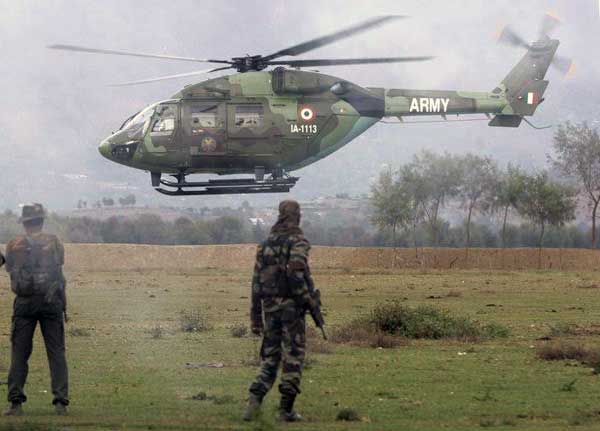
Commandos were airdropped from copters near the Myanmar border. 

The death toll in the Army’s strike on two militant camps inside Myanmar on Tuesday could touch 70 as defence officials spoke of keeping up the pressure on anti-India insurgents operating from there.

Inside Myanmar, in hot pursuit

June 11, 2015

By striking at militant camps across the border and inside Myanmar territory, Prime Minister Narendra Modi has demonstrated that he is willing to bite the bullet and take tough action when it comes to the killing of Indian soldiers. Days after the June 4 killing of at least 20 personnel of the 6 Dogra Regiment in Chandel district of Manipur allegedly by militants of the National Socialist Council of Nagaland (Khaplang), a robust response has come from the Indian Special Forces. Confirmation of the strike on two militant camps inside Myanmar territory has come from none other than Minister of State for Information and Broadcasting Rajyavardhan Singh Rathore. He confirmed that the Indian forces “carried out strikes on two of the militant camps, annihilating the entire camps, and have returned safely”. He pointed out that Prime Minister Modi had taken a “very bold step” and given the go-ahead for hot pursuit into Myanmar, adding that the response was a message to other countries that might be inimical to India. Meanwhile, the official Army version simply spoke of the forces having engaged two separate groups of insurgents “along the Indo-Myanmar border”, without referring to any cross-border operation.

Myanmar Operation: Message to the Neighbours

By Monish Gulati
11 Jun , 2015

Para commandos of the Indian Army carried out covert surgical operations using helicopters inside Myanmar early on June 9 and killed several militants in two camps along the Indo-Myanmar border. The Special Forces (SF) commandos returned back safely after the 13 hour-operation in which militants belonging to the NSCN-K (NSCN Khaplang) and KYKL (Meitei Kanglei Yawol Kanna Lup) were killed. Nationalist Socialist Council of Nagaland (NSCN) (K), which reneged from a ceasefire in March this year, has been involved in a series of attacks in coordination with some other militant groups under the banner of the so-called “United Liberation Front of South East Asia”.

India and Myanmar have a “Hot Pursuit” agreement under which, both countries can cross the border if they get any input on militant activity on the territory of the other country, but with consent.

Taking Stock of Modinomics: India’s Economic Course One Year Later

By Sven-Eric Fikenscher
June 10, 2015

To keep India’s economy growing, Modi needs to embrace even more far-reaching reforms. 

It was announced recently that India’s economic growth had climbed to 7.3 percent in the fiscal year that ended in March. After some economic setbacks in previous years, India has become “a bright spot” on an otherwise fairly “cloudy global horizon” as the International Monetary Fund’s head, Christine Lagarde, put it. For India’s Prime Minister Narendra Modi, who was sworn in just over one year ago, this is excellent news. Modi campaigned on an economic platform and promised to turn India’s then-ailing economy around. More specifically, Modi cast himself as a business-oriented alternative to the socialist-leaning Congress party.

Narendra Modi can claim some credit for India’s impressive economic showing. The Modi administration’s first budget included the commitment to increase caps on foreign investment in the defense and insurance sector from 26 to 49 percent. In addition, India’s rules regarding foreign investments in construction projects have been eased. Narendra Modi also managed to secure a promise from Japan to invest $34 billion in India and China’s pledge to bring $20 billion to the table over the next five years. Furthermore, India’s corporate tax rate is supposed to be reduced from 30 to 25 percent over a four year-period.

Army Statement on Operations in North East

By IDR News Network
10 Jun , 2015

Army statement on operations in North East read out by Major General Ranbir Singh, Additional Director General of Military Operations (A) on 09 Jun 15 is appended below :-

Manipur Ambush: The Real Lesson we need to Learn

By Brig Deepak Sinha
10 Jun , 2015

The ambush of the 6 DOGRA convoy, in Manipur, resulting in the tragic death of eighteen soldiers and injuries to many more has brought out a virtual deluge of comments on what went wrong and the corrective actions needed to be initiated. The Government too asked the army to adopt proactive measures to control the situation that, as per Major General R Singh, Additional Director General Military Operations, has already resulted in considerable success being achieved during the conduct of interdiction operations against the suspected groups involved in the vicinity of the Indo-Myanmar border.

No, India Isn't Outpacing China, and Other Modi Myths

June 8th, 2015 

Having converted a potentially precarious majority into a grand majority, India’s Prime Minister Narendra Modi is now suffering the horrific blues of the winner’s curse of absolute majority.
Follow up:

Despite promises of seismic change to economic policy, we still don’t know Modi’s precise economic strategy. His sycophants have mouthed the obvious litany of praises about the already-transforming Indian economy, while detractors grudgingly await his pronouncement of the roadmap for economic recovery.

With the faux socialism of former Prime Minister Manmohan Singh rejected by voters, Modi took the opportunity for reform with both hands, scripting the most important economic policy shift of the Century.

Myanmar ops a one-off, can't expect replay on western border

June 10, 2015

Those advocating a similar raid in Pakistan-Occupied Kashmir, for instance, need to have a reality check on the applicability of the same template on other borders, says Nitin Gokhale.

Twenty-four hours after the Indian Army's daring raid on two insurgent camps in Myanmar, an intense debate has begun on a possible change in India's counter-terrorism approach. 

After all, such an action has not been seen in several years. The last such publicly known operation by the Indian Army in a neighbouring country was in December 2003, when camps of the United Liberation Front of Asom and the National Democratic Front of Bodoland were jointly raided by Indian and Bhutanese troops. 

Rohingya in Limbo

By Alex Bookbinder
June 10, 2015

Disruption of human trafficking networks has not meant respite for Myanmar’s oppressed Rohingya minority. 

Three years ago, Rakhine State – the coastal region where Myanmar meets Bangladesh – was struck by violence that largely targeted Rohingya Muslims. In the wake of the clashes, more than 140,000 Muslims were left homeless and destitute. Most of the displaced came from the state capital, Sittwe, and that city’s erstwhile Muslim residents have been resettled in underserviced, Spartan camps, lacking adequate food and healthcare. They are forcibly separated from the rest of society, echoing Apartheid-era South Africa.

The Rohingyas were the target of intense government persecution long before the violence. Most are stateless under Myanmar’s harsh 1982 citizenship law. Myanmar refuses to refer to them by their chosen name, officially dubbing them “Bengalis” owing to their cultural and linguistic affinities with populations across the border, despite the fact that many can trace their ancestry in the region for generations.

China Wants to Reform its Defense Industry

June 10, 2015

Beijing remains technologically one or two generations behind its main competitors in the global arms industry. 

Last week, China set up a new committee that will help reform and expand the country’s burgeoning defense industry, China Military Online reported.

According to the State Administration of Science, Technology and Industry for National Defense (SASTIND), the government agency in charge of defense industrial policy, the committee, formally named the Strategic Committee of Science, Technology and Industry Development for National Defense, met on June 3rd for the first time.

China Military Online reports that the committee is composed of experts from various government agencies and public institutions including the Chinese Academy of Sciences, Chinese Academy of Engineering, the National Development and Reform Commission, Ministry of Education, Ministry of Science and Technology, Ministry of Finance and the PLA General Armaments Department.

How the Next 5 Years Could Make or Break China's 'War on Pollution'

June 10, 2015

China’s environment minister is hopeful that the next five year plan will include strong environmental targets. 

China’s Environment Minister Chen Jining promised Tuesday that the next five year plan, to cover the period from 2016-2020,will include “more forceful” measures to protect the environment. The National People’s Congress won’t formally pass the 13th Five Year Plan until March 2016, but the government is already deep in discussions on the policies and targets that will guide China’s development for the next five years.

The 12th Five Year Plan, released in March 2011, contained an historic emphasis on climate change and other environmental issues. As Deborah Seligsohn and Angel Hsu wrote at the time, “What’s notable in the Plan and the Work Report is the prominent position of both climate change and environmental issues, in addition to energy.” The 12th Plan included targets for reducing energy and emissions intensity (energy and emissions per unit of GDP rather than overall energy and emissions use) by 16 and 17 percent respectively. The plan also included goals for raising the percentage of non-fossil fuels in China’s energy consumption to 11.4 percent.

China’s Green Revolution

BY KEITH JOHNSON
JUNE 8, 2015 

China has been the world’s worst environmental offender for years. That could change a lot sooner than expected.

Some good environmental news has emerged from an unlikely source: China — whose greenhouse gas emissions could peak even earlier than Beijing has promised and give the world a fighting chance to limit the worst damage from climate change.

A new study released Monday by the Grantham Research Institute on Climate Change and the Environment at the London School of Economics concludes that both China’s economic rebalancing away from dirty, heavy industries and its newfound concern for the environment are real and producing tangible results sooner than had been expected. That translates into an economy that is burning less coal and spitting out fewer emissions than even a few months ago. Last November, during a summit with U.S. President Barack Obama, Chinese president Xi Jinping said he would seek to curb the country’s emissions around 2030.

Cyberwar? Top China arms-maker flames Russian rival on WeChat


SHAI OSTER
09 JUN 2015 

China and Russia signed an agreement last month not to carry out cyber-attacks on each other. Looks like no one told China’s biggest arms maker.

Norinco is resorting to social media to lob military-grade taunts at its Russian rival’s most advanced tank. It took to popular messaging service WeChat in May to tout its top-line armored vehicles… and trash-talk the competition.

The Beijing-based company took aim at a widely reported and embarrassing incident involving the T-14 Armata, the latest product of Russia’s military machine. One of the high-tech tanks ground to an abrupt halt on Red Square during rehearsals for the 70th anniversary celebrations of World War II victory.

Japan, Philippines to Hold New South China Sea Naval Exercise


Tokyo and Manila are preparing for yet another joint maritime drill. 

Japan and the Philippines plan to hold a joint maritime drill later this month near the South China Sea, local media sources reported.

The exact details of the exercise have yet to be fully disclosed. According to Japan’s public broadcaster NHK, the two countries will carry out exercises near the South China Sea later this month. Tomohisa Takei, chief of staff for Japan’s Maritime Self-Defense Force (MSDF), said that Japan would announce further specifics like the schedule and the assets to be sent “as soon as the plan is fixed.” But NHK reported that Japanese defense sources had suggested Monday that the MSDF would dispatch a P-3C maritime surveillance aircraft to the drill, while the Philippine Navy (PN) would send a vessel and a plane to the sea.

Japan Is Running out of Fighter Jets

Zachary Keck
June 9, 2015

Japan could be facing a fighter jet shortage over the coming decade plus as it phases out some of its older aircraft.

Last week Defense News reported that Japan will face a fighter jet shortage as it starts phasing out its fleetes of F-2s and F-15s starting in the 2020s.

Currently, according to Franz-Stefan Gady at The Diplomat, a Tokyo-based publication, the Japanese Air Self Defense Forces (JASDF) operate 223 F-15s; 94 F-2s, an indigenous longer-range variant on Lockheed Martin’s F-16C; and McDonnell Douglas F-4 Phantom IIs.

Japan has already begun retiring the F-4 Phantoms from the fleet, following the example of many other countries, including the United States, which retired the last of its F-4s in the late 1990s.

Get Ready, World: Could ISIS Develop Lethal Chemical Weapons?

Rod Barton
June 9, 2015 

Last Friday in a speech to a multinational arms control forum known as the Australia Group, Foreign Minister Julie Bishop said the terrorist group ISIS is “prepared to use any and all means, any and all forms of violence they can think of, to advance their demented cause. That includes use of chemical weapons.” She added that ISIS has recruited “highly technically trained professionals' to develop chemical weapons and has already used chlorine as such a weapon.”

If Bishop's claims have substance and ISIS has acquired the capability to develop and deliver chemical weapons, this adds a new and worrying dimension to the conflict in Syria and Iraq. Indeed, the Australia Group has taken this possibility seriously and has prudently adopted new guidelines to make the acquisition of chemical weapons materials and technology by terrorist groups more difficult.

The Pentagon’s ISIS Strategy, By Its Own Accounting, Is a Mess


Flight operations aboard USS Theodore Roosevelt, May 2015. (Photo: U.S. Navy) SHARE ARTICLE ON FACEBOOKSHARE TWEET ARTICLETWEET PLUS ONE ARTICLE ON GOOGLE PLUS+1 PRINT ARTICLE EMAIL ARTICLE ADJUST FONT SIZEAA by BING WEST June 8, 2015 2:23 PM On June 5, at a Pentagon press conference, Lieutenant General John W. Hesterman III, Combined Forces Air Component Commander, vigorously championed both the success of the bombing in Iraq and Syria, and the Defense Department’s method for controlling air strikes. The briefing illustrated how, as in Vietnam, the military becomes politicized and loses focus. A few observations: Attrition is not a strategy. The general began by saying that bombing was “killing 1000 [ISIS] fighters a month.” These deaths, he asserted, have “a profound effect upon the enemy.” Stop right there. Bombing is not a strategy. It is weapon, like a rifle. If attrition were our strategy, then the measure is the number of enemy killed as compared to the total number of fighters plus replacements. For years in Vietnam the CIA and the military claimed that bombing was having a severe effect and that North Vietnamese morale under B-52 strikes was at rock bottom. Maybe so, but North Vietnam eventually conquered South Vietnam. Pentagon officials shouldn’t be political mouthpieces. It was disappointing that the general asserted, “air power is giving coalition nations the time to execute the effort to finish Daesh. . . .

Unfinished Business Are We Ready to Close the Gaps in American Counterinsurgency Strategy?


Daniel Glickstein holds a Bachelor’s degree in International Security Studies from the Univeristy of Oklahoma and served with the Army National Guard in Afghanistan in 2011. His writings have previously appeared in Parameters Magazine. The opinions expressed here are the author’s alone, and do not reflect those of the U.S. Army the Department of Defense, or the U.S. Government. 

On the heels of the 40th anniversary of America’s departure from Vietnam, a reflection on the past is appropriate. In honor of this occasion I found myself revisiting David Halberstam’s Best and the Brightest. Multiple dissertations could be written over individual components of the book, including Halberstam’s detailed portraits and backgrounds of the key decision-makers involved in run-up and execution of the Vietnam War.

THE BUDAPEST MEMORANDUM AND THE RUSSIA-UKRAINE CRISIS

David S. Yost
June 10, 2015

As the war in eastern Ukraine simmers, one of its first casualties is still discussed with regret and frustration: the Budapest Memorandum. In 1994, on the margins of the Budapest Summit of the Conference on Security and Cooperation in Europe (CSCE), Russia, the United Kingdom, and the United States convened to provide security assurances to Belarus, Kazakhstan, and Ukraine. In return these three countries transferred the Soviet-made nuclear weapons on their soil to Russia and acceded to the Treaty on the Non-Proliferation of Nuclear Weapons (NPT) as non-nuclear-weapon states.

Russia’s violations of its Budapest Memorandum commitments to Ukraine have dismembered the country (with the annexation of Crimea) and forced it into an open-ended war, with grave implications for NATO and the European Union. Russia’s actions have also undermined the global nuclear nonproliferation regime and the international legal order.

America and South Korea Strengthen Military Alliance

David Eunpyoung Jee
June 10, 2015 

The United States and the Republic of Korea (ROK) are embarking on a bold experiment of shared command at the tactical level. On June 3, 2015, the U.S. Forces in Korea (USFK) and ROK Armed Forces established the alliance’s first combined division, comprising subordinate units of the U.S. 2nd Infantry Division and the ROK Army 8th Mechanized Infantry Division. An American two-star general will command the unit while working hand-in-hand with a South Korean one-star deputy commander. The combined division is a unique example of two states sharing command and control of a military unit at a tactical level. During peacetime, the division staff will work together on a daily basis, and its troops will enter combined operations during wartime.

ARGUMENT Russian-Backed Rebels Are Restarting the War in Ukraine

BY JAMES MILLER
JUNE 8, 2015

Last week, Russian-backed forces in eastern Ukraine launched a significant offensive against Marinka, a town less than 10 miles west-southwest of Donetsk, the separatists’ capital. While the Ukrainian military repulsed the attack, there is now renewed fighting across eastern Ukraine. Not only has this fighting shattered February’s “Minsk II” cease-fire, which was already frayed, it may also have permanently destroyed the peace process with which the international community was seeking to end this war. And the rebels’ latest moves give a sense of what the Kremlin and its proxies could have planned next.

On June 3, Ukrainian Prime Minister Arseniy Yatsenyuk warned that Russia’s “terrorists” had launched a major military offensive in eastern Ukraine just hours after Moscow canceled a meeting of the trilateral contact group — which includes representatives of Ukraine, Russia, and the Organization for Security and Cooperation in Europe (OSCE), and is tasked with negotiating a settlement to the crisis.

Paul Volcker warns on health of US state finances

Nicole Bullock
9 Jun 2015

Paul Volcker, former chairman of the Federal Reserve, has warned that US states rely on faulty practices to balance their budgets, masking the true nature of their finances and leading to poor policy making.

While states have returned to better health after the depths of the financial crisis and recession of the last decade, many remain under "heavy pressure," with overall tax revenues, adjusted for inflation, barely recovered from their pre-recession peaks.

Paul Volcker, former chairman of the Federal Reserve.

"The continued fiscal stress is tempting states to continue, and even intensify, budgeting and accounting practices that obscure their true financial position, shift current costs on to future generations, and push off the need to make hard choices on spending priorities and revenue practices," Mr Volcker said in a report released on Monday by the Volcker Alliance, a government reform group he founded in 2013.

Mounting fiscal stress in Illinois, Detroit's bankruptcy and the financial troubles coming to a head in Puerto Rico demonstrate the importance of developing better financial policies, the report said.

Reagan’s Rendezvous with Destiny

Geoffrey Kabaservice
June 9, 2015 

ON A steamy night in June 2004, I stood in line for almost seven hours on the National Mall, along with several thousand strangers. We were all waiting for our turn to enter the Capitol, where the body of Ronald Reagan lay in state. Since smartphones hadn’t yet been invented, I had nothing else to do during that time but to ask others what had prompted them to pay homage to the Gipper. Many were young—I met an entire fraternity that had driven up from North Carolina—and some weren’t even born when our fortieth president took office. But everyone there felt that Reagan had been a great president, that this was a historic occasion and that honoring his memory was, in some way, their duty as Americans. Reagan gave our country back its pride, several told me. He made us strong again. He revived the economy. He won the Cold War. Finally, we entered the hushed Capitol Rotunda, where Reagan’s flag-draped casket lay upon Abraham Lincoln’s catafalque, guarded by a member of each of the four armed services. No more than a minute later we were outside, and a bright dawn was breaking over Washington.

The Culture War Returns

Jacob Heilbrunn
June 9, 2015 

A growing chorus of voices on the right is arguing that the turmoil in Baltimore and Ferguson is ushering in a new round of the culture wars.

1968 IS BACK. A growing chorus of voices on the right is arguing that the riots in Baltimore and Ferguson are ushering in a new round of the culture wars. On the website Breitbart, for example, Robert W. Patterson, a former George W. Bush administration official, wrote, “The Grand Old Party must decide: Go libertarian, and sympathize with the protesters and rioters? Or does it want to be conservative, and side with the police, the rule of law, and the forces of order? The lessons of the 1960s suggest the latter is the path to victory.” William Kristol, editor of the neoconservative Weekly Standard, observed during the recent riots in Ferguson, “It does feel like a Nixon ’68 moment. Who will speak for the Silent Majority?”

Superpower Showdown: Why the U.S.-China Relationship Is in Big Trouble

Graeme Dobell
June 9, 2015 

Remember a decade ago when the U.S. appealed for China to be a responsible stakeholder?

Congratulations, Washington. Wish come true. China sure is responsible for a lot of things happening strategically and economically. And a lot is at stake.

When Robert Zoellick launched the stakeholder line in September 2005, the deputy U.S. Secretary of State was arguing for Beijing to take more responsibility in the system that had delivered China so much:

“For the United States and the world, the essential question is—how will China use its influence? To answer that question, it is time to take our policy beyond opening doors to China’s membership into the international system: We need to urge China to become a responsible stakeholder in that system. China has a responsibility to strengthen the international system that has enabled its success.”

Russia and America: Toward a New Détente

June 9, 2015

It is totally unrealistic to think that the West can gain desired Russian restraint and cooperation without dealing with Moscow as a great power that possesses real and legitimate interests. 

WITH THE Cold War’s demise, the menacing Russia that long loomed over Europe seemed to vanish. The Russia of 1992 was just a fragment of its historic self in military punch and economic weight. Not even Russia’s still-formidable nuclear arsenal deflected perceptions of decline. It was inevitable, then, that Western policy makers would feel that this shrunken Russia was more to be ignored than feared. They were wrong.

Now, memories of the bad old days are storming back, especially of Moscow’s capacity to stir up trouble with its military power. While President Vladimir Putin’s “covert” war in Ukraine continues to inflame tensions, he also torments his Baltic neighbors and threatens Europe with provocative military flights and nuclear rhetoric. Western alarms are heightened by Putin’s seeming unpredictability and his apparently unlimited internal power. The West can’t reckon how far he will take his muscle flexing—or how to stop him.

The Ex-Im Bank and the Foundations of American Power


"Congress is now considering whether to renew funding for the Export-Import Bank. That should not be a tough call."

Congress is now considering whether to renew funding for the Export-Import Bank. That should not be a tough call. Economic and national security concerns argue strongly for continued funding.

The Bank is, of course, a small U.S. government agency designed to help American companies compete more effectively for business abroad, by backing up loans and helping with financing in ways that wind up typically costing the American taxpayer nothing or even (as in recent years) turning a profit. As things stand, the Bank will stop functioning on June 30 unless action is taken.

Ottawa to Help Kiev Launch Surveillance Satellite

Jun 09, 2015

Ukraine has reached an agreement with Canada to jointly launch a Ukrainian surveillance satellite, the country's Ukroboronprom state defense conglomerate said Monday.

The agreement was reached at the CANSEC 2015 conference, staged by the Canadian Association of Defense and Security Industries in Ottawa.

"After substantiating the need for a surveillance satellite for Ukraine, the Ukrainian delegation reached agreements on cooperating with Canada within this project," the company's statement said.

The sides also discussed ways to deepen cooperation between defense industries in the two countries, according to the statement.

Last month, Ukraine announced its plans to put at least six satellites into orbit by 2022.

Ukraine launched its first satellite in 1995 and has since placed ten spacecraft into orbit, according to the country's State Space Agency.

Russia Puts Military-Purpose Satellite Into Orbit

Jun 08, 2015

A spokesman for Russia's Aerospace Defense Forces says that a Russian military satellite has reached its designated orbit and established stable contact with ground control services.

A Russian military satellite has reached its designated orbit and established stable contact with ground control services, a spokesman for Russia's Aerospace Defense Forces told RIA Novosti on Friday.

The satellite was launched earlier on Friday on board a Soyuz-2.1a carrier rocket from the Plesetsk space center in northern Russia.

"The telemetry link with the satellite has been established and maintained. All on-board systems are performing normally," Col. Dmitry Zenin said.

The satellite, designated Kosmos-2505, is believed to be part of the Russian optical reconnaissance satellite network.

This was the first launch of a Soyuz-2.1a rocket after the failure of the Progress-M27M mission in April.

Recent Cyber Attack on Israel Shows That Hezbollah’s Cyberwar Capabilities Are Growing

Jeff Moskowitz
June 8, 2015

TEL AVIV — Israel is familiar with defending itself against cyberattacks from small hacker groups and armed militants alike. Last year, it claims to have fended off a large-scale strike from Iran during the war with Hamas.

But recently, security researchers in Israel uncovered something different – a widespread cyberespionage campaign carried out by skilled hackers that targeted military suppliers, telecom companies, media outlets, and universities with malicious software meant to steal sensitive data and monitor its victims.

The campaign appears to have been ongoing since 2012 and has been found in networks in roughly a dozen other countries, too. The hackers penetrated sensitive systems with custom-built malicious software that has been named “Explosive” by Check Point, the Israeli security firm that discovered it attacking a Web server on a private network.

While Check Point did not specifically attribute the malware to a particular group or organization, other technical experts say the attack has all the markings of a campaign orchestrated by the Lebanese Shiite militant group Hezbollah, which maintains close ties to Iran and its Revolutionary Guard.