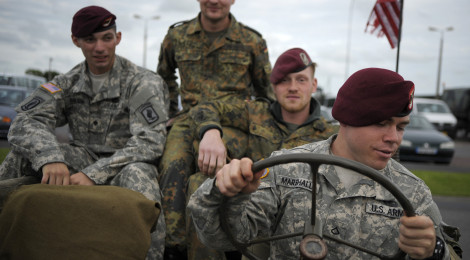
The poll comes at a critical juncture as NATO allies intensely debate how to respond to Russia’s hybrid warfare, employed so successfully in Crimea and eastern Ukraine. NATO’s easternmost members, particularly the Baltic States, have rightly pointed to the gaps in conventional military capabilities that exist between Russia and the alliance, fearing that it might not be prepared to take effective countermeasures if push comes to shove.
7 July 2015
ARE GERMANS FREE-RIDING ON AMERICAN SECURITY?
Did the U.S. and UK Governments Abandon the Bosnian Enclave of Srebrenica To Its Fate in 1995?
Florence Hartmann and Ed Vulliamy
July 5, 2015
How Britain and the US decided to abandon Srebrenica to its fate
They will fill the VIP stands at Srebrenica next weekend to mark the 20th anniversary of the worst massacre on European soil since the Third Reich; heads of state, politicians, the great and good.
There will be speeches and tributes at the town’s memorial site, Potocari, but the least likely homily would be one that answered the question: how did Srebrenica happen? Why were Bosnian Serb death squads able, unfettered, to murder more than 8,000 men and boys in a few days, under the noses of United Nations troops legally bound to protect the victims? Who delivered the UN-declared “safe area” of Srebrenica to the death squads, and why?
Over two decades, 14 of the murderers have been convicted at the war crimes tribunal in The Hague. The Bosnian Serb political leader Radovan Karadžic and his military counterpart, General Ratko Mladic, await verdicts in trials for genocide. Blame among the “international community”charged with protecting Srebrenica has piled, not without reason, on the head of UN forces in the area, General Bernard Janvier, for opposing intervention – notably air strikes – that might have repelled the Serb advance, and Dutch soldiers who not only failed in their duty to protect Srebrenica but evicted terrified civilians seeking shelter in their headquarters, and watched the Serbs separate women and young children from their male quarry.
Opinion: Reforming Germany’s domestic intelligence service
Deutsche Welle
July 5, 2015
It is and it always will be a dirty business, but a necessary one. Intelligence agents who act in secret are needed to ensure the best possible protection of a country’s free democratic order. The state wouldn’t have a clue about the threats the country and its citizens face without them. The threats have many different faces: that of the religious fanatic, the political extremist and the organized crime boss.
All are a potential threat to the peaceful coexistence of people in Germany. It’s the state’s duty to defend against them. To that end, the state has a monopoly on the use of force.
The reforms of the Federal Office for the Protection of the Constitution (BfV), Germany’s domestic intelligence service, which passed Germany’s lower house of parliament, would hardly have been necessary if federal and state authorities had done their job in a responsible way.
Their negligence became particularly clear in the case of the National Socialist Underground (NSU). The far-right terrorist cell is suspected of being behind 10 murders the occurred under the eyes of the BfV.
The Japanese Navy’s 5 Most Lethal Weapons of War
Tokyo brings the thunder on the water.
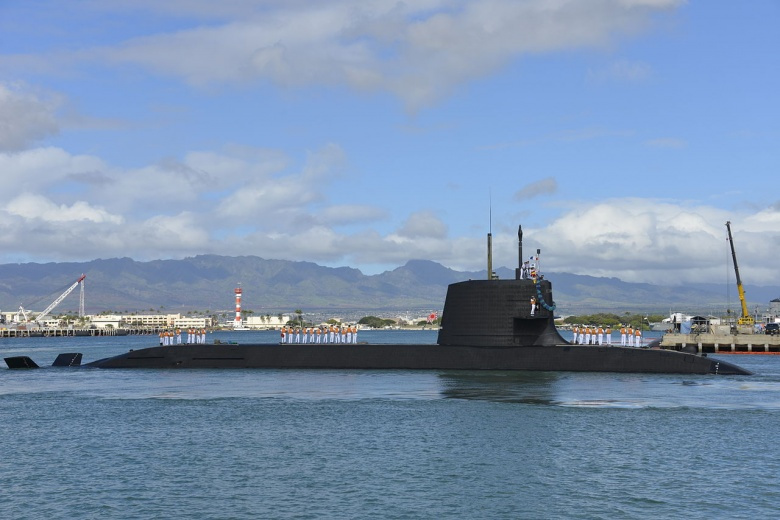
The current-day Maritime Self Defense Forces (MSDF), created during the 1950s, is the result of lessons learned during World War II. The American blockade of the Home Islands led to widespread hunger and economic decline. Modern Japan is still heavily reliant on secure sea lanes, and the MSDF was geared heavily toward anti-submarine and anti-mine warfare. The end of the Cold War did little to change that.
The rise of the People’s Liberation Army Navy (PLAN) has prompted the MSDF to undertake long-overdue changes. In response, MSDF ships are becoming larger and more capable. The end result should be a Maritime Self Defense Force capable of defending against the PLAN while assisting allies and protecting Japanese interests overseas. With that said, here are five of the MSDF’s most lethal weapons of war.
Why Greece and Europe Will Stay Attached
By David Gordon and Thomas Wright
Greek Prime Minister Alexis Tsipras’ decision to call a referendum on the latest plan for handling Greek debt—to which his government is urging the public to vote “no”—brought to a shocking end a week that started with high hopes of a compromise agreement between Greece and the European Commission, the European Central Bank (ECB), and the International Monetary Fund (IMF). Many observers had long seen a referendum in the cards, but they expected Tsipras to call one in order to seek public approval for an agreement that he actually backed in order to outflank the far left within his own Syriza party. Instead, the man who argued for months that an agreement with Europe was the only possible path forward appears to be declaring “game over” with time left on the clock.The ‘new’ type of war that finally has the Pentagon’s attention
© Sean Gallup/Getty Images Special Forces of the Polish Army atttack a house during the NATO Noble Jump military exercises of the VJTF forces on June 18, 2015 in Zagan, Poland.
Army Gen. Martin E. Dempsey, chairman of the Joint Chiefs of Staff, on Thursday released the 2015 National Military Strategy, in which he cited Russia’s actions in Ukraine and said “hybrid conflicts” will persist well into the future.
This kind of warfare transcends traditional notions of one military confronting another by incorporating conventional and unconventional forces, information warfare such as propaganda, as well as economic measures to undermine an enemy, according to Frank Hoffman, a professor at the National Defense University.
6 July 2015
AFSPA in J&K will remain a bone of contention
Arun Joshi
Jul 6 2015
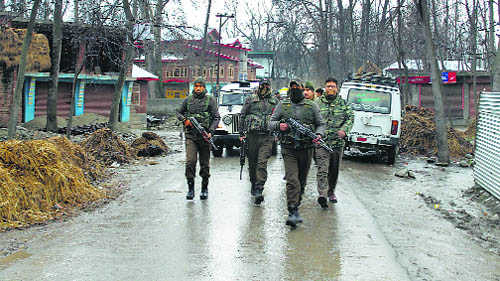
The Armed Forces Special Powers Act, (AFSPA) providing special powers to the armed forces, was first invoked on July 5, 1990, when the entire law-and- order machinery collapsed and normal laws were found inadequate to deal with the rising graph of armed militancy. At that time, the writ of the government had become virtually non-existent and the terrorists operating as “mujahideen” (warriors) had hijacked the system.
Lessons from ‘Black Friday’
RK Raghavan
Jul 6 2015
Coupled with the successful thrust of elements affiliated to the ISIS in the Sinai region of Egypt that immediately followed, there is everything to suggest that we are in for major catastrophes, not merely in the Middle East but across the globe, in the near future. The woeful lack of advance intelligence, especially at the micro level, to quell those striving to destroy peace all over the world in the name of religion is a great worry. Recent trends make the scene murkier and more dangerous than before.
Barack Obama’s Indian summer?
SANKARAN KRISHNA
July 6, 2015
Given the constraints all U.S. Presidents operate under, and given the additional burden Barack Obama carries because of his race, his recent winning streak is both unusual and likely temporary. It would be churlish to grudge him his moment of success
In India, every now and often, there emerges a passionate debate about the virtues of the Presidential system. Frustrated by coalition governments, hung Parliaments and ineffective Prime Ministers, we look longingly toward what we think of as a dynamic and effective alternative. In our imagination, Presidents can choose their equivalent of our cabinet of ministers from a pool of expert candidates not beholden to the political party of the President, or even involved in politics.
Least resistance - A question about the Emergency left unaddressed
Swapan Dasgupta
At a function in New Delhi to mark the 40th anniversary of the Emergency, the finance minister, Arun Jaitley, recounted a conversation he had with the former Supreme Court judge, H.R. Khanna - the dissenting judge in the infamous habeas corpus case - during the course of a leisurely morning walk sometime in the late-1990s. Khanna apparently told him that the astonishing admission of the attorney general, Niren De, that the Emergency regulations meant that the right to life was at the mercy of the State was prompted by a leading question he asked from the bench.
To drive home the point that natural justice was above the suspension of fundamental rights, Khanna asked the government counsel whether the Emergency could deny someone the right to life as also mentioned in Article 21. The question was as much aimed at the attorney general as the brother judges. However, as Khanna lamented, the rest of the bench headed by the then chief justice, A.N. Ray, sat there stony-faced and expressionless. "It was at that point I knew which way the verdict would go."
Towards Developing India’s Reusable Space Vehicle
By Radhakrishna Rao
Abstract :In the context of the enormous cost of building and operating conventional launch vehicles based on chemical fuels, there is a worldwide quest to develop reusable space vehicle that could render space journey routine and affordable. The only reusable space vehicle, the US space shuttle, was phased out in July 2011 after it was realized that it wasnot only costly and technologically complex but also far from safe to ferry humans. India has now joined the race to build its own reusable space vehicle along with the front ranking space faring nations including USA and Russia.
The current genre of conventional, once-only used launch vehicles based on chemical fuels are costly and technologically complex space transportation systems.As such,there isa worldwide clamour to build and operate reusable space vehicles that are technologically viable, economically efficient and safe.Of course, the era of reusable space transportation system was inaugurated with the successful flight of the US space shuttle way back in 1981. However the space shuttle which was found to be unsafe for human crew—besides being costly and technologically complex to operate—was phased out in July 2011.As it is,more
Pakistan's New Military Budget: By the Numbers
Shane Mason
July 5, 2015
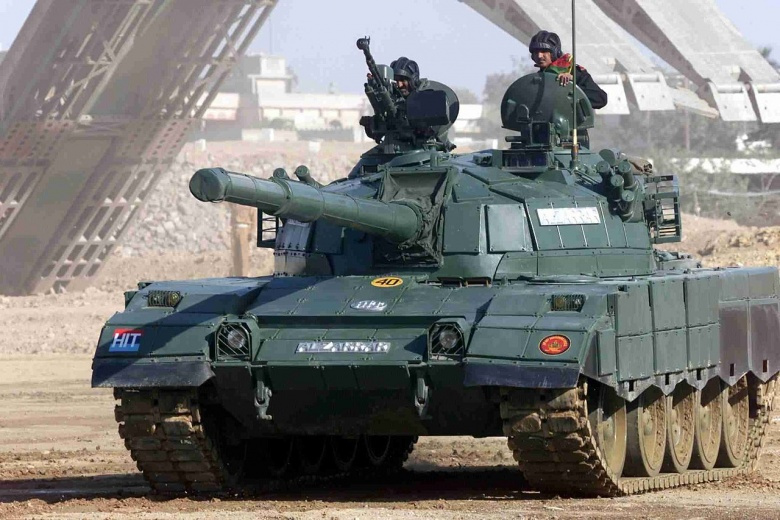
It should come as no surprise that the release of Pakistan’s federal budget on June 5 went unremarked in Washington. Nevertheless, Pakistan’s budget—particularly its defense budget— will quietly attract the attention of American officials and analysts who work this issue because important U.S. interests are engaged in Pakistan.
Pakistan is a large country with the potential to enjoy robust economic growth and attract foreign investment. It is a front-line state in the fight against violent extremism, and it is one of the world’s nuclear powers. The United States, in other words, wants Pakistan to succeed. Its national budget can help or hinder success.
Rage isn't the only emotion that drives terrorists ‒ there's guilt, too
Nadeem F. Paracha
From the European left-wing militants of the 1970s to Pakistani fundamentalists today, guilt has been a powerful driver.
There is a very interesting chapter in Blood and Rage, British author Michael Burleigh’s hefty and comprehensive book on the history of terrorism.
The chapter is about the rise (and fall) of left-wing terrorism in European countries and the United States in the late 1960s and across the 1970s.
Burleigh correctly reminds the reader that the Marxist and anarchist terror outfits operating at the time in Europe and the US were largely groups that had emerged from the collapse of the widespread student uprisings that had erupted in the West in the 1960s.
This meant that the Western terrorist outfits of that time were almost entirely being operated by the well-educated urban middle-class youth.
The Trouble With Indonesia's Rudderless Economic Policy
By Joshua Kurlantzick
The volume of transactions in Indonesia conducted in foreign currency is substantial—the Journal reports that “transactions within the country in currencies other than rupiah amount to $73 billion a year,” in a country with a GDP of around $900 billion. Many transactions are conducted in foreign currencies because companies—particularly large investors in
From unmanned fighters to orbital lasers, how the U.S. and China could fight a war
If the United States and China ever got into a shooting war, it might look a lot like "Ghost Fleet," a new book co-written by Washington think-tankers. Set up as a novel told from the perspective of, alternately, a Navy captain, a U.S. Marine-turned-insurgent and an occupying Russian official, among others, "Ghost Fleet" explores how our military's reliance on digital technology is both an asset and a liability. I spoke last week to co-author P.W. Singer, a researcher at the New America Foundation who studies the future of warfare. Here's an edited transcript of our conversation. The book comes out June 30.
What would you say "Ghost Fleet" is all about?
The Chinese military has a new secret weapon: Lightning-fast trains
Robert Beckhusen
July 3, 2015
But on May 14, one section of the growing network served a very different purpose. A People's Liberation Army brigade from the Lanzhou military region boarded a high-speed train and set off for Xinjiang — 300 miles to the west.
The exercise was a rapid and clever way to move troops around the huge country, something which Beijing is struggling to handle. China has the largest ground army and the longest land border in the world, which abuts 14 nations … more than any other country except Russia.
Beijing's South China Sea runway 'nearly complete': US think-tank
July 2, 2015
A satellite picture taken on Sunday showed that China was paving and marking the runway on Fiery Cross Reef and an apron and taxiway have been added, the Center for Strategic and International Studies (CSIS) said on its website.
Beijing's project to build artificial islands and facilities on various reefs and outcrops in the Spratly islands only became publicly known in recent months but construction has since been rapid, raising tensions with both its neighbours and Washington.
The South China Sea is home to strategically vital shipping lanes and is believed to be rich in oil and gas.
The Japanese Navy’s 5 Most Lethal Weapons of War
Kyle Mizokami
July 5, 2015
The current-day Maritime Self Defense Forces (MSDF), created during the 1950s, is the result of lessons learned during World War II. The American blockade of the Home Islands led to widespread hunger and economic decline. Modern Japan is still heavily reliant on secure sea lanes, and the MSDF was geared heavily toward anti-submarine and anti-mine warfare. The end of the Cold War did little to change that.
Here's the manual that Al Qaeda and now ISIS use to brainwash people online
By Pamela Engel
2 Jul, 2015
Rukmini Callimachi of The New York Times recently wrote about a 23-year-old American woman from Washington state who has been communicating with Islamic State (also known as ISIS, ISIL, or Daesh) recruiters online.
The woman, "Alex," showed Callimachi the messages and reading materials these recruiters had sent her, and their approach to grooming her seems textbook.
The Times notes that the tactics are similar to those laid out in an Al Qaeda manual called "A Course in the Art of Recruiting." Though ISIS and Al Qaeda are now two separate organizations, ISIS recruiters seem to follow many of the same basic guidelines for luring people into their group and indoctrinating them. And with the rise of social media, reaching these recruits across the globe has become even easier.
Islamic State destroys priceless statues in ancient city of Palmyra
By Ishaan Tharoor
July 3
Separate reports this week indicated that Islamic State fighters were smashing cultural relics in the ancient city of Palmyra, once one of Syria's most crowded tourist destinations, but now in the grips of the extremist organization.
The jihadists consider representations of divinity, especially those from pre-Islamic times, to be heretical and worthy of destruction. According to Syria's director of antiquities, Maamoun Abdelkarim, the militants this week hacked apart the famous Lion of al-Lat, a limestone statue dating back to the first century B.C. that had been placed outside Palmyra museum.
Islamists only want one thing. We cannot appease them
By Charles Moore
03 Jul 2015
David Cameron calls Isil an “existential threat” to the Western way of life. On the face of it, that seems ridiculous. How could a bunch of relatively poor, ill-armed fanatics and psychopaths conceivably topple what remains the most dominant civilisation since the Roman Empire?
In physical terms, they can’t (yet). We in the West have much more money, many more weapons (though here in Britain, we have been doing our best to weaken ourselves militarily) and greatly superior technology. While Islamist fanatics can murder 30 British tourists on a North African beach, we can probably intercept enough of them here to keep their activities below a certain level.
Al Qaeda and the Islamic State: Three myths (and three truths)
Alexander Evans
Jul 02, 2015
Despite the onslaught of video propaganda, it is time to rise above the sweeping generalisations about how the threat from the Islamic State is new and profoundly different.
As policy makers and analysts wrestle with how to respond to the advancing Islamic State in Iraq and Levant extremists – also known as the Islamic State Iraq and Syria and the “Islamic State” – there is a danger of falling victim to a pervasive disease in international politics which might be called “recent-ism.” This is the difficult-to-resist temptation to look no further back than the most recent crisis or analogy to develop policy. “Recent-ism” affects counter-terrorism, too. It’s easy to get caught up in sweeping generalisations about how the threat is new and profoundly different.
Iran nuclear talks set to drag into weekend -- and beyond
By Simon Sturdee and Cecile FeuillatreVienna
July 2, 2015
Agonising talks towards a grand bargain nuclear deal between Iran and major powers looked set Thursday to drag into the weekend and beyond, with stubborn differences still separating the two sides in Vienna.
There was little indication meanwhile whether the head of the UN atomic watchdog had made any progress in Tehran on one of the main sticking points: a probe into allegations of past nuclear weaponisation work.
French Foreign Minister Laurent Fabius said late Thursday at the end of a sixth day of negotiations involving US Secretary of State John Kerry and an army of other diplomats and experts that some progress had been made.
"Things have advanced but we have not yet reached the end," Fabius told reporters.
For South Korea's 'Comfort Women,' Justice in America?
Twelve former “comfort women” were due to file a $24 million civil suit against Japan and a number of Japanese firms on July 1, unless Japan agreed to compensation and an apology, according to Yonhap News Agency.
But, as non-U.S. citizens suing foreign entities, how likely is it that they’ll find satisfactory redress in a U.S. court?
Not very, according to two U.S. experts in international law that spoke to The Diplomat.
While each was keen to stress that they didn’t have details of the case beyond news reports, they both indicated a low chance of success due to jurisdictional issues.
These two maps show ISIS’s big losses in Syria
Zack Beauchamp
ISIS is seeing some significant setbacks in Syria. Its de facto capital, the Syrian city of Raqqa, is under serious threat from Kurdish (YPG) troops. ISIS "is barely surviving in Syria," Yasir Abbas, an associate at the private research and consulting firm Caerus Associates, told me last week. "It is struggling to halt YPG advances and is out of low-hanging fruit [to seize]."
ISIS has recently lost some critical territory in northern Syria. To see how quickly that's happened, first look at this map of the battle-lines in Syria, from the always-excellent Institute for the Study of War, in late May. Pay attention to the purple (Kurdish) and grey (ISIS) blotches up north, especially near Tal Abyad (labeled as Tel Abyad on the map):
Russia's nuclear doctrine takes an alarming step backwards
But incidents like the close call during the Cuban Missile Crisis, when a Soviet nuclear torpedo was almost fired at a US aircraft carrier, eventually proved to many the need for limits on tactical nuclear weapons. By the end of the Cold War, there was consensus that tactical weapons were inherently destabilising, and this led in part the Intermediate-Range Nuclear Forces (INF) Treaty in 1987.
CELEBRATING AMERICAN INDEPENDENCE ABROAD: ADVENTURES IN IRAN, POLAND, AND ISRAEL
Exclusive: U.S. Operates Drones From Secret Bases in Somalia
BY TY MCCORMICK
JULY 2, 2015
KISMAYO, Somalia — Some say the Americans are everywhere. Some say they are nowhere. Still others say they are everywhere and nowhere at once. But the shadowy U.S. presence in this strategic port city in war-torn southern Somalia has clear consequences for anyone with a share of power here. That includes Somali regional officials who are quick to praise American counterterrorism efforts, African Union forces who rely on U.S. intelligence as they battle back al-Shabab, and even the al Qaeda-linked militants themselves, who are increasingly hemmed in by a lethal combination of AU-led counterinsurgency, airstrikes, and raids by U.S. special operators.
What Europe's Left-Wing Moderates Have Forgotten
Kaj Leers
July 2, 2015
Politics has always been a game of chicken or egg. Do you stick with your convictions, or do you follow whatever direction a majority of the electorate is taking? In the past 20 years, the left and right across Europe have converged on the political center, leading moderate left-wing parties to adopt policies from the moderate right, and vice versa.
Superpowers Don't Get to Retire: What Our Tired Country Still Owes the World
By: Robert Kagan
Almost 70 years ago, a new world order was born from the rubble of World War II, built by and around the power of the United States. Today that world order shows signs of cracking, and perhaps even collapsing. The Russia-Ukraine and Syria crises, and the world’s tepid response, the general upheaval in the greater Middle East and North Africa, the growing nationalist and great-power tensions in East Asia, the worldwide advance of autocracy and retreat of democracy—taken individually, these problems are neither unprecedented nor unmanageable. But collectively they are a sign that something is changing, and perhaps more quickly than we may imagine. They may signal a transition into a different world order or into a world disorder of a kind not seen since the 1930s.
If a breakdown in the world order that America made is occurring, it is not because America’s power is declining—America’s wealth, power, and potential influence remain adequate to meet the present challenges. It is not because the world has become more complex and intractable—the world has always been complex and intractable. And it is not simply war-weariness. Strangely enough, it is an intellectual problem, a question of identity and purpose.
Europe’s Many Economic Disasters
JULY 3, 2015
It’s depressing thinking about Greece these days, so let’s talk about something else, O.K.? Let’s talk, for starters, about Finland, which couldn’t be more different from that corrupt, irresponsible country to the south. Finland is a model European citizen; it has honest government, sound finances and a solid credit rating, which lets it borrow money at incredibly low interest rates.
It’s also in the eighth year of a slump that has cut real gross domestic product per capita by 10 percent and shows no sign of ending. In fact, if it weren’t for the nightmare in southern Europe, the troubles facing the Finnish economy might well be seen as an epic disaster.
Macroeconomics, trade, health care, social policy and politics.
And Finland isn’t alone. It’s part of an arc of economic decline that extends across northern Europe through Denmark — which isn’t on the euro, but is managing its money as if it were — to the Netherlands. All of these countries are, by the way, doing much worse than France, whose economy gets terrible press from journalists who hate its strong social safety net, but it has actually held up better than almost every other European nation except Germany.
POLICY RELEVANT SCHOLARSHIP: WHAT’S CHUTZPAH GOT TO DO WITH IT?
The Ethics of Cyberwar
By John Arquilla
July 2, 2015
All over the world, there is a growing sense that conflict is spreading from the physical realm to the virtual domain. The 2007 cyber attacks on Estonia, the military use of cyberwar techniques in the 2008 Russo-Georgian War, and the act of "cybotage" committed against Iran’s nuclear program using the Stuxnet worm are but a few of the most salient signs of a growing trend. And these likely form just the tip of an iceberg, as cyber attacks and counter-attacks ongoing between combatants can be observed in many other places, from Ukraine to the Middle East, and on to East Asia and beyond. Thus it is high time, as this new mode of conflict diffuses in breadth and deepens in intensity, to think through the ethics of cyberwar.
Information Warfare: Duqu Lives
July 4, 2015: A respected Russian Internet security firm (Kapersky) recently revealed that it had found new spyware software in three hotels used by delegates to negotiations with Iran over sanctions and the Iranian nuclear weapons program. The spyware was described as a much improved version of Duqu and that Israel was probably behind this. Israel denied any involvement but this is actually an old story. In 2012 Internet security researchers accused Israel of a similar stunt when new spyware was found throughout the Middle East. Similar to Stuxnet and Duqu (both created by a joint U.S.-Israeli effort for use against Iran), the new spyware was called Gauss, and it was used to monitor Hezbollah (an Iran backed Lebanese terrorist group) financial activity. Gauss was apparently unleashed in 2011, and had already done its job by the time it was discovered.
Hackers Installed Sophisticated Malware on U.S. Computers. Why Doesn’t Anyone Care?
Andrea Castillo
July 4, 2015
The malware was made public in June, when Russian software security firm Kaspersky Lab rocked the information-security community by revealing that a powerful computer worm—similar to the 2010 Stuxnet virus—had been unleashed on computers in America and around the world roughly one year prior. The new malware, called "Duqu 2" for its apparent succession to 2011’s Duqu worm, alarmed info-security professionals with both its unprecedented strength and audacious targets. For months, attackers deployed frighteningly sophisticated espionage technology to secretly spy on all sorts of parties involved (however tenuously) in the ongoing Iranian nuclear negotiations, including government leaders, telecommunication and electrical-equipment companies, and impartial researchers.
Subscribe to:
Posts (Atom)