30 January 2016

*** Did Some of the Leaked NSA/GCHQ Documents Come From Another Source Other Than Snowden?

December 26, 2015

Leaked documents that were not attributed to Snowden

Peter Koop

electrospaces.blogspot.nl

December 24, 2015

Since June 2013, numerous top secret documents from the American signals intelligence agency NSA and its British counterpart GCHQ have been disclosed. The overwhelming majority of them came from the former NSA contractor Edward Snowden.

But what many people probably didn’t notice, is that some of these documents were not provided by Snowden, but by other leakers. Often, the press reports didn’t mention that very clear, and it was only by not attributing such documents to Snowden, that it became clear they came from someone else.

So far, the following secret and top secret documents have been disclosed without having been attributed to Snowden:

Document collections

*** U.S. Department of State Case No. F-2014-20439 Doc No. C05760317 Date: 12/31/201


by SWJ Editors
December 31, 2015
U.S. Department of State Case No. F-2014-20439 Doc No. C05760317 Date: 12/31/201

From today’s Department of State FOIA release of then Secretary of State Hillary Clinton's e-mails. Includes counterinsurgency discussion concerning Afghanistan strategy based on a historical perspective. Redacted portions are excluded.

UNCLASSIFIED U.S. Department of State Case No. F-2014-20439 Doc No. C05760317 Date: 12/31/2015

Who served in the counter-insurgency program in Vietnam with John Paul Vann. He writes about Bernard Fall, the great French journalist and analyst, whom he studied with. His memo is a critique of COIN proposals and his own recommendations.

The other document consists of notes from my conversation with William Murray, former station chief of CIA in Pakistan. He was one of the members of a small CIA team, including Milt Bearden (whom you probably know and who is close to Richard Holbrooke), that directed the Afghan resistance to the Soviet occupation. Murray also served as station chief elsewhere, including Lebanon. His remarks focus on the lack of a clear mission and message in Afghanistan.

Meet China’s Killer Drones


From Iraq to Nigeria, countries looking for cheap, armed drones are increasingly turning to China — and leaving the United States behind.

Iraqi officials revealed last weekend that one of their armed drones carried out an airstrike which mistakenly killed nine members of a Shiite militia near Tikrit in a friendly fire incident. The news came as a surprise, mostly because many people didn’t know Iraq had armed drones.

Iraq, for the record, very much does. And so do a number of countries, especially in the Middle East, thanks to the rise of China as a prolific developer and no-questions-asked exporter of armed unmanned aerial vehicles (UAVs). Chinese exports are now helping to loosen the door policy of the once-exclusive club of countries with drones capable of destroying targets on the ground. Unmanned Chinese aircraft like the armed Caihong, or “Rainbow,” series of drones are fast becoming the Kalashnikovs of the drone world — entry-level alternatives for countries eager to achieve a basic unmanned strike capability quickly and cheaply.

Upholding the Asian Order


Brahma Chellaney A column internationally syndicated by Project Syndicate
http://chellaney.net/ 

China’s ambition to reshape the Asian order is no secret. From the “one belt, one road” scheme to the Beijing-based Asian Infrastructure Investment Bank, major Chinese initiatives are gradually but steadily advancing China’s strategic objective of fashioning a Sino-centric Asia. As China’s neighbors well know, the country’s quest for regional dominance could be damaging – and even dangerous. Yet other regional powers have done little to develop a coordinated strategy to thwart China’s hegemonic plans.

To be sure, other powers have laid out important policies. Notably, the United States initiated its much-touted strategic “pivot” toward Asia in 2012, when India also unveiled its “Act East” policy. Similarly, Australia has shifted its focus toward the Indian Ocean, and Japan has adopted a western-facing foreign-policy approach.

The Transnistrian Conflict in the Context of the Ukrainian Crisis

December 2015
This paper analyzes the status of Transnistria through the lenses of Ukraine’s faceoff with pro-Russian separatists in Donbass. The text’s author specifically explains 1) how Russia helped Transnistria break away from Moldova to become a de facto and little recognized ‘statelet’; 2) how Moscow uses the ersatz state to exert influence over Moldova and Ukraine; and 3) the critical role that Transnistria plays in defending Russia's geopolitical interests in several European sub-regions. The author closes the analysis by suggesting ways NATO should manage the Transnistria problem and assist Moldova to reform its defense, security and intelligence sectors. 
Download: 

Israel’s electric authority hit by “severe” hack attack

http://arstechnica.com/security/2016/01/israels-electric-grid-hit-by-severe-hack-attack/ 
Electricity Authority computers were paralyzed by attack and are still recovering. 
by Dan Goodin - Jan 27, 2016 
Israel's Electricity Authority experienced a serious hack attack that officials are still working to repel, the country's energy minister said Tuesday. 
"The virus was already identified and the right software was already prepared to neutralize it," Israeli Energy Minister Yuval Steinitz told attendees of a computer security conference in Tel Aviv, according to this article published Tuesday by The Times of Israel. "We had to paralyze many of the computers of the Israeli Electricity Authority. We are handling the situation and I hope that soon, this very serious event will be over … but as of now, computer systems are still not working as they should." 
The "severe" attack was detected on Monday as temperatures in Jerusalem dipped to below freezing, creating two days of record-breaking electricity consumption, according to The Jerusalem Post. Steinitz said it was one of the biggest computer-based attacks Israel's power authority has experienced and that it was responded to by members of his ministry and the country's National Cyber Bureau. The response included shutting down portions of Israel's electricity grid. The energy minister didn't identify any suspects behind the attack or provide details about how it was carried out. 

Highly destructive malware creates "destructive events" at 3 Ukrainian substations.News organizations reporting Steinitz' comments gave no indication the attacks resulted in any power disruptions. A representative for Israel's Electricity Authority said some of its computer systems had been shut down for two days in response to the attack. According to The Times of Israel, Israel's Electricity Authority is a department in the country's Ministry of Energy and is separate from the Israel Electric Corporation, the country’s state-owned utility company. Contrary to a previous version of this post, there's no indication Israel's power grid was attacked.
The attack comes five weeks after Ukraine's power grid was successfully disrupted in what's believed to be the world's first known hacker-caused power outage. Researchers still aren't sure if the malware known as BlackEnergy was the direct cause of the blackout, but they have confirmed the malicious package infected at least three of the regional power authorities that were involved in the outage. Researchers have since said the attack was extremely well-coordinated
Post corrected throughout to reflect the hack reportedly hit Israel's Electricity Authority. At the moment, there's no indication the attack extended to the country's power grid.

Why Is Daesh Propaganda Not Shut Out Of The Internet?

Dr Noureddine Miladi 

The question of ‘Why is Daesh not shut out of the internet?’ seems so unpretentious, but the answer to such a question is certainly problematic and sophisticated.

In the US and Europe, openly and behind closed doors in the corridors of policy-making bodies, discussions warn against the use of social media networks by the so called ‘Islamic State’ (known in Arabic by the name Daesh) as an effective tool for recruiting fighters, to spread propaganda material and to gain support.

It is no secret that Daesh has succeeded so far in harnessing various Internet platforms to spread its propaganda messages around the world. It has become a reality partly through its effective YouTube videos, some of them even referred to as official sources by the mainstream international news media.

In the West free speech is sacred. Hence the argument in the US for instance has been whether to consider censorship of Daesh’s media platforms a contradiction of the basic rights of free speech enshrined in the country’s constitution. Contrary to what may be expected, many in the USA argue that the best method to fight hate speech is not to censor it but to widen the debate around it and to increase the voices of those who can counteract it.

Secret Pentagon Report Reveals US "Created" ISIS As A "Tool" To Overthrow Syria's President Assad

05/24/2015 

From the first sudden, and quite dramatic, appearance of the fanatical Islamic group known as ISIS which was largely unheard of until a year ago, on the world's stage and which promptly replaced the worn out and tired al Qaeda as the world's terrorist bogeyman, we suggested that the "straight to beheading YouTube clip" purpose behind the Saudi Arabia-funded Islamic State was a simple one: use the Jihadists as the vehicle of choice to achieve a political goal: depose of Syria's president Assad, who for years has stood in the way of a critical Qatari natural gas pipeline, one which could dethrone Russia as Europe's dominant - and belligerent - source of energy, reaching an interim climax with the unsuccessful Mediterranean Sea military build up of 2013, which nearly resulted in quasi-world war.

The narrative and the plotline were so transparent, even Russia saw right through them. Recall from September of last year:

The Red Line and the Rat Line Seymour M. Hersh on Obama, ErdoÄŸan and the Syrian rebels


You are invited to read this free essay. Register now for 24 hours of free access to the entire LRB archive. Email address: 

Your email will be added to our mailing list. By registering you agree to our terms

In 2011 Barack Obama led an allied military intervention in Libya without consulting the US Congress. Last August, after the sarin attack on the Damascus suburb of Ghouta, he was ready to launch an allied air strike, this time to punish the Syrian government for allegedly crossing the ‘red line’ he had set in 2012 on the use of chemical weapons.​* Then with less than two days to go before the planned strike, he announced that he would seek congressional approval for the intervention. The strike was postponed as Congress prepared for hearings, and subsequently cancelled when Obama accepted Assad’s offer to relinquish his chemical arsenal in a deal brokered by Russia. Why did Obama delay and then relent on Syria when he was not shy about rushing into Libya? The answer lies in a clash between those in the administration who were committed to enforcing the red line, and military leaders who thought that going to war was both unjustified and potentially disastrous.

Cyber Superpower: Netanyahu Reveals Bold Plans for Israel

http://www.nationalinterest.org/blog/the-buzz/cyber-superpower-netanyahu-reveals-bold-plans-israel-15038
Adam Segal,  January 27, 2016
Cybertech 2016 convened this week in Tel Aviv, and I was in the audience for Prime Minister Benjamin Netanyahu’s plenary address, courtesy of the America-Israel Friendship League and the Israeli Foreign Ministry. Israel has an ambitious domestic and international agenda designed to make it one of the world’s super cyber powers.
The prime minister has made cybersecurity one of his trademark issues and is a big promoter of the idea that better network defenses are essential for national security and that the information security industry is a driver of economic growth (Israel now has more than 300 cybersecurity companies, exports of $6 billion, and 20 percent of the world’s private investment in cyber). In his speech, Netanyahu stressed two large themes. First, there is a need for action now, and as a result some policies may be incomplete or eventually reversed, but the general direction has been decided and everyone needs to start moving. He returned to a metaphor from the army that he has used before of forces in the field changing direction even if every detail is not yet in place.
Second, Netanyahu highlighted a contradiction between the necessity of and the risks inherent in cooperation. The Israeli government is actively looking to partner with other countries and the private sector, but sharing information and capabilities will always be a calculated risk.
Four specific points in the speech were of interest. First, the standing up of the National Cyber Authority and the delineation of its authorities are running into some resistance, presumably primarily from the Shin Bet, Israel’s internal security agency. The Shin Bet is responsible for defending critical infrastructure, has much of the country’s cyber capability, and does not want to give up influence. The prime minister spoke of challenging vested interests, including the intelligence agencies; the officials I spoke with took the resistance as an entirely predictable outcome of bureaucratic politics and expected the turf battles to be resolved quickly.

The Days After a Cyberattack Strikes the U.S. Power Grid

http://nationalinterest.org/feature/the-days-after-cyberattack-strikes-the-us-power-grid-15028?page=show
Ted Koppel's new book shines a light on America's vulnerable infrastructure.
Kevin Reagan, January 27, 2016
In his new book, Lights Out: A Cyberattack, A Nation Unprepared, Surviving the Aftermath, ABC News veteran Ted Koppel concludes that America’s dependence on internet-connected critical infrastructure systems is making it increasingly vulnerable to a devastating cyberattack, and that the nation is completely unprepared for the aftermath of any such attack. The cover depicts America at night but with the eastern half of the country in darkness, evoking the memorable contrast of real-life nighttime images of the Korean peninsula. Indeed, after a clichéd opening describing the United States in a North Korea–like state (the first sentence of the book is “Darkness.”), the first chapter arrives at the focus of Koppel’s study: the centrality of the electrical grid in the United States, and what would happen if it went offline for an extended period of time, particularly as the result of a cyberattack.
After developing his cyberattack premise, Koppel then bizarrely teases readers with sparse details of other potential grid vulnerabilities of equal or greater interest, briefly acknowledging their existence before moving on with his argument. The second chapter of the first section, “AK-47s and EMPs,” details how electromagnetic pulse (EMP) attacks could be used to neutralize not only the power grid, but all electronics across the country. Without much further examination, Koppel leaves readers to ponder the somber conclusions of a2008 congressional report on the EMP threat—namely, the forecast of a 90 percent population reduction.
The chapter also details one concerning incident in 2013, in which a power substation in California wasphysically infiltrated and taken offlinein a coordinated attack by individuals armed with assault rifles. While the attack did not prove fatal or cause a widespread power outage, it highlighted the vulnerability of the grid to physical attack and the need for increased physical security at critical sites. Given the ease with which the tools used in this attack can be acquired in the United States, this threat merits much more in-depth discussion, but Koppel largely glosses over its significance in this chapter.

Wide Range of Ukrainian Industries Vulnerable to Cyber Attacks, Report

Exclusive - Hackers may have wider access to Ukrainian industrial facilities
Reuters, January 27, 2016
Hackers were able to attack four sections of Ukraine’s power grid with malware late last year because of basic security lapses and they could take down other industrial facilities at any time, a consultant to government investigators said.
Three power cuts reported in separate areas of western and central Ukraine in late December were the first known electrical outages caused by cyber attacks, causing consternation among businesses and officials around the world.
The consultant, Oleh Sych, told Reuters a fourth Ukrainian energy company had been affected by a lesser attack in October, but declined to name it.
He also said a similar type of malware had been identified by the Ukrainian anti-virus software company Zillya! where he works as far back as July, making it impossible to know how many other systems were at risk. 
“This is the scariest thing - we’re living on a powder keg. We don’t know where else has been compromised. We can protect everything, we can teach administrators never to open emails, but the system is already infected,” he said.
Sych, whose firm is advising the State Security Service SBU and a commission set up by the energy ministry, said power distributors had ignored their own security rules by allowing critical computers to be hooked up to the Internet when they should have been kept within an internal network.
This so-called “air gap” separates computer systems from any outside Internet connections accessible to hackers.
“A possible objective was to bring down some branches (of the Ukrainian energy system) and create a ‘domino effect’ to collapse the entire system of Ukraine or a significant part,” Sych said.
Ukraine has also been targeted in other cyber attacks, which included hacking into the system of Ukraine’s biggest airport and TV news channels. 

Operation Protective Edge: Ends, Ways and Means and the Distinct Context

Ron Tira

Between July 8 and August 26, 2014, Israel and Hamas engaged in hostilities known in Israel as Operation Protective Edge. An analysis of the operation can provide valuable understanding regarding the orchestration of ends, ways and means – in a distinct context.

Politicians, strategists and campaign planners tend to survey experiences that resemble the current challenge. Yet often, the seemingly analogous case is characterized by different contexts, and may thus be misleading. Rather than seeking resemblance, the differences between the specific challenge ahead and the seemingly analogous precedents should be distilled. Extracting the distinctness of the challenge may provide the real guidance.

Operation Pillar of Defense - the Misleading Backdrop

Why Weaker Insurgents Survive or Beat Stronger Incumbents

By Omar Ashour for Istituto Affari Internazionali (IAI) 
26 January 2016

Since the 1970s, the number of victories by insurgents over stronger incumbents has risen significantly while the ability of incumbents to defeat much weaker insurgents has decreased. Today, Omar Ashour cites seven possible reasons for this phenomenon, two of which particularly apply to Syria and Iraq. 

The following extract is part of a larger report ("Why does the Islamic State [IS] Endure and Expand?") which the Instituto Affari Internazionali (IAI) published in December 2015. If you are interested in the broader text, which explores IS’ military capabilities, the strategy it’s pursuing against the West, and the current and long-term counter-strategies being employed against the group, go here

An Assessment of Known Drone Use by Non-State Actors

25 January 2016

Thus far, drones have been used by terrorist, insurgent, criminal, corporate and activist groups for two broad purposes – to stage IED-type attacks and gather intelligence. Today, Chris Abbott and others provide specific details on how “threat groups” have exploited drones in the past and how they might rely on them in the future. 

By Chris Abbott and Matthew Clarke and Steve Hathorn and Scott Hickie for Oxford Research Group (ORG) 

The following extract is part of a larger report ("Hostile Drones: The Hostile Use of Drones by Non-State Actors against British Targets") which the Oxford Research Group (ORG) published on 11 January 2016. If you are interested in the broader text, which additionally explores the attributes of many commercially available unmanned vehicles and how to counter the potential threats they pose, go here

Lights Out for the Putin Regime The Coming Russian Collapse

January 27, 2016 

Russian President Vladimir Putin used to seem invincible. Today, he and his regime look enervated, confused, and desperate. Increasingly, both Russian and Western commentators suggest that Russia may be on the verge of deep instability, possibly even collapse.

This perceptual shift is unsurprising. Last year, Russia was basking in the glow of its annexation of Crimea and aggression in the Donbas. The economy, although stagnant, seemed stable. Putin was running circles around Western policymakers and domestic critics. His popularity was sky-high. Now it is only his popularity that remains; everything else has turned for the worse. Crimea and the Donbas are economic hellholes and huge drains on Russian resources. The war with Ukraine has stalemated. Energy prices are collapsing, and the Russian economy is in recession. Putin’s punitive economic measures against Ukraine, Turkey, and the West have only harmed the Russian economy further. Meanwhile, the country’s intervention in Syria is poised to become a quagmire. 

Things are probably much worse for Russia than this cursory survey of negative trends suggests. The country is weathering three crises brought about by Putin’s rule—and Russia’s foreign-policy misadventures in Ukraine and Syria are only exacerbating them.

There Is no Plan B for Europe

by Kaj Leers 
January 27, 2016

As European leaders prepare for a mid-February summit -- just the latest such gathering to seek a solution to the Continent's refugee crisis -- the politics surrounding that crisis are intensifying. Under the aegis of Dutch leadership, the 28 heads of state must somehow compromise in order to save one of the fundaments of the EU: free movement across borders. Failing such a compromise, there is no Plan B.

Europe's attention is fixed for now on Amsterdam, as the Dutch government holds the rotating presidency from January until July 1. Within these six months, the European Union needs to find solutions to several daunting challenges at once. The refugee crisis is at present the number one problem faced by Dutch Prime Minister Mark Rutte, EU president Donald Tusk, and European Commission President Jean-Claude Juncker.

What Happened When Ash Carter Crashed Davos

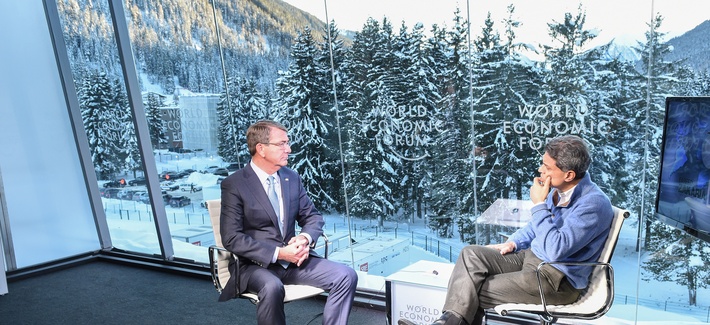
Defense Secretary Ash Carter with CNN's Fareed Zakaria at the World Economic Forum in Davos, Switzerland on Jan. 22, 2016. 
January 27, 2016 By Kevin Baron 
The defense secretary's legacy may have been forged in the Alps, connecting economic elites to the Pentagon — and the war on terrorism. 
DAVOS, Switzerland — Past the luxury shops, black cars, and pop-up spaces opened on tiny ski-village streets by iconic banks and technology giants, U.S. Defense Secretary Ash Carter came to the World Economic Forum with dual messages. One for world leaders on this global stage: get into the fight against the Islamic State. And a second for corporate leaders: join forces with the Pentagon and get into the business of fighting for something bigger. 
Kevin Baron is executive editor of Defense One. He is also national security/military analyst for NBC News and MSNBC. Baron has covered the military, the Pentagon, Congress and politics for Foreign Policy, National Journal, and Stars and Stripes. He previously ran investigative projects for five ... Full Bio

In a way, Carter’s Davos mission encapsulates his probable legacy as President Barack Obama’s final defense secretary. The methodical technologist and government servant who rose through the political-appointee ranks has about one year left to make his mark on the job. Over the past few months, as Secretary of State John Kerry has focused on Iran, Carter has become Obama’s point-man for the war on ISIS. Ordered to “accelerate” the U.S.-led campaign, Carter has since September tried to cadge additional forces and finances from America’s allies. On this European swing, he stopped first in Paris, where attacks in November renewed the continent’s fighting mood. There he laid out his plan to key coalition partners: follow December’s liberation of Ramadi with one-two punch invasions of Mosul in Iraq and Raqqa in Syria. He also announced a Brussels conference next month where he expects at least 26 nations to come with additional offerings.
But Carter also wants to put the Pentagon on a firmer footing as a government agency for the new era of terrorism, massive employer of personnel, and driver of technology. His solution: lure the world’s most innovative minds, firms, and business leaders to work with the federal behemoth.

Israel’s Electrical Grid Hit by Major Cyber Attack

‘Israel’s electrical grid attacked in massive cyber attack’
Jerusalem Post, January 26, 2016
As Israelis cranked up their heaters during the current cold snap, the Public Utility Authority was attacked by one of the largest cyber assaults that the country has experienced, Minister of Infrastructure, Energy and Water Yuval Steinitz said onTuesday. 
“Yesterday we identified one of the largest cyber attacks that we have experienced,” Steinitz said at the CyberTech 2016 conference at the Tel Aviv Trade Fair and Convention Center. 
Steinitz said that attack was dealt with by his ministry and the National Cyber Bureau and that it was under control. 
The incident occurred during two consecutive days of record-breaking winter electricity consumption, with the Israel Electric Corporation reporting a demand of 12,610 megawatts on Tuesday evening as temperatures dipped to below-freezing levels.
“I can tell you that the virus was identified and software was activated to neutralize it,” Steinitz said. 
“This is a fresh example of what we need to be prepared to face at any time,” he added. 
Hundreds of international delegations were attending the CyberTech 2016 Conference.
The third annual event drew state leaders, representatives of leading multinational and Israeli corporations and startups, investors and entrepreneurs in the field of cyber security.
A US delegation led by Homeland Security Deputy Secretary Alejandro Mayorkas, a large Japanese representation, a group of Canadian banking executives and a delegation organized by the International Monetary Fund from developing countries were among those expected to attend what is referred to as the largest exhibition of cyber technologies outside the United States.

Full Spectrum Signals Intelligence (SIGINT) and Cyber Operations Technology

I. FUNDING OPPORTUNITY DESCRIPTION

Air Force Research Laboratory Information Directorate (AFRL/RI) is soliciting white papers for various scientific studies, investigations, and experiments to increase our knowledge, understanding and capability in order to expand cyber operations technologies involving full spectrum signals intelligence (SIGINT) and Electronic Warfare (EW) within the Department of Defense (DoD). Areas of interest include the integration, better coordination of, and capability to conduct cyberspace operations. This includes integration research into operational and contingency planning, as well as technology and approaches to better equip the warfighter. Concepts at the intersection of the areas of SIGINT, EW and Cyber technologies are sought in this Broad Agency Announcement (BAA). Development proposals, specifically as applies to new ideas/concepts for practical application, are of interest.

Research efforts under this program are expected to result in experimental capabilities, concepts, theory, and applications addressing cyber operations problems involving SIGINT and EW to support the future needs of DoD including 24th Air Force, 25th Air Force and other government agencies. Broad topics of interest include applying machine learning, mission platforms, and spectrum issues to cyber operations, and improving cyber exercise technology. Projects specializing in highly novel, interesting, and applicable techniques will also be considered if deemed to be of "breakthrough" quality and importance.

High-Tech Execs in Silicon valley Seem Open to Going Back to Work With US Spy Agencies

Danny Yadron and Julia Carrie Wong
January 9, 2016

Silicon Valley appears open to helping US spy agencies after terrorism summit

Obama administration acknowledges ‘complicated first amendment issues’ after top counter-terrorism officials traveled to California to woo technology executives from companies including Apple, Facebook and Twitter

Technology giants appeared to be open to helping the US government combat Islamic State during an extraordinary closed-door summit on Friday that brought together America’s most senior counter-terrorism officials with some of Silicon Valley’s most powerful executives.

The remarkable rendezvous between Apple, Facebook, Twitter, Microsoft and others and a delegation from the White House revealed a willingness on the part of tech firms to work with the government, and indicated that the Obama administration appears to have concluded it can’t combat terrorists online on its own.

Robert Steele: The Virtual Caliphate – Between Two (or More) Evils

** How to Be a Better Writer: 6 Tips From Harvard’s Steven Pinker


Nov. 14, 2014

Eric Barker writes Barking Up the Wrong Tree. 

Good writing is often looked at as an art and, frankly, that can be intimidating. No need to worry. There are rules — even science — behind writing well.

Our brain works a particular way; so what rules do we need to know to write the way the brain best understands?

To find out the answer I gaveSteven Pinker a call.

Steven is a cognitive scientist and linguist at Harvard. He’s also on the Usage Panel of the American Heritage Dictionary.

Steven was recently ranked as one of the top 100 most eminent psychologists of the modern era.

The other side of the CGSC story: Some of our Army officers are functionally illiterate

BY THOMAS E. RICKS
JANUARY 5, 2016
Source Link


By “Flash Override”
I would like to take the discussion regarding CGSC even further. Yesterday you heard from the top of the class. But there is another side to this story. Unlike the other armed services, who only send 25 percent or fewer members of each year group to resident staff college, the Army sends almost 50 percent of each year group. This results in functionally illiterate Army majors coming to CGSC.
Think I’m exaggerating? Then you need to see the test scores from the Nelson-Denny Reading Exam. The Nelson-Denny, which has been around since 1929, measures the reading and comprehension ability of students. Approximately five percent of incoming U.S. Army students at CGSC each year score so low on the Nelson-Denny that they could fairly be classified as functionally illiterate.

Official History of the 1971 India Pakistan War

1971 Bangladesh War 
Created: 12 October 2006 

© History Division, Ministry of Defence, Government of India. Adobe Acrobat Reader is required to view these file. Two files (Introduction.pdf & Chapter 1.pdf) were received in a corrupted state from the original source and are included here only for the sake of completion.

Introduction.pdf: File Size - 1.6M

Foreword.pdf: File Size - 95k

Preface.pdf: File Size - 277k

Abbreviations.pdf: File Size - 393k

Appendix.pdf: File Size - 2.3M

Bibliography.pdf: File Size - 240k

29 January 2016

Negotiating with the Taliban

Return to frontpage
January 29, 2016 

Delegations from Afghanistan, Pakistan, U.S.A and China discuss a road map for ending the war with the Taliban at the Presidential Palace in Kabul, Afghanistan. Representatives of four countries met in the Afghan capital for a second round of talks aimed at bringing an end to Afghanistan's war by charting a roadmap to peace, a Foreign Ministry official said. 

The Taliban’s newfound willingness to engage in a negotiated power-sharing arrangement is a good sign for the Afghan peace and reconciliation process. India should play a more proactive role.

The recently concluded Doha Dialogue on ‘Peace and Security in Afghanistan’ presents a number of opportunities for the international community, as well as India, in dealing with the resurgent Taliban phenomenon.

The second round of the unofficial Doha Dialogue, organised by the Nobel Peace Prize-winning Pugwash Conferences on Science and World Affairs with support from the state of Qatar, comes at a time when the official Quadrilateral Coordination Group on Afghan Peace and Reconciliation, with participation from the governments of Afghanistan, China, Pakistan, and the U.S., has become a non-starter due to the non-participation of the Taliban.

China’s long game in West Asia

January 29, 2016 

APDEEPENING FOOTPRINT: “It is natural for China to see Tehran as an entry into West Asia, historically a region of U.S. influence, at a time when the U.S. is pivoting to East Asia.” Picture shows Chinese President Xi Jinping with Iranian President Hassan Rouhani at an official arrival ceremony, at the Saadabad Palace in Tehran.

Iran’s strategic location connecting West Asia and Central Asia is key to President Xi’s One Belt, One Road initiative.

For decades China remained on the sidelines of West Asia’s stormy waters. Even when the country was rising as an economic powerhouse and stepped up cooperation with the major powers in West Asia, the cornerstone of this engagement was non-interference: be it the Israeli-Palestinian conflict or the Saudi-Iran rivalry, the Chinese would continue to sit on the fence. Beijing looked at the region through its own prism. It didn’t want to get swamped in the complex geopolitics of the region at a time when its primary focus was on economic development. So it built ties with West Asian nations based on three principles — secure energy supplies, expand markets for finished goods and find investment opportunities — while leaving the U.S.’s primacy in the region unchallenged.

'India under threat from Al Qaeda, ISIS'

http://www.rediff.com/news/interview/india-under-threat-from-al-qaeda-isis/20160127.htm
January 27, 2016 23:15 IST
'India is a major target for ISIS and Al Qaeda because it has a very large Muslim Diaspora, regular conflicts with a Muslim country and experiences violent clashes between Hindus and Muslims on a regular basis.' 
'This provides for a very stable breeding ground for jihadist radicalisation and recruitment.' 
In early 2015, New Zealand -- located thousands of miles and two oceans away from the Syria-Iraq battlegrounds, with a negligible Muslim population of less than 1 percent -- had 6 fighters enlisted with Islamic State or Da'esh, which had till mid-2015 recruited 25,000 people from over 100 countries. 
In spite of ISIS's ferocious social media presence, partly responsible for successful enlistments -- its affiliates posted 129,600 tweets in 2014 alone, before some 500 accounts were deactivated -- till late 2015, ISIS had lured and converted only some 17 Indians to its cause, according to United Nations and the US National Counterterrorism Centre statistics. 
Experts have suggested that young Indians have been immune to a certain type of radicalisation that makes the ISIS cause attractive because they do not cope with the feelings of alienation that young Muslims elsewhere face. 
Daniel Koehler, director, German Institute of Radicalisation and De-radicalisation Studies, Berlin, has devoted his career to understanding terrorism, radicalisation, and de-radicalisation. 
In the wake of last week's arrests of ISIS synmpathisers all over India, Koehler discussed ISIS-inspired radicalisation with Vaihayasi Pande Daniel/Rediff.com

What is the Indian situation vis-a-vis ISIS? 
India is one major target for ISIS and Al Qaeda because the country has a very large Muslim Diaspora, regular conflicts with a Muslim country (Pakistan) and experiences violent clashes between Hindus and Muslims on a regular basis. 
This provides for a very stable breeding ground for jihadist radicalisation and recruitment. 

Does India figure in any ISIS plan in a larger and more sinister manner?Is there something the Indian national security establishment needs to be worried about?
Right now, I would say that the biggest problem for India, with regard to ISIS, is the threat of recruitment to join the jihad in Syria and Iraq and the returnees. 
The bigger threat currently could come from Al Qaeda, which has proclaimed the 'caliphate' in Myanmar, Bangladesh and parts of India. The competition between the two groups forces Al Qaeda to be more aggressive and commit terrorist acts. 
On the other hand, ISIS has shown a great deal of attraction for the Taliban in Pakistan and other violent network already present. 
India lies right at the centre of two jihadist terrorist groups fighting each other for power. 

Journalism today: Will social media turn mainstream media irrelevant?

http://www.firstpost.com/india/journalism-today-will-social-media-turn-mainstream-media-irrelevant-2594736.html
by Vedam Jaishankar Jan 24, 2016 09:38 IST
There is something intriguing happening at the “subaltern” level that is sensitising “India, that is Bharat” to issues that were never debated for the last 200 years. The past few days in Bengaluru, a city that boasts of being open to ideas, technology, concepts and outlook have been educative, to say the least.
Interestingly, the die was cast when two-time Pulitzer Prize winning journalist Steve Coll, in a discussion with Rohini Nilekani, chairperson of Arghyam, spoke of the challenges thrown at main stream journalism by social media and corporates.
Coll, the dean of the Columbia University Graduate School of Journalism believed journalism was vital in forging accountability and transparency while at a discussion held in a five-star hotel attended by a select gathering of around 150. Many of them were drawn from the media and extremely inquisitive on how to push back the onslaught coming from Twitter, Facebook and other social media tools.

Now cut away to a series of lectures and lively discussions taking place across the same city (at Karnatak Samskrit University Auditorium, Chamrajpet; Bharati Vidya Bhavan; Aksharam, Samskrita Bharati, Girinagar; IISc, Satish Dhawan Auditorium; Amrita College of Engineering, Kasavanahalli; The Art of Living Campus, and a workshop in Jayanagar) where Rajiv Malhotra, arguably one of the foremost thinkers of our time according to his fans, was drawing packed crowds on the first leg of his five-city (Bengaluru, Chennai, New Delhi, Mumbai and Ahmedabad) whirlwind tour of India during which he would also launch his seminal book, The Battle For Sanskrit: Is Sanskrit Political or Sacred? Oppressive or Liberating? Dead or Alive? Most of Malhotra’s lectures were being slotted at big brand institutions like IIT, IISc, JNU, Delhi University etc and aimed at a discerning audience.
Additionally, the current Malhotra tour has been enriched by the presence of some really big names at the discussions. For instance, at IISc, those sharing the dais were Padma Vibhushan awardee and well-known aerospace scientist Roddam Narasimha and the erudite Mohan Das Pai, both of whom pulled no punches during their addresses. Among the packed audience of professors, research students and others was the whiz-kid Balaji Srinivasan of Counsyl and other fame.

India Beefs Up Maritime Surveillance Near Malacca Strait

India's recent announcement that it will deploy two of its new Boeing P-8 maritime surveillance and strike aircraft to the Andaman & Nicobar Islands could create new opportunities for enhanced cooperation with Australia and the US.
The islands, which run some 800km from the top of Indonesian Sumatra to Myanmar, are India's strategic outpost in Southeast Asia, potentially allowing India to dominate the western approaches to the Malacca Strait just as China's artificial islands in the South China Sea dominate the sea lanes at the other end of the Strait.
India has been building its military capabilities on the islands for decades, but its capabilities in intelligence, surveillance & and reconnaissance (ISR) have been limited. But the Indian Navy's air station on Great Nicobar island in the south of the archipelago is now being developed to accommodate large aircraft such as the P-8. Great Nicobar is near the western end of the Malacca Strait and the Six Degree Channel through which most commercial shipping passes.

India's response to China
The most immediate driver of these deployments is China's growing presence in the Indian Ocean. The PLA Navy has made continuous deployments to anti-piracy operations in the Arabian Sea since 2008. But deployments of Chinese conventional submarines to the Indian Ocean in the last couple of years have caused considerable disquiet in Delhi. Port calls by a Chinese submarine in Sri Lanka in 2014 were especially controversial, and were essentially seen as a hostile act against India by Sri Lanka's former Rajapaksa regime. Last December, Beijing announced the establishment of its first foreign military base in Djibouti to support Chinese forces operating in the western Indian Ocean.
This means the Chinese navy has now become a permanent feature of the Indian Ocean, and one day this could include deployments of Chinese ballistic-missile submarines.
The growing Chinese presence in the Indian Ocean has led the Indian Navy to rebalance its fleet more towards its east coast and the Bay of Bengal. The development of new capabilities in the Andaman & Nicobar islands will help India to potentially dominate the entire Bay of Bengal and the western approaches to the Malacca Strait. The P-8 deployment will also enhance India's surveillance and strike capabilities further afield, potentially including in the South China Sea.

Watching the gateway
But the deployment of P-8 aircraft to the Nicobars could also have broader strategic consequences for India's defence relations with Australia, the US and Southeast Asian partners.
For one thing, India's maritime surveillance efforts could complement Australia's activities in the area. For more than 35 years, as part of Operation Gateway, Australia has conducted maritime surveillance in the Malacca Strait itself and at each end of the Strait in the South China Sea and Bay of Bengal. Operation Gateway was instituted by the Fraser Government in 1981 in response to the growing Soviet presence in the Indian Ocean and throughout the 1980s, Australian P-3 aircraft, operating from or staging through Butterworth in Malaysia, actively 'prosecuted' Soviet submarines transiting the Malacca Strait between the Pacific and Indian Oceans. These ISR operations continued after the Cold War and from 2017 will include Australia's new fleet of P-8 aircraft.

Navigating the changing geo-economic landscape


This Special Report is based on some of the most important ideas shared amongst participants in ORF's roundtable on Changing Geo-economic Landscapes, held on 21 December 2015 in New Delhi. The discussion examined current patterns in world economy, initiatives being taken by the Indian leadership to steer domestic economy, and the need for the country to carefully integrate its domestic economic priorities, including those of reforms, with its foreign policy.

SMALL STATES HAVE OPTIONS TOO: COMPETITIVE STRATEGIES AGAINST AGGRESSORS

http://warontherocks.com/2016/01/small-states-have-options-too-competitive-strategies-against-aggressors/
THOMAS G. MAHNKEN,  JANUARY 27, 2016
Editor’s Note: This article is adapted from an essay that first appeared in Frontline Allies: War and Change in Central Europe, published by the Center for European Policy and Analysis.
Looking back at history, one might reasonably conclude that small states are destined to be on the losing end of geopolitics. Events of the last decade in particular do not give us much reason for optimism about the destiny of small states facing coercion at the hands of their larger and more powerful neighbors. Russia used force against Georgia in 2008, has been using force against Ukraine since 2014, and could prospectively use force against a number of its other neighbors. China, for its part, has used a variety of coercive techniques in its territorial disputes with its neighbors. One common feature of these situations is an explicit effort by the coercing state to stay below the thresholds of a military response and, in particular, outside military intervention. As a result, small states have largely been left to their own devices to defend themselves against their more powerful neighbors.
Small, frontline states do not, however, lack options in the face of coercion. To the contrary, they could pursue a number of competitive strategies in an effort to make coercion less attractive. These include strategies of denial, which seek to harden a state against coercion; cost-imposing strategies, which seek to force an adversary to bear burdens sufficient to cause a reconsideration of coercion; efforts to attack and render ineffective the adversary’s coercive strategy; and strategies that seek to exploit divisions within the enemy’s political leadership to end the coercive campaign. The United States can, and in many cases should, assist small, frontline states in developing and implementing competitive strategies against their larger neighbors seeking to coerce them.

The Competitive Strategies Approach
Strategy has to do with how a state or other political actor arrays its resources in space and time in order to achieve its political objectives against a competitor. The key features of any strategy are rationality (the existence of political objectives and a plan to achieve them) and interaction with a competitor who seeks at the very least to achieve different objectives if not thwart our ability to achieve our aims. Competitive strategies are a particular family of strategy with two aspects that deserve consideration.

How to Prevent: Extremism and Policy Options.

The Tony Blair Faith Foundation has released the second volume in our Global Perspectives series, How to Prevent: Extremism and Policy Options. 


This volume engages our practical support to counter religious conflict and extremism, with the thinking of academic and policy experts in this field. It focuses on our core areas of work: analysis of the interaction of religion and conflict, education and supporting leaders. 

Edited by the Foundation in collaboration with Khalid Koser, Executive Director of the Global Community Engagement and Resilience Fund, the volume outlines some of the increasingly vital policy options for preventing extremism. 


Taliban Blow Line Transmitting Uzbek Electricity to Kabul

http://thediplomat.com/2016/01/taliban-blow-line-transmitting-uzbek-electricity-to-kabul/
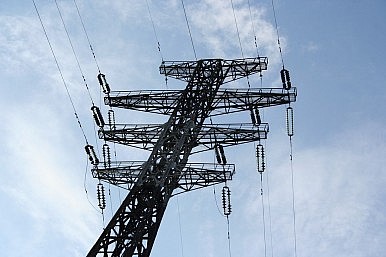
Electricity pylons are also known as transmission towers.
One blown pylon illustrates the vulnerability of electricity transmission lines in Afghanistan
By Catherine Putz, January 27, 2016
Taliban blew up an electricity pylon in Baghlan province Tuesday. According to TOLOnews, the Chairman of Da Afghanistan Breshna Sherkat (DABS), Afghanistan’s state-owned utility company, confirmed that the Taliban blew up a “major electricity pylon in Dand-e-Shahabuddin area near Baghlan-Kunduz highway.” The chairman, Mirwais Alimi, told TOLOnews that it can be repaired in a day, provided the fighting ends. This attack nonetheless highlights the vulnerability of electricity transmission infrastructure in Afghanistan to militant attacks.
Baghlan province is situated south of Kunduz province and is bisected by the only highway to cross the Hindu Kush, a vital lifeline between Kabul and the north. Tuesday, as reported by the Pajhwok news agency, Afghan security forces launched a clearing operation outside of Baghlan’s capital in Dand-i-Ghori, saying that the area has been under Taliban control for nearly nine months. TOLOnews suggested that the blowing up of the electricity pylon was retaliation for the ongoing security operation.
In October, Taliban seized control of the city of Kunduz for 15 days. As noted by Gran Hewad in an excellent piece for the Afghanistan Analysts Network (AAN), the Taliban’s strong presence in Baghlan to the south was hugely important. Taliban were able to delay government reinforcement along the road. Indeed, it seems the taking of Kunduz was prefaced by the securing of Baghlan — something Afghan forces are now trying to correct. In early September a controversial understanding was reached between the government and local elders in Dand-i-Ghori in which the elders pledged to maintain order and prevent the targeting of government forces. Hewad goes into more detail but the key criticism of the agreement likened it to a surrender of the area to the Taliban.
As Afghan security forces battle Taliban in the province, the Taliban retaliated by blowing up a pylon carrying electricity from Uzbekistan to Kabul. This exposes a crucial vulnerability in Afghanistan’s energy infrastructure and underscores concerns some analysts have about regional initiatives to supply energy to South Asia from Central Asia. Afghanistan’s power infrastructure has been the focus of billions in development funds, yet the country remains energy insecure. In another AAN report, Mohsin Amin noted in February 2015 that in the winter Kabul receives 260 MW of electricity from abroad, namely Uzbekistan.