28 March 2016

Is Someone Watching You Online? The Security Risks Of The Internet Of Things

21 March 2016
- -- this post authored by Patryk Szewczyk and Nikolai Hampton, Edith Cowan University
The range and number of "things" connected to the internet is truly astounding, including security cameras, ovens, alarm systems, baby monitors and cars. They're are all going online, so they can be remotely monitored and controlled over the internet.
Internet of Things (IoT) devices typically incorporate sensors, switches and logging capabilities that collect and transmit data across the internet.
Some devices may be used for monitoring, using the internet to provide real-time status updates. Devices like air conditioners or door locks allow you to interact and control them remotely.
Most people have a limited understanding of the security and privacy implications of IoT devices. Manufacturers who are first-to-market are rewarded for developing cheap devices and new features with little regard for security or privacy.
At the heart of all IoT devices is the embedded firmware. This is the operating system that provides the controls and functions to the device.
Our previous research on internet device firmware demonstrated that even the largest manufacturers of broadband routers frequently used insecure and vulnerable firmware components.
IoT risks are compounded by their highly connected and accessible nature. So, in addition to suffering from similar concerns as broadband routers, IoT devices need to be protected against a wider range of active and passive threats.
Active IoT threats

Poorly secured smart devices are a serious threat to the security of your network, whether that's at home or at work. Because IoT devices are often connected to your network, they are situated where they can access and monitor other network equipment.
This connectivity could allow attackers to use a compromised IoT device to bypass your network security settings and launch attacks against other network equipment as if it was "from the inside".
Many network-connected devices employ default passwords and have limited security controls, so anyone who can find an insecure device online can access it. Recently, security researchers even managed to hack a car, which relied on readily accessible (and predictable) Vehicle Identification Numbers (VINs) as its only security.

About Anonymous – an emerging cyberpower

Summary: Our defense experts obsess over obsolete weapons while non-state groups perfect 4GW and cyberwar, one reason their forecasts for our wars are so often wrong. Unlike supercarriers and stealth fighters, these new forces will shape the 21st century. This post by cybersecurity expert Emilio Iasiello looks at Anonymous, a growing cyber-power.
By Emilio Iasiello
Posted at Dead Drop (of the LookingGlass Cyber Threat Intelligence Group)
28 January 2015. Posted with his gracious permission.
The decentralized hacking enclave “Anonymous” is known for undertaking numerous campaigns that target perceived injustice, as well as cause general digital civil disobedience. Regardless, the group’s extensive membership is varied and widespread, gaining global attention for its various activities. The diversity of their campaigns adds to their mystique and further complicates public perception of their motives.
While Anonymous has received significant press from its recent efforts against the Islamic State of Iraq and Syria (ISIS) via the now-splintered offshoot the Ghost Security Group, there are several other campaigns that have slipped under the media’s radar. A recent article has surfaced highlighting some of these efforts that span across a variety of social issues. While some of their activities are not looked favorably upon by some, the enigmatic group’s recent engagements potentially demonstrate a maturing evolution into an issues-orientated movement that both thinks and acts globally.
The attention garnered by Anonymous has been important in drawing attention to those issues that may escape the public spotlight. Some of these include but are not limited to…
Operation Refugee Outreach: Billed as more of a social media campaign than a hacking effort, this operation focuses on the needs of refugees the group calls some of the most vulnerable people in society. On the group’s main website, it provides a list of materials and charitable organizations that people can contribute to in order to better serve those in need.

Operation Death Eaters: Partially prompted by the cover-up of the 1980s Westminster ring, this campaign is focused on exposing global pedophile networks. The group has called for an international effort to develop databases of all pedophile cases, cross-referencing connections across all aspects of society. According to one article on Operation Death Eaters, the group maintains that it wants to completely eliminate the child pornography industry by “dismantling the power structure which held it there and educating to create a cultural change.”

Operation Beast: This campaign focuses on targeting websites that promote and share bestiality content. The group has successfully hacked, defaced, and deleted several websites hosting this type of material. These activities serve to impact these purveyors of animal abuse as well as raise awareness about animal cruelty. In April 2015, Anonymous successfully defaced seven and removing six animal porn websites.

Operation Safe Winter: First initiated in 2014, the intent of this campaign is to bring attention to the challenges and difficulties of people living on the street have during the wintertime. It is hoped that in addition garnering attention for the cause, that it with other Anonymous groups as well as charitable individuals/organizations to participate in the distribution of services, donations, etc.

** At West Point, millennial cadets say rigid military career tracks are outdated


http://www.militarytimes.com/story/military/careers/2016/03/26/west-point-millenials-military-careers/82261372/
Andrew Tilghman, Military Times, March 26, 2016
WEST POINT, N.Y. — When Megan McNutley, a 22-year-old cadet at the United States Military Academy here, graduates this spring, she won’t be heading off to a conventional unit at an Army installation. Instead, she’ll start her Army career spending a year in Dublin, Ireland, studying international development at University College. She’s among a small minority of West Point students who are “breaking the routine,” she said.
“We’re getting away from the classic trajectory of what an Army career looks like,” she told Military Times. “People like us are already pushing the envelope. You need some officers to do that.” But McNutley is already cognizant that the nontraditional assignment may put her career at risk if she falls behind her peers in fulfilling the Army’s rigid requirements for advancement. “The Army will try to move some things around so I can still be with my year group. I’ll have less platoon leader time, but then at the career captains’ course mark, hopefully I'll be back with the class of 2016,” she said, referring to the normal progression for the first five years of a junior officer’s career.
Under the military’s current “up-or-out” rules, an officer like McNutley gets only a brief window of time to be considered for promotion along with the rest of her “year group,” the cadre of officers who enter the officer corps in the same year. Promotion boards may reject her if she does not stack her resume with conventional assignments valued by the Army. And if she fails to be promoted two years in a row, federal laws will force her to leave the Army for good.
The military’s rigid career tracks are a top concern among many cadets here. And they are a top concern for Defense Secretary Ash Carter, who visited West Point recently to meet with students. It’s been one year since Carter vowed to fundamentally change the military’s “industrial era” personnel system, saying it is discouraging some of today's best and brightest young people from military careers. Carter touted that among his top priorities after taking over the Pentagon's top job last year. But reforming how troops are paid, promoted and managed has turned out to be a difficult task, facing stiff institutional resistance, and it for now remains a work in progress.
Initially, Carter and other top Pentagon officials signaled a desire to change the up-or-out rules proscribed under the 1980 law known as the Defense Officer Personnel Management Act. Carter's also expressed concern about the military's joint billet requirements mandated under the 1986 Goldwater-Nichols Act, which Congress passed in the wake of the Vietnam War in an effort to force the parochial services to coordinate more effectively on the battlefield. Many experts believe today’s joint force functions well and that the law is outdated. The law requires mid-career officers to spend at least 36 months in a job assignment officially designated as “joint” before they can be eligible for promotion to general or flag officer.
Critics say that takes time away from developing technical expertise, which is especially important in the Navy and the Air Force. It may also discourage troops from pursuing non-traditional assignments like internships in the private sector or studying at graduate school.
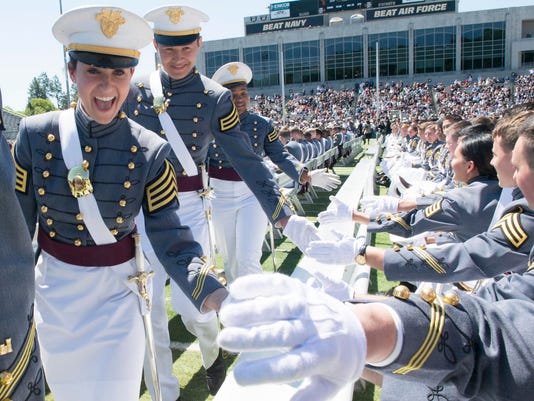
Defense Secretary Ash Carter met with several cadets during a visit to West Point on Wednesday. He acknowledged that pushing through personnel reforms has proven to be a challenge. (Photo: Mass Communication Specialist 1st Class Tim D. Godbee/Navy)

Yet the military is often instinctively resistant to change. Especially the senior-most leaders who, by definition, achieved success under the current rules. Carter's personnel office drew up a slate of ambitious reforms last summer. But that ran into stiff bureaucratic resistance. The Joint Chiefs of Staff recently debated the issue, but it remains unresolved.
After a meeting with cadets, Carter acknowledged that making such fundamental changes has proven to be a challenge.“There is [a consensus in the Pentagon] about some parts of them but we’re still exploring others,” Carter told a group of reporters during his visit to West Point on March 22. “People are still learning about these things. These things are complicated things when it comes to the management of people, so we really are careful to really think things through with all the services and the chiefs and look at our analysis and look at our surveys and make sure we have a basis for things.

“It’s important to act with resolve and not wait. But it is also important to do it thoughtfully,” he said.
Carter’s reform effort suffered a setback recently when his to personnel official, Brad Carson, who served as acting undersecretary for personnel and readiness, resigned. Carson will leave officially on April 8.

As architect of the controversial “Force of the Future” initiative, Carson faced a disastrous confirmation hearing on Capitol Hill in February. Senators accused him of presuming confirmation to his post and violating a once rarely enforced law that bars new appointees from serving in their high-level positions while awaiting the Senate’s formal approval.

Lawmakers also criticized the reform effort. Sen. John McCain, R-Ariz, called it “an outrageous waste of official time and resources.”

Congress would have to approve any changes in federal law, making support from Capitol Hill essential for any far-reaching military personnel reform.

Carter has made changes to Defense Department policy on matters that do not require approval form Congress. For example, he expanded the forcewide maternity-leave policy to 12 weeks in an effort to make the military more family friendly and retain female service members. He’s sought to expand internship programs that allow officers and senior enlisted troops to spend time working in the private sector. He’s also promised to modernize the services’ computer systems that maintain individuals’ personnel files and match them to specific jobs.

But the secretary has not formally asked for any changes to the laws affecting the up-or-out rules, the joint billet requirements or the military’s pay system, which he’s said should be changed from one-size-fits-all pay charts to one that is is influenced by "the principles of talent management."

Carter says he's working on more proposals. But time may be running short. He'll likely be forced out of office when a new president takes over the White House in January, and election-year politics make Congress unlikely to vote on any controversial reforms this year.

Carter spent a lot of time hearing from cadets during his visit to West Point. (Photo: MC1 Tim D. Godbees Communication Specialist 1st Class Tim D. Godbee/Navy)

At West Point, Carter heard directly from cadets who are eager for change. Cadet Wyatt Frazier, who is a “cow” or the academy’s equivalent of a college junior, spoke bluntly to Carter during the secretary’s question-and-answer session with students.
“As a younger generation of millennials enters the work force, American corporations are shifting towards a less-hierarchical and more-flat-and-casual organizational structure,” Frazier said. “What is the Department of Defense doing to stay competitive in this new work environment?”
Carter liked the question.
“We're making a lot of changes in the way we promote people and how we give you opportunities along the way, so we're not so rigid about, say, you have to punch this ticket and then punch that ticket, and then punch that ticket. And you find that all you're doing is punching tickets," Carter said.
That made sense to Cadet Eugene “EJ” Coleman, a cadet who will graduate this year and has chosen an Army career in field artillery, but plans to attend graduate school rather than follow the traditional path for a second lieutenant. He will study business or economics but has not yet decided what school to attend.
“One of my majors here is economics and this is one thing that we talk about a lot, the way the Army is fundamentally set up as compared to the private sector. [In the Army] there is a timeline, you have to do so many years in service to get to this point and that point and that point,” Coleman said.
“Is our system perfect for putting the right people in the right place? No system is perfect, but where can we look at that system and make it better?” Coleman said.
“This is an internal issue for the entire Department of Defense,” he said. The private sector has changed significantly in recent years and “we’d be foolish to think the Army doesn’t have to do the same,” he said.
Retention and recruiting are important. But Coleman suggested that the most urgent reason to change the military personnel system is to prevent the military world from diverging too much from civilians’ professional culture.
“It’s about making sure the United States military is not disconnected from the United States citizen. It’s important for us to revamp the way we do things.”

2016 Predictions: A Look Ahead at the Future of War

DECEMBER 21, 2015 BY PETER W. SINGER
ew America polled former Navy SEALs, Pentagon officials, technologists, historians — and here’s what they expect.
Imagine you had a time machine that could take you back to compare what people thought would happen in 2015 with what actually did occur.
Some of the events of the last year, like the Syrian rebel training programs falling apart, were utterly predictable. Others were deeply surprising; the scale of theOPM breach left U.S. cybersecurity experts, and also likely the attackers themselves, agape at the massive harvest of data. Still other events, such as Russia’s doubling down in Syria, were in fact predictable, yet surprising to too many. And, finally, other events, like the formal admission of women into combat roles, were not merely predictable, but belated.
If we had that time machine, though, we’d want to jump ahead, to see what lies in the future. The problem is that while we do have hoverboards that work in labs and as Christmas presents that catch on fire, the time machine that Hollywood promised us on Oct. 15 hasn’t yet arrived.
So instead, we turned to a group that ranges from former Navy SEALs and Pentagon officials to technologists and historians, and asked them: “Give one prediction for 2016 in the realm of national security and warfare.”
Let’s hope the good-news predictions are the ones that come true, and the bad-news ones merely prove the experts wrong.

A Thin Veneer of Great-Power Cooperation
The combination of American presidential campaign politics; increased terror attacks in the EU, U.S., Russia, and China; and forced coexistence in battle spaces such as Syria will generate an increased appearance of collaboration among the European Union, United States, Russia, and China. Such collaboration will, however, be exceedingly fragile and difficult to maintain. Especially between the United States, and both Russia and China, it will represent more of a change in tone: the structural conflict between a rising China and the U.S., and the fundamental differences in worldview and interests between the U.S. and Russia, are too deep for anything else. Moreover, it will not last past the exigencies that require it. Nonetheless, the veneer of civility and collaboration will create an opportunity to encourage and institutionalize deeper communication among the world’s major militaries, which will be seized, and will prove to be one of the few bright spots in an increasingly complex environment of global conflict. But such increased collaboration might also generate significant costs: consider what such a collaboration among nation-states might well look like from an Islamic perspective, especially given the rhetoric of the American presidential campaign to date and the inherent tendency of militant Islam to reject secular authorities (cue Clash of Civilizations).

27 March 2016

Where does the world’s food grow?

John McArthur and Krista Rasmussen | March 21, 2016 3:44pm

http://www.brookings.edu/blogs/future-development/posts/2016/03/21-agriculture-crop-shares-developing-world-mcarthur-rasmussen?utm_campaign=Brookings+Brief&utm_source=hs_email&utm_medium=email&utm_content=27638899&_hsenc=p2ANqtz-973SGOWeWvnGnEPpoevlEQKR--HATDtfSJhDm-4FlgihcDZ2Ia8eaJdK5ns_gHvBW2CQP6EqFZwAeVL7mQO8zlVCQ-7g&_hsmi=27638899

Developing countries are home to roughly 80 percent of the world’s population, 98 percent of humanity’s hungry people, and 78 percent of harvested croplands. Their farming systems have an essential role to play in addressing global food needs, ending extreme poverty, tackling climate change, protecting biodiversity, safeguarding water systems, and many other crucial challenges. But agriculture itself is a complex and vibrant sector, characterized by huge diversity. Therefore analysts and practitioners working on these big picture global issues can all benefit from a basic understanding of what the global distribution of crops actually looks like.
To that end, we recently worked together on a paper, “What does ‘agriculture’ mean today? Assessing old questions with new evidence,” which provides a simple overview of crop types around the developing world. The analysis draws from Food and Agriculture Organization (FAO) data for crops harvested across 140 low- and middle-income countries. Full data tables are also available for download here.

Below we highlight five basic insights:
1. Cereals are central in most (but not all) countries

Figure 1 illustrates the extent to which, across developing countries, cereals account for the largest share of area harvested, often the majority. Indeed 59 countries have more than half their cropland harvested to cereals. In some developing regions the category accounts for nearly two-thirds of harvested areas, including 65 percent in Europe and Central Asia and 64 percent in the Middle East and North Africa. However, there is regional variation. Cereals account for only 34 percent of area harvested in Latin America and the Caribbean. In some countries with large agricultural land areas, such as Argentina and Brazil, oil crops like soy are more prominent. 
Figure 1: Crop with largest share of area harvested, 2010


Source: Authors' calculations based on FAO data
2. The type of cereal grown is often tied to geography

Different plants grow in different places. This is a key reason why patterns of technology diffusion in agriculture are distinct from those in other economic sectors. Figure 2 shows clear geographic patterns for cereal crops. Wheat grows best in temperate environments and is prevalent in parts of Europe and Central Asia, but almost entirely absent in sub-Saharan Africa. Paddy rice flourishes in lowland tropical environments, as are found in much of South and Southeast Asia. Maize can grow in both temperate and tropical areas, although its germinating properties are highly place-specific. It grows commonly in Central America and also Southern and Eastern Africa. In the Sahelian region of Africa, other cereals like millet and sorghum are most prominent. 
Figure 2: Predominant Cereal, 2010

(where each accounts for at least 20 percent of area harvested)

Source: Authors' calculations based on FAO data

3. Only a minority of countries are major cash crop producers

*** Bosnia, Kosovo and Brussels

March 26, 2016

Summary: There is a deep connection between the end of the Cold War, the Yugoslav wars and the attacks in Brussels. They may appear separate but are deeply interconnected. The release of tensions between the United States and the Soviet Union triggered a seismic shift along the fault line of U.S. containment strategy that runs through the Middle East. These tremors are still playing out today.
Radovan Karadลพiฤ‡, former president of Republika Srpska, a Serbian enclave in Bosnia, was found guilty of genocide by a United Nations tribunal yesterday. He was accused of the deaths of more than 8,000 Bosnian Muslims in the 1990s. The date of his conviction, March 24, is also the 17th anniversary of the beginning of the NATO bombing campaign in Serbia that led to separation and independence of Kosovo from Serbia. It is also the week in which members of the Islamic Statecarried out an assault on Brussels. The three events are intimately connected.
The American strategy during the Cold War was to contain the Soviet Union. One part of the containment line ran through Europe. Another part, after the Sino-Soviet split, ran along the northern Chinese border. The third line ran from Yugoslavia to Afghanistan - through the Islamic world, with predominantly Muslim countries on each side of the line. The tremendous force of the Western alliance, China and the Soviet Union had frozen these boundaries into place. With the exception of Afghanistan later in the Cold War, this created a tense but coherent region. Various countries were in different alliances, and some in none, but on the whole the Cold War brought a relative stability to the region. The shifts that took place were managed by the great powers to limit their destabilizing effect along the line of confrontation.

When the Soviet Union collapsed and the line disappeared, three things happened. In Europe,Western-style democracies emerged in the former Warsaw Pact countries. In China, the People's Liberation Army and the Communist Party shifted their focus to economic development. And the line from Yugoslavia to Afghanistan destabilized. It did not destabilize all at once, or even quickly. But as the force field between the U.S. and the Soviets disappeared, the region regained its autonomy and destabilized. Put another way, the Muslim world destabilized, and Muslims confronted the Christian world that had shaped their map.
This began in Yugoslavia. Yugoslavia was a country invented after World War II, containing Muslims and Christians, with a wide range of bad memories about each other and therefore hostility. After World War II, Yugoslavia was frozen into place by two forces. One was the communist government of Josip Broz Tito, which submerged ethnic and religious difference under its government apparatus and security structure. The other force freezing Yugoslavia into place was the fact that, having come to power independent of the Soviets, Tito did not want to become a Soviet satellite. Therefore, Yugoslavia maintained a neutrality tilted mildly to the West. That stance froze Yugoslavia, as neither the U.S. nor the Soviets wanted to take the risk of shifting its orientation, and Tito did not want do anything to trigger a change in policy.

*** My Tagore

Alokeranjan Dasgupta
(Keynote address delivered at the Tagore Symposium at Darmstadt on the occasion of the Indian Festival in Germany, 1993.)
When my friend Lothar Lutze urged me to soliloquise on my Tagore, the immediate reflex that circled in my mind was to reverse the sequence of such an undertaking and dwell simply on Tagore's Me. For one thing, here is a man who tends to mould the very design of my Dasein, the niche of my innermost being and becoming. There is here a sort of pre-ordained determinism at work. It has often occurred to me, whilest pondering on my behaviourial responses to certain phenomenal stimuli, that it is Rabindranath Tagore's characteristic way of confronting reality that has invariably affected mine. It has struck me with a kind of shudder in those junctures of time that he, in an all-encompassing manner has been integrating, if not devouring, my biography. Someone who does not know Tagore could call this a kind of impinging on Tagore's part, in view of the fact that although he composed a few autobiographical fragments, he never took this form really seriously in the context of Art, for he maintained that a true poem transcends its materials and aptly compared a poem to 'A dewdrop which is a perfect integrity that has no filial memory of its parentage'.

Tagore's lingering distrust of the relevance of biographical details to any of his works could suffice to set the scene today here in Darmstadt, where 72 years ago, paradoxically, his legendary personality shone so luminously that his Art was totally lost sight of. Like many of the citizens of Darmstadt who were mesmerized during the Tagore-Woche 1921, I myself, in Bengal, also became vulnerable to the legend called Tagore in my childhood days at his Ashram, Santiniketan, and possibly considered his creative works rather secondary. Recently while reading Holger Pausch's Biographia Literaria of Paul Celan, a writer who, as a poet in and of exile, has loomed far larger in my life than Rabindranath Tagore, I chanced upon the author's laconic remark: Biografisches, Sekundares. Apparently, this condescension towards the biographical as something secondary bears some resemblance to Tagore's view-point. But while reading between the lines I found the author was doing this because most of the facts concerning Paul Celan's life are irretrievably lost and therefore he was inviting us to concentrate solely on his poetry, which reads like hieroglyphics.

Not so with Goethe and Tagore. Almanacs such as With Goethe throughout the year are revised every now and then to record each moment of his illustrious life. Similarly, hundreds of bibliographic documentations on Tagore are now and again rushed into print so that we are bound to learn by heart every item about his life. In itself, this is no heinous crime. But something is deliberately mistaken here. Quite a lot of sublimising and stylising ingredients are concocted to project him as greater than he was. Long ago Keats has taught us that greatness as such has nothing to do with poetry. But Bengali Tagore-biographers have always irritated me in their painstaking mission to glorify the otherwise great man with overhead projections in order to minimise the greatness of his poetry.

The Tagore euphoria, European or otherwise, has been aptly branded as 'Idolatrous' and 'Bardolatry' by Stephan Zweig and William Radice respectively. As a child I felt an easy prey to this kind of prismatic reception. As a boy of eight I caught glimpses of the mammoth mourning procession escorting Tagore's dead body from our south Calcutta flat, bitterly wept and felt obliged to register my elegiac reaction in a fragment of verse. The next morning I was put to shame when I saw that in most of the Bengali newspapers the funeral procession was depicted in flowing diction. I tore up my prosaic composition describing the death of a poet. That was 1941, the year when Rabindranath Tagore, James Joyce and Virginia Woolf passed away. Later on the other two names came to mean much to me and it was in an act of devotion to their geniuses that I dismissed the celestial hierarchy which gave Tagore a higher rank than the two others. But in those early days such an act would have been regarded as the worst possible sacrilege. In one sense I was lucky not to have experienced Tagore alive. For then I might have become completely immersed in him, bereft of all the contours of my own self, however small its dimension may be in relation to Tagore's.

Reliance Jio’s Much-Delayed Launch Suggests It Is Too Big To Move Fast

March 25, 2016
Ambani is taking a big gamble away in riskier and low-margin businesses in retail and telecom, both consumer facing businesses where success will not be easy.
While the risk-taking spirit of the Ambanis is not in doubt, it is worth asking if a group as big as Reliance can really be nimble.
The world over, being big is no longer a guarantee of success.
Two suggestions that can help Reliance:
Reliance should convert itself into a holding firm with investments in various businesses, with each one of them being separately listed. This is the Warren Buffett type of investing, with the promoter’s main job being capital allocation between competing businesses.
In order to insulate itself from disruptive technologies, Reliance needs to become an investor in other start-ups so that it can buy into a future Whatsapp or Facebook or even a Micromax.
Despite a rash of failures, small is the future of big business. It is not the humble cockroach that is extinct, but T-Rex.

If a report by Bank of America Merrill Lynch is right, the launch of Reliance Jio’s 4G services nationally may get delayed to December 2016. The fact that the public has not got even one whiff of the final product as yet (Mukesh Ambani said the product was being intensively tested inside the Reliance Group last December) lends credence to the suspicion that the Jio product is yet to find its final form.
At the Reliance annual general meeting in June 2015, Ambani said he was “glad to announce that the financial year 2016-17 will be the first full year of commercial operations for Jio.” Well, financial 2016-17 is just a week away, and we see no frenetic activity in opening up showrooms, purchase of advertising billboards, or anything suggestive of an early launch. The earlier expectation was that the service would at least be launched in a limited way by April.
So there is little reason to disbelieve the Bank of America Merrill Lynch report about a postponement to December. The report noted: “Despite completing an employee soft launch in December 2015, we do not yet have visibility on the timeline on commercial launch by Jio. In our recent meetings with industry participants, we found a consistent view coming out of risks of Jio launch being pushed to December 2016.”
Meanwhile, Jio’s rivals have hit the ground running, with Airtel rolling out 4G services in 350 cities, and Vodafone and Idea hitting the road with ambitious launch plans recently.
Has Reliance Jio goofed up on its second coming into telecom, after losing the first one to the group split, with brother Anil Ambani getting Reliance Communications?

Consider the negative cues.
#1: As far back as 2010, Reliance bought all-India spectrum in the 2,300 Mhz band. It paid Rs 4,800 crore to buy 95 percent in Infotel Broadband, which itself had bid over Rs 12,848 crore for 22 circles. Since 2010, this spectrum has been lying idle -a phenomenal waste of such a huge investment.

#2: Since the Infotel BWA (broadband wireless access) spectrum was obviously not going to do the job of Reliance Jio, which has huge ambitions in both voice and data, the company spent another fortune buying spectrum in the 1,800 Mhz and 800 Mhz bands at various telecom auctions. Ambani said last June at his AGM: “In addition to the existing pan-India 2,300 Mhz spectrum and 1,800 Mhz in 14 circles, Jio invested over Rs 10,000 crore during this year’s auction to acquire 800 Mhz spectrum in 10 circles and 1,800 Mhz spectrum in six circles. This brings our cumulative investment in spectrum assets to nearly Rs 34,000 crore. Jio now has the largest footprint of liberalised spectrum in the country, acquired in an extremely cost-effective manner.” So much of idle spectrum for so many years can hardly be called “cost-effective.”

#3: Even in its first coming, when Ambani launched Reliance Infocomm (Anil Ambani changed the name to RCom after he got it as part of the asset division among the brothers), he had made the wrong call on technology. He chose the spectrum-efficient CDMA instead of the universal GSM. Anil Ambani had to opt for a dual-tech licence, and his growth has been in GSM.

#4: In the process of diversifying away from its core oil-petroleum-petrochemicals-plastics business, Reliance has converted itself from a zero-net-debt company to a relatively debt-financed company. As at the end of December 2015, Reliance Industries had net debts of Rs 86,341 crore, with overall debts of Rs 1,78,077 crore being partly balanced a bit by cash and cash equivalent assets of Rs 91,736 crore. It is more than likely that much of this debt is due to Reliance Jio, where the company plans to spend nearly Rs 1,00,000 crore, with three-quarters of it already spent, an Economic Times report of July 2015 said.

Why We Are Losing The War On Privacy; Aadhaar At Least Gives Us A Figleaf

http://swarajyamag.com/ideas/why-we-are-losing-the-war-on-privacy-aadhaar-at-least-gives-us-a-figleaf
R Jagannathan, March 22, 2016
We have lost the battle for privacy – both to government and private parties.
Big brothers will be watching over us now, and one can only hope our privacy will not be compromised to a level where it hurts us.
On the brighter side, the big brother may occasionally protect us from the jihadi suicide-bombers.
Whether we like it or not, citizens are steadily losing the battle for privacy. A brave Tim Cook, CEO of Apple, has said ‘no’ to the US Federal Bureau of Investigation’s request to take a peek at the encrypted iPhone used by a terrorist, Syed Farook, who killed 14 people in San Bernardino, California, and was himself killed in the shootout.
The case will be argued in court, and will, surely be appealed repeatedly till it reaches a conclusion in the highest court. The chances are Apple will ultimately lose the appeal, especially when terrorism has shown no signs of abating. Even if it wins, it would have won a battle, not the war. The war is heading in the other direction.
If Apple can’t win this war, India can’t either, but we must thank the NDA government for small mercies. Last week the government legislated the Aadhaar (Targeted Delivery of Financial and Other Subsidies, Benefits and Services) Bill 2016, which – for the first time – mandates a modicum of privacy for the data gathered by the Unique Identification Authority of India (UIDAI).
Nearly a billion Indians – men, women and even children – have shared biometric data with the UIDAI. Under the new law, this data will not be shared with anyone, including the Aadhaar recipient, and only national security can be a reason for forcing UIDAI to share it with the law enforcement agencies, and that too after proper vetting by responsible officials.
This is a darn sight better than what the UPA did, which simply pushed ahead with collecting private data without any legislation – effectively making the Aadhaar effort partly illegal. The NDA law at least gives Aadhaar a post facto legal basis for directing subsidies to the right beneficiaries.
Given our scant respect for the law – any law – it is quite possible that in actual practice the privacy protections guaranteed by the legislation may be breached. If someone high up (say, a top cop, or someone in the PMO or the CMO) asks for data, the system may still oblige even without formal authorisations. Remember how the Radia tapes got leaked to the media? But overall it is clear that there is some legal protection for the privacy of citizens.

The problem though emanates elsewhere, and the Apple case in the US illustrates this very well. In its fight with the FBI, Apple has only declined to share information stored on the terrorist’s iPhone (which is encrypted), but the company still provides anti-terror investigators lots of info on email, pictures, and other data stored on its iCloud servers. In other words, the fight is only about data stored in the iPhone device, not all the data Apple stores. This is like putting your finger in the dyke.
Even though other tech giants – Google, Facebook, and Microsoft, who like to encrypt their services and devices - have weighed in on Apple’s side, the companies have effectively bartered away their data to police forces all over the world. Blackberry, which tried hard to restrict access in India and the rest of the world, ultimately caved in as pressure from governments has proved insurmountable. They have already compromised privacy to a large extent.

Beyond Pakistan’s Claims to Have Caught a ‘RAW Agent’ Lies a Wilderness of Mirrors

http://thewire.in/2016/03/26/beyond-pakistans-claims-to-have-caught-a-raw-agent-lies-a-wilderness-of-mirrors-26116/
If we work with the assumption that Jadhav is indeed an Indian intelligence officer, there are several possibilities here
Let us dispose of the notion that India does not carry out covert operations against Pakistan. New Delhi has, at least since 1990, refused to use the instrumentality of terrorism to hit back at Pakistan, but you can be sure that – short of terrorist acts – it employs all the weapons available in the covert arsenal for both defence and offence. This is the least you can expect, given Pakistan considers India its primary adversary and is into all kinds of activity ranging from ordinary espionage, to subversion of currency, promoting separatism and supporting terrorism.
India has important strategic interests in Pakistan, including in the Balochistan region. Balochistan is of interest principally because of the stepped up naval activities of the Chinese in Gwadar and the plans for the China-Pakistan Economic Corridor.
For the past two decades, India has made no secret of its activities in Iranian Balochistan. It has sought to develop the port of Chabahar for alternative routes to Afghanistan and Central Asia. It has used its consulate in Zahedan, which is near the Pakistan border, to keep an eye on Pakistani activity there and support Indian interests. All this is done, of course, under the watchful eyes of the Iranian authorities who, no doubt, have their red-lines on what the Indians can do and what they cannot.
Looking at the case of Commander (retired) Kulbhushan Jadhav, the arrested India man that Pakistan says is a ‘RAW officer’, it is worthwhile recalling the legendary CIA counter-intelligence officer James Jesus Angleton’s description of intelligence craft as “a wilderness of mirrors.” Finding out where the truth lies is next to impossible, and reality is what you want to believe.
At first sight, the facts of the case are fairly straightforward.

On Thursday, local media in Pakistan reported that its security forces had arrested “a serving officer in the Indian navy and deputed to the intelligence agency Research & Analysis Wing (RAW)” in Balochistan. Subsequently, Dawn reported Balochistan home minister Mir Sarfaraz Bugti as saying that “an Indian spy” was arrested in the southern part of the province.
On Friday, the Pakistan foreign office summoned Indian high commissioner Gautam Bambawale to protest what it claimed was the “subversive activities” of a “RAW officer.”
In a statement, the Pakistan foreign office said: “The Indian high commissioner was summoned by the foreign secretary today, and through a dรฉmarche (we) conveyed our protest and deep concern on the illegal entry into Pakistan by a RAW officer. And his involvement in subversive activities in Balochistan and Karachi.”
Later on Friday, the official spokesman of the Ministry of External Affairs, Vikas Swarup told reporters that the “said individual has no link with the government since his premature retirement from the Indian navy.” Indian diplomats in Pakistan had sought consular access, he said, adding that “India has no interest in interfering in the internal matters of any country and firmly believes that a stable and peaceful Pakistan is in the interest of all in the region.”
Pakistan’s Dunya News channel said that Jadhav had been arrested from the Chaman area of Balochistan, that his address in Mumbai was No 502B Silver Oak, Powai, Hiranandani Gardens and that he had a passport no. L9630722, with a valid Iranian visa made out in the name of Hussein Mubarak Patel. The channel said that Jadhav had joined RAW in 2013 and was initially based in Chabahar, the port in Iran which India is helping to develop.

The Great Whitewash By the Ministry of Defence LT GENERAL P.C.KATOCH The Great Whitewash By the Ministry of Defence

http://www.thecitizen.in/index.php/NewsDetail/index/1/7234/The-Great-Whitewash-By-the-Ministry-of-Defence
Lt GENERAL P.C.KATOCH, Friday, March 25,2016
NEW DELHI: During a press conference on March 4, Defence Minister Manohar Parrikar made a startling announcement, revealing he had discovered India was paying the US Department of Defence (DoD) for new weaponry, even though US$ 3 billion which had been earlier paid by MoD was piled up and lying forgotten in a Washington account. 
Despite Parrikar stating this at a press briefing, the issue curiously didn’t find mention in national dailies. MoD had reportedly put the said money in a Pentagon account for weaponry that was to be bought under the Foreign Military Sales (FMS) agreement. This is the shortest way of procuring weaponry from the US under which the DoD procures equipment on behalf of the foreign government from US vendors. The US opened up FMS sales to India in the immediate aftermath of the 9/11 terrorist attacks. 
It is unclear when the money was paid by MoD but if it was piling up in Washington, it obviously was paid over a period of years. 
US$ 3 billion is not a small amount considering that in rupees today it amounts to some Rs 20,100 crores. How could it be “forgotten” if FMS procurements are supposed to be in quick time? Isn’t it intriguing that such a large amount lying unspent and earning interest money for the US was not once pointed out by the Comptroller and Auditor General (CAG)? 
Of course if the CAG is a former Defence Secretary who himself was party to such stashing away of defence money in his former avatar, he obviously would remain mum. 

It certainly raises a stink that needs to be thoroughly investigated by the CBI. What military modernization could have been done with US$ 3 billion can be gauged from the fact that INS Vikrant, India’s indigenously built aircraft carrier launched in August 2013 was at a cost of US$ 7.7 billion. 
Parrikar referred to the lapse as “because of ill-management or lack of attention to this account”. Did this comment indicate a lid was to be put on the issue in the exuberance of this new find of forgotten billions? 
With reference to the above, the Press Information Bureau (PIB) has now come out with a statement which says MoD has fine-tuned FMS procedure with the US Government where all the bills have been pooled together in a corpus; so for contractual obligations the said amount is being withdrawn from the corpus - payment is being effected from the corpus of 2.3 billion US Dollars. 
The PIB release adds, “This has happened through scrupulous and holistic financial management. Consequently, while US government will continue to meet their contractual obligations, there will be no additional burden on Government of India on this account”. 
But under what regulations does MoD have the mandate of creating a corpus abroad to the tune of billions of dollars, especially when Parrikar clarified on March 4 that this $3 billion stash was not earning any interest for India. 
If , as the Defence Minister refers in an open forum, the lapse was “because of ill-management or lack of attention to this account”, without doubt it is ill-management because such an amount can’t simply be forgotten”. 
On the contrary this was most likely a willful act. It does seem that billions of dollars accumulated like this over years with the CAG not pointing out the lapse could have ulterior motives? What if it was “forgotten” for a few more years? The question also arises whether there are more such stashes abroad, a possibility which exists with CAGs failing to point this out even once. 

Nexter Submitted Final Offer for Indian Artillery

Pierre Tran, Defense News, March 23, 2016 
RIS — Nexter submitted on Feb. 15 its final bid in an Indian tender for a €1 billion ($1.1 billion) contract for 1,400 155mm towed cannons, Stรฉphane Mayer, chairman of the land armaments company, told a parliamentary committee. 
“We submitted our final offer Feb. 15,” Mayer told the National Assembly defense committee on March 2. The competition, worth €1 billion and the largest for land weapons, will yield “the contract of the century for artillery,” he said. 
Indian authorities have set final selection between the two bidders by the end of the year, to allow for exclusive negotiations, he said. 
Nexter has teamed with local partner Larsen & Toubro to pitch its Trajan 155mm/52 caliber gun against Elbit Systems, partnered with Bharat Forge. 
The French state-owned company is also pitching its Caesar 155mm/52 caliber cannon in a second Indian tender for 800 truck-mounted guns, with a bid due in 2018, Mayer said. That Indian project compares to 77 units delivered to the French Army. 
The Indian defense acquisition council approved in November 2014 a budget of $2.5 billion for 814 of truck-mounted artillery, dubbed mounted gun system. 
“Experience has shown in India, patience is very much needed in general, and in defense in particular, and the delays are not rare,” Mayer said. 
On the truck-mounted gun, Nexter has teamed with Larsen & Toubro and Ashok Leyland, with the latter for the truck chassis. 
For Qatar’s tender for 300 infantry fighting vehicles, Nexter has given demonstration trials with its vรฉhicule blindรฉ de combat et infanterie, with a heavier gun than the weapon fitted on the French Army VBCI, he said. 
Nexter and BAE Systems are partners on the 50-50 joint venture, CTA International, which builds the 40mm cased telescoped cannon. 

Nexter also has made pitches to Egypt, Mayer said, without further detail. The Middle East is a “consuming region” for defense equipment, he said. 
“That is a euphemism,” said Member of Parliament Charles de La Verpilliรจre. 
Any order for the Army would follow Egypt’s recent moves on modernizing the Air Force and Navy, which are re-equipping with the Rafale fighter, a multimission frigate and four corvettes, with two more on option. 
In Europe, the land weapons company last year sold cannons worth some €100 million to BAE, and expects a British requirement in 2018 for 300 to 400 infantry fighting vehicles, Mayer said. Nexter has given a demonstration for Norway, which is looking to order artillery, while Denmark and Finland also seek new cannons. 

The company struck its first sale in Africa with a deal with Gabon, he said. 
Nexter said October 2014 it signed a contract for 12 Aravis four-wheel drive vehicles armed with a 20mm gun. 
On the difference in German and French arms export rules, the two governments are in talks on updating the 1972 Debrรฉ-Schmidt bilateral agreement on foreign sales, but that has been disappointing. 
“I have to say the intergovernmental discussions — necessarily long — have not so far led to amendments that meet our expectations,” Mayer said. 
Those changes are seen as key as Nexter has formed a 50-50 joint venture with Krauss-Maffei Wegmann, to share technology to build a future tank for France and Germany by 2030 and cooperate in the pursuit of foreign markets, he said. 

*Map of The Week: North Korea in the Dark

March 26, 2016 
By George Friedman 
Is living in the dark North Korea's sacrifice for developing nuclear weapons, or does it demonstrate incapability? 

Dear Friend,
Geopolitics begins with maps and maps tell extraordinary stories. The map above is the Korean peninsula taken from space, showing ground illumination—lights. Notice the bright lights in South Korea, the sparser lighting in China. Then look at the darkness in North Korea. That map tells you more about the reality of North Korea than all the doctoral dissertations in the world. North Korea appears pre-electric. We have a nuclear power whose night is as dark as the Middle Ages. 

America Must Embrace New Silk Road As Its Own If It Is to Survive this Financial and Cultural Meltdown

https://larouchepac.com/20160323/america-must-embrace-new-silk-road-its-own-if-it-survive-financial-and-cultural-meltdown

The Bering Strait bridge, connecting a mere 65 km separating the North American continent from Eurasia.
The reality of the collapse of the entire western financial system is no more clearly expressed than in the discussion now dominating the leading banking circles across Europe and the US—to adopt "helicopter money" as the next stage of insanity in dealing with the bankruptcy of the system. An idea introduced by economic fascist Milton Friedman, and promoted by former Fed Chairman Ben Bernanke, helicopter money entails the central banks by-passing the banks altogether, and simply printing money for the governments, or even for businesses and private citizens. 
Insane? Of course—and those few leading bankers who have retained an ounce of sanity are admitting it. Otmar Issing, the former chief economist at the European Central Bank (whose current chief Mario Draghi announced this month that it will increase the QE printing of money for the banks from 60 to 80 billion euros every month, and reduce interest rates to negative!) today told the German Press Agency that this discussion was simply a declaration of bankruptcy."I see the entire idea of helicopter money as worrisome, even devastating," Issing said. "For it is nothing else than a bankruptcy declaration of monetary policy.... A central bank that is throwing out money for free, will hardly be able to regain control of the printing-press.... I view that as a total mental disarray." 
Yet the American and European populations have been so beaten down and terrified that they tolerate this madness. As the American population is driven into massive drug addiction, demoralization and escalating numbers of suicides, people say, "Yes, but—I didn't cause that and there is nothing I can do." 

That is both false and cowardly. What can and must be done was demonstrated today in Frankfurt, Germany, where scientists and engineers and citizens from across Europe and Africa met with Schiller Institute founder Helga Zepp-LaRouche to discuss "Solving the Economic and Refugee Crises with the New Silk Road!" It was also demonstrated in Texas, where LaRouchePAC leader Kesha Rogers intervened in a demoralized meeting of NASA scientists who were resigned to living within Obama's collapsing NASA budget. Rogers revived their spirits by addressing the cause of the crisis in the collapse of the financial system, which can and must be replaced, and in Obama himself, who can and must be removed from office—now, not next year. It was even demonstrated in war-torn Yemen, where a friend of LaRouche released the recently translated Arabic version of the EIR Special Report The New Silk Road Becomes the World Land-Bridge, introduced enthusiastically by the former President of Sana'a University. 
Backing up this effort stand China and Russia. Secretary Kerry is in Moscow, where he is meeting with Foreign Minister Lavrov and President Putin, continuing to carry on real diplomacy outside of the control of the White House, to end the terrorist threat in Syria and beyond. In China, Premier Li Keqiang brought the leaders of the Mekong nations together to launch the Silk Road process along the Mekong—a policy promoted by Franklin Roosevelt in the 1930s, modeled on his TVA project, but which has been systematically sabotaged from any significant progress over these past 80 years under the influence of the World Bank and the Asian Development Bank. China will now sidestep that sabotage and help these national launch real development, as they are across the world. 

Americans and Europeans are beginning to recognize, although far too slowly, that the hysterical effort to present Russia and China as enemies, and that we must prepare for war, is both suicidal for the human race, and the opposite of the truth. China and Russia and the BRICS nations are offering a life-line of a scientific and cultural Renaissance to a dying culture in the West. Are we human enough to get on board?

The seminar, "Solving the Economic and Refugee Crises with the New Silk Road!" organized by EIR in cooperation with the Consulate General of Ethiopia in Frankfurt, was attended by an audience of 75, consisting of representatives of several diplomatic offices, of subscribers and contacts of EIR in the region, and about 10 Syrians (students as well as refugees waiting for enrollment at universities). Several contacts even came from as far away as Berlin, and cities in Switzerland. Extending over the entire afternoon, the seminar featured presentations by Helga Zepp-LaRouche, chairwoman of the Schiller Institute; Hussein Askary, EIR Arabic Editor, Stockholm; Mehreteab Mulugeta Haile, Consul General Federal Democratic Republic of Ethiopia; Marcello Vichi, former Director, Foreign Department Bonifica company, author of the Transaqua concept; Andrea Mangano, Vice President, Italian Association of Water Engineers and contributor to the Transaqua outline. The speakers were joined by Mohammed Bila, Lake Chad Basin Commission, and Ulf Sandmark, Schiller Institute Stockholm and Swedish-Syrian Committee for Democracy, for an expanded panel in the second part of the seminar. The seminar was moderated by Claudio Celani of the EIR's European center in Wiesbaden.

In her keynote, Helga Zepp-LaRouche stressed that this would not be an academic seminar but rather a discussion about the fact that in this existential crisis of mankind, shown by the refugee crisis, the wars and the financial crash, solutions are within reach and must be realized now. In the wake of the terror attacks in Brussels yesterday, it is more than appropriate to recall former U.S. Senator Bob Graham's statement of mid-November last year after the terror attacks in Paris then, that had the classified 28 pages of the Joint Congressional Inquiry into 9/11 been made public, such atrocities could and would have been prevented.

Back Into Afghanistan?

http://www.nationalinterest.org/feature/back-afghanistan-15597?page=show
It's time to stop throwing good money after bad.
Gerald F. Hyman, March 25, 2016 
The eroding political and security dominion of the government of Afghanistan has once again raised the potential of increased U.S. military and civilian assistance. President Obama made the complete withdrawal of U.S. military forces by the end of 2016 a central premise of his policy toward Afghanistan, but on the advice of his military and civilian staffs, he has modified that target. The new one is 9,800 troops through most of 2016, and 5,500 by the effective conclusion of his term. Moreover, he curbed the mission of these remaining troops to training and assisting the Afghan National Defense and Security Forces (ANDSF) and to counterterrorism.
However, the Pentagon’s fourth-quarter assessment of security in Afghanistannoted that “[through] the second half of 2015, the overall security situation in Afghanistan deteriorated with an increase in effective insurgent attacks and higher [ANDSF] and Taliban casualties.” Indeed, the September collapse of the ANDSF and the civilian government in Kunduz, previously safely in government hands, and its stunning (if only temporary) capture by the Taliban, shocked Kabul to the core. Retaking it became the government’s highest priority, and the city proper was recaptured in a concerted military effort days later, although the surrounding provincial countryside remains contested.

Similarly, Badakhshan province, also securely in government hands a few years ago, is now also contested. So, too, are Faryab and Uruzgan. Helmand Province, the traditional home of the Taliban, has been almost entirely lost; only three of its fourteen districts remain under government control, at best, and its provincial capital is surrounded. Likewise Kandahar, the Taliban’s “capital,” remains (optimistically) disputed.
Meanwhile, over 1,800 Afghan soldiers and police were killed in the first third of 2015 and another 3,400 were wounded, almost 66 percent more than the previous year. Most troublingly, out of near desperation, the government is turning for security to the same marauding warlords and private militias it pledged previously to crush.
The insurgency is now also divided between the Taliban and Daesh, that is, Islamic State. The Taliban are now, unexpectedly, the relative moderates, but they have had their own internal splits since the death of Mullah Muhammad Omar. Although Daesh has enjoyed only limited inroads so far, it has considerable momentum, much of it at the Taliban’s expense. More importantly, perhaps, Daesh redefines an insurgency pole pulling the Taliban in more fundamentalist and rejectionist directions, and probably narrowing the limits for any negotiated settlement to which the Taliban can agree and commit.

Pakistan's General problem

~ Mohammad Hanif...

What is the last thing you say to your best general when ordering him into a do-or-die mission? A prayer maybe, if you are religiously inclined. A short lecture, underlining the importance of the mission, if you want to keep it businesslike. Or maybe you’ll wish him good luck accompanied by a clicking of the heels and a final salute.
On the night of 5 July 1977 as Operation Fair Play, meant to topple Zulfiqar Ali Bhutto’s elected government, was about to commence, then Army Chief General Zia ul Haq took aside his right-hand man and Corps Commander of 10th Corps Lieutenant General Faiz Ali Chishti and whispered to him: “Murshid, marwa na daina.” (Guru, don’t get us killed.)

General Zia was indulging in two of his favourite pastimes: spreading his paranoia amongst those around him and sucking up to a junior officer he needed to do his dirty work. General Zia had a talent for that; he could make his juniors feel as if they were indispensable to the running of this world. And he could make his seniors feel like proper gods, as Bhutto found out to his cost.
General Faiz Ali Chishti’s troops didn’t face any resistance that night; not a single shot was fired, and like all military coups in Pakistan, this was also dubbed a ‘bloodless coup’. There was a lot of bloodshed, though, in the following years—in military-managed dungeons, as pro-democracy students were butchered at Thori gate in interior Sindh, hundreds of shoppers were blown up in Karachi’s Bohri Bazar, in Rawalpindi people didn’t even have to leave their houses to get killed as the Army’s ammunition depot blew up raining missiles on a whole city, and finally at Basti Laal Kamal near Bahawalpur, where a plane exploded killing General Zia and most of the Pakistan Army’s high command. General Faiz Ali Chishti had nothing to do with this, of course. General Zia had managed to force his murshid into retirement soon after coming to power. Chishti had started to take that term of endearment—murshid—a bit too seriously and dictators can’t stand anyone who thinks of himself as a kingmaker.

Thirty-four years on, Pakistan is a society divided at many levels. There are those who insist on tracing our history to a certain September day in 2001, and there are those who insist that this country came into being the day the first Muslim landed on the Subcontinent. There are laptop jihadis, liberal fascist and fair-weather revolutionaries. There are Balochi freedom fighters up in the mountains and bullet-riddled bodies of young political activists in obscure Baloch towns. And, of course, there are the members of civil society with a permanent glow around their faces from all the candle-light vigils. All these factions may not agree on anything but there is consensus on one point: General Zia’s coup was a bad idea. When was the last time anyone heard Nawaz Sharif or any of Zia’s numerous protรฉgรฉs thump their chest and say, yes, we need another Zia? When did you see a Pakistan military commander who stood on Zia’s grave and vowed to continue his mission?
It might have taken Pakistanis 34 years to reach this consensus but we finally agree that General Zia’s domestic and foreign policies didn’t do us any good. It brought us automatic weapons, heroin and sectarianism; it also made fortunes for those who dealt in these commodities. And it turned Pakistan into an international jihadi tourist resort.

Don't Ignore the Threat of Nuclear Terrorism

http://www.nationalinterest.org/feature/dont-ignore-the-threat-nuclear-terrorism-15598
The chaos following an attack would be global.
Togzhan Kassenova, March 25, 2016 
Just in time for the annual appearance of cherry blossoms, fifty-two heads of state will come to Washington to discuss nuclear security. The fourth and finalNuclear Security Summit, launched by President Barack Obama in 2010, will take stock of the progress made in securing vulnerable nuclear material over the last six years.
Thanks to the summit process, nuclear security, which was previously relegated to small groups of mainly Western bureaucrats and nuclear nerds, has become a prominent issue on the international stage. Major media outlets cover it, governments around the world have been forced to learn about it and greater understanding exists of why protecting nuclear material is critical to international security.
Despite the buzz that these regular meetings of heads of states have generated, many states around the world and their citizens still do not consider nuclear security a relevant concern. The message the Nuclear Security Summit is promoting—that nuclear or high-risk radiological material might end up in the wrong hands and used in a bomb—just doesn’t resonate.

Why is this so?
Many in non-Western countries simply think the threat of nuclear terrorism does not apply to them. They see nuclear security as a preoccupation of advanced Western countries that consider themselves potential targets of nuclear terrorism.
Semantics matters, and how we talk about the risks of nuclear terrorism contributes to these perceptions. The discourse on nuclear security focuses disproportionately on the West. For example, whenever those who care about nuclear security make their argument, they usually say something like: “Imagine a nuclear bomb detonating in Manhattan, London or Paris…” Common threat scenarios involve Western targets, and therefore make the problem seem like a Western one.
Further, divergent views on nuclear security are undergirded by tensions in the broader nuclear realm. Many countries without nuclear weapons or military nuclear materials are reluctant to embrace the idea that the nuclear security regime needs strengthening. States with nuclear weapons have prevented the Nuclear Security Summit from addressing the security of nuclear material in military stockpiles, which constitutes more than 80 percent of all global stockpiles of fissile material.

John McCain: Salute to a Communist

http://mobile.nytimes.com/2016/03/25/opinion/john-mccain-salute-to-a-communist.html?_r=2

“For Whom the Bell Tolls” was my favorite novel, and its hero, Robert Jordan, my literary idol. Like him, Delmer Berg fought in Spain, for love.
By JOHN MCCAIN, MARCH 24, 2016
AN interesting obituary appeared in The New York Times recently, though the death of its subject last month was largely unnoticed beyond his family and friends.
That’s not surprising. Delmer Berg wasn’t a celebrity. He wasn’t someone with great wealth or influence. He had never held public office. He was a Californian. He worked as a farmhand and stonemason. He did some union organizing. He was vice president of his local N.A.A.C.P. chapter. He protested against the Vietnam War and nuclear weapons. He joined the United States Communist Party in 1943, and, according to The Times, he remained an “unreconstructed Communist” for the rest of his life. He was 100.

He was also the last known living veteran of the Abraham Lincoln Brigade.
Not many Americans younger than 70 know much about the Lincoln Brigade. It became the designation given to the nearly 3,000 mostly American volunteers who fought in the Spanish Civil War in 1937 and 1938. They fought on the Republican side, in defense of the democratically elected leftist government of Spain, and against the Nationalists, the military rebels led by Gen. Francisco Franco.
The Nationalists claimed their cause was anti-Communism and the restoration of the monarchy, and the Republicans professed to fight for the preservation of democracy. Fascists led the former, while Communists, both the cynical and naรฏve varieties, sought control of the latter. And into the Republican camp came idealistic freedom fighters from abroad.
The Lincoln Brigade was originally called a battalion, one of several volunteer units that were part of the International Brigades, the name given the tens of thousands of foreign volunteers who came from dozens of countries, and were organized and largely led by the Comintern, the international Communist organization controlled by the Soviets. Franco’s Nationalists were supported by Nazi Germany and Mussolini’s Italy.

Radicalised And Nuclear Armed Pakistan Is More Dangerous Than Iran Or North Korea

http://swarajyamag.com/world/radicalised-and-nuclear-armed-pakistan-is-more-dangerous-than-iran-or-north-korea
Mohamed Zeeshan March 22, 2016

Pakistan has neither the strong state machinery of North Korea nor the middle class revolution of Iran, thereby making Islamabad less easy to control.
Even Pakistan’s army has started to lose its cadre to radical Islamist propaganda, thereby increasing chances of defection among soldiers.
Pakistan is ridden with radical groups, engaged in mutual one-upmanship, and the entry of ISIS affiliates has only worsened the instability.
News around global nuclear proliferation in recent days has largely surrounded North Korea, whose nuclear missile tests horrified the international community earlier this year. But a recent report by the Harvard Kennedy School says that there is in fact a far graver threat to the world than North Korea or Iran.
“Overall, the risk of nuclear theft in Pakistan appears to be high,” the Kennedy School report said, under the title ‘Preventing Nuclear Terrorism: Continuous Improvement or Dangerous Decline?’ The report blamed Pakistan’s recent shifts toward tactical nuclear weapons for the heightened threat of nuclear theft.

This isn’t the first time fears have been raised around the security of Pakistan’s nuclear establishment. Last week, the US Under Secretary of State for Arms Control and International Security, Rose Gottemoeller, told the Senate Foreign Relations Committee that Pakistan’s deployment of battlefield nuclear weapons was a cause for concern. “Battlefield nuclear weapons, by their very nature, pose security threat,” Gottemoeller said, “because you’re taking battlefield nuclear weapons out to the field where, as a necessity, they cannot be made as secure.”
Pakistan’s nuclear arsenal does, in fact, deserve greater global attention than North Korea’s – or Iran’s non-existent one. Neither North Korea nor Iran face the dangers that challenge the security of Pakistan’s nuclear installments. For all of Kim Jong-un’s recurrent antics, North Korea is still a strong, centralized state, with no threats posed to the dictator’s hold on power – or his control over the country’s nuclear arsenal.
In Iran, an increasingly vocal middle class, led by President Hassan Rouhani, has begun to ensure that Tehran is unlikely to turn trigger-happy any time soon, least of all once the economy begins to integrate itself with the rest of the world.
But none of this is true in the case of Pakistan. Pakistan’s state machinery has been weakened significantly over time, owing to the prolonged battle for power between the civilian government and the military establishment. Prime Minister Nawaz Sharif’s control over his country’s nuclear arsenal is highly debatable. Buteven the Pakistani army is not quite as strong an institution as many would think.

Americans Say Terrorism Is The Top Threat To Their Nation

by Felix Richter, Statista.com
-- this post authored by Niall McCarthy
A Gallup survey conducted earlier this year reveals that Americans still consider international terrorism the top threat to their nation. A total of 79 percent of respondents indentified international terrorism as a critical threat, with Iran's nuclear weapons program in second place despite last year's deal.
Interestingly, a new and more modern threat appears in third place. This was the first year where Gallup asked people about the threat from cyberterrorism and 73 percent of them considered it a critical threat.

This chart shows the most critical threats to the US over the next decade, as cited by US adults in 2016.