18 August 2016

The Pentagon Needs You To Help Them Take Down Small Drones

http://www.defenseone.com/technology/2016/08/pentagon-needs-you-help-them-take-down-small-drones/130727/?oref=d_brief_nl
BY PATRICK TUCKER
AUGUST 12, 2016

As tiny drones proliferate and make their way onto the battlefield, the Pentagon calls for solutions.
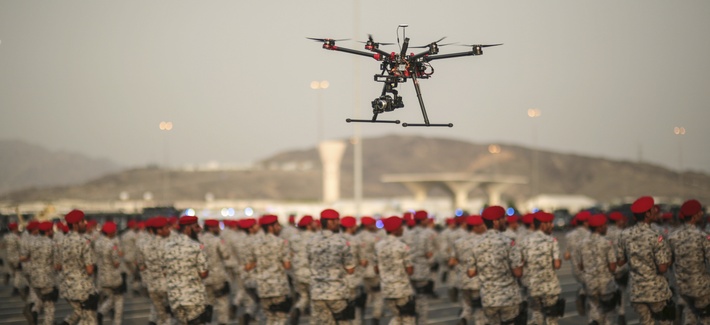
The FAA isn’t the only government body worried about the harm that small drones could cause. On Thursday, the Defense Advanced Research Projects Agency, or DARPA, released a request for information for new measures to defeat small UAVs, which, they say, are “creating new asymmetric threats for warfighters.”
Small “UASs’ size and low cost enable novel concepts of employment, which present challenges to our current defense systems,” according to the request.

DARPA is looking for technology to “detect, identify, track, and neutralize these systems on the move, on a compressed timeline, and while mitigating collateral damage and providing flexibility to operations in multiple mission environments.”
More than a few technologies exist to counter drone threats, but jamming can pose a threat to nearby electrical and computer equipment. One of the more interesting solutions so far comes out of Japan where Tokyo police are deploying drones armed with nets to capture other drones.
By itself, most small drones don’t pose a great danger but they can easily be modified with a variety of payloads. Pro-Russian forces fighting in Ukraine use drones to spot and target enemypositions. Last August, a group of hackers at DEF CON unveiled asmall garage-built drone that flies around looking for vulnerabilities in computer networks.

Isreali Aerospace Industries markets something that they call amulti-rotor loitering munition for ground forces, basically a quadcopter with a bomb strapped to it that hovers in the air until the operator decides to kill someone with it. Hamas and Hezbollah’s use of small drones goes back to 2004. ISIS, too, is experimenting with small intelligence drones (and possibly armed ones as well). In July, the Pentagon switched $20 milliontoward a new anti-drone effort.

Any drone under 55 lbs is considered small by FAA standards. The agency projects that more than seven million small UAVs could cloud America’s skies by the year 2020. The development community for small drones is also growing rapidly, bolstered by trends in 3D printing and tiny off-the-shelf computer systems like the Raspberry Pi. Anybody with an internet connection can create their own drone at minimal cost. As large as seven million sounds, the figure might be woefully conservative.

Leaked report reveals Russian battlefield cyber-weapons

http://www.scmagazineuk.com/leaked-report-reveals-russian-battlefield-cyber-weapons/article/516009/
August 15, 2016
The tactical dimension of cyber-warfare has not often been publically explored (credit: Government.ru)
A new report has presented some stark findings about the UK's cyber-readiness for modern war. A document, entitled Insights to “Training Smarter” Against a Hybrid Adversary, and seen by the Times aims to teach armed forces how to fight against a new kind of adversary.
Among its more shocking conclusions is that Russia ‘outguns' the UK army on the battlefield. Not only does Russia outspend the UK in defence by a little over £10 billion but has been preparing for an entirely different war. While UK forces have been training and investing in counter-insurgency, Russia has been preparing for war with NATO, and returning to the old state-on-state vision of warfare.

The report was written under the guidance of the UK army's head, General Sir Nick Carter, and sought to learn new lessons about Russian capability from its tactics in Ukraine, a conflict where proxy forces and cyber-warfare have played a marked role.
The report concludes, according to The Times, that Ukraine was a testing ground for Russian forces, in which they could hone “new methods of warfare as well as testing modern and prohibited weapons”.
Aside from its more stark revelations, the paper provides an intriguing look at the role of cyber in modern warfare.
The new threats that troops may face on the battlefield when facing Russian troops apparently include the spoofing of military GPS systems to misdirect soldiers on the battlefield, using devices within civilian vehicles to intercept communications and texting entire towns before an attack to sow panic and chaos. Furthermore, the report notes that UK troops can be targeted with social engineering over Facebook and Twitter and encourages them to leave laptops and phones behind.
Cyber-war is typically an asymmetric device, often bleeding into the realm of espionage as much as strategy. Its live tactical use on the battlefield is a major, if predictable, intervention in the field.

Upload Cyber Command

Aug. 14, 2016 
By ORANGE COUNTY REGISTER EDITORIAL
It’s late in coming, but some good might finally come of the ongoing low-intensity campaign against the Islamic State. That conflict, which critics have charged has been too slow and too narrowly drawn to defeat the self-proclaimed caliphate, led military planners to pursue unconventional forms of conflict at a distance, including new forms of cyberwarfare. Now U.S. officials have cleared the way for the White House to approve elevating Cyber Command to the highest organizational level. President Obama can – and should – do exactly that.
To be sure, America is behind Russia, and perhaps others, in the race to operationalize permanent structures that recognize the increasing centrality of cyberwarfare and cybersecurity. The outsized role cyber plays in Russian military and foreign policy has only recently made waves in news and policy circles, but Moscow has orchestrated sophisticated, groundbreaking cyber campaigns for years. Beginning most notably with a wave of disabling attacks on Estonia in 2007, and a “hybrid” cyber and conventional war against Georgia in 2008, Russian operatives have honed their craft to the point where, today, the U.S. must endure humiliating hacks against its political parties (and perhaps even its presidential candidates).

But the U.S. has a deep advantage in cyber, reaching back decades to the internet’s creation on American soil and, even further, to the National Security Agency’s founding in the early 1950s. That long lineage has supplied the U.S. with the infrastructure and institutional memory cyber commanders need to be effective in a dramatically changing world. But more is needed – the efficiency, flexibility and resources that will flow toward Cyber Command if President Obama approves the new plan.
There is more at stake than prestige or even independence. Elevating Cyber Command will, of necessity, clearly separate it from the NSA. Currently, Admiral Michael Rogers heads both Cyber Command and the NSA; going forward, if Cyber Command is elevated, the NSA will no longer be headed by a military official at all, and there would be fewer concerns about the two agencies’ missions being conflated and convoluted. As a result, the task of orchestrating offensive and defensive cyber capabilities be cabined off from the NSA’s task of managing surveillance capabilities – good news for those concerned those two missions could be conflated and convoluted. What’s more, Cyber Command will not have to rely on NSA work to achieve its objectives – a plus for military commanders who have not always been satisfied with how the cyberwar against ISIS has been prosecuted.

What Defines the Profession of Arms?

http://smallwarsjournal.com/blog/what-defines-the-profession-of-arms
SWJ Blog Post | August 14, 2016 

The Professional Standards Councils suggest that ‘a profession positions itself as possessing special knowledge and skills… [and] is prepared to apply this… in the interest of others’. When considering many professions, the uniting principle that defines them is relatively easy to discern. For medical practitioners it is understanding the human body; for lawyers, a nation’s law codes – these provide a unifying start point for the development of more specialised expertise. However, what is the specialist knowledge that defines the profession of arms? I would contend that understanding of the nature and character of war should be the specialist knowledge that underpins the profession of arms, enabling it to deliver the military effects required by Government. In the Australian context, however, a coherent, unified view is missing of what the profession of arms actually is. This lack of clear definition must be addressed as part of Army’s ongoing review into the intellectual component of fighting power.
Much of the literature surrounding the profession of arms refers to Lieutenant General Hackett’s lectures on the topic. Hackett states that ‘the function of the profession of arms is the ordered application of force’ (p3); critically, however, he also discusses the importance of understanding war itself. It is unfortunate that selective readings of Hackett’s lectures have provided too much focus on the concept of unlimited liability, and with it, associated codes of conduct (p24); rather than emphasising why understanding war’s nature and character must be the profession’s primary competency.

A 2011 ADF report on this important topic sought to define the profession of arms specifically in terms of codes of conduct and behaviours. It acknowledges that Australia’s profession of arms has ‘exclusive responsibility [for] applying military force in the pursuit of national interests’ (p62), but fails to articulate what defines the profession itself. This was a missed opportunity, as discussion of a code of conduct is incongruous if the reader is unable to discern what special knowledge and skills set the profession of arms apart. This in turn reduces the understanding at all levels of the policy instrument – war – that only the profession of arms is authorised to provide for Government (p244).
The recent Ryan Review acknowledges this point when it states that ‘it is not clear that Army has adequately defined what it means by professional mastery’ (p54). I would suggest that this is because no foundation document makes it clear what defines or underpins the profession of arms in the Australian context. Indeed, LWD-1 makes it clear that it is an individual responsibility to study the profession of arms, but still fails to outline exactly what the profession is (p49). This is a topic that the US Army has spent considerable time reflecting upon, yet Australian documents seem to take the definition of the profession of arms as an implied understanding. Unfortunately, the absence of a definition and underpinning concepts ensure misunderstanding and a lack of organisational alignment by failing to provide the bedrock upon which all military education, training and doctrine is then based. Put another way, how can you have professional mastery, when it is unclear what you are seeking to master?

Timeless Tips for 'Simple Sabotage'


Since World War II, US intelligence agencies have devised innovative ways to defeat their adversaries. In 1944, CIA’s precursor, the Office of Strategic Services (OSS), created the Simple Sabotage Field Manual. 

This classified booklet described ways to sabotage the US’ World War II enemies. The OSS Director William J. Donovan recommended that the sabotage guidance be declassified and distributed to citizens of enemy states via pamphlets and targeted broadcasts. 

Surprisingly Relevant Sabotage Instructions 

Many of the sabotage instructions guide ordinary citizens, who may not have agree with their country’s wartime policies towards the US, to destabilize their governments by taking disruptive actions. Some of the instructions seem outdated; others remain surprisingly relevant. Together they are a reminder of how easily productivity and order can be undermined. 

Here’s a list of five particularly timeless tips from the Simple Sabotage Field Manual: 
Managers and Supervisors: To lower morale and production, be pleasant to inefficient workers; give them undeserved promotions. Discriminate against efficient workers; complain unjustly about their work. 
Employees: Work slowly. Think of ways to increase the number of movements needed to do your job: use a light hammer instead of a heavy one; try to make a small wrench do instead of a big one. 
Organizations and Conferences: When possible, refer all matters to committees, for "further study and consideration." Attempt to make the committees as large and bureaucratic as possible. Hold conferences when there is more critical work to be done. 
Telephone: At office, hotel and local telephone switchboards, delay putting calls through, give out wrong numbers, cut people off “accidentally,” or forget to disconnect them so that the line cannot be used again. 
Transportation: Make train travel as inconvenient as possible for enemy personnel. Issue two tickets for the same seat on a train in order to set up an “interesting” argument. 


Historical Document
Posted: Jul 12, 2012 12:13 PM
Last Updated: Apr 30, 2013 01:01 PM

17 August 2016

*** The Triumph of Geopolitics

http://nationalinterest.org/feature/the-triumph-geopolitics-17336?page=show

Amoral geopolitics, more than any clash of civilizations, dictated Venetian-Ottoman relations.
August 12, 2016

Noel Malcolm, Agents of Empire: Knights, Corsairs, Jesuits and Spies in the Sixteenth-Century Mediterranean World (New York: Oxford University Press, 2015), 604 pp., $34.95.

THOUGH HISTORIANS know about the vast difference between the early modern world and the modern world, journalists and policymakers are often confused about the distinction. But the distinction is crucial, and grants an insight into where human society might be headed next. The early modern period is often popularly defined as beginning with the Renaissance and ending with the Industrial Revolution. The modern period begins after that. A key to early modernism is how it generated identities far more multiple and elastic, and, therefore, benign compared to those wrought by the ethnic straitjackets demanded by modern nationalists. Indeed, the main point of the late Harvard professor Samuel P. Huntington’s The Clash of Civilizations and the Remaking of World Order—a book that everyone owned an opinion about, but that few actually read—is that political identities based on culture and civilization are not primordial, but integral to the very process of modernization. Yet, if modernism is itself just a stage, are identities—despite the headlines of sectarian war and the conflict between Islam and the West—moving imperceptibly in the direction of something more flexible? Might the early modern era offer a relevant and more hopeful guide to the future?

Arguably the most accurate and finely shaded view into Europe’s early modern past has only recently been published: Noel Malcolm’s Agents of Empire: Knights, Corsairs, Jesuits and Spies in the Sixteenth-Century Mediterranean World. Malcolm is the definitive academic historian: a research professor at All Souls College, Oxford, intimidatingly multilingual, a trained archival detective and a fiercely engaging writer. He knows that the art of biography is to illuminate the entire period in question and can write a rich portrait of a country encompassed within a smartly drawn geopolitical panorama. Agents of Empire, which is roughly about the contest for supremacy in the Adriatic and the eastern Mediterranean between Venice and the Ottoman Empire in the late sixteenth century, is a “microhistory” of a family within an encyclopedic, almost Proustian, vision of early modern Europe. Malcolm is writing academic, not popular, history. Emotions don’t bleed off these pages: you are told only what the archives and other records reveal. The result is a dose of dryness combined with extreme erudition—the mark of the true academy.

Ulcinj, located on the Adriatic Sea in the far south of Montenegro, close to Albania, is where Malcolm’s narrative begins. Originally Illyrian, Ulcinj fell to the Romans, Byzantines and Slavs before coming under Venetian rule in 1405 and Ottoman rule in 1571. Of course, Ulcinj still mattered greatly to Venice in the sixteenth century because it stood on a vital frontier. For here was the messy Venetian-Ottoman borderland of periodic atrocities, where clan conflicts mattered more than religious ones, even as Christians fled the Ottoman conquest. Nevertheless, the Ottoman conquest fashioned subtle changes, not an upheaval. As Malcolm writes:

“It may seem that an alien element took over at every level. . . . This impression is false. With a few exceptions (soldiers, and some others), the Muslims were not immigrants brought in from distant Islamic territories; they were local Albanians who happened to convert to Islam. Reasons for conversion were various, and in many cases probably had more to do with advancing one’s social and economic position than with any religious concerns.”

*** Why It Is Necessary For AFSPA To Continue

http://swarajyamag.com/politics/why-it-is-necessary-for-afspa-to-continue
Jaideep Mazumdar - August 14, 2016, 

The demand for repealing the AFSPA is often used as a cover by many in the left-liberal cabal to advance their anti-national agenda. 
Extraordinary situations demand extraordinary measures, and AFSPA is what is required to deal with anti-Indian terrorists whose stated objective is breaking up the country. 
Terrorism would never have been rooted out in Punjab or Mizoram without the AFSPA and without the tough measures that were taken by the security forces operating under the protection of the Act.

The decision by Irom Chanu Sharmila to end her 16 years long hunger strike demanding the removal of the Armed Forces Special Powers Act (AFSPA) has again brought to the fore the debate over the AFSPA that has been described by human rights activists and the so-called left-liberal cabal as “draconian” and “unconstitutional”.
The demand for repealing the AFSPA is often used as a cover by many in the left-liberal cabal to advance their anti-national agenda. Portraying the Indian state as a monster and the Indian army as an occupational force that kills, rapes and maims Indian citizens at will suits the agenda of the left-liberals who are hypocritically silent on the unspeakable depredations by, say, China in Tibet or even their Maoist comrades in the jungles of central India.
It is important to understand the Act and the context in which it was decreed before censuring it. The AFSPA does confer a lot of extra-judicial powers on the army operating in counter-insurgency theatres. Section 4(A) of the Act allows army officers, junior commissioned officers and non-commissioned officers (all ranks except the jawans) the power to shoot, or order to shoot, to kill for the following offenses: acting in contravention of any law or order for the time being in force in the disturbed area prohibiting the assembly of five or more persons, carrying weapons, or carrying anything which is capable of being used as a firearm or ammunition. To justify the invocation of this provision, the officer need only be “of the opinion that it is necessary to do so for the maintenance of public order” and only give “such due warning as he may consider necessary”.

Section 4(B) of the Act empowers the army to destroy any property if it is an arms dump, a fortified position or shelter from where armed attacks are made or are suspected of being made, if the structure is used as a training camp, or as a hide-out by armed gangs or absconders. Under Section 4(C), the army can arrest anyone who has committed, is suspected of having committed or of being about to commit, a cognisable offense without an arrest warrant and use any amount of force “necessary to effect the arrest”.
Under Section 4(D) of the Act, the army can enter and search without a warrant to make an arrest or to recover any property, arms, ammunition or explosives which are believed to be unlawfully kept on the premises. This section also allows the use of any amount of force necessary for the search.
Section 5 of the Act states that after the army has arrested someone under the AFSPA, they must hand that person over to the nearest police station with the “least possible delay”. Section 6 of the Act establishes that no legal proceeding can be brought against any member of the armed forces acting under the AFSPA, without the permission of the Central Government. All these sections, according to human rights activists and detractors of the AFSPA, give the army unbridled powers to kill, rape and maim at will and protection from being prosecuted for their crimes.

Redesigned Army Career Tracker helps soldiers more easily map, manage their careers

http://www.armytimes.com/story/military/careers/army/2016/06/09/redesigned-army-career-tracker-helps-soldiers-more-easily-map-manage-their-careers/85647780/

Redesigned Army Career Tracker helps soldiers more easily map, manage their careers
Michelle Tan, Army Times June 10, 2016

Soldiers looking for help to navigate their way to a successful career can now log on to a new and improved Army Career Tracker.
The tracker is a career management site that helps enlisted soldiers, officers and Army civilians map out their careers based on their specialties. And as of May 27, more than 1 million users — more than 670,000 enlisted, 135,000 officers and warrants, and almost 200,000 Army civilians — are now using the system, which pulls together in one place information from 14 different Army systems, including training opportunities and education requirements.
The redesigned version of the Army Career Tracker includes some new features and gives users a new look and feel. Using feedback from soldiers, the new site also offers improved navigation, officials said.

“A young soldier can look at it and see the career path from an E-1 all the way to a sergeant major, all the schools they must go through, all the different training they must attend,” said Aubrey Butts, the director of the Institute of Noncommissioned Officer Professional Development, which is part of Training and Doctrine Command. “And if you look at a career that’s 30 years, you can look on the site and it’ll take you to the source documents that tell you what you need to do and what you must accomplish. It’s a self-service feature to help guide soldiers to success.”
Sgt. Maj. James Thomson, the sergeant major for the Institute of NCO Professional Development, encouraged all soldiers to use the Army Career Tracker.
“What I would counsel a young soldier on is there’s no better advocate for their career than themselves,” he said. “As your supervisor, I’m here to support you and mentor you and help you, but the best way for you to help yourself is to act now and log in to the Army Career Tracker.”

The Army Career Tracker was redesigned using soldier feedback. (Photo: Army)


The Army Career Tracker was first launched in 2009 as a way to easily present to soldiers the “wealth of information” that’s out there, said Jeffrey Colimon, the Army Career Tracker functional program manager. The intent is to offer soldiers personalized career information based on their rank and military occupational specialty, Colimon said.

*** One Army dad's lessons to his son

http://www.baltimoresun.com/news/opinion/oped/bs-ed-military-dad-20160811-story.html

Karl Zagorin 
Dear son: Be proud of me, as a soldier and your dad, for the things I experienced and learned. Here are five. 

Dear son:

Remember eight years ago? You were 5 years old, and I joined the Army. 

Before I enlisted, I visited a friend and mentor for his advice. He was a retired Army two-star general, the first African American to serve as sergeant at arms of the United States Senate.

I brought you with me. 

He smiled at you as you played nearby and then looked carefully at me. "If you make this commitment, there are two things you must understand," he said. "First, you will go to combat. Second, your family will make sacrifices no less important than your own."

The general was right.

You were too young to understand my motivations. But you were old enough to be confused and profoundly hurt by my absences over the years. We grew apart. Maybe because I stayed in the Army, or because your mom and I got divorced. I can't go back and fix it now.

But I wish more than ever to be in your life.

Your grandfather and great-grandfather were soldiers too. They never encouraged me to follow in their footsteps. My dad and grandpa just wanted the same things I want for you: read books and play sports, love and respect the women in your life, form your own opinions.

So I played ball and went to college. I established a civilian career. Along the way, I was lucky to meet your mom. We had you and your little brother. Only then did I want to serve.

You see, Americans always stand up and defend what we treasure most. Our families. Our Constitution. Our democracy and way of life.

Be proud of me, as a soldier and your dad, for the things I experienced and learned.

Here are five:

1. Our military is not for everyone.

It strips away ordinary choices we take for granted. You don't decide what you eat, when you sleep, or with whom you work — and you can't just quit.

But you always determine your effort and attitude.

Because the stakes are so high — the success of the mission and the safety of your buddies — our military belongs to those who work hardest and place the team, not themselves, first.

2. Our military truly is for everyone.

I trained and fought alongside the most dedicated and courageous Americans I will ever know. I trusted them with my life. And guess what?

They were of every race and religion. From big towns and small. Some immigrated from other countries. They were gay and straight. Men and women. I tell you because I've seen it: Women possess the courage and ability to succeed in any role.

3. It would not upset me if you never saw or touched an assault rifle in your life.

I never did. Until I joined the Army.

I learned to expertly maintain and operate an M4 Carbine. I didn't eat, sleep or breathe without it; but my rifle was designed, manufactured and issued to me for the sole purpose of combat.

Our country has to figure out how to keep these deadly weapons out of the hands of criminals and terrorists. If it means I don't get to keep one in our home — I'll be just fine without.

4. Our military is strong — and it's not at war with Islam.

I am awestruck by the competence of military leaders throughout our ranks.

We will defeat groups like ISIS, but we need help from our Muslim friends all over the world who want peace just as much as we do.

Anti-Muslim rhetoric and calls for immigration bans are not just against America's best values; they damage our efforts to defeat the real enemy.

5. Don't believe everything I say is true.

You are my son. There are times I expect you to listen and do as I say. In the Army, I follow the orders of my senior officers.

But I want you to discover your own ideas — based not on emotion or dogma but thoughtful study and observation. Welcome viewpoints that challenge your own and people who seem different than you.

You enjoy these liberties because Americans have always fought to protect them.

So go on and read a book.

Shoot some hoops with your brother — keep practicing your left hand.

Always do your best and, most of all, be good to your mother.

Love,

Dad

Karl Zagorin is a captain in the U.S. Army; his email is kzagorin@yahoo.com.

*** The Chinese President's Thirst for Power

Geopolitical Diary AUGUST 4, 2016 | 

Chinese President Xi Jinping is removing political and institutional barriers so he can implement the policies he thinks are necessary for China's and the Party's long-term survival. 
Beijing has delayed this year's National Financial Work Conference, the South China Morning Post reported Wednesday. Citing a vague comment from the National Development and Reform Commission, which historically has overseen the country's economic and industrial policy, the report said the conference will now be held no earlier than late September. The apparent delay of the conference, which takes place every five years and in the past has produced pivotal economic policy changes, lends credence to media speculation that China's leaders are not of one mind when it comes to the economy.
The report also comes a day after Chinese authorities announced a plan to overhaul the leadership, personnel and organizational structures of the Communist Youth League. Founded in 1920 to cultivate new generations of loyal cadres, the Communist Youth League has long been an important pipeline for future Party leaders and a powerful tool for dispensing Party patronage. Former President Hu Jintao once served as its first secretary, and many of his most prominent allies and proteges — including Premier Li Keqiang — rose to power through its ranks.

For more than two decades, the coherence and influence of the youth league network has been such that outside observers regularly refer to it as the Youth League "faction," or tuanpai. It stands out as being among a handful of national power bases, so its reorganization and streamlining — along with the downsizing of its committees on central and provincial affairs in order to focus on county and local affairs — marks an important step in President Xi Jinping's effort to consolidate control over the Party.
Ostensibly, these two developments are unrelated. The reorganization does not bear directly on economic policy, let alone on the final date of a single conference. But viewed through a wider lens, it is hard not to see the reform and the delay as pieces in a larger, if still unsolved, puzzle.

It is widely understood that Xi is concentrating political power, sidelining key potential opponents and breaking up patronage networks he has not historically controlled. Prominent among those opponents have been officials directly affiliated with the youth league and its intersecting networks, including Ling Jihua, Hu's former right-hand man who was sentenced to life in prison for corruption last July. Xi plans to secure both his position and his lasting policy influence by placing allies and proteges in key positions at next October's 19th Party Plenum, during which a number of officials selected by Hu and former President Jiang Zemin will step down.

Be warned! Bad times ahead for the Indian economy

http://www.rediff.com/business/column/be-warned-bad-times-ahead-for-the-indian-economy/20160808.htm
August 08, 2016 23:49 IST
'We have a very difficult period ahead of us.'
'Fortunately we have a popular government and a popular leader who is ideally placed to take us into confidence,' says Aakar Patel.

India has begun the process of passing what many think is its most important economic reform in two decades.
The Goods and Services Tax will simplify indirect taxation in India and some think merely this simplification would add a couples of points of economic growth. Others disagree, but all believe that this is a key reform.

What other reforms can we expect?
Not many and none the size of GST.
If the expectation was that the Narendra Modi government would legislate dramatic change, this expectation has been let down.
The GST bill being pushed as a big reform is the idea of the previous Congress government and had actually been opposed by Modi as chief minister.
When he won the general election, he changed his position and I think that is very good and wise politics.

In an interview to The Wall Street Journal some time ago, Modi said he himself did not know what big reforms remained to be legislated in India. He said: 'When I came to the government, I used to sit down with all the experts and ask them to define for me what is the "big bang" for them,' Modi said. 'Nobody could tell me.'
He said much of the reform now concerned the states and he would look to states to further liberalise labour laws, an area seen as crucial and contentious.
'Labour reform should not just mean in the interest of industry,' Modi said. 'Labour reform should also be in the interest of the labourer.' These words show that Modi is cautious.
I think the prime minister is absolutely right. What exactly are the big bang reforms left to be legislated in a country which is no longer socialist?

Both the ruling party and the Opposition stand in favour of liberalisation. The fact is that not much remains to be liberalised. But if this is so, and not much legislative change is to be anticipated, what does that mean for our economic growth?
I believe that the present rate of six or seven per cent will not be exceeded in the medium term, meaning the next decade or so. And the passing of time will make maintaining even this growth rate more difficult because the base will become larger.
We should not expect 10 per cent growth simply because no big change is on its way and in the absence of big change things will continue the way they are.

The Night That Obama and Hillary Founded ISIS

http://nymag.com/thecut/2016/08/night-that-obama-and-hillary-founded-isis.html?mid=fb-share-thecut
It was late one night in the White House when Obama first came up with the idea for ISIS. He hadn’t been sleeping well. Michelle told him to take some deep breaths, have some hot milk, and rewatch Princess Bride, but he’d made it all the way to the Billy Crystal scene, and he was out of milk, and Michelle had started snoring. The snoring was loud and nasty and kind of wet-sounding, like a broken boat was giving birth to another boat. He had to get out of there.

First, he headed down to the Oval Office and tried to sleep on the couch, but it wasn’t long enough for his legs, and it smelled like generals’ butts. For a long time, he just wandered around the West Wing alone. He was sad and tired and had the nervous feeling that he was doing something he shouldn’t. He peeked into people’s desk drawers and found pictures of cats and dogs and babies. He was thinking about stealing a Kind bar off one of his interns’ desks, when suddenly a word appeared to him: ISIS. He grabbed a Post-It note and wrote it down. What was it? What did it mean?
It wasn’t until months later, at Coachella, that the idea started to take shape. Obama loved electronic music — the beats, the lights, the DJs, the wonderful fans — and every year, for just one day, the Secret Service allowed him to go to the music festival. They would hang back, and he would wear sunglasses, a flower crown, a neon tank top, and a tight European-style bathing suit and just dance. The people who did recognize him were too drunk and high to convince anyone of what they’d seen. (“Hey, bro, it’s the president!” “Yeah, bro!”) The president would block it all out and surrender to the thumping, sick beat. He had done a tiny bit of molly with a French Canadian woman named Bonjour when the word “ISIS” came back to him. Ever since he was a little boy, he had wanted to start an international terrorist organization of his own. He’d just never had the right idea. People had been starting terrorist groups for years, and he knew that if he wanted to break into the market, he needed some big new shtick. Wait. Of course. He went into his wallet and dug out the crumpled Post-It note. Yes. He would be the first American president to start an international terrorist organization, and it would be called ISIS. Bonjour was naked now, trying to bend a glow stick around one of her breasts. He gave her his flower crown, got in an Uber, and drove straight back to Washington. By the time he got home, he had a plan. 

PLA hawks fuel Pakistan’s push for limited war By MADHAV NALAPAT | New Delhi | 14 August, 2016

http://www.sundayguardianlive.com/news/6095-pla-hawks-fuel-pakistan-s-push-limited-war#comment-211281

There are reports of significant transfers of missile systems from China to Pakistan to add to the stores already present in that country.
The rising level of tensions in the Kashmir valley is not accidental, but forms part of a design by GHQ Rawalpindi to boost tensions in that state and in the rest of India, so that the way gets cleared for a limited conflict which would depress investor sentiment about India for several years. Given the disposition and dispersal of forces, the Pakistan army is confident of holding its own in a limited and conventional conflict with India across the Line of Control (LoC) as well as the International Boundary (IntB) in Jammu & Kashmir. The perception at GHQ is that India could be deterred from opening more fronts (especially in the Punjab and Sindh sectors, as took place in 1965) by the threat of escalation through use of tactical nuclear weapons, which in their view, Indian forces are “yet to possess”. This time around, GHQ Rawalpindi is confident of support from China in the form of feints across the Line of Actual Control (LOAC) between that country and India. The Pakistan air force already has J17 fighters, the technology for which has been transferred to Pakistan, and there are reports of significant transfers of missile systems from China to Pakistan to add to the stores already present in that country. China has already signalled its acceptance of Pakistan as the legitimate owner of Kashmir by declaring the border between itself and Pakistan-occupied Kashmir (PoK) as the “International Boundary”, on which both countries now routinely and jointly patrol. Within the Afghanistan Quad, China has invariably taken the side of Pakistan, and has gone as far as to host three rounds of talks with the Taliban, despite that group’s record as a terrorist force. In a display of what may be expected in a future conflict situation, the PLA has made incursions into Uttarakhand, a sector that till now had been relatively free of such incidents, even as PLA troops in uniform have regularly been seen on the Indian side of the LoC. PLA hawks have, over the past year, increased their level of cooperation with the Pakistan army, including in ways that pose a direct challenge to India’s interests.

Concurrently, the Pakistan army is secretly gearing up to fight a limited war in the Kashmir theatre, which will take place on the excuse of “responsibility to protect”, relying on the spurious claim that there is a “genocide of civilians” taking place in the Kashmir valley, a false claim that surprisingly has found more than a few takers in India, besides the usual suspects abroad. Chief of Army Staff Raheel Sharif is lobbying for another term on the excuse of tensions with India, and has ensured that posters asking for him to take over and “save” the country have appeared all across cities in Pakistan. Public opinion surveys show that the general is certainly more popular than Prime Minister Nawaz Sharif, who has been scarred by constant revelations (including in the Panama Papers) about the wealth of his family. Not that Nawaz Sharif would do anything to block offensive action against India. During the 1993 Mumbai bomb blasts, the 1999 Kargil incursions and the 2016 Pathankot terror attack, it was Sharif who was technically Head of Government in Pakistan. Also, in effect, much of the powers of the Prime Minister now vest with the Chief of Army Staff, as indeed has been the case throughout most of the history of Pakistan. It is COAS Sharif who okayed the plastering of a train with posters of Burhan Wani, and who has sanctioned fund collection in Pakistan, India and the GCC in the name of Burhan Wani by the JeM and the JuD, both international terror organisations protected by China in the United Nations. It was no accident that the PML (Nawaz) “won” the elections in PoK, a farce that is invariably scripted by the army. In September at the UN General Assembly, Pakistan is expected to focus on the situation in Kashmir, and this time around, India may not be fielding its most potent speaker, Prime Minister Narendra Modi and perhaps not even External Affairs Minister Sushma Swaraj, perhaps in an effort to downplay the importance of what is usually simply a talking shop. Overall, the year ahead is planned by GHQ Rawalpindi to be exceptionally bumpy for the Modi government. In such a battle of both mind and muscle, courteous behaviour is a casualty, as was shown by the affront to Home Minister Rajnath Singh during his recent visit to Islamabad.

** Afghanistan's Long Road to Peace

http://nationalinterest.org/feature/afghanistans-long-road-peace-17304?page=show
How much sway does Pakistan hold over the Afghan Taliban?
August 10, 2016
THE FIRST significant round of negotiations between the Afghan state and the Taliban essentially came to an end on May 21, with the killing by an American drone strike of Mullah Akhtar Muhammad Mansour on the Pakistani border with Afghanistan. The Obama administration, it appeared, had abandoned hopes of successful talks with the Taliban in favor of a military-led strategy of decapitating the movement and provoking its fragmentation as a result. Leading figures in the Afghan government and security forces have urged Washington to adopt this strategy.
The death of Mullah Mansour did not fracture the Taliban, as hoped. Its leadership has come together to choose a new titular head, Maulavi Haibatullah Akhunzada, a respected religious figure, with an enhanced role for his deputy, Sirajuddin Haqqani, successor to his father Jalaluddin as effective leader of the formidable Haqqani network. This leadership would seem to be, if anything, even less pragmatic than that of Mullah Mansour. Meanwhile, Washington has emphasized the Haqqani network’s links to Al Qaeda and other terrorist groups.

Afghanistan will likely endure years more of conflict, and the United States will have to retain air power and special-operations forces to prop up the faltering Afghan National Army and to prevent the country from succumbing to its fissiparous tendencies. America will also almost certainly have to intervene repeatedly in Afghan politics in order to prevent political and ethnic rivalries from tearing the state apart, as they have done so often in the past, and—judging by what I saw and heard during recent visits to Afghanistan—as they are quite capable of doing again, even without the Taliban’s help.
The collapse of the peace process has led to further deterioration of relations between Afghanistan and Pakistan, and between Pakistan and the United States. The Afghan government, and most U.S. officials, are convinced that Pakistan was never sincere about the peace process, and that its strategy is based on supporting the Taliban. The Pakistani establishment is convinced that Washington and Kabul were never sincere about the peace process, and that their strategy was to use peace talks to dismember the Taliban and provoke Pakistan into launching a new war against those remnants on its own soil. There is a good deal of truth to both propositions—but not the whole truth. Enough nuances remain in all sides’ positions to accommodate a renewed peace process, though probably not for several years.

America is losing its longest war

http://theweek.com/articles/641351/america-losing-longest-war?utm_source=Sailthru&utm_medium=email&utm_campaign=Defense+EBB+08-09-16&utm_term=Editorial+-+Early+Bird+Brief

August 8, 2016 

Eight years ago, Barack Obama premised his foreign policy on the idea that the Iraq War was a distraction from the real task at hand in Afghanistan. Anyone think he has completed the task there?
Obama himself isn't so sure. In the past month, he announced a further drawdown of American troops in Afghanistan, from 9,800 to 8,400. It was an alteration of his plan to keep just 5,500 troops there. It seems he wants to keep just enough troops to prevent a disaster on his watch, but just few enough to look like he's living up to his promise of finishing the job.
But it is becoming clearer by the day that America is losing the longest war in its history. After it removed the Taliban from government 15 years ago, the Taliban is recapturing larger parts of the country, making governance of the nation's far-flung regions from Kabul impossible, and doing the most violence it has in years. Afghanistan's civilian casualty rates this year are near record levels.

What was it all for?
Obama's strategy in Afghanistan has been confused. He invested in a surge, which made America's operation there an extremely large counter-terrorism force. But he never went all-in for a counter-insurgency strategy or in building up the Afghan government. This meant more American casualties for a time. And it also meant more successes against the Taliban. But almost as soon as these victories started to come in 2012, Obama began withdrawing.
The president had soured on the war he had preferred to fight. And he showed it in the exact same way that George W. Bush did on Iraq. The much touted surge in Baghdad and Anbar province turned out to be less of a long-term strategy for Iraq than a face-saving strategy for America's eventual exit.
Just as in Iraq, instead of routing an insurgent force, the Obama administration temporarily overwhelmed it and drove it into hiding in its traditional redoubts. As the drawdown picked up speed in 2012 and 2013, the Taliban regained their momentum, and even some of their territory. Naturally, these gains eroded any efforts at improving the governance of the country.

Paul D. Miller relays:

The Defense Department reported at the end of 2013 that, "the insurgency has also consolidated gains in some of the rural areas in which it has traditionally held power." Real estate prices in Kabul fell and applications for asylum skyrocketed. Civilian fatalities, which had declined in 2012, rose to an all-time high in 2014. The number of internally displaced persons in Afghanistan exploded, nearly doubling from 352,000 in 2010 to 631,000 in 2013. [American Interest

Obama’s Last Chance to Terminate USNuclear Policy (Thanks to Trump)

http://www.defenseone.com/ideas/2016/08/obamas-last-chance-terminate-us-nuclear-policy-thanks-trump/130762/?oref=d_brief_nl
BY JOE CIRINCIONE
AUGUST 15, 2016
Here are four ways Obama can make humanity safer from nuclear weapons before anyone else gets the launch codes.
Who would you rather have in control of America’s nuclear weapons, Skynet or Donald Trump?
Stay with me on this. In Arnold Schwarzenegger’s Terminator films, humanity is nearly eliminated when Skynet, a computer program designed to automate missile defense, “wakes up” and decides that humans are the main threat to the planet. “It used our own bombs against us. Three billion died in the nuclear fire,” hero Kyle Reese explains in the latest movie, Terminator Genisys.

In this story, despite the obvious insanity of doing so, the public overwhelmingly supported the government plan to put Skynet in charge. By contrast, in the real world, polls show that only 27 percent of Americans trust Donald Trump to make the right decisions about the use of nuclear weapons.
The nuclear issue is the only issue that moves swing white voters on Trump, according to some independent focus groups. It is not his misogyny, or racism, or bankruptcies, but his ability as president to destroy the world that gives even dedicated supporters pause.
Hillary Clinton’s campaign seems to have unearthed the same results. It is likely not an accident that she lead her June 2 speechon national security with, “This is not someone who should ever have the nuclear codes.” Her most widely-cited conventionspeech quip was also on nuclear responsibility: “A man you can bait with a tweet is not a man we can trust with nuclear weapons.”
But this is more than a campaign advantage. Fears of a nuclear-armed Trump have opened up a major policy opportunity for President Obama.

More people are discussing the dangers of nuclear use now than at any moment in the past six years. Thanks to Trump’s reported question to his briefers, “Why do we have nuclear weapons if we can’t use them?” millions of Americans have suddenly learned that the U.S. president can launch Armageddon without any check or balance.
Nuclear weapons policy and the king-like powers of the president to obliterate a city or a planet without debate, deliberation, or vote, are the most undemocratic aspect of our government. Congress never authorized this system and gives it little oversight. Congress devoted thousands more hours to the four who died in Benghazi than to the four billion who could die in a nuclear war.
Obama can now change that. In a policy review that is taking far too long and has suffered from far too many leaks, the president is considering several options to reducing the risks inherent in the current posture:

Afghanistan political crisis: Entitlement vs democracy

http://www.aljazeera.com/indepth/opinion/2016/08/afghanistan-political-crisis-entitlement-democracy-160813140531295.html

Only legitimate, effective and sustainable politics can untangle the country from its multitude of challenges.The domestic dimension of the Afghan conflict is the absence of agreement among the elites on the framework and principles of political power, writes Moradian [Reuters]
Davood Moradian is the director-general of the Afghan Institute for Strategic Studies and former chief of programmes in President Hamid Karzai's office and chief policy adviser to Afghanistan's ministry of foreign affairs.
If war is the continuation of politics by other means, then the four-decade-old Afghan war has become one of the world's most entrenched political puzzles, involving many actors and dimensions.
The growing political crisis within the Afghan National Unity Government is compounding the ongoing security and economic crises in the country.
According to the agreement that was brokered by the United States Secretary of State John Kerry, the National Unity Government would have to implement a number of electoral and political reforms by September 2016, including organising parliamentary elections and conveying the constitutional Loya Jirga, the grand assembly.

No meaningful step has been taken to honour those promises. Many are anxiously watching how Washington and the Afghan government will handle the looming September deadline.
Former President Hamid Karzai has begunexpressing his desire to challenge Washington for the US' perceived role in delaying the required reforms.
Moreover, Washington is consumed by its own electoral fever and its reliance over its leverage.
Unfortunately, the underlying causes and possible corrective measures are being overshadowed by Washington and Karzai's macho duel, Ashraf Ghani's clever strategy of delay and deception, and Abdullah Abdullah's haplessness.
US' doublethink approach
The US military intervention in late 2001 heralded a prompt victory over the Taliban and initiating a promising and inclusive political process. It also enjoyed an unprecedented local and international consensus and legitimacy.
However, soon Iraq proved more attractive to Washington and hence its diversion from the Hindu Kush mountains to the Tigris-Euphrates river.

‘China’s stance makes cooperation on counter terrorism difficult’

http://www.sundayguardianlive.com/opinion/6061-china-s-stance-makes-cooperation-counter-terrorism-difficult
By JAYADEVA RANADE | 13 August, 2016

China will require to conform to the international definition of terrorism as its involvement in Afghanistan and Pakistan deepens.
The increase in activities of international terrorist groups in areas of China’s specific interest like Afghanistan and Pakistan and their potential to fan further violence in China’s already troubled Xinjiang-Uyghur Autonomous Region (XUAR) would be of concern to Chinese leaders. There is the possibility too that extant discontent in the Tibet Autonomous Region (TAR) could erupt into violence. While China accelerated strengthening of its security architecture after the Chinese Communist Party’s (CCP’s) 18th Congress in November 2012, the apprehension that terrorist activity could spread across China was a prime consideration in enacting stringent counter-terror laws which came into force from 1 January 2016. China will additionally require cooperation from the international community to tackle the menace.

In an article in October 2015, Xue Li, director of the International Strategy Research Office, World Politics and Economy Research Institute of the Chinese Academy of Social Sciences, identified “religious extremism” as a “big challenge that confronts Xinjiang and the central government”. Emphasising the Chinese government’s success in attacking “Xinjiang Independence” forces he, however, admitted that these are now spreading outside Xinjiang to other Chinese provinces and beyond China’s borders. Confirming that terror attacks have taken place in big cities like Beijing, Guangzhou, Shenyang and Kunming as well as medium-size cities like Wenzhou, Xue Li said “splittist forces” have appeared in some Southeast Asian countries and the incidence of these elements leaving China for training and then returning to carry out terror attacks has increased. He regretted that China could not expect much cooperation from governments of other countries.

Meanwhile, there is increasing independent evidence of the involvement of Uyghurs with ISIS. Chinese officials estimate that 300 Uyghurs have joined ISIS. Credible reports reveal that ISIS is enlisting a thousand fighters from among Uyghur families it had helped escape from China to Turkey. Other reports state that “20,000 Turkistanis are being organised by Turkish intelligence” and that the Turkistani Islamic Party is preparing an army that will first fight in Syria and whose survivors will return to “Chinese Turkistan” some day. China’s state-run Global Times confirmed Turkey’s complicity and reported in July 2015 that Turkish embassies and consulate generals in Southeast Asia had “knowingly processed proof of citizenship and issued passports and travel documents to Chinese people from Xinjiang”. It disclosed that in 2015, police had arrested 10 Turkish nationals in Shanghai on suspicion of supplying fake passports to ethnic Uyghurs,

CLASH OF THE SUPERPOWERS China will match American military power within a decade experts warn, as they predict conflict between the countries will ‘shatter’ the world’

https://www.thesun.co.uk/news/1613468/china-will-match-american-military-power-within-a-decade-experts-warn-as-they-predict-conflict-between-the-countries-will-shatter-the-world/


Chinese forces, with soldiers marching on Tiananmen Square pictured, are expected to grow over the next decade
Report warns conflict should be avoided at all costs as the US and China remain at loggerheads over regional disputes
BY DEBRA KILLALEA , 15th August 2016

CHINA could match the military might of the US in a decade and any conflict between them would rock the entire world economy.
That is the frightening warning issued by research organisation, Rand Corporation, which highlights how the US and China remain at loggerheads over several regional disputes with large military forces operating closely together.
By 2025, Rand predicts China will have built up its ability to saturate enemy naval forces with missiles (stock image)

In its new report War With China, Thinking Through the Unthinkable, Rand warn any conflict would ultimately be intense, destructive and protracted.
“If an incident occurred or a crisis overheated, both have an incentive to strike enemy forces before being struck by them,” the report warns.
“And if hostilities erupted, both have ample forces, technology, industrial might, and personnel to fight across vast expanses of land, sea, air, space and cyberspace.”
The report also warns while the US has the military might to win any such conflict now, that may not be the case within a decade as the Asian powerhouse catches up.
By 2025, Rand predicts China will have built up its ability to saturate enemy naval forces with missiles and a US victory at this stage would be more uncertain.

Reinventing the Levant

http://nationalinterest.org/feature/reinventing-the-levant-17296?page=show
These countries should incorporate themselves into a single economic zone.
August 9, 2016
AMERICAN POLICY toward the Middle East has been a dismal failure for the past thirty-five years, if not longer. Officials have approached policymaking in the Middle East without a clear sense of the region’s history, poverty, predominance of authoritarian rule or intraregional relationships. The failure begins with the concept of “separate peace”—the basis of the 1978–79 U.S.-sponsored negotiations between Egypt and Israel—which never led to a broader settlement. It has continued with Washington’s haphazard response to the tumult of the past five years since the Arab Spring, the rise of Daesh (ISIS) and the continuing stream of dislocations flowing from the invasion of Iraq. Each failure has only deepened the sense that the region is beyond repair. Hence, the American public and many elites are tempted by simplistic solutions—draw back from the region even further; deepen support for authoritarian regimes; take extreme measures to end refugee flows; provide Syrian rebels advanced arms; “carpet-bomb.” The sense of frustration is understandable, but doubling down on failed policies will not work.

There is a yearning for a more organic solution, one in which the governments and the people of the region have equal stakes. And, indeed, there is a model rooted in the region’s history that could be a solution. It enabled nearly four hundred years of peace and prosperity in the Levant. At its core is economic integration, with the free movement of goods and people across a broad swath of territory. Such an approach contrasts sharply with the present-day reality, to put it mildly. But the region is approaching a point of exhaustion, and the United States will have a new opportunity, as it did after the first Gulf War, to advance this model. It will find a receptive region. The habits of integration are deeply ingrained in Levantine culture and reside just beneath the surface, waiting to be tapped. A recent experiment suggests that this model is more than a historical artifact and can be successfully adapted to the modern context.

Six years ago, without American assistance, a movement seemed to be emerging that provided a new framework for economic and political cooperation in the eastern Mediterranean—including Turkey, Lebanon, Jordan, Syria and possibly even Israel—and offered a different vision of regional stability, one essentially integrationist. Though American media and officialdom paid it little attention, it represented the most significant development in the politics of the peace process in some years, and deserves close and careful examination. Now is the time for the United States to reflect on an honest historical accounting of the Mashriq’s (the Arab world east of Egypt) recent history, and then take action. Now is the time to advance “Integration for Peace.”

IN JUNE 2010, Turkey, Syria, Lebanon and Jordan announced a “free-trade zone” and visa-free travel among the four countries. This development built on the rapid expansion of trade relations between Turkey and its Arab neighbors. Trade among the countries of the Arab League and Turkey doubled between 2007 and 2011, to a value of approximately $30 billion annually. Cities like Gaziantep, which had long languished economically, were booming as a consequence of the rapid and dramatic expansion of trade with Syria and Iraq. One source estimated that half the region’s goods were bound for the Middle East, compared with just a quarter going to Europe. The language of the agreement struck a tone of inclusivity, noting that the “quadripartite mechanism . . . will be open to the participation of all the other brotherly and friendly countries in the region.”

Is Selling Tanks to Saudi Arabia Such a Good Idea?

http://nationalinterest.org/feature/selling-tanks-saudi-arabia-such-good-idea-17323
The relationship with Riyadh has been bumpy but lucrative.
August 11, 2016
Washington has made another major arms sale to Saudi Arabia to replace tanks destroyed in the war in Yemen. The sale underscores the Obama administration's deep role in backing the Saudi-led coalition fighting the Houthi rebels as the war is escalating.
The State Department this week notified Congress of an impending sale of 153 M1A2 Abrams main battle tanks and twenty heavy tank recovery vehicles plus assorted ammunition, weapons and other kit to the Saudi army. Buried in the fine print of the notification is the statement that twenty of the Abrams tanks are intended to replace tanks destroyed in combat. The only place Saudi tanks are in combat are along the Saudi–Yemeni border in the Kingdom's southwest where the Houthi rebels have been surprisingly effective in striking targets inside Saudi Arabia since the start of the war sixteen months ago. It's probably a good bet that more than just twenty Saudi tanks have been damaged. The Kingdom has an inventory of 400 Abrams.

Since the start of the war, the Zaydi Shia Houthis have released videos of their troops destroying Saudi tanks and other targets with missiles. They have also shelled towns inside the Kingdom, some of which have been evacuated. Yemeni troops loyal to the Houthis ally former President Ali Abdullah Saleh have launched Scud missiles at Saudi airbases and other targets. The Saudis have used Patriot missiles to intercept at least a dozen Scuds, and this week reported two more ballistic missiles were intercepted by Saudi defense measures.
The Houthis have been a thorn in the Saudis’ side for over a decade. Before the Arab Spring toppled Saleh, the Houthis fought a series of small border clashes with Saudi forces along the border and generally got the best of the fighting. The Houthis have their own strongholds right across the border in Sa'ada province.

Another indication of the war's cost to Riyadh came last month when the Grand Mufti and President of the Senior Islamic Scholars Abdul-Aziz Al ash-Sheikh, the top Wahhabi cleric in the Kingdom, called on private firms, banks and businesses to donate money to help support the families of soldiers killed in the war and on the country's universities to give "martyr" children free tuition. He also appealed for donations to help the border towns under attack. This appeal underscores the expense of the war and the government's challenge in paying for what is an open ended quagmire.
The tank deal is only the latest in a series of arms sales to the Kingdom since the Saudis announced the start of Operation Decisive Storm last year. The Royal Saudi Air Force has received billions in munitions and spare parts to keep up its aerial bombardment of Yemen. Without U.S. and UK support and logistics, the RSAF would be a diminished war machine.

Did a U.S. think tank sponsor a military coup? Turkey thinks so.

http://www.latimes.com/world/europe/la-fg-us-turkey-think-tank-coup-20160809-snap-story.html?utm_source=Sailthru&utm_medium=email&utm_campaign=Defense+EBB+08-11-16&utm_term=Editorial+-+Early+Bird+Brief 

Tracy Wilkinson and Laura King 
Bespectacled and slightly balding, Washington academic Henri J. Barkey hardly appears the type to mastermind political revolt and foreign intrigue.
But as Turkey’s government seeks to cast blame for a recent failed military coup, Barkey — and the prominent Washington think tank where he works — have come into Ankara’s cross-hairs. 
“Now I plotted the coup,” Barkey, director of the Middle East program at the nonpartisan Woodrow Wilson International Center for Scholars, said sarcastically Tuesday.

Barkey, who was born in Turkey, was attending a long-planned academic conference on an island off Istanbul on July 15 when Turkish army, navy and air force units sought to overthrow President Recep Tayyip Erdogan. 
The failed putsch left about 250 people dead, hundreds injured and widespread allegations that a Turkish cleric living in rural Pennsylvania, the White House, the CIA — and now a widely respected U.S. think tank — secretly orchestrated the attempted overthrow of a key American ally. 
In recent days, pro-government newspapers in Turkey have splashed Barkey’s supposed CIA connections across their front pages — he worked on the State Department’s policy planning staff from 1998 to 2000 — all but accusing him of James Bond-like subterfuge. 

The accusations “have become more and more salacious, more and more outrageous,” said Barkey, who is a keen and oft-quoted critic of his native land’s politics.
The Wilson Center, which was established by Congress in 1968 as part of the Smithsonian Institution, has denied any involvement, and no proof has emerged suggesting otherwise. In a statement, the center expressed concern about “possible reprisals” against the researchers and scholars who attended the conference. 
“Not all that long ago, Turkey was an example of the possibility of democracy in the Middle East,” Barkey’s colleague Haleh Esfandiari wrote Tuesday on the center’s website. “But it has started down the slippery slope of its neighbors. Internal disorders are blamed on CIA machinations. Academic activity is being criminalized.”
For its part, the Obama administration roundly condemned the attempted military overthrow of one of the two Muslim members of NATO. It also has criticized the Erdogan government’s harsh crackdown since mid-July, sparking anger in Ankara.

Are Turkey and Russia on the Road to Rapprochement?

http://nationalinterest.org/feature/are-turkey-russia-the-road-rapprochement-17322?page=show
Business and political interests may thrive.
August 11, 2016
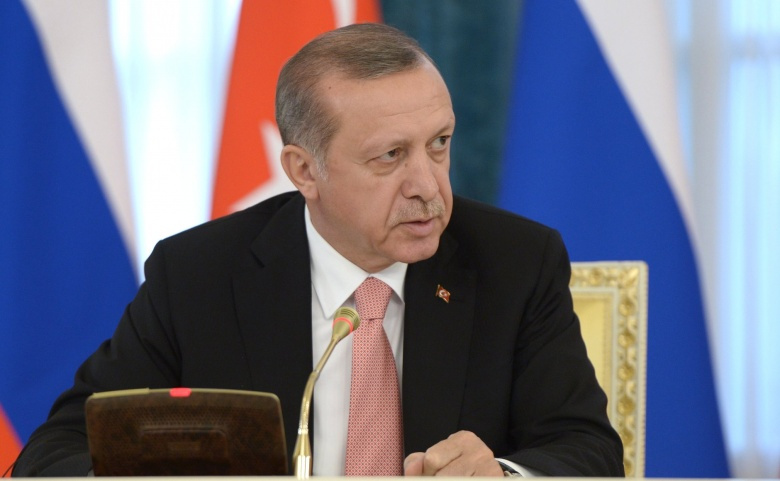
Turkish President Recep Tayyip ErdoฤŸan’s visit to Russia has sparked all sorts of speculation. To some, it marks a supposed transformation of Turkish–Russian relations, a pivot by President ErdoฤŸan toward Vladimir Putin that somehow signals a turn away from the West that the Turkish leader found uninterested in, if not perhaps supportive of, the attempt to overthrow him and his government in July. Turkish public disappointment with a tepid Western media and public reaction to the assault on their elected government is a fact, but nothing about Ankara’s rapprochement with Moscow is unwelcome or obviously threatening to U.S. interests.
ErdoฤŸan’s visit to Moscow was a final step in fixing the problem of relations with Russia created by military’s shooting down of a Russian fighter jet in November 2015. That event ruptured ties between the two countries that were very important in economic and commercial terms and politically gave both Ankara and Moscow options in handling regional issues and their respective relations with the West. The economic losses in Turkey were quite significant, especially for the tourism industry, construction, investment and agricultural exports. These losses particularly affected constituencies important to Turkey’s ruling Justice and Development (AK) Party.

In the wake of Ahmet DavutoฤŸlu’sdismissal as prime minister in May 2016 and replacement by Binali Yฤฑldฤฑrฤฑm, the Turkish government moved to step away from some of the recent confrontations that had complicated and limited Turkey’s ability to pursue its interests in foreign affairs. This was partly ErdoฤŸan cutting his losses, but it also reflected Yฤฑldฤฑrฤฑm’s personal pragmatism and the opportunity his taking over the government to turn a new leaf. Yฤฑldฤฑrฤฑm’s government similarly took halting steps toward restoring relations with Egypt that were broken after Abdel Fattah el-Sissi overthrew the government of Mohamed Morsi 2013. It moved to complete the restoration of ties with Israel. There was talk of a new approach on Syria and perhaps even a new push to take up the normalization of relations with Armenia that was abandoned in 2010.
Outreach to Russia was another new pragmatic line that included both an exchange of letters and an apology from ErdoฤŸan for the shoot down. The effort to fix relations with Moscow found a welcome response in Russia, which also suffered economic losses because of sanctions it imposed on Ankara and, in any case, wanted to restore reasonably normal ties with Turkey as a way to nibble at the isolation imposed upon it after its forces invaded eastern Ukraine and threatened Western interests elsewhere in Europe. For both countries, rapprochement is normal and, in general, an unthreatening thing for the United States.