19 August 2016

The Subatomic Race to Harness Quantum Science

http://www.defenseone.com/technology/2015/09/subatomic-race-harness-quantum-science/120260/
PATRICK TUCKER, SEPTEMBER 3, 2015

US, China are betting millions on the promise of this newish field, but the real-world potential remains a mystery.
An assortment of super powers awaits the superpower that harnesses quantum science: unhackable communications, radars that see underground, supercomputers that make today’s biggest machines look like first-generation Ataris. But which of those goals are achievable in the near future, and at what cost?

Earlier this summer, the Pentagon announced a $45 million research effort into quantum networking. Meanwhile, China hopes to complete construction of the world’s largest quantum communication network and become the first nation to put a quantum communications satellite into orbit. But other military-funded research has suggested that quantum comms and cryptography may prove too complicated to warrant the effort, while quantum computing will remain out of reach for a decade or more. (Some argue that’s being very optimistic.)
All of this power, and all of this hype, emerges from a source almost unfathomably small: atomic and subatomic particles that behave differently than larger objects, especially at very cold temperatures. It’s enormously difficult even to study quantum objects; simply observing them generally changes their behavior.
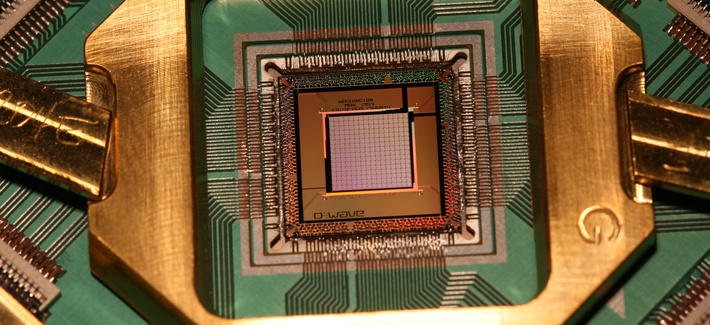
The Holy Grail of applied quantum science is quantum computation, which is as different from regular computers as humans are from jellyfish. Whereas conventional computing uses electrical impulses running through transistors to manipulate bits, or binary values of one or zero, quantum machines track the strange behavior of ultracold atoms that can exist in two states at once — a one, a zero, or both. If you’ve got two qubits in the same so-called superposition, you have what’s called an entanglement gate. They’re atomically linked even if they’re miles apart. And this opens up the possibility of massive parallel calculating. What would you use that for? Think about cracking a code: you try one combination after another after another. But if you can try all the possible combos at once, you arrive at the solution instantly.


KILLER ROBOTS: OUR ETHICS AREN’T THE PROBLEM

http://warontherocks.com/2016/08/killer-robots-our-ethics-arent-the-problem/
KEVIN SCHIEMAN, AUGUST 16, 2016

“If we must act in accordance with our interests, driven by our fears of one another, then talk about justice cannot possibly be anything more than talk.”

-Michael Walzer, Just and Unjust Wars

Are our overly precious ethics standing in the way of getting autonomous weapons into the fight? That is what three authors would have you believe in an article published last week at War on the Rocks. Brecher, Niemi, and Hill claim that “self-imposed and self-important legal and ethical constraints on autonomous weapons” place U.S. forces “at risk of suffering a decisive military disadvantage.” Autonomy will play an important role in shaping the success of future military forces, but their argument commits the United States to a false choice between values and operational relevance. The authors are mistaken in their claim that U.S. policy prohibits the development of lethal autonomous weapon systems. Likewise, they are wrong to suggest that adherence to the laws of war and applicable international treaties is either inappropriate or harmful to U.S. interests. Beyond obvious moral concerns, lamenting Western adherence to such principles runs risk of distracting attention from the institutional and procedural barriers that actually place the U.S. at strategic disadvantage with respect to fielding lethal autonomous weapon systems.

Far from impeding the development of lethal autonomous systems, DoD Directive 3000.09 offers a framework for ensuring the safe development of mission capable systems consistent with the laws of war. Brecher, Niemi, and Hill argue for this directive to be updated so that it “allows the full development and use of robotics.” As they point out, the policy is explicit in limiting routine development of fully autonomous weapon systems to applications involving non-lethal, non-kinetic force. What their argument overlooks, however, is that the directive also specifies guidelines for the development of lethal autonomous weapon systems.
By policy, lethal autonomous weapons and other non-routine autonomous systems must undergo additional review and approval by two under secretaries of defense and the Chairman of the Joint Chiefs of Staff prior to formal development and again before fielding. Among other considerations, the additional review must determine whether the system design incorporates “the necessary capabilities to allow commanders and operators to exercise appropriate levels of human judgment in the use of force.” Even then, the secretary of defense may waive the majority of these requirements in the case of “urgent operational need.” The directive sets a clear framework for developing autonomous capabilities without committing the Pentagon recklessly beyond its current understanding of the technology and its ramifications.

America’s Spies Want to Speed UpIBM’s Quest for a Quantum Computer

http://www.defenseone.com/technology/2015/12/americas-spies-want-speed-ibms-quest-quantum-computer/124334/
BY MIKE MURPHY,QUARTZ
DECEMBER 9, 2015
IBM has been working on quantum computers for decades, and now it has the support of IARPA, the U.S. intelligence community’s research agency.
As we approach the physical limits of shrinking the components on computer chips, it’s getting harder to attain more computing power. But quantum computers—which rely on the strange properties of atom-sized logic gates—could have exponentially more power than even today’s most advanced supercomputers. These machines could be used to develop new drugs, crack codes, or potentially even create true artificial intelligence.
IBM has been working on quantum computers for decades, and now it has the support of the US intelligence agencies. On Nov. 8,IBM announced that IARPA, the intelligence community’s research arm, had awarded the company a multi-year grant to continue its research into building quantum computers.

Classical computers—everything from the giant mainframes that used to take up entire rooms, to the smartphone in your pocket—consist of billions of tiny transistors. Those are switches, essentially, that can be turned on or off, represented on computers as 1 or 0. Every, tweet, text, document, and photo is composed of a series of those 1s and 0s, known as bits. In quantum computing, a transistor consists of a single atom, which can exist as a sort of combination, or “superposition,” of 1 and 0 at the same time. These quantum bits, or qubits, in essence allow a computer to perform multiple parts of a calculation at once, making it far more powerful.
But that’s assuming you can get enough qubits working in one place. These qubits are much less stable than traditional bits, and need to be isolated in large machines that can cool them to almost absolute zero. IBM has a few such machines, and the most powerful contains a mere eight qubits.
Right now, IBM is working on correcting errors that are thrown up during its quantum computing tests—due to the fragility of the qubits—and assuming it’s able to wrangle thousands of qubits in one place, all computing as desired, it would potentially have a computer far more powerful than one with a similar number of traditional bits.

iStock As India Gears Up for Cybersecurity Challenges, Threats Are Multiplying

BY AMIT KUMAR, • AUGUST 16, 2016
Content Lead, IBM

Amit is worldwide Content Lead for IBM Security. He has about 10 years of experience in technology marketing. He has worked in a variety of roles in content management, campaign
India is gearing up to bring in new encryption and privacy policies to take on growing cybersecurity challenges. It may also amend the existing laws to make cyberspace more secure.
Digital India Marches On
In recent times, India has launched a series of cybersecurity initiatives to digitally empower its citizens and safeguard cyberspace. As the Digital India initiative progresses,cyberattacks have doubled year over year, and Indian businesses and government sites have become more vulnerable.
In the wake of increasing cyberthreats, India appointed its first chief information security officer (CISO). The appointment underlines India’s commitment to combating cyberattacks. It will help India develop the vision and policy to fight cybercrime and manage cybersecurity more effectively.
India is also in the process of setting up national cybersecurity architecture. The architecture will provide a framework for designated agencies to monitor, certify and fortify India’s networks in accordance with the law.
However, there is currently no national agency to assess the nature of cyberthreats and respond to them effectively. Some analysts recommend the creation of a National Cyber Security Agency (NCSA) as an answer to the challenge. An NCSA would improve India’s resilience and defense systems. It would also be responsible for a wide range of cybersecurity transformations in the area of policy formulation and its implementation at the national level.
Global Cooperation

India and the U.S. agreed to cooperate on cybersecurity issues during Prime Minister Narendra Modi’s recent trip to the U.S. As a part of the U.S.-India Cyber Relationship Framework, both countries agreed to share cybersecurity best practices, share threat information on a real-time basis, promote cooperation between law enforcement agencies and encourage collaboration in the field of cybersecurity research. India and the U.S. will also establish joint mechanisms to mitigate cyberthreats and protect internet infrastructure and information.
In 2015, India and the U.K. made a joint statement about cooperation in the cybersecurity space. The two countries agreed to work together to provide professional development and establish a Cyber Security Training Centre of Excellence. The U.K. also agreed to help launch the proposed National Cyber Crime Coordination Centre in India.
India has also entered into cybersecurity cooperation with Malaysia and the European Union. There is a strong case for India to collaborate with more countries, but in the meantime, these partnerships are a great foundation.
Growing Cybersecurity Challenges

Though India has taken a series of steps to harden its security posture, the number of cyberattacks and average cost of a data breach have increased significantly.
The “2016 Cost of Data Breach Study: India” reported that the average total cost of a data breach paid by Indian companies increased by 9.5 percent, while the per capita cost increased by 8.7 percent and the average size of a breach grew by 8.1 percent. Additionally, 41 percent of Indian companies experienced a data breach as a result of a malicious or criminal attack — the most common root cause of a data breach.
India needs a comprehensive cybersecurity law to be prepared to tackle cybersecurity challenges more effectively. Singapore’s proposed Cyber Security Bill will offer a good template. A new cybersecurity law would enable India to protect critical infrastructure more effectively. It would also empower cybersecurity agencies to manage incidents quickly and mandate reporting of significant cybersecurity incidents. Additionally, it would create a stronger cybersecurity culture among businesses and Indian government agencies.

Establishing a national cybersecurity command center, such as the recently announced National Cyber Security Centercreated by IBM for Australia, would boost India’s cybersecurity defenses, make Indian businesses globally competitive and create a safer Digital India.

Cyber Terrorism a Major Concern for U.S. Businesses

http://www.claimsjournal.com/news/national/2016/08/15/272825.htm
By Denise Johnson | August 15, 2016

U.S. businesses focused on addressing crisis management in the event of an on premise terrorist attack may be leaving their information systems vulnerable to a cyber attack.
According to The Global Risks Report 2016, compiled through a strategic partnership between Marsh & McLennan Companies and Zurich Insurance Group, cyber attacks are expected to be the top tech risk most likely to occur in the US, and according to the World Economic Forum’s “2016 Global Risk Report”, terrorism is one of the top three risk concerns for companies doing business here.
Liars Lie. You don't have to chase premium away to know where the fraud is in your book. Use vehicle sightings at underwriting and renewal to identify bad addresses, validate VIN information and verify registration state. Don't wait to find out at claim. Download the eBook.

Defining what constitutes cyber terrorismcan be difficult, said Matthew McCabe, senior vice president of Marsh’s Cyber Practice, who spoke during a recent New Reality of Risk webcast on managing terrorism risk hosted by Marsh.
“Under U.S. law, generally speaking, there are three major elements to a terrorist’s act. First, it’s an act that is violent or potentially jeopardizes human life. Second, the act will violate criminal law in the United States…and third, the act is motivated by some ideological basis,” McCabe said.
He explained that a hacker from Kosovo was charged with accessing personal information of more than a thousand U.S. service members and federal employees and releasing the information to a terrorist group.

“The Justice Department confirmed that this was the first case which a hacker has been prosecuted in the U.S. on terrorism charges. Physical consequence is not prerequisite for an act of terrorism,” McCabe said.
Disruption of a computer system is enough to constitute cyber terrorism, according to some cyber insurance policies.
“If you look for the definition of cyber terrorism under a cyber insurance policy, the standard changes significantly. Instead of a violent or potentially life threatening act, cyber policy generally applies to disruptive activities against a computer system, McCabe said.

The next world war is going to be fueled by state-sponsored hacking

http://www.businessinsider.in/The-next-world-war-is-going-to-be-fueled-by-state-sponsored-hacking/articleshow/53715799.cms

Battles in the next world war will be fought in the air, on the ground, and online.
"We've grown used to the fight being in just one domain," Dr. Peter Singer, a strategist at the think tank New America and coauthor of "Ghost Fleet," told Business Insider. "[But] we have these new domains that we've never fought in before, and that's outer space, and cyber space."
While the US has gotten somewhat used to fighting insurgencies and irregular wars, Singer believes the world may be swinging back toward the conventional path, especially as China continues to ramp up its military capabilities.
Singer and August Cole's "Ghost Fleet" put forth a story of what could potentially happen if the US, China, and Russia went to war, and hacking and electronic warfare played a big part in it. Though the book was fictional, all the technology the authors used was drawn from the real world, whether it was currently deployed or in a prototype stage - and it has become recommended reading by the military's top leaders.
"If you're not able to operate the way you want to in cyberspace," Singer said. "That means you can lose battles on land and sea."

Interestingly, the shift to using cyber means of attack instead of conventional ones has already been happening for some time, as Singer explained. We've seen a "micro version" of this new age of warfare playing out recently in Ukraine, Syria, and elsewhere.
Or as one Army officer put it during a 2015 training exercise, "future fights aren't going to be guns and bullets. They're going to be ones and zeroes."
World War 3.0
Singer explained that states can do only four things in cyberspace: Collect, steal, block, and change information. And all of them are happening right now, but not at a scale large enough to consider it a global cyberwar.
"That's what any future cyber conflict is going to involve," Singer said. "A mix of these things."
For example, intelligence agencies already collect mountains of data that's out in the open, and those in the offensive hacking space try to steal more. China, for example, seeks out information on classified military projects like the F-35 fighter so it can develop its own, very similar, counterpart.
Then there's the idea of blocking information from flowing. In a cyber context, that means major distributed denial-of-service campaigns that take websites offline, or website defacements.

How Nazi Germany's Fighter Planes Saved Israel

http://nationalinterest.org/blog/the-buzz/how-nazi-germanys-fighter-planes-saved-israel-17371?page=show
August 16, 2016 
When Israel declared independence from British colonial rule in May 1948, it immediately went to war with the neighboring Arab states. One of the first weapons Israel acquired was a fighter plane designed by a country that had sought the extinction of the Jewish people.
The German Messerschmitt Bf.109 — later re-designated Me.109 — was the most advanced fighter plane of its time when it first saw combat in 1937 in the Spanish Civil War. Flown by German pilots in support of General Franco’s Nationalists, Bf. 109s secured air superiority over Spain and allowed Fascist bombers to terror bomb cities nearly unopposed.

The Bf.109E model was upgraded with 20-millimeter cannons and a new Daimler Benz 601 engine that increased its speed to 354 miles per hour. It swept its opponents from the skies in the invasion of Poland and the Battle of France.
Only when it met large numbers of Royal Air Force Spitfires in the Battle of Britain did it meet its match — resulting in the Nazi war machine’s first major defeat.
While superior fighter aircraft began entering service on all sides by 1942, Nazi Germany continued upgrading and producing 109s until the end of the war. Much of this production took place in heavily industrialized Czechoslovakia, which had been annexed by Germany in 1938. After the defeat of Nazi Germany, the Czechs decided to reopen production by making their own version of the 109, the Avia S-199.

The Czechs planned on using their stock of Daimler Benz 605 engines intended for use in 109 aircraft. However, a factory fire destroyed the engines, forcing the Czechs to find an alternative. They settled on tapping a stockpile of Jumo 211F engines and propellers used by Nazi Heinkel-111 twin-engine bombers.
Needless to say, the 211F wasn’t designed to be a fighter engine — and caused endless problems when fitted to the 109's airframe. Not only were the engines underpowered, but the 109’s original nose-hub cannon was incompatible with it, so the Czechs instead strapped MG 151 cannons under the wings using World War II-era Rüstsatz VI add-on kits. These worsened the S-199’s flight performance.

18 August 2016

NAVIC: India’s eye in the sky

http://www.livemint.com/Opinion/nvUxIhQveytvMNQKADl3wM/NAVIC-Indias-eye-in-the-sky.html
The indigenous global navigation satellite could boost India’s credentials as a regional collaborative partner
Kira HujuAnanth Padmanabhan

NAVIC (Navigation with Indian Constellation), India’s indigenous global navigation satellite system, is expected to become fully operational from this month. Consisting of a constellation of three geostationary, four geosynchronous and two on-standby satellites, NAVIC will facilitate accurate real-time positioning and timing services over India and the region around it extending to 1,500km. While India is joining a club of global powers—the US, EU, China and Russia—who control their own navigation satellite systems, NAVIC’s reach is regional. This is an auspicious occasion for South Asian cooperation.
While the Narendra Modi administration has sought to primarily draw attention to the benefits of NAVIC to Indian citizens, dedicating the acronym to Indian fishermen and navigators, its full operationalization carries profound implications and opportunities for the South Asian region at large. At a time when neighbours like Sri Lanka and Nepal harbour misgivings over Indian interference in their internal affairs and question the Indian commitment to a balanced regional order, sharing the benefits of NAVIC could countenance India’s credentials as a collaborative partner in the region.

“Net security providers” are states that deploy their surplus national assets for the safety and stability of other countries, including by way of responding to natural and man-made disasters. Having a global navigation system bolsters the ability of a nation to serve as a net security provider, especially through the guarantee of such assurance policies. The US equivalent, Global Positioning System (GPS), played a significant role in relief efforts post disasters such as the tsunami in the Indian Ocean region in 2004 and the Pakistan-India earthquake in 2005, and has delivered significant strategic and economic benefits to the US.
Through land-area mapping, yield monitoring and precision-planting of crops, NAVIC allows for the development of civic capabilities in food and livelihood security. In the wake of the 2015 earthquake in Nepal, NAVIC also arrives as an instrument for environmental and meteorological monitoring, as well as climate research. These capabilities can be leveraged to design reliable and efficient response mechanisms for natural disasters, alleviating the devastation they wreak through well-managed disaster relief.

America uses stealthy submarines to hack other countries’ systems

https://www.washingtonpost.com/news/the-switch/wp/2016/07/29/america-is-hacking-other-countries-with-stealthy-submarines/ 
By Brian Fung and Andrea Peterson July 29 
When Donald Trump effectively called for Russia to hack into Hillary Clinton's emails Wednesday, the GOP nominee's remarks touched off a (predictable) media firestorm. Here was a presidential candidate from a major U.S. party encouraging a foreign government to target American interests with cyberspying — an act that could not only expose national security information but also potentially undermine the actual security infrastructure of the United States. 

Cyberwarriors working for Moscow and other regimes are already poking and prodding at our networks, so there's little reason to think Trump's words were all that damaging in themselves. But it's a good opportunity to talk about the state of state-sponsored hacking, and to offer a reminder that the United States is just as active in this space as the next government. 
The U.S. approach to this digital battleground is pretty advanced. For example: Did you know that the military uses its submarines as underwater hacking platforms? 
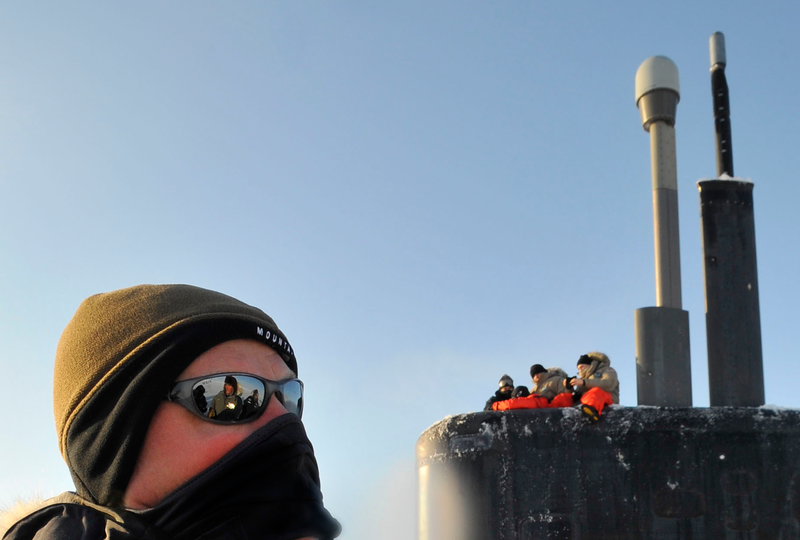
In fact, subs represent an important component of America's cyber strategy. They act defensively to protect themselves and the country from digital attack, but — more interestingly — they also have a role to play in carrying out cyberattacks, according to two U.S. Navy officials at a recent Washington conference

"There is a — an offensive capability that we are, that we prize very highly," said Rear Adm. Michael Jabaley, the U.S. Navy's program executive officer for submarines. "And this is where I really can't talk about much, but suffice to say we have submarines out there on the front lines that are very involved, at the highest technical level, doing exactly the kind of things that you would want them to do." 
The so-called "silent service" has a long history of using information technology to gain an edge on America's rivals. In the 1970s, the U.S. government instructed its submarines to tap undersea communications cables off the Russian coast, recording the messages being relayed back and forth between Soviet forces. (The National Security Agency has continued that tradition, monitoring underwater fiber cables as part of its globe-spanning intelligence-gathering apparatus. In some cases, the government has struck closed-door deals with the cable operators ensuring that U.S. spies can gain secure access to the information traveling over those pipes.)

The View From Olympus: Watch Korea

https://www.traditionalright.com/author/wslind/
Author: William S. Lind 

By now, the Korean drill is familiar to all. We take some symbolic action against North Korea. The North responds with its Tasmanian Devil act, threatening “lakes of fire”, firing missiles into the ocean and maybe, at the limit, shooting some artillery at South Korea. Casualties, if there are any, are few. South Korea in turn tugs at its leash, which we hold firmly. Yawn. 
This time may be different. We did the usual, announcing some meaningless new sanctions on the North, though this time targeting its rulers by name, which slightly ups the ante. The North is playing its part, shouting hyperbolic threats, including war. 
But here is where the current case departs from the script. No one is paying any attention to North Korea’s tantrum. We’ve seen it too often. The world’s reaction is, “let ’em starve in the dark.” From the North Korean perspective, the act no longer works. 
Except in South Korea. This is the second change from the usual script. The South is fed up with the North’s antics. The South Korean president’s mother and father were killed years ago by North Korean assassins. She has not forgotten. In every recent incident, the South has suffered more casualties (when there were any) than the North. The general South Korean attitude seems to be, “We’re not going to take it any more.” 

What can South Korea do? Invade North Korea. 

The Pentagon’s Korean war scenarios all assume an attack by North Korea on South Korea. I suspect we have devoted little or no thought to the opposite case. We can always just jerk on South Korea’s leash and tell it to sit. 
That may no longer be true. South Korea has a powerful military of its own. If the president says, “Go get ’em!,” it would. 
Here’s a possible scenario: Its hysteria universally ignored, the North hits South Korea hard in an action that quickly ends. One possibility would be an artillery raid on Seoul that is over in 15 minutes. The physical damage would not be great, but the South Korean government and military would be utterly humiliated. 
The South Korean people, enraged, demand serious action in return. They don’t want mere retaliation; they want a final solution to the North Korean problem. Remembering her parents, South Korea’s president orders her armed forces to invade, with the object of complete conquest and reunification. We tell the South Koreans, “Stop!” They reply with, “Lead, follow, or get out of the way.” 

** Russia and Turkey Maneuver

Aug. 10, 2016 
By George Friedman 
The two countries seem to be moving closer, but will it last? 

Russian President Vladimir Putin and Turkish President Recep Tayyip ErdoÄŸan had a meeting on Tuesday. It is not clear what precisely came of it, but it is clear what is at stake. Russia is a weakening power where the state of the economy is now the main issue, and the question of Ukraine remains at the center of its strategic concerns. Turkey is an emerging power whose current internal crisis is being managed effectively, if brutally. Both face an enormously powerful United States, uncertain of what to do with its power and acting at times in a random and unpredictable way. For Russia and Turkey, their next moves can have existential consequences. For the United States, nothing that happens to either of the two countries rises to an existential event. Distance and power greatly insulate the United States from miscalculation. 

Therefore, Russia and Turkey are measuring their moves with as much precision as they can bring to bear. In the short term, they have common interests. Each wants to maintain its own freedom for maneuver by deflecting the United States, rather than directly confronting it. Each watches as the European Union tries to figure out what it is and what it plans to do. Europe’s uncertainty gives both countries breathing room and at the same time a large degree of uneasiness. They cannot assume that they know what the shape of European power will be five years from now. The chaos may intensify, or a powerful country or coalition might emerge. What happens in Europe matters to Russia and Turkey.

On the surface then, they would appear to have common interests. In fact, there are signs that these common interests are bearing fruit. Ever since the fall of the Soviet Union, Armenia has maintained a close but subordinate relationship with Russia. This allowed Armenia to defeat Azerbaijan in a war in the early 1990s, which allowed it to seize what had been Azerbaijani territory prior to the war. The region in question is called Nagorno-Karabakh and it has remained a flashpoint between the two countries. Almost 40,000 people were killed in the war, even more Azerbaijanis fled Nagorno-Karabakh and the war sputtered on with periodic clashes and casualties. 


Azerbaijan’s foreign policy was complex. Caught between Iran and Russia, it constantly had to maintain a policy that preserved its independence without threatening either country to the point that they might act. The Azerbaijanis wanted a close relationship with the U.S., but the U.S. pushed them away over human rights issues and because strategically it would place the U.S. in an unsustainable position, between Russia, Iran and Turkey. Lacking an anchor, Azerbaijan shifted its weight constantly. The Nagorno-Karabakh situation remained a fundamental issue.

Asia’s Looming Subsurface Challenge

http://warontherocks.com/2016/08/asias-looming-subsurface-challenge/ 
August 11, 2016 

From the 1950s until today, Russia’s dangerous Atlantic submarine force has represented the technological pacing threat for the U.S. Navy in the undersea domain. However, this trend is slowly changing. It will be the waters of the Pacific, not the Atlantic, where the U.S. Navy will be most sorely tested. In his 2016 posture hearing, Commander of U.S. Pacific Command Admiral Harry Harris noted that Chinese, Russian, and North Korean submarines constitute 150 of 200 submarines currently in the Pacific. Numbers only tell part of an increasingly ominous story. The trajectory of submarine investments made by these nations — and ten other Asia-Pacific countries — will create a far more dangerous undersea domain in the Asia-Pacific by 2030. Developing the policies and frameworks that will enable effective shaping of this environment must be started before the crisis hits. 

The recent unanimous award by the International Tribunal on the Law of the Sea and China’s vocal and active rejection of the legitimacy of the decision bolsters the need for many countries in the region to have a credible submarine deterrent force. Not surprisingly, countries throughout the region have been working for some time to bolster their submarine forces and others are considering establishing such capabilities. Both trends are captured in figure one below, tracing current and 2030 expected total diesel (SSK) and nuclear (SSN) submarine fleet numbers. Countries in Asia are seeking credible deterrence forces as their confidence wanes regarding the peacefulness of China’s rise and the reliability of U.S. commitment to preserve stability
. Figure 1: Current and Expected Future Attack Submarine Forces of Asia-Pacific Countries 

Submarine Missions 
Submarines can be used to defend a nation’s territory and to project power abroad. Most nations in maritime Asia are acquiring submarines for their sea denial capabilities to credibly deter larger, more militarily capable adversaries. Submarine warfare is inherently asymmetric, imposing potentially large costs on any potential adversary. The mere threat of submarine activity can dramatically affect an adversary’s planning considerations. In peacetime, submarine forces accomplish these goals by monitoring the naval activities of other countries, protecting their country’s sea lines of communication, and, for a small number of nations, providing a sea-based nuclear deterrent. A well-equipped submarine force operated by a highly trained crew provides an exceptionally capable and flexible platform for these many missions. 

Geography in the Asia-Pacific 
The maritime geography of the Asia-Pacific — and its centrality to the U.S. and global economy — has powerful implications for how submarines can be employed throughout the region. The first island chain, running from Japan through Taiwan to the Philippines, forms a natural barrier that China fears may “bottle up” its naval forces. Similarly, the relatively small number of approaches through the islands provides China’s increasingly capable missile force a relatively small number of aim-points should it seek to counter foreign countries’ navies. Key chokepoints such as the Malacca, Lombok, and Sunda Straits further complicate access to the region (Figure 2, below)
. Figure 2: Maritime Chokepoints in Asia (Source: Asia Maritime Transparency Initiative) 
Spying on the U.S. Submarine That Spies For the NSA and CIA

http://phasezero.gawker.com/spying-on-the-u-s-submarine-that-spies-for-the-nsa-and-1693109418
Adam Weinstein and William M. Arkin 4/07/15 

Everyone saw the USS Annapolis come home last year. It returned, poignantly, on Sept. 11, and there was a seriousness amid the usual dockside fanfare—sailors meeting newborn children for the first time, a school band playing "Anchors Aweigh." But there was no mention of the boat's secret missions. 
From March to September 2014, the U.S. submarine's 152-man crew cruised the deeps of the Mediterranean, Red Sea and Arabian Gulf, earning a earning a coveted Battle "E" for their efficiency in doing all the fleet had asked of them. Which involved ... what, exactly? They covered 34,000 nautical miles, participated in one multinational exercise, and made port calls in Portugal, Spain, Bahrain, and Gibraltar, according to official Navy reports
There was something else, according to the sub's captain, Commander Chester T. Parks. "During this time," he told reporters, "Annapolis completed four missions vital to national security." 
Technically, his boat is a fast-attack submarine, responsible for tracking and killing enemy subs and surface ships when shit goes down. But the Annapolis was equipped for a very special top secret task, one that didn't involve its Mark 48 ADCAP torpedoes—or any shooting weapons at all. It was a mission that wasn't yet accomplished as the boat ported and the crew embraced their families on the dock at Submarine Base New London, Conn. 

First, Parks and his team would have to brief some high-level NSA and CIA officials.
This jewel of the silent service, it turns out, is a very good listener. 
Deep in the trove of National Security Agency documents leaked by Edward Snowden is a classified Powerpoint training presentation for workers at the Naval Information Operations Command Maryland—the Navy component of the NSA. The presentation explains the ins and outs of computer network exploitation (CNE) "to change or collect information residing on or transiting computer networks." To spy, that is, on any computer network anywhere—and not just to listen, but to manipulate and even shut it down. 
The heavily redacted presentation includes an example of a "tailored access operations" target for these military hackers: an unidentified nation's president, Parliament, and military leaders: 

A proliferation of quieter submarines is pushing navies to concoct better ways to track them

Seek, but shall ye find? 
http://www.economist.com/news/science-and-technology/21703360-proliferation-quieter-submarines-pushing-navies-concoct-better-ways Aug 6th 2016 | From the print edition

DURING war games played off the coast of Florida last year, a nuclear-powered French attack submarine, Saphir, eluded America’s sub-hunting aircraft and vessels with enough stealth to sink (fictitiously) a newly overhauled American aircraft-carrier, Theodore Roosevelt, and most of her escort. An account of the drill on a French defence-ministry website was promptly deleted, but too late for it to go unnoticed. 
Nor was this French victory a fluke. In 2006, in what was very far from being a war game, a Chinese diesel-electric submarine surfaced near Okinawa within torpedo range of another American carrier, Kitty Hawk, without having been detected by that carrier’s escort of more than a dozen vessels and anti-submarine aircraft. And, from the point of view of carrier-deploying navies, things are threatening to get worse. Saphir, launched in 1981, hardly represents the state of the art in underwater undetectability; in the decade since the Okinawa incident diesel-electrics have become even quieter. For an inkling of the silence of the new generation of such subs when they are running on battery power alone, without their engines turning, Jerry Hendrix, a former anti-submarine operations officer on the Theodore Roosevelt, asks: “How loud is your flashlight?” 
In this section
Seek, but shall ye find? 
Moreover, submarines are spreading. Since the cold war ended, the number of countries deploying them has risen from a dozen or so to about 40. Many of the newcomers are not part of the Western system of alliances. Some are actively hostile to it. And more may join them. A secondhand diesel-electric boat—not state of the art, admittedly, but effective nevertheless—can be had for as little as $350m. 
Worse, for those trying to defend ships from submarine attack, Western powers have routinely cut anti-submarine spending since the end of the cold war. American carriers retired the S-3 Viking submarine-hunting warplane in 2009, leaving shorter-range helicopters to compensate. Since the Soviet Union’s demise the average surface escort of an American carrier has shrunk from six vessels to four. 

Modern submarines are not merely quieter than their predecessors, they are also better armed. Many carry anti-ship guided missiles as well as torpedoes. One such, the CM-708 UNB, was shown off by China in April. It packs a 155kg warhead and, after popping out of the water, flies at near the speed of sound for about 290km. An export version is available but, if you prefer, Russia’s submarine-launched Kalibr-PL missile offers a bigger warhead and a terminal sprint at Mach three. In December a submerged Russian submarine hit Islamic State targets in Syria with four similar missiles. 
Potential adversaries operate or have ordered more submarines than Western powers could feasibly find and track with their existing defences. Even Iran has more than a dozen well-armed “midget” subs that hide in the shallows of the Persian Gulf, as well as three big Russian-made Kilo class diesel-electrics. Israel’s navy trains as if this trio carry the Kalibr-PL’s export variant, according to an Israeli expert. Countries which plan to arm submarines with that missile include China, India and Vietnam. The upshot is that many warships are in jeopardy and may only learn just how great that jeopardy is, says Alain Coldefy, a former vice-chief of France’s defence staff, once a missile is closing fast. 

America Is Smashing Russia and OPEC's Grip On The Oil Market

http://nationalinterest.org/feature/america-smashing-russia-opecs-grip-the-oil-market-17340?page=show
The shale gas revolution in the United States is overturning the old order.
Anthony Fensom, August 14, 2016

Far from being threatened by recent weak prices, America’s status as an emerging energy superpower has solidified in 2016, weakening OPEC’s grip over the oil market along with Russia’s influence over Europe’s gas supplies. For the next U.S. president, the geopolitical environment could look a lot more benign, should the nation’s energy industry continue on its current path.
The start of the revolution occurred in February, when the first major U.S. gas export shipment from Cheniere Energy set sail for Brazil. According to Cheniere, the United States could be “one of the three biggest suppliers of LNG (liquefied natural gas) by 2020.” In recent months, U.S. LNG has even been exported to the energy-rich Middle East, a move British newspaper theFinancial Times described as akin to “sending coal to Newcastle.”
But the shale gas revolution in the United States is rapidly overturning the “old order,” and the dust has yet to settle.

Taking on the cartel
For decades it was thought U.S. oil production had peaked around 1970, as thirty years of declining production set in and the OPEC cartel’s manipulation of oil supply and prices gave a number of politically sensitive regions an uncomfortably large degree of influence over global markets.
But in 2009, driven by the newly economically viable hydraulic fracking extraction method, U.S. oil production rose, and it kept rising until global oversupply forced U.S. production cuts last year.
After initially downplaying shale’s potential to rival OPEC’s monopoly, Saudi Arabia launched what critics called a price war against the new industry in 2014: it refused to cut production when many other OPEC states wanted to do so, and Riyadh contended that it was merely letting the market take its course. This continues to glut the market, with the Saudis hitting a new all-time production high just last month.
But while their strategy of oversupply may have made some high cost operators economically unviable, including those in OPEC member states Angola, Nigeria and Venezuela, U.S. shale extractors have proven highly adept at cutting costs. This has opened up a profit margin even below that which Saudi Arabia needs to fund its welfare state, which the International Monetary Fund believes could go bankrupt in five years without major policy changes.

Outgoing Pioneer Natural Resources CEO Scott Sheffield last month declaredhis company had cut pre-tax production costs in the West Texas Permian basin to just $2.25 per barrel, and low production costs are not the only advantage U.S. shale extractors enjoy.
New projects using traditional extraction methods typically have a five-year lead time and a ten-year payback time, while new shale projects have only a one-year lead time and an eighteen-month payback time, according to Goldman Sachs head of European Equity Research Michele Della Vigna. In addition, the ease of developing new projects, and of increasing or decreasing supply to meet demand, has drastically flattened the supply curve of the global oil market, and weakened OPEC’s power to manipulate prices.
Della Vigna expects this shift will leave the United States and OPEC fighting for market share as the two key players, with the rest of the producers battling to remain relevant.

Freeing Europe from Russia’s stranglehold
Ten years ago, Russia, Qatar and Iran were the established gas giants, together owning 57 percent of global conventional gas reserves and forming the core of the Gas Exporting Countries Forum (GECF), referred to by then Russian Energy Minister Sergey Shmatko as the “gas OPEC.”

Islamic State faces uphill 'branding war' in Afghanistan, Pakistan

http://www.reuters.com/article/us-pakistan-afghanistan-islamicstate-idUSKCN10P0QZ?utm_source=Sailthru&utm_medium=email&utm_campaign=Defense%20EBB%2008-15-16&utm_term=Editorial%20-%20Early%20Bird%20Brief
By Kay Johnson and Mehreen Zahra-Malik | ISLAMABAD
The U.S. drone strike that killed Islamic State's commander for Afghanistan and Pakistan was the latest blow to the Middle East-led movement's ambitions to expand into a region where the long-established Taliban remain the dominant Islamist force.
Islamic State has enticed hundreds, perhaps thousands, of jihadist fighters in Afghanistan and Pakistan to switch loyalty and has held a small swathe of territory in the eastern Afghan province of Nangarhar, where leader Hafiz Saeed Khan was killed on July 26 by a U.S. drone, Washington confirmed late Friday.
But outside that pocket of territory, security officials and analysts say that Islamic State remains - for now - more of a "brand name" than a cohesive militant force in much of the region.

"Groups around the world want to jump on that bandwagon and cash in on their popularity and the fear they command," said a Pakistani police official based in Islamabad, on condition of anonymity because he was not authorized to speak to media.
Anxiety over Islamic State - also known as ISIS or "Daesh" - in Afghanistan and Pakistan has been building since the al Qaeda breakaway movement seized portions of territory in Iraq and Syria in 2014 and began promoting itself worldwide.
Those fears had gain fresh impetus in the last month after IS's self-declared "Khorasan province" in Afghanistan and Pakistan claimed two especially deadly bombings that each killed more than 70 people - one in the Afghan capital, Kabul, and the latest in the southwestern Pakistani city of Quetta last week.
Yet Pakistani officials and independent analysts have raised doubt on the IS claims, especially for the Quetta bombing - saying the more credible claim for the suicide attack at a hospital was by a Pakistani Taliban offshoot, Jamaat-ur-Ahrar.
"ISIS is increasingly on the defensive as it struggles to defend its shrinking caliphate in Iraq and Syria, so it has a strong incentive to show it's still relevant by taking credit for something it didn't do," said Michael Kugelman, South Asia analyst for the Woodrow Wilson Center, a U.S.-based think tank.

ISIS Expanding Its Presence In Southern Afghanistan

Afghan officials: IS expands presence in restive south
Associated Press, August 14, 2016
KANDAHAR, Afghanistan (AP) — The Islamic State group, which has been building a presence in Afghanistan for more than a year, has established a recruitment and training camp in a restive southern province bordering Pakistan, Afghan officials said.
Last year, hundreds of insurgents fled to Afghanistan from neighboring Pakistan, where the military launched a campaign to clear militants from the lawless tribal regions in the country’s north. Among them were members of the Islamic Movement of Uzbekistan, who joined forces with local Taliban fighters to attack northern Afghan cities such as Kunduz, which was briefly overrun in September.
The Pakistani military campaign also caused around 400 families loyal to the Islamic State group to flee to Afghanistan, Afghan authorities said. The families, many of them Arabs and Chechens, settled in the southern province of Zabul, in the district of Khak-e-Afghan, a former Taliban stronghold with a history of militant violence that has made it a no-go area for Afghan security forces.
The long-term intentions of the IS loyalists in Khak-e-Afghan were initially unclear. Locals said they kept to themselves but appeared wealthy, purchasing expensive properties and never bargaining down prices in the bazaar.
Now officials say the IS operatives have established a headquarters in the district, and are actively recruiting and training locals to join the group as gunmen.

“They have a lot of money. People here are very poor, and that makes them very easy targets for these foreigners,” said Atta Mohammad Haqbayan, the director of Zabul’s provincial council. He said that he asked central authorities in Kabul for help to drive the IS operatives out of the province —"but no one is listening to us.“
In late July, the Afghan military launched an offensive against IS in the east of the country, backed by U.S. forces and air strikes.
This week, the U.S. Department of Defense confirmed that the leader of IS in Afghanistan and Pakistan, Hafiz Saeed, was killed some weeks ago in an American drone strike in the eastern province of Nangarhar.
U.S. military officials have said that there are between 1,500 and 3,000 IS-linked militants in the eastern region, most of them former operatives for the Afghan and Pakistani Taliban groups. They have direct links with the leadership of IS in Iraq and Syria, and for some months earlier this year held control over a number of districts near the Pakistan border.

The commander of American and NATO forces in Afghanistan, U.S. Gen. John Nicholson, has said that dozens of IS commanders and hundreds of fighters have been killed since the Afghan military declared its offensive in late July. He said many insurgents were now fleeing to the south of the country. It was unclear if they were escaping to Zabul.
Afghan officials in Zabul say their requests for military action against IS in the south have gone unanswered. U.S. officials insist there is no substantial evidence to suggest that the Islamic State group is active in Zabul.
IS drew attention to its presence in Zabul last November, when the militants kidnapped and killed seven people from the ethnic Hazara group as fierce fighting raged between IS and local Taliban militants. The killing sparked widespread anger among the Hazara community, a Shiite Muslim group that has long faced discrimination, who organized a mass march to the presidential palace in Kabul.

** Afghan Army Struggling to Hold Territory Against Resurgent Taliban

Afghanistan Forces Struggle to Hold Firm Against Taliban in South
MUJIB MASHAL
New York Times, August 15, 2016
CHAH-I-ANJIR, Afghanistan — As Taliban fighters push toward the southern city of Lashkar Gah, members of Afghanistan’s elite forces are trying to hold their ground here, about 10 miles from the city, the capital of Helmand Province and a critical link in the defense of the entire region.
The Afghan government’s need to rely on the special forces, highly trained for commando raids, to guard the perimeter of the city exposes a stark reality. As Helmand, the largest province in Afghanistan and the center of its opium production, endures intense enemy fire this summer, the regular police and army forces have failed to stand firm, raising the possibility that the Taliban could overrun Lashkar Gah.
“The police, as soon as they were inflicted with some casualties, gave up about 27 posts one after another without a fight, and our posts were surrounded by surprise,” said Col. Nematullah Khalil, the commander of the Afghan Army’s Third Regiment, 215 Corps, whose soldiers are trying to help the special forces hold the line in Chah-i-Anjir, in the Nad Ali district. “The enemy planted a lot of mines wherever they reached, and that slows us down.”
Lt. Col. Mohammad Omar Jan, the police chief of the Nad Ali district, rejected that assessment. The army is blaming the police to cover up its own weakness, Colonel Jan said, adding that the army was responsible for Chah-i-Anjir’s security because his forces were busy trying to secure the district governor’s compound.
“The police are fighting in the front line and suffer heavy casualties more than any other forces,” he said. 
The main road that separates the Afghan forces from the Taliban, who have been striking more forcefully and relentlessly this fighting season, is heavily mined. The waist-high cornfields around the largely abandoned homes look calm, but at night the forces regularly clash with the Taliban. The troops have managed to retake only about a mile in the 10 days since they lost much of the Chah-i-Anjir area, said Colonel Khalil, the Afghan Army officer.

The entire area held by government forces in Helmand has shrunk in recent months. Four districts, including Musa Qala and Nawzad, that were the focus of thousands of American and coalition troops during the 2010 surge are under Taliban control. Frequent airstrikes and reinforcements are required to keep many of the other 10 districts, some only nominally in government control, from falling.
While Afghan officials insist that Lashkar Gah will not be lost, their helter-skelter strategy seems unsustainable against an enemy that has proved to be mobile and resilient. Defending the district centers that have not fallen to the Taliban has required a delegation of senior generals and officials from Kabul to shuttle back and forth to monitor developments.
On Thursday morning, the senior generals led the fighting, pushing their ground troops and calling in strikes by Afghan and American aircraft to fend off Taliban advances on the district center of Nawa, just south of Lashkar Gah and one of the safest places in Helmand until recently. The Taliban fire, including mortar barrages, damaged the government buildings and demolished the watchtowers.
On returning to Lashkar Gah, the generals remained in emergency mode, constantly on the line with troops in other districts, urging them to hold their ground. The Taliban fighters, many of them retreating from Nawa, shifted to exert pressure on the center of the neighboring district of Garmsir. The generals rallied some commandos and then piled into helicopters to save Garmsir.
Another team was busy trying to clear the main road to Kandahar Province, which had remained blocked for a week because of Taliban mines and check posts, officials said. Sultan Muhammad, the police chief of Maiwand District, who participated in the road clearance, said that the authorities had defused as many as 100 roadside bombs, and that teams were continuing to clear more even as they were being engaged by the Taliban.

Rising Debt, Shrinking Investment in China

Aug. 16, 2016
By Jacob L. Shapiro

While Beijing knows it needs to reform state-run companies, political and social factors create serious roadblocks.
On Aug. 12, two important reports were published on the current state of the Chinese economy. The first was the International Monetary Fund’s annual review, which said the outlook for near-term growth had improved and then in virtually the same breath pointed out that corporate debt is rising and capital outflows for 2016 will equal 2015’s at $1 trillion. The second report was China’s monthly release of investment data, which showed that fixed asset investment growth in China slowed to 8.1 percent in July. According to Caixin, that’s the slowest year-to-date fixed asset investment growth China has seen in 16 years.

The juxtaposition of these two reports helps us trace the contours of the problems that the Chinese economy faces. It shows how these problems are ultimately not about just facts and figures but rather are about politics. The IMF report’s proposed mitigation efforts make it all sound very easy – reduce corporate debt, restructure or even liquidate state-owned enterprises (SOEs) exhibiting subpar performance and accept lower growth. But for China, as in many countries, economic policy decisions like this are fraught with political consequences that often prevent the goals from being realized.
The Chinese government has identified the need to reform SOEs. It is a common talking point for President Xi Jinping these days. The Chinese government has gone so far as to say publicly that it will eliminate 1.8 million jobs in the overstocked coal and steel sectors, though the timeline for the elimination of those jobs has always been indeterminate. However, that is not good enough for the IMF. The IMF suggests that China cut 8 million jobs in a few key sectors. This is simply not something that China can just do – the social and political costs outweigh the economic.

The corporate debt problem is similar. One of the key issues the IMF report identified is the intensity at which credit growth has accelerated. The regions that have seen the highest levels of credit growth are largely the northeastern and north-central provinces, where industry is the main driver of the economy. Such credit growth is not specifically in keeping with the party line – Premier Li Keqiang spoke to provincial governors in July and exhorted them to eliminate inefficiencies, i.e., not to lend money to SOEs that are struggling to make ends meet.
China is an authoritarian state, but that does not mean that the central government can simply dictate what it wants to local authorities and have it be done. In a sense, the system is built on the lower-ranking party members profiting from their activities. Real reform, on the other hand, is contingent on many of those local officials taking a long-term view rather than short-term view. That is easier to do from IMF headquarters or even from Beijing. It’s much harder for a local official in Shanxi or Heilongjiang to allow SOEs to fail and protests to break out because millions are losing their jobs.
This is not, however, just a center-periphery divide. The central government is caught between continuing to encourage growth to maintain employment and accepting lower growth while boosting domestic consumption. The monthly investment numbers released by the Chinese bear this out. The monthly release is a stark data point of a trend that began roughly around December 2015.


As the graph above shows, before December 2015, the percentage growth between investment in fixed assets by SOEs and by private enterprises was roughly equal. (In absolute terms, private investment accounts for roughly 60 percent of all investments.) January, however, was a rough month for the Chinese economy, as shocks in the stock markets severely weakened investor confidence. In response, China relied on stimulus – more stimulus in the first quarter of 2016, in fact, than any other quarter since the 2008 financial crisis.

** We Welcome China In Djibouti, Just As We Welcomed The West

http://www.defenseone.com/ideas/2016/08/we-welcome-china-djibouti-just-we-welcomed-west/130765/?oref=d_brief_nl

BY MAHAMOUD ALI YOUSSOUF
Djibouti’s foreign minister pushes back on assertions China is elbowing Americans out of the strategic East African footprint.
It is hard for me to take James D. Durso’s assertions about Djibouti, our government, and China’s influence here seriously when his article contains so many errors. Djibouti held no election in 2015, and although April’s presidential election may have had no American monitors, or indeed Mr Durso, in attendance, the African Union’s monitors described it as “inclusive, free and sufficiently transparent to be considered as a credible reflection of the will of the Djiboutian people.” 
I could identify further inaccuracies, but will instead highlight the facts concerning Djibouti’s geopolitical importance and the enduring strength of its relationship with the United States.
Djibouti is a vital partner for the West, Asia, and its Middle East and African neighbors concerning international security matters. It also acts as a regional hub providing critical sea, air, rail, and road linkages for eastern Africa, including the land-locked economies of Ethiopia and South Sudan.

Towards regional stability, Djibouti is a contributor of troops to the African Union Mission in Somalia, or AMISOM. As well as acting in a peacekeeping role, AMISOM provides safe passage and protection to all those involved in the ongoing national reconciliation process. 
Within our own borders, Djibouti has a long tradition of hosting refugees from different countries in the region, such as Somalia and Eritrea. More recently, Djibouti has been at the forefront of countries helping the people of Yemen by providing logistical and humanitarian support to refugees fleeing the violence.

Although tens of thousands of refugees have passed through Djibouti towards safety, 9,000 now reside in our capital, with a further 1,000 living in a refugee camp in the north of the country. As you might imagine, the influx of large numbers of Yemeni civilians pose considerable challenges in terms of security, as well as placing a strain on our economic resources. We are trying to address all of these issues in partnership with the international community.
Some people have questioned whether China’s decision to establish a presence in Djibouti means that our nation’s ties with the United States are weakening. The answer is simple – no.

We welcome China’s presence in Djibouti, just as we previously welcomed forces from the U.S., NATO, France, the United Kingdom, Italy, and Japan, who are present in our country. These are vital strategic allies for Djibouti as we fight against terrorism and piracy, which remain significant threats to the international community and the global economy.

The United States and Djibouti have been allies since our nation gained independence in 1977. We supported the Americans in the Gulf War and after the 2001 terrorist attacks. Camp Lemonnier, the U.S.’s only permanent military base in Africa, houses 4,000 American personnel.

US vs China war would be ‘intense, destructive, protracted’

http://www.news.com.au/world/asia/us-vs-china-war-would-be-intense-destructive-protracted/news-story/4fca5bc6b0d021d5cb291c64d89e3f55
AUGUST 15, 2016

CHINA could match the military might of the US in a decade and any conflict between them would rock the entire world economy.
That is the frightening warning issued by research organisation, Rand Corporation, which highlights how the US and China remain at loggerheads over several regional disputes with large military forces operating closely together.
In its new report War With China, Thinking Through the Unthinkable, Rand warn any conflict would ultimately be intense, destructive and protracted.
“If an incident occurred or a crisis overheated, both have an incentive to strike enemy forces before being struck by them,” the report warns.
“And if hostilities erupted, both have ample forces, technology, industrial might, and personnel to fight across vast expanses of land, sea, air, space and cyberspace.”
A missile is launched from a guided-missile destroyer during a live ammunition drill in the East China Sea this month. Picture: Wu Dengfeng/XinhuaSource:AP

The report also warns while the US has the military might to win any such conflict now, that may not be the case within a decade as the Asian powerhouse catches up.
By 2025, Rand predicts China will have built up its ability to saturate enemy naval forces with missiles and a US victory at this stage would be more uncertain.
The US remains the biggest spender on military across the globe, spending four times as much as rival China.
Figures released by Global Firepower (GFP) confirms spending in 2015 was highest for the US ($581bn) followed by China ($155bn).

The Rand report, which specifies conflict should be avoided at all costs, said there would be a massive political and economic costs associated with such a war.

Political Violence And Sectarianism In Pakistan – Analysis

http://www.eurasiareview.com/13082016-political-violence-and-sectarianism-in-pakistan-analysis-2/ 

By RSIS August 13, 2016 
The recent terrorist attacks in several countries by individuals inspired by the so-called Islamic State (IS) highlight the enduring ideological threat of IS. Serious consolidated efforts are needed to meet the threat with counter-ideology messages to target audiences. 

By Mohamed Bin Ali* 

The spate of terrorist attacks across Asia claimed by the so-called Islamic State group during Ramadan have marred the spiritual victory enjoyed by Muslims during the holy fasting month. Spanning cities across the Muslim world like Istanbul, Baghdad, Dhaka, Jakarta and even Islam’s second holiest city, Medina in Saudi Arabia, the terror attacks appear coordinated. 
The deliberate attacks by terror groups like IS were probably motivated by their fallacious claim that Ramadan is a month of armed struggle for Muslims, which is another misuse of the notion of Jihad in the Islamic legal tradition. While efforts to step-up counter-IS ideology is necessary it is more critical to dispense accurate counter-extremist prescriptions that reach all of its target audiences. 
IS Attacks in Ramadan 

Terror attacks by Muslim extremist groups in the month of Ramadan are not new. Before IS, Al-Qaeda had a history of launching attacks in Iraq during Ramadan. However, the attacks in Ramadan 2016 are seen to be the worst to date in terms of their frequency, intensity and choice of location, especially those attacks that took place in three locations in Saudi Arabia where four suicide bombs exploded killing at least four people. One of the locations was in proximity to the Prophet’s Mosque in Medina. 
While Muslims devote the month of Ramadan to spiritual jihad, IS and other violent Islamist groups claim that Muslims must also perform the physical jihad or armed struggle in this holy month. The attacks in Ramadan are based on their interpretation and emulation of the Battle of Badar, the first battle in Islam which occurred in the month of Ramadan. In that battle that took place in 624 CE, Muslims gained victory against their opponents, the then-pagan Quraish of Mecca. 

The attacks by IS in Medina, Dhaka and Baghdad occurred in the last ten days of Ramadan. According to Islamic traditions, the Night of Power or Lailatul Qadar will occur in the last ten nights of Ramadan when Muslims are encouraged to perform devotional acts such as extra night prayers and charity to seek blessing and forgiveness of God. IS believe that killing their enemies in the name of jihad – as understood by them – in the last ten days of Ramadan is one of the most preferred forms of devotional acts and a way to gain martyrdom. 
IS Ideology 

To counter IS ideology and the misuse of religious concepts such as jihad and martyrdom it is important to understand their religious orientations. IS attempt to assert themselves as the representative of the authentic and original Islam as practised by the early Muslims. They advocate strict adherence to their understanding of Islamic practices as enjoined by Prophet Muhammad, the final prophet, and subsequently practised by the early pious Muslims known as the salaf al-salih. 
In their attempt to portray the authenticity of Islam in their propaganda, IS manipulate religious doctrines such as Jihad (struggle), Syahadah (martyrdom), Al-Wala’ wal Bara’ (Loyalty and Disavowal), Hijrah (migration) and many others to influence young Muslims to join their fold. They also inherited a legacy of takfiri (excommunication) from violent Islamists before them. 
As shown in the recent attacks, IS ideology is also based on a culture of hate and hostility towards both Muslims and non-Muslims. This means that while they preach hatred towards infidelity (kufr) and polytheism (syirik), they also harbour hostility towards Muslims who hold different opinions and disagree with them such as the Shias or those Muslims who promote innovations in religious matters (bid’ah).