24 June 2017

*** THE BATTLE FOR MARAWI CITY


On what was to be her wedding day, Stephanie Villarosa ate chocolate-flavored rice porridge out of a styrofoam cup. Under normal circumstances—rings exchanged, fidelity promised, bride kissed—she and her family would have been feasting on lechón, roasted suckling pig, a delicacy in her fiancé’s hometown of Iligan City on the southern Philippine island of Mindanao. Instead, Villarosa was huddled on an institutional plastic chair 38 km south of Iligan, inside Marawi City’s provincial government building. Outside, sniper fire crackled over the mosque-dotted hills to the east and military FA50 fighter jets thundered overhead. Wedding or no, the porridge was nourishing, and Villarosa was happy: “God is good. Today we survived.”

Survival has become a daily battle in Marawi, the capital of Mindanao’s Lanao del Sur province and whose mostly Muslim 200,000 population make the city the biggest Islamic community in what is otherwise an overwhelmingly Catholic country. Villarosa, a teacher in Marawi, was handing out wedding invitations when black-clad fighters of what the locals call Grupo ISIS swarmed the streets. She ran, hid, and took shelter in a nearby house with 38 other people. Outside, she heard, her workplace Dansalan College was burning, and Christians were being killed. “We rescued ourselves—no military,” says Villarosa. “We had to run, walk, crawl.” Seven of her colleagues, including the school’s principal, were unaccounted for, but, low on food and water, and with news that the military was set to bomb the area, Villarosa decided to get to the sanctuary of city hall. “It looked like a movie outside, it looked like The Walking Dead,” she says, referring to the post-apocalypse U.S. TV series.


*** The Race to the Iraqi Border Begins

By Omar Lamrani

One of the best ways to track Iran's priorities in Syria and Iraq is to follow the movements of one of its highest-ranking military leaders, Maj. Gen. Qassem Soleimani. In September 2016, the commander of the Islamic Revolutionary Guard Corps' (IRGC's) elite Quds Force made an appearance south of Aleppo just before loyalist forces launched the final offensive that led to the critical city's capture. Seven months later, he was spotted in the northern Syrian governorate of Hama as loyalist troops, backed by Iran, geared up for a difficult fight with rebel forces on the outskirts of the provincial capital.

This month, Soleimani is on the move once again. On June 12 the elusive figure paid a visit to Iranian-led militia units on the border between Syria and Iraq, giving prayers of thanks for their recent victories in the area. His presence is telling of the newest phase unfolding in Syria's protracted civil war: the race to the Iraqi border.
The First to the Finish Line

As the Islamic State is slowly being driven out of Syria, its enemies are scrabbling to pick up the territory it leaves behind. Syrian rebels, supported by the U.S.-led coalition, are facing off against the government of President Bashar al Assad, backed by Iran and Russia, to wrest control of the extremist group's remaining positions from its weakened grasp. Yet despite having the same finish line in sight, each participant is driven by its own interests, and is willing to risk colliding with its rivals to secure them.

*** The Maharaja’s Mandala India’s geopolitics offer a fascinating insight into its past and future strategic imperatives.

Anirudh Kanisett

Planet Earth’s crust is a set of massive interlocking, interacting tectonic plates, floating on its molten mantle. Above these plates, Earth’s storms, oceans, and climate buffet and shape its biomes and environments. And in them, nudged and shaped by forces which we barely comprehend, are little bubbles of human life, lines we draw on our maps called “nation-states”.

As below, so above. One way of looking at the human world is to think of it as interlocking, interacting geopolitical plates, defined by climates which shape culture and history. These plates, like actual plates, have “centers of gravity”, where politico-cultural “mass” is centered, and where the central balance is to be found. A change at the center of gravity affects all states on the plate.

For the East Asian plate, the center of gravity would be China. For North America, The United States; for Europe, France and Germany.

Modern India’s geopolitics are centered around the North, and especially in the former imperial capital of Delhi. India’s strategic and security imperatives (it is argued) lie to the North-West, towards our rival Pakistan and its designs on Kashmir. If the news is anything to go by, India’s media and populace seem generally obsessed with Kashmir to the point of utter myopia towards the rest of our international actions.

** Professional Military Education: What Is It Good For?

By Pauline Shanks Kaurin

Professional Military Education (PME) covers a wide range of activities. In one sense it refers to a plethora of training, continuing education, and other activities designed to provide development to members of the military at various points in their career and to prepare them for the next level of responsibilities. The U.S. military requires professional education for both officers and enlisted personnel and its form, content, and objective varies across rank, service, and military role. But what is its overarching purpose? Why do we invest so much in this effort? In his 2012 White Paper on Joint Education, General Martin Dempsey argues the purpose of PME is “…to develop leaders by conveying a broad body of professional knowledge and developing the habits of mind central to the profession.”[1] In addition to critical thinking, he lists the ability to understand the security environment, respond to uncertainty, anticipate and lead transitions through change, and operate with trust, understanding, and empathy as important skills for future military leaders.[2]

Taking this document as a starting point, I focus here on the Staff and War College experiences in U.S. professional military education. While many of the questions raised here apply equally—if perhaps differently—to the education of others in the military and other militaries, a narrow scope allows for more precise framing of questions about the purpose of PME. While it seems we would be able to discern the purpose and aims of military education by looking at various official military and institutional documents, they only tell part of the story. What we find upon closer scrutiny are multiple stories about what exactly professional military education is supposed to do and how it is to be done. Some think of it as the equivalent of graduate school needing research and rigor, others think of it as training that ought to be conducted by expert practitioners, and still others a higher level initiation into the Profession of Arms. Accordingly, a closer look at PME is necessary to clarify these basic questions, which then can lead us to thinking through what the focus and content of these experiences ought to be.

** The Emerging Trump Doctrine Of Strategic Savvy

By Jiri Valenta and Leni Friedman Valenta

EXECUTIVE SUMMARY: “America will not lead from behind. America First does not mean America alone. It is a commitment to protecting and advancing our vital interests…” So wrote President Donald Trump’s NSA, General H.R. McMaster, with Gary Cohn, head of the National Economic Council, in the Wall Street Journal. What follows is a discussion of US leaders’ failed strategies in several wars, Trump’s team of generals, and the emerging Trump doctrine, which is here termed “strategic savvy”.

1964 Vietnam War; “Lies that Led to Vietnam”

Bullet-headed Lt. General H.R. McMaster, the US National Security Adviser, is not just a brave warrior. Like his mentor, General David Petraeus, he is a prominent military intellectual. Both men wrote their PhD dissertations on the lessons of Vietnam. In The American Military and the Lessons of Vietnam, Petraeus concluded, “…significant emphasis should be given to counterinsurgency forces, equipment and doctrine.” McMasters’s thesis, Dereliction of Duty, addressed the roles of LBJ and Secretary of Defense Robert McNamara. His subtitle was “Lies that Led to Vietnam.”

On August 4, 1964, the Gulf of Tonkin Resolution was pushed through Congress authorizing military action against North Vietnam as “vital” to US national interests. It sought to punish Hanoi for an allegedly unprovoked attack by three torpedo boats on a US destroyer in the Gulf of Tonkin. In fact, it had not been unprovoked; the US had made repeated prior attacks on the North Vietnamese coast.

The Future of Military IT: Gait Biometrics, Software Nets, and Photon Communicators**

BY PATRICK TUCKER

DISA director Lt. Gen. Alan Lynn talks about the tech he’s eyeing, some of which is barely out of the theoretical realm.

Tomorrow’s soldiers will wield encrypted devices that unlock to their voices, or even their particular way of walking, and communicate via ad-hoc, software-defined networks that use not radio waves but light according to Lt. Gen. Alan Lynn, who leads the Defense Information Systems Agency, the U.S. military’s IT provider. On Tuesday, Lynn talked about next-generation technologies that DISA is looking into, some of which are barely experimental today.

Here are few of the key areas:

Biometric access

Forget thumbprint unlock screens for phones and communications equipment. Tomorrow’s next-generation biometric identifiers are related to the data that soldiers create through their activity. That could include everything from the way that a soldier walks, to the way she holds her phone, to places that she’s been.

The IMF: Pakistan’s History And Future With The Lender Of Last Resort – OpEd

By Sara Cheema

Last year marked the end of Pakistan’s most recent IMF Loan Programme. While many commemorate at the thought of finally coming out of the programme and its forced macroeconomic restrictions, others remain doubtful about our future with the Fund. Are we likely to relapse into the fold of yet another burdensome and economically disastrous programme? In truth, our relationship with the IMF has been a long and uncomfortable one. Loans from the Fund continue to be the gift that keeps on giving, even if at times we do not want it, and certainly regardless of whether or not we are in the position to return it.

As of 1988, Pakistan has entered into 12 different programmes with the IMF, which by contrast, is greater than all countries in the region combined. India till now has signed only 1 facility with the Fund, while countries such as Nepal and Bangladesh have signed a mere 2. Pakistan, for this very reason, was classified as a ‘prolonged user’ by the IMF in 2002, ranking third in the world, higher than every low-income African nation, but surpassed only by two countries; the Philippines and Panama.

One reason for this most certainly has been our constant and very costly effort to keep at par with India, economically and militarily, as well as our long-standing war on terror, all of this done too in the face of exceptionally low levels of savings in the country. As a result of such expenditures, our external accounts have typically remained under pressure, which along with soaring costs of commercial borrowing from international markets, made the IMF was an easy solution to our problems.

US Still Tilting at Windmills in the ‘Ghan: Why Is the US Sending 4,000 More Troops to Afghanistan?


KABUL, AFGHANISTAN - Sixteen years into its longest war, the United States is sending another 4,000 troops to Afghanistan in an attempt to turn around a conflict characterized by some of the worst violence since the Taliban were ousted in 2001. They also face the emergence of an Islamic State group affiliate and an emboldened Taliban, who by Washington’s own watchdog’s assessment now control nearly half the country.

In February, Special Inspector General for Afghan Reconstruction John Sopko, in his first report to the Trump administration, offered a bleak picture of a country struggling under the burden of a deeply corrupt government, a strengthening Taliban and a U.S. development budget rife with waste.

While the government of President Ashraf Ghani asked for a troop surge, at least one lawmaker, Nasrullah Sadeqizada, was skeptical of the plan and cautioned that any should be coordinated with the Afghan government and not be done unilaterally by the United States.

“The security situation continues to deteriorate in Afghanistan and the foreign troops who are here are not making it better,” he said.

At its peak, the war involved 120,000 international troops from 42 countries. So many in Afghanistan question whether adding 4,000 troops to the 8,500 U.S. soldiers in the country will bring peace. But failure could leave the U.S. vulnerable to an increasingly hostile Afghanistan and its growing anti-Western sentiment.

WHAT CAUSED THE DETERIORATION ULTIMATELY LEADING TO THE TROOP SURGE?

Sounding The Warning: DoD Report Examines The Growing Security Challenge From China

by Dean Cheng

The annual Department of Defense report on Chinese military and security development makes clear that China’s military capabilities are steadily expanding in every potential warfighting domain: land, sea, air, outer space, and information space. The Chinese are clearly intent upon dominating the western Pacific in order to secure their environment. This will affect not only U.S. allies, but the United States itself. America needs to respond by reassuring our allies and deterring potential adversaries.

Key Takeaways

China is expanding in every potential warfighting domain: land, sea, air, outer space, and information space.

The Chinese are clearly intent upon dominating the western Pacific in order to secure their environment.

The PLA Strategic Support Force will likely undertake missions to help establish dominance of the key domains of outer space and cyber space.

Select a Section 1/0

Consistent with the fiscal year 2000 National Defense Authorization Act (NDAA), the Department of Defense (DOD) recently released its annual report to Congress on Chinese military and security developments. The report lays out the official views of the DOD and the U.S. intelligence community on the state of the Chinese military and Chinese security activities. Its issuance has been protested annually by the People’s Republic of China (PRC) as furthering perceptions of a “China threat.”

Israel, the Six Day War and the End of the Two-state Solution

By David Gardner

Donald Trump entered the White House promising to be ‘the most pro-Israel president ever’. This hyperbolic bombast gratified what is certainly the most right-wing Israeli government ever, which is celebrating the 50th anniversary of Israel’s crushing victory over Arab armies in 1967, and half a century of occupation of the West Bank and Arab east Jerusalem it has no plans to end.

President Trump, the self-described dealmaker, keeps hinting and tweeting he is on course to do ‘the ultimate deal’ that has eluded his predecessors: never spelt out but assumed to mean an Arab-Israeli peace encompassing a deal for the Palestinians, who have sought in vain the state proffered tantalisingly by the Oslo accords of 1993-95.

This most erratic of US presidents, meeting Benjamin Netanyahu, Israel’s prime minister, in February, threw the international consensus on the Israeli-Palestinian conflict since Oslo to the winds, saying that the two-state solution, meant to offer security to Israel and justice to the Palestinians, may not be the way to resolve it. ‘I am looking at two-state and one-state [solutions], and I like the one that both parties like,’ Trump said, to nervous chortles from Netanyahu and general bemusement.

Trump, Who Said He Was Smarter Than All America’s Generals, Has Outsourced the War in Afghanistan

Mark Landler and Michael R. Gordon

WASHINGTON — When President Trump made his first major decision on the war in Afghanistan, he did not announce it in a nationally televised address from the White House or a speech at West Point.

Instead, the Pentagon issued a news release late one afternoon last week confirming that the president had given the defense secretary, Jim Mattis, the authority to send several thousand additional troops to a war that, in its 16th year, engages about 8,800 American troops.

Mr. Trump, who writes avidly on Twitter about war and peace in other parts of the world, said nothing about the announcement. But its effect was unmistakable: He had outsourced the decision on how to proceed militarily in Afghanistan to the Pentagon, a startling break with how former President Barack Obama and many of his predecessors handled the anguished task of sending Americans into foreign conflicts.

The White House played down the Pentagon’s vaguely worded statement, which referred only to setting “troop levels” as a stopgap measure — a tacit admission of the administration’s internal conflicts over what to do about the deteriorating situation in Afghanistan.

With a president who ran for office almost never having talked about the war, a coterie of political advisers who bitterly oppose deeper American engagement in it, and a national security team dominated by generals worried about the consequences if the United States does not act quickly, the decision could succeed in buying time for Mr. Trump and his advisers to fully deliberate over what to do in Afghanistan.

Backgrounder: The Six-Day War


With the fiftieth anniversary of the 1967 Six-Day War this month, we offer a quick review of work on the subject produced over the years by the Middle East Forum's staff and fellows, and by contributors to its flagship journal, Middle East Quarterly (MEQ).
Causes

The basic facts of the Six-Day War aren't really in dispute. In the face of a military buildup by Arab armies, bellicose threats by Arab leaders, Egyptian President Gamal Abdel Nasser's closure of the Straits of Tiran to Israeli shipping (an act of war that cut off the Jewish state's access to the Red Sea), and other provocations, Israel struck first on June 5. Catching its enemies by surprise, Israel effectively destroyed Nasser's air force in the first hours, then defeated the Egyptian, Jordanian, and Syrian armies in quick succession. By the end of the war it had captured the entire Sinai from Egypt, the West Bank and East Jerusalem from Jordan, and the Golan Heights from Syria.

The conventional wisdom is that the Six-Day War was more or less accidental in that Nasser did not want war. Led astray by Soviet misinformation and egged on by rival Arab leaders, he took the escalation a bridge too far, cornering Israeli leaders into seeing a "preemptive" strike as the only option.

But MEQ editor Efraim Karsh argues in the new Summer 2017 issue of MEQ that whatever specific triggers may have led to war on June 5, 1967, a "second all-out attempt ... to abort the Jewish national revival" was going to happen eventually given the Arab world's unwavering rejection of Jewish statehood, together with Nasser's pan-Arab ambitions and overconfidence.

New playground for non-state actors

M. K. Narayanan

‘Internet-enabled’ terrorism has introduced greater complexity in an already difficult scenario

Hidden terror was, till now, believed to be confined mainly to the less developed regions of the world — the 9/11 attack in the U.S. was seen as an aberration, or exception, rather than the rule in this respect. Since 2015, however, with the attack in January of that year on the Charlie Hebdo offices in Paris, followed by a series of major terrorist incidents in Brussels, Paris, Nice, Berlin and Istanbul during the past two years, it is evident that the developed world is no longer immune from terror strikes.

The Islamic State (IS) has claimed responsibility for the vast majority of these attacks, though this may not be true in all cases. What is not disputed any longer is that the West now has a sizeable number of radicalised Islamist elements who are willing to perpetrate acts of terror — either on their own, or under instructions from elsewhere.

Timeline of the new phase

As ISIS Shrinks in Syria, the US and Iran Draw Closer to Conflict

BY MOHAMAD BAZZI

On Sunday evening, a U.S. warplane shot down a Syrian jet after it bombed American-backed rebels in northern Syria. This marked the first time the United States has downed a Syrian warplane since the start of the country’s civil war in 2011. On Tuesday, the Pentagon announced that the United States had shot down an Iranian-made drone in the country’s southeast, where American personnel have been training anti-Islamic State fighters. 

Since President Donald Trump took office, the U.S. military has struck the Syrian regime or its allies at least five times, in most cases to protect U.S.-backed rebels and their American advisers. Even if the Pentagon may not want to directly engage Syrian forces or their Russian and Iranian-backed allies, there’s a danger of accidental escalation, especially as various forces continue to converge on eastern and southern Syria to reclaim strategic territory from ISIS. Russia, for its part, angrily condemned the U.S. action and threatened on Monday to treat all coalition planes in Syria as potential targets

But the dangers are perhaps particularly acute when it comes to Iran, which made dramatic battlefield moves of its own on Sunday, when it launched several missiles from inside Iran against ISIS targets in eastern Syria. Officially, Iran’s Revolutionary Guards said the volley of missiles fired at Deir Ezzor province was a response to a pair of attacks by ISIS in Tehran on June 7, which killed 18 people and wounded dozens; the attacks marked the first time that ISIS had struck inside Iran. But the Iranian regime had several less-dramatic means to exact revenge against ISIS targets in Syria—after all, there’s no shortage of Iranian allies operating in the war-ravaged country. 

Why Talk About Disinformation Now?

By Alina Polyakova

Cyberattacks played a key, but relatively small part in this operation. Kremlin-backed hackers used targeted phishing e-mails to steal troves of documents and communications between Democratic Party operatives, but the bigger, and more sophisticated, part came later. Rather than using the stolen information for intelligence gathering—a normal and expected technique in the world of spycraft—the data instead appeared on WikiLeaks and other sites beginning in July 2016. It was at this point that an intelligence-gathering operation turned into an influence operation.

Disinformation has become a hot topic since Russia’s interference in the US presidential elections in 2016. As seventeen US intelligence agencies agreed in December of last year: “Russian President Vladimir Putin ordered an influence campaign in 2016 aimed at the US presidential election.” This influence operation aimed to undermine faith in democracy and the credibility of the Western institutions.

The Kremlin’s well-resourced media networks, including RT and Sputnik, and its social bots and troll armies quickly spun narratives about Democratic presidential nominee Hillary Clinton’s campaign. Western media, compelled by trending topics and dramatic headlines, followed suit. And “fake news entrepreneurs” looking to turn an easy profit from ad dollars by writing false stories with alarming headlines took advantage of the scandals. As a result, the e-mail hacks, rather than policies, came to dominate our political discourse while polarizing our society. The Kremlin effectively exploited the virtues of free and open societies and the plurality of our media space to undermine our electoral process.

CJCS Dunford Talks Turkey, Iran, Afghan Troop Numbers & Daesh

By JAMES KITFIELD

Breaking Defense contributor James Kitfield spoke with Gen. Joe Dunford, chairman of the Joint Chiefs of Staff, during Dunford’s swing through Japan, Singapore, Australia, Wake Island, and Hawaii. BD readers know that Defense Secretary Jim Mattis promised Sen. John McCain yesterday that America would get a new Afghan strategy by mid-July. In this second part of Kitfield’s interview, Dunford talks Turkey, Kurds, Daesh (ISIS) and whether the US will boost the number of troops stationed in Afghanistan. Read on! The Editor.

BD: Just while you were meeting with your Asian counterparts in Singapore and Sydney, Australia, there were terrorist attacks claimed by the Islamic State of Iraq and Syria (ISIS) in London, Melbourne, and Kabul. What are we and our allies doing to try and contain the threat from ISIS’ foreign fighters returning to their home regions and launching attacks?

Dunford: One of the issues we talked about with our allies is that there are three pieces of connective tissue that unites these terrorist groups: the flow of foreign fighters, the flow of resources, and a common ideology. And we need to cut that connective tissue. A primary way we are doing that is through a broad intelligence and information sharing network that we have established with the members of the anti-ISIS coalition, who all share a common view of this threat of ISIS foreign fighters.

Who Will Fill America’s Shoes?


RICHARD N. HAASS

NEW YORK – It is increasingly clear that US President Donald Trump represents a departure when it comes to America’s global outlook and behavior. As a result, the United States will no longer play the leading international role that has defined its foreign policy for three quarters of a century, under Democratic and Republican presidents alike.

We have already seen many examples of this change. The traditional US commitment to global organizations has been superseded by the idea of “America first.” Alliances and security guarantees once regarded as a given are increasingly conditioned on how much allies spend on defense and whether they are seen to derive unfair advantage from trade with the US.

More broadly, foreign trade is viewed with suspicion – supposedly a source of job loss rather than an engine of investment, job creation, growth, and stability. Immigration and refugee policies have become more restrictive. Less emphasis is being placed on promoting democracy and human rights. More dollars are going to defense, but fewer resources are being devoted to supporting global health or development.

This is not to be confused with isolationism. Even Trump’s America will continue to play a meaningful role in the world. It is using military force in the Middle East and Afghanistan, increasing diplomatic pressure on North Korea to rein in its nuclear and missile programs, and renegotiating the North American Free Trade Agreement with Canada and Mexico. And the policies of states, cities, and companies will translate into an American commitment to climate change, despite Trump’s decisionto abandon the Paris agreement.

UK Blazes New Path on Information Sharing


The United Kingdom has revamped the way its intelligence agencies collaborate with private industry by establishing a new National Cyber Security Centre that leans towards more open and meaningful exchanges to help secure the country against malicious cyber attacks. The Cipher Brief’s Levi Maxey spoke with Sir David Omand, the former director of the Government Communications Headquarters (GCHQ) and the first UK Security and Intelligence Coordinator, about how this novel model of private-public collaboration is seeking to bridge the gaps between government and private industry when it comes to sharing information on cybersecurity threats.

The Cipher Brief: How has the UK traditionally collaborated with the private sector in areas such as threat intelligence sharing?

David Omand: The starting point for a discussion of these issues has to be the experience, driven sadly by the past terrorist threat from the Provisional IRA, that the UK security authorities have built up while working with the private sector over many years. The owners and operators of the critical national infrastructure in particular are not fazed by working with the Centre for the Protection of National Infrastructure, a part of MI5, the UK’s counterpart to the FBI, giving and receiving sensitive information about vulnerabilities.

Specialist advice on protective security and sharing of intelligence-based threat warnings and assessments became normal business practice and developed mutual confidence based on the shared goal of public protection. Now those relationships of trust between government and industry are being transferred into the cyber domain through the new National Cyber Security Centre (NCSC) a part of Government Communications Headquarters (GCHQ), the UK signals intelligence agency and partner of the U.S. National Security Agency, to face the new threats from criminal and state hackers.  

The Whiskey-Fueled Riot That Forged West Point

Matthew Gault

The United States Military Academy at West Point is synonymous with prestige. Its list of graduates includes two U.S. presidents, 40 astronauts and countless Rhodes Scholars and Medal of Honor recipients. For the past 150 years, West Point’s name has meant excellence, discipline and courage.

The name once meant debauchery, laziness and alcohol poisoning. For the first half of the 19th century, West Point was more Animal House than, well, West Point. That all changed when a new superintendent took control of the academy, modernized its practices and disciplined its cadets.

In return, the cadets got shit-can drunk on Christmas Eve and rioted.

The ensuing chaos destroyed one whole barracks. Dozens of inebriated students ran through the campus, threatening officers and puking all over the grounds. In the morning, the new superintendent rounded up a third of the worst cadets and expelled them.

It was a moment that defined the academy, the last outburst of public excess before West Point settled down and became the prestigious institution it is today. The Eggnog Riot was West Point’s last great bender.

The White House, Wonder Woman and What to Know About Thucydides

Olivia B. Waxman

For a man who's been dead for more than 2,000 years, the Ancient Athenian historian Thucydides is proving surprising relevant. He makes an appearance — though not one entirely based on facts — in the blockbuster Wonder Woman, and on Wednesday Politico reported that Graham Allison, the political scientist who wrote Destined for War: Can America and China Escape Thucydides's Trap?, recently briefed President Donald Trump's National Security Council on what the Peloponnesian War, fought between Athens and Sparta in the 5th century BC, could teach them about U.S.-China relations. 

But, though Thucydides may be having a moment, theorists of international relations have always looked to his writings for guidance on approaching international conflicts. 

He didn't always have all of the answers, however, and in fact, learned them the hard way. Thucydides was well-connected in Athenian society (he snagged an elite position as one of the ten stratÄ“goi, or military commanders, who were picked each year) but didn't prove himself a particularly adept military leader. During the war, the Spartan general Brasidas caught him and his fleet off-guard and was able to snatch up the strategically-important city of Amphipolis from under his nose. Thucydides was banished as a punishment so, during his 20 years in exile, which lasted until Sparta finally conquered Athens in 404 B.C., he had a lot of time to think about the meaning of war and write about the history he was living through. 

Why I’m Directing The Air Force to Focus on Space

BY HEATHER WILSON 

In the coming months, the US Air Force will grow the space force in numbers and capabilities. 

For the service that I once served and now lead, one of the most important tasks ahead is getting space operations right.

In many respects, the Air Force and the nation are at a critical crossroads. We realize, as do our potential adversaries, that space is interconnected to American life and to U.S. military success. The time is now to integrate, elevate, and normalize space in the Air Force and thus assure continued American dominance in this most critical domain. 

We will do this systematically and doggedly, drawing lessons from earlier periods in which airmen created the resources, tools, and tradecraft to assure freedom of access and freedom of operation for the U.S. military writ large. Today, we begin the process of standing up a new organization at the Pentagon that will be responsible for recruiting, training and equipping airmen involved in the space mission. The establishment of the deputy chief of staff for space operations is the next step toward ensuring that we maintain space superiority.

This move will allow us to focus our attention on many critical areas as we make the policy and budget decisions necessary to train and equip airmen for the challenges in space, an essential but sometimes overlooked area of military operations. In the months ahead, you will hear much more about how we are transforming a mission that for some time has been designed around a relatively benign environment to one that has grown crowded and contested.

Empowering DOD with critical cyber training

By Jonathan Sholtis

U.S. federal agencies have increasing concerns about cybersecurity -- and rightly so. Recently, the Department of Defense faced criticism about its preparedness for a cyber-attack. A December 2016 report from the Office of the Director, Operational Test and Evaluation stated: “DOD personnel too often treat network defense as an administrative function, not a war fighting capability. Until this paradigm changes…the Department will continue to struggle to adequately defend its systems and networks from advanced cyber-attacks.”
While critical feedback can sometimes be warranted and even beneficial to drive improvement, this characterization does not reflect current efforts.

Both former Defense Secretary Ash Carter and current Secretary James Mattis have been explicit in their view that cyber is a key part of our national defense and should be classified as part of the war-fighting domain. The likely elevation of U.S. Cyber Command to combatant command status will put it on equal footing with commands like U.S. Central Command and U.S. Special Operations Command, clearly advancing cybersecurity as a priority for DOD leadership.

Ending The Endless Crypto Debate: Three Things We Should Be Arguing About Instead of Encryption Backdoors

By Kevin Bankston

Recently I participated in a fascinating conference at Georgia Tech entitled “Surveillance, Privacy, and Data Across Borders: Trans-Atlantic Perspectives.” A range of experts grappled with the international aspects of an increasingly pressing question: how can we ensure that law enforcement is able to obtain enough information to do its job in the twenty-first century, while also ensuring that digital security and human rights are protected? How can or should law and policy adapt to a world of digital evidence, much of which is easily obtainable—but much of which is not?

The primary focus of that conference was on how best to regulate the sharing of needed user data between internet companies in one country and law enforcement in another country. However, in this post—part of an online symposium at Lawfare following up on that conference—I’ll be mostly focusing on another, particularly controversial part of the broader conversation regarding modern policing: the debate over encryption, and how law enforcement should respond to it.

First, to very briefly summarize a long-running debate: until he was dismissed in May, FBI Director Comey had been arguing since 2014 that the growing prevalence of encryption—in particular, default encryption on some smartphones, and end-to-end encrypted messages that neither messaging service providers nor the government can decode—is depriving government investigators of needed evidence. This is what the FBI calls the “Going Dark” problem. For the past several years, and most recently in two speeches in March and in testimony to Congress in early May, Comey called for a solution to that problem. Privacy and security advocates fear that the FBI’s preferred solution may end up being a wrong-headed legislative mandate requiring providers to ensure some sort of exceptional technical access to encrypted data for government—what opponents (like me) would call a “backdoor”—or otherwise ensure that they do not deploy any encryption that they themselves cannot decrypt. I won’t bother repeating here the many arguments why such a mandate would be bad for America’s cybersecurity and economic security, as well as the civil and human rights of people around the world, nor why it would be mostly useless at preventing bad guys from using encryption if they want to; see here for arguments that I and my organization Open Technology Institute have previously made.

Intelligent Machines The Dark Secret at the Heart of AI

Will Knight

Last year, a strange self-driving car was released onto the quiet roads of Monmouth County, New Jersey. The experimental vehicle, developed by researchers at the chip maker Nvidia, didn’t look different from other autonomous cars, but it was unlike anything demonstrated by Google, Tesla, or General Motors, and it showed the rising power of artificial intelligence. The car didn’t follow a single instruction provided by an engineer or programmer. Instead, it relied entirely on an algorithm that had taught itself to drive by watching a human do it.

Getting a car to drive this way was an impressive feat. But it’s also a bit unsettling, since it isn’t completely clear how the car makes its decisions. Information from the vehicle’s sensors goes straight into a huge network of artificial neurons that process the data and then deliver the commands required to operate the steering wheel, the brakes, and other systems. The result seems to match the responses you’d expect from a human driver. But what if one day it did something unexpected—crashed into a tree, or sat at a green light? As things stand now, it might be difficult to find out why. The system is so complicated that even the engineers who designed it may struggle to isolate the reason for any single action. And you can’t ask it: there is no obvious way to design such a system so that it could always explain why it did what it did.

The mysterious mind of this vehicle points to a looming issue with artificial intelligence. The car’s underlying AI technology, known as deep learning, has proved very powerful at solving problems in recent years, and it has been widely deployed for tasks like image captioning, voice recognition, and language translation. There is now hope that the same techniques will be able to diagnose deadly diseases, make million-dollar trading decisions, and do countless other things to transform whole industries.

Ransomware attack reveals breakdown in US intelligence protocols, expert says

Edward Helmore 

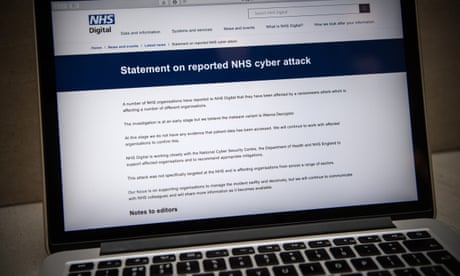
The attack that temporarily crippled the NHS in Britain and dozens of other institutions across Europe and Russia reveals the failure of the US government’s protocols for warning software developers and the private sector about system vulnerabilities, a cyber-security expert told the Guardian.

Under the vulnerability equities process (VEP) established by the US government, US intelligence agencies are supposed to collectively determine whether to disclose a vulnerability it has obtained or discovered – so the software developer has a chance to fix the problem – or withhold the information to use the flaw for offensive or defensive purposes.

“The NSA is supposed to lead the vulnerability equities process with all the other government agencies gathered round to discuss their interests in the vulnerability, and to weigh the offensive capabilities against defensive concerns for the private sector and US interests,” said Adam Segal, the director of the digital and cyberspace policy program at the Council on Foreign Relations. The EternalBlue-WannaCry attack showed that the NSA did not reveal the vulnerability it had discovered before it was stolen and apparently auctioned off, Segal said.

The US government has consistently indicated it is predisposed to releasing vulnerabilities and leaning toward taking a defensive position. In testimony, NSA director Mike Rogers has said the intelligence agencies revealed close to 90% of vulnerabilities they discover.

According to Segal, the Shadow Brokers case and Wikileaks’ recent ‘Vault 7’ release of CIA hacking tools have led to increasing suspicion that may only be true given a narrow definition of vulnerability.

23 June 2017

*** PAKISTAN’S ANXIETIES ARE INCURABLE, SO STOP TRYING TO CURE THEM

C. CHRISTINE FAIR

CORRECTION: This article originally and unfortunately referred to Moeed Yusuf as a proxy of Pakistani officials. Due to a serious editorial lapse, for which I take personal responsibility, this was not removed prior to publication. It absolutely should have been removed and we are implementing stricter editorial practices to help ensure something like this does not happen again.

Dr. Yusuf is a well-regarded and valuable member of the South Asia security community. War on the Rocks does not endorse Prof. Christine Fair’s baseless characterization of him as a “proxy” and we regret that we published it due to an oversight. Dr. Yusuf’s body of work on democracy, militancy, and a host of other issues offers valuable contributions to U.S. policymakers, academics, government officials, and security practitioners. We offer our sincere apologies to Dr. Yusuf as well as to our readers who rightly hold us to a higher standard. It is absolutely vital that we engage in public debate without personal attacks. -Ryan Evans, editor-in-chief

For the last 16 years, the Washington policy community has debated how the United States should deal with its problematic partner in its war in Afghanistan: Pakistan. During the Obama administration, there was a growing consensus that Pakistan was the problem, even if there was no agreement on how to manage it. Despite disagreements, at the end of the Obama administration, there was a grudging acknowledgment that the Washington needed

*** Iran, Russia, and the Taliban: Reassessing the Future of the Afghan State


By Amin Tarzi

The first combat zone utilization of the GBU-43/B Massive Ordnance Air Blast (MOAB) device by the U.S. forces in Afghanistan (USFOR-A) on 13 April 2017 brought the Islamic State–Khorasan Province (ISKP) to the headlines. ISKP emerged in Afghanistan and Pakistan in early 2015 after individuals and groups of militants pledged their allegiance to Abu Bakr al-Baghdadi, the leader of ISIS. This ISIS affiliate became operational after only a few months. While the ISKP represents a danger to the stability of Afghanistan and Pakistan and to the wider region including India and Central Asia, the outfit has become a vehicle to legitimization of the growing internationalization of the wider Afghan conflict, particularly in changing the calculus of Iran and Russia vis-à-vis the Taliban, and it has the potential of becoming a tool for proxy warfare in Afghanistan evocative of the mid-1990s.

ISKP and the Taliban: Taking Different Paths

Since its emergence in the mid-1990s, the Taliban sought international legitimacy, unlike the self-identified Islamic State. The initial proclamations of the Taliban’s Islamic Emirate were mostly Afghan-centric. However, with the cementing of their ties with al-Qaeda after capturing Kabul in 1996, their views took on a more pan-Islamist outlook.1 Retrospectively, the strategies of the Taliban and those of al-Qaeda differed fundamentally, as the former wanted to become a national movement and be recognized by the international community as such, while the latter wanted to keep Afghanistan in a perpetual state of anarchy, utilizing it as a base for waging global jihad. In a 2012 study on Taliban’s attitudes towards reconciliation, most respondents agreed that al-Qaeda was responsible for derailing the Taliban’s initial aim of establishing an Islamic state in Afghanistan.2 Currently, the majority of the Taliban has returned to the founding Afghanistan-centric principles of the movement with an arguably less religiously zealous message, calling on Muslims to avoid extremism in religion with the goal of becoming a legitimate force in the political arena of the country as well as in the international calculations on Afghanistan. Perhaps learning from their initial mistakes, the reemerging Taliban has tried to speak for the totality of Afghanistan, including providing assurances that they will respect the rights of the Shi‘a and other minorities within the country. Nevertheless, the Taliban remains a violent insurgency and is very keen not only on retaining its monopoly over this violence, but also on controlling and managing it to help calibrate the reactions of both domestic and foreign actors.3

***ISIS Captures Tora Bora, Once Bin Laden’s Afghan Fortress


By ROD NORDLAND

KABUL, Afghanistan — Tora Bora, the mountain redoubt that was once Osama bin Laden’s fortress, fell to the Islamic State early Wednesday, handing the extremists a significant strategic and symbolic victory, according to Afghan officials and local elders and residents.

Taliban fighters who had previously controlled the extensive cave and tunnel complex fled overnight after a determined, weeklong assault by the Islamic State, also known as ISIS or ISIL, according to villagers fleeing the area on Wednesday.

Hazrat Ali, a member of Parliament and a prominent warlord from the area who helped the Americans capture Tora Bora from Al Qaeda in 2001, said that the offensive was prompted by the American decision to drop the so-called mother of all bombs on an Islamic State network of tunnels in Achin District in April. The 20,000-pound bomb was thought to be the largest non-nuclear bomb ever deployed.

The Islamic State then decided to shift its refuge to the Tora Bora caves and tunnels, Mr. Ali said. “Some 1,000 ISIS militants were gathered close to Tora Bora, to capture the area,” Mr. Ali said. “I informed government forces to target them, and I told them they are trying to capture Tora Bora, but they did not pay attention.”

A local Afghan police official confirmed that the fortress had fallen. “ISIS has captured Tora Bora and areas around it,” he said. “The tribal elders are here in my office. They all escaped the area last night.” He spoke on the condition of anonymity because he was not authorized to speak to the news media.

*** A Coalition of the Less-Than-Willing

By George Friedman

It’s been almost 16 years since the United States responded to 9/11 by going to war in Afghanistan, and 14 years since the United States invaded Iraq. Neither war has been successful, and there is no reason to believe that either is going to succeed if it continues to be fought as it is. Indeed, it’s been some time since they’ve been fought with any expectation of success. They have been fought in large part because neither George W. Bush nor Barack Obama were prepared to admit failure. Domestic consequences in the U.S. would be grave, but there was also legitimate fear that abandoning the wars would result in the creation of radical Islamist states in the region and the toppling of governments that the U.S. regarded as, at best, preferable to the radicals.

The wars turned into a holding pattern whose primary purpose was to keep al-Qaida, the Taliban and, now, the Islamic State off balance, destroying their capabilities in some areas but ideally destroying the groups themselves. But this was wishful thinking. The U.S. did not have enough forces in either theater to eliminate groups like the Taliban and IS. And it was a mistake to believe the destruction of the groups would mean the destruction of the jihadist movement. Instead, it spawned new flag bearers for the movement. Further, the idea that these operations reduced the amount of terrorist activity was becoming dubious. There were no more attacks on the scale of 9/11, but there were several smaller attacks that went on despite the wars.

The Wrong Approach

** Pentagon Cyberwarriors Find Fertile Ground in Silicon Valley

By Sandra Erwin

It is virtually unheard of in government contracting for the Defense Department to be brief and straightforward in stating requirements.

So it was a surprise when a Pentagon solicitation this month for cybersecurity software was summed up in a single sentence: “The Department of Defense is interested in systems to automatically find previously unreported vulnerabilities in software without source code and automatically generate patches to remediate vulnerabilities with minimal false positives.”

The time window to bid on this opportunity also is unusually short. Responses will be accepted only from June 12 to June 20.

This is how business is done at the Defense Innovation Unit Experimental, known as DIUx. The Pentagon’s two-year-old enclave in Silicon Valley has moved rather quickly to shake up the contracting culture — and to prove that it is more interested in getting results than in forcing vendors to deal with red tape.

Necessity has forced the Pentagon to make innovation a top priority, especially in the cybersecurity field as the U.S. government and military information networks face unprecedented threats from hackers and malware. DIUx is being challenged to find solutions, and fast.

In technology-rich Silicon Valley, it falls on DIUx to spot relevant products, test them and select the ones that best solve problems for the Defense Department. DIUx has 40 people based in Mountain View, Calif., and smaller offices in Boston and Austin, Texas.

** Information Warfare: THAAD The Hack Attack Magnet


June 11, 2017: In May 2017 the United States revealed that it had sent one of its few cyber protection teams to defend the THAAD (Terminal High Altitude Area Defense) battery sent to South Korea earlier and declared operational in April. This anti-missile unit is considered a major target for hackers. Each THAAD battery consists of two or more launcher vehicles (each with eight missiles stored in canisters they are fired from), a fire control and communications system and a TPY-2 X-Band radar (or equivalent radar or radars). THAAD missiles weigh 836 kg (1,400 pounds) and are about the same size as the Patriot anti-aircraft missile and have a range of 200 kilometers and max altitude is 150 kilometers. THAAD is intended for stopping short (like SCUD) or medium range (up to 2,000 kilometer) range ballistic missiles. To work properly the battery depends a lot of networks for quickly transmitting target and other data. Since China, Russia and North Korea all have excellent network hacking capabilities and have been hostile to the stationing of a THAAD battery in South Korea, it was expected that the THAAD networks would be subject to penetration and disruption attempts by foreign hackers.

Neither the THAAD nor the cyber protection teams have had any real combat experience. THAAD has been successful in tests but the army is still seeking a realistic way to test the effectiveness of the cyber protection teams. The tense situation in South Korea could be the first real test of both new systems. At the moment THAAD seems more likely to succeed, but only if the untried cyber protection teams can keep numerous and determined hackers out.

The army knows it has a major problem with cyber protection as do the other services (air force, navy and marines). This was made clear after U.S. Army established its first Cyber Protection Brigade in late 2014. There were plans to create two more brigades by 2016. That did not happen because the army in particular and the military in general could not create or recruit enough qualified personnel. There were other problems but the key difficulty was a shortage of qualified people to staff the key units; the cyber protection team.

* Google ramps up efforts to combat online terrorism, recruitment efforts


by Paige Williams

Google announced Sunday that it is taking additional steps to prevent online terrorism using Google-owned platforms, according to a company blog post.

The company denounced the use of its websites to disseminate terrorist recruitment materials, most prominently YouTube, calling on industry to step up and participate in prevention.

“While we and others have worked for years to identify and remove content that violates our policies, the uncomfortable truth is that we, as an industry, must acknowledge that more needs to be done,” said Kent Walker, senior vice president and general counsel of Google.

Google, and similar companies that own social media websites, must toe the line between freedom of speech and responsibility for security. Google stated that their increased efforts are a good balance between the two.

Its four-pronged mission intensifies the technological efforts it has already taken against extremist content.

Ideas and ivory towers

Written by Dinesh Singh 

The Indian readymade garments industry has been a vital enabler of our export trade. Each year it exports to the West, ready-to-wear apparel worth several billion dollars. Trade analysts, in the recent past, have been quite gung-ho about this sector’s prospects. Where do countries like India, China and others in the region derive the strength that adds so much value to their economies? It is not as if nimble fingers and skilled tailoring hands do not exist in developed nations. The answer lies is in the availability of cheap labour. Unfortunately, this advantage is likely to disappear in the near future. Just as worrying is the obliviousness of this looming danger on the part of our policy and decision-makers.

We simply need to delve into the realm of robotics and artificial intelligence to gauge the situation. A former professor of robotics at the Georgia Institute of Technology has helped create a robotic tailor that can stitch a perfect circle: If you can stitch a perfect circle, then you can perform almost any complicated sewing task that, in the past, could only have been undertaken by skilled and experienced hands. The only seemingly viable option for the garments industry in the Asian region is to seek to import such machines. There goes a part of our plan to keep unemployment figures down.