2 November 2017

INTERNET GOVERNANCE

I have some interest in matter cyber. When I attend seminar/discussions on cyber related issues I often hear of Internet Governance Multi Stake Holder Approach, UNGGE, Net Mundial etc.

Being a GD person most of these go over my head.

I decided to understand what is these all about.

My first take on Internet Governance is given below.

Watch this space for some more including some controversial observation ! 

INTERNET GOVERNANCE

                                                                           - Maj Gen P K Mallick,VSM (Retd)

The Internet is often described as a “network of networks” because it is not a single physical entity, but hundreds of thousands of interconnected networks linking hundreds of millions of computers around the world. As such, the Internet is international, decentralized, and comprised of networks and infrastructure largely owned and operated by private sector entities. Computers connected to the Internet are identified by a unique Internet Protocol (IP) number that designates their specific location, thereby making it possible to send and receive messages and to access information from computers anywhere on the Internet. Domain names were created to provide users with a simple location name, rather than requiring them to use a long list of numbers. The domain name system (DNS) is the distributed set of databases residing in computers around the world that contain the address numbers, mapped to corresponding domain names. Those computers, called root servers, must be coordinated to ensure connectivity across the Internet.

The Internet is often described as a “network of networks” because it is not a single physical entity, but hundreds of thousands of interconnected networks linking hundreds of millions of computers around the world. As such, the Internet is international, decentralized, and comprised of networks and infrastructure largely owned and operated by private sector entities. As the Internet grows and becomes more pervasive in all aspects of modern society, the question of how it should be governed becomes more pressing.

Currently, an important aspect of the Internet is governed by a private sector, international organization based in California called the Internet Corporation for Assigned Names and Numbers (ICANN). ICANN manages and oversees some of the critical technical underpinnings of the Internet such as the domain name system and Internet Protocol (IP) addressing. ICANN makes its policy decisions using a multistakeholder model of governance, in which a “bottom-up” collaborative process is open to all constituencies of Internet stakeholders.

National governments have recognized an increasing stake in ICANN policy decisions, specially in cases where Internet policy intersects with national laws addressing such issues as intellectual property, privacy, law enforcement, and cybersecurity. Some governments around the world are advocating increased intergovernmental influence over the way the Internet is governed. For example, specific proposals have been advanced that would create an Internet governance entity within the United Nations (U.N.). Other governments (including the United States), as well as many other Internet stakeholders, oppose these proposals and argue that ICANN’s multistakeholder model is the most appropriate way to govern the Internet.

One working definition was developed at the World Summit on the Information Society (WSIS) in 2005: Internet governance is the development and application by governments, the private sector and civil society, in their respective roles, of shared principles, norms, rules, decision-making procedures, and programmes that shape the evolution and use of the Internet

The U.S. government has no statutory authority over the DNS. However, because the Internet evolved from a network infrastructure created by the Department of Defense, the U.S. government originally funded and operated (primarily through private contractors) many of the key components of the network architecture that enabled the domain name system to function.2 In 1998, with the Internet expanding beyond the academic and governmental spheres, the U.S. government transitioned the management of the DNS to a newly created not-for-profit international organization based in California called the Internet Corporation for Assigned Names and Numbers (ICANN).3 ICANN employed (and continues to employ) a multistakeholder system of governance whereby policy decisions are made by a Board of Directors with input from the various stakeholder groups that comprise the Internet and the domain name system. These stakeholders include owners and operators of servers and networks around the world, domain name registrars and registries, regional IP address allocation organizations, standards organizations, Internet service providers, local and national governments, noncommercial stakeholders, business users, intellectual property interests, and others.

On March 14, 2014, NTIA announced its intention to transition its stewardship role and procedural authority over key domain name functions to the global Internet multistakeholder community.11 NTIA’s stated intention was that it would let its IANA functions contract with ICANN expire on September 30, 2015, if a satisfactory transition could be achieved. Role of Congress in the IANA Transition Concerns have arisen in Congress over the proposed transition. Some Members have argued that the transition requires additional scrutiny by Congress, while others have questioned whether the transition should take place at all. While the U.S. government has no statutory authority over ICANN or the DNS, Congress does have legislative and budgetary authority over NTIA, which is seeking to relinquish its contractual authority over the IANA functions. As such, Congress has keenly monitored the progress of the transition, primarily through congressional committees with jurisdiction over NTIA. These include the House Energy and Commerce Committee and the Senate Commerce, Science, and Transportation Committee. Additionally, the House and Senate Appropriations Committees—which determine and control NTIA’s annual budget—could impact NTIA’s ability to relinquish its existing authority over the IANA functions.

Debate over Future Models of Internet Governance

Given its complexity, diversity, and international nature, how should the Internet be governed?

Some assert that a multistakeholder model of governance is appropriate, where all stakeholders (both public and private sectors) arrive at consensus through a transparent bottom-up process. Others argue that a greater role for national governments is necessary, either through increased influence through the multistake holder model, or under the auspices of an international body exerting intergovernmental control.

As part of the debate over an appropriate model of Internet governance, criticisms of ICANN have arisen on two fronts. One criticism reflects the tension between national governments and the current performance and governance processes of ICANN, whereby governments feel they lack adequate influence over ICANN decisions that affect a range of Internet policy issues. The other criticism has been fueled by concerns of many nations that the U.S. government has held undue legacy influence and control over ICANN and the domain name system.

The debate over multistakeholderism vs. intergovernmental control initially manifested itself in 2005 at the World Summit on the Information Society (WSIS), which was a conference organized by the United Nations. More recently, this debate has been rekindled in various international for a.

NETmundial

The day after the Montevideo Statement was released, the President of ICANN met with the President of Brazil, who announced plans to hold an international Internet governance summit in

April 2014 that would include representatives from government, industry, civil society, and academia. NETmundial, which was described as a “global multistakeholder meeting on the future of Internet governance,” was held on April 23-24, 2014, in Sao Paulo, Brazil.38 The meeting was open to all interested stakeholders, and was intended to “focus on crafting Internet governance 

NETmundial

The day after the Montevideo Statement was released, the President of ICANN met with the President of Brazil, who announced plans to hold an international Internet governance summit in

April 2014 that would include representatives from government, industry, civil society, and academia. NETmundial, which was described as a “global multistakeholder meeting on the future of Internet governance,” was held on April 23-24, 2014, in Sao Paulo, Brazil.38 The meeting was open to all interested stakeholders, and was intended to “focus on crafting Internet governance.

Internet Governance and Terrorism

With ongoing concern over the use of the Internet by terrorist organizations, the question has arisen whether Internet governance mechanisms could be used to combat the use of the internet by terrorist entities. Traditionally, nation-states can govern the use and content of the Internet within their national boundaries and many have the authority, pursuant to their respective national laws, to monitor, block, and/or shut down websites within their borders.49 In some instances, these powers and actions have been controversial when, for example, antiterrorism concerns may be used to justify censorship or the suppression of free speech on the Internet.50 On an international level, governance of the Internet with respect to its content and use is problematic. As discussed earlier in this report, the Internet is decentralized and its functioning relies on the cooperation and participation by mostly private sector stakeholders around the world. As such, there is no international governance entity that currently has authority to remove global Internet content used to promote terrorism. While there have been proposals to establish some level of authority over the Internet by the United Nations, these proposals have originated, for the most part, from regimes such as China, Russia, and Iran, and have been consistently opposed by the United States and other Western nations who fear that increased United Nations authority over the Internet would ultimately support censorship and suppression of free speech.51

Could ICANN—a functioning model of nongovernmental multistakeholder Internet governance—be deployed to restrict or limit the use of the global Internet by terrorist groups? Currently, ICANN administers the technological infrastructure of the Internet (domain names, Internet protocol numbers and standards) and explicitly does not regulate Internet content. Any attempt to change ICANN policy toward regulating Internet content would likely be strongly opposed by most of the Internet stakeholders who administer and set policy for ICANN through a consensus process.

Finally, the ongoing debate over Internet governance will likely have a significant impact on how other aspects of the Internet may be governed in the future, especially in such areas as intellectual property, privacy, law enforcement, Internet free speech, and cybersecurity. Looking forward, the institutional nature of Internet governance could have far-reaching implications on important policy decisions that will likely shape the future evolution of the Internet. 

One of the important ways that the Internet differs from other telecommunications technologies is in how much it depends on voluntary co-operation. The Internet is a network of networks (of networks, and so on), and each network operates more or less independently. The networks cooperate with one another, without a lot of central co-ordination, because it is in their independent interests to do so. In this way, the Internet is something like a market economy: people trade (goods in the economy, “packets” on the Internet) because they each get something out of it. In my view, it is the very alignment of each operator’s interests with the outcomes that has allowed the Internet to grow and flourish, such that it is a dominant communications technology of our time. In a centrally-organized and centrally-operated system, controls over how people configure systems would be imposed by the center. Centrally-managed systems tend to be expensive or hard to operate (or both) when they get very large. But the Internet is distributed, because in a network of networks there is no center. In a distributed environment, it’s often easier if one has clues about how to get started interoperating with others. Those clues are the IANA registries. They fall into three broad categories, which I describe below

under the U.S. Constitution, freedom of speech is an extremely broad right, but in many other countries, there are significant constraints on freedom of speech in the interests of preventing, for instance, hate speech. If ICANN adopts the more common and limited interpretation of free speech in its human rights commitment, it could create means for governments or businesses to use ICANN to moderate content.

It does not engender great confidence in ICANN that, at the same time it is seeking greater independence from governmental authorities, it turns to those same authorities for assistance in resolving controversial matters within its remit. As the transition moves forward, ICANN will need to develop the institutional maturity to deal with controversies of this sort independently.

Nearly half of the world’s population, including almost everyone in the United States, uses the Internet for business or personal purposes and pursuits, and it has become a critical vehicle for research, discourse, and commerce. ICANN plays an important role in maintaining the safety, security, reliability, and openness of the Internet, and it is necessary that it remain accountable and transparent.

The proposed changes to ICANN provide numerous improvements and tools for enhanced accountability, but there are also uncertainties. The proposal is a blueprint for an accountable institution, but it is unclear whether the result will be sound or whether the ICANN community can or will act responsibly and in a timely manner to hold ICANN accountable. no multistakeholder system that can be devised will ever be as effective at protecting a free and open Internet as the current United States government oversight system.

Daniel Sepulveda, 3 the Deputy Assistant Secretary of State and U.S. Coordinator for International Communications and Information Policy in the State Department’s Bureau of Economic and Business Affairs (EB) 4 and Lawrence E. Strickling, the Assistant Secretary of Commerce for Communications and Information and Administrator, National Telecommunications and Information Administration, is that the Internet is already being fractured by China which has developed an alternate root zone system as well as a separate naming convention. Sepulveda and Strickling write, “The digital economy has become one of the most powerful engines for global economic growth. If left unchanged, China’s regulations would undermine some of the most fundamental aspects of the Internet –- openness, reliability, and interoperability –- within China. By creating its own rules for domain name management, China is threatening to fragment the Internet, which would limit the Internet’s ability to operate as a global platform for human communication, commerce, and creativity.”

And those who believe that the IANA functions transition would temporarily stem China’s threat to fracture the Internet, need only look at China’s attempted censorship demands on the .XYZ top level domain name where the government of China demanded last year that the owner not allow 12,000 different words be accepted as domain names including “liberty” and “democracy” as revealing the terrible potential cost of maintaining the Internet’s “interoperability.” 

Cruz, Lee and Lankford continue writing, “However any provision, such as human rights, that is included in ICANN’s bylaws automatically becomes an integral part of ICANN’s core mission and, in this case, could provide a gateway to content regulation.”

The United States government stands as the protector of freedom on the Internet. Vendors like ICANN help bring specific expertise to manage the day to day operations of the Internet, and the system functions well when the United States government plays its oversight role to prevent abuse. Absent the U.S. government’s light handed oversight, the idea of a free and open Internet will certainly become a thing of the past.

The Internet as we know it depends on there being a single, authoritative source for the names and numbers in order to work. For, while the government-overseen contracts and agreements are in place to establish the rules of the road, ICANN, Verisign, the regional registries, etc. are all shielded from antitrust scrutiny. Such pitfalls of collusion, monopoly power and price gouging might have arisen otherwise if the Internet had been brought up singularly in the private sector. Instead today’s single, usable and affordable Internet, again, is a virtue of U.S. oversight. It is a monopoly, yes, but a regulated one that can be pulled back if needs be, where claims of U.S. government property over the IANA functions act simply as a failsafe — just in case anything goes wrong. We must consider whether trading the current system for a single, unaccountable monopoly beyond law or competition, or one that could be subject to antitrust suits the moment it engages in anticompetitive activities, splintering the Internet, could actually be a far worse outcome. Antitrust law challenges to the IANA functions were fully anticipated in the 1998 statement of policy: “Applicable antitrust law will provide accountability to and protection for the international Internet community. Legal challenges and lawsuits can be expected within the normal course of business for any enterprise and the new corporation should anticipate this

Some governments have expressed concerns that the transition proposal limits governments’ ability to participate in the ICANN community on equal terms with other stakeholders. This is because, post-transition, government participation in ICANN policy development will be limited to a purely advisory role within the Governmental Advisory Committee (“GAC”). The new ICANN bylaws confine the GAC in two important ways. First, GAC “advice” to the ICANN Board requires “consensus,” defined as general agreement in the absence of any formal objection by any government, including the United States. Second, GAC advice can be rejected by a 60 percent vote of the Board, and government representatives cannot serve on the Board. Thus, in order for governments to dictate Board action, they would first need to obtain consensus (unanimous agreement) within the GAC, an organization in which the United States and other like-minded countries take an active role. Thereafter, any advisory decision still could be rejected by a 60 percent vote of the Board. The consequence of these developments is that governments that failed to capture ICANN during the transition process now are refocusing their efforts on other venues, including the United Nation’s International Telecommunication Union (“ITU”). In June, the presidents of China and Russia issued a joint statement supporting a multilateral global Internet governance system and “maintain[ing] [the] UN’s important role in setting up global Internet governance mechanisms.” Russia, China, Saudi Arabia, and others also are focusing on the ITU’s upcoming World Telecommunication Standardization Assembly (“WTSA”), which will address several important Internet public policy issues. The ITU will be an important setting for post-ICANN debates about the appropriate role for governments in Internet policy. Governments that failed to gain influence over ICANN are turning their attention back to the ITU. In June, the presidents of China and Russia issued a joint statement supporting a multilateral global Internet governance system and “maintain[ing] [the] UN’s important role in setting up global Internet governance mechanisms.” In October, the ITU’s World Telecommunication Standardization Assembly (“WTSA”) will convene, with an agenda likely to include a wide range of Internet-related issues. Governments like Russia, Saudi Arabia, China, and others are trying to expand the ITU’s activities at WTSA further into Internet public policy-related issues. As a result, I do not believe that governments will discontinue their efforts to expand government authority over the Internet—rather, those efforts are shifting to the ITU and other venues. Promoting and protecting a thriving Internet will require continued engagement in the global debate and ensuring that Internet governance mechanisms remain open, transparent, and representative of all relevant stakeholders. The transition will ensure that non-governmental stakeholders, including U.S. industry, will have front row seats in discussions about the Internet’s future – making it easier, though no less challenging, to keep it free and open for future generations.

Supporters of the transition45 argue that by transferring its remaining authority over ICANN and the DNS to the global Internet community, the U.S. government will bolster its continuing support for the multistakeholder model of Internet governance, and that this will enable the United States to more effectively argue and work against proposals for intergovernmental control over the Internet.

Those opposed, skeptical, or highly cautious about the transition48 point out that NTIA’s role has served as a necessary “backstop” to ICANN, which has given Internet stakeholders confidence that the integrity and stability of the DNS is being sufficiently overseen. Critics assert that in the wake of the Edward Snowden NSA revelations, foreign governments might gain more support internationally in their continuing attempts to exert intergovernmental control over the Internet, and that any added intergovernmental influence over the Internet and the DNS would be that much more detrimental to the interests of the United States if NTIA’s authority over ICANN and the DNS were to no longer exist.

Another concern regards the development of the transition plan and a new international multistakeholder entity that would provide some level of stewardship over the DNS. Critics are concerned about the risks of foreign governments—particularly repressive regimes that favor censorship of the Internet—gaining influence over the DNS through the transition to a new Internet governance mechanism that no longer is subject to U.S. government oversight The future of how ICANN and the DNS will be governed is highly relevant to the broader question of how the Internet should be governed. While it is true that ICANN’s jurisdiction is limited to the technical underpinnings of the Internet (unique Internet identifiers such as domain names and addresses), it is also true that ICANN policy decisions (such as new gTLDs) can affect other areas of Internet policy such as intellectual property, cybersecurity, privacy, and Internet freedom.

As the Internet expands and becomes more pervasive throughout the world in all aspects of modern society, the question of how it should be governed becomes more pressing, with national governments recognizing an increasing stake in ICANN policy decisions, especially in cases where Internet DNS policy intersects with national laws and interests. ICANN is viewed by many as a ground-breaking example of multistakeholder governance. While ICANN does not “control” the Internet, how it is ultimately governed may set an important precedent in future policy debates—both domestically and internationally—over how the Internet might be governed, and what role governments and intergovernmental organizations should play.

Who should attend? ICANN meetings are all about participation, collaboration, and finding solutions to the small – and large – problems that the Internet constantly faces. As a meeting attendee you could be from almost any profession and from any corner of the planet. ICANN is setup to allow everyone affected by its work – and that is pretty much everyone – to have a say in its processes. To ensure that the organization stays flexible and changes to meet the needs and demands of a rapidly changing Internet, not only do the SOs, ACs, and the Board go through regular reviews, but ICANN also maintains a strong culture of general public participation. Typical attendees include government representatives, business managers, IT managers and consultants, DNS industry managers and experts, intellectual property managers, academics, and others invested in the continuing stable, secure and resilient operation of the Internet. End users are also well represented. If you prefer to participate remotely, there are a wide range of mechanisms that make that possible.

*** Catalonia Takes the Independence Leap


The standoff over Catalan independence has entered a new phase of political fragility, economic uncertainty and social unrest. On Oct. 27, the Catalan parliament approved to unilaterally declare independence from Spain. Shortly after, the Spanish Senate authorized a series of measures against the rebellious region, dismissing members of the Catalan government and seizing several Catalan institutions, including the treasury, the interior ministry and the regional police. The central Spanish government in Madrid has no intention of permanently controlling Catalonia. It wants instead to hold regional elections Dec. 21 to elect a new Catalan government, though it will struggle in the meantime to actually enforce its punitive actions.

Up to this point, the Catalan conflict has been characterized by delay tactics, threats and ambiguity from both sides. Catalonia's Oct. 27 declaration of independence makes the conflict more concrete, but no less convoluted. This is the first time since the end of the Spanish Civil War that a region has openly challenged Madrid; it is the first time since Spain's return to democracy in the late 1970s that Madrid has decided to take direct control of an autonomous region's institutions. Whatever happens next, it will be unprecedented.

Sino-Indian Space Race Rivalry Lifts Off


China and India are using satellites in space to win influence and secure their geo-political and economic interests, and while China's program is better funded and more ambitious, India's Indian Space Research Organization is catching up. 

On May 5, India began a new diplomatic push in South Asia by launching the “South Asia satellite” into space. Built and launched by the government-run Indian Space Research Organization (ISRO), the satellite will provide communications and meteorological data to India’s South Asian neighbors. 

The Twists and Turns along China’s Belt and Road

By Michael Kovrig

“The project of the century” is how Chinese Foreign Minister Wang Yi touted the Belt and Road Initiative to the world when addressing the UN General Assembly on 21 September. It was only the latest in a series of pronouncements and events, including a Belt and Road Forum in Beijing in May and the ninth BRICS (Brazil, Russia, India, China and South Africa) summit in Xiamen in early September, choreographed to position China at the vanguard of a new stage of globalisation. Step by step, China is demonstrating that the Belt and Road is now the guiding framework for its international economic statecraft.

How Taliban are evolving to compete in Afghanistan


OCTOBER 26, 2017 KABUL, AFGHANISTAN—The final Taliban threat was the most chilling, the culmination of months of pressure built against a single Afghan policeman – and it worked.

Introducing himself as “the scholar,” the Taliban operative warned that it would be the last phone call, the last threat to convince Ahmad, a veteran of frequent battles with the Taliban with calluses on his shooting hand, to leave the police force.

How a State Department Study Prevented Nuclear War With China

By Franz-Stefan Gady

The People’s Republic of China (PRC) under Mao Zedong was the nuclear “rogue state” of the 1960s in the eyes of the United States. The PRC was viewed by officials in two consecutive U.S. administrations — John F. Kennedy and Lyndon B. Johnson — as both extremist and irrational, a country where the prevailing U.S. Cold War strategies of containment and deterrence would not apply. President Kennedy reportedly saw a nuclear China as “the great menace in the future to humanity, the free world, and freedom on earth.” Lyndon B. Johnson told a reporter in 1964 during the ongoing presidential campaign that “we can’t let [Barry] Goldwater [Johnson’s opponent] and Red China both get the bomb at the same time. Then the shit would really hit the fan.”

China Has New Leaders. What Now?

By Jonathan Brookfield

Well, it’s official. The Chinese Communist Party’s new Politburo Standing Committee (PSC) will consist of seven individuals. Listed in order of seniority, they are: Xi Jinping, Li Keqiang, Li Zhanshu, Wang Yang, Wang Huning, Zhao Leji, and Han Zheng.

With President Xi Jinping (now 64 years old) and Premier Li Keqiang (62 years old) continuing on from the previous PSC, the new line up brings five new faces into China’s highest policy making body.

Why America Could Lose a War with Russia or China

William Adler

The U.S. Military possesses considerable conventional power and reach, but it currently lacks the endurance to prevail in a protracted war against a near-peer opponent. The destructiveness of modern unlimited conventional warfare will rapidly exhaust the existing base force leaving few military options for the nation. 

Incremental improvements in doctrine, global basing, and force structure are all steps in the right direction, but they are fundamentally insufficient to allow the United States to prevail in a large-scale conventional war. 

Iraqi Kurdistan Was Never Ready for Statehood

BY DENISE NATALI

Iraqi Kurdistan’s referendum on independence has made an already bad situation for the Kurds far worse. Instead of enhancing the Kurds’ political leverage and autonomy, it has squandered international goodwill toward them, antagonized Baghdad and its neighbors, and deepened economic risks and societal fissures. It has also spurred the loss of control over important territories and resources. Iraqi security forces have reasserted authority over Kirkuk and its oil assets, other “disputed territories,” and Iraqi border crossings after a negotiated withdrawal of Peshmerga forces.

Raqqa After ISIS Still Needs US Help

BY MONA YACOUBIAN

The group’s ultimate defeat is far from assured, and the United States can play a critical role in precluding the emergence of Islamic State 2.0. 

The liberation of Raqqa in Syria marks a watershed in the campaign against the Islamic State. Both a symbolic and strategic defeat, the fall of the capital of the group’s self-proclaimed caliphate further diminishes its dwindling territory and deprives it of a core element of its defining narrative. Yet the group’s ultimate defeat is far from assured, and the United States can play a critical role in precluding the emergence of Islamic State 2.0.

How Brexit has made Britain the new sick man of Europe


BY GEORGE EATON

In the 1970s, Britain was often more pitied than envied or admired, its economy characterised by little or no growth, high inflation and rising unemployment. This was the era of “stagflation”.

Weary of being outpaced by its continental competitors, the UK belatedly joined the European Economic Community in 1973. In 1976, the plummeting value of the pound forced Jim Callaghan’s Labour government to humiliatingly accept a £2.3bn bailout from the International Monetary Fund, the largest in its three-decade history. Britain became known as “the sick man of Europe” – a label first applied by Russia’s Tsar Nicholas I to the Ottoman empire in 1853. “Britain is a tragedy,” observed the then US secretary of state, Henry Kissinger, in 1975. “It has sunk to begging, borrowing and stealing until North Sea oil comes in.”

Russia Uses Its Oil Giant, Rosneft, as a Foreign Policy Tool

By CLIFFORD KRAUSS

Russia is increasingly wielding oil as a geopolitical tool, spreading its influence around the world and challenging the interests of the United States.

But Moscow risks running into trouble, as it lends money and makes deals in turbulent economies and shaky political climates.

The strategy faces a crucial test this week in Venezuela, a Russian ally that must come up with a billion dollars to avert defaults on its debts.

N. Korea denies involvement in WannaCry cyberattack


North Korea has slammed Britain for accusing it of being behind a global ransomware attack that hit the National Health Service, calling the allegation a "wicked attempt" to further tighten international sanctions against Pyongyang.

A third of Britain's public hospitals were affected by the WannaCry worm in May, according to a government report.

Up to 300,000 computers in 150 countries were hit by WannaCry, which seized systems and demanded payment in Bitcoin to return control to users.

Religion and Ethnicity are Not Indicators of Extremism

By Denys Reva

Counter-terrorism fails when it alienates the very communities it is meant to help.

Counter-terrorism strategies aim to disrupt activities of violent extremist groups and limit the spread of violent ideologies. Recent ISS research, supported by several other studies, suggests that some state responses to terrorism – far from alleviating security concerns – instead exacerbate the problem.

An Army Officer’s Guide to Public Speaking


Right. So I’m just going to put this out here right off: if I have to listen to yet another stumbling, rambling, mispronounced, mumbled, dry, and generally boring as hell briefing from one of my peers, I’m going to find a way to beat someone over the head with their own PowerPoint slides. Seriously, we’ve all been there, right? There’s far little that is worse than a terrible briefing. It adds insult to the already existing injury of the mandatory nature of the briefings. Not only that, but when there’s an officer up there delivering a terrible briefing – no matter the rank – that reflects poorly on all of us. And let’s face it, we already have the deck stacked against us because at one point we were all second lieutenants, and some people don’t forget that.

Five rules for the Army’s Combat Aviation Brigades

By: Todd South 

One year after senior leaders sounded the alarm that Army aviation was in a “deep hole” because of inconsistent funding and high demand overseas, the top general at Forces Command is continuing five rules that he hopes will provide soldiers with some relief.

Last year’s warning from Gen. Robert Abrams came as the Army saw a decrease in manpower and aviation assets.

And while the Army’s aviators are doing “tremendous work,” they also haven’t had time to prepare for a potential fight against a near-peer competitor, Abrams said at the time.

No Safe Place In Next War: The Army’s Expanded Battlefield

By SYDNEY J. FREEDBERG JR.

A soldier from the Army’s offensive cyber brigade during an exercise at Fort Lewis, Washington.

What if the next war starts, not with a gunshot, but with a tweet? As tensions rise, US troops discover their families’ names, faces, and home addresses have been posted on social media as they prepare to deploy, along with exhortations to kill the fascists/imperialists/infidels (pick one). Trolls call them late at night with death threats, a mentally ill lone wolf runs over a soldier’s children, fake news claims the military is covering up more deaths, and official social media accounts are hacked to post falsehoods. The whole force is distracted and demoralized.

Fix the Inadequate Systems that Protect .gov Networks

BY MIKE ROGERS

DHS manages the National Cybersecurity Protection System in a piecemeal fashion using outdated and outmoded technology.

The current National Cybersecurity Protection System is insufficient to manage the threats facing U.S. networks today, let alone tomorrow. The Department of Homeland Security’s approach to defending our government’s network architecture, NCPS is a system of systems that uses a variety of platforms and services intended to detect, analyze, and share threat information as well as filtering malicious code before it appears on government networks. Despite the best of intentions, it hasn’t been very successful.

Zuckerberg’s Preposterous Defense of Facebook

Zeynep Tufekci

Responding to President Trump’s tweet this week that “Facebook was always anti-Trump,” Mark Zuckerberg, the chief executive of Facebook, defended the company by noting that Mr. Trump’s opponents also criticize it — as having aided Mr. Trump. If everyone is upset with you, Mr. Zuckerberg suggested, you must be doing something right.

“Both sides are upset about ideas and content they don’t like,” he wrote in a Facebook post. “That’s what running a platform for all ideas looks like.”

Cyber Enabled Information War Challenges Our Grip on Reality

LEVI MAXEY

One of the opening rounds of an information war between the Kremlin and a democratic country came from Melvin Redick, a fake Facebook account designed to look like your average American – only he was believed to be the handiwork of Russian intelligence.

“These guys show hidden truth about Hillary Clinton, George Soros and other leaders of the US,” Redick’s account posted on June 8, 2016, in the midst of the U.S. presidential campaign. “Visit #DCLeaks website. It’s really interesting!”

1 November 2017

A World in Flux: The Atlantic Community, West Asia, Indo Pacific

I had attended a discussion on “A World in Flux: The Atlantic Community, West Asia, Indo Pacific” at Brooking India available at https://strategicstudyindia.blogspot.in/2017/10/a-world-in-flux-atlantic-community-west.html. Dhruv Jaishankar, the moderator, subtly mentioned Jhon Mearsheimer theory on Europe. One had to see the reaction of Strobe Talbott, President of Brookings Institute.

I being a “GD” person, my fauzi brethren will understand, thought of finding out John J. Mearsheimer theory on US Policy in Europe. 

John J. Mearsheimer is the R. Wendell Harrison Distinguished Service Professor of Political Science and the co-director of the Program on International Security Policy at the University of Chicago, where he has taught since 1982. He graduated from West Point in 1970 and then served five years as an officer in the U.S. Air Force. He then started graduate school in political science at Cornell University in 1975. He received his Ph.D. in 1980. He spent the 1979-1980 academic year as a research fellow at the Brookings Institution, and was a post-doctoral fellow at Harvard University's Center for International Affairs from 1980 to 1982. During the 1998-1999 academic year, he was the Whitney H. Shepardson Fellow at the Council on Foreign Relations in New York.

Mearsheimer proposed the theory of offensive realism which describes the interaction between great powers as dominated by a rational desire to achieve hegemony in a world of insecurity and uncertainty regarding other states' intentions. He was a vocal opponent of the Iraq War in 2003 and was almost alone in opposing Ukraine's decision to give up its nuclear weapons in 1994 and predicted that, without a deterrent, they would face Russian aggression. His most controversial views concern alleged influence by interest groups over US government actions in the Middle East which he wrote about in The Israel Lobby and U.S. Foreign Policy. 

In accordance with his theory, Mearsheimer considers that China's growing power will likely bring it into conflict with the United States. His work is frequently taught to and read by twenty-first century students of political science. Highlights of his theories are :

The Rise and Containment of China

Mearsheimer asserts that China's rise will not be peaceful and that the U.S. will seek to contain China and prevent it from achieving regional hegemony. He believes that China will attempt to dominate the Asia-Pacific region just as, he asserts, the U.S. set out to dominate the western hemisphere. The motivation for doing so would be to gain a position of overwhelming security and superiority against its neighbors which it sees as potential challengers to its status. Additionally, he maintains that the U.S. will attempt to form a balancing coalition that consists primarily of India, Japan, the Philippines, South Korea, Vietnam and Indonesia to counter the growing strength and power projection capabilities of China. He points to increased alliances and warming U.S.–Vietnam and U.S.–India relations as evidence of this.

Nuclear Weapons and Ukraine


After the break up of the Soviet Union, the new independent Ukraine had a large arsenal of nuclear weapons on its territory. However, in 1994 Ukraine agreed to give up nuclear arms, became a member of the Nuclear Nonproliferation Treaty, and within two years had removed all atomic weapons. Almost alone among observers, Mearsheimer was opposed to that decision because he saw a Ukraine without a nuclear deterrent as likely to be subjected to aggression by Russia.

2014 Crimean Crisis

In September 2014 Mearsheimer wrote the article "Why the Ukraine Crisis Is the West’s Fault. The Liberal Delusions That Provoked Putin" published in Foreign Affairs. The essay was highly critical of American policy towards Russia since the conclusion of the Cold War. Mearsheimer argued that Russian intervention in Crimea and Ukraine had been motivated by what he saw as the irresponsible strategic objectives of NATO in Eastern Europe. He compared US-led NATO expansion into Eastern Europe and planned inclusion of Ukraine to the hypothetical scenario of a Chinese military alliance in North America, stating, "Imagine the American outrage if China built an impressive military alliance and tried to include Canada and Mexico."

Mearsheimer argued that Russia's annexation of the Crimea was fueled by concerns that it would lose access to its Black Sea Fleet naval base at Sevastopol if Ukraine continued to move towards NATO and European integration. Mearsheimer concluded that US policy should shift towards recognising Ukraine as a buffer state between NATO and Russia rather than attempting to absorb Ukraine into NATO. Mearsheimer's article provoked Michael McFaul and Stephen Sestanovich to publish their response in November/December 2014 issue of Foreign Affairs.

He had written a remarkable essay on Defining a New Security Architecture for Europe that Brings Russia in from the Cold, published in May-June 2016 issue of Military Review. In this he states the following:

Between 1990 and 2008, all was well in Europe. That was because the West was not a serious threat to Russia. But, that situation began to change in 2008. First of all, there was the NATO summit in Bucharest in April 2008. At the end of that summit, NATO said in no uncertain terms that both Georgia and Ukraine would become part of NATO. The Russians, in response, made it perfectly clear at the time that this was unacceptable. And they made it clear they would go to great lengths to prevent that from happening. Nevertheless, NATO did not back off . Not surprisingly, in August 2008, you had a war between Georgia and Russia, which was in good part a result of the April 2008 decision to eventually include Ukraine and Georgia in NATO. The Georgians thought that NATO would back them if they got into a crisis or a conflict with the Russians. They of course were wrong; nevertheless, that was the first big piece of evidence that trouble was in store in Eastern Europe.

NATO expansion and democracy promotion were the other two underlying strategies. Democracy promotion in principal is an attractive idea to virtually all of us in the West. But, the fact is that democracy promotion in the hands of the United States is mainly about top leaders who are seen as anti-American or anti-West, and putting in their place leaders who are pro-American or pro-West. Of course the Orange Revolution was all about doing just that. Toplling Viktor Yanukovych was all about putting a leader in power in Kiev who would be pro-West

What in particular has to be done? Ukraine has to be turned into a neutral buffer state. The West has to recognize that there is no way it can continue to pursue a set of policies that are designed to make Ukraine a Western bulwark on Russia’s border. The Russians will not tolerate this and will instead go to great lengths to wreck Ukraine to prevent it from becoming part of the West. This is what is going on now. Putin is basically telling the West they have two choices. Either they back off, or he will work to damage Ukraine so badly that it cannot join the West.

If you want to end this crisis, and you care greatly about the Ukrainian people, and you don’t want to see their country destroyed, then it’s imperative that we back off and give up on the idea of making Ukraine part of the West. Instead, we must work to make Ukraine a neutral buffer state, which it was effectively between 1991 and 2014. I am talking here about returning to the status quo ante. I think it’s very unlikely this will happen.

My bottom line is that we had an excellent situation with regard to European security before 2008. And we, meaning the West, blew it big time.

No wonder Strobe Talbott saw red. I leave this to your judgment who is correct.

However, I have the following points.

Where are the International Theorists in India ? 70 years back we got independence we can’t hide behind stating that India is a nascent state. The vociferous academia from JNU and its ilk mostly educated in western renowned universities where they go very often have nothing to show about authoring any new theory. When we will get some theorist ?

Our foreign policy practitioners from the IFS cadre have mostly no formal academic rigorous course/training, though they have the option to undergo high level courses in some of the finest universities of the world teaching International Relations. No wonder a large number of retired IFS fraternity who are present in all such discussion or write on these issues can’t answer the whys. They can only narrate what has happened.

Can you imagine Indian Army War College Journal publishing a paper by a theorist of International Relations.

I welcome some discussion on this issue. 

Chinese engineers plan 1,000km tunnel to make Xinjiang desert bloom

Stephen Chen

The proposed tunnel, which would drop down from the world’s highest plateau in multiple sections connected by waterfalls, would “turn Xinjiang into California”, one geotechnical engineer said.

China’s longest tunnel is the eight-year-old 85km Dahuofang water project in Liaoning province, while the world’s longest tunnel is the 137km main water supply pipe beneath the city of New York.

However, the Chinese government started building a tunnel in the centre of Yunnan province in August that will be more than 600km long, local media reported. Comprising more than 60 sections, each wide enough to accommodate two high-speed trains, it will pass through mountains several thousand metres above sea level in an area plagued by unstable geological conditions.

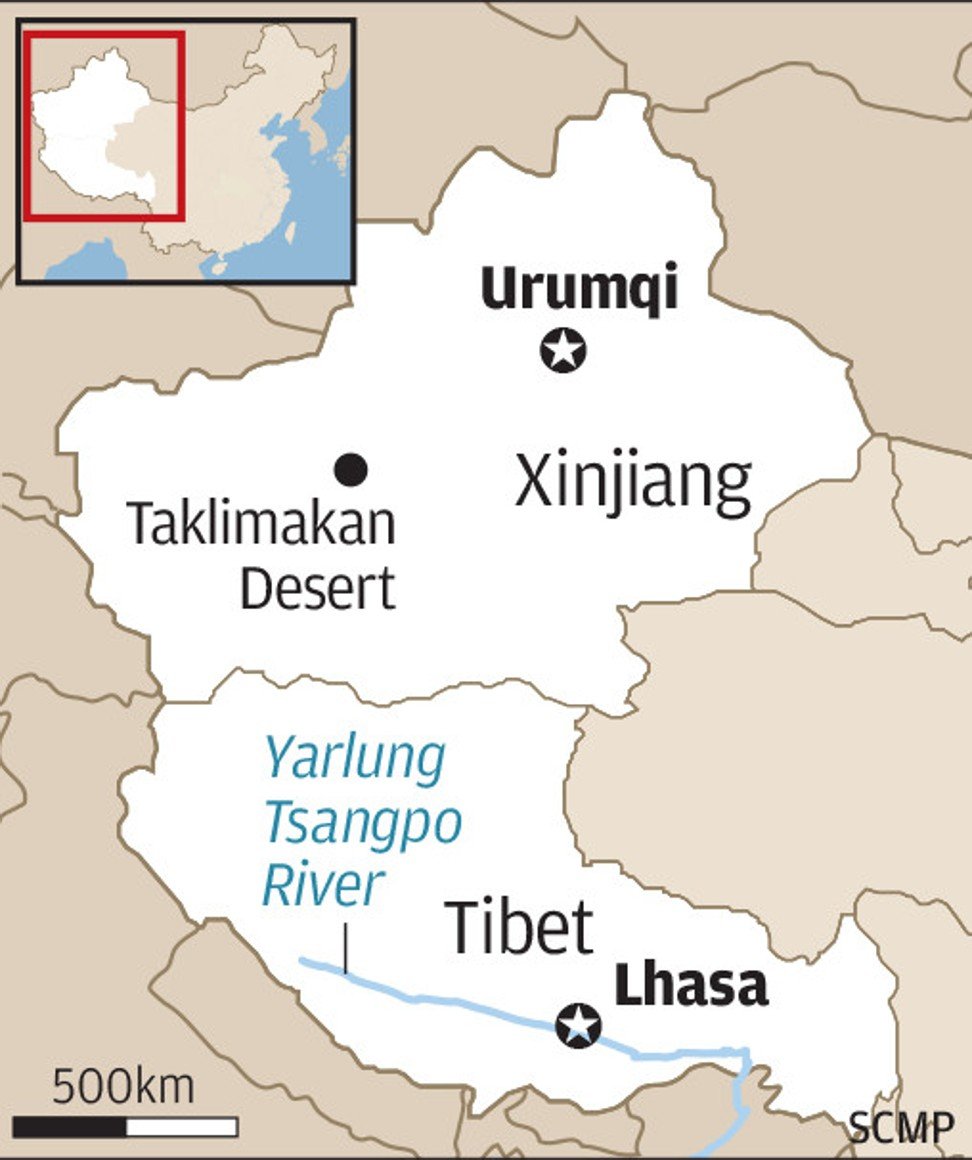
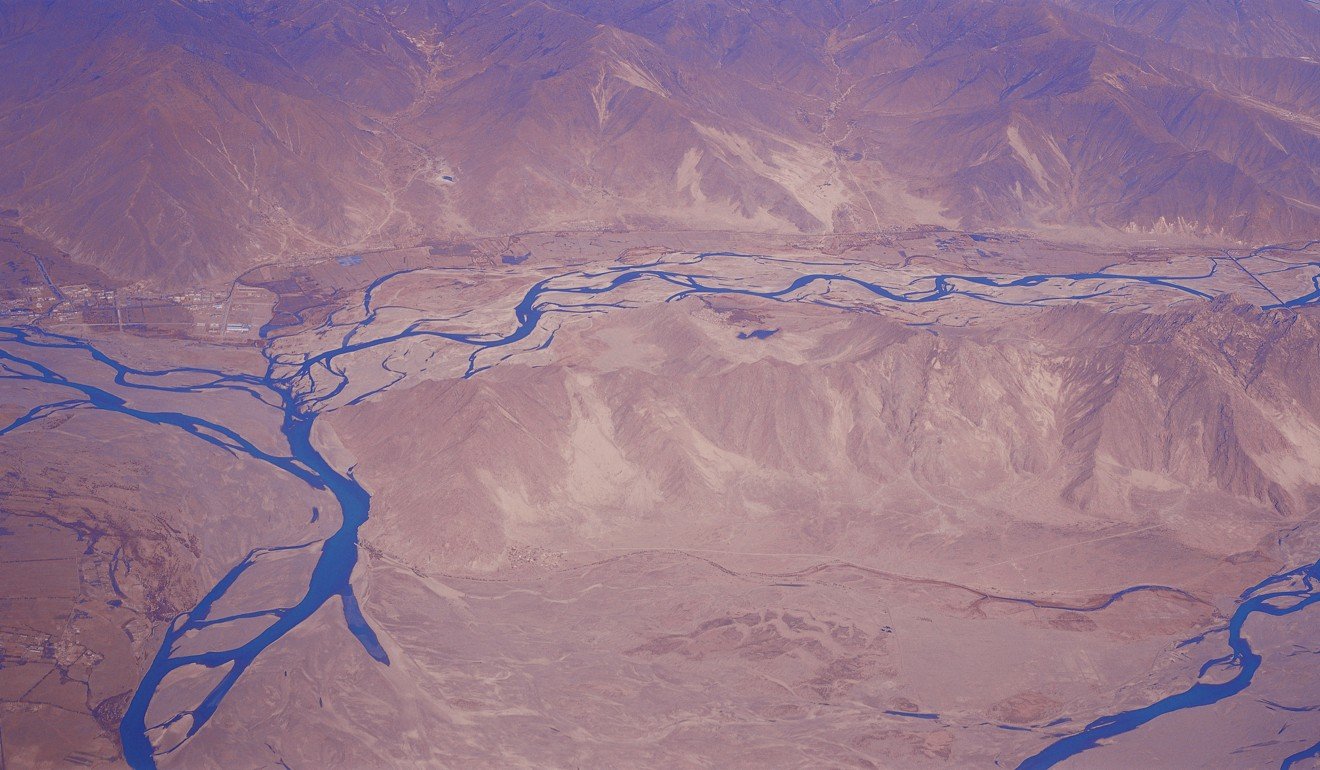
Researchers said building the Yunnan tunnel would be a “rehearsal” of the new technology, engineering methods and equipment needed for the Tibet-Xinjiang tunnel, which would divert the Yarlung Tsangpo River in southern Tibet to the Taklimakan Desert in Xinjiang. Downstream, in India, the river becomes the Brahmaputra, which joins the Ganges in Bangladesh.

The Tibetan Plateau stops the rain-laden Indian Ocean monsoon from reaching Xinjiang, with the Gobi Desert in the north and the Taklimakan Desert in the south leaving more than 90 per cent of the region unsuitable for human settlement.

However, the Taklimakan sits right at the foot of the Tibetan Plateau, which is known as the water tower of Asia. The more than 400 billion tonnes of water it releases each year – almost enough to fill Lake Erie in the United States – also feeds the source of other major rivers, including the Yellow, Yangtze, Mekong (known in China as the Lancang) and the Ganges.

The earliest proposals to divert water from Tibet to Xinjiang were made by Qing dynasty officials Lin Zexu and Zuo Zongtang in the 19th century. In recent decades, Chinese government branches, including the Ministry of Water Resources, have come up with engineering blueprints involving huge dams, pumps and tunnels.

The project’s enormous cost, engineering challenges, possible environmental impact and the likelihood of protests by neighbouring countries have meant it has never left the drawing board, but Zhang Chuanqing, a researcher at the Chinese Academy of Sciences’ Institute of Rock and Soil Mechanics in Wuhan, Hubei province, said China was now taking a quiet, step-by-step approach to bring it to life.

“The water diversion project in central Yunnan is a demonstration project,” said Zhang, who has played a key role in many major Chinese water tunnel projects, including the one in Yunnan. “It is to show we have the brains, muscle and tools to build super-long tunnels in hazardous terrains, and the cost does not break the bank.”

The construction of the tunnel on the Yunnan-Guizhou Plateau, the country’s second-highest, would make political leaders more confident about the Tibet-Xinjiang project and more likely to approve it, he said.

The Yunnan-Guizhou Plateau in southwest China is, like the Tibetan Plateau, an earthquake-prone zone with many active faults.

“Fault zones are our biggest headache,” Zhang said. “If we can secure a solution, it will help us get rid of the main engineering obstacles to getting water from Tibet to Xinjiang.”

The solution they came up with was inspired by subway trains, whose carriages are connected by elastic joints. In the tunnel, Zhang said, flexible materials that were also waterproof and strong would be used to bind concrete pipes together when they passed through fault zones.

The Yunnan tunnel and support facilities will take eight years to build at an estimated cost of 78 billion yuan (US$11.7 billion). It will carry more than three billion tonnes of water each year from northwestern Yunnan to the province’s dry centre and directly benefit more than 11 million people, according to the provincial government.

The Yunnan Daily said the tunnel would create 3.4 million jobs, more than 30,000 hectares of new farmland and give the local economy a 330 billion yuan boost.

Wang Wei, a researcher who helped draft the latest Tibet-Xinjiang water tunnel proposal, which was submitted to the central government in March, said more than 100 scientists formed different teams for the nationwide research effort.

The team he was part of was led by China’s top tunnelling expert, Wang Mengshu. It suggested the government drain the Yarlung Tsangpo River at Sangri county in southern Tibet, near the disputed border with India.

Sangri county featured a large, relatively flat valley that was ideal for the engineering project. An artificial island would be built in the middle of the river to create rapid turbulence, which could filter out sediment, and direct water to a well. The well could control the amount of water flowing into the tunnel.

Wang, a researcher at the State Key Laboratory of Hydraulics and Mountain River Engineering at Sichuan University in Chengdu, said the tunnel would mostly be underground and would be built in many sections. In some places, large boring machines with drill heads around 15 metres wide would be lowered through wells to drill tunnels from opposite directions.

Some of the drops involved would be so steep that the tunnel would be fitted with hydropower turbines to slow the water flow and avoid damage to lower sections.

“No man-made structure can withstand the direct bombardment of water falling from 3,000 to 4,000 metres above,” Wang said.

The researchers estimated the tunnel would be able to carry 10 billion to 15 billion tonnes of water from the Yarlung Tsangpo River to the Taklimakan Desert each year. That’s about a quarter of the annual flow of the Yellow River, the second longest river in China and the cradle of Chinese civilisation.

But the cost would be astronomical. According to Wang’s estimate, each kilometre of tunnel would cost at least one billion yuan due to the difficult terrain and taxing altitude of the Tibetan Plateau.

Wang said the project would also prompt protests from India and Bangladesh, which lay downstream. But compared to other proposals, which would require the construction of massive dams on the river, the underground tunnels would leave Tibet’s natural landscape largely unscathed.

“It won’t leave a mark on the surface for other countries or environmental activists to point their fingers at,” he said.

Zhang said China would definitely go ahead with the project one day.

“In five to 10 years from now, the technology will be ready and the cost affordable, and the temptation of the benefits will be difficult to resist,” he said.

Zhang said the water shortage in Xinjiang was in many ways similar to that in California early in the 20th century. The Central Valley Project, devised in 1933, diverted water from northern California to the San Joaquin Valley, turning it into the world’s most productive agricultural region.

“With new water from Tibet, Xinjiang would boom like California,” he said.

Zhou Shiqiao, a researcher at the Chinese Academy of Sciences’ Institute of Tibetan Plateau Research in Beijing, said the government should study the feasibility and environmental impact of the different proposals extensively before giving the final nod.

“It will change the landscape of an entire region,” Zhou said. “To my knowledge, no environmental evaluation has been carried out. The nature and scale of the impact remains in the dark.”

The Tibetan Plateau, also known as the Third Pole, has been battered by climate change, with its glaciers shrinking and permafrost melting. Some studies have warned that Asia’s water tower might run dry if global temperatures continue to rise.

This article appeared in the South China Morning Post print edition as: Tapping Tibetan river to ease distant thirst