5 February 2018

Debate: India Is Not ‘Self-Destructing’, It’s Being Destroyed Systematically

BY SAJAI JOSE

A startlingly pessimistic vision of India’s looming environmental and economic collapse – aired by a senior business leader – deserves our urgent attention. 

Recently, writing against the backdrop of the unprecedented spike in Delhi’s air pollution, Raghu Raman, the president of Reliance Industries’ risk, security & new ventures division and former CEO of India’s National Intelligence Grid (NATGRID), put forward a starkly apocalyptic vision of the country’s

China’s Understanding of Global Order Shouldn’t Be Ours

BY AARON FRIEDBERG

Niall Ferguson is a prolific public intellectual who has made a career out of shattering shibboleths. At various points he has defended the achievements of the British Empire, argued that the United Kingdom’s entry into the First World War was “the biggest error in modern history,” and made the case at length that Henry Kissinger is a misunderstood idealist.

China needs more nuclear warheads to deter US threat, military says

Minnie Chan

China must expand its nuclear stockpile so it can better deter and hit back at an enemy strike as geopolitical uncertainties mount and the US appears bent on a nuclear build-up, according to the Chinese military’s mouthpiece.

In the PLA Daily on Tuesday, a commentary said China had enough nuclear weapons to prevent “bullying” by other nuclear powers

How China’s military is girding for battle, and what it means for neighbours

Kristin Huang

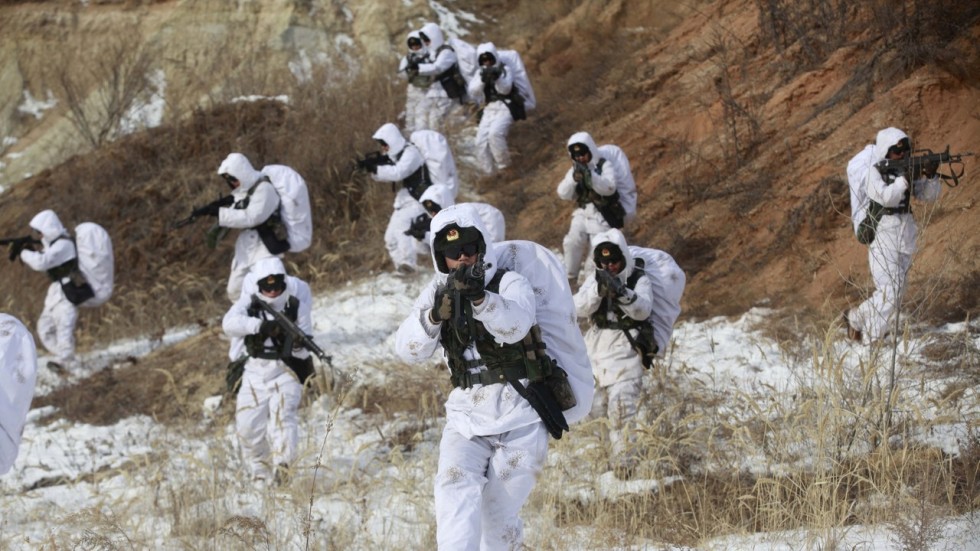
The three young men were not playing a computer game, but soldiers with a special People’s Liberation Army (PLA) brigade undergoing combat training as China’s military ramps up the quantity and quality of its exercises.
Li hid in a river to evade a surveillance drone, while Liu hit 24 targets after fixing his broken rifle in a matter of minutes, the army mouthpiece PLA Daily said in a January 11 report on the training, designed to boost the soldiers’ fighting skills and spirit.

China’s New Role in the Baltic States

Una Aleksandra Bērziņa-Čerenkova

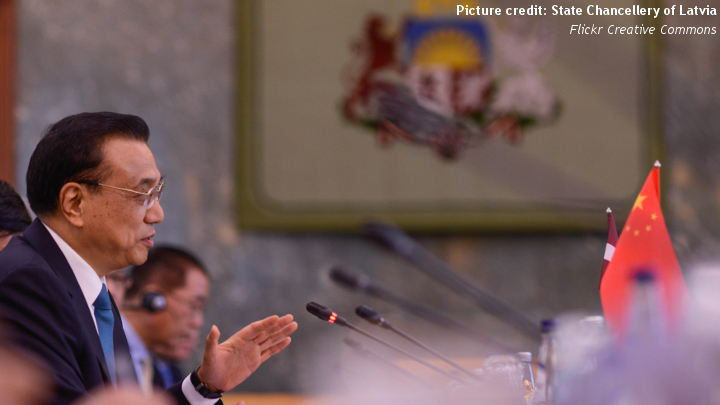
Since its inception in 2012, China’s “16+1” cooperation platform—an initiative aimed at intensifying Beijing’s economic and cultural ties with 16 countries in Central and Eastern Europe—has attracted great speculation about China’s motives and questions about the format’s concrete deliverables. Controversy over Beijing’s proposals to finance critical infrastructure, increase foreign direct investment (FDI), and boost trade has arisen both from within the 16 participating countries and from EU neighbors. In this atmosphere of political ambivalence,

Understanding Turkey’s Afrin Operation

Bulent Aliriza

Q1: Why is Turkey attacking Afrin?

A1: On January 20, Turkey launched a major military operation beyond its southern border code-named “Olive Branch” directed at the Syrian Kurdish canton of Afrin. The move followed months of increasingly harsh statements by President Recep Tayyip Erdogan about the emergence of a belt immediately beyond the Turkish-Syrian border controlled by the Democratic Union Party (PYD) and its armed wing, the People’s Protection Units (YPG), viewed by Turkey as the Syrian Kurdish affiliate of the Kurdistan Workers’ Party (PKK). On January 13, Erdogan had announced that there would be action “within a week…if the terrorists in Afrin do not surrender,” and four days later the Turkish National Security Council

The Ally from Hell: How Pakistan cultivated American dependency while subverting American policy in Afghanistan

Mark Mazzetti

Two months after the 2008 U.S. presidential election, Vice President–elect Joe Biden sat with Afghanistan’s president, Hamid Karzai, in the Arg Palace, an 83-acre compound in Kabul that had become a gilded cage for the mercurial and isolated leader. The discussion was already tense as Karzai urged Washington to help root out Taliban sanctuaries in Pakistan, implying that more pressure needed to be exerted on Pakistani leaders. Biden’s answer stunned Karzai into silence. Biden let Karzai know how Barack Obama’s incoming administration saw its priorities. “Mr. President,” Biden said, “Pakistan is fiftytimes more important than Afghanistan for the United States.”

China and Russia can now kill American satellites

Source Link
 By Harold Hutchison

The United States has long relied on satellites to help the grunts on the ground win fights. Whether it’s enabling reliable communications, guiding weapons, or even telling troops just where in the world they are (though Carmen Sandiego’s precise location still eludes us), satellites play an essential role.

It’s a huge advantage, to put it mildly. Space is the ultimate high ground in warfare today,

Chabahar Port lures Afghan traffic away from Karachi

By F.M. SHAKIL

Afghanistan has shifted 80% of its cargo traffic from Pakistan’s Karachi seaport to Iran’s Bandar Abbas and Chabahar ports. The move comes two months after Chabahar, barely 100 kilometers from Pakistan’s Gwadar port, was inaugurated. The shift, prompted in part by a new trade tariff imposed by Islamabad, is expected to greatly reduce Pakistan’s role in the transit of Afghan goods.

The Return of Political Warfare

by Seth G. Jones

The Trump administration’s National Security Strategy and National Defense Strategy outline a U.S. shift from counterterrorism to inter-state competition with China, Russia, Iran, and North Korea. However, U.S. policymakers need to be prepared for much of this competition to occur at the unconventional level, since the costs of conventional and nuclear war would likely be catastrophic.

Bangladesh's New Generation of Militants

By Siddharthya Roy

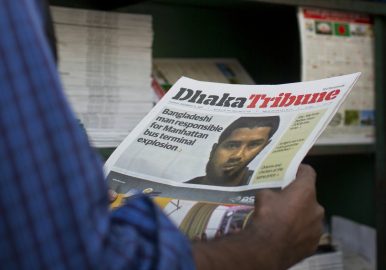
When compared to his peers in the terrorism community, Akayed Ullah was most certainly a loser. The wannabe jihadist attempted to blow himself up at the New York City port authority bus terminal by strapping a pipe bomb to his body. But the bomb — made with firecracker powder and lit with a Christmas candle — was so low intensity that, far from creating widespread terror, he didn’t even end up killing himself. In the weeks that have followed since, the 27-year-old Bangladeshi migrant has received more ridicule than fear or praise.

Bitcoin and Other Cryptocurrencies Plunged $100 Billion in One Day. Here's What Happened

By BRAD TUTTLE

The cryptocurrency market, long described as a bubble that’s bound to pop, is crashing hard this week. Several cryptocurrencies decreased by more than 25% over the past 24 hours, and $100 billion in value simply disappeared in a single day.

Bitcoin, the leading cryptocurrency, is down more than 60% off its all-time high hit less than two months ago. The value of each unit of Bitcoin dropped as low as $7,700 on Friday, compared to $10,000 on Wednesday and around $20,000 at its peak in December.

What He Did on His Summer Break: Exposed a Global Security Flaw


By ISABELLA KWAI

Nathan Ruser, an Australian college student, discovered that a fitness app had revealed the locations of military bases around the world. “Whoever thought that operational security could be wrecked by a Fitbit?” he said. CreditJan Mark

SYDNEY, Australia — When Nathan Ruser, an Australian university student, posted on Twitter over the weekend that a fitness app had revealed the locations of military sites in Syria and elsewhere, he did not expect much response.

America’s Digital Infrastructure Is Crumbling, Too

Bloomberg · 
by James Stavridis and Dave Weinstein 

Last weekend I passed through the glittering main terminal of the Hamad International Airport in Doha, Qatar. It is highly efficient, utterly beautiful and ultramodern. I cannot think of a single U.S. airport that compares favorably to it in any dimension. China today is building high-speed rail networks, new modernized ports, and seemingly endless stretches of smooth highways at a prodigious rate. We used to think of a “missile gap” threatening the U.S. during the Cold War. Today we are increasingly facing an infrastructure gap — and it is expanding daily.
And as we begin yet another tumultuous year of politics and policy in America, the White House, statehouses, and elected officials on both sides of the aisle are already putting infrastructure at the top of the political agenda. In Tuesday’s State of the Union message, President Donald Trump called on Congress to allocate at least $1.5 trillion for “the infrastructure investment we need.”

Much of the conversation relates to people’s most tangible perception of infrastructure: roads, rails and bridges. The media rightly give us increasingly frequent images of derailed train cars, collapsed trestles, cracked stanchions and crumbling bridges.
But in the 21st century, infrastructure is more than concrete and metal. Equally important is the digital infrastructure that underlies America’s economy and governments. In an era when goods, services and ideas are increasingly transported via the internet, the strands of fiber, routers, servers and seemingly endless lines of code that compose our digital highways and hubs are quickly becoming the backbone of U.S. infrastructure — and it too is crumbling.

RUSSIA BOASTS OF USING 215 NEW WEAPONS SYSTEMS IN SYRIA CIVIL WAR SERVED AS KREMLIN TESTING GROUND

Dave Majumdar

Russian Pres. Vladimir Putin praised the performance of the Russian military and its hardware during the Kremlin’s campaign in Syria, but stressed that Moscow has to fix problems that were brought to light during those operations.

“The rout of the well-equipped terrorist groups in Syria demonstrated the power of our Army and Navy, and the course of the operation demonstrated the tradition of reliability and effectiveness of Russian weapons,” Putin said in a speech.

Europe’s defining choice on Poland


Pawel Zerka 

Europe’s decision on whether or not to declare Poland in breach with European rule of law standards comes down to a choice between principles and pragmatism. 

The triggering of Article 7.1 by European Commission in December 2017 has forced Poland to seek a new relationship with Europe. Jaroslaw Kaczynski, the leader of Law and Justice (PiS), must have concluded that something needed to be done in order

Trump's Troubling Nuclear Plan

By Adam Mount

Like President Donald Trump, the Pentagon’s new nuclear policy document sees a dark and threatening world. It argues that potential U.S. adversaries such as China, North Korea, and Russia are rapidly improving their nuclear capabilities and gaining an edge over the United States. But rather than laying out a plan to halt this slide into a more dangerous world and working to decrease reliance on nuclear weapons, the Nuclear Posture Review (NPR) hastens its rise by accepting the reasoning of U.S. adversaries and affirmatively embracing nuclear competition. 

Technology for the Many: A Public Policy Platform for a Better, Fairer Future


A world infused with new technologies demands courageous, imaginative policy solutions that will both harness technology’s tremendous potential for good and mitigate the displacement effects of rapid change. This is one of the greatest policy challenges of our generation, and one of the biggest gaps in the prospectus across the political spectrum. 

A world infused with new technologies demands courageous, imaginative policy solutions

THE 2018 STATE OF THE DIGITAL UNION: THE SEVEN DEADLY SINS OF CYBER SECURITY WE MUST FACE

PETER W. SINGER

When President Barack Obama made his first State of Union address, there were a series of key challenges for cyber security policy. There was increasing problems of state-linked intellectual property (IP) theft that, in the wake of such incidents like the hacking of the F-35 fighter jet program, were becoming both an economic and national security issue, clouding Sino-American relations. There were growing worries about such ills as transnational criminal networks harming trust in the growing e-commerce marketplace, as well as botnets threatening to clog the “pipes” of cyberspace. Cyber warfare was starting to emerge as a

FUZZY THINKING ABOUT DRONES

JON ASKONAS AND COLBY HOWARD

Are drones reliable? Would you bet your life on them? In a recent article, Jacquelyn Schneider and Julia Macdonald argued that “the troops don’t trust drones” to protect them in combat with close air support. To understand how the people who actually coordinate airstrikes feel, they interviewed and surveyed Joint Terminals Air Controllers (JTACs) and Joint Fires Observers (JFOs) about their thoughts on working with manned and unmanned aircraft. They find some measure of hesitation about and distrust towards working with unmanned aircraft. In their conclusion, they argue that

America is losing the cyber war: Here's how to turn the tide

By Michael Chung 

When I served as a commissioned officer in the Navy and in Operations Enduring and Iraqi Freedom, we fought battles on three fronts: air, sea and land. Our country is now faced with a fourth battlefront -- one that has already made its way into the private lives of many American citizens: cyber warfare.

This battle has significant potential to be the most elusive, challenging and dangerous. There are no front lines, no established territories, and an enemy that is invisible to us. The weapons are computer keyboards and lines of code. The collateral damage is ultimately sensitive data and personal information.

Understanding the “IN” in COIN

Source Link
by Dean Shumate

We cannot solve our problems with the same thinking we used when we created them.

-- Albert Einstein

After the Vietnam War, it has been apparent that the Department of Defense (DOD) wanted to ignore any counterinsurgency (COIN) lessons learned. It was as if the DOD wanted to downgrade the importance of COIN. Operation Desert Storm created an albatross for policymakers, military leaders, and the public view on how “all” wars could be waged. The

The Limits of a Limited Strike


In 1962, facing Soviet missiles in Cuba, President John F. Kennedy considered limited strike options. Here he confers with Defense Department leaders during the Cuban Missile Crisis. From left to right, Assistant Secretary of Defense for International Security Affairs Paul H. Nitze, President Kennedy, Chairman of the Joint Chiefs of Staff Maxwell D. Taylor, and Secretary of Defense Robert S. McNamara.

A Solution Looking for a Problem

By Amos C. Fox

Warfare exists in the realm of both art and science – as a phenomenon in which sensing and intuition (in other words, art) play a complementary role to education and training (science). Just as a painter must have more than one color on his pallet, the practitioner of warfare must understand more than one form of warfare to be effective on the battlefield. However, the emphasis on maneuver warfare in current U.S. Army doctrine, at the expense of other forms of warfare, limits Armor and Cavalry leaders’ ability to be true artists in warfare by not fully educating and training them on the realities of warfare, thus negatively influencing their ability to sense and apply intuition in battle. Doctrine’s focus on maneuver warfare lies at the heart of this conundrum.

4 February 2018

No ‘Automaticity,’ But Yes To Low Yield Nukes: NPR

By COLIN CLARK and SYDNEY J. FREEDBERG JR.on February 02, 2018 a

PENTAGON: The United States government sees a fundamentally more threatening world today, one that requires a more nuanced balance of delivery systems than we’ve deployed since the end of the Cold War.
That’s really the change that has driven the results of the Trump Administration’s Nuclear Posture Review, officially released today.
Careful transparency continues to underpin the US crafting of nuclear policy. In fact, the State Department briefed the Russians and Chinese on the NPR today, according to Acting Assistant Secretary of State Anita Friedt, who briefed the press here this afternoon. Actually, she told a somewhat skeptical press corps, “we talked to the Russians a lot.”

Perhaps the most intriguing tidbit we got from this afternoon’s official unveiling of the NPR was the persistent use of the term “automaticity” by John Rood, undersecretary of Defense for policy.“There is no automaticity to this policy,” Rood replied when asked how the US would manage its response to “extreme circumstances,” the undefined occurrences that the NPR says could drive the United States to use nuclear weapons.
The NPR states: “the United States would only consider the use of nuclear weapons in extreme circumstances to defend the vital interests of the United States, its allies and partners.”

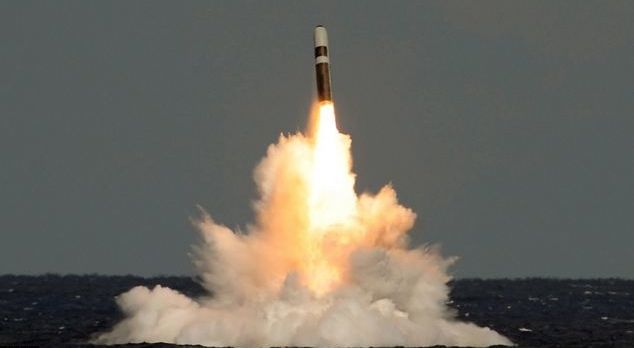
To better manage the ongoing modernization of the Russian and Chinese nuclear arsenals, as well as the proliferation of nuclear weapons to North Korea and other states, the US, Rood said, needs a more flexible set of deterrents. The development of a low-yield submarine-launched nuclear cruise missile would help.

“I view this as a prudent reaction to Russian ‘escalate to de-escalate’ doctrine,” said Bob Work, formerly deputy defense secretary under both Obama and Trump, in an email. “If the Russians employ a small yield nuke for coercive action, and the only responses we can provide the President are large-yield options, that is not a good place to be. We want to be able to respond proportionately, to signal our resolve without undue escalation.”

“Also, as I understand it, these will be delivered by SLBM (Submarine-Launched Ballistic Missiles), which have a higher probability of penetration than other means,” Work said. Submarine-launched weapons give the adversary less warning time than aircraft or IBCMs launched from the U.S., which makes them more worrying as potential first-strike weapons but also means missile defenses have less time and space to shoot them down.

India and the U.S. Find Common Ground in the Indo-Pacific


The world's three most populous countries are locked in a power struggle across the Indo-Pacific region. The United States wants to strengthen its defense partnership with India as part of a broader effort to counter China's growing influence in the region and around the world. India, too, is interested in challenging China by asserting itself in Southeast

The Distance Between Davos and Delhi


Finance Minister Arun Jaitley of India presented the country’s Union Budget for Fiscal 2018–2019 to Parliament on February 1, 2018. This is the last full budget of the Narendra Modi government ahead of the spring 2019 parliamentary election. There were expected measures related to farmers, rural workers, and employment generation. There was also a surprisingly high level of trade protectionism—especially coming on the heels of Prime Minister Modi’s speech against protectionism at the World Economic Forum (WEF) meeting in Davos, Switzerland. U.S.-India trade policy discussions in 2018 are likely to be even more antagonistic.

A quiet water war takes a page out of Sun Tzu’s Art of War playbook


by Brahma Chellaney

China’s hyperactive dam building is a reminder that, while the international attention remains on its recidivist activities in the South China Sea’s disputed waters, it is also focusing quietly on other waters – of rivers that originate in Chinese-controlled territory like Tibet and flow to other countries. No country in history has built more dams than China. In fact, China today boasts more dams than the rest of the world combined.

Nine ways Chinese scientists pushed the envelope in 2017

Military breakthroughs, supercomputers, dark matter and more. Chinese scientists marked several firsts in 2017, such as testing spy drones in near space and detecting the world’s first trace of dark matter. They also embarked on some groundbreaking research projects, including building the world’s most powerful facial recognition system that can identify its 1.3 billion citizens within three seconds. Here are some of the most popular China science stories we covered this year. China builds world’s fastest wind tunnel to test weapons that could strike US within 14 minutes

Seven Priorities for the African Union in 2018


Vital institutional and financial reform will likely be at the top of the AU’s agenda in 2018. However, the ICG contends that the organization must ensure that this priority does not draw attention away from conflict prevention and resolution. Indeed, the AU must also give priority to limiting the disruption friction between Morocco and the Sahrawi Arab Democratic Republic’s (SADR) could cause the organization; helping to resolve or avert election-related crises in the DRC, Cameroon, Mali and Zimbabwe; and managing conflicts in the Central African Republic, Somalia and South

Unraveling the Mess in North Korea

By Jay Ogilvy

As a Stratfor contributor, I generally avoid prescribing policy. But today I can't resist, having found myself in a position to report a policy prescription available nowhere else in English. Philip Bobbitt has come up with a novel proposal for managing the mess in North Korea, which BBC China published in Chinese on Jan. 28. Having access to the English original, as well as five other essays Bobbitt has published in English, I'll use this column to do two things. First, I'll summarize professor Bobbitt's proposal. Second, I'll suggest in ways that its author could not, modesty forbidding, why it's so important that the proposal comes from Philip Bobbitt and why we should listen to him.

What Is Hybrid Warfare?


By Joshua Stowell 

The term “hybrid warfare” describes a strategy that employs conventional military force supported by irregular and cyber warfare tactics.

Conventional Western concepts of war are incompatible and fundamentally misaligned with the realities of conflict in the twenty-first century. The emergence of a unipolar post-Cold War world order has resulted in a significant paradigm shift.

Trump Officials to Syria: Stop Using WMD or We Strike, Again


KIMBERLY DOZIER 

Sometimes reporters get called to a briefing so an administration can defend what it has done. And sometimes, it’s a warning of what it may be about to do.

On Thursday, two senior administration officials warned that the Trump administration could take military action – again – against the Syrian regime of Bashar

Exclusive: Mattis seeking to ban cell phones from Pentagon

By Danny Sjursen

 Vietnam: It’s always there. Looming in the past, informing American futures.

A 50-year-old war, once labeled the longest in our history, is still alive and well and still being refought by one group of Americans: the military high command. And almost half a century later, they’re still losing it and blaming others for doing so.

Of course, the US military and Washington policymakers lost the war in Vietnam in the

Current Russian and Chinese ways of warfare: the end (?) of military violence in peer-state conflict


DR ROD THORNTON

When it comes to the winning of wars, it might be thought that military organisations today, just as they have always done, would be concentrating their efforts on how best to use kinetic force. Military violence is, after all, what militaries do. But not, it seems, any more – or at least not in regard to peer-state warfare as conducted by the Russian and Chinese militaries. Today, both are making