27 April 2018

Modi Will Meet Xi For an Informal Summit: What's on the Agenda?

By Ankit Panda

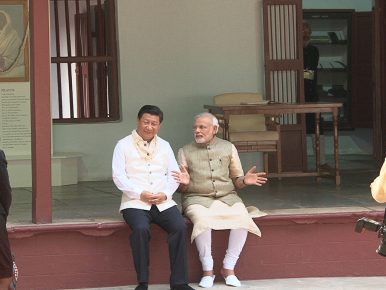
Indian Prime Minister Narendra Modi will meet Chinese President Xi Jinping for an unofficial bilateral summit on April 27 and 28, the two countries announced on Sunday. The meeting will take place in Wuhan, in China’s Hubei province.  The sudden announcement of this kind of an unprecedented meeting between the leaders of these two countries was announced after a trip by Indian External Affairs Minister Sushma Swaraj to China to meet with her Chinese counterpart Wang Yi. A Modi trip to China had long been rumored amid reports of Indian attempts to “reset” bilateral relations with China, but the announcement for an end-April summit is especially quick. The Indian prime minister will also travel to China in June, for the Shanghai Cooperation Organization’s security summit.

Trade war

MOHAN GURUSWAMY:

Prime Minister Narendra Modi and China’s President Xi Jinping will once again meet at Wuhan on Saturday. Wuhan which is capital of Hubei province is at the confluence of the Han River and Yangtze Rivers, is recognized as the political, economic, financial, cultural, educational and transportation center of central China. It has a three thousand year old history and has played a significant role in China’s recent history. Will history be made now once again in Wuhan? The significance of this meeting is not that the two leaders are meeting under the shadow of Dokolam. There is a larger shadow of the looming trade war and the attendant rollback of globalization, of which the US President Donald Trump has fired the first shot with sanctions targeting $100 billion of US-China trade. The collapse of the globalization arrangements that had set off the greatest expansion of the world economy in the last three decades, threatens not just China’s economic well being but also India’s. 

How Walmart’s Purchase Of Flipkart Will Change The Rules Of Online Game

by R Jagannathan

India offers a clear path to online leadership through Flipkart, which is why Walmart is willing to plonk $12 billion for the acquisition. Walmart is already in the Indian wholesale retail game, and Flipkart means plugging directly into retail customers to make up for what it is barred from doing offline. The face in Indian e-commerce will change forever with Walmart, the world’s largest offline retailer, now close to acquiring a majority stake in Flipkart, India’s leading online player. The deal, according to reports, will value Flipkart at around $20 billion, and some of the big investors, including Tiger Global and Softbank, may sell the whole, or the bulk, of their stakes in the company.

Uzbekistan Agrees to ‘Take Part’ in TAPI

By Catherine Putz

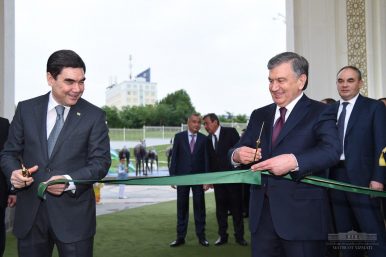
Uzbekistan has reportedly agreed to participate in the massive Turkmenistan-Afghanistan-Pakistan-India (TAPI) pipeline. The news comes as Turkmen President Gurbanguly Berdimuhamedov paid a visit to Tashkent on Monday. As the visit began, RFE/RL reported that sources had indicated TAPI was on the agenda, followed by Reutersreporting that Uzbek President Shavkat Mirziyoyev had told journalists after meeting with the Turkmen president, “We have agreed that Uzbekistan will also take part in this project.”

Bangladesh Set to Reach Economic Par With India

By Sajeeb Wazed

The United Nations Committee for Development Policy announced in March that Bangladesh had successfully met the criteria to graduate from a “least developed country” (LDC) to a “developing country” (DC). That sounds like a lot of bureaucratese. But it isn’t. The UN’s low-key proclamation has led to celebration in Bangladesh and for good reason.  This once famously impoverished nation – regularly crushed by famine and floods – will soon have the same economic status as Mexico, Turkey, and its neighbor India. And it achieved that ranking fast; Bangladesh has been an independent nation for just 47 years.

Zuckerberg Was Called Out Over Myanmar Violence. Here’s His Apology.

By KEVIN ROOSE and PAUL MOZUR

Rohingya refugees arriving in Bangladesh last year from Myanmar, where advocacy groups have criticized Facebook’s approach to hate speech. In an email, Mark Zuckerberg, Facebook’s chief executive, told the groups: “I apologize for not being sufficiently clear about the important role that your organizations play in helping us understand and respond to Myanmar-related issues.” Last week, after frustrated activists from Myanmar sent an open letter to Mark Zuckerberg, the chief executive of Facebook, they got something unexpected: a reply. The activists, representing six civil society organizations, harshly criticized Mr. Zuckerberg in the letter, saying he had mischaracterized Facebook’s response to violence-inciting messages in Myanmar and had not devoted sufficient resources to enforcing its hate speech rules in the violence-stricken country. Mr. Zuckerberg wrote back to the group the next day from his personal email address, apologizing for misspeaking and outlining steps that Facebook was taking to increase its moderation efforts.

How America can win its tech war with China

James Pethokoukis

The U.S.-China trade throwdown isn't just about helping "American steel," protecting Corporate America's intellectual property, reducing bilateral trade deficits, or really much of what President Trump typically tweets about. To focus exclusively on tariffs or international investment flows misses the big picture. What's actually playing out on a global stage is an escalating conflict to be the technological leader and thus leading economic superpower of the 21st century. Beijing made its fighting intent clear in 2015 when it announced its goal to create "national champions" in 10 high-tech manufacturing sectors by 2025. Since then, it has expanded its ambitions with a strategic plan to become the world leader in artificial intelligence, a technology that a recent McKinsey Global Institute report called the "transformational technology of our digital age."

A new Cold War with the US and China as bitter rivals would be a grievous mistake

David Rothkopf

In the 17 years since the 9/11 attacks, the United States has made combating terrorism worldwide its number one national security priority. The shift away from its Cold War and immediate post-Cold War stance was the biggest it had made since the end of the Second World War and resulted in trillions of dollars of expenditures, two major wars and constant US military engagement in the Middle East for nearly two decades.

HOW DOES CHINA'S NAVY COMPARE TO AMERICA'S?

BY DAVID BRENNAN

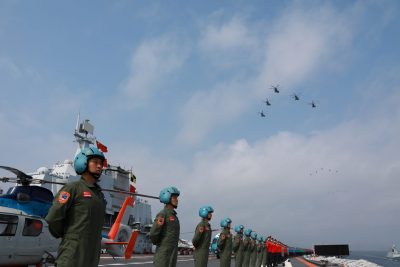
Every year on April 23, China’s People Liberation Army (PLA) Navy Day commemorates the founding of the service in 1949. This year’s celebrations have special significance, as a chance to display the hardware that will define the country’s future place among the world's great powers. China is preparing to launch its first domestically produced aircraft carrier, the steam-powered Type 001A, for sea trials. Naval operations are scheduled from April 20-28 in the Bohai and Yellow seas, and Chinese experts believe the Type 001A could be put to sea during that window.

How China Is Buying Its Way Into Europe

By Andre Tartar, Mira Rojanasakul and Jeremy Scott Diamond
Source Link

China’s Cosco Shipping Ports Ltd., which operates around 180 container berths at ports worldwide, is purchasing a stake in Euromax Terminal Rotterdam BV. For more than a decade, Chinese political and corporate leaders have been scouring the globe with seemingly bottomless wallets in hand. From Asia to Africa, the U.S. and Latin America, the results are hard to ignore as China has asserted itself as an emerging world power. Less well known is China’s diffuse but expanding footprint in Europe. Bloomberg has crunched the numbers to compile the most comprehensive audit to date of China’s presence in Europe. It shows that China has bought or invested in assets amounting to at least $318 billion over the past 10 years. The continent saw roughly 45 percent more China-related activity than the U.S. during this period, in dollar terms, according to available data.

Tibet can be in China: Dalai Lama


Tibet could benefit economically by staying in China and Chinese citizens could gain from Tibetan Buddhism, he said in a lecture to commemorate the 60th anniversary of his exile to India. “Historically and culturally, Tibet has been independent. The region’s geography shows where Tibet begins. So long as the constitution of China recognises our culture and Tibetan autonomous region’s special history, they can remain [part of China],” he said in the lecture organised by the Nehru Memorial Museum and Library and the Antar-Rashtriya Sahayog Parishad.
The lecture is one of the events planned to celebrate the anniversary of the Dalai Lama’s arrival in India in the late 1950s. The celebrations began earlier this month with a big event at Dharamsala. The Dalai Lama is likely to tour India throughout the year.

Caliphate - Islamic State & The Fall of Mosul Chapter Two: Why Would Anyone Join ISIS?

By Rukmini Callimachi 

A new audio series following Rukmini Callimachi as she reports on the Islamic State and the fall of Mosul. New York Times subscribers get early access to each episode.

On to chapter two .

Can Macron and Trump Bring Stability to the Indo-Pacific Region?

Walter Lohman Valerie Niquet

Trump and Macron can get the ball rolling toward better strategic coordination by focusing on three critical priorities. For the last seven decades, the alliance between the North America and Europe has undergirded peace, freedom and prosperity across the Atlantic. President Emmanuel Macron’s state visit to Washington presents a perfect opportunity to build upon that achievement and extend the benefits of this remarkably successful partnership to the Indo-Pacific region.

New USAF African Drone Base Being Constructed Outside Agadez in Niger

Eric Schmitt

Rising from a barren stretch of African scrubland, a half-finished drone base represents the newest front line in America’s global shadow war. At its center, hundreds of Air Force personnel are feverishly working to complete a $110 million airfield that, when finished in the coming months, will be used to stalk or strike extremists deep into West and North Africa, a region where most Americans have no idea the country is fighting. Near the nascent runway, Army Green Berets are training Nigerien forces to carry out counterterrorism raids or fend off an enemy ambush — like the one that killed four American soldiers near the Mali border last fall.

North Korea’s Nuclear Weapons: The Unfinished Arsenal

In declaring a unilateral freeze in missile testing, North Korea appears ready to settle for now with an imperfect nuclear arms capability, one good enough to stoke fear in the United States but which can’t promise to strike U.S. targets reliably, experts say. North Korea said on Saturday it no longer needed to conduct nuclear or intercontinental ballistic missile tests because it had reached its weapons development goals, even though U.S. officials and experts do not believe the North’s program is complete. The declaration came ahead of talks between North Korean leader Kim Jong Un and South Korea’s President Moon Jae-in on Friday. Kim, whose economy is under pressure from international sanctions, is expected to meet U.S. President Donald Trump in late May or early June.

Why Isn't Russia an Aircraft Carrier Superpower?

Robert Farley

Historically a land power, the Soviet Union grappled with the idea of a large naval aviation arm for most of its history, eventually settling on a series of hybrid aircraft carriers. Big plans for additional ships died with the Soviet collapse, but Russia inherited one large aircraft carrier at the end of the Cold War—that remains in service today. Although many of the problems that wracked the naval aviation projects of the Soviet Union remain today, the Russian navy nevertheless sports one of the more active aircraft carriers in the world.

History of Russian Naval Aviation

Like Vietnam, it is Time to Cut Our Loses in Afghanistan

Chad M. Pillai

Afghanistan, as another Vietnam, conjures images of defeat as U.S. helicopters take the last American off the embassy roof. While the Vietnam War was a near-term strategic defeat, in retrospect, it may yet prove to have been a geo-strategic win. The same may prove true for Afghanistan after a U.S. withdrawal. Like a bad business investment, there are times when you must accept one’s loses and move on. Vietnam, after the U.S. withdrawal and fall of Saigon, was a poor yet united country after centuries of domination by the Chinese, Japanese, and French. Like its more powerful northern neighbor, China, it too is a communist dictatorship embracing capitalism. Despite its similarities with China, China’s rapidly aggressive political-economic-military influence in the Asia-Pacific region is pushing Vietnam closer to the U.S. to counter-balance China. For the U.S., this potential alignment, as seen by the recent U.S. carrier visit to Vietnam , could provide invaluable access for the U.S. and its regional Partners and Allies to hedge against China’s regional hegemonic aspirations.

Where U.S. Trade Policy and Grand Strategy Intersect

By Reva Goujon

History shows how trade policy can be a potent tool in the U.S. strategic arsenal, especially when containing peer competitors. Trade policy was a matter of intense debate for the Founding Fathers, but it took a massive shock in the form of the Great Depression for the United States to restructure and position itself to wield trade policy as a tool of grand strategy. U.S. President Donald Trump's economic assault on U.S. trading partners is a reaction to decades of pent-up economic discontent and a nebulous era in the global arena in which the United States lacked a well-defined adversary. But great power competition is back, and with it will come a more strategic approach toward trade and a focus on containing China.

Will robots and AI take your job? The economic and political consequences of automation

Darrell M. West 

In Edward Bellamy’s classic Looking Backward, the protagonist Julian West wakes up from a 113-year slumber and finds the United States in 2000 has changed dramatically from 1887. People stop working at age forty-five and devote their lives to mentoring other people and engaging in volunteer work that benefits the overall community. There are short work weeks for employees, and everyone receives full benefits, food, and housing. The reason is that new technologies of the period have enabled people to be very productive while working part-time. Businesses do not need large numbers of employees, so individuals can devote most of their waking hours to hobbies, volunteering, and community service. In conjunction with periodic work stints, they have time to pursue new skills and personal identities that are independent of their jobs.

Syria in 2018 is not Iraq in 2003

by Muhammad Idrees Ahmad

Last Saturday, when the United States, the UK and France launched strikes on three chemical facilities in Syria, the move was met with disapproval in some quarters. The pre-announced spectacle blew up three buildings and took no lives, but some pronounced it a "dangerous escalation". Some spoke of its "illegality". All complained about its disregard for the OPCW investigationThe action, which lasted less than an hour, was an escalation only if everything that preceded it was normal. By this reckoning, Syria has now returned to its status quo of genocide by the Assad regime.

Israel celebrates but is war with Iran looming?

Simon Tisdall
Israelis enjoyed a lavish party last week to mark the nation’s seven eventful decades, but the threat to its existence could hardly have been greater An RAF Hercules takes part in an air show that was part of Israel’s independence celebrations last week. There were fireworks, concerts, torch processions and parties throughout the country. In Jerusalem the night sky was illuminated by 300 drones that coalesced to form images of favourite Israeli symbols,such as the national flag and a dove with an olive branch in its mouth. The celebrations included a live, televised retelling of Jewish history dating to biblical times. In one scene children with yellow stars pinned to their clothes fled marching Nazi soldiers. Another showed pioneers building the fledgling Jewish state.

FUKUSHIMA'S NUCLEAR WASTE WILL BE DUMPED INTO THE OCEAN, JAPANESE PLANT OWNER SAYS

BY TOM O'CONNOR

A member of the media uses a Geiger counter at Tokyo Electric Power Company's (TEPCO) Fukushima No. 1 nuclear power plant in Okuma, Fukushima, Japan, February 23. The site includes hundreds of tanks containing about 777,000 tons of water laced with tritium that TEPCO has decided to dump into the nearby sea, despite opposition from local fishermen.Toxic waste produced by one of the world's worst nuclear disasters will be dumped into the sea, according to the head of the Japanese company tasked with cleaning up the radioactive mess, despite protests from local fishermen.

On Seeing America's Wars Whole

By Andrew Bacevich

Congratulations on assuming the reins of this nation’s -- and arguably, the world’s -- most influential publication. It’s the family business, of course, so your appointment to succeed your father doesn’t exactly qualify as a surprise. Even so, the responsibility for guiding the fortunes of a great institution must weigh heavily on you, especially when the media landscape is changing so rapidly and radically. Undoubtedly, you’re already getting plenty of advice on how to run the paper, probably more than you want or need. Still, with your indulgence, I’d like to offer an outsider’s perspective on “the news that’s fit to print.” The famous motto of the Times insists that the paper is committed to publishing “all” such news -- an admirable aspiration even if an impossibility. In practice, what readers like me get on a daily basis is “all the news that Times editors deem worthy of print.”

The Changing Face of the Country

By DER SPIEGEL Staff

Many Germans feel foreign in their own country and are afraid that immigration is changing their homeland rapidly. Every fifth person in Germany comes from an immigration background and that number will continue to climb. What does that mean for the country? Maike Manz runs her hand across the patient's belly and hopes that the young woman in the hospital bed will at least have an inkling of what she's trying to tell her. "We're going to conduct an ultrasound now and then we will decide how to proceed," the gynecologist says, slowly and as clearly as she can. The pregnant woman is from Guinea-Bissau and has only been living in Germany for the past nine months. She peers on helplessly as the doctor does a miming gesture to try to help her to understand. Adhered to her stomach is the sensor of a CTG device that measures babies' heart rates. She's in her 36th week of pregnancy and is expecting twins. Aside from the word "baby," she hasn't understood anything, because she doesn't speak any German.

Globalization Backlash Paradox

ARVIND SUBRAMANIAN

Today, the very countries that have spent 70 years building multilateral institutions and establishing global trade rules are busy undermining them. In this context, the absence of even a whiff of protest against financial integration demands explanation. Most economists wax eloquent about the benefits of “real” global integration – that is, virtually uninhibited cross-border flows of goods, labor, and technology. They are less certain when it comes to global financial integration, especially short-term flows of so-called hot money. Yet today’s anti-globalization backlash is focused largely on real integration – and almost entirely spares its financial counterpart.

26 April 2018

Reforming defence planning in India

Source Link
Harsh V. Pant Apr 24 2018.

Finally, a significant change seems to be in the offing in India’s defence planning architecture with the Narendra Modi government deciding to establish an overarching defence planning committee (DPC) under the national security adviser. The aim is to leverage this cross-governmental body—comprising the chairman of the chiefs of staff committee, three service chiefs, the defence, expenditure and foreign secretaries—to enhance India’s ability to do some long-term strategizing.
The DPC is being tasked with drafting reports on “national security strategy, international defence engagement strategy, road map to build a defence manufacturing ecosystem, strategy to boost defence exports, and priority capability development plans”. Four subcommittees are to be created under the DPC to focus on policy and strategy, plans and capability development, defence diplomacy, and the defence manufacturing ecosystem.
This decision comes at a time when Indian defence planning stands at a crossroads. The silo-driven approach to defence planning has resulted in the lack of an integrated view. The three services as well as the civilian and defence agencies are often seen to be working at cross purposes. Such an ad hoc approach has meant that more often than not, issues like threat perception and force structure are not managed via a centralized and authoritative overview. Instead, individual services tend to be driving the agenda at their own levels.

India Shelves FGFA Project – Where to Now?

by Dan Darling, 
After years of stalled negotiations with Russia, the Indian Air Force (IAF) is pulling the plug on an 11-year collaborative effort to develop and produce a fifth-generation fighter that would be used by both countries. The IAF opted to walk away from the project due to lingering differences over developmental costs, technology capabilities, and other points of contention – particularly what it feels is a lack of sufficient stealth for a fifth-generation aircraft.
Though Indian officials have stated that they might revisit the project at a later date or simply purchase the aircraft off the shelf once it has been inducted into service with the Russian Air Force, it appears likely that time and cost pressures have combined to push the IAF in a different direction.

The IAF is sorely in need of modern replacements for its aging platforms and seeks a stealth combat aircraft to comprise part of the high end requirement of its multi-role array of jet fighters. Therefore, leaving the Fifth-Generation Fighter Aircraft (FGFA) program – code-named Project 79L Perspective Multi-Role Fighter (PMRF) by the Indian Ministry of Defense – renders the IAF short a declared requirement.
With the IAF in need of covering a lot of ground quickly in order to make up for a shortage of numbers – plus the stated requirement of a stealth fighter with advanced combat avionics, sensors, and radars – there is now a lot of pressure for the service to find a solution within the next 5-6 years as platform retirements begin to shrink an already-stressed fighter fleet.

One Step Forward, One Step Back for PLA Military Education

By Ying Yu Lin,  April 25, 2018

CCP General Secretary Xi Jinping’s sweeping reorganization of the People’s Liberation Army (PLA) in 2016 was meant to shake up ossified bureaucracies, boost operational jointness and technical ability, and refocus the PLA on its mission to “fight and win wars” (China Brief, January 12). It is thus unsurprising that military academies and schools in China have seen significant reorganization since the initiation of the 2016 reforms, with some changes modeled on the training systems used in the United States and Taiwan. While some progress has been made towards desired outcomes, including combatting entrenched corruption within the PLA officer corps, significant obstacles remain, particularly in building cooperation across branches within services, and promoting the civil-military cooperation necessary for an effective civilian office reserve corps.

Before and After the Reforms
Prior to the 2016 reforms, PLA military education was jointly controlled by each of the four general departments of the Central Military Commission (CMC). In the 2016 military reforms, the four general departments of the CMC were re-organized and transformed into 15 functional departments and organs. (Xinhuanet ,Dec.18, 2017). After the disbandment of the four general departments in the 2016 military reforms, all military academies and schools have been placed under the joint control of the CMC Training and Administration Department (CMCTAD), and the appropriate service branch (TAKUN, July 29, 2017).

According to open source information, there were a total of 67 military academies and schools in China before the military reforms, with 15 attached to the People’s Armed Police (PAP) alone. With the new military structure in place, the number has now dropped to 43, which were made public by China’s Ministry of National Defense in June 2017 (Xinhuanet, June.30, 2017). They include two schools directly subordinate to the CMC, namely the National Defense University (NDU) and National University of Defense Technology (NUDT), 35 under the control of the services and service branches, and six belonging to the People’s Armed Police (PAP).

New Russian Missiles May Be Aimed East


By Norman Friedman, April 25, 2018

Russian President Vladimir Putin devoted a March 2018 speech on the state of Russia to a series of five spectacular “new” strategic weapons—though all have been known to the West for years. All five—the Sarmat ballistic missile, the Avangard hypersonic maneuvering reentry vehicle, the Kinzhal air-launched hypersonic cruise missile, the Status-6 nuclear-powered autonomous underwater vehicle, and a nuclear-powered cruise missile—have Cold War antecedents. Only the cruise missile amounted to news, though analysts were aware of it even if the media were not. In spite of Putin’s declarations that some are operational—and “invincible”— he illustrated his remarks with paintings on slides, not with photographs of actual hardware. (An anonymous U.S. official told CNN there have been several unsuccessful tests of the nuclear-powered cruise missile, all ending in crashes.)Some commentators see Putin’s announcement as an attempt to force the West to take him more seriously, while others point to his reelection campaign. Polls conducted by the Pew Research Center show that the Russian population blames the West and international sanctions, rather than the Russian government, for the poor state of the economy. Putin’s claim of overwhelming strength is doubtless very popular domestically, where U.S. work on strategic missile defense generally has been taken as a direct attack on Russia instead of as protection against small numbers of ballistic missiles in the hands of rogue regimes, particularly those of Iran and North Korea.

It seems significant that Putin did not unveil some exotic means of defending Russia against Western strategic weapons. Effective large-scale missile defense is the only way the nuclear balance of power can be tipped, but neither Russia nor the United States can buy enough strategic interceptors to defend completely against the quantity of nuclear weapons the other already has. Without a new missile defense shield, Putin merely is threatening the West with what Russia has been able to do for decades. Nuclear weapons are a relatively inexpensive form of military power, made even cheaper if—thanks to the Nuclear Test Ban Treaty—they never need to be demonstrated.

Beijing’s Ambitions in the South China Sea: How Should Europe Respond?

By Nicola Casarini, 23 April 2018 

Beijing’s growing assertiveness in the South China Sea is putting Europe’s economic interests in the area at risk. More than one third of Europe’s external trade takes place with the Indo-Pacific region and any escalation of tensions in this area will undoubtedly have a direct impact on Europe.
China has recently stepped up territorial and maritime claims over large swaths of the South China Sea. These claims are not only based on economic and security considerations, but also on national identity and the renewal of China’s past grandeur. President Xi Jinping’s reiteration of his vision of a “Chinese dream”, as most recently outlined during the 13th National People’s Congress held in Beijing in March 2018, reflects these efforts to rebrand China’s image and polish its credentials as a global actor.[1]

Xi’s closing speech at the 2018 National People’s Congress chimed with an increasingly assertive foreign policy, in particular when he cited China’s island-building campaign in the South China Sea as one of the key accomplishments of his presidency. This implicitly linked his vision of a Chinese dream and the rejuvenation of the country with the idea of restoring the glory of the ancient times, when China presided over a Sino-centric order in East Asia

Blue China: Navigating the Maritime Silk Road to Europe

Policy Brief

SUMMARY
China’s Maritime Silk Road is about power and international influence, but Europeans should not overlook the importance for China of further developing its blue economy, which already represents 10 percent of China’s GDP.

The Maritime Silk Road already affects Europe in five main areas: maritime trade, shipbuilding, emerging growth niches in the blue economy, the global presence of the Chinese navy, and the competition for international influence.

On balance, the Maritime Silk Road creates more competition in Europe-China relations, but it also creates space for cooperation in the blue economy and for specific maritime security missions.

Europe should emulate China’s blue economy as an engine of growth and wealth, and encourage innovation to respond to well-funded Chinese industrial and R&D policies.
Europeans should strengthen their contribution to maintaining a strategic balance in the Indo-Pacific region and uphold their vision of a rules-based maritime order.

China in the Pacific: where there’s smoke, there’s mirrors

http://www.eastasiaforum.org/2018/04/23/china-in-the-pacific-where-theres-smoke-theres-mirrors/23 April 2018
Author: Jon Fraenkel, Victory University of Wellington
A Fairfax news report that ‘preliminary discussions’ were held between the Chinese and Vanuatu governments about the establishment of a naval base at a Beijing-funded wharf in Luganville is causing quite a stir in Australia. The US$87 million wharf was funded by a loan from China’s EXIM bank to allow cruise ships to dock on the island. But some US and Australian intelligence analysts fear that it could provide port facilities for Chinese warships less than 2000 kilometres from Australia’s east coast.

While the original Sydney Morning Herald story acknowledged that there had as yet been ‘no formal proposals’, that qualification vanished in The Diplomat’s report that China had ‘formally approached’ Vanuatu about a ‘permanent military base’. ‘Clearly the Chinese are serious about establishing a military base in the Pacific’ claimed Malcolm Davis from the Department of Defence-funded Australian Strategic Policy Institute, speculating ‘my guess is there’s a Trojan horse operation here that eventually will set up a large facility that is very modern and very well-equipped’. Even Australian Prime Minister Malcolm Turnbull expressed ‘grave concern’ about the risk of a Chinese naval facility in the Oceania region.

Taliban announce the start of their annual spring offensive, dismiss peace overtures

Taliban announce spring offensive, dismiss peace overtures 
Reuters, April 24, 2018

KABUL (Reuters) - The Taliban announced the start of their annual spring offensive on Wednesday, dismissing an offer for peace talks by President Ashraf Ghani but pledging to focus on U.S. forces in Afghanistan.
The announcement of the Al Khandaq campaign, named after the so-called Battle of the Trench, fought by the Prophet Mohammad to defend the city of Medina in the early days of Islam, marks the symbolic start of the fighting season.
But heavy fighting has been going on in different parts of the country and hundreds of people have been killed and wounded in a series of high profile attacks in Kabul since the beginning of the year, despite Ghani’s offer in February for peace talks “without preconditions”.

The Taliban, in their statement on Wednesday, dismissed the peace overtures as a “conspiracy”.
“Their main effort is to deviate public opinion from the illegitimate foreign occupation of the country, as the Americans have no serious or sincere intentions of bringing the war to an end,” the Taliban said.
The militants, fighting to restore their version of strict Islamic law to Afghanistan, said the campaign was a response to a more aggressive U.S. military strategy adopted last year, which aims to force the militants into peace talks.
“Its primary target will be the American invaders and their intelligence agents. Their internal supporters will be dealt with as a secondary target,” the Taliban said.

Beijing’s Ambitions in the South China Sea: How Should Europe Respond?

By Nicola Casarini

Beijing’s growing assertiveness in the South China Sea is putting Europe’s economic interests in the area at risk. More than one third of Europe’s external trade takes place with the Indo-Pacific region and any escalation of tensions in this area will undoubtedly have a direct impact on Europe. China has recently stepped up territorial and maritime claims over large swaths of the South China Sea. These claims are not only based on economic and security considerations, but also on national identity and the renewal of China’s past grandeur. President Xi Jinping’s reiteration of his vision of a “Chinese dream”, as most recently outlined during the 13th National People’s Congress held in Beijing in March 2018, reflects these efforts to rebrand China’s image and polish its credentials as a global actor.[1]

Propaganda delivered the Brexit vote but it can’t land more fish


Mon 23 Apr 2018
British skippers weren’t denied fair quotas by the EU, Britain let them sell their fishing rights to foreign boats
Standing on the shingle of Hastings beach beside his fishing boat, Paul Joy says his family have fished these waters since before the time of William the Conqueror. He’s done the research, and the Joys have had boats here since records began. His boat had been out at dawn that morning, hugging the coastline with a skipper, two crew and the “boy” ashore, aged 80, who winches the Kaya up the pebbles with a rusty bulldozer. “My father, Will, born in 1906, made an adequate living with a smaller boat than mine. Now everyone subsidises fishing with other work. I earned the same as a carpenter, now you’re lucky to get a Tesco shelf-stacker’s pay.” Fishing quotas are killing the small fishermen, he says.

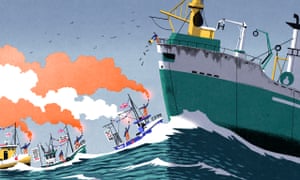
Stand here to breathe in the heart of Brexit. Last week, in ports around the country, fishing boats protested – sending up flares to oppose the transition dealthat leaves them in the common fisheries policy (CFP), but without a seat at the EU table sharing out the fish. Protest organisers said: “We are sickened by remainers gleefully peddling the deliberate narrative that fishing doesn’t matter.”
Does it matter? The fishing industry is worth less than 0.5% of GDP. They rightly fear this pinprick to the economy will be traded for bigger prizes – finance, cars, pharma, airline routes. Why else, they ask, is the government’s fisheries white paper delayed time and again? Thirteen Rees-Moggites and one DUP MP swear they’ll vote down any deal unless the UK breaks from the CFP. As these hard Brexiteers want no deal anyway, fishing is their perfect pretext, though no deal would be the fishermen’s apocalypse.