16 May 2020

Cyber Wargame - An Indian Scenario

Maj Gen P K Mallick, VSM (Retd), Consultant, VIF

Introduction

Immediately after the first gulf war in the early 1990’s the theories of Revolution in Military Affairs (RMA) and Information Warfare were being studied all over the world as a new kind of warfare. During that time, a course on Information Warfare was conducted at the National Defense University of USA. The course participants were from senior officers of the armed forces, representatives of Department of Defence and Department of State and policy makers from the government. Rand Corporation of US was conducting this course.

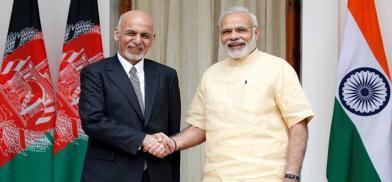
No permanent friend or enemies: Need for India’s deeper and bolder engagement in Afghanistan

By Chayanika Saxena 
Source Link

India is one of the key actors to have contributed to the post-war redevelopment of Afghanistan. So far, India has contributed USD 3 billion to it, which makes Delhi the largest donor to Afghanistan in South Asia and the fifth largest in the world, writes Chayanika Saxena for South Asia Monitor

Pursuing the elusive objective of arriving at some semblance of peace in Afghanistan, especially in these trying pandemic times, the US Special Representative for Afghanistan Reconciliation, Zalmay Khalilzad, has been shunting between different stakeholder-nations in the hope of keeping the peace process from falling through the cracks.

Making a dash to India on May 7 in this regard, but mostly to assuage the latter’s concern at being excluded from the recently-held regional discussions on Afghanistan at the UN. Khalilzad made sure that he made the right kind of noise. Reflecting what appears to be the new American approach to the peace process in Afghanistan, it appears Washington is keen on getting the different Afghan and international stakeholders to speak to each other, including India and the Taliban. Unlike in the past, when the US dithered on endorsing India’s direct involvement in the Afghan peace negotiations it had previously led, a change in the US stance is refreshing and welcoming. However, this new approach is not without its underside.

On the Coronavirus, Pakistan’s Government Is Missing in Action

BY NEHA MAQSOOD
Source Link

KARACHI—During a televised broadcast on March 22, Pakistani Prime Minister Imran Khan expressed his hesitancy in imposing a nationwide lockdown in response to the coronavirus pandemic, explaining that such a move would have devastating economic consequences for the poor.

“Twenty-five percent of Pakistanis are below the poverty line,” Khan said. “Today if I impose a complete lockdown, then my country’s rickshaw drivers, pushcart vendors, taxi drivers, small shopkeepers, daily wage earners … all of them will be shut in their homes.”

In Pakistan, where around 30 percent of the population lives in grave poverty, avoiding catching the coronavirus isn’t the only thing on people’s minds. Staving off hunger often comes first.

The coronavirus pandemic and the economic recession the International Monetary Fund predicts will follow it have imperiled the food security of many Pakistanis, and a broader economic collapse and escalating rates of unemployment would only add to the country’s poverty.

How technology is safeguarding health and livelihoods in Asia

By Oliver Tonby, Jonathan Woetzel, Noshir Kaka, Wonsik Choi, Jeongmin Seong, Brant Carson, and Lily Ma
Source Link

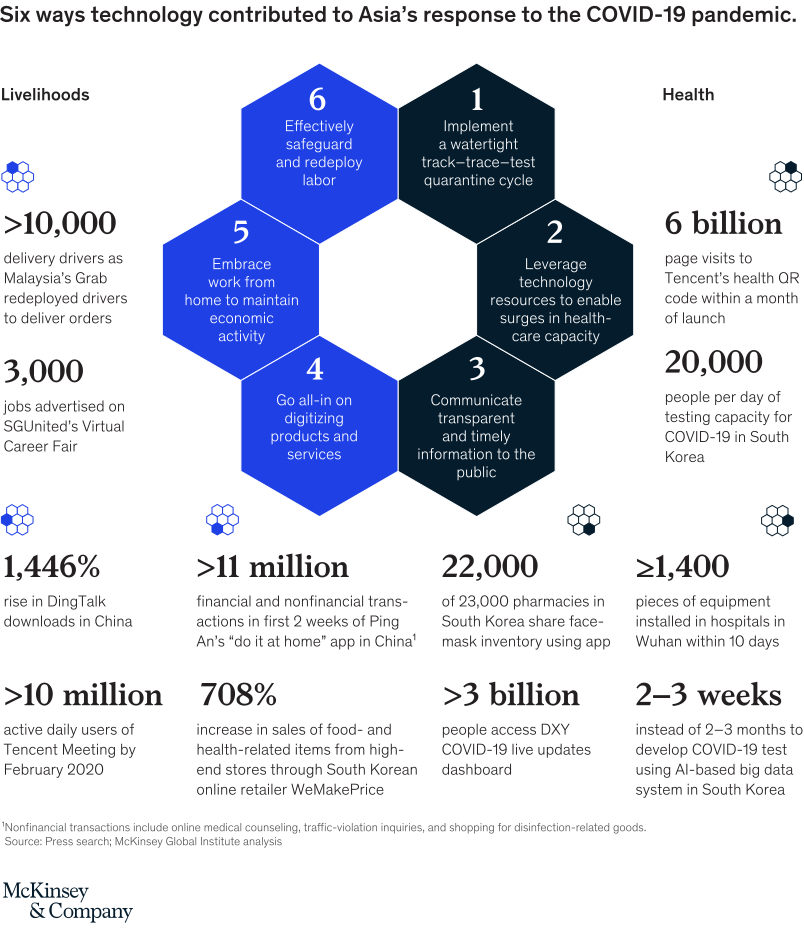
In Asia, deepening technological capabilities and innovations—most notably digital and mobile technologies—enabled early responses to the COVID-19 crisis. Six broad categories of measures to safeguard both health and livelihoods helped guide governments and businesses in the region (exhibit). They could also help countries in and beyond Asia as they seek to contain the current and future pandemics. In a globalized world fighting a virus that does not respect borders, exchanging best practices and experiences appears to be vitally important in combating this common enemy.
Exhibit
We strive to provide individuals with disabilities equal access to our website. If you would like information about this content we will be happy to work with you. Please email us at: McKinsey_Website_Accessibility@mckinsey.com

What Does Washington Want From China?

By Christopher R. Hill

During one of the Balkan wars in the 1990s, a group of senior officials met in the White House Situation Room and listened to a proposal for bombing Serbia yet again in retribution for the latest outrage by its dictator, Slobodan Milosevic. As the officials, almost all civilians, discussed the options, they turned to the U.S. military representative at the meeting for his view of the proposed new bombing campaign. He answered with a question: “And then what?”

Policy and strategy should be tethered to answering that question. That simple fact is especially true in great-power relations, when one country’s ability to affect internal change in the other is at best proscribed, and efforts to do so may backfire. Newtonian laws apply to foreign policy and national security matters as much as they do to the physical world: every action does indeed lead to an equal and opposite reaction. Rarely does the receiver of the action simply turn the other cheek and carry on.

There is no question that China grossly misbehaved in not being transparent with the rest of the world about what was happening in Wuhan. But although China seemed to be covering up the outbreak during those chaotic days in December, it is also very possible that Chinese health and security agencies simply didn’t know what they were dealing with in Hubei Province as thousands of citizens descended on an overmatched health system. The question of who knew what and when they knew it will in time be answered, largely because that question is being asked the world over—especially by the shaken Chinese public, for whom the effects of this virus are very raw even as the government claims to be achieving victory over it. 

The way back: What the world can learn from China’s travel restart after COVID-19

By Will Enger, Steve Saxon, Peimin Suo, and Jackey Yu
Source Link

China’s COVID-19 lockdown has ended, and travel is tentatively restarting. In this article, we look at how it has recovered so far, what Chinese travelers think about their future travel, and how industry players are responding to these trends. Countries and regions around the globe are gradually moving past the peak of the pandemic. We hope that China’s experience can shed light on what other countries can—and cannot—expect for their own travel recoveries.
How tourism in China is restarting

Mainland China’s lockdown is over; new domestic reported cases of COVID-19 are practically zero. Businesses remain cautious, but almost all offices, factories, schools, and retail outlets have reopened. So have most tourist attractions. Our recent China consumer-sentiment survey shows that confidence is coming back: more people feel safe returning to work than did just two weeks ago.1

When a lockdown ends, the first thing people want to spend money on is eating out. The second is travel.2 Our consumer survey shows that confidence in domestic travel rose by 60 percent over the past two weeks. The number of travelers for the recent May Labor Day long weekend was down 53 percent from 2019, but that represents a recovery from the April long weekend, when travel was down by 61 percent. (Exhibit 1).

Indo-Pacific Region: The Gathering Conflictual Storm – Analysis

By Dr. Subash Kapila
Source Link

The United States would not be far wrong in perceptively viewing the China-originated and China-suppression of information on the Wuhan Virus 2019 outbreak resulting in nearly 70,000 US citizens dead and US economy losing trillions of dollars as akin to the Japanese Pearl Harbour attack on United States leading to United States opening its biggest World War II offensives in Asia Pacific.

Strategic analysts like me were anticipating that with the rapid strides being made by China in Cyber Warfare that should conflict breakout between United States and China a temptation would emerge for China to launch Cyber Warfare Pearl Harbour-type attack on the United States.

What has emerged in the wake of the global breakout of the Wuhan Virus 2019 Pandemic where circumstantial evidence points out that China by suppressing crucial information on the outbreak of Wuhan Virus 219 breakout has opened itself to accusations of deliberate suppression of information on the Pandemic outbreak with ulterior motives. Nor has China as recompense offered any apologies for the Pandemic outbreak as an inadvertent occurrence.

China Is Still Wary of Invading Taiwan

BY DREW THOMPSON
Source Link

U.S.-China relations have never been worse. Verbal sparring between a Trump administration determined to find someone to blame for the pandemic and China’s aggressive diplomats pushing conspiracy theories has exacerbated tensions and overshadowed previous pandemic cooperation, including donations of tons of equipment and antiviral medicines to Wuhan and Chinese exports of personal protective equipment to major U.S. cities. With bilateral trade crashing, diplomatic relations at their worst, and a politically divided United States fighting an epidemic, this seems like an opportune time for Chinese President Xi Jinping to achieve a critical element of his “China Dream” and call on the People’s Liberation Army (PLA) to force Taiwan to unify with the People’s Republic. But despite a recent outbreak of jingoistic language, the chances of China’s military crossing the Taiwan Strait to subdue the self-governing island still remain small.

China has flexed its military muscles on its periphery throughout the pandemic, flying fighters across the centerline of the strait and bomber encirclement missions around Taiwan. Maritime missions in the South China Sea have included deploying an aircraft carrier, a survey ship now operating in Malaysia’s exclusive economic zone, and coast guard vessels ramming and sinking a Vietnamese fishing boat.

Navigating the US-China 5G competition

Nicol Turner Lee

The United States and China are in a race to deploy fifth-generation, or 5G, wireless networks, and the country that dominates will lead in standard-setting, patents, and the global supply chain. While some analysts suggest that the Chinese government appears to be on a sprint to achieve nationwide 5G, U.S. government leaders and the private sector have been slowed by the local and federal bureaucracies, restrictive and outdated regulations, and scarcity of available commercial spectrum. Added to this are the current national security concerns of Huawei and ZTE, which are integral to the global supply chain for 5G equipment and software.

This paper lays out a three-point plan to accelerate U.S. global leadership in 5G. The three points include U.S. adoption of more flexible and timely spectrum policies, scalable alternatives for 5G equipment, and long-term planning, inclusive of increased research and development (R&D) spending, to plan for and enable future platforms and applications powered over advanced mobile networks. On the last point, despite China’s slight lead on spectrum and equipment, the U.S. can maintain its dominance over innovation, particularly in the applications and software enabled by next-generation mobile networks. But the country must shift the conversation away from catching up with the Chinese government to being more proactive in the planning around 5G to allow for expedient network deployments and a pathway for the quick accrual of the benefits that will arise from their use.

Maintaining China’s dependence on democracies for advanced computer chips

Saif M. Khan and Carrick Flynn

The Chinese government is investing tens of billions of dollars in its computer chip factories and may eventually achieve global state-of-the-art manufacturing capabilities. However, China can succeed only if the United States, Japan, and the Netherlands continue to sell it the manufacturing equipment necessary to operate its chip factories. If these states deny access to this specialized equipment, China would find it nearly impossible to develop or maintain advanced chip factories for the foreseeable future. Countering the Chinese government’s market-distorting subsidies with such export controls would shift chip factory capacity to democracies, especially the United States, Taiwan, and South Korea. As a result, the firms making specialized manufacturing equipment for chips would experience little to no long-term revenue loss from such export controls, and may even benefit from working with more reliable partners in these democracies.

It is in the security interests of democratic states, including the United States, for China to remain reliant on democracies for state-of-the-art chips. Advanced weapons systems and many emerging technologies for surveillance and oppression depend on state-of-the-art chips — currently produced only by firms in the United States, Taiwan, and South Korea. Maintaining exclusive control of these chips will allow democracies to implement targeted end-use and end-user export controls on them, largely preempting China’s development and use of many dangerous or destabilizing technologies.

Global China: Technology

Tarun Chhabra, Rush Doshi, Ryan Hass, and Emilie Kimball

China’s rapid technological advances are playing a leading role in contemporary geopolitical competition. The United States, and many of its partners and allies, have a range of concerns about how Beijing may deploy or exploit technology in ways that challenge many of their core interests and values. While the U.S. has maintained its position as the technologically dominant power for decades, China has made enormous investments and implemented policies that have contributed significantly to its economic growth, military capability, and global influence. In some areas, China has eclipsed, or is on the verge of eclipsing, the United States — particularly in the rapid deployment of certain technologies.

These dynamics are enmeshed in a broader context of U.S.-China tensions; U.S. alliance management challenges; complex and shifting global supply chains; debates over economic and technology “decoupling”; tensions between norms of research openness and concerns about technology transfer; a contest for global technology standard-setting; rapid technological development in other countries, particularly in East Asia; and transnational debate about the regulation of large technology firms.

The Appearance of Three New Radical Islamist English-Language Online Magazines: Al Risalah, One Ummah & Voice of Hind

Robert J. Bunker and Pamela Ligouri Bunker
Source Link

This research note provides an update concerning new radical Islamist English-language online magazines appearing since the ebook publication of The Islamic State English-Language Online Magazine Rumiyah (Rome). Within that work, the following five new magazine issues (for previously identified magazines) concerning the time period January 2017-June 2018 were identified:

Al Risalah (No. 4); titled: “The Balanced Nation.” January 2017, published by al-Nusrah Front

Inspire (No. 17); titled: “Train Derail Operations.” July 2017, published by al-Qaeda

Gaidi Mtaani (Iss. 9); titled: “Ole! Kwa Wanazuoni waovu.” September 2017, published by al Shabaab

Sunnat E Khola (aka Sunnat Khawlah; Sunnat e Khaula (SK) (Vol. 2); titled “Eid Ul Adha Special.” October 2017, published by Tehrik-e Taliban Pakistan

Al-Ḥaqiqah (Iss. 4, Special Edition); titled “7 Years of Jihad in Syria.” June 2018, published by an al-Qaeda affiliate (Syria)[1]

Since July 2018 to the present, three new radical Islamist English-language online magazines have appeared— Al Rishalah with the publication of two issues in January and February 2019, One Ummah with the publication of one issuein mid September 2019 and Voice of Hind with the publication of two issues in late February and late March 2020.[2] It should be noted that no new issues of pre-existing magazines identified in our earlier works were published during this time span. A general overview of these three new magazines and the contents of their issues follow:
Iran and the United States: Breaking the Rules of the Game?

Sima Shine, Eldad Shavit
Source Link

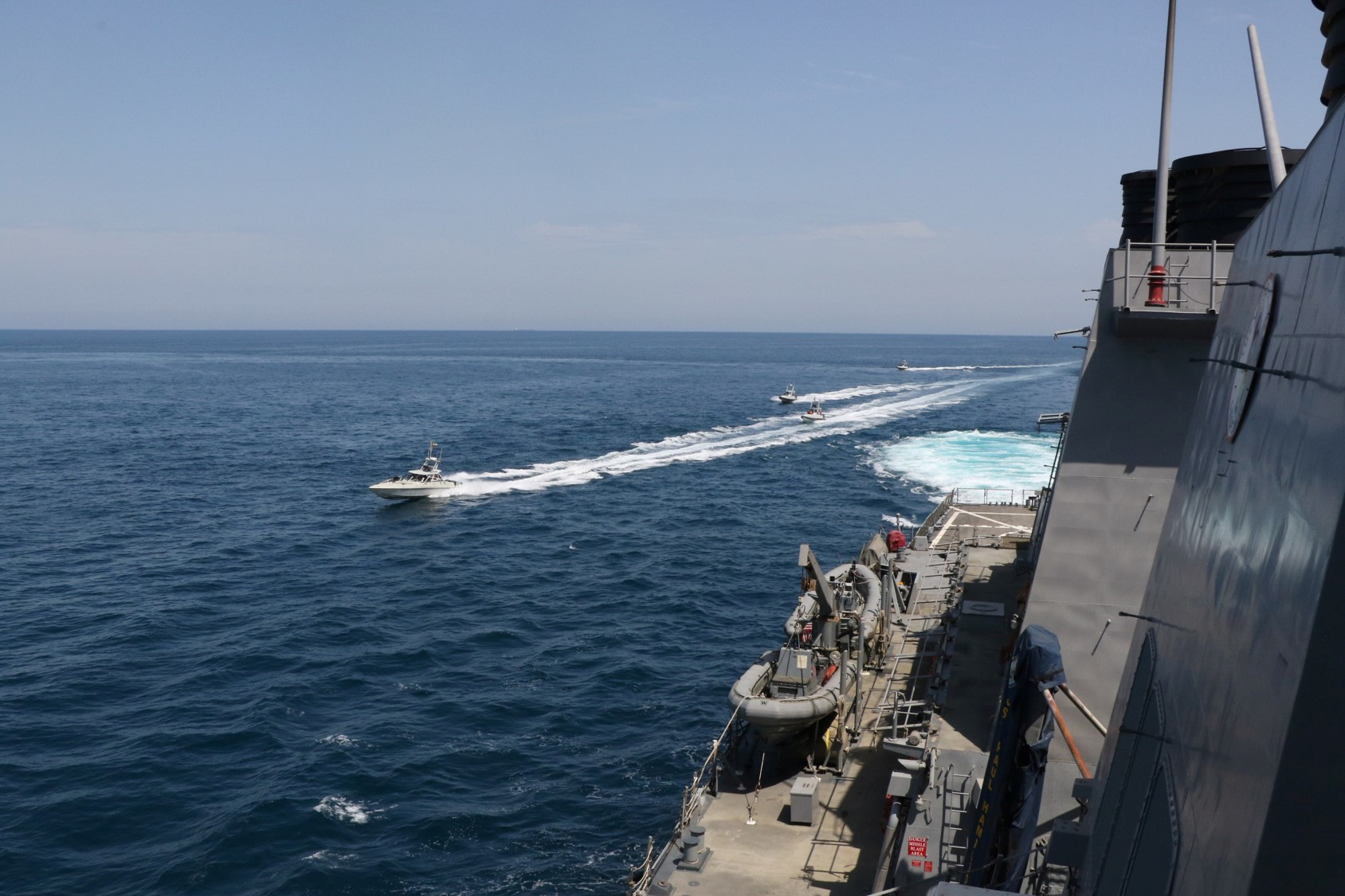
The military, economic, and political conflict between Iran and the United States is escalating. Following the attacks on bases in Iraq where US forces are stationed and provocative action against US vessels by Iranian gunboats, potential exists for a limited direct conflict, even though neither side wants one. Friction is also increasing regarding the US drive to extend the article in UN Security Council Resolution 2231 on a conventional weapons embargo against Iran, which was passed following the signing of the nuclear agreement and expires in October 2020. Iran opposes this extension, and has hinted that it will respond in the nuclear sphere, including withdrawal from supervision agreements, and possibly also from the NPT. The American measure aims more to prevent Iranian purchase of modern weapons from Russia and China and less to damage exports, since Iran continues to send arms to Hezbollah, Syria, Iraq, and Yemen in spite of the embargo. The US demand to extend the embargo is opposed by Russia (and apparently China), and the European partners as well are reluctant to join. Failure of the US effort in the Security Council will impact negatively on Israel, and therefore it is now the time for an intimate US-Israeli dialogue to formulate a strategy on moves and policies to be pursued in case Iran decides on a nuclear breakout.

The military, economic, and political conflict between Iran and the United States has escalated recently, and even the worsening coronavirus crisis in both countries has not tempered this trend.

· Terrorism Monitor, May 17, 2020, v. 18, no.9

o Al-Shabaab Threatens COVID-19 Interventions in Somalia

o The “Tajik Plot” Represents Continuity in Germany’s History of Terrorism

o Counter-Boko Haram Offensives in Chad, Niger, and Nigeria under the Specter of Coronavirus: Public Relations or Permanent Destruction?

The Medical Structure and Calculated Risk

By George Friedman

Medical research is always involved in the important work of understanding disease and the human body. It is now at the center of a global crisis whose evolution can define the international system, the internal systems of nation-states and the shape of our lives. The medical system is no longer vital only to the management of disease but also to the future of humanity. This statement will seem hyperbolic. I don’t think it is. Unlike other global crises, like the threat of nuclear war or the possibility of global warming, COVID-19 threatens to fundamentally disrupt civilizations, and unlike these other existential crises, how it evolves depends on the successes and failures of medical research.

Like the military or the financial system, the medical system is a social system. It is a substantial establishment, in the United States but also in many other countries. It has fought battles against devastating diseases such as polio, HIV, heart disease and the like. It sometimes succeeds, it sometimes fails and it sometimes falls in between. It conducts its battle with patient research, and expending time in order to prevent doing harm. It is not at the center of society usually, but at the points where many of us will live or die. In the United States, the establishment is part government and part private. In that way, it tracks with other institutions.

This Is What Ground Forces Look Like To An Electronic Warfare System And Why It's A Big Deal

BY JOSEPH TREVITHICK
The head of the U.S. Army's 11th Armored Cavalry Regiment has offered an interesting and unusually detailed look at the threat that electronic warfare and electronic support measures pose to American troops on the modern battlefield. The likelihood of a potential adversary monitoring friendly movements via electronic emissions and launching electronic attacks, as well as kinetic ones, on those units has only grown in recent years, with Russia, in particular, demonstrating just how effective these capabilities can be in Ukraine and Syria. American forces in Syria, as well as troops in Europe, have been also subjected to Russia's electronic harassment, as well, underscoring these threats.

On May 7, 2020, Army Colonel Scott Woodward, the commander of the 11th Armored Cavalry Regiment, posted an annotated satellite image on Twitter that showed the electronic emissions signature of a battalion-sized element, along with support units, or "trains," during an exercise at the National Training Center at Fort Irwin in California. The 11th is the unit at the NTC that is dedicated to playing the role of enemy troops, or the Opposing Forces (OPFOR), during exercises and has a fleet of modified vehicles and other systems to mimic the capabilities and visual appearance of potential adversaries

Woodward's Tweet was in response to a question about the value of certain types of modern visible camouflage. He did say that under the right circumstances that traditional methods of concealment, especially nets that break up the general outline of vehicles and make them harder to immediately identify, an important general camouflage concept, could still be useful. 

2020 Second-Quarter Forecast


The global economy will contract in the second quarter and COVID-19 will hold the attention of the globe. The second quarter will adjust the rate at which a number of our annual trends progress, many of which will slow down or be on hold as governments scramble to adapt to a post-COVID reality. For instance, we will see fragile governments in Europe and the Middle East survive past their original expiration dates as they temporarily come together to weather the crisis. The U.S.-China trade battle will be put on the back burner as certain requirements are waived or delayed — but the systemic differences, especially in technological development, will not disappear or be forgotten. COVID-19 will also accelerate the pace of other trends discussed in our annual forecast. The pandemic plus an ongoing price war between Saudi Arabia and Russia will cause a number of oil-producing nations to struggle mightily during the quarter. We will also see certain countries emerge from the COVID-19 crisis and try to start to take advantage of the fallout beginning in the second quarter. For instance, despite COVID-19 outbreaks of their own, Asian countries other than China will try to take advantage of companies looking to diversify supply chains in the wake of the recent upheaval. In short, most of our annual trends hold, but COVID-19 has shifted the timeline of many.

RUSSIAN MILITARY CYBER OPERATIONS IN CONTEXT


Report analyzes risk in state-sponsored cyber operations

If you can figure out why a cyber attack may have occurred, you can better predict what’s next and act deliberately to manage risk to your organization. That’s a key takeaway from Booz Allen’s comprehensive new report, Bearing Witness: Uncovering the Logic Behind Russian Military Cyber Operations. The report details how the timing, targets, and impacts of Russia’s military intelligence agency—the GRU—has been linked to more than 200 espionage, disruption, and disinformation incidents and campaigns between 2004 and 2019.

Many organizations view cyber attacks as indiscriminate threats, but from financially driven “pray-and-spray” attacks to highly targeted attacks by state-aligned adversaries, there’s a motivated threat actor for every attack—even if it’s not immediately obvious to the victims. In this case, our report illustrates how GRU-linked operations directly responded to Russia’s concerns about specific geopolitical events and developments often by shaping beliefs and perceptions.

In this Q&A with the report’s authors, you’ll gain insights into GRU cyber operations, how to better understand the drivers behind those operations, and the value of “threat-centric risk management.”

Inspector General Criticizes U.S. Counterterrorism Coordinator

BY ROBBIE GRAMER
Source Link

The U.S. government office charged with coordinating counterterrorism initiatives around the world has been dogged by management issues and staffing shortages that hamper U.S. efforts to combat foreign terrorist organizations, according to an inspector general’s report issued on Monday. 

The report reviewed the State Department’s Bureau of Counterterrorism and found that the top counterterrorism envoy, Nathan Sales, “exhibited decisive leadership” but also “engaged in conduct that negatively affected” the bureau’s morale and productivity. 

The State Department’s Office of Inspector General (OIG), which wrote the report, cited incidents where Sales “lost his temper” in meetings with both U.S. and foreign officials, and said the bureau did “not provide sufficient policy guidance” or support to U.S. officials overseas working to coordinate counterterrorism efforts with foreign governments.

The inspector general’s report paints a mixed picture of a bureau with a crucial and sweeping mandate for one of the Trump administration’s top national security priorities, particularly as terrorism threats grow in the Middle East and Africa and routine counterterrorism operations are hampered or derailed by the coronavirus pandemic. 

The World Order After COVID-19 Hinges on What Kind of America Emerges

Stewart M. Patrick 

Since reports of a novel coronavirus outbreak in China emerged around the new year, the lion’s share of attention has focused on immediate efforts to contain and respond to the pathogen that has now infected millions around the world and killed nearly 300,000 people, according to official counts. As the initial wave crests in many countries, observers are debating how the pandemic might reshape the world order, including prospects for international cooperation. Some anticipate accelerated U.S. decline and the advent of a more multipolar world. Others predict a deepening authoritarian turn worldwide, with an emboldened China atop the global standings.

The future of the world order is not preordained, but one thing seems certain. The arc of history will depend heavily on whether the post-coronavirus United States embraces constructive internationalism or clings to its current, disastrous course under President Donald Trump. ...

Under a Cloud: The Future of Middle East Gas Demand

BY ROBIN MILLS

During the early years of the 21st century, the Middle East emerged as a fast-growing center not just of natural gas production and exports but also of demand. Including Egypt, total growth in annual demand from 2000 to 2017 was greater than any region except Asia, a feat more surprising when considering the region’s relatively small population and economy. That’s about to change, however. After two decades of rapid expansion of natural gas consumption in the Middle East, growth should drop through 2035 due to four factors: improved efficiency, higher gas prices, slower economic growth, and alternative generation.

Demand growth was driven by low, subsidized gas prices intended to spur economic growth, encourage energy-intensive industrialization, and share some benefits with the local population. But budget deficits and unsustainably rising domestic energy consumption have encouraged regional governments to cut subsidies and introduce efficiency policies, particularly since the fall in oil prices in late 2014. Industrial demand growth is also poised to fall as the Middle East’s key competitive advantage was its low energy and feedstock cost.

The analysis undertaken in this paper to project future gas demand in the Middle East yields significantly lower estimates than forecasts by a number of international bodies (IEA, GECF, BP, ExxonMobil), especially post-2030. Important findings include:

The Promise and Perils of Technology in International Affairs


Technology has the potential to dramatically improve the quality of life for the world’s populations, but there are no guarantees it will. Concerns remain about everything from how the growing digital divide risks leaving large swathes of society—and the world—behind, to questions about the security of data and its potential weaponization. And, of course, there is the ongoing debate around how technology and information platforms can be used to undermine democratic processes, including elections.

To address these concerns, a panel of experts assembled by the United Nations last year called for a “multistakeholder” approach that would convene governments, members of civil society, academics, technology experts and the private sector in an attempt to develop norms and standards around these technologies. Even they could not agree on what this structure might specifically look like, though, underscoring how difficult it will be to ensure that technology is harnessed for everyone’s benefit.

Making Cyberspace Safe for Democracy

By Laura Rosenberger

With the 2020 U.S. presidential campaign underway, stories of Russian interference are again in the headlines. In 2016, Russia’s hacking operations and use of social media to manipulate public discourse in the United States caught U.S. policymakers off-guard. Four years later, officials have not yet fully understood that those attacks reflected the changing landscape of geopolitical competition. Viewing Russia’s attempts at interference in 2016 in isolation misses the larger context: rival states compete in the twenty-first century as much over information as any other terrain. 

Democratic countries view information as an empowering force in the hands of people: the free and open flow of ideas, news, and opinion fuels deliberative democracy. Authoritarian systems see this model as a threat, viewing information as a danger to their regimes and something the state must control and shape. Using surveillance, censorship, and the manipulation of information, authoritarian regimes shore up their power at home while weakening democratic competitors abroad. 

Thunderbolt Flaws Expose Millions of PCs to Hands-On Hacking


SECURITY PARANOIACS HAVE warned for years that any laptop left alone with a hacker for more than a few minutes should be considered compromised. Now one Dutch researcher has demonstrated how that sort of physical access hacking can be pulled off in an ultra-common component: The Intel Thunderbolt port found in millions of PCs.

On Sunday, Eindhoven University of Technology researcher Björn Ruytenberg revealed the details of a new attack method he's calling Thunderspy. On Thunderbolt-enabled Windows or Linux PCs manufactured before 2019, his technique can bypass the login screen of a sleeping or locked computer—and even its hard disk encryption—to gain full access to the computer's data. And while his attack in many cases requires opening a target laptop's case with a screwdriver, it leaves no trace of intrusion and can be pulled off in just a few minutes. That opens a new avenue to what the security industry calls an "evil maid attack," the threat of any hacker who can get alone time with a computer in, say, a hotel room. Ruytenberg says there's no easy software fix, only disabling the Thunderbolt port altogether.

"All the evil maid needs to do is unscrew the backplate, attach a device momentarily, reprogram the firmware, reattach the backplate, and the evil maid gets full access to the laptop," says Ruytenberg, who plans to present his Thunderspy research at the Black Hat security conference this summer—or the virtual conference that may replace it. "All of this can be done in under five minutes."

The Post-Pandemic Military Will Need to Improvise

BY BRYAN CLARKSENIOR FELLOW, HUDSON, DAN PATTFELLOW
Source Link

We don’t mean Pentagon-style “innovation.” We mean like the chefs on the reality show “Chopped.”

The COVID-19 pandemic is still in its opening phases, but the disease and responses to it are already taking a disproportionate bite out of military innovation. While ship, aircraft, and vehicle construction continue, the U.S. military’s efforts to develop new technologies and tactics are slowing in the wake of cancelled exercises, postponed experiments, and idled laboratories. And when R&D can resume, the money needed to sustain it could instead be diverted to economic recovery. 

Although competitors like China or Russia may suffer similar drag, they were already ahead in some technologies, like hypersonic weapons, and have “home field” advantages that reduce their reliance on others, like autonomous systems. To sustain or regain its edge, the U.S. military will need to use its existing tools to create complex and challenging situations for enemies. But integrating and recomposing older ships and aircraft with new autonomous systems or commercial micro-satellites will require DoD to shift more money and effort toward the connective tissue that makes “kill webs” possible. 

15 May 2020

Takshashila Discussion Document: Deriving India’s Strategies for a New World Order

BYANIRUDH KANISETTI, ANUPAM MANUR AND PRANAY KOTASTHANE

“The New World Order” is a phrase often used but rarely understood. This discussion document proposes an analytical framework to decode what a New World Order means for India.

The document presents a flexible action portfolio to hold India in good stead over the next 25 years, regardless of the contours of the international system. The action portfolio is derived by imagining 20 likely scenarios for a New World Order at the intersection of two axes. The first axis represents five possible geopolitical trends, organised by the degree of global polarity. The second axis represents four geoeconomic trends; the degree of growth, automation, trade, and labour movements. In each scenario, we propose strategies to maximise India’s national interest.

Finally, we collate recommendations for India which occur in the maximum number of scenarios and propose that acting on these recommendations is the most optimal path for India to secure its national interests in an ever-changing world. These recommendations form the basis of India’s action portfolio, and are divided into two broad categories:

Domestic Economic Reforms

Liberalise major sectors, implement labour and factor market reforms. Be an attractive destination for FDI.

The Middle East's Evolving Security Landscape: Prospects for Regional Cooperation and US Engagement


Amid ongoing conflict in the Middle East, collective security arrangements have historically proven elusive. Regional states’ mutual mistrust, the absence of shared perceptions of threats, and competing national interests have contributed to the failure of attempts to create a broad, region-wide security system. In the Gulf, Russia, Iran and the United States have proposed competing mechanisms to foster cooperation, but these proposals have foundered, garnering little support from either Arab Gulf nations or international actors. Longer-term progress towards Gulf security cooperation will remain unlikely unless Saudi–Iranian tensions decrease. This rapprochement would require stronger cooperation between the members of the Gulf Cooperation Council themselves. US efforts to support regional security cooperation should focus on strengthening intra-GCC defence and political relationships, including through confidence-building measures, resolution of the Saudi–Qatari rift and increased interoperability of defence systems, as well as reducing perceptions that a US withdrawal from the region is imminent.

Paper produced in the framework of the FEPS-IAI project “Fostering a New Security Architecture in the Middle East”, April 2020.

U.S. Naval Standoff With China Fails to Reassure Regional Allies

BY EUAN GRAHAM
Source Link

On the face of it, the recent standoff along Malaysia’s Borneo coast was a robust response by the U.S. Navy to some cynically timed Chinese adventurism in the South China Sea, offering reassurance to wavering Southeast Asian countries that Washington still has their back in the midst of a global pandemic. Unfortunately, few in the region are likely to view it that way.

For several days, starting on April 20, the USS America—a small carrier equipped with a handful of F-35 jets, helicopters, and an embarked force of U.S. Marines—patrolled, with its two escorts USS Bunker Hill and USS Barry, in close proximity to a Chinese survey ship, Haiyang Dizhi 8, and its accompanying screen of coast guard vessels and fishing boats, the latter widely assumed to be part of China’s maritime militia. Two Chinese navy destroyers and a frigate subsequently arrived on the scene.

The target of China’s motley but highly coordinated maritime force was the West Capella, a drillship working under charter to Petronas, Malaysia’s state-owned energy company. It has been operating near the outer edge of Malaysia’s 200-nautical-mile exclusive economic zone (EEZ), off the state of Sarawak, since late 2019. Beijing’s apparent aim was to intimidate and disrupt Malaysia’s exploration activity, coercing it and other Southeast Asian littoral states into accepting joint development with China.

China’s role in the global biotechnology sector and implications for US policy

Scott Moore

Even by the standards of emerging technologies, biotechnology has the potential to utterly transform geopolitics, economics, and society in the 21st century. Yet while the United States has long been the world leader in most segments of the global biotechnology sector, China is fast becoming a significant player. This brief assesses the implications of China’s changing role in biotechnology for the United States, which span national security, data security, and economic competitiveness.

water_futuresOn current trends the United States is likely to remain the world leader in most biotechnology areas. However, the gap between China and the U.S. is narrowing in the biotechnology sector, and U.S. policymakers must boost public investment, liberalize immigration and foreign student visa policies, and enact regulatory reforms to ensure America remains competitive. At the same time, areas like vaccine development and regulation of emerging technologies like synthetic biology present rich opportunities for Sino-U.S. cooperation.

Making the Most of It, Part II: Xi Jinping Leverages Coronavirus ‘War Without Smoke’ to Spur Digital Transformation, Test National Defense Mobilization


In this paper, Dorman states that “Despite being tied to the pandemic or “economic restart,” current Chinese domestic propaganda efforts on topics ranging from “crisis management” to “digital transformation” and “defense mobilization” did not originate with the coronavirus. Instead, each represents an agile repackaging of Communist Party guidance and propaganda messaging that was already months or years old. Facing a crisis of confidence following its muddled response to the coronavirus outbreak, domestic propaganda efforts were initiated within days or weeks to remold the Party image. Instead of starting from scratch, existing campaigns were repackaged to highlight a Party that was not only in control and leading the crisis response, but even taking advantage of the crisis to accelerate China’s domestic and international goals.”

COVID-19, Debt, and Strategic Competition


In this paper, Dr. Oehlers states that “The current pandemic-induced economic crisis presents a unique opportunity for the United States and like-minded partners to reverse the gains China has made through its debt-led approach to acquire economic and political leverage. By addressing the debt challenges increasingly faced by some developing countries, the financial leverage China holds over any of these can be weakened significantly. Additionally, a multilateral response to the debt challenge grounded on current international rules-based norms, principles, and institutions, will counter Chinese intentions to create a parallel rival system centered on the Belt-Road Initiative. This approach will consequently also assume a crucial role helping shape the economic and financial architecture of the post-pandemic world to come.”

China’s Global Covid-19 Assistance is Humanitarian and Geopolitical. That’s Why People are Worried.


The main thrust of the Chinese Communist Party’s domestic propaganda work since late January has focused on masking the early role of the Party in stifling public health transparency and creating the pandemic crisis. The primary propaganda message, widely disseminated in domestic state-run media, highlighted the “political and organizational advantage” of the Communist Party in tackling the health emergency once the decision to contain the crisis was made in Beijing.

Academic Co-operation with the People’s Republic of China: Dangers and Temptations

Märt Läänemets
Source Link

Critical Article from University of Tartu’s magazine was not published at first due to pressure coming from university’s the administration, that was afraid of the negative impact to its collaboration with Huawei.

Members from the Estonian Oriental Society condemned university’s reaction, because they saw it as threat to freedom of speech and academic freedom. Besides the silencing effect of Chinese funding, this brief addresses other potential threats from scientific espionage to soft power based influencing activities.

Legal Constraints of China’s BRI: The Case of Myanmar


There are many consequences of China’s global Belt and Road Initiative. Amongst the least appreciated are the legal implications that arise from its investments. In Myanmar, one of the chief destinations for Beijing’s largesse, legal problems often occur at the local level due to land disputes, a lack of transparency or poor public consultation. If these project-related issues cannot easily be settled, some form of dispute resolution is needed between the various states, companies and individuals. Arbitration, mediation and conciliation are several of the most common types, but the framework for resolving such cases has not been fully established. This vacuum adds to the uncertainty surrounding China’s foreign involvement, particularly in developing states like Myanmar.

Introduction

Myanmar is strategically located, connecting China’s southwestern province of Yunnan and South-East Asia on one side, with India and South Asia on the other. A high proportion of China’s maritime trade passes through the Malacca Strait near Singapore, which Chinese officials fear could be closed off by the United States in times of dispute. As a potential solution to this, Myanmar offers indirect access to the Indian Ocean, bypassing the narrow shipping lanes altogether. China’s Belt and Road Initiative (BRI) is its sweeping vision for investment, aiming to connect itself with the rest of the world by creating new land and sea trade routes. The program is less rigid and centrally controlled by China than is often imagined. Indeed, many projects that are now considered part of the BRI in Myanmar were actually proposed years before the scheme officially launched in 2013. The original China-Myanmar Bilateral Investment Treaty was signed in 2001, which underpins cooperation, and outlines how disputes are to be resolved.

The Takshashila PLA Insight


I. The Big Story: More on the South China Sea

The Liaoning aircraft carrier strike group, after month-long military exercises near Taiwan and in the South China Sea, has finally returned to Qingdao port this week. Its “annual cross-region drills” included intensive air and sea operations. However, despite the return of the carrier strike group to its base, there is unease within PRC’s neighbouring countries over the recent display of its muscle. These countries are worried that they would be a victim of PRC’s power struggle with the US in the East and Southeast Asian regions. In this context, Indonesia’s Foreign minister, Retno Marsudi, expressed her concerns, noting that the recent activities could have potentially escalated tensions at a time when the global collective effort is vital in fighting the COVID-19 outbreak.

“Indonesia calls on all relevant parties to exercise self-restraint and to refrain from undertaking action that may erode mutual trust, and potentially escalate tensions in the region,” she stated.

Meanwhile, the Chinese coastguard, On April 1, launched an eight-month law enforcement campaign named “Blue Sea 2020”, with one of its stated aims being to crackdown on “violations in offshore oil exploration and exploitation”, as well as marine and coastal project construction. The campaign is a multi-agency effort between the coastguard and transport, natural resources, and environment ministries. “There is only very little information available about the campaign, but we are watching closely to find out what the implications are for the South China Sea,” said a Diplomat from the Association of Southeast Asian Nations on this development.