4 December 2022

As G20 President, Can India Advance Its Multipolar Worldview?

Jagannath Panda

Days after the G-20 summit in Bali, which marked the end of the Indonesian presidency and heralded the group’s Indian leadership for the new term beginning in December, Indian Prime Minister Narendra Modi addressed his domestic audience about India’s “big opportunity” to “focus on global good.” This encapsulated the essence of his speech at the closing session of the summit in Indonesia, which linked India’s global ambitions of establishing a multipolar world and its growing projection as the leader of the Global South.

Thus, the overarching theme of India’s G-20 presidency will revolve around development (making the G-20 “a catalyst for global change”). This primarily involves facilitating the redistribution of global goods by enhancing sustainable partnerships between developed and developing countries, and also reinvigorating South-South cooperation.

Xi Jinping in His Own Words

Matt Pottinger, Matthew Johnson, and David Feith

In October, at the 20th National Party Congress of the Chinese Communist Party (CCP), General Secretary Xi Jinping set himself up for another decade as China’s most powerful leader since Mao Zedong, replaced his most economically literate Politburo colleagues with a phalanx of loyalists, and enshrined the Stalinist-Maoist concept of “struggle” as a guiding principle in the Party Charter. The effect was to turn the page on “reform and opening,” the term the CCP uses to describe the economic liberalization that began in the late 1970s and led to the explosive growth of the Chinese economy in the past four decades.

At the party congress, Xi was granted a third term as the CCP’s top leader—an unprecedented development in the contemporary era and a crucial step in his effort to centralize authority. But perhaps even more significant was the way the congress served to codify a worldview that Xi has been developing over the past decade in carefully crafted official party communications: Chinese-language speeches, documentaries, and textbooks, many of which Beijing deliberately mistranslates for foreign audiences, when it translates them at all. These texts dispel much of the ambiguity that camouflages the regime’s aims and methods and offer a window into Xi’s ideology and motivations: a deep fear of subversion, hostility toward the United States, sympathy with Russia, a desire to unify mainland China and Taiwan, and, above all, confidence in the ultimate victory of communism over the capitalist West. The end state he is pursuing requires the remaking of global governance. His explicit objective is to replace the modern nation-state system with a new order featuring Beijing at its pinnacle.

China signals it could soften its zero-Covid policy, but there are more questions than answers

by Simone McCarthy

China has given its most significant signal yet that it may adjust its stringent zero-Covid policy that has transformed daily life, roiled the economy – and sparked a wave of protests.

The top official in charge of China’s Covid response told health officials Wednesday that the country faced a “new stage and mission” in pandemic control.

“With the decreasing toxicity of the Omicron variant, the increasing vaccination rate and the accumulating experience of outbreak control and prevention, China’s pandemic containment faces a new stage and mission,” Vice Premier Sun Chunlan said Wednesday, according to state news agency Xinhua.

The remarks follow a surge in public frustration with zero-Covid and its high human cost, which erupted into unprecedented demonstrations in at least 19 cities since last Friday.

Sun – who has been the face of the Chinese Communist Party’s enforcement of the policy – made no mention of “zero-Covid,” as reported by Xinhua. Her comments came a day after a separate body of top health officials pledged to rectify some approaches to Covid control and said local governments should “respond to and resolve the reasonable demands of the masses” in a timely manner.

On Thursday, Sun reiterated the new tone, telling a health symposium in Beijing that China’s health care and disease control systems now had “effective diagnosis and treatment techniques” against the epidemic. Overall, China had “created conditions for the country to further optimize its prevention and control measures,” she said, according to state media.

China’s Zero COVID Policy Is a Double-Edged Sword

PAUL HAENLE

Over the past several days, China has witnessed both an increasingly severe coronavirus outbreak and an explosion of protests against its Zero COVID policy. A deadly fire in a locked-down apartment building in Xinjiang was the proximate cause of the latest round of unrest, though resentment and anger against Beijing’s harsh virus containment policies has been building for some time. The Chinese leadership now faces a difficult choice between relaxing restrictions, with the potential for greater viral spread, or ignoring protesters’ demands at the cost of greater social discontent.

In recent weeks, the Chinese government has sent mixed signals about the degree of coronavirus restrictions necessary to contain the virus, leading many to question the efficacy of the current policy. At the 20th Party Congress in October, many Chinese observers anxiously searched for indications that China would shift away from Zero COVID, but such hints were disappointingly absent. Chinese President Xi Jinping only mentioned the policy in the section of his speech on achievements of the past five years, wherein he highlighted the restrictions’ importance in stopping the spread and reducing fatalities. The work report did not include information on how the Chinese Communist Party (CCP) would handle the coronavirus pandemic going forward.

China’s zero-covid policy won’t work forever. But there’s no easy way out of it.

Dan Vergano

Chinese President Xi Jinping is facing mounting political pressure to end the country’s strict and increasingly unpopular “zero-covid” policy. But experts say there’s no easy way to end zero-covid without significant illness, suffering and death.

China’s frequent, large-scale lockdowns have halted outbreaks and saved lives — but they’ve also prevented widescale infections that would help build immunity in China’s population. Compounding the problem, Xi has relied on mediocre homegrown covid vaccines. And the virus has grown more infectious over time, raising doubts about how long the current approach will hold.

“China’s ‘Dynamic Zero-Covid’ strategy is unsustainable and will almost certainly fail over time,” said Lawrence Gostin, faculty director of the O’Neill Institute for National and Global Health Law at Georgetown University. “SARS-CoV-2 is too infectious to be contained, especially with a population that has very little natural or vaccine-induced immunity. If China abruptly ends its zero-covid strategy, it would see an explosion of hospitalizations and deaths.”

Amid a rash of protests against China’s pandemic policies, the country’s National Health Commission on Tuesday announced a new “Work Plan” aimed at getting more booster shots among those 80 and older, the most vulnerable, claiming that two-thirds of them now had boosters (a marked jump from a lower estimate released earlier in November) and decrying a “one size fits all” approach to restrictions from local governments.

China Protestors Call for End to CCP Rule

by Gordon G. Chang

The CCP, as the Chinese Communist Party is informally known, has now lost hearts across the country.

China throughout the Communist period has witnessed demonstrations, but most of them are, as Burton noted, "highly localized" and "directed at malfeasance, corruption, and incompetence of lower level Communist functionaries."

Now, however, the anger is directed at the Party itself. In short, as evident from the spontaneous demonstrations of the weekend, the Chinese people have had enough of Xi Jinping and CCP rule. They recognize the fundamental fact that the Party's system does not work.

The Chinese people are not only angry over Xi Jinping's "dynamic Zero-COVID policy;" they are also troubled by a crumbling economy and the collapse of the all-important property sector. New-home prices in 70 cities, for instance, fell in October for the 14h-straight month. There have been abnormally few sales in recent months as the market is "frozen," with big spreads between what sellers demand and what buyers are willing to pay. These drops in prices and sales are of great concern because some 70% of Chinese household wealth is tied up in property. China's people, as a result, were not happy even before Thursday's fatal blaze.

America Must Disarm Russia’s Energy Weapon

Don Ritter

Energy is Russia’s chief weapon in the war against Ukraine. Why? Because oil, gas, and coal energy resources are paying the bills for Russia’s personnel as well as the missiles, artillery, tanks, ammunition, and drones that are raining down destruction on Ukraine. And, painfully, it is Europe that is footing the bill, financing a longer-term war against itself.

Despite Europe’s success in reducing its energy imports from Russia, global scarcity, U.S. energy stagnation, and OPEC+ production limits have resulted in sharply higher prices. Indeed, Russia’s energy earnings from European countries remain about the same as before the war. Europe has been paying nearly a billion dollars a day to Vladimir Putin’s regime even while getting far less energy for their money.

This is an unsustainable irony for Europe right now and for the United States in the longer term. Russia’s energy exports in 2022 are projected to be $338 billion, a third higher than in 2021 before it invaded Ukraine! Russia’s war in Ukraine, at least financially, has been quite profitable. The United States could easily expand production and begin substituting Russian energy not only in Europe but all over the world, including India, Indonesia, and elsewhere—but higher production is blocked by the importance attached to fighting climate change in U.S. politics.

Can America Balance European Autonomy With China Competition?

Seth Cropsey

European Council president Charles Michel’s impending visit to China is indicative of a worrying trend in Europe’s approach to Eurasian competition. French president Emmanuel Macron, despite stabilizing his position in recent months, repeatedly broke ranks with the United States and the United Kingdom and advised some sort of conciliation with Russia. German chancellor Olaf Scholz, meanwhile, has been a consistent voice for conciliation as well, including advocating for the free transit of goods between the three Baltic states, all of which are EU members, and Russia. Boris Johnson’s remarks that neither France nor Germany seriously believed in the Russian threat, and moreover, that Germany specifically hoped the conflict would end with a rapid Russian victory to mitigate economic damage, fit with this broad pattern of behavior. It is increasingly apparent that the Western European powers remain unready to engage in protracted Eurasian rivalry. Therefore, the United States should consider how to leverage European strategic weight most effectively, and whether New Europe might prove a more effective long-term partner than Old Europe’s traditional powers.

Western Europe’s equivocation and lack of clarity on China policy is the culmination of long-term geopolitical trends. Indeed, Franco-German, and to a lesser degree British, policies toward China stem from strategic choices equally apparent in Europe’s Russia policy. Old Europe is not blind. Rather, it operates under a set of grossly misguided strategic assumptions that contributed to Russia’s invasion of Ukraine and significant Chinese aggrandizement.

US Policy Toward China Is Undermining Security for Communities in the Asia-Pacific

Kate Alexander and Colleen Moore

The Biden administration recently released three military policy documents – the Nuclear Posture Review, National Defense Strategy, and Missile Defense Review – that prioritize “defending the homeland, paced to the growing multi-domain threat posed by the People’s Republic of China.” While the Department of Defense iterates the importance of communication channels and arms control talks, the United States’ current militarized, zero-sum approach toward China is ultimately undermining security by causing environmental destruction in the Asia-Pacific region, fueling anti-Asian hate and xenophobic authoritarianism in the United States, and limiting the space for cooperation on issues such as nuclear risk reduction, climate change, and human rights, all while increasing the risk of military conflict.

U.S. strategy in the Asia-Pacific region to contain China has increased militarization of Hawai’i, Guam, and other Asia-Pacific countries caught in the middle of this great-power competition. The Feminist Peace Initiative, led by MADRE, Women Cross DMZ, and Grassroots Global Justice Alliance, is working with Asia-Pacific grassroots organizers to raise awareness of how U.S. militarism undermines security in communities across the region. We advocate for the United States to abandon the patriarchal notion of security that sees violence as the solution for conflict and prioritize diplomacy and cooperation in order to address urgent threats such as climate change and environmental destruction.

How U.S. Support for Syrian Kurds Actually Benefits Erdogan

Steven A. Cook

Of the many issues that divide the United States and Turkey, Washington’s support for the Kurdish People’s Defense Units (YPG) in Syria is the thorniest. The YPG makes up the bulk of the Syrian Democratic Forces (SDF) and is linked to the Kurdistan Workers’ Party (PKK)—a group the United States designates as a terrorist organization and that has been engaged in a decadeslong fight against the Turkish government. The origins of the YPG date back to 2011. When Syrian President Bashar al-Assad began using military force against Syrians protesting his regime, the PKK helped Syrian Kurds set up a fighting force that would protect Kurdish areas of the country.

Turks are rightfully angry about U.S. policy, but because most of them live in a pro-government news bubble, they are missing critical context. In 2014, the United States sought Turkey’s help in its battle against the Islamic State, but leaders in Ankara made it clear that their primary security concern was the threat of Kurdish nationalism and terrorism. This compelled Washington to make common cause with the YPG in the fight against then-leader Abu Bakr al-Baghdadi’s terrorist army. Ever since, the United States has sought to balance its commitment to Turkey—a NATO ally—and its Syrian Kurdish partners, even as the former periodically attacks the latter.

Could a Russia-Iran Gas Partnership Bear Fruit?


It might seem that for Iran, the West’s attempt to isolate Russia is a good opportunity to fill the resulting market gaps. In practice, however, it only creates new problems.

As 2022 draws to a close, both Russia and Iran find themselves in a bitter confrontation with the West, and subject to more and more Western sanctions. It’s not surprising, therefore, that an active rapprochement between Moscow and Tehran is under way: not just in the military sphere, but in the energy sector, too. The two countries have signed a memorandum for $40 billion of Russian investment in Iranian gas projects and have already embarked on its implementation.

Given that Russia and Iran hold the world’s first and second biggest gas resources, respectively, many believe this cooperation threatens to give rise to a “global gas cartel.” In reality, the implementation of these ambitious plans may be thwarted by sanctions and other obstacles.

Just a few months ago, Russia and Iran might have been viewed as rivals rather than collaborators. Almost as soon as Russian gas exports to Europe ran into problems over Russia’s invasion of Ukraine, the Iranian authorities said they were considering the possibility of stepping in to make up for the resulting deficit on the European market.

The New National Defense Strategy Makes a Subtle Yet Significant Break From Its Predecessors

JENNIFER KAVANAGH

Across presidential administrations and regardless of the political party in power, the U.S. Department of Defense has continuously resisted shedding legacy commitments, tending to expand its role over time. At first glance, the recently released 2022 National Defense Strategy (NDS) is no different: it makes few real choices and even adds priorities, such as the Arctic and climate, to the DOD’s docket.

But a closer read suggests that this NDS begins to break from that habitual pattern, responding to an increasingly challenging security environment not by growing the DOD’s responsibilities, but by refining and focusing its commitments. It reveals several areas where the DOD signals an explicit intention to concentrate its own investments more narrowly on top priorities while delegating other responsibilities to interagency, private sector, and foreign partners—a tactic known as burden sharing. Though subtle, these changes are significant steps in the right direction in three key ways.

First, the 2022 NDS commits not just to cooperate with allies and partners, but to put them in the driver’s seat on issues of self-defense and regional security, freeing up U.S. forces for more important security demands. The desire to improve the integration of allies and partners with the U.S. military is a perennial one for the DOD, appearing in the 2018 NDS and other strategic planning documents. But this NDS moves beyond previous statements, defining specific areas where the DOD will expect more participation from allies and partners and placing itself in a supporting role.

What Makes France So Aggravating to the United States Is Also What Makes It So Valuable

CHRISTOPHER S. CHIVVIS, MATHIEU DROIN

On Thursday, U.S. President Joe Biden will welcome French President Emmanuel Macron to the White House with the full pomp of an official state visit. France and America need each other now more than ever, but history suggests that cooperation won’t be easy.

Macron’s visit is a chance for Washington to get over its hang-ups about his sometimes irascible foreign policy and realize that France’s independence is at the root of what makes it such a valuable ally. For its part, France needs to show that its transformative agenda for Europe and its role in the world can deliver concrete benefits for America.

Macron’s predecessors have been aggravating Washington for more than fifty years, starting with president Charles De Gaulle, who lambasted America for the Vietnam War, protested the U.S. dollar’s global dominance, built France’s own nuclear weapons, and distanced France from NATO. Macron has been no less frank. When he called NATO “brain dead” in 2019, heads exploded in the corridors of the Pentagon, CIA, and State Department. When the Biden administration announced new plans for military cooperation with Australia and Britain in 2021, U.S. officials were stunned by Paris’s sharp rebuke. Macron’s insistence on keeping a diplomatic channel open with Moscow after its invasion of Ukraine only made more steam blow from the ears of U.S. policy elites. Most of all, Macron’s energetic cheerleading for European “strategic autonomy”—by which he means that Europe needs the economic and military might to take on much more responsibility for its foreign policy—rankles ardent NATO backers here and in and Europe.

How cybercriminals have been affected by the war in Ukraine


Less extortion and theft, but more digital destruction. That is one of the ways in which the conflict in Ukraine is altering cybercrime. The shift, says Oleh Derevianko, chairman of issp, a Ukrainian computer-security firm, is striking. Recent years had seen a boom in the use of ransomware, which scrambles victims’ computer data until a payment is made. Now, Mr Derevianko says, the number of such attacks on issp’s corporate and government clients has dropped pretty-much to zero. Instead, many of those once involved in such enterprises seem to have been co-opted by Russia’s government and are focusing on “wiping” computers to damage Ukraine’s war effort by erasing whatever data they can reach.

The same is true of attacks on Russian computers by Ukrainians, says Olga Khmil, a researcher at Molfar, an intelligence firm in Kyiv. Such hackers now care less about stealing money and “more about the damage they can cause to the aggressor”.

Lessons from Russia’s cyber-war in Ukraine


Shaping the battlefield. Darius, king of Persia, did it in 331bc, with caltrops strewn where he thought his enemy Alexander the Great would advance. The Allies did it in 1944, with dummy aircraft and landing craft intended to fool Germany’s high command into thinking their invasion of France would be in the Pas de Calais, not Normandy. And Russia attempted it on February 24th, when, less than an hour before its tanks started rolling into Ukraine—on their way, they thought, to Kyiv—its computer hackers brought down the satellite communications system run by Viasat, an American firm, on which its opponents were relying.

Victor Zhora, head of Ukraine’s defensive cyber-security agency, said in March that the result was “a really huge loss in communications in the very beginning of war”. A Western former security official reckoned it took “a year or two of really, really serious preparation and effort”.

A Presidential Trojan Horse: The Inflation Reduction Act

by Lawrence Kadish

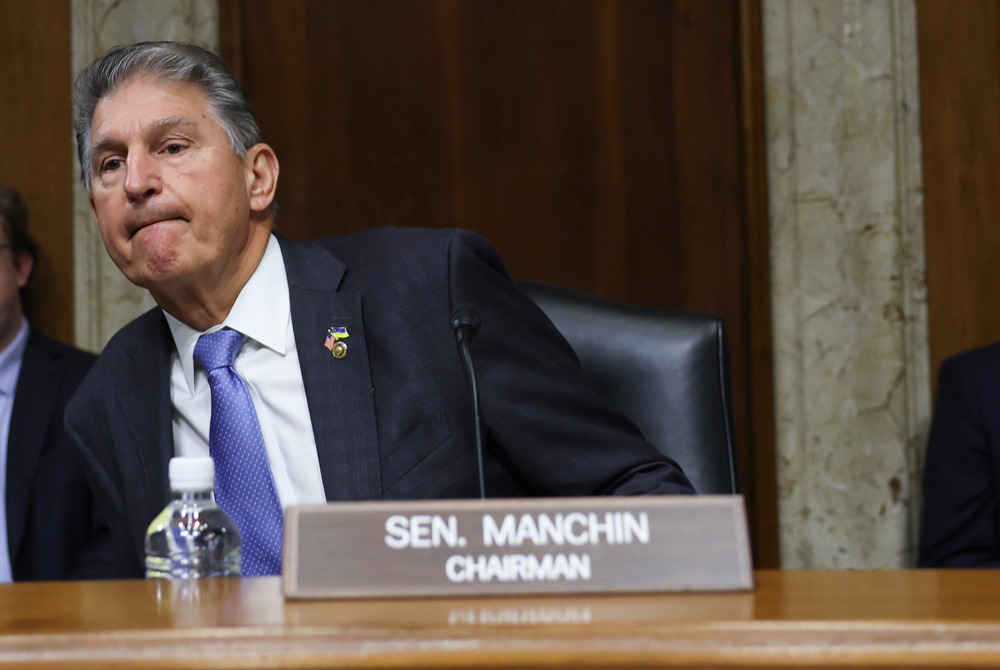
U.S Senator Joseph Manchin has been playing both sides against the middle for the past year and it appears that game is about to end.

This year Manchin offered his vote to pass the so called "Inflation Reduction Act" in return for Senate leadership support of legislation that would loosen regulations now impacting energy pipeline construction in his home state of West Virginia. In some earlier era in Washington, that kind of Capitol Hill give-and-get would have gone unnoticed, just another deal being cut with taxpayers' money before lunch in the Senate dining room.

That was then. This is now.

Manchin's vote essentially gave the Biden Administration a blank check, spending hundreds of billions of dollars wherever and whenever they want as the White House ramps up their reelection bid. If one is permitted to say so, a citizen would have to be beyond naïve to believe that this blizzard of federal cash will all be accounted for on behalf of projects that actually strengthen the republic. No one knows that better than Manchin, as he cut his deal with Senate Majority Leader Charles Schumer in a scene from "Advice and Consent."

WhatsApp Files on Dark Web Show Millions of Records For Sale

Alessandro Mascellino

In mid-November, a threat actor posting on a dark web forum claimed to have stolen the personal information of almost 500 million WhatsApp users.

Now, Check Point Research (CPR) has published a new advisory analyzing the exposed files and confirming the leak includes 360 million phone numbers from 108 countries.

While CPR was unable to confirm the leaked numbers belonged to WhatsApp users, their analysis showed that the phone numbers varied in quantity among countries, ranging from 604 in Bosnia and Herzegovina to 35 million attributed to Italy.

According to the document, the whole list went on sale for four days and is now being distributed for free among dark web users.

"While the information on sale does not expose the content of any messages themselves, it is still worrying to see such a large volume of phone numbers for sale on the Dark Web. There is the potential that this information could be used as part of tailored phishing attacks in the future,” said Deryck Mitchelson, field CISO of EMEA at CPR.

Will Elon Musk’s lax Twitter content moderation help ignite violence around the world?

Benjamin Powers

Elon Musk’s decision to gut Twitter’s content moderation capacity is poised to hit hardest in countries where English is not the main language — opening the door to human rights abuses, along with hate speech and misinformation.

Since the billionaire took over Twitter on Oct. 28, he has eliminated most of its Trust and Safety team, ceased enforcing its covid-19 misinformation policy and reneged on promises to create a content moderation council. He’s also reinstated banned accounts, including that of former president Donald Trump — in that case, based on a single Twitter poll.

Civil society and human rights groups in countries like India, Poland and Nigeria say they’re frustrated that media attention and public debate over Musk’s dramatic reshaping of Twitter has largely focused on its effects in the United States, such as the restoration of Trump’s account. In a matter of weeks, Musk has reversed hard-fought gains in the site’s ability to moderate content in languages other than English in places where the social media site has previously been used to incite violence against minority groups or subvert protest movements.

“Since Musk has taken over Twitter, this situation has become perilous,” said Wendy Via, president of the Global Project Against Hate and Extremism. “I’m sure you’ve seen the reports of how the U.S. has seen a sharp increase in hate speech, and that’s in English. Imagine what the other countries are experiencing. And banned users are now evading the system by setting up new accounts often successfully because there are no global staff to report violations and take action.”

Private-Sector Cyber Defense in Armed Conflict

By Stephanie Pell 

Just hours before the first group of Russian tanks crossed into Ukraine in February 2022, Microsoft’s Threat Intelligence Center discovered a new piece of “wiper” malware known as Foxblade “aimed at the country’s government ministries and financial institutions” and capable of wiping data from their computers.

As the New York Times reported, Microsoft quickly updated its virus detection systems to block the malicious code, and it contacted Anne Neuberger, the U.S. deputy national security adviser for cyber and emerging technology.

Neuberger facilitated Microsoft’s sharing of information about the malicious code with other countries in order to prevent it from spreading and potentially “crippling the military alliance or hitting West European banks.” This early intervention was perhaps the first public indicator of how integral the private sector would become in both cyber defense and resilience during the course of Russia’s unlawful war of aggression against Ukraine.

As Susan Landau has observed, the interaction between Microsoft and Neuberger “represents an important change in the cooperation between the U.S. government and the tech industry”—the kind of cooperation that may not have seemed possible just a decade ago in the wake of the Edward Snowden disclosures.

NSA cyber director talks threats, opportunities

By JOHN SAKELLARIADIS

— Rob Joyce, director of NSA’s cybersecurity directorate, spoke with MC about his agency’s fight against ransomware, how not to defend the country’s essential infrastructure, a controversial new law in China and a whole lot more. It’s a special, Joyce-heavy edition of MC that’s tailor-made to cure your food coma.

HAPPY MONDAY, and welcome to Morning Cybersecurity! They used to say our Founding Fathers would recoil in horror if they saw modern America.

Then we played the Brits to a 0-0 tie in the group stage of the 2022 World Cup.

Enjoy a Sam Adams on us, Sam Adams. You’re welcome.

Got tips, feedback or other commentary? Send them my way at jsakellariadis@politico.com. You can also follow @POLITICOPro and @MorningCybersec on Twitter. Full team contact info is below.

Want to receive this newsletter every weekday? Subscribe to POLITICO Pro. You’ll also receive daily policy news and other intelligence you need to act on the day’s biggest stories.

RANSOMWARE

What’s next in cybersecurity


By Lorenzo Franceschi-Bicchieraiarchive

In the world of cybersecurity, there is always one certainty: more hacks. That is the unavoidable constant in an industry that will spend an estimated $150 billion worldwide this year without being able, yet again, to actually stop hackers.

This past year has seen Russian government hacks aimed at Ukraine; more ransomware against hospitals and schools—and against whole governments too; a seemingly endless series of costly crypto hacks; and high-profile hacks of companies like Microsoft, Nvidia, and Grand Theft Auto maker Rockstar Games, the last hack allegedly carried out by teenagers.

All these types of hacks will continue next year and in the near future, according to cybersecurity experts who spoke to MIT Tech Review. Here’s what we expect to see more of in the coming year:

Russia continues its online operations against Ukraine

Ukraine was the big story of the year in cybersecurity as in other news. The industry turned its attention to the embattled country, which suffered several attacks by Russian government groups. One of the first ones hit Viasat, a US satellite communications company that was being used by civilians and troops in Ukraine. The hack caused “a really huge loss in communications in the very beginning of war,” according to Victor Zhora, the head of Ukraine’s defensive cybersecurity agency.

There have also been as many as six attacks against Ukrainian targets involving wiper malware, malicious computer code designed to destroy data.

WAR INDUSTRY LOOKING FORWARD TO “MULTIYEAR AUTHORITY” IN UKRAINE

Jeremy Scahill

GEN. MARK MILLEY, chair of the Joint Chiefs of Staff, recently offered some matter-of-fact observations about the immense human suffering and death caused by Russia’s invasion of Ukraine and placed the responsibility for ending the war squarely on Moscow’s shoulders. “There’s one guy that can stop it — and his name is Vladimir Putin,” Milley said. “He needs to stop it.”

But then Milley crossed what he most certainly never imagined to be a tripwire when he said, “And they need to get to the negotiating table.”

The general cited the multiyear death toll of 20 million during World War I — caused, he said, by the failure to negotiate an earlier end to the war — and went on to suggest that it would be better for the war in Ukraine to end soon in negotiation rather than continue on indefinitely.

“There has to be a mutual recognition that military victory is probably — in the true sense of the word — is maybe not achievable through military means, and therefore you have to turn to other means,” Milley said during the November 9 event at the Economic Club of New York. Referring to recent Russian setbacks at the hands of Ukrainian forces and the coming winter, Milley went on: “When there’s an opportunity to negotiate, when peace can be achieved, seize it. Seize the moment.”

DIGNITY AND RESPECT: AN EXCLUSIVE LOOK AT HOW THE ARMY IS TRAINING DRILL SERGEANTS FOR A NEW ERA

Alex Hollings 

Drill sergeants with 2nd Battalion, 48th Infantry Regiment, welcome a new Soldier to Fort Leonard Wood on training day zero. (U.S. Army photo)

In fact, it was that very bias that led to my decision to write this story in the first person.

The fact of the matter is, I’m not an outsider at all. Since I first stepped foot on the yellow footprints of Parris Island in 2006 — some 16 years ago now — I’ve lived and breathed America’s military in a variety of capacities: from recruit to Marine; from Marine to veteran; from veteran to defense contractor; from defense contractor to journalist.

It’s because of my experiences, both in uniform and out, that I arrived at Fort Jackson believing the Army’s shift in training methodology might be more about managing Gen Z’s negative perceptions of service than truly about training recruits to become the most capable warfighters. But it’s similarly because of those experiences that my time in Fort Jackson, and subsequent research, have convinced me otherwise.

I’m now certain that Dignity and Respect isn’t just the right approach to training for the future… It’s the right approach to training, period.

SSG Devante McLean, the Drill Sergeant Academy’s 2022 Drill Sergeant of the Year, managed to recontextualize my entire perception of basic training and the “shark attack” early in my visit.

3 December 2022

China Is Deepening Its Military Foothold along the Indian Border at Pangong Tso

Matthew P. Funaiole, Brian Hart, Joseph S. Bermudez Jr., and Jennifer Jun

China’s recent willingness to tamp down tensions with India at their disputed Himalayan border belies Beijing’s broader strategic ambitions in the region. In September 2022, the two regional powers mutually began to move their troops back from key positions along the hotly contested Line of Actual Control (LAC) near the Gogra Hot Springs. Yet neither side is engaging in a broader pullback. In fact, satellite imagery reveals that China is investing in a significant, long-term military presence near Pangong Tso, a remote lake that straddles the LAC just 50 kilometers south of the Gogra Hot Springs.

Let’s Put the Pentagon’s China Report in Context

BY WILLIAM D. HARTUNG

The Pentagon released its annual report on Chinese military power this week, and hawks in Congress and the Pentagon will no doubt use it as evidence that China is on the march militarily, and that the U.S. should therefore continue its buildup in the Pacific and its development of a new generation of nuclear weapons. But a closer look at China’s military aspirations in the context of current U.S. capabilities tells a different story.

The report says that China likely possesses 400 nuclear warheads, and that if production stays on pace, the number could more than triple over the next decade. But the United States has over 5,400 warheads in its stockpile, including over 1,600 deployed on bombers, submarines, and long-range ballistic missiles. Even if the Pentagon’s assessment is correct, deterrence would hold; Beijing would be in no position to launch a nuclear strike on the United States or its allies without suffering a devastating attack in return.

Indeed, the disparity suggests that the Pentagon could forgo a significant portion of its three-decade, up-to-$2 trillion plan to build new nuclear-armed bombers, submarines, and missiles, along with new warheads to go with them. Instead of continuing a wasteful and destabilizing arms race, the United States could move towards a “deterrence-only” posture along the lines outlined by the organization Global Zero.

The Significant Hurdles Facing Pakistan’s New Army Chief

TIM WILLASEY-WILSEY

EXPERT PERSPECTIVE — Pakistan’s Prime Minister Shehbaz Sharif has made his decision and has chosen Lieutenant-General Asim Munir to be the next Chief of Army Staff (COAS). Sharif has agonised for weeks over this choice and even flew to London in early November to consult his brother, Nawaz, the former prime minister.

Both Nawaz and Shehbaz are still haunted by their near-fatal error in choosing Pervez Musharraf in 1998, only for the apparently mild-mannered general to mount a coup the following year and appoint himself president for the next eight years. Nawaz’s long periods of exile and prison serve as constant reminders of the perils of such decisions.

However, the choice seems to be a good one. Munir was the highest ranking General on the list and has a good pedigree. He has commanded a brigade on operations in the north-west and an army corps near the Indian border. He has run Military Intelligence (MI) the body which monitors the security of the army itself and Inter-Services Intelligence (ISI) the powerful espionage and security agency which looks at external and internal threats to the state. The latter two appointments demonstrate that he has the total confidence of the outgoing chief, General Qamar Bajwa. After all, Bajwa needs someone to protect his back against any future political or judicial moves against his record in office.

Xi Jinping in His Own Words

By Matt Pottinger, Matthew Johnson, and David Feith

In October, at the 20th National Party Congress of the Chinese Communist Party (CCP), General Secretary Xi Jinping set himself up for another decade as China’s most powerful leader since Mao Zedong, replaced his most economically literate Politburo colleagues with a phalanx of loyalists, and enshrined the Stalinist-Maoist concept of “struggle” as a guiding principle in the Party Charter. The effect was to turn the page on “reform and opening,” the term the CCP uses to describe the economic liberalization that began in the late 1970s and led to the explosive growth of the Chinese economy in the past four decades.

At the party congress, Xi was granted a third term as the CCP’s top leader—an unprecedented development in the contemporary era and a crucial step in his effort to centralize authority. But perhaps even more significant was the way the congress served to codify a worldview that Xi has been developing over the past decade in carefully crafted official party communications: Chinese-language speeches, documentaries, and textbooks, many of which Beijing deliberately mistranslates for foreign audiences, when it translates them at all. These texts dispel much of the ambiguity that camouflages the regime’s aims and methods and offer a window into Xi’s ideology and motivations: a deep fear of subversion, hostility toward the United States, sympathy with Russia, a desire to unify mainland China and Taiwan, and, above all, confidence in the ultimate victory of communism over the capitalist West. The end state he is pursuing requires the remaking of global governance. His explicit objective is to replace the modern nation-state system with a new order featuring Beijing at its pinnacle.

China’s Middle Class May Be Xi Jinping’s Biggest Threat

Minxin Pei

Myths take years to propagate and only days to puncture. In addition to shocking China’s seemingly unprepared authorities, recent Covid protests in major Chinese cities have claimed two enduring myths about the People’s Republic.

One obviously is the purported superiority of China’s top-down authoritarian system. The ruling Chinese Communist Party (CCP) has stuck to harsh Covid Zero policies mainly to demonstrate that it can do a better job than Western liberal democracies at suppressing the pandemic. With new infection rates rising to record levels and public anger growing, China’s strategy and the political system behind it are clearly failing, not succeeding.

The other debunked myth is that the CCP has successfully co-opted China’s middle-class. Given that young professionals and college students appear to have made up the bulk of the protesters, we need to ask whether the world was too quick to write off middle-class Chinese as a force for political change.

Jiang Zemin Helped China Become a Global Powerhouse

Victor Shih

When Chinese recall Jiang Zemin, who stepped down as general secretary of the Chinese Communist Party (CCP) in 2002, they sometimes laugh about a well-known episode in 2000 when he berated a Hong Kong reporter for being “too simple, sometimes naive.” Jiang’s outsized response to an innocuous question about the next leader of Hong Kong spurred bemused murmurs and plenty of sarcasm. It epitomized a patronizing and bullying style of leadership stemming from the deep conviction of Jiang and other leaders that they knew best.

In truth, Jiang, who, according to official media, died on Nov. 30 in Shanghai at the age of 96, oversaw two crucial transitions that shaped and largely improved the lives of the people of China. First, he peacefully guided his country out of the shadow of China’s founding revolutionaries, who had spent decades purging one another and at times caused great pain and sorrow for everyone else. Second, although hesitant at first, Jiang came to embrace the market economy. As China struggles under the pressures of its zero-COVID policy, and after nationwide protests swept the country last weekend, Jiang’s rule now seems to many like a period of relative hope.

Technology propels China’s Gulf strategy forward

N Janardhan,  and Gedaliah Afterman

A ‘flying car’ built by Chinese company Xpen Aeroht made its first public flight in the United Arab Emirates (UAE) in October 2022. A few months earlier, China’s NWTN — a passenger transport company — announced that it would build an electric vehicle facility in Abu Dhabi. These technological headways show that US efforts to convince Gulf allies to restrict China’s influence have been unsuccessful.

Across the UAE’s borders, Huawei and the Saudi Digital Academy agreed in 2022 to advance local technological talent and realise the digital transformation — the use of artificial intelligence, cloud computing, cybersecurity and 5G — envisioned in Saudi Vision 2030, Riyadh’s blueprint for economic diversification. Despite US President Joe Biden explicitly arguing in July 2022 that improving US–Saudi relations is essential to ‘outcompete China’, it will be an uphill task with the intensification of the Gulf–China synergy.

China may get top ownership of US lithium mine

RYAN MORGAN

A Canadian company is hoping to get approval and federal funding for a new lithium mine in northern Nevada, but former Secretary of State Mike Pompeo and Republican lawmakers are raising concerns about the mining company’s largest shareholder, a Chinese firm. The mining company is going through with an effort to dilute this Chinese ownership, but concerns remain about China’s potential influence over the critical mineral mine at a time when China is seeking to overtake the U.S. as a dominant global power.

Lithium Americas, a Canadian-based company, has been trying to get approval from the U.S. federal government to proceed with its Thacker Pass mine in northern Nevada for years but is awaiting approval to begin mining. The company is already facing a variety of legal challenges to the new mining project — including from Native American and environmental groups — but the Republican politicians are also honing in on the mining company’s largest shareholder: China-based Ganfeng Lithium Co Ltd.

Lithium is a key material for electric batteries. Lithium Americas is trying to get approval for the Thacker Pass mine at a time when China controls roughly 60 percent of the world’s lithium resources and has a commanding position over the electric battery supply chain. Bloomberg Law reported the U.S. currently only has one lithium mine in operation at Albemarle’s Silver Peak in southwestern Nevada.

Reject the CCP’s Effort to Co-opt Buddhism

Michael Rubin

In 2001, the world was aghast when the Taliban dynamited the 1,500-year-old Bamiyan Buddhas, a United Nations Educational, Scientific and Cultural Organization (UNESCO) world heritage site. The destruction of the Buddhas in Afghanistan was not the world’s worst assault on Buddhist heritage, however. That began in 1950 when the People’s Liberation Army (PLA) invaded Tibet. Nine years later, Chinese Communist Party (CCP) leader Mao Zedong began a twenty-year campaign to eliminate Buddhist heritage in Tibet. Chinese forces destroyed more than 99 percent of the country’s 6,000 monasteries and forced the Dalai Lama into exile in India.

The CCP’s role as the most destructive force to Buddhism since Genghis Khan makes Beijing’s attempt to leverage Buddhism to China’s diplomatic benefit even more cynical and audacious. It is akin to Turkey seeking to speak on behalf of Armenian culture or Serbia seeking to be the voice of Bosnian or Kosovar Muslims.

Where Realpolitik Went Wrong

FRED KAPLAN

It may be a sign of decline in John Mearsheimer’s mental acuity that, nine months after coming off quite badly in one Q&A by the New Yorker’s Isaac Chotiner, he agreed to strap himself in for another round of grilling and emerged more battered still.

Professors of political science don’t generally cause a stir, but intellectual self-immolation is a rare spectacle. And Chotiner’s one-two torching of Mearsheimer is a barn-burner.

In the past year, to a degree rarely matched by academics in his field, Mearsheimer made a splash in the public debate. He has argued that NATO—and especially the United States—is “principally responsible” for Russia’s invasion of Ukraine; that Vladimir Putin’s aims in this war are limited to keeping Ukraine in Moscow’s orbit; that Putin has the right to make this claim; and that the U.S. should not only end the war quickly but form an alliance with Russia in broader geopolitical ventures. He is wrong on all these points, for reasons that go deeper than the obvious ones.

Why Isn’t Joe Biden Supporting Protests In China And Iran?

Michael Rubin

Biden Should Speak Out Forcefully for Chinese and Iranian Protestors: China’s protests caught the White House by surprise. America’s “near-peer” competitor and top military threat hobbled, at least temporarily, by widespread protests was not something the State Department or the intelligence community’s top China hands expected.

The Biden administration’s response was weak. “We’ve long said everyone has the right to peacefully protest, in the United States and around the world. This includes in the PRC [the People’s Republic of China],” a National Security Council statement read.

Once again, political appointees and professional diplomats responded as if by a computer algorithm rather than with an appreciation of the ideological battle in which the United States finds itself, the outcome of which will shape the fate of the rules-based order over the remainder of the century. The tepidness of the statement undermines any meaning it might have.

Washington’s Carthaginian Peace Collides With Reality

Douglas Macgregor

The national political and military leaders who committed America to wars of choice in Vietnam, the Balkans, Afghanistan, and Iraq, did so as a rule because they were convinced the fighting would be short and decisive. American presidents, presidential advisors, and senior military leaders never stopped to consider that national strategy, if it exists at all, consists of avoiding conflict unless the nation is attacked and compelled to fight.

The latest victim of this mentality is Ukraine. In the absence of a critical root-and-branch analysis of Russia’s national power and strategic interests, American senior military leaders and their political bosses viewed Russia through a narrowly focused lens that magnified U.S. and Ukrainian strengths but ignored Russia’s strategic advantages—geographic depth, almost limitless natural resources, high social cohesion, and the military-industrial capacity to rapidly scale up its military power.