10 October 2023

India-China Tango Continues in Sri Lanka

Rajeswari Pillai Rajagopalan

Sri Lanka has been caught in a tug of war between India and China. Most recently, a Chinese maritime research vessel, Shi Yan 6, was expected to enter Colombo for research in purposes, in collaboration with Sri Lanka’s National Aquatic Resources Research and Development Agency (NARA).

NARA had earlier indicated that Shi Yan 6 will be in Sri Lanka “as per the agreement reached with the University of Ruhuna.” However, the Sri Lankan university announced its exit from the project. The University of Ruhuna provided various logistical reasons for pulling out of the research partnership with the Chinese vessel.

Given India’s objections to the Chinese ship docking in Colombo for a month, Sri Lanka is reported to have asked China “to defer the visit.” But China insisted on sticking to the original schedule in October-November and demanded that the ship be allowed to dock in Sri Lanka. Sri Lankan Foreign Minister Ali Sabry said that Sri Lanka had “not given permission to the Chinese vessel Shi Yan 6, as Indian security concerns were important to the island nation.” But he added that “negotiations were going on, and if the vessel complied with the standard operating procedures of Sri Lanka, then there would be no problems.”

Pakistan’s Never-ending Battle Against Terrorism

Qurat-ul-Ain Shabbir and Moneeb Mir


Local residents stand at the site of a suicide bombing in Mastung near Quetta, Pakistan, Sept. 29, 2023.

In a single day last week, Pakistan’s faced two deadly terrorist attacks, one in Khyber Pakhtunkhwa province and the other in Balochistan province. Together, the bombings claimed the lives of around 60 people and injured dozens of others. It provided a tragic bookend to a bloody month: The first week of September also saw the Chitral incursion, in which a contingent of Tehreek-e-Taliban Pakistan (TTP) fighters crossed into Lower Chitral and attacked two military checkposts, resulting in casualties on both sides.

Before that, the month of August was hailed as the deadliest in Pakistan since November 2014.

By 2015, Pakistan was able to bring a halt to years of terrorism after conducting full-fledged military operations. The recent reinvigoration of terrorism in Pakistan has often been blamed on the return to power of the Afghan Taliban across the border. However, terrorism in Pakistan also reflects a deep-rooted ideological problem, which needs to be understood if the country is to fully curtail the violence.

North Korea Will Never Give Up Its Nuclear Weapons. Will Japan and South Korea Go Nuclear?

Malcolm Davis

As these words are written, North Korea has halted the operation of the five-megawatt nuclear reactor at Yongbyon. This move is most likely intended to extract plutonium for weapons-grade enrichment and provide fissile material for more nuclear weapons. Late in September, North Korea amended its constitution to enshrine the goal of accelerating the production of nuclear weapons. Its focus remains on building up a significant force of strategic and tactical nuclear weapons. These, it claims, are meant for deterrence. Nevertheless, Pyongyang could easily employ them for compellence and coercion.

Pyongyang continues a series of missile tests for weapons suitable to deliver nuclear warheads against South Korea, Japan, and United States military forces in the Indo-Pacific region, as well as against the continental United States itself. It has also unveiled a new conventionally powered but nuclear-armed submarine designed to give it a basic second-strike capability.

The Biden Administration isn’t really engaged with Pyongyang, even indirectly, in discussions on achieving the goal of comprehensive and verifiable nuclear disarmament of North Korea. If Donald Trump regains the White House after the 2024 Presidential election, it is unlikely that he will make meaningful progress toward that goal. Moreover, there will be no restoration of personal summit diplomacy, especially after the failure of the 2019 Hanoi summit.

Hasina, Macron Seal Deal on Aircraft that Bangladesh Doesn’t Need, Cannot Afford

Zia Hassan

French President Emmanuel Macron meets Bangladeshi artists during his visit to Dhaka, Bangladesh on September 10-11, 2023.Credit: X/France in Bangladesh

French President Emmanuel Macron’s visit to Bangladesh on September 10-11 was meticulously choreographed to highlight smiles, handshakes, and cultural delights. However, behind the optics lies a more calculating economic and political agenda that merits scrutiny about who truly benefits.

During his two-day sojourn, Macron played the consummate visiting dignitary. He listened appreciatively to live folk music, rode a rickshaw through Old Dhaka, and sat down to sample rich Bengali cuisine.

Yet Macron’s charm offensive could not fully disguise the more dubious motivations driving this historic visit – namely, the sale of 10 unneeded Airbus aircraft worth $3.2 billion to Bangladesh’s state-owned carrier Biman Airlines, which is besieged by corruption, chronic underutilization of aircraft, and consecutive years of losses hidden by tricky accounting.

While Macron framed his visit as an opportunity to establish a “third way” in a region grappling with the expansion of China’s influence, the primary objective was to capitalize on Bangladeshi Prime Minister Sheikh Hasina’s gambit for clinging to power. Macron managed to secure lucrative deals favoring the French aircraft industry ahead of a general election in Bangladesh that many believe would be rigged to ensure that the authoritarian Hasina remains in power.

Bangladesh Gets First Uranium Shipment From Russia for Its Moscow-built Nuclear Power Plant

Julhas Alam

Bangladesh on Thursday received the first uranium shipment from Russia to fuel the country’s only nuclear power plant, still under construction by Moscow. Once finished, the plant is expected to boost Bangladesh’s national electrical grid and help the South Asian nation’s growing economy.

The Rooppur power plant will produce 2,400 megawatts of electricity — powering about 15 million households — when the twin-unit facility goes fully online. The plant is being constructed by Rosatom, Russia’s state nuclear energy corporation. Moscow has funded the construction with a $11.38 billion loan, to be repaid over two decades, starting from 2027.

Once Rooppur starts production, Bangladesh will join more than 30 countries that run nuclear power reactors.

The uranium, which arrived in Bangladesh late last month, was handed over to the authorities at a ceremony in Ishwardi, where the plant is located, in the northern district of Pabna on Thursday. Bangladesh’s Prime Minister Sheikh Hasina and Russian President Vladimir Putin joined the ceremony — both by video link.

Inside the secretive business of geopolitical advice


These are anxious times for the bosses of Western multinational companies. After decades of being wooed by governments the world over, many now live with an ever-present fear of being caught in the crossfire of fraying geopolitical relations. An increasingly assertive China has now taken to slapping exit bans on the executives of foreign firms. The latest example came on September 29th, when a Hong Kong-based restructuring consultant at Kroll, an American advisory firm, was reported to have been barred from leaving the mainland.

Doing business in China is far from the only source of worry. American chief executives are contending with the regulatory zeal of Brussels just as their European counterparts are dealing with a more interventionist America. Both groups are trying to tap the cash gushers of the Gulf without appearing to cosy up to its authoritarian rulers. A diplomatic spat between Canada and India over the alleged assassination of a Sikh activist on Canadian soil will have sent shivers down the spines of many Western business grandees. Trouble, it seems, is everywhere.

Luckily, an industry of consiglieri is at hand to help multinational firms traverse these treacherous waters. Although geopolitical advisers have existed for decades, demand for their services is now soaring, thanks to the growing complexity of doing business abroad. Bankers, lawyers and management consultants are pouring into the field. What was once a niche and secretive business is entering the mainstream of professional services.

Retiring statesmen have long sought to cash in on their knowledge and foreign connections. In 1982 Henry Kissinger, previously America’s secretary of state, set up Kissinger Associates to that end. Later administrations produced their own equivalents, from McLarty Associates and Albright Stonebridge Group to WestExec Advisors and plenty more. All are packed full of former government luminaries.

In Chip Race, China Gives Huawei the Steering Wheel: Huawei’s New Smartphone and the Future of Semiconductor Export Controls

Gregory C. Allen

Introduction

On August 29, Huawei launched its new Mate60 Pro smartphone. Normally, smartphone launches do not attract attention in U.S. national security circles. However, this one did, and rightfully so. The Mate60 Pro dramatically marked Huawei’s return to the 5G smartphone business after years of ever-tightening U.S. Department of Commerce export controls effectively cut Huawei off from 5G technology. How? By restricting Huawei’s access to U.S. semiconductor technology, especially chips, chip design software, and chipmaking equipment.

The mobile application processor chip at the heart of the new Huawei phone has an integrated 5G modem. The chip was designed by Huawei’s HiSilicon subsidiary and manufactured by a Chinese company, Semiconductor Manufacturing International Corporation (SMIC). In March 2023, China’s government reportedly made Huawei and SMIC, along with two leading Chinese semiconductor equipment companies, Advanced Micro-Fabrication Equipment (AMEC) and Naura, the heart of a new government initiative for semiconductor self-reliance. Huawei is effectively the leader of the Chinese government-backed team, with a privileged position to influence semiconductor policymaking.

SMIC manufactured the new chips at the advanced 7-nanometer (nm) technology node (N+2 in SMIC process naming conventions), raising questions in U.S. national security circles about whether the effectiveness of U.S. technology export controls on Huawei—and perhaps China more broadly—is coming to an end.

The U.S. Nuclear Arsenal Can Deter Both China and Russia

Charles L. Glaser, James M. Acton, and Steve Fetter

In a speech this June, U.S. National Security Adviser Jake Sullivan drew attention to China’s nuclear buildup, Russia’s development of new nuclear capabilities, and the United States’ planned response. His remarks signaled the Biden administration’s assessment that nuclear risks are growing, particularly in the wake of Russia’s suspension of New START, the last U.S.-Russian treaty governing the two states’ nuclear arms, in February. What was most notable about his speech, however, was what he promised President Joe Biden would not do: launch a countervailing U.S. nuclear buildup. On this point, Sullivan was emphatic: “I want to be clear here—the United States does not need to increase our nuclear forces to outnumber the combined total of our competitors in order to successfully deter them.”

Sullivan’s statement was a direct response to various calls for such a buildup. Advocates of nuclear expansion are motivated by a new national security problem: for the first time, the United States faces two nuclear peers, China and Russia. China is expanding its nuclear arsenal rapidly and improving its forces, including by adding multiple warheads to its intercontinental range ballistic missiles and deploying a new longer-range missile on submarines. The result is a nuclear force that promises to provide China with a massive nuclear retaliatory capability, known as an “assured destruction capability” in the lingo of nuclear strategy. Russia, too, maintains a large and diverse nuclear force that it is currently modernizing, including through the development of novel delivery systems, such as a nuclear-powered, nuclear-armed underwater drone.

How Coups In Niger, Mali And Burkina Faso Have Further Destabilized Africa’s Sahel Belt

Robert Bociaga

North African states have seen an uptick in the number of migrants arriving and risking the perilous Mediterranean crossing to Southern Europe since a military coup in Niger severed cooperation between the West African nation and the EU.

Migration emanating from the Sahel, a belt of nations stretching from Mali in the west to Sudan in the east, has had major repercussions for Arab countries including Libya and Algeria, where gangs of smugglers are exploiting the crisis.

Following the coup in Niger in July, analysts say there has been a notable transformation in the latitude afforded people smugglers, who appear to be operating with a heightened sense of impunity in the region.

“Smugglers have found alternative routes and methods to cross into the country,” Moustapha Saleh, an expert specializing in migration and illicit economies in North Africa and the Sahel, at the Global Initiative against Transnational Organized Crime, told Arab News.

“The new Nigerien authorities seem to tolerate these bypass routes, enabling migrants to continue their journey to Algeria and Libya.”

The Nigerien crisis began in late July when the country’s presidential guard mounted a coup against President Mohamed Bazoum, replacing him with their own commander, Abdourahamane Tchiani.

‘A new form of warfare’: how Ukraine reclaimed the Black Sea from Russian forces

Luke Harding 

It was a moment of humiliation for Moscow. The headquarters of Russia’s Black Sea fleet – a building of elegant white columns overlooking the Crimean port of Sevastopol – was ablaze. Smoke billowed into a blue sky. First one, and then a second Storm Shadow missile slammed into its roof. Video captured the impact: a precise, deadly, thunderous strike.

The attack on 22 September killed 34 officers, including Viktor Sokolov, the fleet’s commander, according to Ukraine. Russia denied this, releasing footage of Sokolov, suggesting he was still alive. Whatever the truth of the admiral’s fate, the blow deep into enemy territory was of major significance. It was further proof that Vladimir Putin’s full-scale invasion, 19 months on, had not gone to plan.

On land, Kyiv’s counteroffensive has made slow progress. Ukrainian troops have run into formidable Russian obstacles. But on water, it is a success story. Largely unnoticed, Ukraine has reclaimed the Black Sea at least in part, by turning it into a no-go zone for Russia’s bristling warships – no mean feat given that Ukraine has no navy to speak of, and a handful of old jets.

In Sevastopol, a naval exodus has occurred. Two frigates and three attack submarines have left port and moved east to the safer Russian harbour of Novorossiysk, according to satellite data. Five large landing ships, a patrol boat, and small missile vessels have joined them there. A cluster of other boats have sailed from Sevastopol to Feodosia, a port on Crimea’s eastern side.

US Army Set For Elon Musk’s SpaceX ‘Starshield’ Trials; SFAB To Become 1st Unit To Adopt The Systems

Ashish Dangwal

The United States Army is gearing up to conduct trials to evaluate SpaceX’s Starshield systems, tailored explicitly for defense purposes and adapted from the company’s Starlink satellite internet service.

The commanding general of the 5th Security Force Assistance Brigade (SFAB) of the United States Army revealed that their unit is poised to become one of the initial adopters of Starshield.

US Army Colonel Brandon Teague, commander of the 5th Security Force Assistance Brigade (SFAB), disclosed that on October 1, the brigade took delivery of four Starshield systems.

These systems represent the military-specific variant of SpaceX’s Low-Earth Orbit satellite constellation tailored for communication purposes.

These newly acquired Starshield systems are slated for deployment at the Joint Pacific Multinational Readiness Center, where they will play a crucial role in a training rotation scheduled from late October to early November.


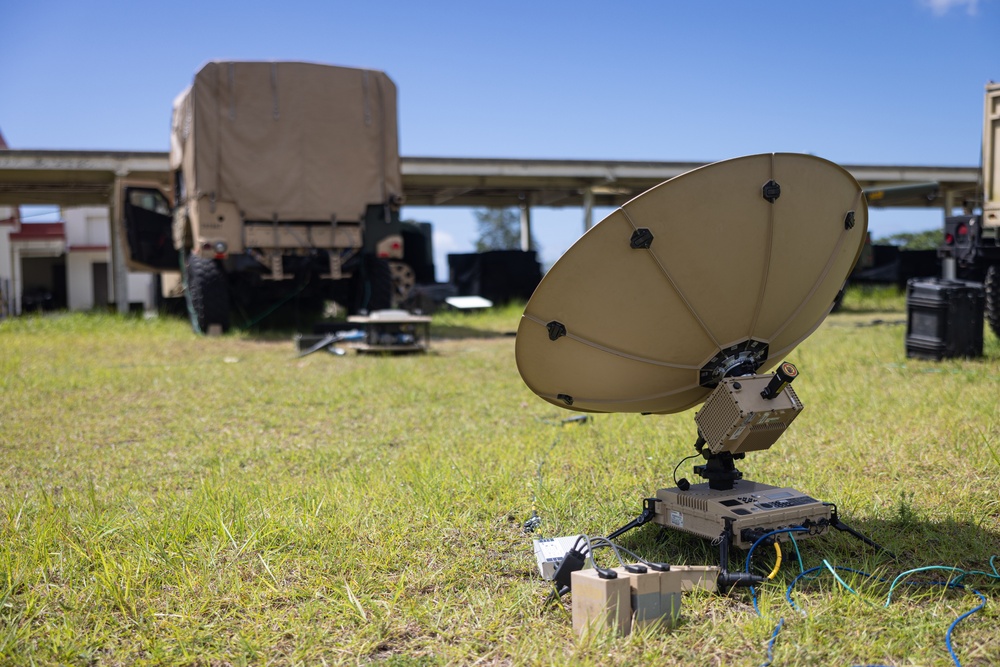
A Marine Corps Wideband System-Expeditionary Terminal is utilized during Exercise Vanguard on Camp Hansen, Okinawa, Japan, June 8, 2023. The MCWS-X allows Marines to be capable of operating, defending, and preserving information networks to enable command and control for the commander in all domains, and support and conduct Marine Air Ground Task Force operations in the information environment.

Time for A Firm Stand: U.S. Policy Options in Light of Hamas’ Invasion of Israel

Gregg Roman & Clifford Smith

In the tumultuous wake of an unprecedented attack on Israel by Hamas forces from Gaza, a defining moment has arisen for United States foreign policy.

As a longstanding ally of Israel, the U.S. is compelled to reevaluate its stance and actions amidst a conflict steeped in complexity and historical precedent. The escalation of violence prompts the consideration of stringent policy measures aimed at curbing the Islamist organization’s aggression and restoring stability in the region.

The adoption of a “Dismantle Hamas” resolution represents one such measure. In the face of ongoing crisis, rhetorical support or increased pressure on Hamas proves insufficient. A Congressional resolution calling unequivocally for the eradication of the Hamas threat would signify a paradigm shift, underscoring the United States’ unyielding commitment to Israel’s sovereignty and safety, and the eradication of threats to Israel, and the wider region.

Yet, Israel’s security is intertwined with regional dynamics, notably the role of Qatar in funding Gaza. While ostensibly aimed at humanitarian relief, the financial aid flowing from this Gulf state has inadvertently fueled Hamas’s militancy. A recalibration of U.S.-Qatar relations is urgent. Measures such as the revocation of Qatar's Major Non-NATO Ally Status, threatening Qatar’s access to US financial systems, and even the potential relocation of the Al Udeid Air Base, hang in the balance as potent levers to enforce a cessation of all funding to Gaza.

Army Plans Major Cuts to Special-Operations Forces, Including Green Berets

Gordon Lubold

WASHINGTON—The Pentagon is poised to make controversial cuts to the Army’s storied special-operations forces, amid recruiting struggles and a shift in focus from Middle East counterterrorism operations to a threat from China.

The Army is cutting about 3,000 troops, or about 10% from its special-operations ranks, which could include so-called trigger-pullers from the Green Beret commando units who have conducted some of the nation’s most dangerous and sensitive missions around the world, from the jungles of Vietnam to the back alleys of Baghdad.

The reductions would enable the Army to rebalance toward the large conventional ground forces needed in a potential fight in Asia. The trims in the ranks of special forces would also help the Army cope with a recruiting shortfall in a strong labor market. But opponents of the cuts, notably senior special-operations officers, have argued they could hinder training of U.S. partners, including the Ukrainian and Taiwanese militaries, and limit the elite units’ ability to respond to crises.

The service plans to brief Capitol Hill in the coming days on the reductions. Mostly, the Army plans to cut special-operations troops in supporting roles such as psychological warfare, civil affairs, intelligence operators, communications troops, logistics and other so-called enablers, U.S. military officials said. The cuts would follow the reallocation last year of more than 700 special-operations troops from the Army and other services. In sum, the cuts to the Pentagon’s umbrella Special Operations Command would amount to about 3,700 troops since last year.

The newest threat to elections is AI-boosted disinformation

BRUCE SCHNEIER

Elections around the world are facing an evolving threat from foreign actors, one that involves artificial intelligence.

Countries trying to influence each other’s elections entered a new era in 2016, when the Russians launched a series of social media disinformation campaigns targeting the U.S. presidential election. Over the next seven years, a number of countries – most prominently China and Iran – used social media to influence foreign elections, both in the U.S. and elsewhere in the world. There’s no reason to expect 2023 and 2024 to be any different.

But there is a new element: generative AI and large language models. These have the ability to quickly and easily produce endless reams of text on any topic in any tone from any perspective. As a security expert, I believe it’s a tool uniquely suited to internet-era propaganda.

This is all very new. ChatGPT was introduced in November 2022. The more powerful GPT-4 was released in March 2023. Other language and image production AIs are around the same age. It’s not clear how these technologies will change disinformation, how effective they will be or what effects they will have. But we are about to find out.

US Army scrambles to catch up to rising drone threat

SAM SKOVE

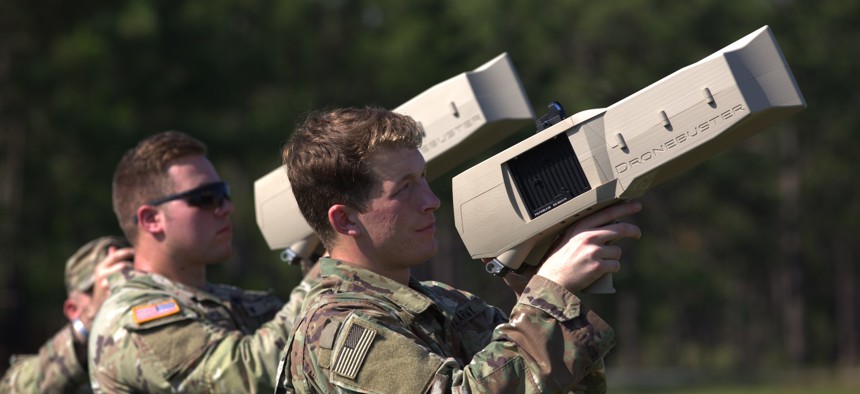
LONDON—Dangling from the ceiling and laid flat on display stands, sleek drones of every shape and size were ubiquitous at last month’s sprawling DSEI arms show. Far less common were weapons to stop them.

The same is true on the battlefields of Ukraine—and in the arsenals and training grounds of the U.S. Army.

Army officials say NATO’s largest land force is making progress when it comes to defending troops from drones. But service leaders have yet to make definitive plans for their future counter-drone force, even as they field far fewer defenses than analysts suggest will be needed.

Drones are ubiquitous on Ukrainian battlefields, where they have been used for everything from artillery coordination to strikes on civilian infrastructure. Russian loitering munition drones, for example, are the leading cause of destruction of Ukraine’s Polish-supplied artillery, Polish Land Forces’ Lt. Gen. Wieslaw Kukuła told Defense One.

Consequently, Ukraine and Russia both field a wide array of drone-killing tech, from hand-held jammers to vehicle-mounted autocannons. Ukrainians say Russian electronic warfare is particularly potent against their drones.

The U.S. Economy Is Headed for a "Hard Landing"

Desmond Lachman

Now that the economic facts are rapidly changing for the worse, the Federal Reserve would do well to heed Keynes’s observation. Maybe then it would back down quickly from its current mantra that interest rates need to stay high for longer to bring down inflation. If, despite these new facts, the Fed persists with its hawkish monetary policy stance, we should brace ourselves for a hard economic landing.

Among the more disturbing new facts is the sudden loss of investor appetite, both at home and abroad, for long-term U.S. Treasury bonds. Investors are becoming increasingly concerned that the budget deficit is heading towards 8 percent of GDP at a time when the country is close to full employment.

They are also concerned that given the political dysfunction in Washington, there is little prospect that this budget deficit will be reduced anytime soon.

The question investors are asking is: who will fund the government’s long-term borrowing needs and at what price? This question becomes all the more poignant at a time when the Fed continues to reduce the size of its balance by $95 billion a month by not rolling over maturing Treasury bonds and mortgage-backed securities.

Russia’s War in Ukraine: Ballistic and Cruise Trajectories

William Alberque , Douglas Barrie , Zuzanna Gwadera & Timothy Wright

Russia’s war on Ukraine has been calamitous for its land forces, and an unnecessary tragedy for Ukraine’s people. It has also provided a further proving ground for a variety of ‘ballistic’ and cruise missile types, at once illustrating the utility and sometimes the limitations of such classes of weaponry. The war has for the first time seen the limited use of an air-launched aero-ballistic missile and the large-scale operation of direct attack munitions, or one-way uninhabited aerial vehicles. Cooperation on the latter is drawing Moscow and Tehran closer together, with uncomfortable implications for many countries concerned as to the destabilising behaviour of the two states.

Moscow’s war will almost certainly further fuel the demand for long-range conventionally armed land-attack cruise missiles and pique greater interest in direct attack munitions among state and non-state actors. This is at a time when the arms control architecture for managing ballistic and cruise missile acquisition has already been greatly eroded. The remaining mechanisms for managing the spread of such systems have never been more ill-suited for the task.

Challenges to multilateral arms control

Timothy Wright

The world is likely approaching an era of unconstrained nuclear activity. While destabilising in and of itself, geopolitical rivalry and distrust are set to further undermine strategic stability. In this environment, actions connected to strategic nuclear forces and associated ballistic-missile tests may be misunderstood or misinterpreted among rivals as being escalatory. The five permanent members of the United Nations Security Council (P5) could plausibly explore creating new transparency mechanisms, especially a multilateral pre-launch notification regime, to reduce risk, but proposals to bring China, France and the United Kingdom into a re-negotiated New Strategic Arms Reduction Treaty (New START) look to be dead in the water.

New START

In February 2023, Russia suspended implementation of New START due to what it said was Washington’s ‘extreme hostility’ in relation to Moscow’s 2022 invasion of Ukraine. Russia’s Ministry of Foreign Affairs said at the time that ‘conducting business as usual with the United States and the West in general is no longer possible’. The 2011 bilateral agreement had remained in force under a 2021–26 extension and placed warhead and launcher limits on Russian and US strategic arsenals, while transparency and verification measures provided each country with important information about the other’s force structure. The US reciprocally suspended its implementation of New START in June 2023, but stressed its readiness to reverse these countermeasures if Russia returned to compliance.

RUSSIAN OFFENSIVE CAMPAIGN ASSESSMENT, OCTOBER 7, 2023

Kateryna Stepanenko, Karolina Hird, Angelica Evans, Christina Harward, and Mason Clark

The Kremlin is already and will likely continue to exploit the Hamas attacks in Israel to advance several information operations intended to reduce US and Western support and attention to Ukraine. The Kremlin amplified several information operations following Hamas attacks in Israel on October 7, primarily blaming the West for neglecting conflicts in the Middle East in favor of supporting Ukraine and claiming the international community will cease to pay attention to Ukraine by portraying attention to the Middle East or alternatively Ukraine as a zero-sum comparison. Deputy Chairman of the Russian Security Council Dmitry Medvedev claimed the United States and its allies should have been “busy with” working on “Palestinian-Israeli settlement” rather than “interfering” with Russia and providing Ukraine with military aid.[1] The Russian Ministry of Foreign Affairs (MFA) accused the West of blocking efforts by a necessary “quartet” of Russia, the US, the European Union, and the United Nations, leading to an escalation in violence, implicitly blaming the West for the current fighting.[2] Prominent Russian propagandist Sergei Mardan directly stated that Russia will benefit from the escalation as the world “will take its mind off Ukraine for a while and get busy once again putting out the eternal fire in the Middle East.”[3] These Kremlin narratives target Western audiences to drive a wedge in military support for Ukraine, seek to demoralize Ukrainian society by claiming Ukraine will lose international support, and intend to reassure Russian domestic audiences that the international society will ignore Ukraine’s war effort.

Several key sources within the Russian information space shifted the focus of their daily coverage to the situation in Israel on October 7, which may impact the information environment around the war in Ukraine in the coming days or weeks. Many Russian milbloggers focused largely on the Hamas attacks in Israel on October 7, and some promoted Kremlin information operations by claiming that the West’s attention has shifted away from Ukraine and towards Israel.[4] This focus on Israel even prompted one Russian milblogger to urge others to not “forget” about the war in Ukraine.[5] ISW cannot forecast at this time how the source environment will change as the Hamas attacks in Israel unfold but will provide clear updates on any impact on ISW’s ability to collect from Russian milbloggers and geolocation sources, and subsequent effects on the detail available ISW can provide in these daily assessments.

Ukrainian Soldiers Must Breach the Most Formidable Military Fortifications Since WWII

THOMAS MUTCH

DONETSK REGION, UKRAINE—“Advance! Five bogies, take cover! Fire!” These are the commands Kevin Leach and his team of Canadian colleagues are shouting to the assembled recruits of Ukraine’s Fourth Rapid Reaction Brigade. The men latch on to every word, keen to soak up every morsel of information—knowing can be the difference between life and death on Ukraine’s remorseless battlefields.

As part of Ukraine’s counteroffensive, these troops must approach and breach some of the most formidable military fortifications seen in Europe since World War II. Ukrainian and American officials admit the counteroffensive has made slower-than-expected progress since it began in June 2023, largely due to the density of these defenses. The summer came and went without a major Ukrainian breakthrough.

Built at various degrees of depth over the 600-mile or so frontline, the defenses start with “tank traps” designed to slow down advancing armor, supported by huge minefields, layers of barbed wire, and concrete pillboxes full of Russian soldiers armed with anti-tank weapons. In the meantime, advancing Ukrainians are coming under heavy fire from Russian artillery and air power.

Ukraine’s Much-Hyped Counteroffensive Meets Grim Reality

Andrew Thornebrooke

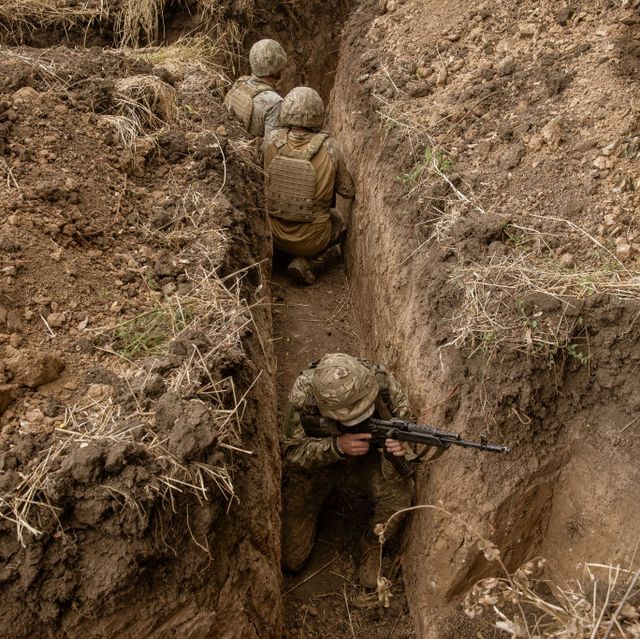
Each day, Ukrainian soldiers trudge over a morass of dried mud. They stop frequently, staying low to the ground. For much of the day, they hunker in ditches and dig small trenches while they wait for their Soviet-era mine-clearing vehicles to complete their laborious task.

They know that a Russian unit is nearby. Perhaps just behind the tree line.

Russia has amassed 100,000 troops and more than 500 battle tanks just east of here, past Bakhmut. None of the soldiers know where those Russian troops will deploy, but everyone knows that they will deploy. Maybe they already have. A day without contact is exceedingly rare.

They can only hope that the unit doesn't attack again. They have lost men already and can't afford to lose their mine-clearing capability.

If these Ukrainians are lucky, they'll advance the length of two football fields today.

The Trident

It's this way along most of the front lines, which now sprawl more than 600 miles, bisecting the nation.

The Mine-Clearing Monsters of Ukraine

Patrick Drennan

As of April 2023, it is estimated that 174,000 square kilometers of Ukrainian territory is contaminated by landmines sown by Russia. Facing the Ukrainian army in their goal to recapture their Russian occupied territory each major village and town and is surrounded by hundreds of meters of minefields. To clear their occupied lands the Ukrainians require huge mechanical mine-clearing machines supplied by the West.

Based on figures supplied Oryx and Wikipedia it is estimated that Ukraine has been supplied with about 105 of these monsters . They estimate it is only 15% of what they need (hence about 700). Not all this equipment is of equal value. This war is unique from its predecessors, for which this equipment was originally designed to combat.

First, the mines themselves. Russia has deployed every type of mine available and have made variations of their own. The primary mines the Ukrainians must destroy to advance are anti-tank mines. Most anti-tank mines go off in one of two ways; by weight as the heavy track rolls over it or by a plastic tilt rod that is screwed into the top of the mine. The tilt rod resembles a car radio antenna but is normally black or green plastic and stands a few feet tall. As the tank passes over the mine, the belly of the tank pushes the tilt rod which detonates the mine. A soldier would not be heavy enough to set off an anti-tank mine by stepping on it but could inadvertently brush against the tilt rod enough to set it off.

The CIA’s data-challenged AI imperative

LAUREN C. WILLIAMS

The Central Intelligence Agency is developing its own Chat-GPT-like tool, but the agency is still struggling to manage its data and quickly adopt commercially available solutions, said Dan Richard, the CIA’s chief cyber policy advisor.

“One of the things that we are grappling with is data management. We assemble and review large amounts of data information and we are constantly looking for ways to be able to more effectively analyze, synthesize, and provide insights that we can get from that information out to the private sector,” Dan Richard, the CIA’s chief cyber policy advisor, said during a Billington Cybersecurity virtual event Thursday. “We are constantly on the outlook for better ways for us to manage our data, better ways for us to more efficiently and effectively use the data we have to get it to where it needs to more quickly and in a more efficient manner.”

That need to improve data management is grounded in how the CIA collects and integrates intelligence data other agencies use to inform policymakers and private companies.

“Although invisible to most, we actually support a lot of the information that [Department of Homeland Security], the Defense Department, [Director of National Intelligence], FBI are actually providing to the private sector and take that feedback and fuse that into all of the information that we possess,” he said.

US’s hidden and forgotten forever war

JASON C MUELLER

Thirty years after the infamous Battle of Mogadishu, the US military is still conducting operations in Somalia.

Popularized in the US by the 2001 film “Black Hawk Down,” the Battle of Mogadishu occurred on October 3, 1993, and saw the downing of two US helicopters and the deaths of 18 American soldiers. Some of their bodies were dragged along city streets by Somali militants.

The battle was considered one of the worst fiascoes in US military history.

Since then, the US has waged economic and military warfare in Somalia to first eliminate the Union of Islamic Courts, a grassroots legal and political group, and most recently to attack the militant group al-Shabaab. There have been at least 282 US counterterrorism operations in Somalia, including drone strikes and other aerial bombardments.

But it’s my belief as a scholar of contemporary US-Somali relations that the US efforts to develop political stability and eliminate terrorism have achieved the very opposite and not brought an end to political violence in the war-torn country.

In fact, al-Shabaab is still waging one of the largest and deadliest insurgencies in the world.

Army changing its approach for command post tool

MARK POMERLEAU

ABERDEEN, Md. — The Army is altering its acquisition strategy for its command post tool, moving to a more agile software approach.

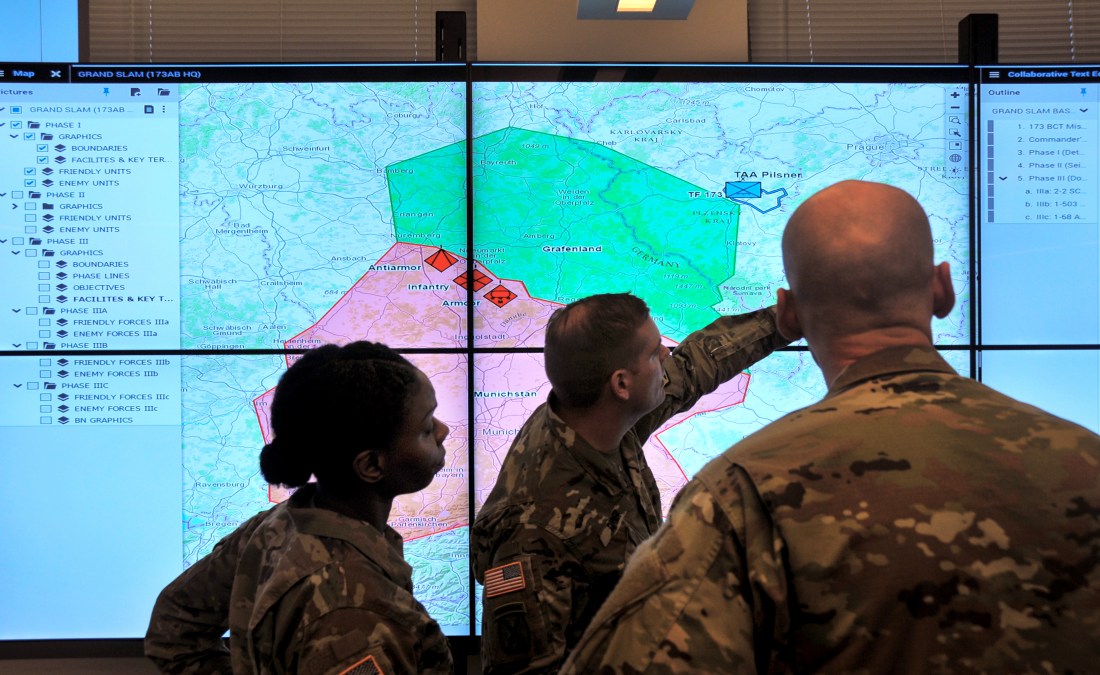
As opposed to the old waterfall method the program currently executes, the Army will be releasing new capability drops at minimum once per quarter for the Command Post Computing Environment. CPCE is a web-enabled system that will consolidate current mission systems and programs into a single user interface at command posts to provide a common operational picture.

The shift is part of an Army-wide change led by Young Bang, principal deputy assistant secretary of the Army for acquisition, logistics and technology, and Jennifer Swanson, chief systems engineer for the ASAALT office, to push the Army to become more software centric.

“My entire portfolio is pivoting to an agile CI/CD [or continuous integration/continuous delivery] approach. Six months ago, that would have been really unthinkable,” Col. Matthew Paul, project manager for mission command at Program Executive Office Command, Control, Communications-Tactical, said during a presentation at an AFCEA Aberdeen chapter event Sept. 26. “CPCE is going to be one of my trailblazers.”

9 October 2023

A lasting legacy of India’s G20: Trade opportunities for small businesses

Gopal Nadadur

India’s presidency of the Group of Twenty (G20) runs until December 1, when the rotating position will pass to Brazil. But even with several weeks left, it is an opportune moment to take stock of what India’s leadership has accomplished. There is, of course, the September 9-10 G20 leaders’ summit in New Delhi and the meaningful communiqué that came out of it, for which India is rightfully being lauded for its adroit navigation of immensely challenging circumstances. As the Atlantic Council’s Kapil Sharma has highlighted, India demonstrated a new model of diplomacy built on consensus, inclusiveness, and solutions.

The G20 Summit’s highest-profile outcomes include progress on digital public infrastructure, crypto regulation, climate financing, and reform of multilateral development banks. But the India-led G20 has also delivered several outcomes that, while lower-profile, nonetheless could result in big gains, most notably for micro-, small-, and medium-sized enterprises (MSMEs). For example, the G20 declaration refers to the Jaipur Call for Action, which highlights the need to enhance MSMEs’ access to information. The declaration also endorses the Regulatory Toolkit for Enhanced Digital Financial Inclusion of MSMEs and the Financial Inclusion Action Plan, both aimed at improving credit access for individuals and MSMEs.

But arguably the most concrete and impactful outcome for MSMEs is in the “Unlocking Trade for Growth” section of the G20 declaration. This section includes a reference to the High-Level Principles on Digitalization of Trade Documents, which former Assistant US Trade Representative for South and Central Asian Affairs Mark Linscott pinpointed for their importance. And one of the thrusts of these high-level principles is the digitalization and interlinking of countries’ trade documentation systems.

Pakistan’s Missing Market

Sanjay Kathuria

As Pakistan lurches from one crisis to another, it needs a fundamental rethink of its geopolitical and economic strategy. Without it, any International Monetary Fund program—the most recent being a “stand-by arrangement” for around $3 billion, approved on July 12—only buys some time before the next cataclysm.

Pakistan must start putting sustainable and inclusive economic growth above all else, especially its elite-focused policies that have created a cycle of profligacy and austerity. Average annual economic growth between 2010 and 2022 has been lackluster, around 4 percent, and has been accompanied by a rise in Pakistan’s total debt as a share of its GDP, from 55 percent to 76 percent. Bangladesh, in contrast, grew at an annual average of 6.2 percent over the same period, while its debt to GDP ratio rose from 30 percent to 39 percent.

In addition to addressing spiraling debt, faster and more inclusive growth is the best pathway for the poor and vulnerable to join the middle class.

The big step Pakistan could take to reinvigorate growth would be to embrace trade with India, which is currently almost nonexistent. World Bank research, on which I worked, reveals that Pakistan’s exports could increase by 80 percent, with commensurate impacts on GDP and employment, if it had a normal trading relationship with India. Extrapolating from these estimates, Pakistan’s exports of goods, only a mere $31.5 billion in 2022, could be about $25 billion higher if trade with India was realized. Another World Bank study shows that India accounts for as much as 85 percent of Pakistan’s total unrealized trade potential.

Yes, the World Is Multipolar

Emma Ashford

An obscure academic term is suddenly back in vogue in international affairs. Multipolarity—the idea that there are many important global powers, not just a few superpowers—is being touted by leaders, CEOs, and pundits as the future. Headlines suggest the growing importance of middle powers, from Turkey and Brazil to South Korea and Australia.

But not everyone is convinced. As Jo Inge Bekkevold wrote in Foreign Policy last month, it “is simply a myth that today’s world is anywhere close to multipolar. … Today, there are only two countries with the economic size, military might, and global leverage to constitute a pole: the United States and China. Other great powers are nowhere in sight, and they won’t be anytime soon.” This also appears to be the opinion of the Biden administration, whose attempt to build a “networked security architecture” in the Pacific and to link European and Asian allies together feels very much like an attempt to rerun the Cold War playbook.

Both are mistaken. In a paper recently published by the Stimson Center, we set out to assess whether the world is indeed becoming more multipolar and how U.S. policymakers can best leverage the features of the emerging international environment to achieve U.S. interests. We came to a stark conclusion: The United States simply does not hold the level of military and economic power it did during the early decades of the Cold War. Nor does today’s China match the Soviet Union at its peak.

A multipolar system doesn’t require three powers of equal size; it just requires that significant power is concentrated in more than two states. Today, the middle powers—from Japan to India—are significantly more influential than they once were. This is the textbook definition of what scholars call “unbalanced multipolarity.”

A Bold Challenge to Chinese Aggression Succeeded. What Does That Mean?

FRED KAPLAN

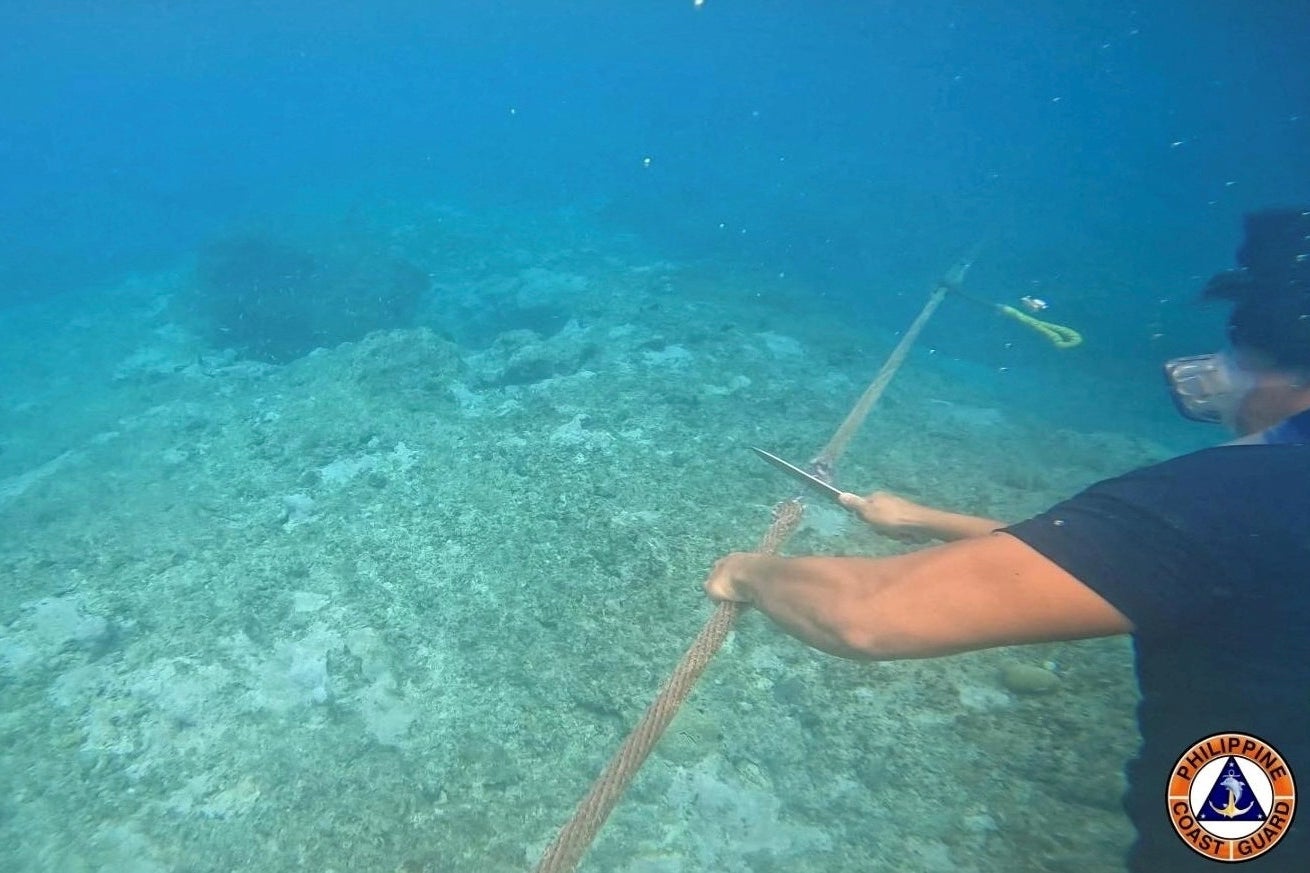
When the Philippine Coast Guard removed a Chinese barrier in a contested stretch of the South China Sea last week, some observers feared it might light a fuse to war. It didn’t—and it’s worth examining why it didn’t, because we may soon see similar challenges to China’s dominance in the region.

Initial reports of the removal—which happened on the orders of the Philippines’ President Ferdinand Marcos Jr.—cited worries that Chinese President Xi Jinping might react with some escalatory counteraction. But, so far anyway, he has not.

Marcos’ action was legally and morally proper. The Chinese barrier clearly violated international law and blocked the movement of Philippine fishing boats. Still, Manila has rarely—and, in the past decade, has never—challenged Beijing’s territorial claims so boldly. It’s an open question whether Xi will now double down on his claims or settle into a more “rules-based” coexistence.

After the Philippine Coast Guard cut the rope that held the barrier in place, a commentator and former military officer in Beijing, Song Zhongping, denounced the move as “a serious threat to China’s national sovereignty and security,” adding, “China must take decisive measures to put an end to the Philippines’ provocation.”

How China is fighting in the grey zone against Taiwan

Joel Guinto

When Taiwan raised the alarm last month over a record number of Chinese fighter jets crossing the unofficial border between them, Beijing said that line did not exist.

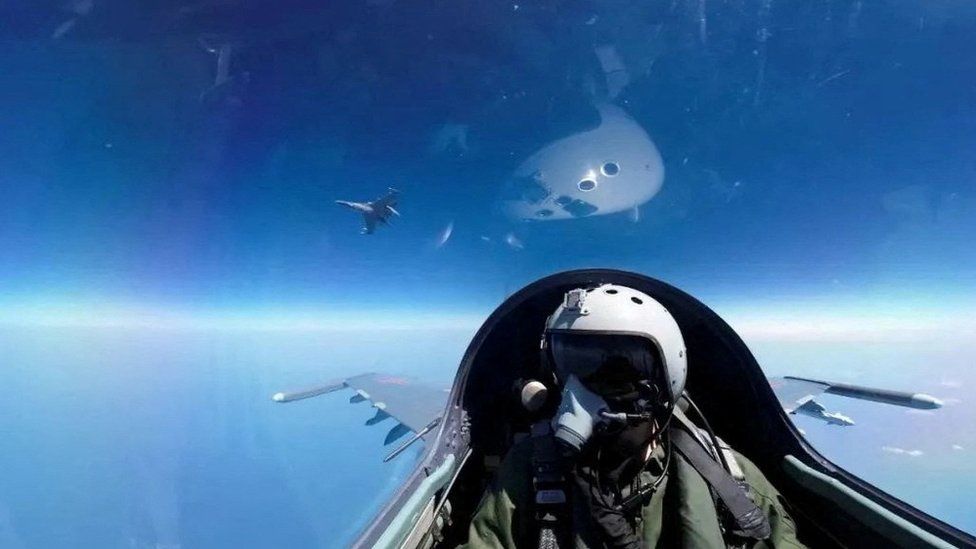
The 103 fighter jets that China flew near Taiwan - 40 of which entered the island's Air Defence Identification Zone (ADIZ) - were yet another escalation in Chinese war games.

Beijing, which has long claimed Taiwan, has in the past year repeatedly rehearsed encircling the self-ruled island with fighter jets and navy ships. The military drills have taken an especially menacing turn in light of China's vows to "reunite" with Taiwan.

So far, the manoeuvres have fallen short of an invasion and stayed within a grey zone, which is military speak for tactics that fall between war and peace.

But Taiwan is now a tinderbox in what has become a volatile US-China relationship - and analysts say grey zone tactics are part of Beijing's strategy to control Taipei without firing a single shot.

What is China trying to achieve?

Grey zone warfare tactics are aimed at weakening an adversary over a prolonged period - and that is exactly what China is trying to do with Taiwan, observers say.

By regularly crossing Taiwan's ADIZ, Beijing is testing how far Taipei will go to reinforce it, says Alessio Patalano, a professor of war and strategy in East Asia at King's College in London.

Xi Jinping: China’s New ‘Dragon Emperor’

Mark Toth and Col. (Ret.) Jonathan Sweet

Two 30-foot, carved white marble columns — “huabiao” in Chinese — stand guard over the entrance to the Gate of Heavenly Peace in Beijing. Perched atop each huabiao, gazing southward, are two mythical dragons, known as Denglong, who, as legend has it, warned Chinese emperors when they had been away from the Forbidden City for far too long, or more ominously, howled to let a ruler know it was time to abdicate.

Mythology notwithstanding, Chinese President Xi Jinping is well aware of the usefulness of the symbolic power of the dragon. It encapsulates his vision of China, now and into the future. During a state visit by then-President Donald Trump in November 2017 to Tiananmen Square, Xi noted that “Chinese civilization is a unique lasting culture in the world, that passed down through generations consistently.”

During their walkabout, Xi pointedly underscored to Trump: “We call ourselves descendants of the dragon.” Left unsaid was that Xi, wittingly or not, views himself as China’s modern-day heir of Qin Shi Huang. Known as the “Dragon Emperor,” Qin Shi Huang, beginning in 221 BC, was the first Chinese monarch to unite the country under “a new Chinese script, a new currency, and a new system of weights and measures.” He was responsible for the “life-size terra-cotta army” and for connecting the Great Wall of China.

US tightens intelligence links with Asia to combat Chinese cyberattacks


The US is deepening intelligence cooperation with countries across Asia as it looks to counter Beijing’s sophisticated spying apparatus and blunt Chinese cyberattacks.
The Biden administration has developed a set of separate but overlapping partnerships in Asia, including an intelligence-sharing arrangement with the “ Quad” grouping of the US, India, Japan and Australia, according to US officials who asked not to be identified discussing matters that aren’t public.
The web of relationships also includes trilateral partnerships among the US, Japan and South Korea, and one encompassing the US, Japan and the Philippines, the officials said.

The push also involves strengthened bilateral sharing of information with Japan, India and Vietnam, according to the officials, who added that a major focus of these relationships is boosting resilience to Chinese offensive operations online.

This new and strengthened partnerships, known formally as intelligence liaison relationships, are in part aimed at reducing the growing power of China’s spy apparatus, which a recent UK parliamentary report described as the world’s largest. The administration effort is part of a broader drive to deepen links across the region amid growing alarm at the threat from Beijing.

“Intelligence liaison can serve as an important force multiplier,” said Daniel Byman, a specialist on the topic at the Centre for Strategic and International Studies in Washington. “It can expand overall collection as different countries will have access to different secrets in different parts of the world.”

U.S. Weaves Web of Intelligence Partnerships Across Asia to Counter China

PETER MARTIN AND JENNY LEONARD

The U.S. is deepening intelligence cooperation with countries across Asia as it looks to counter Beijing’s sophisticated spying apparatus and blunt Chinese cyber attacks.

The Biden administration has developed a set of separate but overlapping partnerships in Asia, including an intelligence-sharing arrangement with the “Quad” grouping of the U.S., India, Japan and Australia, according to U.S. officials who asked not to be identified discussing matters that aren’t public.

The web of relationships also includes trilateral partnerships among the U.S., Japan and South Korea, and one encompassing the U.S., Japan and the Philippines, the officials said.

The push also involves strengthened bilateral sharing of information with Japan, India and Vietnam, according to the officials, who added that a major focus of these relationships is boosting resilience to Chinese offensive operations online.

M1 Abrams Ineffective By 2040 In Fight Against China

JOSEPH TREVITHICK

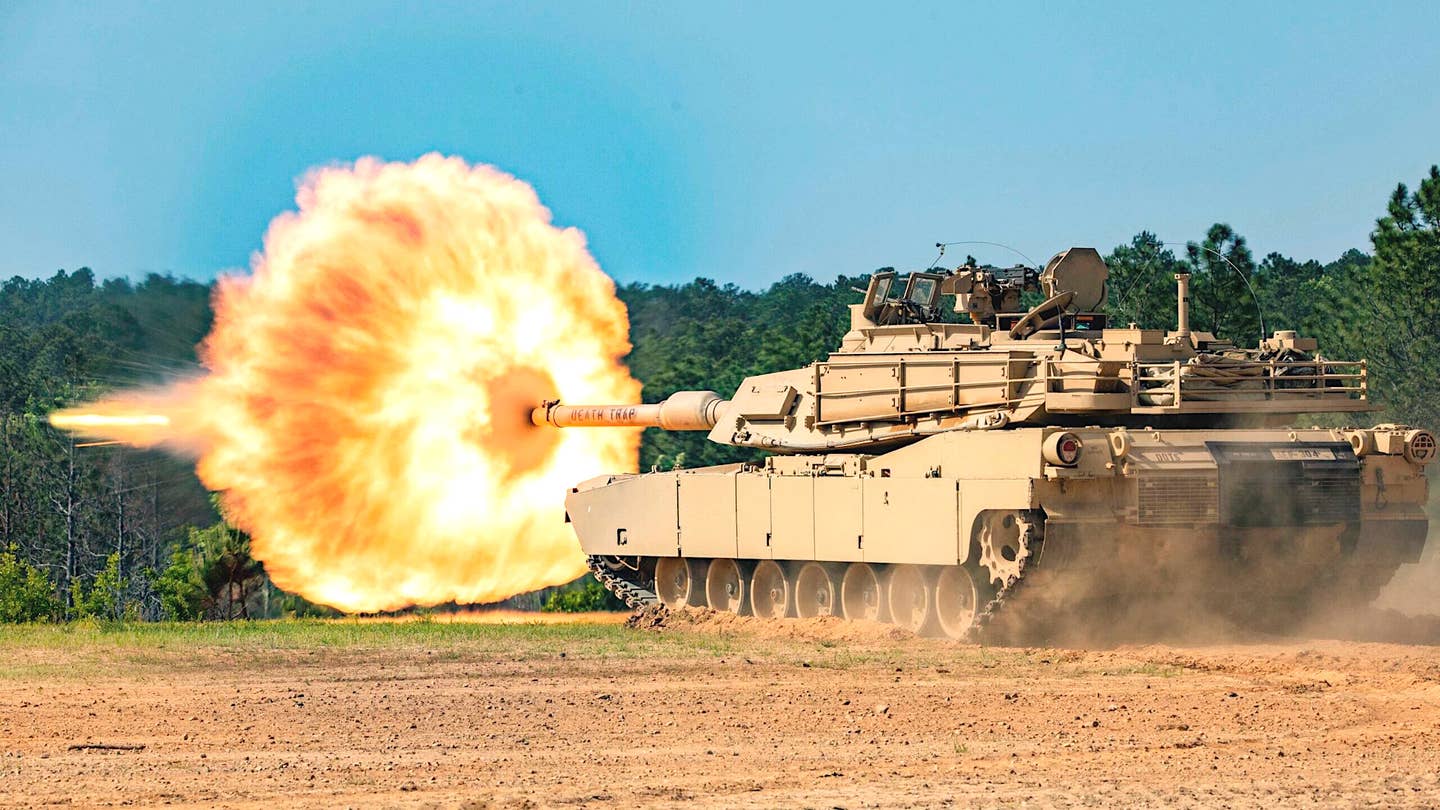
The U.S. Army's M1 Abrams tanks will "not be effective" or able to "dominate" on the battlefields of the 2040s, especially in the context of a potential high-end conflict against China. This is the conclusion of an official advisory body that is also calling for an Abrams replacement effort that could include a next-generation M1 derivative, as well as lighter 'tanks' armed with larger caliber guns and hypersonic anti-tank missiles, and uncrewed ground vehicles.


The Army Science Board, a federally-sanctioned independent group of experts that advises the Secretary of the Army, recently published an assessment about the future of the M1 tank. It also outlines the need for one or more types of "5th Generation Combat Vehicle," or 5GCV, to meet operational demands in the 2040s. The origins of this study trace back to 2019 and the final report is dated August 2023.


US Army M1A2 Abrams tank. 

The Army currently has around 2,500 M1 Abrams tanks in service today, with thousands more in storage that could potentially be refurbished and returned to service, if necessary. The original M1 entered service in the 1980s and significantly more capable variants have been introduced since then.

New Army "Quiet" & "Helo-Like" FTUAS Drone Develops AI For Fast-Attack

KRIS OSBORN

Finding targets in milliseconds, taking off vertically amid uneven terrain while under enemy fire, networking threat specifics across an integrated series of manned and unmanned combat sensor “nodes” and possibly even delivering attack weapons are merely a few of the US Army’s intended missions for its Future Tactical Uncrewed Aircraft Systems (FTUAS).

The Army’s FTUAS is a fast-emerging effort to engineer a new drone able to perform helicopter-like take-off and landings, survey high threat enemy areas, process targeting data and instantly send specifics to a meshed series of platforms across a multi-domain force.

Rapid prototyping and further testing is the Army’s focus at the moment, as it surges into a new phase 2 of development for the drone, exercising options for Griffon Aerospace and Textron Systems offerings. An Army essay on the FTUAS explains some of the operational advantages the new drone is expected to bring to the current and future force. Not surprisingly, vertical take-off, low acoustic signature, networking and agility are key elements of the Army’s vision for the platform.

“The FTUAS Program of Record requirements include runway independence and a rapidly deployable UAS capability. When fielded, FTUAS will provide a distinct tactical advantage over current systems due to increased maneuverability through VTOL, improved command and control supported by the on-the-move capability, a reduced transportation and logistics footprint, as well as significantly improved survivability due to reduced noise signature,” an Army essay says.