18 November 2023

The U.S. says Hamas operates within and beneath hospitals, endorsing Israel’s allegations.

Michael D. Shear

The United States has intelligence that shows that Hamas has been using hospitals in Gaza, including Al-Shifa, as command centers and ammunitions depots, a spokesman for the National Security Council said on Tuesday.

John Kirby, the spokesman, said that the intelligence, gathered from American-generated sources, supported Israel’s allegation that Hamas has been operating out of hospitals, which Mr. Kirby said amounted to a war crime.

Mr. Kirby declined to provide details about the U.S. intelligence, but he made clear that it goes beyond the information collected by the Israeli intelligence service. “It comes from a variety of intelligence methods — of our own, of our own,” he said, adding that the classification of the intelligence had been downgraded so that it could be shared publicly.

“I can confirm for you that we have information that Hamas and the Palestinian Islamic Jihad use some hospitals in the Gaza Strip, including Al-Shifa, and tunnels underneath them, to conceal and to support their military operations and to hold hostages,” Mr. Kirby told reporters on Air Force One as President Biden headed to San Francisco for a summit with Asia-Pacific leaders.

“Hamas and the Palestinian Islamic Jihad — J.I.D. — members operate a command and control node from Al-Shifa in Gaza City,” he added. “They have stored weapons there, and they’re prepared to respond to an Israeli military operation against that facility.”

The revelation of the U.S. intelligence comes as Israel is under harsh international criticism for attacks on and around hospitals as it conducts a war against Hamas in the wake of the armed group’s terrorist attacks on Israel on Oct. 7. Israel says more than 1,200 people were killed in the attacks and that 239 others remain hostages.

Israel must be given time to complete its mission in Gaza


As Israel’s war efforts against Hamas and its vast infrastructure continue in Gaza, a couple of elements have become clearer and clearer.

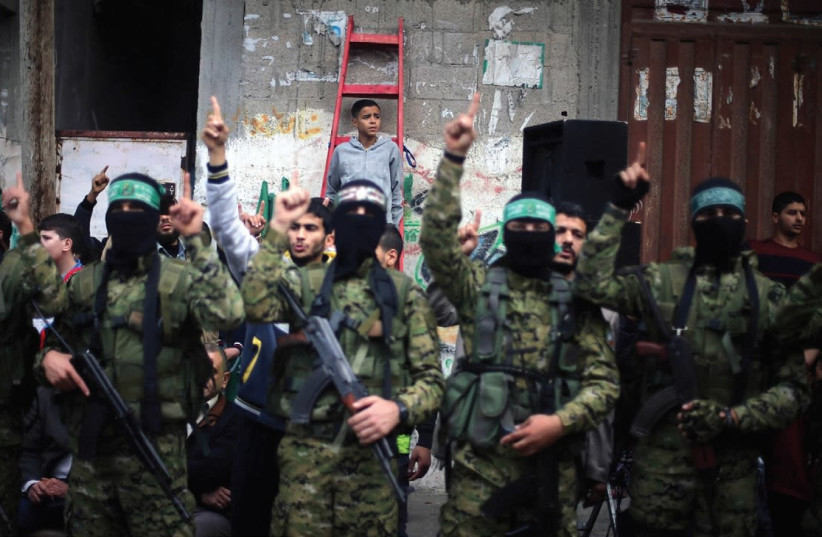
Israeli claims that Hamas has been using Gaza’s civilian population as human shields in the most cynical and cruel way have proven to be completely true.

On Monday, IDF Spokesman R.-Adm. Daniel Hagari revealed an underground Hamas command center under Gaza’s Rantisi Hospital (named after Hamas leader Dr. Abdel Aziz Rantisi, who was killed by Israel in an air strike in 2004), which not only contained assault rifles, suicide vests, rocket-propelled grenades, and other weapons but also items – such as baby bottles – that Hamas had presumably held Israeli hostages there.

Hagari said there was evidence and independent separate intelligence that Hamas terrorists had returned directly to the hospital after participating in the massacre on October 7.

He also noted that an IDF robot found additional tunnels equipped with electricity being siphoned off the hospital for use by the terrorists underground.


Israeli military spokesperson R.-Adm. Daniel Hagari shows what he says is the house of a senior Hamas naval commander located next to a school at a location given as Gaza, in this still image taken from video released November 13, 2023.

This War Won’t Solve the Israel-Palestine Conflict

Steven A. Cook

Last weekend, U.S. Secretary of State Antony Blinken visited Israel, Jordan (to meet with Arab foreign ministers), Ramallah (located in the West Bank), Iraq, and Turkey. With the war between Israel and Hamas now entering its sixth week, U.S. diplomacy has kicked into high gear. As Blinken works to secure humanitarian relief for Gazans caught in the crossfire, he has been signaling where he and the White House would like things to go once the fighting stops: a “revitalized” Palestinian Authority (PA) that would administer the West Bank and Gaza and a temporary international force to help provide security in the latter.

These ideas are probably the only ones that satisfy U.S. political, diplomatic, and geo-strategic concerns as well as those of some Arab governments. Yet they are likely to fail.

The Biden administration is embarking on a path that it studiously avoided during its first three years—and for good reason. It is now going to discover that, despite its efforts, when the war between Israel and Hamas ends, the region will look more like a version of the status quo that existed on Oct. 6 than a new Middle East.

As Blinken crisscrossed the Middle East, he seemed of the mind that this war is a paradigm-shifting event. This is a misplaced hope, however. No doubt there is a place for U.S. diplomacy in the conflict, but the secretary of state is approaching it with a set of assumptions—about the likely effects of the war on Israeli and Palestinian politics, the interests of regional actors, and Washington’s influence—that are defective.

The West’s Incoherent Critique of Israel’s Gaza Strategy

Raphael S. Cohen

Since Hamas’s Oct. 7 massacre of more than 1,200 Israelis, a multitude of voices—from U.S. senators to the Chilean president, from the Norwegian prime minister to United Nations officials—has attempted to strike a similar line: that while Israel has the right to self-defense, its current operation in Gaza is disproportionate. Presumably, this same group would support a more targeted operation, but when pressed to explain what such an operation would look like, they demur, and instead say that one should ask “military experts.”

Well, I am a military expert. I have studied military operations in Gaza for a decade now. What would a more targeted operation look like? I have no idea.

Israel has tried more limited operations in Gaza before. In 2012, it conducted limited air campaigns like Operation Pillar of Defense or, more recently, 2021’s Operation Guardian of the Walls. It also tried limited ground campaigns in Operation Cast Lead from 2008 to 2009, as well as Operation Protective Edge in 2014. During all of these campaigns, many voices similar to those now criticizing Israel’s actions criticized those more targeted operations as disproportionate. For Israel, the lesson from these prior conflicts is that limiting its operations may not actually placate its critics.

But more important, from Israel’s perspective, is the fact that these limited operations were not successful. Israel has tried to kill Mohammed Deif, the commander of Hamas’s military wing, seven times already, to no avail. The Israeli success rate against Hamas infrastructure has proved similarly limited. Yehia Sinwar, Hamas’s Gaza leader, claimed that Operation Guardian of the Walls only succeeded in damaging a mere 5 percent of Hamas’s tunnel network beneath Gaza in 2021. And one need only look at the Oct. 7 attacks for evidence that Hamas’s military capabilities remained very much intact after all previous, more targeted operations.

As Israel fights on in Gaza its dilemma gets worse

NEGEV DESERT

Alarge screen dominates a tent at the edge of a military base in the Negev Desert. Dozens of blue squares represent Israeli troops on the ground, 20km away, north-east of Gaza city. Inside the headquarters of one of the infantry brigades of the Israel Defence Forces (idf), operations officers co-ordinate search-and-destroy missions of Hamas tunnels from afar.

Two weeks after the launch of its ground offensive inside the Gaza Strip, Israel has around four divisions (somewhere around 10,000 troops) in the territory. Some of the columns are making their way into the centre of Gaza city. Others are operating in the outlying towns, which are now mostly empty, going from house to house, searching for more tunnel openings. “This will be our only opportunity to finish off as much of Hamas’s underground network as we can,” says one of the officers, referring to the group’s 500km-long tunnel system. “We don’t know how long we have to operate and we need to make the most of it while we can.”

Hamas, Israel’s Golem: The Danger Of Working With Religious-inspired Proxies

James Durso

It seemed like a good idea at the time, they said in Jerusalem on 8 October 2023.

Israel’s national security leaders were caught flat-footed by the 7 October attack by Hamas launched from the Gaza Strip, and you’d have to feel sorry for the poor saps if you were willing to overlook their hubris and gross negligence.

Norman Mailer explained how it probably went down: “We all congregated in the Director’s meeting room on the seventh floor for a bit of summitry, all of us, satraps, mandarins, lords paramount, padishahs, maharajahs, grand moguls, kingfish, the lot. And we sat there…It’s the only time in all these years when I saw so many brilliant, ambitious, resourceful men – just sitting there.”

Hamas is a Cold War creation and was founded by Sheikh Ahmed Yassin (and funded by Israel) in 1987, at the start of the First Intifada, to oppose the secular, nationalist Fatah organization, run by Yasser Arafat. The group is an offshoot of the Muslim Brotherhood.

Hamas then opposed the peace efforts between Israel and the Palestine Liberation Organization, and opposed the Oslo Accords when rival Fatah renounced violence and recognized the existence of Israel as part of a two-state solution.

After 9-11, President George W. Bush, as part of his “Freedom Agenda,” supported the “Road map for peace,” a plan proposed by the Quartet on the Middle East (the United States, the European Union, Russia, and the United Nations). Unfortunately, the plan deadlocked and was overshadowed by the Second Intifada. Israeli prime minister Ariel Sharon, frustrated, evacuated the Gaza Strip in 2005 and rocket attacks, which started in 1994 when the Israeli Defense Forces left most of the Strip, jumped.

Is the Two-State Solution Still Viable?

William D. Fletcher

A two-state solution for Israel and the Palestinians has been a goal since the Oslo Accords were signed 30 years ago. This alternative is up for discussion again. If we aren’t willing to do what it takes to implement a two-state solution, we should take this option off the table.

If a two-state solution is unworkable, a one-state solution may be less attractive to both the Israelis and the Palestinians. A one-state solution would result in Jews eventually becoming a minority and Israel would no longer be a Jewish state. The Palestinians would not get a state of their own. Trying to maintain the present situations in Gaza and the West Bank may be the worst alternative.

Before we can discuss possible solutions, we need to recognize some facts.

There probably isn’t enough land. Israel, Gaza, and the West Bank are only about 11,000 square miles, a little larger than Maryland or Vermont. In addition, much of this land is arid, with limited water supplies, and not suitable for agriculture or even residential use.

The Palestinians aren’t going anywhere. Israel’s population is about 9.8 million including 7.2 million Jews and 1.7 million Muslims, most considered to be Palestinians. The West Bank population including East Jerusalem is about 2.9 million, 2.7 million Palestinians, and about 670,000 Israel settlers. Gaza’s population is about 2.1 million almost all of whom are Palestinians. About 1.6 million Palestinians still live in refugee camps in Gaza, the West Bank, and neighboring countries.

Any permanent resolution requires an international effort to relieve some of the population pressure by providing homes for refugees and others who would voluntarily resettle in other countries that would accept them.

Why this war is different to the others

Jeremy Bowen

If this Gaza war was like all the others, a ceasefire would probably have been in force by now.

The dead would be buried and Israel would be arguing with the United Nations about how much cement could come into Gaza for rebuilding.

But this war is not like that. It is not just because of the enormity of the killing, first by Hamas on 7 October, mostly of Israeli civilians, followed by Israel's "mighty vengeance" as its Prime Minister Benjamin Netanyahu called it, which has mostly killed Palestinian civilians.

This war is different to the others because it comes at a time when the fault lines that divide the Middle East are rumbling. For at least two decades, the most serious rift in the region's fractured geopolitical landscape has been between the friends and allies of Iran, and the friends and allies of the United States.

The core of Iran's network, sometimes called the "axis of resistance", is made up of Hezbollah in Lebanon, the Assad regime in Syria, the Houthis in Yemen and assorted Iraqi militias that are armed and trained by Iran. The Iranians have also supported Hamas and Islamic Jihad in Gaza.

Iran is also getting closer to Russia and China. Iran has become a significant part of Russia's war effort in Ukraine. China buys a great deal of Iranian oil.

Considering India’s Encryption Policy Dilemma

ANIRUDH BURMAN

SUMMARY

The increasing ubiquity of encryption as a tool for protecting communication has led to increasing calls for developing technical solutions to weaken it for law enforcement and national security purposes. No consensus has, however, been developed on how to do this without weakening the security and integrity of communications platforms that use encryption.

This paper examines different solutions that have been proposed in the context of India’s specific imperatives for seeking access to encrypted communications. The objective of this research is to place different encryption-weakening technologies or workarounds in the context of national security and law enforcement agency (LEA) activities in India, and the tools and mechanisms they employ for meeting their objectives. Through this analysis, this paper highlights the pros and cons of different encryption-weakening solutions or workarounds and tries to identify the least imperfect alternative. In doing so, it considers which alternatives would meet the specific requirements of national security and LEAs and how these alternatives should complement, rather than supplant, existing tools and mechanisms.

In a previous paper in this series, my co-author and I laid out the different dimensions of the encryption debate as they are taking place in India, leading up to new rules imposed on social media intermediaries.1 These rules mandated the “traceability” of encrypted communications that Indian law-enforcement authorities were interested in.2 While these rules are currently in abeyance due to ongoing litigation, they highlight the seriousness of the Indian government in devising mechanisms to access encrypted information. In that previous paper, we provided detailed background on three imperatives for weakening encryption in India:

Bangladesh-Nepal Energy Cooperation: Applying The BIN Approach

Syed Raiyan Amir

In September 2022, during the visit of Prime Minister Sheikh Hasina to India, Bangladesh made a request to import power from Nepal and Bhutan through India. The Nepal Electricity Authority (NEA) has requested authorization from the Indian regulatory bodies to export 40-50 MW of electricity to Bangladesh by utilizing India’s current transmission infrastructure.

Hence, in the context of Bangladesh-Nepal energy cooperation, the term “BIN approach” refers to a trilateral strategy involving Bangladesh, India, and Nepal. By putting in place transnational energy initiatives, infrastructure, and transmission networks, it focuses on making the most of the region’s energy potential. For the benefit of Bangladesh and Nepal, the strategy aims to boost power commerce, create hydropower projects in Nepal, upgrade transmission infrastructure, integrate power grids, support renewable energy initiatives, assure policy and regulatory cooperation, and promote regional energy integration. The paper aims to refer it in the context of Bangladesh Nepal Energy Cooperation.

Moreover, during August 2022, the governments of Bangladesh and Nepal reached a mutual agreement to formally request India’s permission for the exportation of 40-50 MW of electricity from Nepal to Bangladesh. This proposal would be implemented in the initial phase, utilizing the high-voltage Baharampur-Bheramara cross-border power transmission link. According to the consensus reached by the Joint Steering Committee (JSC) at the secretary level, which was established for the purpose of facilitating energy cooperation between Nepal and Bangladesh, the Nepal Electricity Authority (NEA) and the Bangladesh Power Development Board have made a request to India for a trilateral agreement on the sale and purchase of energy, utilizing the power line.

India, US Are On Pathway To Contain China

M.K. Bhadrakumar

If the United States is a declining power and China’s rise inevitable in the Indo-Pacific; if Russia regards itself as a global power and is determined to bury the US-dominated rules-based order; if the defeat of the US and NATO in the Ukraine war has become a fait accompli; if Canada was encouraged by the US to fret and fume over alleged Indian involvement in Nijjar’s killing; if Israel’s bloodbath in Gaza is actually genocide — well, India’s policymakers haven’t heard any of this. That is the message coming out of the US-Indian 2+2 foreign and defence ministers meeting in New Delhi on November 10.

The big picture is that after audaciously claiming the mantle of leadership of the Global South as recently as in September, in a span of over two months, India is gliding over to the American camp as the US’ indispensable ally, even aspiring to be a “global defence hub” with Pentagon’s help.

The following were some of the takeaways at the 2+2 meeting: 
  • Sharing technology relating to “maritime challenges, including in the undersea domain”;
  • co-development and co-production of ground mobility systems;
  • India to undertake US aircraft maintenance and mid-voyage repair of US naval vessels;
  • US investment in India’s maintenance, repair, and overhaul of US aircraft and unmanned aerial vehicles;
  • finalisation of a Security of Supply Arrangement, which will deepen the integration of defence industrial ecosystems and strengthening of supply chain resilience;
  • creation of new liaison positions between the two armed forces further to India’s full membership of the multinational Combined Maritime Forces, headquartered in Bahrain;
  • Maximisation of the scope of the Logistics and Exchange Memorandum Agreement, and identify steps to enhance the reach of the US naval vessels to Indian bases.

Why Pakistan Is Pushing Out Refugees

Lynne O’Donnell

Afghan refugees who fled their country to escape from decades of war and terrorism have become the unwitting pawns in a cruel and crude political tussle between Pakistan’s government and the extremist Taliban as their once-close relationship disintegrates amid mutual recrimination.

On Oct. 3, Pakistan’s government announced that mass deportations of illegal immigrants, mostly Afghans, would start on Nov. 1. So far, at least 300,000 Afghans have already been ejected, and more than a million others face the same fate as the expulsions continue.

The bilateral fight appears to center on Kabul’s support for extremists who have wreaked havoc and killed hundreds in Pakistan over the last two years—or at least that is how Islamabad sees it, arguing that it is simply applying its own laws. The Taliban deny accusations that they are behind the uptick of terrorism in Pakistan by affiliates that they protect, train, arm, and direct.

Mass deportations are a sign that Pakistan is “putting its house in order,” said Pakistan’s caretaker minister of interior, Sarfraz Bugti. “Pakistan is the only country hosting four million refugees for the last 40 years and still hosting them,” he said via text. “Whoever wanted to stay in our country must stay legally.” Of the 300,000 Afghans already ejected, none have faced any problems upon returning, he told Foreign Policy. As the Taliban are claiming that Afghanistan is now peaceful, he said, “they should help their countrymen to settle themselves.”

“We are not a cruel state,” he said, adding: “Pakistanis are more important.”

Why We Need "Brain-Inspired AI" For True Unmanned Autonomy

Ayodeji Coker, Ph.D., and Jandria Alexander

A group of five unmanned surface vehicles in the South China Sea spots a contingent of enemy vessels, but can’t get that information back to operators— it’s a contested environment, and satellite communications in the area are jammed. The UVs, working together, determine that one of them needs to leave the area to send a message back.

They decide among themselves which of the five should go, based on which has the best information and the best chance of sending the message without being detected. The chosen UV leaves the area, and figures out for itself when conditions are right to send the message, and the safest, most efficient way of sending it.

The artificial intelligence that can provide UVs with these and other advanced autonomous capabilities
will soon be available. But there’s a problem. Such sophisticated AI requires computers that are too big, and require too much power, to fit on UVs.

What the AI needs is a way to lighten its workload, so that onboard computers can be smaller and use less power. And two new approaches are now able to do that, by making computers—and the AI itself—mimic how the brain operates.

One approach is an emerging new design for computers, allowing them to process and store information the same location—similar to the way the brain does—rather than in two different locations. With the second new approach, the AI reaches conclusions with less data, through inference—comparable to how we can identify an object even if we have only a partial view of it, by filling in the blanks.

Algorithms of war: The use of artificial intelligence in decision making in armed conflict

Ruben Stewart and Georgia Hinds

Even before recent hype, you have probably already used AI in various forms, indeed you might be reading this article on a device largely powered by AI. If you have used a fingerprint or face to open your phone, participated on social media, planned journeys using a phone application or purchased anything online from pizzas to books, it has probably involved AI. In many ways we have grown comfortable with AI, adopting it, often unwittingly, into our everyday life.

But what if that facial recognition software was used to identify a person to be attacked? What if, instead of finding the cheapest flight to get you to a destination, software along similar lines was finding aircraft to perform an airstrike on a target. Or, rather than recommending the best pizza place or the closest available taxi, the machine was recommending plans of attack? This is apparently a reality that is ‘coming soon’ from companies developing AI-based decision platforms for defense purposes.

These kinds of AI decision support systems (AI-DSS) are computerised tools that use AI software to display, synthesise and/or analyse data and in some cases make recommendations – even predictions – in order to aid human decision-making in war.

The advantages of AI-DSS are often framed in terms of increased situational awareness and faster decision-making cycles. These claims are unpacked below, in light of both AI system and human limitations, and in the context of the planning processes of modern conflicts.

Minimising risk of harm to civilians in conflict

The advent of new technologies in warfare is often accompanied by assertions that its integration will reduce civilian harm (though this is not always borne out in practice). In the case of AI-DSS, it has been claimed that such tools could help to better protect civilians in conflict in certain circumstances. Certainly, international humanitarian law (IHL) obliges military commanders and others responsible for attacks to base their decisions on information from all sources available to them at the relevant time. In the context of urban warfare in particular, the ICRC has recommended that information about factors such as the presence of civilians and civilian objects should include open-source repositories such as the internet. Further, specifically considering AI and machine learning, the ICRC has concluded that, to the extent that AI-DSS tools can facilitate quicker and more widespread collection and analysis of this kind of information, they could well enable better decisions in conflict by humans that minimize risks for civilians.

Countering China's “Intelligentized” Military Demands That Pentagon Embraces New Technology

Gia DeHart

China’s rapid and aggressive investment in its military is a “pacing challenge,” a new report by the Department of Defense (DoD) found – noting specifically that Beijing increased defense spending by 7.1% to modernize its capabilities and improve its proficiencies across all warfare domains, though many estimate actual spending is much larger. Central to this approach is China’s vision for future conflict, which it calls "intelligentized warfare"— a concept that encompasses the extensive development of dual-use AI and cutting-edge technologies across all levels of warfare, from traditional battlefields to cyberspace.

Given the threat this poses to the United States and its allies, Washington must redouble its efforts in adopting and fielding advanced technology to effectively counter China's rise and maintain the nation’s standing as the preeminent military force.

This "intelligentized" strategy is not some distant-future concern; it's already being executed, as evidenced by China's actions against our key regional partner, Taiwan.

One aspect of "intelligentized" warfare involves the use of cyber capabilities to disrupt or infiltrate enemy networks, communication systems, and infrastructure. We received a glimpse of this in 2022 when then-Speaker of the House Nancy Pelosi visited Taiwan. China noted their displeasure by launching widespread cyber-attacks, targeting everything from convenience stores to public transportation in the lead up to and during her visit. While some experts dismissed this incident as more theater than a genuine threat, the Pentagon's report warns that China is developing cyber capabilities “to counter the U.S. military in the Indo-Pacific region, and compel Taiwan’s leadership to the negotiation table on the PRC’s terms.”

Zero-Days in Edge Devices Become China's Cyber Warfare Tactic of Choice

Jeffrey Schwartz

The government of China has become considerably more proficient in exploiting zero-day vulnerabilities to achieve their espionage goals in the past five years, posing an alarming persistent threat to organizations throughout the world. Now, the country's nation-state actors are increasingly exploiting novel vulnerabilities in public-facing devices, notably edge appliances.

In fact, an estimated 85% of known zero-day vulnerabilities exploited by Chinese state-sponsored groups since 2021 have targeted public-facing appliances, including firewalls, enterprise VPNs, hypervisors, load balancers, and email security tools, according a recent report published by Insikt Group, the threat intelligence research arm of Recorded Future.

Their success is underpinned by threat sharing and support apparatus, according to Insikt. "The observed sharing of malware and exploit capabilities across Chinese state-sponsored actors is likely enabled by both upstream capability developers and wider domestic policy around software vulnerability discovery and weaponization," the report stated.

The approach has helped China transform into a much stealthier adversary, according to the findings, and therefore trickier to defend against.

Specifically, many of these devices and appliances have limited visibility, logging capabilities, and support for traditional security solutions. "Organizations should consider these factors when initially procuring network appliances in order to enhance the ability to detect and respond to threats," according to the report.

Centcom aims to be Pentagon’s AI ‘integration testbed’

BRANDI VINCENT

U.S. Central Command’s leadership is moving deliberately to get end users of new artificial intelligence capabilities involved as early as possible in the development of those emerging tools, according to Centcom’s Chief Technology Officer Schuyler Moore.

“The earlier that you can get the actual human in close to a realistic environment, the better you will be equipped to speak with authenticity and in quantitative terms about how AI is being integrated in a responsible and ethical way,” she said Tuesday at Intel’s public sector summit.

Broadly, Central Command — which is responsible for U.S. military operations in the Middle East — is considered one of the Defense Department’s early AI adopters. The hub has deployed high-tech AI that enables computer vision, pattern detection, and decision support for intelligence, reconnaissance and other missions.

The Pentagon has produced and released guidance and resources to inform what it has deemed “responsible AI” use across all components, with an eye toward deploying more of these types of tools in the future.

“We set a lot of expectations of — ‘for responsible and ethical AI, you’ll perform in XYZ ways.’ But the only way that you will be able to measure whether or not a model or capability performs in XYZ ways is if you put it in the hand of the person who is supposed to actually use it. We struggle sometimes to anticipate the way that real users interact with technologies,” Moore said.

Her team has learned in their efforts that the ways that military users interact with new capabilities in testing phases “matters significantly,” she added.

Army Chief Says A General Retired Rather Than Wait Out Alabama Sen. Tuberville Holds


A two-star general opted to retire instead of waiting out Republican Alabama Sen. Tommy Tuberville’s hold on his promotion, the Army’s chief said Tuesday.

The number of officers subject to Tuberville’s hold has grown to nearly 450 since the senator announced his tactic in March in a bid to force Secretary of Defense Lloyd Austin to rescind an abortion travel policy.

Army Secretary Christine Wormuth worried more senior officers would follow the two-star, whom she did not name, in leaving the Army if Tuberville’s one-man blockade on military promotions isn’t resolved by the end of the 2023 calendar year in remarks at Politico’s defense summit.

“I don’t have certainty and I think what’s best for me and for my family is to just go ahead and pull my papers,” Wormuth said, characterizing the general who recently submitted his retirement papers while awaiting Senate confirmation.

“I would expect that if we don’t see the Senate resolve this hold by Christmas there will be more of those,” she said.

Tuberville’s holds will soon affect another yearly round of military promotions, Air Force Secretary Frank Kendall noted Monday as Pentagon alarm over the stymieing of top military officers grows. “Devastating. It’s horrific. I’d think of a stronger term if I could,” Kendall said.

Officers, even junior ones not directly affected by Tuberville’s hold, awaiting change of station orders and promotions required for advancing in their careers may grow weary of operating in limbo while their superiors are unable to promote, service secretaries have said. Families looking to create roots and find schools may also refuse to endure that uncertainty much longer.

The Top US Cybersecurity Agency Has a New Plan for Weaponized AI

LILY HAY NEWMAN

Last month, a 120-page United States executive order laid out the Biden administration's plans to oversee companies that develop artificial intelligence technologies and directives for how the federal government should expand its adoption of AI. At its core, though, the document focused heavily on AI-related security issues—both finding and fixing vulnerabilities in AI products and developing defenses against potential cybersecurity attacks fueled by AI. As with any executive order, the rub is in how a sprawling and abstract document will be turned into concrete action. Today, the US Cybersecurity and Infrastructure Security Agency (CISA) will announce a “Roadmap for Artificial Intelligence” that lays out its plan for implementing the order.

CISA divides its plans to tackle AI cybersecurity and critical infrastructure-related topics into five buckets. Two involve promoting communication, collaboration, and workforce expertise across public and private partnerships, and three are more concretely related to implementing specific components of the EO. CISA is housed within the US Department of Homeland Security (DHS).

“It's important to be able to put this out and to hold ourselves, frankly, accountable both for the broad things that we need to do for our mission, but also what was in the executive order,” CISA director Jen Easterly told WIRED ahead of the road map's release. “AI as software is clearly going to have phenomenal impacts on society, but just as it will make our lives better and easier, it could very well do the same for our adversaries large and small. So our focus is on how we can ensure the safe and secure development and implementation of these systems.”

UK sees ‘incredible acceleration’ in military capabilities from Ukraine war

SAM SKOVE

ABOARD HMS PRINCE OF WALES — Supporting Ukraine has led to a sharp increase in the British military’s technological capabilities, thanks to captured Russian technology and Ukrainians' battlefield observations, Britain’s armed forces minister said.

Costly experience and the acid tests of combat have brought about an "incredible acceleration in Western military capability," James Heappey said while visiting the United States aboard the HMS Prince of Wales, a British aircraft carrier that put into Norfolk, Virginia, last week, in part to test F-35s.

Britain is learning from information shared by Ukraine, including data gained from compromised Russian equipment, Heappey said. Within days of Russia’s full-scale invasion in February 2022, Ukraine began to capture highly sophisticated Russian electronic warfare systems and other sensitive equipment.

Britain is also closely observing how donated British weapons and gear—cutting-edge prototypes as well as standard-issue kit—are performing on Ukrainian battlefields. (Poland is doing much the same with donated armored vehicles.)

"You learn very quickly what works and doesn't work,” said Heappey. “The pace of defense innovation within NATO countries is kind of where you expect it to be in wartime.”

Britain has led efforts to send more experimental equipment to Ukraine, in part through its International Fund for Ukraine, which has a mandate to procure “priority” equipment for the war-torn country by skipping the standard procurement process.

Russian Cyber Warfare Escalates: 2022 Attack on Ukrainian Power Grid Reveals Alarming Trends

SOFREP

In a stark reminder of the evolving landscape of cyber warfare, a recent report from Google’s cybersecurity subsidiary Mandiant reveals a sophisticated cyber attack on Ukraine’s power grid in October 2022. This disclosure marks the third known assault by Moscow, indicating a troubling trend in the use of digital weapons to disrupt critical infrastructure.

The attack, linked to the Russian Main Intelligence Directorate and its digital warfare unit Sandworm, sheds light on the capabilities of state-sponsored hackers and their potential to cause real-world consequences.

Sandworm: The Chronology of Attacks

Mandiant reported that the October 2022 hacking incident has unfolded in two distinct phases, both demonstrating a high level of sophistication.

In the initial phase, the attackers exploited Ukraine’s own operational technology (OT) to manipulate circuit breakers, plunging four regions into darkness and prompting Kyiv to temporarily halt power exports.

The blackout, occurring between October 10 and 12, coincided with a series of missile strikes on critical Ukrainian infrastructure, amplifying the impact of the cyber attack.

The second phase involved the deployment of CaddyWiper, a malware designed not only to erase the digital footprints of Sandworm but also to wipe out the victim’s data on the compromised systems.

How To Win In The War Of Attrition?

Oleksandr Musiienko

When I see such messages in Western media, the immediate question arises: what are these claims based on? The answer, in reality, can be only one – to the extent to which the West is willing to support, provide for, and assist us in resisting Russian aggression. Everything else is speculation and subjective judgments. Why not 2, 3, 6, 8 years, but 5?

Now, regarding the importance of understanding the situation and accordingly garnering support from our partners. Ukrainian forces are still conducting offensive operations, so we cannot definitively say that we are already 100% in the positional warfare phase or attrition warfare. However, even if we are heading towards the less comforting prospect of transitioning into a war of attrition, it is crucial for us to understand and explain to our partners that the West, together, is technologically stronger than Russia. And with coordinated supply and support, providing us with weapons and resources according to our requests and the Chief Commander’s list of the Ukrainian Armed Forces, we can defeat the enemy in this war.

The thing is, in a war of attrition, demographic and mobilization potential is indeed one of the important factors. But, it’s just one factor. Economic factors, resilience to global changes and shocks, the will to fight, weapons, and technical equipment play a significant role. Predicting the duration of a war of attrition is complex and challenging. At the end of World War I, when Russia, after the Bolshevik revolution, made a separate peace with Germany, it seemed like the situation could still be saved for the Germans. But signs of resource exhaustion, the rise of communist ideology internally, and the entry of the Americans into the war shifted the tide, and the Germans lost.

Russia Struggles To Contain A Ukrainian River Crossing: What Will It Do For The Counteroffensive?

Mike Eckel

The announcement published by Russian state news agencies raised eyebrows: A “regrouping” — a tactical withdrawal to more favorable positions — had been ordered by Russian commanders amid intense fighting on the eastern banks of the Dnieper River and reports of one or more growing Ukrainian bridgeheads.

Minutes later, the news story, which had cited the Defense Ministry, was withdrawn by TASS and RIA-Novosti without explanation. The ministry then pointedly criticized the news agencies, calling their reporting a “provocation.”

Tactical withdrawal or not, here’s what the November 13 incident points to: There’s a lot going on along a 45-kilometer stretch of marshy meadows and sandy riverbanks on the Russian-controlled side of the Dnieper, opposite and upriver from the Ukrainian-controlled city of Kherson.

Initial indications point to a growing Ukrainian operation that has not only sent dozens of troops and some heavy equipment across the river but has also tied up a substantial number of Russian forces, some redeployed from other hotspots along the 1,200-kilometer front line.

The effort itself — sending troops and across a waterway, exposed to artillery, air strikes, and drone surveillance — is a complex, tricky endeavor. It comes with frustration growing about the trajectory of a slogging five-month counteroffensive that has garnered little territorial gain for Ukraine and done almost nothing to change the overall battlefield.

Roman Svitan, a Ukrainian defense analyst and reserve military officer, said there were three or four locations on the eastern bank where there were now established Ukrainian positions.

The Jobless AI Future Is Still a Long Way Off

MICHAEL R. STRAIN

WASHINGTON, DC – In a recent discussion with British Prime Minister Rishi Sunak, tech billionaire Elon Musk prophesied that there “will come a point where no job is needed,” owing to advances in artificial intelligence. “You can have a job if you want a job,” continued the CEO of Tesla and SpaceX, “but AI will be able to do everything.”

The future is long, and Musk did not specify when exactly this point will come. But, at least for the next several decades, the odds of AI causing a jobs apocalypse are vanishingly small.

Fear of technological unemployment is nothing new. In the early nineteenth century, a group of English textile workers known as the Luddites smashed labor-saving machinery to prevent its use. Yet even though technology has leapt forward in the two centuries since then, businesses continue to employ workers.

Much of the concern about technological advances eliminating the need for human workers is rooted in a zero-sum mentality that fundamentally misunderstands how economies evolve. Yes, new technologies will be able to perform some tasks relatively better and at lower cost than humans. Yes, this will lead businesses to use technology, not workers, for those tasks. But the process of creative destruction creates as well as destroys.

New technology will make many workers more productive and thus of greater value to firms, which will compete more aggressively for them in the labor market, driving up their wages and incomes. Higher incomes will increase overall demand for goods and services in the economy, which in turn will increase the need for workers. This dynamic process allows an economy to avoid higher structural unemployment. Moreover, new technology creates novel goods and services, which also increases demand for workers.

The key to ‘fighting through the fog of war’ in cyberattacks

Michael Mestrovich

For decades, organizations have allocated massive amounts of their information technology budgets to cybersecurity technologies to prevent networks and devices from being compromised by attackers. But amid the rise of nation-state cybercrime syndicates, and the general trend of malicious actors employing increasingly sophisticated social engineering tactics, completely stemming the tide of cyberattacks has become a virtually impossible task.

More recently, the biggest challenge stems from financially-motivated actors that are increasingly targeting organizations’ sensitive data in ransomware campaigns, which has fueled the creation of a booming $8.4B industry. This type of crime has become easier to carry out because of the surge in adoption of cloud services and SaaS applications that happened during the pandemic, which enabled businesses around the world to continue operating after the shift to working from home.

Now, all of these factors are fueling a shift in the traditional cybersecurity mindset. More organizations are realizing they need to accept the near-certainty of being hit with a cyberattack. Rubrik Zero Labs data found that global IT and security leaders were notified of a cyberattack an average of 52 times in 2022, or one attack per week. But if they focus more of their security spending and training on getting back up and running afterwards — which includes quickly restoring access to their critical and sensitive data — organizations can minimize the computing downtime that typically comes with ransomware campaigns. This can also help mitigate the financial impact of such attacks: In August, the city of Dallas estimated that a ransomware attack earlier this year cost taxpayers more than $8.5 million.

17 November 2023

Climate Risk In A World At War

Dhesigen Naidoo

Since the Hamas attack on Israel on 7 October, the world has seen the unfolding of possibly the worst humanitarian crisis in the Gaza Strip. This runs parallel to the Ukraine war and several African conflicts – all markers of a world at war. Three of the 10 Economist Intelligence Unit critical global risk scenarios for 2024 are military conflict-related.

The African Union Peace and Security Council has highlighted the climate-development-security nexus as a strategic analysis tool. Globally, there’s growing acceptance of climate as a threat multiplier, with extreme weather events and higher levels of global heating catalysing potential conflict. The United Nations (UN) Framework Convention on Climate Change emphasises how climate change can exacerbate conflict.

What do war and conflict mean for climate risk? An obvious answer is that they generally divert political attention and investment focus. This has been the case with the Ukraine war and will almost certainly be so with Gaza’s war. This has a huge impact on commodity access and affordability.

On 30 October, the World Bank said the current Middle East conflict could bring a ‘dual shock’ to global commodity prices. Looking at oil prices, it says a regional expansion of events in Gaza could produce a ‘medium disruption scenario’ akin to the Iraq war that started in 2003.

War and conflict generally divert political attention and investment focus

That would see an oil production deficit of three to five million barrels per day, pushing up the price by 21% (initially 35%). A ‘large disruption scenario’ with an impact on the scale of the 1970s Arab oil embargo would see a six to eight million barrels per day supply curtailment with a 56% price increase, after a 75% initial shock.

How the War in Gaza Is Reshaping Geopolitics

Bharat Bhushan

The Hamas attack on October 7 and Israel’s retaliation have also destroyed the prospect of peace in the Middle East anytime soon. As major pro-Palestinian protests erupt in response to the Israeli onslaught, the threat of wider regional war seems all too real.

The Palestine-Israel conflict comes in the aftermath of the Abraham Accords in September 2020 – so named for the patriarch of the three Abrahamic religions – signed between Israel, United Arab Emirates and Bahrain, facilitated by the US under then-President Donald Trump.

The Accords recognised the sovereignty of Israel and established full diplomatic ties between the signatories. While doing so, the Palestinian issue was consigned to the back burner. The Accords were followed by normalisation agreements between Israel, Morocco and Sudan, leading to the prospect of more Arab countries recognising Israel.

US President Joe Biden continued the Middle East policy of Trump and took it to another level by trying to normalise relations between two hitherto implacable adversaries – Israel and Saudi Arabia.

Perhaps a fear of Iran’s growing assertiveness also drove the Arab countries towards establishing friendly ties with Israel. These policy shifts inevitably meant backing away from their traditional position on Palestine and aligned well with US policy towards the Middle East.

No Way To Avoid Fighting Hamas and No Other Way To Fight

Alexander Yakobson

“Hamas is deliberately hiding behind civilians,” says Israel. But people look at the horrible pictures coming from Gaza, and their heart refuses to be convinced – though nobody can seriously contest the fact that Hamas is operating among civilians. Why are civilian casualties so heavy? Some ask: Doesn’t every urban (and non-urban) guerilla group unavoidably operate among civilians, like Mao’s “fish that swims in the sea”? And, moreover, do not states also put military and strategic facilities in their cities, especially capitals? Aren’t there many “legitimate military targets,” starting with IDF headquarters, in Tel Aviv? What is the difference, except that the guerillas are much weaker?

In order to get some idea of what Israel is facing, it is important to realize that in this war, virtually 100% of the military targets of the enemy are in the very midst of civilian population. This is really unlike any other war, symmetrical or asymmetrical, because of the unique nature of the jihadi mini-state that Israel tolerated in Gaza for many years, in the vain hope of containing and deterring it, and aware of the tremendous human cost of dismantling it.

There is simply no such thing as a Hamas military unit or target that can be attacked outside the centers of civilian population. In a “normal” war, there are always plenty of such targets. The main military forces of the enemy, of all kinds, will usually be deployed outside population centers, while various other significant targets, including “dual purpose” ones such as communications and production centers, are indeed located among civilians and can only be attacked at the risk of “collateral damage.” But the first category, “purely” military targets, simply doesn’t exist in the case of Hamas in Gaza – uniquely so.

Take rocket fire as an example. Thousands of rockets have been fired on Israel, indiscriminately targeting population centers, since the Oct. 7 massacres; many thousands, increasingly powerful and long-range ones, had been fired since Israel’s withdrawal from Gaza in 2005, during the periodic rounds of fighting and between them, provoking those rounds. In traditional terms of guerilla warfare, this would be the equivalent of Viet Cong rockets falling on American cities; of course, apart from lacking the means to strike at American cities, Viet Cong was also not fighting in order to “liberate” America.

The Rules-Based International Order Is Collapsing in Gaza

ABDULLAH GÜL

ISTANBUL – In 2007, I found myself in a car with Palestinian President Mahmoud Abbas and then-Israeli President Shimon Peres en route to Turkey’s Grand National Assembly. During their historic visit to Ankara, which I had the privilege of hosting, both leaders addressed the Turkish parliament, advocating peace and a two-state solution. This was just two years after Turkey launched its Industry for Peace project, which sought to rehabilitate the Erez industrial park in Gaza. When my Palestinian and Israeli counterparts and I endorsed this initiative, we were all optimistic that developing the Palestinian economy would pave a path toward sustainable peace in the region.

Regrettably, this dream was extinguished by Israel’s decision that year to impose a land, sea, and air blockade on Gaza. Sixteen years later, having witnessed the events of October 7 and its aftermath, I am once again overcome by disappointment and sorrow over this lost opportunity for lasting peace.

October 7 marks a major turning point in Israeli-Palestinian relations, with far-reaching domestic, regional, and global implications. At this critical juncture, we must ask ourselves: Are we truly committed to maintaining a rules-based international order rooted in shared values, or are we prepared for a fragmented and polarized world where these values are obsolete?

Make no mistake: I unequivocally condemn the loss of civilian lives on both sides. Hamas’s killing and abduction of Israeli civilians must not be endorsed under any circumstances. At the same time, the disproportionate response of Israeli Prime Minister Binyamin Netanyahu’s government will not only lead to more violence and suffering across the region but also fuel the spread of hatred and division around the world. Ultimately, it is civilians who suffer the consequences.

Joe Biden, Western Allies Face Reckoning Over Israel-Gaza War

David Brennan

Political clouds are gathering over the U.S. and Europe as acrid smoke columns rise over the Gaza Strip. Israel's latest campaign against Hamas militants in the Palestinian territory is roiling Western capitals and reigniting fierce debates over freedom of expression, immigration, and religion.

Western governments and opposition parties have largely lined up behind Israel following the October 7 Hamas attack, in which some 1,200 people were killed and around 240 abducted. The support remains strong, despite mounting concerns about the scale of the Israeli assault on Gaza, which has killed more than 11,070 Palestinians, per the Associated Press citing the Palestinian Health Ministry.

But administrations in the U.S., U.K., France, and Germany—among others—are grappling with a pluralistic electorate. Hundreds of thousands are marching in protests against Israel's Gaza campaign and in support of Palestinian national liberation, while counter-protests demand the end of Hamas, support for Israeli security, and stronger action against antisemitism at home.

The turmoil has unleashed extremism on both sides, prompting renewed concerns of antisemitism, Islamophobia, and genocide entwined in an Israeli-Palestinian conflict that has scarred the region across generations.

President Joe Biden is fighting on three fronts. The White House is seeking to restrain Israel from the worst brutalities, while backing its right to strike Hamas. Meanwhile, American military might has been deployed to cow Iran and its regional allies and prevent an escalation of the conflict.

Hamas Needed a New Way to Get Money From Iran. It Turned to Crypto.

Angus Berwick and Ian Talley

In mid-2019, Israel’s military used a precision strike on a narrow street to kill a Hamas commander whom it called Iran’s money man in Gaza.

The commander ran an off-the-books system of remittances in which trusted agents shuttled physical cash and goods across borders to settle customers’ balances. This so-called hawala network, as it is known in the Middle East, funneled tens of millions of dollars in financing from Iran to Hamas’s military wing.