2 October 2014

Intelligence Is Only As Good As the People Who Use It: The Obama White House Failed to Pay Heed to Intelligence Warnings About Growing Threat From ISIS

Peter Baker and Eric Schmitt
September 30, 2014

Many Missteps in Assessment of ISIS Threat

WASHINGTON — By late last year, classified American intelligence reports painted an increasingly ominous picture of a growing threat from Sunni extremists in Syria, according to senior intelligence and military officials. Just as worrisome, they said, were reports of deteriorating readiness and morale among troops next door in Iraq.

But the reports, they said, generated little attention in a White House consumed with multiple brush fires and reluctant to be drawn back into Iraq. “Some of us were pushing the reporting, but the White House just didn’t pay attention to it,” said a senior American intelligence official. “They were preoccupied with other crises,” the official added. “This just wasn’t a big priority.”

The White House denies that, but the threat certainly has its attention now as American warplanes pound the extremist group calling itself the Islamic State in hopes of reversing its lightning-swift seizing of territory in Iraq and Syria. Still, even as bombs fall from the sky thousands of miles away, the question of how it failed to anticipate the rise of a militant force that in the space of a few months has redrawn the map of the Middle East resonates inside and outside the Obama administration.

President Obama fueled the debate in an interview broadcast over the weekend when he said that intelligence agencies had underestimated the peril posed by the Islamic State, also known as ISIS or ISIL. Mr. Obama accurately quoted James R. Clapper Jr., the director of national intelligence, acknowledging that he and his analysts did not foresee the stunning success of Islamic State forces or the catastrophic collapse of the Iraqi Army.

But by pointing to the agencies without mentioning any misjudgments of his own, Mr. Obama left intelligence officials bristling about being made into scapegoats and critics complaining that he was trying to avoid responsibility.

“This was not an intelligence community failure, but a failure by policy makers to confront the threat,” said Representative Mike Rogers, Republican of Michigan and chairman of the House Intelligence Committee.

A spokesman denied on Monday that Mr. Obama was blaming intelligence agencies in his interview on “60 Minutes” on CBS News. “That is not what the president’s intent was,” said Josh Earnest, the White House press secretary. “What the president was trying to make clear” was “how difficult it is to predict the will of security forces that are based in another country to fight.”

Mr. Earnest added that “the president’s commander in chief and he’s the one who takes responsibility” for ensuring the national security based on the information provided by intelligence analysts. “And the president continues to have the highest degree of confidence in our intelligence community to continue to provide that advice,” he said.

Caught Off Guard
US Intelligence Community Did Warn About Threat Posed by ISIS, But Nobody at White House Listened - Report

Eli Lake
September 29, 2014

Why Obama Can’t Say His Spies Underestimated ISIS

On 60 Minutes, the president faulted his spies for failing to predict the rise of ISIS. There’s one problem with that statement: The intelligence analysts did warn about the group.

Nearly eight months ago, some of President Obama’s senior intelligence officials were already warning that ISIS was on the move. In the beginning of 2014, ISIS fighters had defeated Iraqi forces in Fallujah, leading much of the U.S. intelligence community to assess they would try to take more of Iraq.

But in an interview that aired Sunday evening, the president told 60 Minutes that the rise of the group now proclaiming itself a caliphate in territory between Syria and Iraq caught the U.S. intelligence community off guard. Obama specifically blamed James Clapper, the current director of national intelligence: “Our head of the intelligence community, Jim Clapper, has acknowledged that, I think, they underestimated what had been taking place in Syria,” he said.

Reached by The Daily Beast after Obama’s interview aired, one former senior Pentagon official who worked closely on the threat posed by Sunni jihadists in Syria and Iraq was flabbergasted. “Either the president doesn’t read the intelligence he’s getting or he’s bullshitting,” the former official said.

Because of areas of Syria that are “beyond the regime’s control or that of the moderate opposition,” Feinstein said in February, a “major concern” was “the establishment of a safe haven.”

Clapper did tell The Washington Post’s David Ignatius this month that he underestimated the will of the ISIS fighters in Iraq and overestimated the ability of Iraq’s security forces in northern Iraq to counter ISIS. (He also said his analysts warned about the “prowess and capability” of the group.)

Still, other senior intelligence officials have been warning about ISIS for months. Inprepared testimony before the annual House and Senate intelligence committees’ threat hearings in January and February, Lt. Gen. Michael Flynn, the recently departed director of the Defense Intelligence Agency, said the group would likely make a grab for land before the end of the year. ISIS “probably will attempt to take territory in Iraq and Syria to exhibit its strength in 2014.” Of course, the prediction wasn’t exactly hard to make. By then, Flynn noted, ISIS had taken the cities of Ramadi and Fallujah, and the demonstrated an “ability to concurrently maintain multiple safe havens in Syria.”

The ability of ISIS to hold that territory will depend on its “resources, local support, as well as the responses of [Iraqi security forces] and other opposition groups in Syria,” Flynn added. He noted that while many Sunnis likely opposed ISIS, “some Sunni tribes and insurgent groups appear willing to work tactically with [ISIS] as they share common anti-government goals.”

Flynn was not alone. Clapper himself in that hearing warned that the three most effective jihadist groups in Syria—one of which he said was ISIS—presented a threat as a magnet for attracting foreign fighters. John Brennan, Obama’s CIA director, said he thought both ISIS and Jabhat al-Nusra, al Qaeda’s formal franchise in Syria, presented a threat to launch external operations against the West.

Sen. Dianne Feinstein, the chairwoman of the Senate Select Committee on Intelligence, said February 4 that because of areas of Syria that are “beyond the regime’s control or that of the moderate opposition,” a “major concern” was “the establishment of a safe haven, and the real prospect that Syria could become a launching point or way station for terrorists seeking to attack the United States or other nations.”

The Challenges of Global Terrorism

29 Sep , 2014

There should be no distinction between a good and a bad terrorist which is what some countries are trying to do. The scourge will consume all unless it is ruthlessly eliminated. Countries sponsoring terrorism might realise that it is like riding a tiger that, one day, they might fall prey to. The biggest worry of these countries which have suffered at the hands of terrorists is that Weapons of Mass Destruction may fall into the hands of the terrorists and that catastrophic consequences would follow. A worldwide integrated approach to tackling terrorism is, therefore, a must.

Currently, the terrorists’ threat is magnified by their acquiring aerial capability, and the very real prospects of them acquiring Weapons of Mass Destruction in pursuit of their endeavours.

Terrorism is neither definable within geographical boundaries nor is it within traditional moulds of rationality. Modern technology and globalisation do not recognise geography. State sovereignty stands diluted; it is easily challenged. Terrorist groups do not owe loyalty to any national flag, religion or even ethnicity. They extinguish innocent lives as legitimate victims and seek ‘martyrdom’ in suicide missions. Currently, the terrorists’ threat is magnified by their acquiring aerial capability, and the very real prospects of them acquiring Weapons of Mass Destruction in pursuit of their endeavours.

Terrorism is ‘violent tactics’ strategy, being used increasingly to influence and change political, social and economic policies of those in authority. It has the capacity to produce, in large masses, a widespread belief in the futility of resistance and a loss of faith in the state and its agencies and their ability to protect life, liberty and property. These patterns of thought gradually create a denial among the people of their own fear and an increasing justification of the terrorist cause. Not only people but also the leadership and state itself can become susceptible to this sentiment of futility, the implicit justification of terrorism – as in the various ‘root causes’ theories advanced – and the erosion of the will to fight across the nation.

Relevance of State Vis-a-Vis Terrorism

The war on terror has proved to be a catalyst that validates the state’s method and centrality. America and NATO started a war against terror out of a deep sense of vulnerability and fear of terrorists attacking other major powers in the future. Earlier in history, the Roman Empire fought against Jewish zealots due to a similar fear. This is the language of power which has its own tone and temperament. But the logic of power politics has not changed throughout history. If, with alliance, proxy, band-wagoning, aid and other political variables as controlled, any weak power like Malaysia or Bangladesh, was attacked by terrorists in this manner, the reaction would have never been so internationalised.

Why Obama Can’t Say His Spies Underestimated ISIS

Eli Lake
09.28.14

On “60 Minutes,” the president faulted his spies for failing to predict the rise of ISIS. There’s one problem with that statement: The intelligence analysts did warn about the group.

Nearly eight months ago, some of President Obama’s senior intelligence officials were already warning that ISIS was on the move. In the beginning of 2014, ISIS fighters had defeated Iraqi forces in Fallujah, leading much of the U.S. intelligence community to assess they would try to take more of Iraq.

But in an interview that aired Sunday evening, the president told 60 Minutesthat the rise of the group now proclaiming itself a caliphate in territory between Syria and Iraq caught the U.S. intelligence community off guard. Obama specifically blamed James Clapper, the current director of national intelligence: “Our head of the intelligence community, Jim Clapper, has acknowledged that, I think, they underestimated what had been taking place in Syria,” he said.

Reached by The Daily Beast after Obama’s interview aired, one former senior Pentagon official who worked closely on the threat posed by Sunni jihadists in Syria and Iraq was flabbergasted. “Either the president doesn’t read the intelligence he’s getting or he’s bullshitting,” the former official said.
Because of areas of Syria that are “beyond the regime’s control or that of the moderate opposition,” Feinstein said in February, a “major concern” was “the establishment of a safe haven.”

Clapper did tell The Washington Post’s David Ignatius this month that he underestimated the will of the ISIS fighters in Iraq and overestimated the ability of Iraq’s security forces in northern Iraq to counter ISIS. (He also said his analysts warned about the “prowess and capability” of the group.)

Still, other senior intelligence officials have been warning about ISIS for months. In prepared testimony before the annual House and Senate intelligence committees’ threat hearings in January and February, Lt. Gen. Michael Flynn, the recently departed director of the Defense Intelligence Agency, said the group would likely make a grab for land before the end of the year. ISIS “probably will attempt to take territory in Iraq and Syria to exhibit its strength in 2014.” Of course, the prediction wasn’t exactly hard to make. By then, Flynn noted, ISIS had taken the cities of Ramadi and Fallujah, and the demonstrated an “ability to concurrently maintain multiple safe havens in Syria.”

Pro-Moscow Rebels Advancing on Donetsk Airport Held by Ukrainian Military

Ukraine Rebels Close In on Donetsk Airport

Associated Press , October 1, 2014

DONETSK, Ukraine — Rebels in eastern Ukraine appeared to be successfully closing in on the government-held airport in Donetsk Wednesday, a strategic victory for the pro-Russian separatists.

At least 10 people were killed as residential areas near the airport were caught in the crossfire, further undermining a shaky truce that was imposed last month and has been riddled by violations since.

Ukraine’s National Security and Defense Council spokesman Andriy Lysenko told journalists in Kiev that the airport was still under control of government troops who were “brilliantly carrying out their duty” and holding ground there.

However, rebel leader Alexander Zakharchenko was quoted by Interfax news agency as saying that the rebels control 90 percent of the airport, which has been the focus of the worst fighting in the region for weeks.

"In two, or maximum three, days the Donetsk airport will come under our control," he said.

While it was impossible to get within close range of the airport because of the ongoing fighting, an AP reporter in Donetsk saw that artillery fire hitting the airport was coming from government-held positions outside the city — an indication that the airport may no longer be under Kiev’s control.

The reporter also saw the bodies of three people killed after a shell exploded in a school courtyard in a residential neighborhood near the airport. The city council of Donetsk said that in total four people had died, and that about 70 schoolchildren were in the school at the time but that all those killed were adults.

Soon after the school was hit, another shell fell on a bus stop nearby. The AP saw two people who had been killed at the bus stop as well as another person on the crosswalk nearby. A minibus that was also hit was still burning hours later — though the AP was unable to confirm how many people were in the bus. The Donetsk city council said the number of killed at the bus stop was six, and that several people were wounded.

In Moscow, Russian Foreign Minister Sergey Lavrov continued to call on the West to look into allegations that there are mass graves in eastern Ukraine of those killed by Ukrainian troops.

"It’s a terrible tragedy. It’s an obvious war crime," he was quoted as saying by Russian news agencies. "We count on Western capitals not being silent about these facts."

No Morsel Too Minuscule for All-Consuming N.S.A.


The N.S.A.’s Evolution: The National Security Agency was founded in 1952, and its surveillance capabilities were limited by legislation in 1978. But with the attacks of September 2001 came a new sense of urgency.

When Ban Ki-moon, the United Nations secretary general, sat down with President Obama at the White House in April to discuss Syrian chemical weapons, Israeli-Palestinian peace talks and climate change, it was a cordial, routine exchange. 

ALLIES AND SPY TARGETS President Obama with other G-20 leaders in St. Petersburg, Russia, in early September, standing between President Dilma Rousseff of Brazil, left, and Chancellor Angela Merkel of Germany.

The National Security Agencynonetheless went to work in advance and intercepted Mr. Ban’s talking points for the meeting, a feat the agency later reported as an “operational highlight” in a weekly internal brag sheet. It is hard to imagine what edge this could have given Mr. Obama in a friendly chat, if he even saw the N.S.A.’s modest scoop. (The White House won’t say.)

But it was emblematic of an agency that for decades has operated on the principle that any eavesdropping that can be done on a foreign target of any conceivable interest — now or in the future — should be done. After all, American intelligence officials reasoned, who’s going to find out?

From thousands of classified documents, the National Security Agency emerges as an electronic omnivore of staggering capabilities, eavesdropping and hacking its way around the world to strip governments and other targets of their secrets, all the while enforcing the utmost secrecy about its own operations. It spies routinely on friends as well as foes, as has become obvious in recent weeks; the agency’s official mission list includes using its surveillance powers to achieve “diplomatic advantage” over such allies as France and Germany and “economic advantage” over Japan and Brazil, among other countries.

Mr. Obama found himself in September standing uncomfortably beside the president of Brazil, Dilma Rousseff, who was furious at being named as a target of N.S.A. eavesdropping. Since then, there has been a parade of such protests, from the European Union, Mexico, France, Germany and Spain. Chagrined American officials joke that soon there will be complaints from foreign leaders feeling slighted because the agency had not targeted them.

James R. Clapper Jr., the director of national intelligence, has repeatedly dismissed such objections as brazen hypocrisy from countries that do their own share of spying. But in a recent interview, he acknowledged that the scale of eavesdropping by the N.S.A., with 35,000 workers and $10.8 billion a year, sets it apart. “There’s no question that from a capability standpoint we probably dwarf everybody on the planet, just about, with perhaps the exception of Russia and China,” he said.

Since Edward J. Snowden began releasing the agency’s documents in June, the unrelenting stream of disclosures has opened the most extended debate on the agency’s mission since its creation in 1952. The scrutiny has ignited a crisis of purpose and legitimacy for the N.S.A., the nation’s largest intelligence agency, and the White House has ordered a review of both its domestic and its foreign intelligence collection. While much of the focus has been on whether the agency violates Americans’ privacy, an issue under examination by Congress and two review panels, the anger expressed around the world about American surveillance has prompted far broader questions.

If secrecy can no longer be taken for granted, when does the political risk of eavesdropping overseas outweigh its intelligence benefits? Should foreign citizens, many of whom now rely on American companies for email and Internet services, have any privacy protections from the N.S.A.? Will the American Internet giants’ collaboration with the agency, voluntary or otherwise, damage them in international markets? And are the agency’s clandestine efforts to weaken encryption making the Internet less secure for everyone?

Matthew M. Aid, an intelligence historian and author of a 2009 book on the N.S.A., said there is no precedent for the hostile questions coming at the agency from all directions.

NSA’s Strategic Mission List

Peter Koop
September 30, 2014

NSA’s Strategic Mission List

One of the most important documents that has been disclosed as part of the Snowden-leaks is also one of the least-known: the Strategic Mission List from January 2007, which provides a detailed list of the goals and priorities for the National Security Agency (NSA).

This Strategic Mission List was published by The New York Times on November 2, 2013, as one of three original NSA documents that accompanied a long reportabout the how NSA spies on both enemies and allies.

About the publication

On the website of The New York Times (NYT), the Strategic Mission List was published as a series of images in png-format, which made it impossible to copy or search the text. It was also difficult to print the document in a readable way. For reasons unknown, NYT is the only media-outlet that published Snowden-documents in this not very user-friendly way.

Hence I asked The New York Times whether they could provide the Strategic Mission List in the standard pdf-format, but the paper didn’t reply. I also asked the author of the report, Scott Shane, but he answered that he had no access to the document anymore.

Eventually I used an Optical Character Recognition (OCR) tool to convert the images from the NYT website into a text document, conducted the necessary corrections by hand and then converted the result into the pdf-document, that is now published here and on the Cryptome website.

The Strategic Mission List

Edward Snowden and Glenn Greenwald claim that NSA has just one single goal: collect all digital communications from all over the world: “Collect it All”. But this is not mentioned in the Strategic Mission List, which instead lists a range of far more specific goals, many of which are of a military nature, which is also something that lacks in the media-coverage of the Snowden-leaks.

The document describes the priorities and risks for the United States SIGINT System (USSS) for a period of 12 to 18 months and is reviewed, and where necessary updated bi-annually. The topics are derived from a number of other strategic planning documents, including the National Intelligence Priorities Framework (NIPF), which sets the priorities for the US Intelligence Community as a whole.

Note that according to the classification marking, the Strategic Mission List is only authorized for release to the US, the UK, Canada and Australia, which leaves New Zealand excluded.

Structure

EUROPOL Says It Needs Greater Powers to Fight Cyber Crime, Including Ability to Hold Customer Data Longer

September 30, 2014

Europe’s police need data law changes to fight cybercrime - Europol

Law enforcers in Europe need greater powers to retain data for longer in order to catch cybercriminals selling discrete services that police cannot trace under existing regulations, according to a Europol report published on Monday.

Cybercrime is increasingly conducted by a highly specialised chain of softwarebreak-in experts, underground market-makers and buy-side fraudsters who convert stolen passwords and identities into financial gains. Criminals can keep data for months or even years before using it to defraud victims.

The study, entitled “The Internet Organised Crime Threat Assessment” by the EU’s criminal intelligence agency, says because laws limit how much data can be held and for how long, police cannot effectively trace and prosecute criminals.

Tougher laws for investigating and prosecuting cybercrime also need to be harmonised across the bloc, the report said.

"The majority of intelligence and evidence for cyber investigations comes from private industry. With no data retention, there can be no attribution and therefore no prosecutions," says Europol of criminals who often operate beyond EU borders in Eastern Europe and beyond.

Europol also says the pool of cyberfraudsters is growing.

"Entry barriers into cybercrime are being lowered, allowing those lacking technical expertise — including traditional organised crime groups — to venture into cybercrime by purchasing the skills and tools they lack,” it said.

While providing no specific numbers, the agency says that the scale of financial losses due to online fraud has surpassed damages to payment from physical credit and other payment cards. Losses are huge, not just for card issuers but also for airlines, hotels and online retailers, the report states.

In other recommendations, it also warns about the abuse of anonymous virtual currency schemes such as bitcoin, pointing to a “considerable challenge in tracking such transactions or even identifying activities such as money laundering”.

The agency highlights the role of anonymous, private networks, known as Darknets, in enabling a vast underground trade in drugs, weapons, stolen goods, stolen personal and payment card data, forged documents and child pornography.

Europol’s report capitalises on a growing body of literature from academic and private sector cyber threat researchers that have traced the rise of such online criminal marketplaces trading in billions of personal financial details.

"THE FUTURE IS ALREADY HERE"

Cybercriminals are cashing in on the latest Internet trends such as Big Data, Cloud Computing and The Internet of Things, allowing them to rent massive computing power to analyse vast troves of data gathered from the ever-expanding range of connected devices in homes, cars and on consumers themselves.

For example, the report finds that “Big Data” predictive software is now used by criminals to identify the most lucrative targets for credit card fraud and to improve methods of tricking consumers into divulging more personal data for later attacks.

"The future is already here," the Europol study states.

The agency describes the rise of what it labels “Crime-as-a-Service”, running illicit activities via a network of independent suppliers, mimicking parts of the “Software as a Service” playbook that drives top Web companies, including Salesforce, Amazon.com and Google.

Crime-as-a-Service offerings include:

* Data as a service collects huge volumes of compromised financial data such as credit cards and bank account details and bundles it with standard personal ID info. Such specialisation allows the massive automation of both online and offline fraud.

* Pay-per-install, another service, is a means of distributing malware to comprisedcomputers, by country or demographic, expediting both online and offline fraud because it frees fraudsters from having to steal personal data themselves.

* Translation services, in which native speakers are hired to convert phishing or spam attacks written in one language into convincing, grammatically correct scripts in other tongues.

* Money laundering services act as bridges to cash out from digital or physical world financial systems, often using money mules as go-betweens.

The Emergence of India as a Space Faring Nation


Implications on the Developing Conflict in the South China Sea

This post was provided by John P. McFarland, a U.S. Army Space Operations Officer. He is currently works for Space and Missile Defense Command in Colorado Springs, Colorado in preparation for an OCONUS deployment in support of joint space operations. The views expressed in this article are those of the author and do not reflect the official policy or position of the U.S. Army, the DoD, or the U.S. Government.

Growing concern over China’s burgeoning military might and seeming willingness to use it has caused many to re-evaluate U.S. Army doctrine and training. Counterinsurgency and asymmetric warfare have dominated Western military thought over the past decade of fighting. However, the escalating conflict in the South China Sea has many strategic thinkers considering how to fight a large-scale war once again. One nation often overlooked in the Pacific equation, though, is India and their emerging capabilities in space, and how those emerging capabilities may impact an armed conflict.

As the Indian economy continues to develop and expand, they look to the South China Sea region with greater interest than ever before, especially in search of oil (Page, 2011). India’s growing economy has placed additional demands on the world’s oil supply, and most of the oil shipped to India from other parts of the world travels through common international shipping lanes in the South China Sea (Keck, 2012). In addition, China’s recent claims of ownership of some of these shipping lanes are a potential flash point for armed conflict.

Regarding India’s expanding space-faring capabilities as they relate to their consideration in the developing situation in the South China Sea, this paper focuses on three main areas of interest: Policy, Military/intelligence, and Industry/economy.

POLICYIndia has emerged as one of the world’s space-faring nations, and although they have not focused as much effort into military space capabilities, they do possess the ability to do so in the near future. This has significant implications on the emergence of the Chinese threat in the South China Sea. As India’s naval capabilities continue to expand and energy demands grow, India looks increasingly to the region for its oil reserves (Page, 2011), even as China does the same. As a result, the potential for conflict between the two large nations is increasing, which would be devastating to their economies and national interests as well as those of the United States. Hence, India’s national objective regarding potential conflict in the South China Sea is to gain control of oil reserves by enhancing space capabilities while avoiding armed conflict with China.

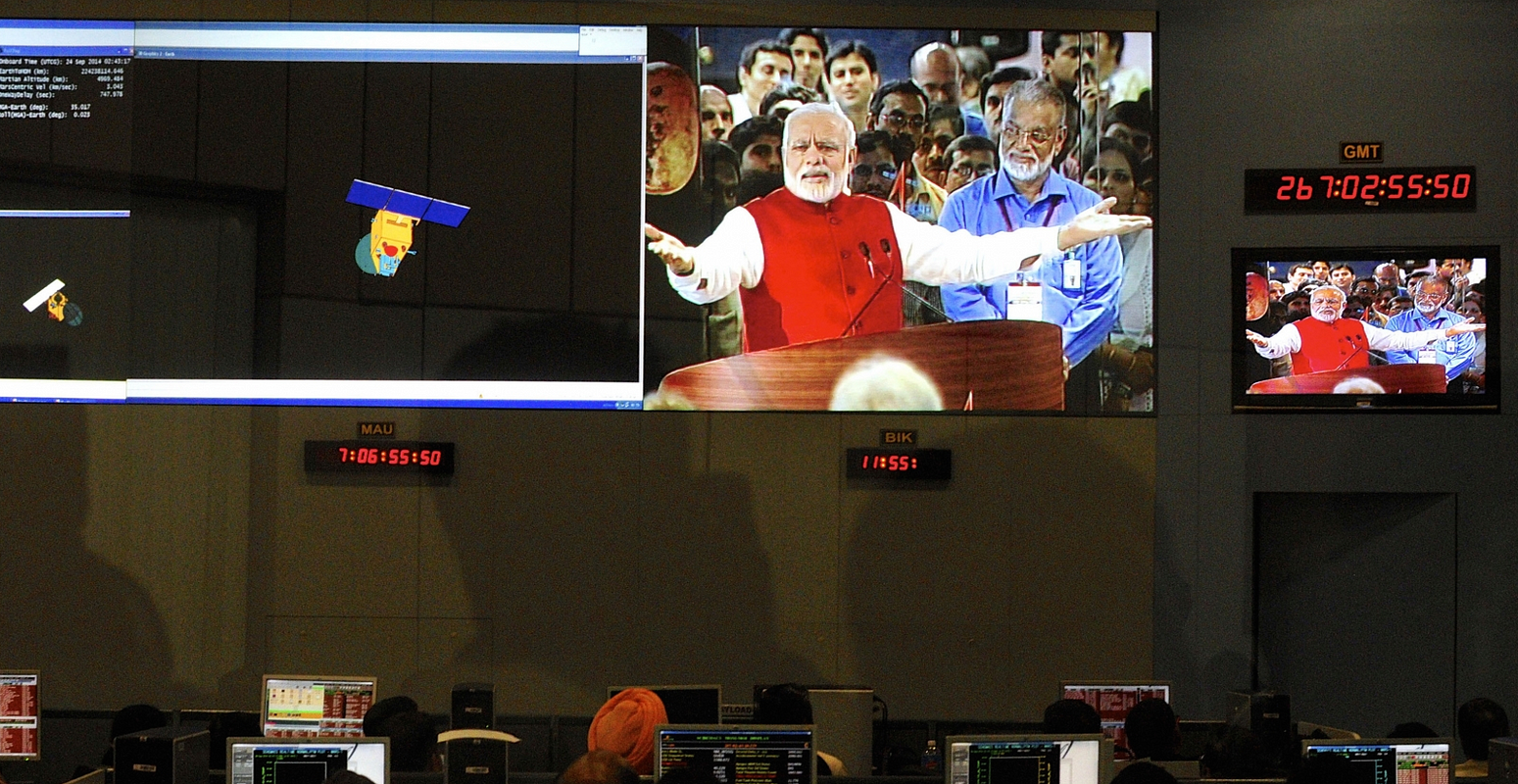
Indian Space Research Organization scientists and engineers watch Prime Minister Narendra Modi (L) on screens after India’s Mars orbiter was successfully put around the Red Planet’s orbit, at their Spacecraft Control Center in the southern Indian city of Bangalore. (Reuters)

Wild Wild Web

By Lillian Ablon and Martin C. Libicki

For Now, Cybercrime Has the Upper Hand in Its Duel with the Law

From shady trading posts to rough-and-ready roundups, from wanted posters to "bug bounties," the World Wide Web (and thus the whole world) has become vast untamed territory for those bent on cybercrime. But will there be a proverbial new sheriff in town? Only if law enforcement agencies rise to the challenge and if private companies harness the power of their legitimate markets to quell the illegitimate ones.
Black markets for computer-hacking tools, services, and by-products, including stolen credit card numbers, continue to grow, posing threats to businesses, governments, and individuals. The most prominent recent example was the capture of an estimated 40 million credit card numbers and 70 million user accounts in the December 2013 breach of retail giant Target. Within days, those data appeared — available for purchase — on black market websites.


A hacker works on his laptop in Taipei. Taiwan has become the front line in the global battle for cyberspace, according to hackers who describe the island as a rehearsal area for Chinese cyberattacks that are then directed toward larger countries.

The markets for cybercrime products and by-products have become so pervasive and accessible that the malicious hacking trade today can be, in certain respects and for some, more lucrative and easier to carry out than the illegal drug trade. Once the domain of lone hackers, cybercrime has become a burgeoning powerhouse of highly organized groups, often tied to drug cartels, mafias, terrorist cells, and even nation-states. It has matured into specialized markets, in which those who have gained the greatest access deal freely in the tools and spoils of the trade: exploit kits (software for creating, distributing, and managing attacks), botnets (remotely controlled computers used for sending spam or flooding websites), "as-a-service" offerings (hacking for hire), compromised hosts, and a continually flooded market for stolen credit card numbers and other personal credentials.

An Inconvenient War

by Brian Michael Jenkins
September 25, 2014
Pentagon Press Secretary Navy Rear Adm. John Kirby briefs reporters on airstrikes on ISIL targets in Syria, Sept. 25, 2014

When the Japanese bombed Pearl Harbor in December 1941, a full 11 months before the 1942 midterm elections, President Franklin Roosevelt was able to go to Congress the very next day and obtain a declaration of war. When terrorists attacked America on 9/11, nearly 14 months before the 2002 congressional elections, Congress authorized the use of military force within one week, thereby providing the legal basis for U.S. actions against al Qaeda's terrorist enterprise. Congressional approval for military action in Iraq and Syria seems likely to take longer. Among the reasons: election year political calculations.

The advance of Islamic State in Iraq and Syria (ISIS) forces across Iraq and their murder of two American citizens provoked extraordinary alarm in Washington. Secretary of Defense Chuck Hagel said that this was beyond anything we've seen. Sen. James Inhofe (R-Okla.) observed, "We are in the most dangerous position we've ever been as a nation." And retired Marine Gen. John Allen, who the president has just appointed to lead the coalition against ISIS, declared that "World War III is at hand."

Well, not just yet. Although the House and Senate voted last week to back the president's plan to train and equip opposition forces fighting the Syrian regime, Congress has not addressed President Obama's plans to take other military steps against ISIS. Some members of Congress do not want to vote on the use of military force until after the upcoming elections. Among these are some who fear their vote could cost them votes.

So far, lawmakers have not been presented with a request from the administration, so it is not yet clear what they would be asked to vote on. And the Congress is used to being ignored when it comes to the War Powers Act. Still, voter reaction could go either way: a vote for the president's plan could be seen by some voters as support for another foreign war, while a vote against could be portrayed as a failure to recognize the ISIS threat.

Either there is a clear and present danger that requires immediate military action, or the threat does not warrant immediate military action. Americans are divided. It is worth a discussion and a vote. But to have one could distract and polarize voters in unanticipated ways, which perhaps some members of Congress would rather avoid right now.

Greenback Empire: Why the Dollar's Dominance Is Here to Stay

September 29, 2014

The dollar is not about to be dislodged as the world’s number-one currency.

The chorus of voices calling for an end to the dollar’s role as the world’s primary reserve, intervention and transactions currency—sometimes referred to as “dollar hegemony”—is far from new. Calls for an end to this system began in the 1960s, when French finance minister Valรฉry Giscard d’Estaing decried the dollar’s “exorbitant privilege.” And yet, despite the consistent presence of an “anti-dollar” lobby in the international monetary arena and the support of parties as diverse as China and even the United Nations, the dollar’s role has endured. 

Indeed if history has taught us anything about the dollar’s key currency role, it is that while talk of ending it is cheap, the likelihood of such an outcome is somewhere in between improbable and absurd. Although opponents of dollar hegemony are quick to note the dollar’s faults, they consistently ignore three important facets of the history and dynamics of dollar supremacy.

The first thing the dollar’s detractors ignore is that there is no historical precedent for an international effort to dethrone a currency. Although some cite the replacement of the pound with the dollar as the world’s reserve currency in the 1940s, this view neglects the economic and geopolitical circumstances of this transition. Between 1914 and 1945, the World Wars dislodged Britain from its position of financial supremacy, turning it from a net exporter of capital (a crucial aspect of British imperial economic strategy) to a net importer and causing the United States to replace it as the world’s largest exporter. 

Moreover, Britain’s central financial position had long been bolstered by colonial possessions that were required to buy its exports and, as a consequence, often used its currency. The wars not only fragmented the British trading system, but also forced imperial countries to deal with this disruption by weaning themselves off British support, beginning the process of decolonization. At theBretton Woods Monetary Conference, where the United States negotiated to enshrine the dollar as the world’s reserve currency in a new international monetary system, the UK was too weak to resist. 

Today, despite its well-known fiscal and current account deficits, the United States is far from the position of postwar Britain. It took two world wars and the fraying of an empire to dethrone the pound, and that was without the dizzying interconnectedness of today’s international financial system, which would make such a transition exponentially more costly to repeat.

The second thing ignored by the dollar declinists is what would be financially necessary to replace the dollar. The dollar’s role at the center of the international monetary system is not merely the result of an agreement signed in 1944. The dollar can perform this role because the United States’ $30 trillion domestic-debt securities market is more than double the size of the next largest domestic market (Japan), because its government issues roughly $1 trillion in ultrasafe Treasury bonds every year and because the massive dollar-denominated holdings of nearly every country in the world give them good reason to be wary of threats to the value of those reserves. 

No currency in the world is backed by financial markets as deep or liquid as the dollar’s. The use of any other currency as the world’s key currency would make it much harder for private companies to hold safe reserves for international transactions, harder for governments to acquire the reserves needed to conduct exchange market interventions and harder for investors to preserve their capital during periods of financial instability.

The third thing these detractors ignore is the political difficulty of coordinating such an action. Would China really go to all the trouble of forcing a monetary transition, risking its own dollar holdings, merely to enshrine the euro? In ten or twenty years, when the renminbi perhaps becomes a viable and fully convertible alternative, will Europe really risk its strategic relationship with the United States for its sake? For almost all the countries in question, the dollar represents the least-bad option. While it may be in the interest of a very small number of nations to replace the dollar with their own currency, it is in almost no nation’s interest (save, perhaps, Russia) to replace it with someone else’s.

Why a leading professor of new media just banned technology use in class

September 25 


Clay Shirky is, as he explains below, a “pretty unlikely candidate for Internet censor.” 

Shirky is a professor of media studies at New York University, holding a joint appointment as an arts professor at NYU’s graduate Interactive Telecommunications Program in the Tisch School of the Arts, and as a Distinguished Writer in Residence in the journalism institute. He is a leading voice on the effect technology has had on society — and vice versa — and has been writing extensively about the Internet for nearly a decade. 

For years Shirky has allowed his students to bring laptops, tablets and phones into class and use them at will. But he just told students to put them away. He explains why below in a piece that first appeared on medium.com

I teach theory and practice of social media at New York University, and am an advocate and activist for the free culture movement, so I’m a pretty unlikely candidate for Internet censor. But I have just asked the students in my fall seminar to refrain from using laptops, tablets, and phones in class. 

I came late and reluctantly to this decision. I have been teaching classes about the Internet since 1998, and I’ve generally had a laissez-faireattitude towards technology use in the classroom. This was partly because the subject of my classes made technology use feel organic, and when device use went well, it was great. Then there was the competitive aspect. It’s my job to be more interesting than the possible distractions, so a ban felt like cheating. And finally, there’s not wanting to infantilize my students, who are adults, even if young ones. Time management is their job, not mine. 

Despite these rationales, the practical effects of my decision to allow technology use in class grew worse over time. The level of distraction in my classes seemed to grow, even though it was the same professor and largely the same set of topics, taught to a group of students selected using roughly the same criteria every year. The change seemed to correlate more with the rising ubiquity and utility of the devices themselves, rather than any change in me, the students, or the rest of the classroom encounter. 

Over the years, I’ve noticed that when I do have a specific reason to ask everyone to set aside their devices (“Lids down,” in the parlance of my department), it’s as if someone has let fresh air into the room. The conversation brightens, and more recently, there is a sense of relief from many of the students. Multi-tasking is cognitively exhausting; when we do it by choice, being asked to stop can come as a welcome change. 

So this year, I moved from recommending setting aside laptops and phones to requiring it, adding this to the class rules: “Stay focused. (No devices in class, unless the assignment requires it.)” Here’s why I finally switched from “allowed unless by request” to “banned unless required.” 

We’ve known for some time that multi-tasking is bad for the quality of cognitive work, and is especially punishing of the kind of cognitive work we ask of college students

Asymmetric Warfare Goes Both Ways


September 29, 2014 

During the last decade and a half of militant extremism with global ambitions, asymmetric warfare has been a much-ballyhooed concept sometimes alleged to give the weaker belligerent an inherent, automatic advantage. But this is a gross oversimplification, and when it takes root in the minds of those threatened by and opposing terrorism, it can become a self-defeating distortion of the truth. Asymmetric warfare goes both ways in conflicts between peers, near-peers, and non-peers alike; and the U.S. and our global partners should constantly be using innovative asymmetry to our own advantage, in every contest of wills we face.

Joint Publication (JP) 1-02, Department of Defense Dictionary of Military and Associated Terms, defines asymmetric like this: “In military operations the application of dissimilar strategies, tactics, capabilities, and methods to circumvent or negate an opponent’s strengths while exploiting his weaknesses.” Asymmetric warfare is nothing magical. The application of dissimilar strategies, tactics, capabilities, and methods is commonsense common practice in every kind of competition, including armed conflict, and it always has been.

Since that is true, it is striking that JP 1-02 had no definition of asymmetric at all until the definition was first introduced in 2012’s brand new JP 3-15.1, Counter-Improvised Explosive Device Operations. JP 3-15.1 is a doctrine document produced only after terrorists and insurgents in Iraq and Afghanistan had demonstrated both the ingenuity and the capability to develop and employ improvised weapon systems whose strategic effects sometimes far surpass their tactical impact, despite relatively small investments. But the fact that it took that painful experience to add the word asymmetric to our military lexicon should tell us that we are selling ourselves short, even if it is only because we have gotten too comfortable thinking of ourselves as the biggest kid on the block and the odds-on favorite.

How then should the U.S. use asymmetry to our advantage regardless of the type of adversary we face? Going bigger and better with our military forces, even at high cost, is clearly part of the answer. It is also clearly not the entire answer, and it comes with stringent fiscal limits of late.

Iraq and Afghanistan were the proving grounds for a new generation of IED tactics, including the way in which IED attacks have been staged, recorded, and then broadcast for all the world to see. Those tactics allowed Al Qaeda and the Afghan Taliban to deliver their own version of “shock and awe,” with devastating direct results for far too many of our American warriors and troubling indirect results for all Americans watching. The barbarous recordings of the beheadings of one civilian at a time are intended to have the same asymmetric strategic impact. How should we respond? By fighting our enemies just as asymmetrically as they fight us.

Asymmetry and The American Way Of War

The World is on Fire: Where is the U.S. Army?

September 29, 2014

The World is on Fire: Where is the U.S. Army?

Russia’s revitalized Army seizes Crimea and skillfully exerts control in Eastern Ukraine. The Islamic State, a collection of fanatical Sunni Muslim terrorists in pickup trucks crush the U.S. trained Iraqi Army and overrun territory from Aleppo to Baghdad. On the Anniversary of Japan’s defeat in WW II, China’s leaders pledge to expunge corruption from the PLA’s senior ranks and build a more powerful Chinese Army.

What is the Army’s response to these challenges?

The Army is blazing a path backward into the Cold War. The Army is rebuilding the ten division force with all the trimmings; divisional artillery brigades, and 80 ton ground combat vehicles (GCVs) using the organizations designed by Lieutenant General Leslie J. McNair in 1942.[i]

If pressed for “new thinking,” the Army may dust off the Future Combat System (FCS), give it a new name and make another run at congress. FCS produced nothing, but FCS did successfully redistribute 20 billion dollars to defense contractors, constituents, retired generals and indirectly to members of congress via campaign donors. Moreover, Senators and congressmen love “unobtainium;” imaginary high-tech solutions that promise miraculous performance, but ignore the laws of physics. The outcome: Today’s U.S. Army is hard pressed to send a battalion of 600 troops equipped with tanks and armored fighting vehicles to Eastern Europe or Iraq in less than six months. For many in the House and the Senate, the question is what should congress do? 

Before the Senate and House appropriators fork over another $20 billion to the Army perhaps they should consider an alternative to the Army’s scandalously ineffective acquisition strategy and anachronistic force design. After all, $20 billion is 15% of the Army’s 129 billion dollar FY 2014 budget. The Light Reconnaissance Strike Group (LRSG), a 5,500 man mobile, armored combat force commanded by a brigadier general, is worthy of serious attention. 

The LRSG is a break from the Army’s Cold War past and a bridge to the Army’s future in 21st Century Joint warfare. It’s designed to be the vanguard of a reorganized 420,000 man Army, an operationally agile formation that combines mobile armored firepower, mobility engineers, and airmobile infantry with manned and unmanned strike assets to find, fix; attack and destroy the enemy in open, compartmentalized or urban terrain. 

Today, precision Strike forces informed by the timely dissemination of actionable intelligence through networked ISR suggests that new capabilities will only emerge in fighting formations that build powerful synergies with the technologies and concepts developed by U.S. Aerospace and Maritime Forces. The LRSG is conceived with this requirement in mind; it’s smaller than a division, but larger than a brigade combat team (BCT). It is designed to integrate functional capabilities—maneuver, strike, intelligence, surveillance, reconnaissance (ISR) and sustainment—across Service lines at the battle group level in a non-linear, nodal and dispersed, mobile warfare. 

Unlike brigade combat team (BCTs), the LRSG is designed to punch above its weight, mobilizing fighting power disproportionate to its size in a 21st Century warfighting environment that rewards high lethality, low density units. The LRSG is equipped with the firepower, protection and mobility to close with the enemy, take hits, sustain losses, keep fighting and strike back decisively in future warfare that is likely to be more lethal than anything seen since WW II

The best way to build the LRSG is to abandon the FCS model and avoid binding Army modernization efforts through expensive programs intended to stamp out ideal designs over 20-year production runs. As the late Ike Skelton, Democratic Congressman from Missouri said on 21 June 2005: “I don't think the troops can wait 10 or 15 years for a new armored vehicle to be developed.” This approach means rapid prototyping.

Army Rethinks the Human Elements of War

September 28, 2014

The U.S. Army has been fighting wars non-stop for over a dozen years — the longest period of continuous conflict in the nation’s history. Other services have made their contributions, but soldiers have done most of the hard combat and suffered most of the casualties. So maybe it shouldn’t come as a surprise that the Army is trying harder than other services to figure out why wars in Afghanistan and Iraq didn’t go as well as they might have.

The analysis is ongoing, but some of the conclusions Army leaders are reaching ring true. As one officer involved in a Strategic Landpower Task Force with the Marines and Special Operations Command put it to me, “war is not a math problem — it’s a clash of wills.” He says that U.S. military planners have become so captivated by the organizational, technological, and logistical facets of warfare that they have lost sight of the human dimension.

The human dimension encompasses behavioral factors such as cultural values and emotional commitment — factors that help explain why achieving “overmatch” in warfighting metrics doesn’t necessarily translate into victory on the battlefield. Army leaders didn’t really get that lesson until it was too late in Vietnam, but now they’re trying real hard to understand how it should inform warfighting practices in the next Anbar or Helmand province.

And make no mistake — there will be future Anbars and Helmands. Having nearly defeated America and its allies in such dusty backwaters despite massive inferiority in men and materiel, extremists have figured out that is where they should make their stand in the next war. The U.S. won’t resort to wholesale bombing of civilians in these places to get at the bad guys, so that means the only way to defeat them is to send in ground forces — including U.S. soldiers.

In thinking through the experience gleaned from recent campaigns, Army thinkers have come to appreciate the value of “persistence.” What that means for them is continuous presence near and interaction with the peoples who populate potential trouble spots. The way they see it, if the military doesn’t show up until there’s trouble, then it probably won’t understand the indigenous culture well enough to shape the human dimension of conflict that drives outcomes.

Obviously, this isn’t a big issue for sailors sitting offshore or airmen flying overhead. But for soldiers and marines who must take the fight to the enemy on its own turf, understanding the local setting is critical to success. Ideally, Army insiders say, soldiers should be on the ground and developing relationships with indigenous peoples years before conflict occurs. That’s the opposite of how ground forces are employed today — typically as a last resort when other tools for influencing hearts and minds have failed.

If these emerging lessons about the importance of persistence and human factors are valid — and they certainly sound reasonable — then perhaps Washington needs to stop making such a stark distinction between whether U.S. forces are on the ground or not in threatened countries. What matters is not so much whether they are there as what they are doing. If they are building the foundations for effective indigenous defenses or strengthening ties to local leaders, then “boots on the ground” may be the best way of avoiding the need for much bigger commitments.

Loren B. Thompson is Chief Operating Officer of the non-profit Lexington Institute and Chief Executive Officer of Source Associates, a for-profit consultancy.

This article originally appeared on the Early Warning Blog, a publication of the Lexington Institute.

Poll: 70% of troops say no more boots on the ground in Iraq


By Andrew Tilghman with Gina Harkins, David Larter, Stephen Losey, Hope Hodge Seck, Michelle Tan and Jeff Schogol 
Sep. 28, 2014 
Source Link


As the tide of war rises again in the Middle East, the military’s rank and file are mostly opposed to expanding the new mission in Iraq and Syria to include sending a large number of U.S. ground troops into combat, according to a Military Times survey of active-duty members.

On the surface, troops appear to support President Obama’s repeated vows not to let the U.S. military get “dragged into another ground war” in Iraq. Yet at the same time, the views of many service members are shaped by a deep ambivalence about this commander in chief and questions about his ability to lead the nation through a major war, according to the survey and interviews.

The reader survey asked more than 2,200 active-duty troops this question: “In your opinion, do you think the U.S. military should send a substantial number of combat troops to Iraq to support the Iraqi security forces?” Slightly more than 70 percent responded: “No.”

“It’s their country, it’s their business. I don’t think major ‘boots on the ground’ is the right answer,” said one Army infantry officer and prior-enlisted soldier who deployed to Iraq three times. He responded to the survey and an interview request but, like several other service members in this story, asked not to be named because he is not authorized to discuss high-level military policy.

The Military Times survey was conducted online this summer and concluded in August just as President Obama was ramping up the air campaign against the Islamic State group.

As the U.S. expands that air war into Syria and increases the number of U.S. boots on the ground in Iraq — topping more than 1,700 total — service members say their feelings about the crisis and the U.S. response to it haveintensified.

In barracks and staff offices, on smoke breaks and over after-hours beers, troops’ conversations about Iraq have shifted abruptly from reflections on the past to questions about the future that are fraught with concerns about the wisdom and scope of new missions. Troops are raising new questions about why the U.S. withdrew from Iraq in 2011, what went wrong and why.

Many simply wonder why anyone should think the long-term outcome will be any different this time.

“It’s kind of futile in the end — regardless of how well we do our job, the Iraqi government isn’t going to be able to hold up,” Marine 2nd Lt. Christopher Fox said.

Related: Families question loss as new Mideast crisis emerges

And many share the views of one Navy hospital corpsman second class at Camp Pendleton, California, who said his multiple deployments to Iraq and Afghanistan have taken a toll on him mentally, physically and personally.

“We’re burned out,” he said.
New pessimism

The World is on Fire: Where is the U.S. Army?

September 29, 2014

The World is on Fire: Where is the U.S. Army?

Douglas Macgregor and Young Kim

Russia’s revitalized Army seizes Crimea and skillfully exerts control in Eastern Ukraine. The Islamic State, a collection of fanatical Sunni Muslim terrorists in pickup trucks crush the U.S. trained Iraqi Army and overrun territory from Aleppo to Baghdad. On the Anniversary of Japan’s defeat in WW II, China’s leaders pledge to expunge corruption from the PLA’s senior ranks and build a more powerful Chinese Army.

What is the Army’s response to these challenges?

The Army is blazing a path backward into the Cold War. The Army is rebuilding the ten division force with all the trimmings; divisional artillery brigades, and 80 ton ground combat vehicles (GCVs) using the organizations designed by Lieutenant General Leslie J. McNair in 1942.[i]

If pressed for “new thinking,” the Army may dust off the Future Combat System (FCS), give it a new name and make another run at congress. FCS produced nothing, but FCS did successfully redistribute 20 billion dollars to defense contractors, constituents, retired generals and indirectly to members of congress via campaign donors. Moreover, Senators and congressmen love “unobtainium;” imaginary high-tech solutions that promise miraculous performance, but ignore the laws of physics. The outcome: Today’s U.S. Army is hard pressed to send a battalion of 600 troops equipped with tanks and armored fighting vehicles to Eastern Europe or Iraq in less than six months. For many in the House and the Senate, the question is what should congress do? 

Before the Senate and House appropriators fork over another $20 billion to the Army perhaps they should consider an alternative to the Army’s scandalously ineffective acquisition strategy and anachronistic force design. After all, $20 billion is 15% of the Army’s 129 billion dollar FY 2014 budget. The Light Reconnaissance Strike Group (LRSG), a 5,500 man mobile, armored combat force commanded by a brigadier general, is worthy of serious attention. 

The LRSG is a break from the Army’s Cold War past and a bridge to the Army’s future in 21st Century Joint warfare. It’s designed to be the vanguard of a reorganized 420,000 man Army, an operationally agile formation that combines mobile armored firepower, mobility engineers, and airmobile infantry with manned and unmanned strike assets to find, fix; attack and destroy the enemy in open, compartmentalized or urban terrain. 

Today, precision Strike forces informed by the timely dissemination of actionable intelligence through networked ISR suggests that new capabilities will only emerge in fighting formations that build powerful synergies with the technologies and concepts developed by U.S. Aerospace and Maritime Forces. The LRSG is conceived with this requirement in mind; it’s smaller than a division, but larger than a brigade combat team (BCT). It is designed to integrate functional capabilities—maneuver, strike, intelligence, surveillance, reconnaissance (ISR) and sustainment—across Service lines at the battle group level in a non-linear, nodal and dispersed, mobile warfare.