Chhengpor Aun
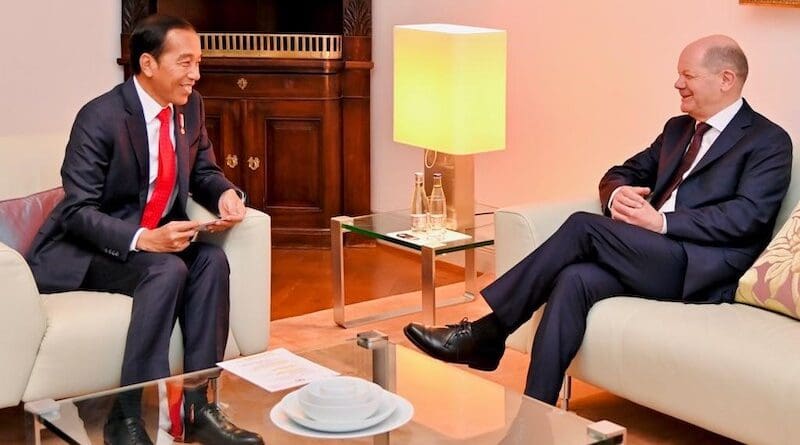
Germany observed its Southeast Asia Week in March 2024, hosting Malaysian Prime Minister Anwar Ibrahim, Philippine President Ferdinand Marcos Jr and Thai Prime Minister Srettha Thavisin at the Federal Chancellery in Berlin. These visits highlighted the resolve of Social Democratic Party (SPD) Chancellor Olaf Scholz’s ‘traffic light’ coalition to walk the talk on engaging Southeast Asia and to pursue a de-risking strategy towards China.
In 2020, Germany became a party to the Treaty of Amity and Cooperation in Southeast Asia as it rolled out its first ‘Policy Guidelines for the Indo-Pacific’, mapped out by then-chancellor Angela Merkel’s government. The guideline provides a roadmap for Germany to partner with ASEAN to boost trade and investment ties, fight climate change and defend the liberal international order.
Germany’s Southeast Asia overture is motivated by incumbent Chancellor Scholz’s aim to reduce dependence on China — a lesson learned from Berlin’s reliance on Russia before the invasion of Ukraine. Germany’s 2023 strategic paper on China referred to Beijing as a simultaneous ‘partner, competitor and systemic rival’.
By inviting Anwar, Marcos and Srettha to Berlin, Scholzsent a strong message to German businesses to speed up the drive towards de-risking, diversifying supply hubs and relocating plants from China by turning to Southeast Asia. Germany is also looking to Southeast Asia for supplies of critical minerals needed for the green transition, with Indonesia, the Philippines, Vietnam and Thailand on the radar as potential suppliers.
Southeast Asia is a natural partner for Germany and the European Union in times of global uncertainty as a result of geopolitical competition and geoeconomic fragmentation. If Donald Trump returns to the White House in January 2025, EU–ASEAN cooperation will be more important than ever in upholding the norms of a rules-based international order and multilateralism.