7 July 2018

India’s NSG Membership And The Human Capital Factor – Analysis

By Abhijit Iyer-Mitra and Tarika Rastogi

The implications of India’s aspiration to join the Nuclear Suppliers Group (NSG) has been dissected variously from a strategic prism, as well as from the industrial. While industrial dissections of the argument have focused on India’s lack of commercially tested and hence viable technology for export, the human aspect of this has been almost completely ignored. On close examination it would seem that the human capital element of India’s nuclear programme could be a major Trojan Horse for entry into the NSG, but could also turn into an industrial bottleneck without NSG membership.
India and North Korea: A Strategic Friendship?

by Tanya Sen

India’s recent revelation that it had sent a junior foreign minister to meet with counterparts in North Korea was greeted with surprise. According to V.K. Singh, India’s Minister of State for External Affairs, the two unlikely candidates came together to discuss "political, regional, economic, educational and cultural cooperation between the two countries." The two don’t seem to have many policy issues in common. Why, then, did India send a senior diplomat to Pyongyang for the first time in twenty years? While the motives of both actors are open to interpretation, it is useful to speculate how this visit fits into India’s broader strategic goals.

Combating Political Violence: Pakistan’s Determination Is Put To The Test – Analysis

By James M. Dorsey

Pakistan’s determination to crack down on United Nations-designated global terrorists is being put to the test barely two weeks after the South Asian nation evaded blacklisting by an international anti-money laundering and terrorism finance watchdog. A statement by a group widely viewed as a front for UN-designated Jamat-ud-Dawa and its leader, Hafez, Saeed, said it would field hundreds of candidates in elections scheduled for July 25 under the banner of an existing Islamist political party. The agreement between Milli Muslim League, the front group, and Allah-O-Akbar Tehreek, an Islamist party, came after Pakistan’s election commission rejected the League’s application to be registered as a political party.

Why Can’t Pakistan Facilitate a Long-Term Ceasefire in Afghanistan?

By Umair Jamal

Last month, the leader of the Pakistani Taliban was killed in a drone strike in Afghanistan’s Kunar province. The drone strike that killed the former head of the Pakistani Taliban, Mullah Fazlullah, has been viewed as an attempt by Washington to repair its broken relationship with Islamabad. On the other hand, Washington appreciated the role Islamabad played in encouraging a ceasefire between the Afghan government and the Taliban. The temporary ceasefire, which was termed a crucial step for any reconciliation process to succeed in Afghanistan, has failed to begin a new phase of talks among key stakeholders in the region. The violence that exploded after the ceasefire period in Afghanistan has again brought the role of Pakistan to the center of the crisis.

Bangladesh Joins The Space Age – Analysis

By Abu Sufian Shamrat*

Bangladesh joined the space age after a SpaceX rocket carrying a Bangabandhu-1 satellite streaked across Florida’s blue sky on May 11. The country, once disparaged by former Secretary of State Henry Kissinger as a “basket case,” became the fourth South Asian nation with its own satellite meeting its communication needs. Named “friend of Bengal,” a moniker for the nation’s founding father Sheikh Mujibur Rahman, the satellite may open the door to a digital Bangladesh – if the government manages the challenges of sustainable technology development.

China electronic spying threat

Bill Gertz

Defense Secretary Jim Mattis‘ recent visit to China highlighted the security dangers posed by sophisticated Chinese electronic spying in the capital of BeijingSecurity precautions for those traveling with the defense secretary were extremely tight during his June 26-28 visit.
To prevent Chinese spying through cellphones or laptop computers, the 10 journalists traveling aboard the secretary’s Air Force E-4B nuclear command plane, a militarized Boeing 747, were prohibited from bringing any electronic devices that were taken off the aircraft during the two-day visit back onto the plane. Anything that used wireless connectivity was deemed potentially vulnerable to Chinese hacking. Security officials were concerned that China’s formidable electronic spies would plant viruses or other malware onto the cellphones and laptops, allowing remote spying aboard the aircraft.

China’s prototype laser rifle is a dangerous gimmick at best

By: Kelsey Atherton   

In the fictional grim darkness of the 41st century, lasers guns are the standard infantry firearms. Lasers resonate in science fiction, whether that fiction is set in the future or long ago and far away, but infantry portable directed energy weapons remain solely the realm of fiction, even as nations move closer to deployable laser weapons on vehicles and ships. So what are we, the discerning public raised on a diet of rayguns, to make of the “ZKZM-500 laser assault rifle,” a prototype of which was recently field tested at the Chinese Academy of Sciences in Shaanxi? “Well, let’s start with this: it is possible to pay me enough to hold it, but I’d probably invalidate my life insurance policy by doing so,” says Phil Broughton, certified laser safety officer.

How the tech industry got caught in the Trump-China trade crossfire


The most recent shot in the technology war between Washington and Beijing is the Trump administration’s decision to deny China Mobile entry into the US market. This move follows plans to strengthen the review of Chinese investment in US technology companies; the banning of the sale of ZTE and Huawei smartphones on military bases; sanctions on ZTE that could have killed the company if they had not been overturned by the president; and the imposition of 25 per cent tariffs on $50 billion worth of Chinese goods related to technology. There is no end in sight of the trade tensions, and the desire to disentangle the US and Chinese technology systems will have long-lasting effect on companies and consumers on both sides of the Pacific.

China’s Belt and Road: Exporting Evangelism?

By Jeremy Luedi

At a time when their compatriots back home are dynamiting churches that have mushroomed across the country, Chinese construction companies are winning contracts to build churches across Africa. The economies of scale and other logistical advantages which Chinese firms enjoy in other sectors are being carried over to church construction. “China is now winning contracts to build churches because its corporations out-bid those from elsewhere,” notes Jesse Mugambi, professor of religious studies and philosophy at the University of Nairobi.

China’s Artificial Intelligence Revolution: a Sputnik Moment for the West?

By Kris Hartley

China is buzzing with a revived interest in the past – specifically dinosaurs. A recent Smithsonian article detailed a boom in research and tourist activity around the excavation of dinosaur remains that are over 100 million years old. The irony is not lost in a country that otherwise embraces forward thinking in all facets of life including urbanization, industry, and technology. Through future-centered initiatives such as sustainable infrastructure and technologies targeting economic and social sectors, China is quietly building a global presence in spheres that are being increasingly vacated by Western countries. For example, China has overtaken the United States in the volume of research paper publications in scientific fields, according to the U.S. National Science Foundation. Furthermore, China’s Belt and Road Initiative appears to be the 21st century’s most comprehensive and transformative economic integration project, with implications for countries on every continent.

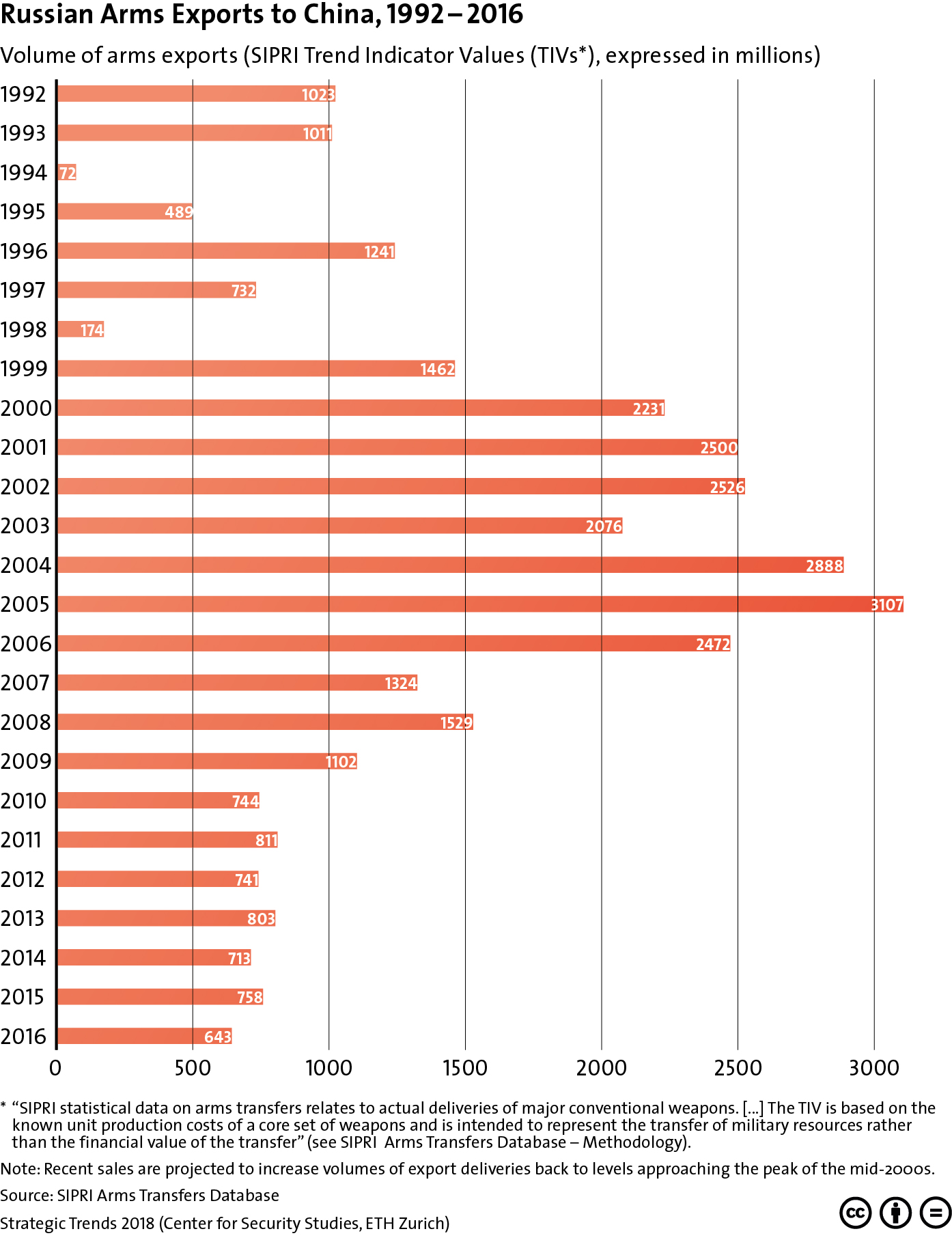
Russian Arms Exports to China, 1992 – 2016

By the Center for Security Studies

An Action Plan on US Drone Policy: Recommendations for the Trump Administration

Rachel Stohl contends that drones have become a mainstay of US counterterrorism operations and national security policy writ large. However, many of the details surrounding the US drone program remain shrouded in secrecy and concerns regarding drone policies have only become more salient during the Trump administration. In response, Stohl argues that the US should now establish a comprehensive drone policy, with a view to aligning national security priorities and commercial interests with American foreign policy ideals.

The Great Russian Disinformation Campaign

David Frum

When Westerners first began to hear of Vladimir Putin’s troll army—now some five years ago—the project sounded absurd. President Obama in March 2014 had dismissed Russia as merely a weak “regional power.” And Putin’s plan to strike back was to hire himself a bunch of internet commenters? Seriously? In a recent talk in Washington, the historian Timothy Snyder observed that Russia’s annual budget for cyberwarfare is less than the price of a single American F-35 jet. Snyder challenged his audience to consider: Which weapon has done more to shape world events? Snyder is an unusual historian-activist, both a great scholar of the terrible cost of 20th-century totalitarianism and also a passionate champion of endangered democracy in Ukraine and Eastern Europe—and now, the United States. Increasingly, he sees his concerns fusing into one great narrative, as methods of manipulation and deception pioneered inside Russia are deployed against Russia’s chosen targets.

Where Does the U.S.-UK Special Relationship Stand Today in the Time of Brexit?

Blood and treasure or fantasy: What is the UK-U.S. ‘special relationship’? 

LONDON (Reuters) - Britain’s so-called ‘special relationship’ with the United States was one of the most enduring alliances of the 20th Century, though Brexit and the election of U.S. President Donald Trump have raised questions about its future. What is the special relationship and how do the United States and Britain compare on key measures? The United States is the world’s biggest economy, worth about $20.4 trillion or 23 percent of global GDP, while Britain is the world’s fifth largest, worth about $2.9 trillion (2.19 trillion pounds) or 3.3 percent of global GDP. While the EU accounts for about half of Britain’s external trade, the United States is by far the biggest single trading partner, followed by Germany, the Netherlands, France and China.

HAMAS IS USING FAKE DATING APPS TO HACK ISRAELI SOLDIERS

David Brennan

Palestinian militant group Hamas is using fake dating and World Cup update apps to hack into the smartphones of Israeli soldiers and turn them into spying devices, the Israel Defense Forces (IDF) has said. If soldiers downloaded the fake apps, it would give Hamas operatives the ability to see a user’s location and contact list. It would also allow the app’s creator to use the phone as a listening device and video camera, The Times of Israel reported. The IDF said hundreds of its soldiers were contacted by imitation Facebook accounts, usually using stolen pictures to pose as young women, asking to talk on WhatsApp. They were then asked to download one of two fake dating apps named WinkChat and GlanceLove. Intelligence officers said those running the fake accounts were not necessarily based in Gaza, the coastal enclave controlled by Hamas.

The Nuclear Non-proliferation Treaty at fifty: a midlife crisis


On 1 July 1968, the Treaty on the Non-proliferation of Nuclear Weapons (Nuclear Non-proliferation Treaty, or NPT) was opened for signature. Since then, the Treaty has become a cornerstone of international efforts to prevent the spread of nuclear weapons, to eventually eliminate them and to facilitate peaceful use of nuclear energy. With the adherence of 190 countries, the NPT is close to universal world participation. In 1995 the Treaty was extended indefinitely, after its initial period of 25 years. The NPT remains unique as there is no other international agreement based on a bargain between nuclear- and non-nuclear-weapon states.

The Palestinians and Nuclear Weapons

by Paul R. Pillar

The significance of the unresolved Israeli-Palestinian conflict has long been the subject of tendentious debates. The right-wing government of Israel, not wanting to relinquish the conquered land whose relinquishment would be necessary for peace, often contends, along with its sympathizers, that peace in that conflict doesn’t really matter much anymore. The region has become preoccupied with other things, goes the argument, and even most Arabs care less about the Palestinians’ situation than about other problems. The kernels of truth in the argument are that the Middle East does indeed have many other troubles independent of the Israeli-Palestinian conflict, and that many Arab governments haven’t exactly been steadfast in upholding the interests of their Palestinian brethren.

Why the U.S. Must Trust but Verify with North Korea

JOSEPH DETRANI

As Secretary of State Mike Pompeo heads to North Korea seeking signs of progress after the recent Singapore summit, some of his colleagues in the U.S. Intelligence community are doubting whether actions will meet up to words when it comes to North Korea’s promise to denuclearize. Ambassador Joe DeTrani has just returned from South Korea, where he attended two conferences that addressed the issue and spent time with representatives from the U.S., China, Russia and Japan, while meeting with South Korean government and former government officials, and academics. The focus was on developments with North Korea and the path ahead. This is what he filed exclusively for The Cipher Brief:

America the Loser

J. BRADFORD DELONG

Donald Trump’s unhinged recent attacks on the iconic motorcycle maker Harley-Davidson distill his larger assault on American democracy. Even if Democrats do manage to retake one or both houses of Congress this November, the damage that Trump and Republican leaders have done to the country’s global standing cannot be repaired. The Washington Post’s Catherine Rampell recently recalled that when US President Donald Trump held a session for Harley-Davidson executives and union representatives at the White House in February 2017, he thanked them “for building things in America.” Trump went on to predict that the iconic American motorcycle company would expand under his watch. “I know your business is now doing very well,” he observed, “and there’s a lot of spirit right now in the country that you weren’t having so much in the last number of months that you have right now.”

The Decline and Fall of Brexit

JACEK ROSTOWSKI

With the clock ticking on Britain’s departure from the European Union, Prime Minister Theresa May's "red lines" rule out an exit deal before this fall. The longer the standoff continues, the more likely a British political crisis will erupt, as the massive economic and social costs of crashing out of the bloc begin to sink in. LONDON – In the beginning, British Prime Minister Theresa May had a plan: “Brexit means Brexit.” The idea was to withdraw the United Kingdom from the European Union so fast that voters would not realize they had been sold a bill of goods during the EU referendum campaign and should therefore not punish the Conservative Party for having lied to them.

Global economy 'under threat as tariff war bites'

Kamal Ahmed

Global economic growth is under threat as the world's economic super powers trade tit-for-tat trade sanctions, according to the World Trade Organization. In its most sober assessment of the growing tariff war between the US, European Union and China, the WTO said the global system of agreed trade rules was at "potentially large risk". It said world economic growth was "in jeopardy" and pleaded for a "de-escalation". The threat of a tariff war was sparked after US President Donald Trump ordered tariffs on steel and aluminium imports from the EU and China.

Can the US bank on AI to stop financial hacks?

By: Justin Lynch

The department invested $200,000 into the firm Cyber 20/20, which expands the capabilities of Cuckoo, an open-source sandbox that can detect and eliminate cyberattacks. In its program, Cyber 20/20 uses AI to respond to the malware, which has become “increasingly popular over the past decade,” according to Greg Wigton, DHS program manager.
A “sandbox” allows firms to place a piece of an operating system into a closed environment that prevents malware from spreading. Viruses can then be eliminated. Cyber 20/20 also has “anti-anti-sandbox” capabilities, which can neutralize malware that intends to “circumvent sandbox protections,” according to the department.

5 new approaches to improving AI research

Maddy Longwell

As artificial intelligence advances there has been an increased push to incorporate it into defense technology. Recently, the Department of Defense ordered the creation of the Joint Artificial Intelligence Center, which will be a hub for AI research. The JAIC is not the first attempt to incorporate AI into the DoD, however. Project Maven, which was established by the DoD to integrate machine learning and big data, will continue as part of JAIC after Google announced it will end its participation in the programTimothy Persons, chief scientist of applied research and methods for the Government Accountability Office, testified June 26 before the House of Representatives Subcommittees on Research and Technology and Energy about AI’s implications for policy and research.

To Hackers, We’re Bambi in the Woods

By Nicholas Kristof

Suddenly, the electricity goes out at the office. Cellphone networks and the internet have also gone black, along with subways and trains. The roads are jammed because traffic lights aren’t working. Credit cards are now just worthless bits of plastic, and A.T.M.s are nothing but hunks of metal. Gas stations can’t pump gas. Banks have lost records of depositors’ accounts. Dam floodgates mysteriously open. Water and sewage treatment plants stop working.  People can’t reach loved ones. Phone systems are down, so 911 is useless. Looters roam the streets. Food and water soon run out in the cities. And that’s just the first week.

Big Tech Is a Big Problem

KENNETH ROGOFF

The prosperity of the US has always depended on its ability to harness economic growth to technology-driven innovation. But right now Big Tech is as much a part of the problem as it is a part of the solution. CAMBRIDGE – Have the tech giants – Amazon, Apple, Facebook, Google, and Microsoft – grown too big, rich, and powerful for regulators and politicians ever to take them on? The international investment community seems to think so, at least if sky-high tech valuations are any indication. But while that might be good news for the tech oligarchs, whether it is good for the economy is far from clear.

6 July 2018

Is India winning the battle against extreme poverty?


India is perhaps no longer home to the highest number of people living in extreme poverty. Researchers at Brookings Institution say Nigeria had 87 million people living in extreme poverty in May 2018, compared to 73 million in India. They predict that the Indian number is expected to drop to around 20 million over the next four years. The World Bank defines a person as extremely poor if she is living on less than 1.90 international dollars a day, which are adjusted for inflation as well as price differences between countries.

Kashmir - An Analysis of Recent Developments

C D Sahay

In a series of swift and surprise moves, on June 19, 2018, the BJP leadership in New Delhi decided to withdraw from the ruling coalition with the People’s Democratic Party (PDP); Chief Minister Mahbooba Mufti submitted her resignation to the Governor; National Conference (NC) leader Omar Abdullah declined to stake claim, and the Governor, as expected, recommended to the Centre, imposition of Governor’s rule in the state which was formalised on June 20. The Governor moved-in quickly to appoint two Advisors and a new Chief Secretary.

How Diego Garcia Can Play a Pivotal Role in America's Relationship with India

by Mark E. Rosen

The small island of Diego Garcia (DGAR) in the Indian Island is not a place that the U.S. Media knows or talks about even though it is arguably one of the most important pieces of real estate in DOD’ strategic arsenal. It is isolated in the middle of the Indian Ocean and that isolation enables it to have security from onlookers or foreign navies that would monitor challenge its activities. DGAR is closed to outsiders and that gives the U.S. military a great deal of freedom to preposition military equipment and use it as a staging area for military operations. As Tom Friedman has often said, the world is getting hotter and more crowded and these isolated little pieces of real estate cannot be replicated by the DOD. Given that, U.S. policymakers need to wake up to the challenges facing continued U.S. military presence on DGAR and take actions to shore-up its basis for remaining there— a long-term lease with the United Kingdom. That fifty-year lease commenced in 1966 and expired in 2016. The UK extended the United States’ lease to the DGAR facility in 2016 until 2036.

An Empire and its nervous periphery

Claude Arpi 

China has been expanding its boundaries to fulfil its dream of becoming the world’s most powerful nation. But the picture is not rosy. Resentment among the best of China’s friends is growing. Since the new Emperor sat on the throne in Beijing in 2012, the Middle Kingdom has steadily extended its influence in the periphery of the Empire. The CPC proclaims today: “The great rejuvenation of Chinese nation is an unstoppable historical trend that won’t be diverted by the will of any individual country or person.” The CPC has a dream: For its 100 years in 2049, it wants China to be the most powerful nation in the world. But if one looks at the Empire’s neighbourhood, all is not rosy and resentment has been created everywhere, even amongst China’s best ‘friends’.

Telcogeopolitics: West vs. China in 5G race

By MARK SCOTT

LONDON — In smoke-filled conference halls and nondescript hotels from Brussels to Busan, South Korea, a yearslong battle has been underway for control over the future of the mobile world. More than 600 government officials and telecoms executives agreed in June to a first round of global standards for so-called 5G telecommunications infrastructure, or the next generation of mobile networks, at a ballroom on the outskirts of San Diego, California. (A second round will be negotiated by the end of 2019.) The agreement — a much-needed step to enable smartphones, mobile devices and, eventually, autonomous cars to work anywhere in the world — cannot be overstated.

China’s strategic investments in Europe: The case of maritime ports

BY: SHIVALI PANDYA AND SIMONE TAGLIAPIETRA

In September 2017 Jean-Claude Juncker, president of the European Commission, proposed a new EU framework for screening foreign direct investments (FDI), arguing that ‘if a foreign, state-owned, company wants to purchase a European harbour, part of our energy infrastructure or a defence technology firm, this should only happen in transparency, with scrutiny and debate’. This proposal sparked a large debate in Europe over whether the EU should have the power to vet FDI and how this would work in practice. Earlier this year, European leaders called on the Council and the European Parliament to make further progress on this topic. The Council accordingly agreed on June 13th 2018 to start negotiations with the European Parliament, in the hope of reaching an agreement before the next elections.

What’s Next for China’s 16+1 Platform in Central and Eastern Europe?

By Alicja Bachulska

Sofia, Bulgaria hosted the annual China-CEEC think tank conference on June 29 under the theme of “Advancing 16+1 Cooperation Platform – the Way Ahead.” The conference was part of the official calendar of events of the 7th CEEC-China 16+1 Summit that will take place in the Bulgarian capital on July 7. The 16+1 was established in 2012 as a multilateral platform facilitating cooperation between China and 16 Central and Eastern European countries (CEEC). In recent years, the platform’s summits have attracted a lot of attention, especially in Western Europe. The intensifying level of engagement between the 16 countries in the CEE region and China has considerably alarmed Brussels and Berlin. Many Western European observers and policymakers have raised concerns about the potential risks of growing Chinese presence in Eastern Europe, claiming that Beijing’s major interest in engaging with the region is a part of its long-term strategy to undermine EU unity. This is by no means a new perspective, as these kinds of concerns have been raised multiple times since the platform’s establishment.

Trump's Tariffs Could Crush China's Ambitions

by Gordon G. Chang

President Donald Trump on Wednesday handed a reprieve to ravenous Chinese acquirers looking for U.S. tech companies by issuing a statement that he will not put in place across-the-board rules blocking certain investments from China. On May 29, the White House in a statement promised by June 30 to “implement specific investment restrictions” barring Chinese parties from acquiring “industrially significant technology.” Instead of using authority granted by the International Emergency Economic Powers Act of 1977 to issue such investment restrictions, the president on Wednesday endorsed legislation, now working its way through Congress, expanding the authority of the Committee on Foreign Investment in the United States. CFIUS, as the Treasury-led interagency body is known, can block certain acquisitions of U.S. businesses by foreign parties.

Trump Has Blocked the World's Biggest Mobile Network Operator From the U.S. on National Security Grounds

By DAVID MEYER

The world’s biggest mobile network operator, China Mobile, probably won’t get to enter the U.S. market after the Trump administration moved to block it on national security grounds.
China Mobile (CHL, +0.00%) is a state-owned enterprise with almost 900 million subscribers, and there is currently no shortage of distrust in the U.S. regarding Chinese companies with ties to the state, particularly in the telecommunications arena. American lawmakers have, for example, described the phone-makers Huawei and ZTE (ZTCOY, +5.08%) as “a severe national security threat.”

China isn’t playing tech catch up – it’s leapfrog and it may get dirty

By Tom Holland, m.scmp.comView OriginalJuly 1st, 2018

The editor of China’s Science and Technology Daily caused a stir last month when he described “the large gap in science and technology between China and developed countries in the West, including the US” and spoke of the obstacles China faces in catching up with more technologically advanced nations. It goes against the narrative of technological achievement trumpeted by Beijing, but he was right about how far China lags behind the US. If you were to believe much of the media coverage, you would think that China was already a world-beater in technology. Endless news stories recount how China now turns out more graduate engineers each year than any Western country, publishes more scientific research papers and files more patent applications.