30 December 2021

From a stock market crash to Covid – what to expect in 2022

George Kerevan

COVID WILL NOT GO AWAY

SURPRISE: COVID is not going to disappear. My swift look through the scientific websites reveals a scary lack of predictions regarding the pandemic in 2022 – which suggests nobody in charge has a scooby about what happens next.

This could be the year we finally accept global pandemics are here to stay, at least under our crazy neoliberal insistence on unmanaged free trade. Conclusion: the holiday and entertainment industries will have to change permanently. Perhaps this retreat from mass escapism could mean a return to a more human-scale conviviality.

To Deter China, Think Big

Steven Metz

Under the Communist Party, China has always insisted that it will eventually absorb Taiwan, by force if necessary,[1] but today a direct invasion from the mainland seems more likely than at any time since the early days of the Cold War. Military provocations,[2] exercises,[3] and incendiary rhetoric[4] from Beijing are reaching levels not seen for decades, combining to form grey zone aggression.[5] China continues to expand and improve its armed forces.[6] This is a very dangerous time.

Although it is impossible to know precisely how Chinese leaders expect an invasion of Taiwan to unfold, the dominant narrative in the United States is that the conflict would be short and limited. Some experts believe that if the United States came to Taiwan’s assistance, it could stave off the invasion and China would desist.[7] Other studies and wargames suggest that a massive barrage of Chinese missiles might prevent effective American intervention.[8]

Whether the assessments believe that a Chinese invasion of Taiwan would or would not succeed, they have one thing in common: they assume a relatively quick and geographically limited conflict. This leads most supporters of Taiwan to advocate increasing U.S. support to help make that nation a harder target.[9] While this is a good idea it is not enough: deterrence by denial[x] limited to the proximate defense of Taiwan is necessary but not sufficient. An effective strategy to deter China must expand deterrence so that it is global and multidimensional.

Strategic Studies Quarterly


Graham Allison and the Thucydides Trap Myth

More Is Not Always Better: Oversight of the Military

North America’s Imperative: Strengthening Deterrence by Denial

Will Emerging Technology Cause Nuclear War?: Bringing Geopolitics Back In

Sophons, Wallfacers, Swordholders, and the Cosmic Safety Notice: Strategic Thought in Chinese Science Fiction

Six Steps to the Effective Use of Airpower: On "The Drawdown Asymmetry: Why Ground Forces Will Depart Iraq but Air Forces Will Stay"

Cultivating Future Airpower Strategists: On "Developing Twenty-First-Century Airpower Strategists"

A Case for Strategic Design: On "A Diplomatic Surge in Afghanistan"

Leveraging Regional Partners: On "US Grand Strategy, the Rise of China, and US National Security for East Asia"

Outline of Strategic Aerial Culture

Russia, US and Ukraine: The State of Play

George Friedman

When nations negotiate, a quiet settles in before the threats begin. Such is the case now between the U.S. and Russia, which will soon hold talks over the status of Ukraine and any number of other issues. Moscow has published its list of demands – more of a wish list, really – to try to set the agenda. But in the end, agendas are set by reality. A quick recap of Russia’s year is a good place to begin establishing that reality.

Russia has been trying to reclaim the buffers it lost after the collapse of the Soviet Union. These buffers, the most important of which are in Eastern Europe, insulate Russia from potential attack. In the past, these attacks have tended to emerge unexpectedly, so Russia wants to have them before a threat emerges. It doesn’t necessarily need the buffers to be part of the Russian Federation; it just needs to make sure they are not hostile (or occupied by hostile powers).

Thus, Russian activities in the past year were predictable. When war broke out in the South Caucasus between Azerbaijan and Armenia, Russia dispatched a peacekeeping force and, with its enormous influence in the region, constructed a system of relationships dominated by Russia. In Central Asia, Moscow built a network of airfields, a process that only accelerated as the U.S. withdrew from Afghanistan. In Belarus, Russia completely dominates Alexander Lukashenko’s government.

AUKUS and Changing Dynamics in the Indo-Pacific

Michael J. Green

This week, Mike unpacks recent developments in the U.S.-Australia alliance, including the AUKUS agreement, with Rory Medcalf, professor and head of the National Security College at Australia National University. The two discuss the second edition to Rory’s book, Indo-Pacific Empire: China, America and the contest for the world's pivotal region, and how regional dynamics and geopolitics have changed over the past two years. What were the conditions that lead to the AUKUS agreement, and what is its strategic significance in the context of U.S.-China competition? What are the major “hotspots” in the Indo-Pacific that the United States and Australia should be concerned about?

Download Full Transcript Here.

The Russia-Ukraine Crisis: A Scorecard on Biden’s Response

Stephen Sestanovich

With large numbers of Russian troops massed on the border with Ukraine and Russian President Vladimir Putin regularly issuing new threats, U.S. President Joe Biden’s administration faces a genuine danger of war in Europe. How well have the president and his senior advisors handled the crisis? The record is mixed: they have shown diplomatic skill in some elements of their response but have conveyed confusion in others. The administration may yet be able to defuse tensions, but it needs to work harder at exposing the absurdity of many Russian demands—and preserving U.S. freedom of action.

High marks. U.S. policy has been most successful in two important areas. First, it has been able to maintain near-total unanimity within the North Atlantic Treaty Organization (NATO). Meeting in Latvia in early December, the alliance’s foreign ministers condemned Russian military pressures on Ukraine. Subsequent meetings, both in Washington and in European capitals, have shown similar unity. Second, these statements sent the same strong message: a Russian invasion would trigger new U.S. and European sanctions dwarfing those that followed the 2014 crisis, when Russia seized Crimea and started the separatist war in eastern Ukraine. European leaders, many feared, would muddy this message in separate meetings or calls with Putin, but they haven’t done so.

2022 look ahead: Expect more of the same for Asia's economy

William Bratton

One of the challenges when considering Asia's near-term outlook is that the trends shaping its economic, financial and political future are multi-decade affairs. They roll remorselessly forward irrespective of the constraints of the Gregorian calendar, and it is often misleading to assume that the trends over the next 12 months will be materially different from those that typified the years recently passed.

As such, although 2022 may see periods of volatility and heightened uncertainty, it is unlikely to witness substantial changes to existing trajectories. The four significant macro risks: the COVID overhang, higher U.S. interest rates, slower-than-forecast China growth and increased tensions over Taiwan will all prove relatively uneventful over the year, albeit for different reasons.

With respect to the COVID pandemic, for example, it has to be assumed that this will ease through next year, despite the different normalization paths across the region and the current omicron wave.

Is There a Kishida Doctrine?

Jeff Kingston

Prime Minister Kishida Fumio is finding it hard to emerge from the shadow of former Prime Minister Abe Shinzo (2006-07, 2012-2020). Kishida faces high expectations for deft diplomacy because he was Japan’s longest serving foreign minister (2012-2017) in the postwar era, but in reality Kishida never got much of a chance to shine because Abe was de facto foreign minister.

Kishida is probably most remembered for his role in reaching two flawed accords with South Korea in 2015. After much public jousting, Seoul and Tokyo reached agreement on UNESCO World Heritage designation for Meiji Industrial sites, contingent on Japan posting signage affirming that Koreans were forced to work at the sites. This rare feel-good moment in bilateral relations was quickly dissipated by Kishida’s comments at the press conference announcing the deal, where he asserted that being forced to work is not the same as forced labor.

Why Kishida felt compelled to rain on the parade by making this dubious distinction is uncertain, but probably he was concerned that right-wing nationalists in Japan might criticize him. Alas, the glimmer of goodwill evaporated, and Japan looked more churlish than contrite.

Russia Is Playing With Fire in the Balkans

Ivana Stradner

This year marks the 30th anniversary of the beginning of the Yugoslav wars, Europe’s bloodiest conflict since World War II. Although the Balkan states moved toward democratic governance and integration with NATO and the European Union in the immediate aftermath of the wars, consistent neglect on the part of the West has contributed to a dramatic backsliding in recent years. Now Russian President Vladimir Putin is seizing his opportunity and using the former Yugoslav states as the next battlefield to weaken NATO and the European Union.

Putin’s efforts to push the Balkans to the brink are part of his mission to reestablish Russia as a global power broker. Similar to the Kremlin’s strategy in the Caucasus, Russia’s goal in the Balkans is to ramp up tensions so that it can position itself as the sole regional mediator and security guarantor. It simultaneously aims to demonstrate that neither NATO, the EU, nor their members are credible partners for any of the Balkan countries. As Moscow also continues its military buildup near the Ukrainian border, its influence campaign in the Balkans serves as another theater to challenge the West.

Without Tutu and Mandela, Is South African Moral Exceptionalism Dead?

Eusebius McKaiser

As the world comes to terms with the news of Archbishop Desmond Tutu’s death, one question that will dominate headlines in the days to come is whether anyone with a functioning moral compass is left among South Africa’s leaders—or was Tutu the last of his generation to regard ethics and morality as more fundamental than law and politics?

South African President Cyril Ramaphosa, in a statement released Sunday, seemed keenly aware that people at home and abroad were asking such questions. “We pray that Archbishop Tutu’s soul will rest in peace but that his spirit will stand sentry over the future of our nation,” he wrote.

There is a very real sense that South Africa, right now, desperately lacks moral leadership when it comes to rooting out corruption and ridding the country’s ruling party, the African National Congress (ANC), of ethically dubious political appointees. But talk of moral compasses, even with respect to the archbishop, is not a useful way of understanding Tutu’s legacy, nor a useful way of making sense of the moral deficiencies of post-apartheid South Africa.

How Russia Decides When to Invade

Eugene Chausovsky

The world is looking fearfully at the Russian-Ukrainian border and for good reason. Russia has amassed some 120,000 troops on the border, and fighting along the line of contact between Moscow-backed separatists and Ukraine’s security forces has intensified in recent days. Signs at the top are no better. The Russian Ministry of Foreign Affairs released a draft proposal on Dec. 17 detailing security guarantees between Russia and the United States that explicitly draws a red line on NATO’s expansion eastward to Ukraine and other former Soviet states, and Russian President Vladimir Putin issued an ominous warning on Dec. 21 of a “military-technical” response to what he deemed as “aggressive” measures by the West.

U.S. and other Western officials have already deemed many of Russia’s proposals “unacceptable,” though the urgency of the situation has spurred plans for security talks between the United States and Russia in January. While many have tried to read the tea leaves and psychoanalyze Russian President Vladimir Putin as to whether or not he will actually make the decision to invade Ukraine, there is a broader structural framework for understanding and anticipating Russian military interventions in the post-Soviet space that can perhaps be a more useful guide. Despite all the hard words from Moscow, Russia’s record shows that an invasion is unlikely.

Psy Ops as the Key to Understanding What Russia Has Been Doing Lately To Force a US-NATO Capitulationby

Gilbert Doctorow

These days “cyber warfare” is all the rage among those doing military threat analysis in geopolitics. Mutually Assured Destruction by launch of ICBMs is passé, vulnerable to ABM systems, although Russia insists its latest variable range hypersonic missiles Avangard, Tsirkon, and Kinzhal evade interception and will get the job done. The West does not yet possess hypersonic missiles, whereas it is going full blast on cyber, so that is the talk of the town here.

All of the foregoing ignores a much older martial art that also gets the job done without harming a soul. I have in mind psychological warfare, in military slang “Psy Ops.” In what follows below, I argue that Russian President Vladimir Putin has been applying precisely that art on us these past several weeks and months, with some notable successes already scored and likely more to come in his ongoing pursuit of a US-NATO capitulation, meaning the rollback of physical threats to Russian national security from the forward positions at Russia’s doorstep presently obtaining.

Over the past month, every few days I have been publishing commentary on the unfolding crisis around Ukraine as Russia massed at the Ukrainian border what was variously reported in our media as between 75,000 and 150,000 troops. Some of these articles have elicited words of praise from readers of my website or of other sites reposting me including www.antiwar.com and LinkedIn.

Putin Is Only Pretending to Be Crazy on Ukraine

Eli Lake

Watching Vladimir Putin Thursday at his year-end press conference, one is tempted to ask whether the Russian president has gone mad.

Here is a man leading a country that in the last few months has amassed tens of thousands of soldiers and advanced military equipment on Ukraine’s border, now asserting that it is Ukraine which is planning an invasion of Russia. Putin claimed (without evidence) that the U.S. intends to arm Ukraine with hypersonic missiles. “They just have to understand that we have nowhere left to retreat,” Putin said.

Peter Pomerantsev, the author of the 2014 book “Nothing Is True and Everything Is Possible,” on the nature of Russian disinformation, told me that Putin sometimes deliberately acts crazy as a way to gain leverage with his adversaries. Launching a new war against Ukraine would indeed be risky for Russia, in part because Ukraine’s own military is better than it was in 2014, when Russia invaded Crimea. Russia would also risk even more devastating sanctions if it moved forward.

20 Companies Profiting the Most from War

Grant Suneson

Though the U.S. has ended the wars in Iraq and Afghanistan, military spending will likely continue increasing. The House overwhelmingly passed a defense spending bill for $768 billion in December 2021. The bill would increase the Pentagon’s budget by $24 billion more than President Joe Biden requested and is expected to pass easily in the Senate.

Some of the main beneficiaries from this spending increase will likely be American military contractors. These companies are tasked with research and development of new arms and defense systems as well as with providing arms, munitions, vehicles, navigational systems, and more to the U.S. military. Worldwide, there are dozens of companies that sell billions of dollars each year in armaments and military services.

To determine the 20 companies profiting the most from war, 24/7 Wall St. reviewed data from the Stockholm International Peace Research Institute Top 100 Arms-Producing Military Services Companies, 2020. Companies were ranked based on SIPRI’s estimates of arms and military services sales in 2020. Some Chinese companies were not considered due to lack of sufficient data. Arms and military services sales figures came from SIPRI. Revenue figures for the latest fiscal year came from financial reports and corporate press releases.

Guardians of Intellectual Property in the 21st Century

Steven Carnovale

MAIN ARGUMENT

The length and complexity, the number of geographically distributed firms, and the number of products that modern supply chains are tasked with delivering to consumers have grown exponentially over the past several decades. Regional supply chains have transformed into global ones with IP and related proprietary information being dispersed across firms’ extended enterprises. Couple these trends with the increase in digitization and the larger presence of internet-enabled technologies, and the number of attack vectors for malevolent actors has outpaced potential protections and safeguards. Succinctly stated, supply chains are vulnerable to IP theft. But questions remain, such as which parts of supply chains are the most vulnerable? What technologies exist to help protect IP? What is missing, and what can be done? The following measures are needed to better protect IP throughout supply chains: (1) the implementation of training for supply chain personnel to match the scale and scope of the increasingly pervasive vulnerabilities of IP in supply chains, (2) the implementation of protocols for traceability and tracking of raw materials at the beginning of the supply chain, and across entities of the supply chain, ideally through an established set of standards for IP protections in the onboarding process, and (3) the establishment of a detection, mitigation, and recovery strategy such that firms have a balanced approach to handling IP theft.

Artificial Intelligence and Autonomy in the Military: An Overview of NATO Member States’ Strategies and Deployment

Maggie Gray, Amy Ertan

The report “Artificial Intelligence and Autonomy in the Military: An Overview of NATO Member States’ Strategies and Deployment” and associated document “Appendix A – Country Profiles” offers a high-level view of the role of AI-enabled and autonomous technologies in the militaries of NATO Allies as of January 2021. It is the first academic work of this kind that focuses specifically on military AI in NATO countries.

The report provides a snapshot of the perspectives and ambitions held by each NATO nation in relation to military AI and outlines their current use of AI technologies. In the Appendix A, the report explores how far each country has engaged with AI in the context of the military and defence, examining national AI strategies and publicly accessible sources on current use of AI-enabled technologies.

The Promise and Perils of Big Tech


Technology has the potential to dramatically improve the quality of life for the world’s populations, but there are no guarantees it will. Concerns remain about everything from how the growing digital divide risks leaving large swathes of society—and the world—behind, to questions about the security of data and its potential weaponization. And, of course, there is the ongoing debate around how technology and information platforms can be used to undermine democratic processes, including elections.

To address these concerns, a panel of experts assembled by the United Nations in 2019 called for a “multistakeholder” approach that would convene governments, members of civil society, academics, technology experts and the private sector in an attempt to develop norms and standards around these technologies. Even they could not agree on what this structure might actually look like, though, underscoring how difficult it will be to ensure that technology is harnessed for everyone’s benefit.

5G wireless — yet another reason to fear flying

TARA D. SONENSHINE

News images of long lines at airports with COVID-19 testing nightmares, delayed flights and exhausted passengers are putting a damper on holiday travel at the busiest time of the year. More than 2,000 flights have been canceled globally on Monday as more airline staff and crew are calling out sick as the omicron variant spreads.

Americans had planned to take to the skies in record numbers, according to the American Automobile Association, which estimated that more than 109 million would travel during the Christmas and New Year holiday season, a 34 percent increase from 2020.

But it’s not just the pandemic that’s threatening airline travel; another safety ghost is hovering. The heads of two major airplane manufacturers – Boeing and Airbus – have warned that new attempts to introduce 5G in early January could threaten the safety of flying.

This makes my head spin: “5G interference could adversely affect the ability of aircraft to safely operate," wrote the bosses of Boeing and Airbus Americas, Dave Calhoun and Jeffrey Knittel, in a recent joint letter to U.S. Transportation Secretary Pete Buttigieg.

Designed to Prepare for Cyberattacks, a Panel Wraps Up Its Work

Julian E. Barnes
Source Link

WASHINGTON — A commission created by Congress to develop a more strategic approach to defending against cyberattacks turned out the lights on Tuesday, ending two and a half years of work on policy recommendations, legislative pushes and warnings about malware, ransomware and other threats.

When the Cyberspace Solarium Commission released its first recommendations in March 2020, after a year of research and writing, its members vowed that the panel would work differently from other blue ribbon Washington exercises. Senator Angus King, independent of Maine and a co-chairman of the commission, said the recommendations would not end up dusty on a shelf, like those drawn up by many other well-meaning panels.

The commission’s name was based on the Eisenhower administration’s Project Solarium, which developed new policies for the Cold War. Influential members of the House and Senate Armed Services Committees led the commission, allowing its cybersecurity recommendations to be packaged as legislation included in one of the few policy bills that pass each year: the annual National Defense Authorization Act.

Gray Zones or Limited War?

Robbin Laird

Western analysts have coined phrases like hybrid war and gray zones as a way to describe peer conflict below the level of general armed conflict.

But such language creates a cottage industry of think tank analysts, rather than accurately portraying the international security environment.

Peer conflict notably between the liberal democracies and the 21st century authoritarian powers is conflict over global dominance and management. It is not about managing the global commons; it is about whose rules dominate and apply.

Rather than being hybrid or gray, these conflicts, like most grand strategy since Napoleon, are much more about “non war” than they are about war. They shape the rules of the game to give one side usable advantage. They exploit the risk of moving to a higher intensity of confrontation.

The Army fought to balance new capabilities with tight budgets: 2021 In Review

ANDREW EVERSDEN

WASHINGTON: This past year was a nervous one for the Army, as Defense Department priorities shifted towards platforms needed in the Pacific, leaving the Army as the potential bill payer. So it’s no surprise Army leaders spent much of 2021 talking up their role in countering China while continuously warning of the damage further budget cuts could do to the service’s multi-billion dollar modernization programs.

Despite budget fears, the service managed to keep modernization efforts moving ahead. Its annual Project Convergence experiment in Arizona taught the service — and broader joint force — that bandwidth constraints could be a limiting factor on the networked battlefield. Its new secretary outlined the land force’s role in the Pacific theater, while leaders also defined how new robots and artillery will change Army formations.

I am new to the Army beat, so what follows are a potpourri of stories from fellow Breaking Defense reporters who covered the service this year, including Sydney Freedberg, now a senior columnist here, and the now-Australian Colin Clark.

Is McKinsey China's Weapon Against America?

GORDON G. CHANG 

Aspat between McKinsey & Company, the world's largest consulting firm, and Senator Marco Rubio, the Florida Republican, highlights a critical American national security vulnerability to China.

The consultancy has been caught covering up its work for the "Chinese government." McKinsey denies deception, but the episode suggests it knows its dual representation of the American and Chinese governments does not serve U.S. interests.

"It has come to my attention that McKinsey & Company appears to have lied to me and my staff on multiple occasions regarding McKinsey's relationship with the Chinese Communist Party and the Chinese government," Rubio wrote in a December 16 letter to Bob Sternfels, McKinsey's global management partner, in San Francisco.

Rubio contends that in July 2020, the firm told him that neither the Chinese government nor the Chinese Communist Party was ever a McKinsey client. The senator also reported that McKinsey repeated its assertion to his advisors in a March 2021 Zoom conference call. Yet in a September 2020 court filing relating to Valaris, an offshore drilling company, McKinsey disclosed its work for the "Chinese government."

29 December 2021

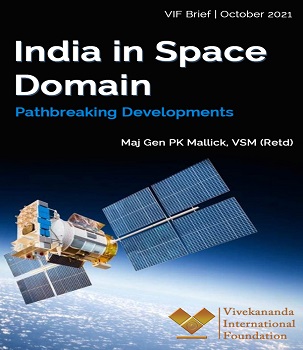
India in Space Domain - Pathbreaking Developments

Maj Gen PK Mallick, VSM (Retd)


Introduction

India is now a major spacefaring nation. Initially, the Indian space programme was focused primarily on societal and developmental utilities. Today, like many other countries, India is compelled to use space for several military requirements like intelligence, surveillance and reconnaissance. Hence, India is looking to space to gain operational and informational advantages.

India has had its fair share of achievements in the space domain. It includes the launch of the country’s heaviest satellite, the GSAT-11 which will boost India’s broadband services by enabling 16 Gbps data links across the country, GSAT-7A, the military communication satellite and the launch of the Geo-synchronous Satellite Launch Vehicle GSLV Mk III-D2, the GSAT 29. The Anti-Satellite (ASAT) test is an intrinsic part of today’s geopolitics and the national security context.

CYBER, COMMUNICATIONS, EW & TECHNOLOGY (C2ET) DIGEST

Maj Gen P K Mallick, VSM (Retd)


Microsoft released its second annual Digital Defense Report, covering July 2020 to June 2021. This year s 134 pages report is quite detailed, with sections on cybercrime, nationstate threats, supply-chain attacks and Internet of Things attacks. The report includes security suggestions for organizations with remote workforces. It has a section describing the use of social media to spread disinformation. The report is a compilation of integrated data and actionable insights from across 


Nepal Begins Hydropower Export to India

Santosh Sharma Poudel

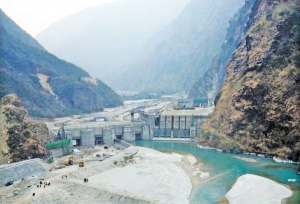
In November 2021, India threw open its doors to purchase of Nepal’s electricity. This is an important milestone for Nepal as it the first time that the Himalayan country is exporting hydropower.

Nepal will export 39 MW of electricity to India under the Indian Energy Exchange (IEX). The India-Nepal Power Trade Agreement was signed in 2014 during Indian Prime Minister Narendra Modi’s visit to Nepal. Nepal is the first of India’s neighbors to participate in the IEX.

The sale of electricity to India marks the realization of a long-cherished Nepali dream of exporting hydroelectricity for national prosperity. This is a huge turnaround for the Nepali energy sector, which met more than half of its electricity needs through imports from India during peak demand in 2019.

Nepal became a power surplus country after the 456 MW Upper Tamakoshi Hydropower Project came into operation in July 2021. With this, Nepal’s hydroelectricity production has reached 1,900 MW. Meanwhile, the peak-hour demand stands at around 1,500MW only. On top of that, 172 projects have secured generation licenses and construction is ongoing for a total capacity of 4,642 MW. Therefore, the supply will outpace the local demand even further in the coming years.

When Indira Gandhi decided to storm the Golden Temple

Deb Mukharji 

Bhairab Datt Pande, known to his generation as B.D., served in the Indian Civil Service from 1939 to 1977. His memoirs, written largely by hand, in 1986, two years after he demitted his last government assignment, carried his instructions that they should not be published before 1st January, 2001 or five years after his death, whichever was later. B.D. Pande died in 2009. His daughter Ratna Sudarshan has painstakingly edited and published the memoirs in 2021.

The reader and present and future generations must be grateful to her for making available within the covers of a book an insider’s perceptive account of economic and political developments in India in her first four decades after independence. By extraordinary happenstance, B.D. was in the midst of the maelstrom of the fraught years of the Emergency and the period leading to the storming of the Golden Temple.

A shy boy who had felt lonely in his early years in school in Almora was taken away for studies to Allahabad by his father who resigned his government job in the postal department to be with his son. B.D. ‘s brief comment later, “his sacrifices for my welfare cannot be put in a few words”, encapsulates the bonds between father and son. After a fine academic record in school and university, B.D. was sent by his father to study in Cambridge to appear for the entrance examination to the Indian Civil Service. In 1939 B.D. Pande signed the covenant inducting him into the ICS and was allotted Bihar as his cadre.

OVER-THE-HORIZON COUNTERTERRORISM: NEW NAME, SAME OLD CHALLENGES

Daniel Brunstetter

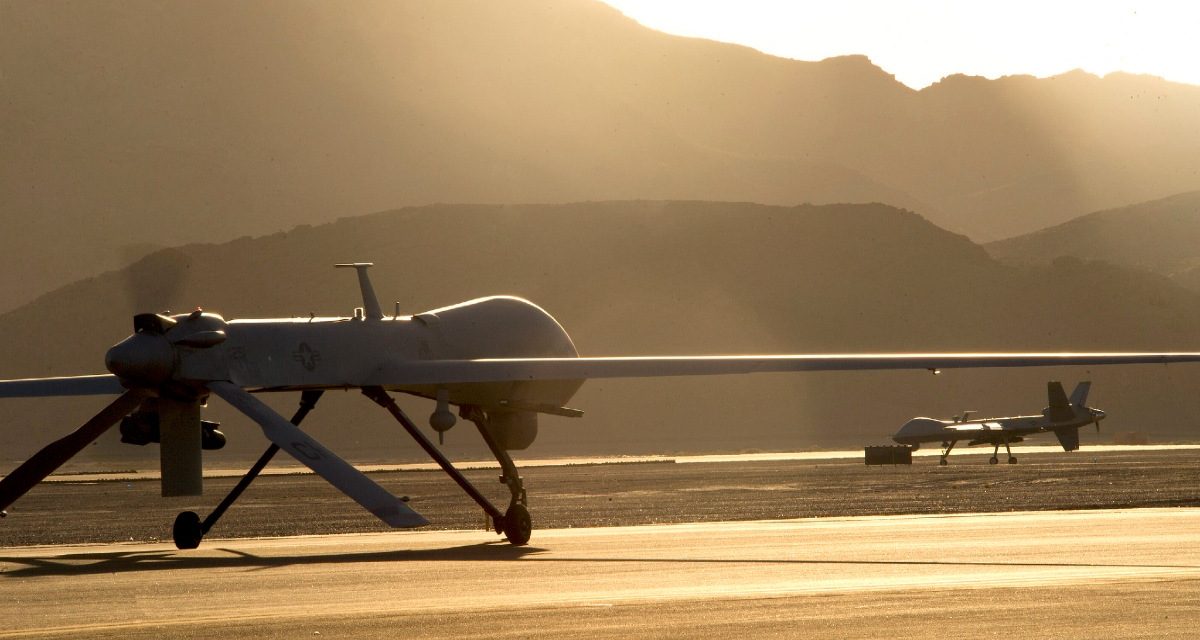
The withdrawal of US troops from Afghanistan offers the opportunity for a recalibration in the use of force abroad in what is America’s truly longest war—the global war on terror. The Biden administration is poised to increase its reliance on “over-the-horizon” operations—a euphuism for drone strikes and special operations force raids—to ensure that Afghanistan does not, once again, become a safe haven for transnational terrorism. In a speech marking the end of the war in Afghanistan, President Joseph Biden portrayed limited force as a moral alternative to the forever wars, a strategic choice to address terrorist threats in a disordered and divided world. But this framing forecloses serious debate on whether the United States should be resorting to force at all and to what ends. If we are to truly turn the page on the 9/11 era, it is imperative to interrogate the antecedents, assumptions, and principles underlying the over-the-horizon approach. Doing so raises concerns about whether a shift to limited force can really end the forever war, but also points to moral insights that may better guide the “targeted, precise strategy” President Biden has promised.

Evidence mounts of Afghanistan withdrawal’s massive failure

Doug Grindle

An Afghan money changer counts money at Khorasan market in Herat, Afghanistan, Wednesday, Dec. 15, 2021. The value of Afghanistan's currency is tumbling, exacerbating an already severe economic crisis and deepening poverty in a country where more than half the population already doesn't have enough to eat. (AP Photo/Mstyslav Chernov)

Four months after the withdrawal from Afghanistan, there are no longer any illusions about what a failure the policy has been. The effort to retrieve people was shoddy enough, with people left stranded and unable to access the airport, despite the high number of evacuees. But the strategic failure and damage to America is even worse.

The undersecretary of Defense for Policy, Colin Kahl, told U.S. senators in October that terrorists could have the capability to attack the U.S. homeland from Afghanistan within six months, and perhaps sooner. He was referring to the Afghan branch of the Islamic State. He also said al-Qaeda could attack from Afghanistan within “a year or two.” The chairman of the Joint Chiefs of Staff, Mark Milley, estimated the same thing happening in two to three years. Let’s recall that al-Qaeda, a close ally of the Taliban, is present in over half the provinces of Afghanistan, according to the U.N.

5 Desperate Days: Escaping Kabul

Mujib Mashal and Thomas Gibbons-Neff

KABUL, Afghanistan — This was as far as they would go, a dozen Marines inside the gutted Kabul airport, fanned out beside a blue gate by a fountain bearing a landmark sign — “I ❤️ Kabul.’’

One of us, Thomas “T.M.” Gibbons-Neff, a correspondent from the Kabul bureau of The New York Times, had moved with the troops to the gate in the hours before dawn. The other, Mujib Mashal, a Times correspondent who grew up in Kabul, carefully approached T.M. in the darkness. The Marines would not move toward him onto de facto Taliban turf.

“We cannot go any further, Mujib. We cannot,” T.M., a former Marine who had served two tours in Afghanistan, said into his phone.

Moments later, the Americans saw Mujib step into the eerie half-light under a flickering street lamp, along with his escort: three Taliban fighters who clutched their rifles nervously.

Behind them, in the murky distance beyond, was a group of more than 120 people: current and former Times employees and their family members.

Taiwan would be better off alone

Derek Grossman

And then there were 14. That was the new tally of Taiwan's official diplomatic partners following Nicaragua's decision earlier this month to swap ties with Taipei for Beijing. The Solomon Islands and Kiribati did the same in 2019. But a curious fact has been overshadowed in the coverage of Taiwan's losses: Taipei has at times preemptively severed ties with partners "to uphold national dignity."

These are smart decisions. Beijing's successful poaching of Taiwan's allies is harming the island's morale and tarnishing its image as a sovereign nation. As counterintuitive as it may seem, Taiwan should further consider unilaterally shedding all remaining partners to strengthen its hand long-term against China.

The uncomfortable truth about Taiwan's remaining allies except for the Vatican, its only partner left in Europe, is that they are with small and impoverished nations like Palau or St. Lucia that are of little geostrategic value. And while Taiwanese President Tsai Ing-wen has disavowed dollar diplomacy, that is exactly what continues to happen when Taipei competes with Beijing to keep countries in its camp.

The Middle East is stuck in the crosshairs of a worsening US-China rivalry

Tamara Qiblawi

(CNN)In a year that has brought profound change to much of the world, the conflict-ravaged Middle East appeared to be finally turning a page. A diplomatic spree that sought to patch up long rifts bore fruit. Iraq transformed from the region's epicenter of violence to one of progress, for example, brokering rare talks between old rivals Saudi Arabia and Iran.

Emerging from the crushing blows of the pandemic and four years of global turbulence during the presidency of Donald Trump, many of the Middle East's nations have shown signs that this level of conflict simply cannot go on.

But as the year grinds to an end, and as a whirlwind of diplomacy picks up speed, another geopolitical fault-line has appeared -- the Middle East has become a political and economic battleground for the US and China, despite its continuous attempts to keep out of this powerhouse rivalry.

In comments that show just how anxious this is making the Middle East's leaders, a high-level Emirati official earlier this month expressed a sense of hopelessness over the showdown between the US and China.

"What we are worried about is this fine line between acute competition, and a new Cold War," Anwar Gargash, diplomatic adviser to the UAE leadership, said in remarks to the Arab Gulf States Institute in Washington last week.

"Because I think we, as a small state, will be affected negatively by this, but will not have the ability in any way to affect this competition, even positively really."

Gargash confirmed reports that the UAE -- a key regional US ally -- had shuttered a Chinese facility over US allegations that the site was being used as a military base. He made clear that Abu Dhabi was merely paying lip service to US intelligence -- the UAE didn't actually agree with Washington's characterization of the site. Abu Dhabi simply did not want to upset a strategic ally.

CNN has reached out to China's foreign ministry for comment.

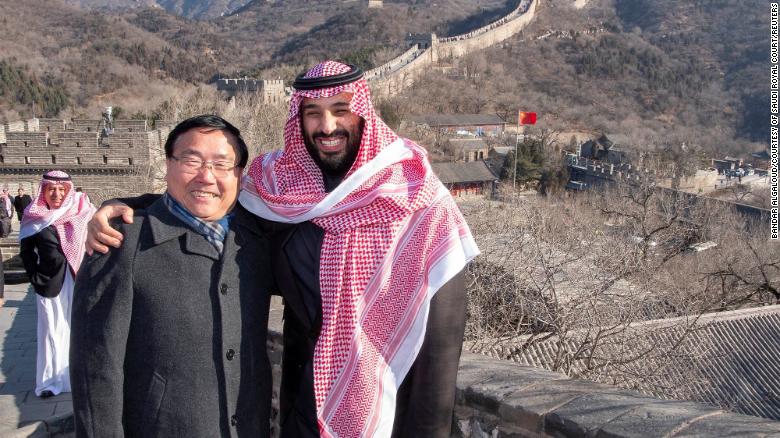
Saudi Arabia's Crown Prince Mohammed bin Salman poses for camera with the Chinese Ambassador to Saudi Arabia Li Huaxin during a visit to Great Wall of China in Beijing, China February 21, 2019.

But the US won't always win the battle for influence in the country. Days after Gargash's remarks, Abu Dhabi apparently decided to stop humoring America. It was suspending a multi-billion dollar purchase of US-made F-35 aircraft, the first deal of its kind with an Arab country. The US had made the sale conditional on the UAE dropping China's Huawei Technologies Co. from its telecommunications network. Washington claimed the technology posed a security risk for its weapons systems, especially for an aircraft the US dubs its "crown jewel."

Abu Dhabi disagrees. An Emirati official said a "cost/benefit analysis" was behind their decision to stick with Huawei at the expense of the F-35s. And while US officials have tried to downplay the significance of the event and insists that the sale has not been killed, Abu Dhabi had set a new tone Abu Dhabi does not intend to always bow to US demands over China, and it is dismissing Washington's notions about Chinese trade deals disguised as covert military activity.

It's an event could set the stage, not just for the Gulf powerhouse, but for an entire region where China's rapidly growing trade relationships transcend old geopolitical rivalries, and where the US' long-running hegemony could be coming to an end.

'A theater of competition'

The Middle East has been rocked by geopolitical tensions arguably since Western colonial powers carved the resource-rich region into spheres of influence over a century ago.

But the region had rarely seen violence on the scale of the 2010s, when simultaneous wars in four different countries -- Syria, Yemen, Libya and Iraq -- as well as long-running violence in Israel and the occupied Palestinian territories, turned vast swathes of the Arab world into a bloodbath.

It was a period that coincided with a momentous political shift -- the US was deprioritizing the Middle East as it became laser-focused on China. The subsequent chaos was unprecedented and appeared to anticipate a major power vacuum in Washington's wake.

The flurry of regional diplomacy that came after -- rushed and sometimes haphazard -- also appeared to be hinged on a perceived US departure from the region. Throughout it all, China, once ideologically reviled by powerhouses like Saudi Arabia, was working in the Middle East's shadows.

Beijing forged wide-ranging economic partnerships with the likes of Riyadh and Tehran. It deepened its foothold in economies that were already strong trading partners, such as the UAE, where it is on its way to becoming the fulcrum of its telecommunication networks.

Used to being targeted with accusations of human rights violations, Beijing promised to stay quiet on those in the Middle East, and to keep out of its conflicts. It has made the Middle East a key part of its Belt and Road Initiative, a massive infrastructural project that connects East Asia to Europe (Egypt's Suez Canal is the project's only maritime connection). And most of all, it presented an opportunity to hedge the region's bets in the event of an American exit.

"You've got this scenario where this preponderant extra-regional power looks like it's leaving and then you have China, a top trading partner," said Jonathan Fulton, senior non-resident fellow at The Atlantic Council. "The region looks like a theater of competition. This looks like the way it's going to play out."

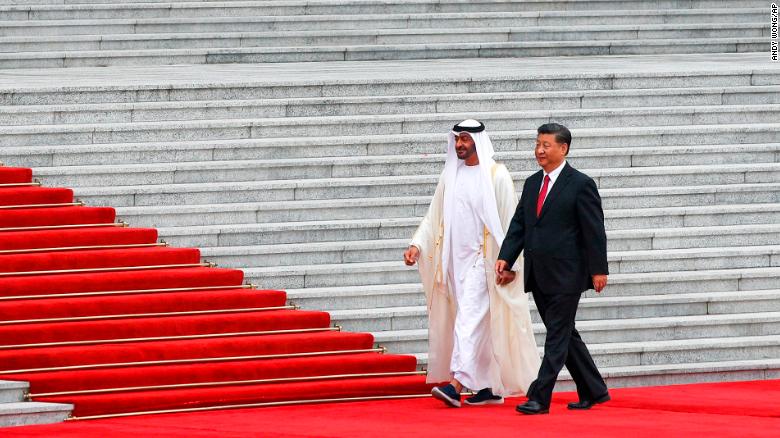
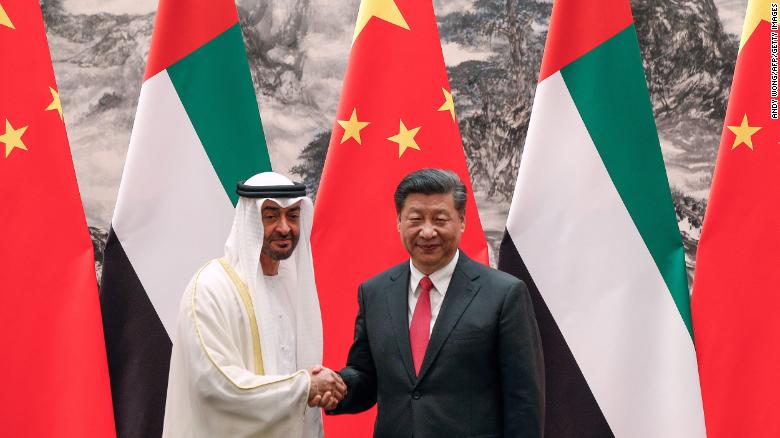
Abu Dhabi's Crown Prince Mohammed bin Zayed shakes hands with Chinese President Xi Jinping after witnessed a signing ceremony at the Great Hall of the People in Beijing on July 22, 2019.

Analysts argue that if Washington forces the region to choose between the US and China, the answer will be a no-brainer -- the US' friends in the region are loath to draw the ire of the superpower, especially while its military presence in the Middle East remains expansive. But ultimately, the region may have no choice but to take the Chinese carrot even if it means subjecting itself to the American stick.

The region's gravitation towards China, argues Fulton, is "the law of nature. That's how it's going probably going to be for the next century."

US needs 'real cash on the table'

The main weakness in the US' proposition regarding China in the Middle East is that Washington offers no alternatives to Beijing's lucrative deals.

The US can try to coerce the UAE, for example, to withdraw from its Huawei deal, but it is unwilling to give them a competitive second option. At the start of Lebanon's financial tailspin in 2020, the US pressured Beirut to resist turning to Beijing for investments in Lebanon's decaying infrastructure, with US Ambassador Dorothy Shea issuing televised warnings about the dangers of Chinese "debt traps." The government of former Prime Minster Hassan Diab bowed to pressure, while the US largely spurned his government, which it believed to be backed by Hezbollah, and Western cooperation with the flailing economy has been little to none.

"US pressure has intensified in recent years, and especially since the start of the Belt and Road Initiative in 2013," said Tin Hinane El Kadi, an associate fellow at the think tank Chatham House. "However, in international politics, you can only pressure countries when you have substantive power and the means to really offer another deal."

He added: "If the US really wants to pressure countries and win this so-called new cold war, it would have to move away from discursive play, and really start to put real projects, and some real cash on the table,"

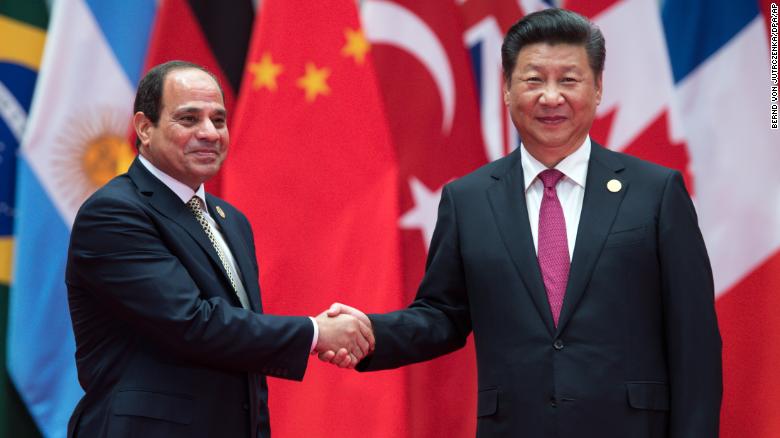
Egyptian President Abdel Fattah al-Sisi being welcomed by Chinese President Xi Jinping at the G20 summit in Hangzhou, China, 4 September 2016.

Nor can the US claim the moral high-ground on human rights issues or on the espionage it accuses Chinese companies such as Huawei of conducting. Recent scandals around Facebook, for example, weakens that position, argued Fulton.

"We've been watching what Facebook does ... and after (whistleblower Edward) Snowden ... it's hard for them to say you can trust us because we're reliable," said Fulton. "If we do it for liberal reasons and they do it for authoritarian reasons, it's not really a case to make here."

In the absence of a Western competitive alternative to Chinese cooperation, the writing appears to be on the wall. China's roots in the region will only become deeper and are only set to rapidly expand. Countries that have been embroiled in largely wasteful conflicts will choose options that serve their economic interests. And as Abu Dhabi's anxieties about being caught in the middle of rising tensions between larger powers has illustrated, the appetite for conflict is quickly dissipating.

"Even though the US right now, with very little leverage, is forcing countries to choose between the US and China, the fact that countries have more options, more loans that they can take from a variety of choices is a good thing," Kadi said.

"Having more alternatives in the global scene can only be a good thing for the region and its stability."

Behind Beijng’s proposal to regulate military applications of AI

MEGHA PARDHI

China recently submitted a position paper on regulating the military applications of artificial intelligence to the sixth review conference of the United Nations Convention on Certain Conventional Weapons (CCW).

The takeaway from this position paper is that countries should debate, discuss, and perhaps eschew the weaponization of AI. By initiating a discussion on regulating military applications of AI, Beijing wants to project itself as a responsible international player.

This proposal is Beijing’s formal acknowledgment of AI as a technology capable of transforming the international security paradigm. Many countries, including the US and China, are trying to leverage the advantages of AI in military applications. According to some reports, China might even be ahead of the US in integrating AI applications for military purposes.

China in 2022: Xi’s Time is Only Beginning, But Where Will it Lead?

John S. Van Oudenaren

The Chinese Communist Party’s (CCP) official narrative holds that China is at a decisive moment. In the CCP’s telling, China’s long-sought goal of “national rejuvenation” is within reach, and can be attained by rallying around General Secretary Xi Jinping’s leadership to fully implement “Xi Jinping Thought on Socialism with Chinese Characteristics for a New Era” (6th Plenum Communique, November 11). Not since Mao Zedong has a leader dominated China’s political life to the extent that Xi currently does. For example, when the CCP’s paper of record- The People’s Daily includes photos above the fold on its front page, they are invariably of Xi giving remarks, meeting with other senior officials or holding video-conferences with foreign counterparts (People’s Daily, December 15, 16). If Xi is not pictured, excerpts of his statements usually headline page one. This summer, seven new research centers devoted to the study of Xi Jinping Thought were established in key state bodies including the National Development and Reform Commission, the Ministry of Ecology and Environment, and provincial governments (Xinhua, June 26). These new centers joined the eleven Xi Jinping Thought research centers that had already been inaugurated.

GETTING COMPETITION WRONG: THE US MILITARY’S LOOMING FAILURE

Arnel P. David, Sean A. Acosta and Nicholas Krohley

A new great game is underway. The United States’ unipolar moment is coming to a close. As a hegemon on borrowed time, we must compete to secure our interests. China offers an alternative vision of the future. Russia seeks a return to faded glories. Iran envisions a fundamentally different Middle East. Regional powers like Turkey, India, and Brazil chart their own, independent paths into the future.

Confronted with global uncertainty, America faces two critical challenges: how to understand this new environment, and how to optimize its military to compete therein. On both counts, consensus has been reached. On both counts, it is wrong.

Conceptually, we have adopted the paradigm of strategic competition. In this framing, the world is a playing field for elite rivalry. Africa is where we compete with China. Eastern Europe is where we counter Russia. The Middle East is where we battle to maintain a marginally favorable status quo, in the face of a hostile Iran and opportunistic encroachment by Russia and China alike. Southeast Asia (and, remarkably, Latin America) are places where we attempt to check Chinese expansion.

What History Tells Us About the Future of Cyber Vulnerabilities in the Power Industry

Dennis Hackney

The power and energy sector is one of the most critical areas of our country’s infrastructure, making it a prime target for cybercriminals increasingly looking for ways to infiltrate and disrupt the sector and ultimately the national grid. In fact, the U.S. Government Accountability Office (GAO) released a report in early 2021 that found the grid, and subsequently its distribution systems that carry electricity from transmission systems to end-users, to be growing targets for large-scale, strategic state-sponsored cyber war operations.

This heightened interest and motivation can be attributed to hackers looking for larger ransomware payouts as well as nation states who consider the sector key to crippling the U.S. economy. High-profile attacks like the Colonial Pipeline have given threat actors more motivation to go after critical infrastructure. These groups continue to mature and adopt sophisticated tactics, techniques, and procedures, while industry leaders look to safeguard their critical systems and essential services.

If recent history is any indication of what we can expect in 2022 and beyond, the power and energy sector must prepare for the worst and prioritize their industrial cybersecurity programs accordingly.

A History of Known Vulnerabilities & Attacks

More than a decade before the GAO’s report, a number of other U.S. agencies came forward to recognize vulnerabilities and threats facing the power and energy sector. The CIA revealed in 2008 that hackers were able to disrupt power supplies in four different cities, stating it typically didn’t make this information public but decided the benefits of sharing outweighed the risk so power equipment operators could protect their systems from the known threat. Shortly after, in 2009, the Dept. of Homeland Security (DHS) disclosed it had known about vulnerabilities in power grid computer systems for years.

These admissions spurred the North American Electric Reliability Corp (NERC) to begin implementing updated cybersecurity measures. NERC sought to increase a company’s accountability, including cybersecurity risk management practices such as asset management, training, perimeter and physical security, and incident response and recovery. It did this by requiring a designated manager with overall responsibility and annual reviews of risk-based assessments. Known as Version 2 of the Critical Infrastructure Protection (CIP) Reliability Standards, the updated measures removed terminology like “acceptance of risk” and “reasonable business judgement” resulting in more stringent control implementation requirements.

Despite the government’s efforts to warn organizations and NERC’s work to help ensure the security of the nation’s power system, the sector began to see a flurry of activity in the years following:

In 2012, US Industrial Control Systems Cyber Emergency Response Team (ICS-CERT) shared that U.S. power plants began to see malware infections through USB drives.

In 2013, DHS reported that the U.S. power grid was constantly being probed by Iranian threat actors.

In 2014, officer members of the Main Intelligence Directorate of the General Staff of the Armed Forces of the Russian Federation, known as GRU, hacked the Georgia utility company, Westinghouse Electric Co. LLC, and stole user credentials and passwords related to nuclear reactor systems.

In 2014, the Dept. of Energy (DOE) revealed that more than 1,100 cyberattacks against its components occurred, 159 of which were successful cyber intrusions between 2010-2014 exposing critical information about the U.S. power systems.

Each of these incidents were examples of classic cyber reconnaissance techniques, also known as Network Information Gathering. And even though NERC was implementing security measures, these cybersecurity reconnaissance efforts were still being pulled off. In these cases, threat actors were looking for ways to circumvent the industry’s cybersecurity practices.

Yet, despite the government alerting the industry, and many years of reconnaissance activities by threat actors to uncover vulnerabilities of the U.S. power grid, a few of the nation’s adversaries launched campaigns against U.S. power companies:

The North Koreans launched a probing campaign, utilizing spear-phishing techniques on U.S. electric companies in 2017 by using fake emails to conduct the early stages of cyber reconnaissance.

An Iranian hacker group targeted the operational technology (OT) environments within power companies in the U.S., Europe, East Asia, and the Middle East in 2017.

A hacker group connected to Russian intelligence services conducted more reconnaissance against OT networks within U.S. and UK electric utility companies in 2017, prompting the DHS to report that they possessed the ability to cause blackouts.

Between known vulnerabilities that have been identified and the flurry of cyber incidents over the course of the last decade, it is clear that a cyber war is well underway, and threat actors are deeply embedded in the electric networks and OT that are responsible for power generation across the nation. This is the new reality.

The Powerful Lessons to Learn from History

Many organizations are already behind in the race to safeguard against an attack. Companies in the power and energy sector must learn from the past and adapt to state-sponsored cyber operations.

For those responsible for protecting critical infrastructure, gaining a better understanding of their OT environment, and accepting the reality that they are exposed a good first step. Well-funded threat actors are spending time and resources to learn how to disrupt power operations to make the biggest impact with a cyber-physical event. These OT environments are found throughout power plants and the grid. Any disruption to these systems could have far-reaching effects such as brownouts, blackouts, and even wide-scale service disruptions, which is why they are such attractive targets for criminals.

In order to adequately secure OT, organizations must handle and secure them differently than they would information technology (IT). OT monitors and controls how physical devices perform, while IT creates, processes, stores, retrieves and sends information. The two typically require the use of different languages and protocols.

What’s even more important to note is that the consequences of exploitation in these areas also differ. IT cyber incidents often have financial ramifications that can be attributed to data loss, business interruption, and reputational damage. OT incidents can have physical impacts such as death or injury, and property or environmental damage – in addition to the financial impacts.

These differences require organizations to engage an industrial cybersecurity expert with experience working in OT in power and energy.

A cybersecurity leader with expertise in industrial cyber security in the power and energy sector will adopt the following best practices:

Conduct a comprehensive audit of all OT systems to determine unique vulnerabilities.

Gain visibility into all OT environments and monitor associated networks and technologies for threats and cybersecurity intrusions.

Implement boundary protection devices and logically isolate OT from other networks.

Ensure that the operating systems, firewalls, and VPN applications are patched and up to date.

Review user accounts and disable or delete dormant or unused accounts.

Implement multi-factor authentication.

Use strong, unique passwords.

Course Correcting in 2022 for Better Protection

They say that those who do not learn from history are doomed to repeat it. For industrial cybersecurity, they might simply be doomed. As industrial systems become more connected, more remotely operated, and more dependent on digitalization, they become much more exposed to cyber attacks. This can have devastating consequences on operations, safety, and the environment. If history has shown us anything, it is that cyber threat actors are quick to adapt. It also shows that companies are often slow to evolve. Recent attacks on critical infrastructure show both the vulnerabilities and impacts of industrial cyber attacks. Failure to put in the basic prevention, detection and response will have increasing consequences for companies, and society as a whole. Not learning from the past, and not preparing for the future risks putting power in the wrong hands.