12 January 2024

Israel defending itself is not ‘escalation’

DANIEL BEN-AMI

Earlier this week, Saleh al-Arouri, the deputy head of Hamas’s political bureau, was assassinated in Beirut, Lebanon by an Israeli air strike. Much of the reaction to the assassination has seemed almost otherworldly.

As you might expect, the attack has been condemned by Hamas and other Islamist groups. A senior Hamas member accused Israel of a ‘cowardly assassination’. Hassan Nasrallah, the leader of Hezbollah in Lebanon, denounced what he called an act of ‘flagrant Israeli aggression’.

Strikingly, some sections of the Western media have been similarly condemnatory of the Israeli strike. Israel has been widely accused of ‘escalating’ the war and needlessly inflaming tensions in the wider Middle East. Reading some of the coverage, you could be forgiven for thinking that Israel is attacking its neighbours out of pure malice.

An article by Trita Parsi in the Nation, a leftist American weekly, claims that ‘Israel wants to expand the war into Lebanon and appears to welcome open warfare against the so-called axis of resistance – Hezbollah in Lebanon, the Houthis in Yemen and the revolutionary government in Iran’. In Britain, Owen Jones, a Guardian columnist who seems to have made it his life mission to paint Israel as the devil incarnate, described Israel as ‘a state which is just drunk on hubris and triumphalism’. He also accused it of ‘opening up multiple fronts in a war’. Both Parsi and Jones are apparently unaware that Israel has already been resisting an onslaught on several fronts for several months now. Yet for these journalists, Israel is the one escalating the war by retaliating.

It is particularly rich for Hamas to complain about Israel’s retaliation. Despite Hamas’s attempts to play down or outright deny the 7 October attack on the Jewish state, which killed 1,200 people, there is no escaping the fact that this brutal pogrom was the trigger for the current conflict. The assassination of al-Arouri is part of an ongoing war that Israel neither started nor wanted.


Israel needs a plan for the day after the war

TOVA HERZL

As October 7 and subsequent events are obviously game changers in Israel’s immediate vicinity and beyond, it is natural that thinking about what happens when the war is over is taking place in many circles. This makes the absence of discussion where it is most vital – the government of Israel – all the more glaring.

Thus, Israeli academics in fields such as the Middle East and the law have set up The Day After the War Forum. Inter alia, they organize seminars on topics such as Iraq after the fall of Saddam and how militaristic Japan became pacifist. Several weeks ago, groups of Israelis who strive to return to Gaza and rebuild the settlements that Israel left unilaterally in 2005 met to discuss how to implement their ideal.

Concern extends to individuals – recently, an American friend whose professional expertise is regional development wrote to share his detailed vision for the “day after.” It included a Marshall-type plan for Gaza, modeled on a divided Berlin after World War II.

However, three months after the outbreak of war, there has not been an official government discussion in Israel about what will happen when the war is over. After debates about the correct forum and assorted delays, a meeting of the political-security cabinet was finally convened last Thursday, but it exploded after several ministers attacked representatives of the IDF who were present at the meeting, including the chief of staff.
Israel would have significant responsibilities in Gaza

The importance of a thorough discussion and of developing a plan – which must obviously be open to change and adapt to circumstances – is self-evident. What happens the day after the war ends? Actions will be needed, and they require money. What has to be done? Who does what? What will it cost? Where will the money come from?

Ethiopia-Somaliland Port Deal And Geopolitics Of Western Indian Ocean – Analysis

Sankalp Gurjar

On January 1, Ethiopia signed a deal with Somaliland for port access. As per the deal, Ethiopia will recognize the self-governing territory of Somaliland in exchange for the sea access and a military base. Ethiopia is the largest land-locked state in the world and a growth engine of the Horn of Africa. The deal will allow Ethiopia to access the Gulf of Aden.

Somalia, which claims Somaliland as part of its territory, has reacted angrily to the announcement of the deal. The agreement is seen as a breach of Somalian sovereignty and territorial integrity, even though Somalia has not been able to exert control over Somaliland since 1991. The deal has a potential to reshape the geopolitics of the Western Indian Ocean.

Strategic Importance of Gulf of Aden

Somaliland is located on the southern coast of the Gulf of Aden. The Gulf of Aden has been a strategically important waterway since the opening of Suez Canal in 1869. The strait of Bab-el-Mandeb links the Gulf of Aden with the Red Sea and offers the shortest route to connect Asia with Europe. Since the emergence of West Asia as an energy heartland of the world, the strategic importance of the Gulf of Aden has increased significantly. The Gulf is critical for the West Asian energy exports to Europe and America. Therefore, over the years, ports located on the Gulf have acquired growing geopolitical significance.

In the recent few weeks, the Gulf of Aden and southern Red Sea have been in the news due to the spate of attacks on cargo ships launched by Houthi rebels in Yemen. These attacks and the decision of major global shipping companies to suspend transit via the Red Sea have underscored the vulnerability of the sea route via the Red Sea-Gulf of Aden. In response to Houthi threats, the US Navy, along with key partners including Britain, have deployed warships to the region. It is in this volatile strategic environment that the deal had been announced between Ethiopia and Somaliland.

Reshaping Geopolitics

The entire Red Sea and Gulf of Aden coastline, from Suez in the north to Somalia in the south has emerged as a geostrategic hotspot over the past few years. Major global and regional players have sought to establish bases in the region. And countries as diverse as the US, Russia, China, Saudi Arabia, Turkey, and the United Arab Emirates (UAE) have systematically expanded their military footprints.

Raghuram G. Rajan Says More…

PS

Raghuram G. Rajan: Monetary policy is a blunt tool, as many have recognized. With an active financial sector, it also becomes a tool with uncertain consequences, since the financial sector can react to extreme monetary-policy settings in unpredictable – and undesirable – ways. For example, a sustained policy of low interest rates engenders risk-taking and leveraging by the financial sector, leaving it exposed to losses when the policy setting changes.

This has happened so many times that no one can claim to be surprised anymore. Yet monetary authorities sometimes act as if someone else – bank management, regulators, supervisors – is responsible for dealing with the spillovers from their policies. A scapegoat is always found, allowing central bankers to avoid accountability. The US Federal Reserve’s Barr Report on the demise of Silicon Valley Bank is a case in point. The report flags the usual suspects, beginning with the bank’s senior management. But there is no hint that Fed policy – for instance, quantitative easing and its subsequent rollback – might have contributed. This wasn’t even included in the terms of reference for the inquiry!

Of course, there also are monetary-policy spillovers across borders, transmitted through capital flows. In moderate doses, the cross-border flow of source-country money is good. But on a sustained basis, it can become problematic.

PS: Central banks’ far-reaching interventions after 2008 “left them poorly positioned for an environment where fiscal spending has ramped up and inflation, not disinflation, is the key problem,” you write inyour book. In fact, when the recent inflationary spike materialized, you observed in 2021, central bankers had become “more likely to make excuses for inflation, assuring the public that it will simply go away.” And yet, in the United States, those who argued that inflation was driven by temporary supply-side factors now claim that recent economic indicators, from prices to employment, have vindicated them. What is this narrative missing, and are the US Federal Reserve’s interest-rate projections for 2024 overly optimistic?

China’s Digital Silk Road (DSR) In Southeast Asia: Progress And Challenges – Analysis

Wang Zheng

This year marks the 10th anniversary of the launch of China’s Belt and Road Initiative (BRI). Proposed by President Xi Jinping in 2013, the BRI has become China’s flagship foreign policy to realise the Chinese vision of a “global community of shared future.”[1] At the third BRI Forum in Beijing in October 2023, President Xi announced that China has signed BRI-related memoranda with over 150 countries and 30 international organisations and established more than 20 multilateral platforms to facilitate the development of the BRI projects worldwide.[2] The BRI’s coverage has also expanded from traditional physical infrastructure to health, clean energy, digital economy, and people-to-people exchanges.[3]

Among the BRI’s new development trends, the Digital Silk Road (DSR) has become a key pillar of the initiative, especially against the backdrop of the intensifying U.S.-China technological rivalry. Given the geographic proximity and close economic ties between China and Southeast Asia, regional states have been major recipients of China’s DSR investments in recent years. However, systematic DSR development analysis in Southeast Asia is still rare. To fill this gap, this report evaluates the DSR’s progress in Southeast Asia between 2017 and 2023 and analyses the major challenges China faces in pushing the DSR forward in the region, with data collected from various sources including Chinese government reports and state media releases, the IISS’s China Connects dataset, the Submarine Cable Almanac, and the websites of Huawei and ZTE.

THE DSR: WHAT’S IN A NAME?

The DSR, initially launched as the digital aspect of the BRI in 2015, was officiated by President Xi at the BRI Forum in 2017.[4] Later, at the fourth World Internet Conference in 2017, China, Laos, Saudi Arabia, Serbia, Turkey, Thailand, and the United Arab Emirates jointly signed the BRI Digital Economy International Cooperation Initiative, marking a new chapter of the DSR’s development.[5] The DSR was promoted as a stand-alone initiative at the second BRI Forum in 2019 and has since become a critical part of China’s foreign policy agenda.[6] Amid the global COVID-19 pandemic, the DSR’s vital role was further enhanced since it allowed China to transcend the physical barriers of national boundaries and maintain the steady growth of the BRI projects overseas without suffering significant losses of investments.[7] According to the White Paper on the BRI released recently, by the end of 2022, China had inked 17 DSR-specific cooperation agreements and 30 e-commerce memorandums globally and signed the Memorandum of Understanding on Strengthening Investment Cooperation in the Digital Economy with 18 countries and regions.[8]

Understanding China’s Approach to Deterrence

Michael Clarke

The era of great power “strategic competition” has seen deterrence as both a concept and operational objective return to a place of pre-eminence in national defense and strategic policy not seen since the end of the Cold War.

While much attention has been given to the technological advances of China’s military – which the United States military openly terms its “pacing challenge” – relatively less attention has been paid to the concepts and strategies that may animate the People’s Liberation Army (PLA)’s capabilities. The Pentagon’s latest annual assessment, “Military and Security Developments Involving the People’s Republic of China,” for example, noted that General Secretary Xi Jinping’s report to the 20th Party Congress of the Chinese Communist Party (CCP) in October 2022 set a goal for the PLA to “build a strong strategic deterrent system” based on development of both “traditional nuclear deterrent force building” and “the construction of conventional strategic deterrent forces” – but without further examination of how China currently conceives of deterrence.

Given China’s escalation of military exercises in the Taiwan Strait over the past year and the recent step-up in incidents in the South China Sea, it is more important than ever to examine and understand how China conceives of and practices forms of coercion like deterrence. An examination of authoritative and semi-authoritative Chinese sources on PLA strategy and doctrine reveals a number of things: that China conceives of and practices deterrence in a distinct manner that combines dissuasive and compellent forms of coercion; that deterrence is explicitly framed as an instrument for the achievement of politico-military objectives; and that PLA doctrine envisages a sequential application of deterrent and compellent postures across a peacetime-crisis-war spectrum.

Chinese Thinking on Deterrence

Recent Chinese actions in the Taiwan Strait and the South China Sea underline the fact that international politics “takes place in a gray region involving no-peace and no-war wherein the threat of violence – more than its mere application – is the critical variable for an understanding of interstate relations and crises.”

What to know about China’s military purge

Mathias Hammer

Over the past six months, a widening shake-up of China’s defense establishment has raised questions about leader Xi Jinping’s ability to root out corruption in the armed forces and modernize the country’s military. The purge, which has reached as high as the defense minister, ratcheted up at the end of 2023: A dozen senior Chinese defense figures were abruptly removed from their roles.

U.S. intelligence believes Xi’s crackdown came after it became clear that widespread corruption has weakened China’s military readiness, Bloomberg reported. China’s military corruption is reportedly so endemic that missiles have been filled with water instead of fuel and many silos in western China have lids that do not work in a way that would allow missiles to be fired effectively, U.S. intelligence shows, according to Bloomberg.

Hacked in China

Joshua D. Baughman

A foreign government's response to a U.S. strategy document rarely earns front page coverage, but in the case of the Chinese Communist Party's (CCP) recent reaction to the U.S. government's new cyber strategy, we should all be paying attention.

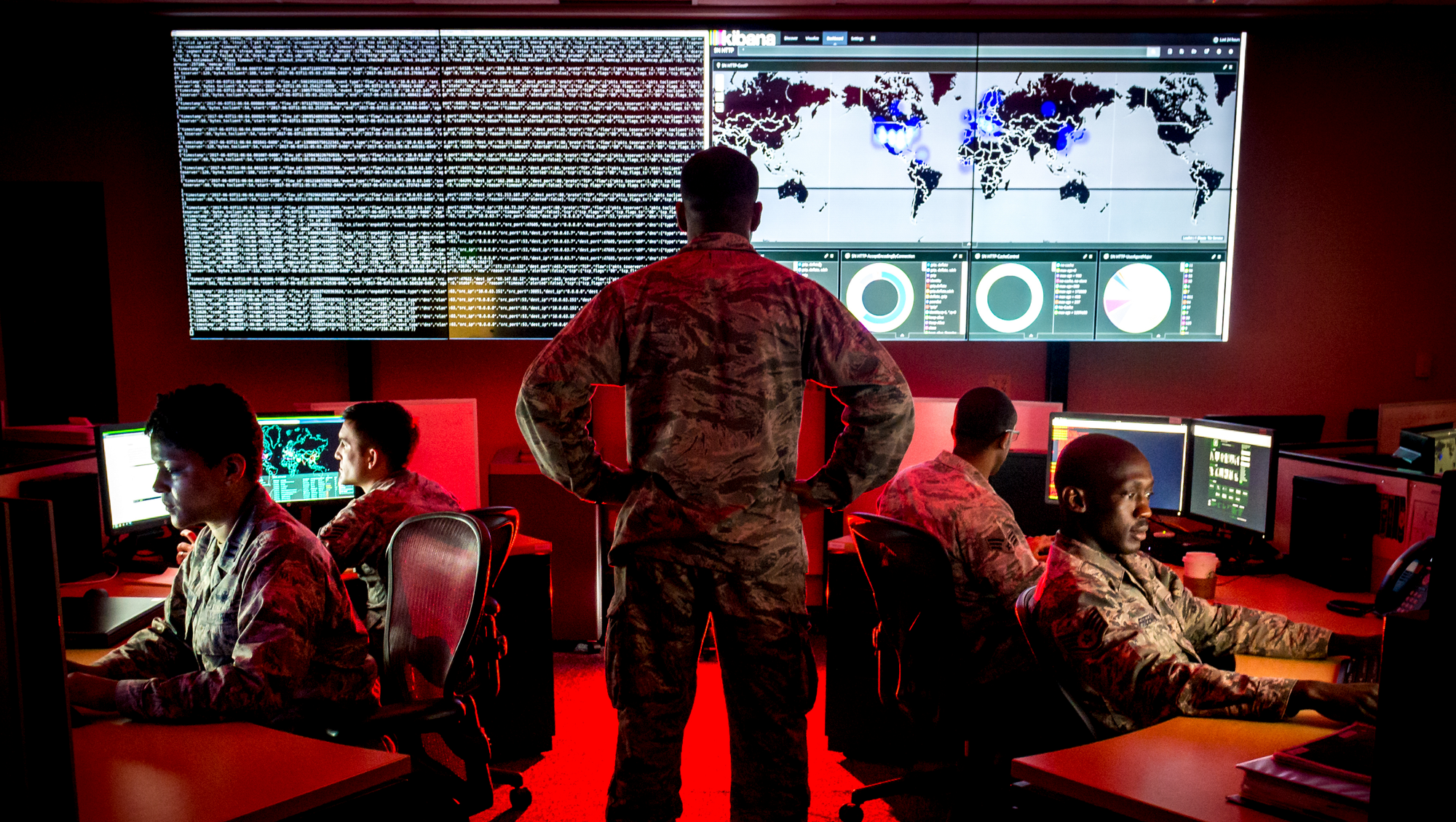
Tensions continue to escalate in the cyber domain, given the recent Chinese-backed intrusions into U.S. government computer systems, which affected dozens of critical infrastructure areas including water and power utilities, oil and gas pipelines, and transportation and communication entities. Brandon Wales, the head of the U.S. Cybersecurity and Infrastructure Security Agency, stated in a recent interview that it's "very clear that Chinese attempts to compromise critical infrastructure are in part to pre-position themselves to be able to disrupt or destroy that critical infrastructure in the event of a conflict." As tensions continue to escalate in the cyber domain, China’s immediate and rigid counter response to the new U.S. cyber strategy gives an illuminating glimpse into the CCP’s strategic mindset and potential for future conflicts.

Shortly after the United States Department of Defense (DoD) released its unclassified 2023 Cyber Strategy Summary, China’s Ministry of National Defense made this official statement:

As we all know, the United States is the largest "Hacker Empire", "Spying Empire" and "Secret Stealing Empire" in the world. It unscrupulously carries out large-scale, systematic and indiscriminate cyber-attacks on other countries, even its own allies. In addition, the United States is also the originator and master of cyber warfare, vigorously developing offensive cyber warfare capabilities, and developing cyber-attack weapons.

This was just the tip of the iceberg that has been China’s response to the new U.S. cyber strategy. Chinese government agencies along with military and civilian media have reacted strongly. There have been high level seminars; even a new policy released to capitalize on young technical talent. The overarching Chinese message has mirrored the wording and structure of the U.S. Cyber Strategy Summary in three key areas: defining the cyber threat; developing a cyber workforce; and preparing for war in the cyber domain. And while it is hardly unusual for China to respond to any perceived negative messaging, the combined response in this instance by the Chinese Communist Party showcases that the DoD policy document has struck at the core interests of the CCP—even hitting a nerve with Xi Jinping himself.

Dire Economic Trend Is a Huge Blow to Xi's China

Micah McCartney

China's economy, once believed to be breathing down the neck of the United States, is losing steam relative to its geopolitical rival.

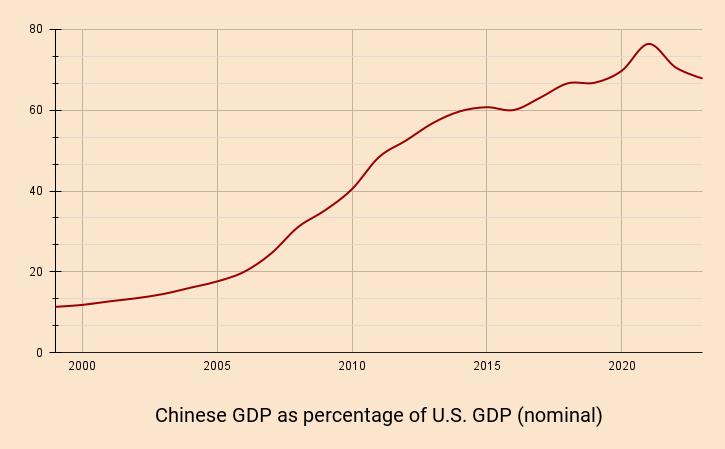
The World Bank now estimates the world's second-largest economy, as represented in Beijing's official reports, was two-thirds the size of Washington's last year, down from 70 percent the previous year and 76 percent in 2021.

The country's recovery from its yearslong anti-virus policies during the COVID-19 pandemic undershot some analysts' expectations, marred by months of rolling lockdowns, a real estate market on the ropes and declining foreign direct investment.

To eventually supplant the U.S. as the No. 1 economic powerhouse, experts said China needed to maintain a minimum annual GDP growth of 5 percent.


This graph shows China's nominal GDP as a percentage of the U.S.'s GDP from 2019 to 2022 and includes the World Bank's estimates for 2023. China's slowing economic growth has moved economists to revisit earlier predictions China would supplant the U.S as the world's largest economy by the end of the decade. 

China, after reporting double-digit growth for the first two decades this century, likely met that 5 percent threshold last year, according to leading financial institutions like the International Monetary Fund. However, it is forecast to register a modest 4.6 percent in 2024.

Syria And US Policy – Analysis

Christopher M. Blanchard

Since 2011, conflict between the government of Syrian President Bashar al Asad and opposition forces seeking his removal has displaced roughly half of the country’s population and killed over half a million people. Five countries operate in or maintain military forces in Syria: Russia, Turkey (Türkiye), Iran, Israel, and the United States.

The United States supports a negotiated political settlement to the Syria conflict in accordance with U.N. Security Council Resolution 2254 and seeks the enduring defeat of the Islamic State (IS, aka ISIS/ISIL). U.S. policymakers work to address threats posed by IS remnants and detainees, counter Al Qaeda, facilitate humanitarian access to Syria, and manage Russian, Turkish, and Iranian challenges to U.S. operations.

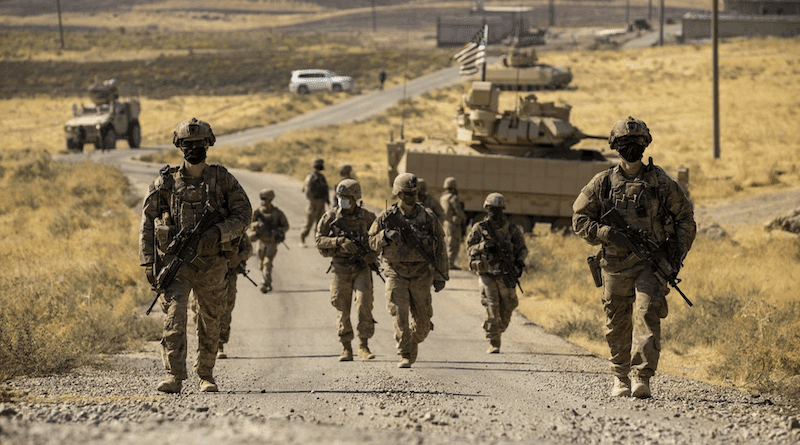
Earthquakes in February 2023 and resurgent Russia-backed government attacks on rebel held areas of northwest Syria have created additional humanitarian needs. Following the October 2023 terrorist attacks in Israel and Israel’s military operations in Gaza, Iran-backed militia have attacked U.S. military personnel in Syria, prompting U.S. response strikes.

Areas of Control

The Asad Government

The Asad government—backed by Russia, Iran, and aligned Syrian and foreign militia forces—controls about two thirds of Syria’s territory, including most major cities. In 2021, President Asad won a fourth seven-year term; U.S. officials described the election as “an insult to democracy.” Some armed resistance to Asad’s rule remains, but the Arab League and some Arab states have normalized relations with the government and engage Asad and his senior officials directly.

Kurdish-Arab Military and Civilian Authorities

After the defeat of the Islamic State by the largely Kurdish U.S.-backed Syrian Democratic Forces (SDF), Kurdish authorities and their Arab partners in northeast Syria established the Autonomous Administration of North and East Syria (AANES), also known as the Self Administration of Northeast Syria (SANES). The SDF and its political wing (the Syrian Democratic Council, SDC) play a leading role in the AANES, whose leaders have stated that it is not aligned with either the Asad government or with opposition forces.

What Drives Great Power Competition in the Sahel?

OLAYINKA AJALA

The Sahel — a region 2,400 miles wide, located south of the Sahara Desert and stretching east-west across the African continent — has been a focus of attention around the world recently.

In the last decade, issues such as terrorism, insecurity, and trafficking have characterized the region.

Military takeovers have been a major source of concern in the region and beyond in the last few years. Since 2020, the region has had four successful coup d’états and three failed ones.

The coup in Niger particularly attracted attention. This is because Niger was seen as a “darling of the West” and a model for democratic governance in the region.

Despite the challenges facing the region, the scramble for the Sahel remains intense.

The main actors in this scramble are the European Union, France, Russia, China, and the United States.

The EU relies on Sahelian countries, especially Niger, to stop mass illegal immigration into the bloc. Niger is a major transit country in the region. Niger had security and defence partnerships with the EU until recently when the country unilaterally cancelled the deals. This is a source of concern to the EU.

Why are these foreign powers interested in the Sahel?

As a scholar in international relations and having researched the region for over a decade, I see the main reasons as follows:
  • availability of natural resources
  • strategic location of the region in Africa
  • economic interests of the countries involved in the scramble
  • defense and security cooperation in the form of arms sales.
Foreign powers all have their reasons to be involved in the scramble for the Sahel.

Hurdles in the Hypersonic Race: The United States’ Failed ARRW Program

Javed Alam

Hypersonic capabilities are becoming a high-priority security imperative for states like China, Russia, and the United States. While China and Russia are now reportedly moving ahead in terms of deploying hypersonic capabilities, the U.S. is facing several difficulties in the same domain.

The U.S. Air Force recently conducted the final test flights of its hypersonic missile program, the AGM-183A Air-launched Rapid Response Weapon (ARRW). The ARRW program was launched in April 2018 and originally planned to achieve initial operational deployment in 2022. However, in November 2023, after conducting two test flights in August and October 2023, the ARRW hypersonic program was officially cancelled.

The Senate Armed Services Committee budget document 2023 clearly stated, “in light of testing failures and statements from Air Force leadership in support of the competitor program, the committee is concerned that continued testing at the scale originally planned in the budget request seems unlikely to deliver persuasive results.”

It is clear that the U.S. hypersonic program is lagging behind those of its primary adversaries due to multiple factors, and the cancellation of the ARRW hypersonic program sheds light on this.

System Description of the ARRW Hypersonic Program

The ARRW was planned as a conventional, air-launched boost-glide hypersonic weapon. The ARRW used a solid-rocket motor booster, similar to a modified version of the MGM-140 Army Tactical Missile System (ATACMS), a ground-launched short-range ballistic missile. The ARRW essentially took help from the Tactical Boost Glide (TAG) program, which is a joint effort of the U.S. Air Force and the Defense Advanced Research Projects Agency.

In Defense of Billionaires

MICHAEL R. STRAIN

“Billionaires should not exist,” argues Vermont Senator Bernie Sanders, who has long described himself as a democratic socialist. Indeed, “every billionaire is a policy failure” is a relatively common slogan among American progressives.

Unsurprisingly, the economic populists and nationalists on the political right find themselves in agreement with the progressive left. A few months ago, Steve Bannon, former US President Donald Trump’s former chief strategist, called for “massive tax increases on billionaires” because too few of them are “MAGA.”

These nationalists and progressives have it backwards: we should want more billionaires, not fewer.

Billionaire innovators create enormous value for society. In a 2004 paper, the Nobel laureate economist William D. Nordhaus found “that only a minuscule fraction” – about 2.2% – “of the social returns from technological advances” accrued to innovators themselves. The rest of the benefits (which is to say, almost all of them) went to consumers.

According to the Bloomberg Billionaires Index, Amazon founder Jeff Bezos is worth $170 billion. Extrapolating from Nordhaus’s findings, one could conclude that Bezos has created over $8 trillion – more than one-third of the United States’ annual GDP – in value for society. For example, Amazon has reduced the price of many consumer goods and freed up an enormous amount of time for millions of Americans by eliminating the need to visit brick-and-mortar retailers. Bezos, meanwhile, has received only a tiny slice of those social benefits.

Of course, not all billionaires are innovators. But the same logic can be applied to billionaires from any professional background. For example, Wall Street titans create value by efficiently allocating capital throughout the economy. Over time, this lowers costs and spurs productivity and innovation, all of which benefit millions of households and businesses.

Military Threats Are Growing, But Military Spending May Not Follow Suit

Loren Thompson

Overseas threats to U.S. security have steadily increased during the Biden presidency. No one expected when Joe Biden was inaugurated that three years in, Washington would be:
  • Aiding Ukraine in resisting a Russian invasion
  • Supporting Israel in defeating Hamas terrorism
  • Absorbing scores of assaults on troops in the Middle East
  • Forming a task force to defeat attacks in the Red Sea
  • Countering Chinese military pressure on Taiwan
  • Responding to North Korean threats of nuclear aggression.
The deteriorating security situation seems to call for increased spending on defense. The nation is currently allocating only 3% of GDP to the military, which isn’t enough given the array of security commitments Washington has taken on around the world.

There are numerous signs that the Pentagon’s budget is inadequate. Arms deliveries to embattled allies are lagging. Recruiting drives are falling short of goals despite loosened standards. Equipment maintenance is not keeping up with needs, while acquisition of new systems is not matching the pace of Chinese weapons production.

However, the outlook for significant increases in defense spending in the years ahead is not promising. The Pentagon may need to rethink its posture and priorities. Four obstacles to further spending increases loom large.

First of all, the military has already received outsized increases in funding over the last several years. When President Trump was inaugurated in 2017, the defense department’s base budget stood at $523 billion. President Biden’s request for the fiscal year beginning October 1 was $842 billion. That’s a 61% increase in nominal terms over seven years.

If the 2017 levels of spending had increased at the same pace as inflation during the intervening years, the base budget request in 2024 would have been for $675 billion rather than $842 billion. The difference is real growth, and that doesn’t even include supplemental funding for contingencies such as Ukraine.

North Korea: the forgotten front in the global wars

DANIEL SNEIDER

Global attention is understandably riveted by the two deadly wars being waged in Ukraine and the Middle East. But an exchange of artillery fire on January 5 in drills held by North and South Korea near a disputed border area served to remind the world that there is a forgotten front in the global wars.

The North Korean regime launched some 200 artillery shells into the waters off its western coast near two South Korean-held islands on the maritime border of the Northern Limit Line, or NLL.

The South Korean military announced plans to conduct its own “naval fire” drills. It is precisely that location that the two Koreans last had a deadly exchange of fire in 2010 and came perilously close to wider conflict.

The artillery exchange marked the end to a tenuous 2018 agreement to withdraw armed forces from the Demilitarized Zone (DMZ), where hundreds of thousands of heavily armed troops, including US forces, face off.

The General Staff of the North Korean People’s Army claimed they were only acting in response to the actions of the South Korean “military gangsters” and warned that “if the enemies commit an act which may be regarded as a provocation under the pretext of so-called counteraction, the KPA will show tough counteraction on an unprecedented level.”

All this comes within a week of a gathering of the North Korean communist party where leader Kim Jong Un declared in unprecedented fashion that they were abandoning the goal of reunification and now would treat the South as an enemy state under the control of the United States.

In his speech to the meeting, Kim called on the People’s Army to be prepared to carry out a “great event” in the South where they would “subjugate the entire territory of South Korea by mobilizing all physical means and forces, including nuclear forces.”

Exhausted, on the Defensive and at ‘Hell’s Gate’ in Ukraine

Carlotta Gall and Vladyslav Golovin

Under the cover of darkness, leaning forward under the weight of packs and rifles, a squad of soldiers walked along a muddy lane and slipped into a village house.

They were Ukrainian infantrymen of the 117th Separate Mechanized Brigade, assembling for a last briefing and roll call several miles from Russia positions before heading to the trenches on the front line. Stolid men in helmets and rubber boots, they listened in silence as an intelligence officer briefed them on a new route in to their positions.

“Morale is all right,” said the deputy battalion commander, who uses the call sign Shira, standing nearby to see the men off. “But physically we are exhausted.”

Ukraine's Defence Intelligence obtains 100 gigabytes of data on Russian drone and electronic warfare manufacturer

YEVHEN KIZILOV

Defence Intelligence of Ukraine (DIU) has obtained 100 gigabytes of classified data from Special Technology Centre (STC) LLC, a critically important company within Russia's military-industrial complex.

Details: According to Defence Intelligence, the Russian company has been sanctioned since 2016. Its facilities produce, among other things, Orlan UAVs of various modifications, a range of electronic warfare and reconnaissance equipment, and other military products.

Quote: "The array of information transferred to DIU contains documentation for 194 items: blueprints, specifications, patents, software, etc., for both existing and prospective military developments."

Details: According to preliminary estimates by Defence Intelligence, the data obtained could be worth US$1.5 billion.

Quote: "This is a significant blow to terrorist Moscow: the archive is already being used to strengthen Ukraine's defence capabilities and weaken the aggressor state."

Details: The intelligence service reported that the classified information was obtained through effective cooperation with "patriotic representatives of civil society and the media community".

Democrats Can’t Admit The Border Crisis Is Spiraling Out Of Control

JOHN DANIEL DAVIDSON

There’s been a lot of nonsense about the southern border going around lately from the usual suspects, starting with the Biden administration’s smug Homeland Security secretary, Alejandro Mayorkas. In two separate interviews last week, Mayorkas blamed the record number of illegal immigrants crossing into the country on climate change and later refused to call the situation a crisis, retreating to his favorite euphemism for the debacle at the border: “It’s a challenge,” he said.

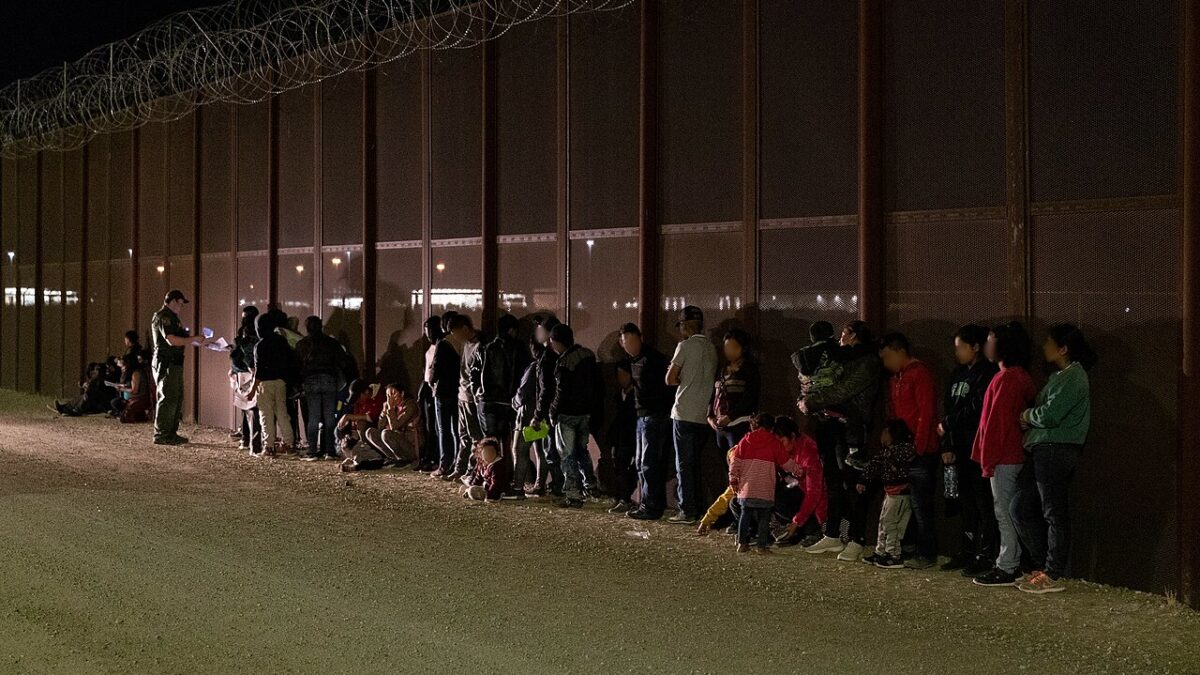
It sure is, not least because in December more than 300,000 illegal immigrants were arrested at the border, the largest monthly total ever recorded. The numbers being what they are, it’s getting difficult to characterize what’s happened to our border under Biden. One way to put it is to note that at the current rate, we can expect 12 million arrests at the border in the first term of the Biden presidency, which is more than the preceding three terms combined. Most of those migrants have been released into the United States.

Or think of the problem from a different angle. Only 142,580 illegal immigrants were deported in all of 2023, which is less than half the number that illegally crossed the border in December alone. Those who were released into the country joined the more than 3 million-case backlog in our immigration courts, where it can take years for an asylum case to get an initial hearing.

So yes, it’s a “challenge,” as Mayorkas says, but probably not as much of a challenge as maintaining the cognitive dissonance required to keep going on national television to spout this gibberish. Yet Mayorkas keeps pulling it off somehow, so credit where credit is due. His approach seems a lot more difficult than just coming out and admitting openly what Democrats really want with all this border chaos: to turn millions of illegal immigrants into Democrat voters. To “fix” the border problem, said Rep. Alexandria Ocasio-Cortez in a recent interview, we simply have to “document the undocumented people.” In case it isn’t bone-crushingly obvious, that’s leftist doublespeak for mass amnesty.

Both Mayorkas and AOC at least have the excuse of being partisan ideologues. One wonders, however, what possible excuse a person like Marc Thiessen could have for trotting out one of the most embarrassingly naïve arguments tacitly endorsing illegal immigration ever to appear in corporate media.

Trump could be good for Europe

RICHARD VINEN

Europe should not be insouciant about the prospect of a second Trump term. As many have pointed out, he would be more radical than the first time round. Everything that has happened since 2020 will have confirmed Trump’s instinct that disregarding constitutional convention is a good strategy, while his victory would also probably mean the end of US support for Ukraine — and possibly the end of Nato. It would certainly mean a period of slash-and-burn economics that would, among other things, undermine any attempt to stop climate change.

There might, though, be some ways in which a Trump comeback would be salutary for Europe — and, especially, for the United Kingdom.

Our relationship with the United States has, in the last few decades, become an unhealthy one. We are like adult children who live with their parents, sulking and complaining but assuming that someone else will do the laundry. If Trump wins it will feel as if Dad has had a sex change and Mum has shacked up with a member of the Hell’s Angels. Perhaps we will finally decide it is time to get a flat of our own.

After all, it is high time to remind ourselves that American hegemony is a recent phenomenon. The United States has been the richest country in the world since the late 19th century, but at first its wealth had little effect on the politics and society of Europe, except in so far as the daughters of American tycoons brought generous dowries and a healthy dose of red blood into a few declining ducal families. The United States fought briefly in the First World War but retreated into isolationism afterwards. And though the Second World War turned American into a global power, it was not obvious even in 1945 that this new role would be sustained. At first, American military commitments were wound down and there were those — especially the southern Dixiecrats — who would have liked to withdraw from world affairs again. What prevented it was the Cold War.

This period, in which America’s special relation with Western Europe was established, was a peculiar one. First, the United States had a significant economic advantage. It had boomed during the war while many European countries had been destroyed: these are the conditions that gave us the Marshall Plan. Second, the United States faced an exceptional political threat. The Soviet Union was not just another great power; it was a state with ambitions to exercise influence in every corner of the globe, and one that attracted idealistic loyalty from people around the world (even if its own leaders were cynical). And so, Nato was born.

2024 could be the year the European consensus is finally shattered by a continent-wide populist surge

Henry Olsen

The confidence of European elites was shaken in 2023 as national populist parties surged in popularity across the continent. Their dismay may soon deepen into despair, as 2024 is shaping up to be the year European populism goes mainstream.

2023 was not a good year for the Brussels consensus despite favoured parties narrowly prevailing in the Polish and Spanish elections. Openly anti-Ukrainian leader Robert Fico’s SMER-SD party won handily in Slovakia’s vote, and the immigration restrictionist Finns Party entered government as part of the new center-Right coalition. Pro-consensus leaders won in Greece, Bulgaria, and Estonia, but populist parties either held their ground or gained strength in all three nations. No nation enthusiastically backed the Brussels status quo.

That consensus’ decisive rejection in the Dutch election was perhaps the strongest evidence yet that European voters are getting fed up. EU Green New Deal chief Frans Timmermans’ return to his home country to lead a newly united alliance of the GreenLeft and Labor Party (GL/PvDA) was hailed as a political masterstroke. New Party of Freedom Democracy (VVD) leader Dilan Yesilgoz’s campaign was considered to be a successful limited break with longtime VVD Prime Minister Mark Rutte’s cagey, centrist approach. Right up the eve of the vote smart money was on a VVD-GL/PvDA-dominated coalition with the only question being which of the two leaders would take the helm.

Instead, Geert Wilders’ strong victory showed that enough was enough. His Freedom Party (PVV)’s 37 seat haul massively exceeded any prior projections, but even this understated the Netherlands’ political earthquake. The Farmer-Citizens Movement (BBB) and Pieter Omtzigt’s creation, New Social Contract, took an additional 27 seats as VVD support collapsed by over a third. The four governing parties lost a combined 37 of their 78 seats. It was one of the largest rejections of a government in Dutch history.

Polls so far suggest populist and nationalist strength is continuing to surge across the European Union. Seats projections for the upcoming elections to the European Parliament show the ECR and ID factions winning between 172 and 184 seats, a record high. Add in unaligned nationalist populist parties such as Fidesz and Reconquete and the estimated total rises above 200. That’s not enough to displace the consensus coalition, but it does place additional pressure on the EPP to continue to shift rightward.

America in 2024: Still First Among Equals?

Leon Hadar

Mirror, mirror on the wall, who is the greatest superpower of all? That is the question being asked once again by foreign policy pundits in Washington, as elsewhere—bearing in mind, as America and the world enter into 2024, that changes in the global balance of power do not develop linearly and tend to run contrary to earlier predictions. The new year found the United States engaged diplomatically and militarily on three global fronts: responding to Russian aggression in Ukraine by strengthening the Western alliance; containing the Chinese geo-strategic and geo-economic surge and, in particular, its threat to Taiwan’s independence; dealing with the threat posed by Iran—and its regional proxies—to America’s allies in the Middle East, amid the backdrop of the Israel-Hamas War.

One way of assessing the American responses to these challenges is to see them as part of an effort by an embattled global hegemon to maintain the international order it had established, together with its allies, in the aftermath of World War II. It was within this order that America gained a dominant position in the “unipolar moment” following the collapse of the Berlin Wall, the disintegration of the Soviet Union, and the ushering in of the era of globalization.

This international order seems, so far, to have withstood the test of strategic and diplomatic challenges that ensued following the costly U.S. military fiascos in the Greater Middle East. True, the Americans failed to remake the Middle East through regime changes and nation-building. This, in turn, led to the humiliating withdrawals from Iraq and Afghanistan, which raised doubts about the ability of the U.S. to maintain its global leadership position. And yet other aspects of recent events proved that America can still shape the global agenda.

Thus, while the 2008 financial crisis and the ensuing fears of the return of the Great Recession did seem to pose a threat to U.S. global economic supremacy when China was pumping its economic muscles, it actually served as a stress test for the ongoing U.S.-led economic globalization and trade liberalization.

Global economy headed for worst half-decade in 30 years, World Bank warns

David J. Lynch

The global economy will slow in 2024 for the third straight year and appears headed for its weakest half-decade since the early 1990s, the World Bank said Tuesday in its latest annual forecast.

While higher interest rates appear to be bringing inflation under control without the serious financial crisis or soaring unemployment that many had feared, the global economy’s overall performance is lagging, said Indermit Gill, the bank’s top economist.

After rebounding sharply in 2021 from the depths of the pandemic, the global economy grew by 3 percent in 2022, dipped to a 2.6 percent rate last year and is expected to post a tepid 2.4 percent this year, the bank said in its annual Global Economic Prospects report. Those rates lag the 3.1 percent average for the decade of the 2010s.

The continuing slowdown all but guarantees that world leaders will fail to meet the 2030 development goals that 193 members of the United Nations, including the United States, agreed to in 2015. Governments pledged to transform the global economy by the end of this decade by setting 17 ambitious aims, including eliminating extreme poverty, cutting greenhouse gas emissions nearly in half, boosting education for the poor and eradicating hunger.

The measures were not legally binding. But resulting from three years of negotiations, and introduced at the United Nations with an address from Pope Francis, they were seen as packing a moral punch.

11 January 2024

After 3 months of devastation in Gaza, is anyone ‘winning’?

IAN PARMETER

The 19th-century German war strategist and field marshal Helmuth von Moltke famously coined the aphorism “No battle plan survives first contact with the enemy.” His observation might well be applied to the tragedy in Gaza.

Three months after the current conflict began, civilians have borne the brunt of the violence on both sides, with the deaths of more than 22,000 Palestinians in Gaza and 1,200 Israelis. Some 85% of Gazans have also been displaced and a quarter of the population is facing a famine, according to the United Nations.

The conflict still has a long way to run and may be headed toward stalemate. From a geopolitical perspective, here’s where the main players stand at the start of the new year.
Israel: limited success …

Israel has so far failed to achieve either of its primary war aims: the destruction of Hamas and freedom for the remainder of the 240 Israelis taken hostage on October 7.

Hamas fighters continue to use their tunnel network to ambush Israeli soldiers and are firing rockets at Israel, albeit in much lower volumes: 27 were fired at the start of the new year, compared with 3,000 in the first hours of the conflict on October 7.

There are still around 130 Israelis being held hostage, and only one hostage has been freed by the Israel Defense Forces (IDF), as opposed to releases arranged through Qatari and Egyptian mediators. Israeli society is divided between those who want to prioritize negotiations to release the hostages and those who want to prioritize the elimination of Hamas.

Israel achieved an important symbolic success with the apparent targeted killing of Hamas deputy leader Saleh al-Arouri in Beirut on January 2. Though Israel has not formally claimed responsibility, there is little doubt it was behind the killing.

Could the Israel-Gaza war spark a wider conflict involving the US, Iran or others?

Rajan Menon and Daniel R DePetris

Soon after Hamas’s 7 October attack and Israel’s retaliatory bombing campaign in Gaza, pundits began debating the odds of escalation. For its part, the Biden administration has tried to prevent the fighting between Hamas and the Israel Defense Forces (IDF) from spreading to other areas of the Middle East, if only to spare the roughly 45,000 US troops based there from another ill-fated war.

“Escalation” lacks a singular meaning. For some, it connotes a vast increase in death and destruction after at least one warring party starts using weapons that are far more powerful than it had employed previously. For others, escalation refers to wars that spread because additional countries or armed groups decide to join the fighting.

Israel’s war in Gaza has already escalated in both these respects, albeit only to a limited extent.

The magnitude and scale of the firepower that the IDF has used in Gaza has increased substantially, even before its ground invasion began at the end of October. According to a recent estimate, 70% of Gaza’s homes and half of all other buildings are damaged or demolished. More than 22,000 residents have been killed and 85% have been displaced from their homes – and within 90 days. The magnitude of the devastation has prompted comparisons to the Allied bombing of Dresden and Hamburg during the second world war.

The Israel-Hamas war has also expanded to other places. There are daily skirmishes along the Israel-Lebanon border between Israel and the Iran-aligned Shia militia Hezbollah. Approximately 150,000 people have fled northern Israel and southern Lebanon, and, despite American attempts at mediating a solution that would push Hezbollah further away from the border, the firefights continue.

Furthermore, the IDF has been attacking Iranian proxies in Syrian-controlled territory, targeting air defense systems, weapons depots and even senior Iranian generals. In Yemen, the Houthis, another Iranian-linked militia, have attacked Red Sea shipping lanes more than two dozen times, prompting the US to create an international maritime coalition to maintain freedom of navigation and, along with 11 other nations, to issue a warning: cease or face the consequences.

The Hezbollah Wildcard

Burcu Ozcelik

The Israeli strike on Hamas’s political leadership on Tuesday threw wide open a new stage of escalation in the ongoing Israel-Gaza conflict. Among the dead was Saleh al-Arouri, an agile strategist, one of the founders of the Qassem Brigades, and a significant liaison to Iran’s wider network of fighters committed to fighting Israel. The scope and timing of the response to the targeted assassination by regional proxies, chief among them Hezbollah, will influence the evolving redlines of the belligerents in the coming days and weeks.

Over a few fateful days, the balance of deterrence between Israel and Iran-backed armed proxies has tipped to the brink. On January 1, Iran dispatched IRIS Alborz to the Red Sea, threatening the U.S.-led maritime coalition deployed to stop Yemen-based Houthi attacks on one of the world’s most critical shipping lanes. A day later, a targeted drone strike killed al-Arouri in a Hezbollah stronghold in Beirut, violating Lebanon’s state sovereignty and dealing a blow to both Hezbollah and Hamas. On January 3, over 103 were killed—hundreds more injured—at a memorial ceremony in Iran marking the fourth anniversary of the U.S. killing of Revolutionary Guards general Qassem Suleimani in Iran. While the Islamic State terror group has claimed responsibility for the attack, the high death toll has shocked the country and will only raise the stakes in a region on edge. Iran has refrained from entering a direct confrontation with the United States and Israel to date. While top Iranian officials have vowed revenge for the twin bombings in the city of Kerman, “strategic patience” rather than saber-rattling is more probable in the short term.

Despite the flare-up, major players embroiled in this war—Israel, the United States, and Iran—are in no haste to greenlight a major escalation that would drag them and their allies into a war with no end. However, the pace and pitch of recent provocations may mean that any misfire or miscalculation could bring forth unintended consequences.

As Hezbollah likely plots its response to Saleh al-Arouri’s killing, it undoubtedly has disruptive, lethal means of violence in its arsenal. But its options are not limitless. In 2010, U.S. Defense Secretary Robert Gates commented that Hezbollah possesses “...far more rockets and missiles than most governments in the world.” The stockpile has expanded significantly in the intervening years, mainly sourced from Iran via Syria. Yet a retaliation against Israel that crosses a new redline may not serve Hezbollah’s ultimate interests.

Is Israel Winning the War in Gaza?

Hussain Abdul-Hussain

Iranian and Arab pundits, both radical and moderate (on state-run TV), seem to have reached a consensus that Israel is not winning in Gaza. Arab loyalists to Tehran go as far as to argue they see signs of mass Jewish emigration out of Israel. In their telling, all the land—from the river to the sea—will then become Palestine.

But while Israel cannot claim a conclusive victory yet, trends suggest the Jewish state is beating its enemies.

Every Israeli “has a second nationality and has his bag ready,” said Hezbollah chief Hassan Nasrallah, in Lebanon, on Wednesday—invoking the popular canard that there is no real Jewish people, only a collection of European settlers on Arab land. “Reverse [Jewish] migration has begun, hundreds of thousands” have already left, he said. “If you are an Israeli with an American passport, go to America, with a British passport, go to England, with a French passport go to France,” Nasrallah said. He added: “You Israelis have only this future, the land of Palestine from the sea to the river will be for Palestinians only.”

Not so fast. Israel has been killing top Iran Revolutionary Guard Corps (IRGC), Hamas, and Hezbollah officers at such a rate that funerals and eulogies have sucked the oxygen out of its enemies’ public life.

Nasrallah delivered his remarks in commemoration of the fourth anniversary of America taking out top IRGC leader Qassem Soleimani. Nasrallah’s speech came two weeks after Israel assassinated IRGC’s Syria viceroy, Razi Mousavi, and six days after an Israeli airstrike allegedly killed 11 top IRGC officers. In Gaza, Israel has eliminated at least a dozen senior Hamas leaders.

The day before Nasrallah’s speech, Israel had surgically taken out Hamas’ number two, Saleh Al-Arouri, and six other Hamas leaders who were meeting in Beirut’s southern suburb, a Hezbollah stronghold.

China’s Game in Gaza

Mark Leonard

Over the past year, as Western diplomats shuttled frantically from one end of the world to the other in their struggle to contain an ever-growing succession of wars, crises, and other calamities—from Ukraine to Darfur to Nagorno-Karabakh to the Democratic Republic of the Congo—China leaned in to the disorder. Hamas’s October 7 attack and Israel’s military campaign in the Gaza Strip have presented Beijing with yet another crisis to exploit. While the United States discredits itself with the countries of the global South through its seemingly unqualified support for Israel, Beijing has carefully calibrated its response to the war, paying close attention to public opinion in the developing world.

Six months ago, I warned in Foreign Affairs that while the West is seeking to preserve the existing rules-based international order by tweaking some of its elements and inviting in a few additional actors, Chinese strategists are increasingly focused on surviving in a world without order. And they are offering to help other countries build their own sovereignty and freedom of maneuver as Western dominance recedes.

Since Hamas’s brutal attack, the Biden administration has tried to reconcile public support for Israel with private pressure to more carefully target its attacks in Gaza and to be more open to a political settlement with the Palestinians. Beijing, on the other hand, has been much less constrained by the need for balance. By calling for a two-state solution, refusing to condemn Hamas, and making symbolic efforts to support a cease-fire, it has taken advantage of global anti-Israeli sentiment in a bid to elevate its own standing in the global South. In its painstaking attempts to mirror global public opinion as closely as possible, China is following a broader strategy: embracing the global conflagrations that so bedevil Western policymakers.

WEASEL WORDS

Just as an artificial intelligence model improves its response to a prompt with each new batch of data it is trained on, each new global crisis has given China a further opportunity to hone its rhetoric toward the global South. In this light, comparing China’s response to the war in Gaza with its response to the war in Ukraine is instructive.