VIJAY GOKHALE
SUMMARY
India’s postindependence ties with Nepal were predicated on the intimate cultural and historical links between the two countries. As India’s first prime minister, Jawaharlal Nehru, noted, “though Nepal was an independent country, it was very closely allied to India in culture and tradition and we did not look upon it as a foreign country.” New Delhi also regarded China as an “interloper” in Nepal in 1950 who threatened India’s security and interests in the region, ignoring at least a century of Sino-Nepali history centering around Tibet. This paper argues that New Delhi’s close relationship with Nepal, bound in history and culture, and the misperception about China’s relations with Nepal before 1950 have contributed to a skewed understanding of Sino-Nepali relations. The Working Paper looks at the impact that New Delhi’s misperceptions of Sino-Nepali relations, termed the “fog of misunderstanding,” has had in the context of the triangular relations between China, India, and Nepal.
The paper is divided into four sections arranged chronologically. The first section looks at the historical Sino-Nepali relationship from the mid-eighteenth to the mid-twentieth centuries. It establishes that this early relationship was centered on Tibet. While the Gorkha kings of Nepal sought to preserve their trade privileges in the region, the Chinese were concerned about the security of their southwestern frontier. Notably though, Beijing’s concern with security does not appear to have extended into any desire to conquer Nepal. This section also touches upon British India’s policy toward Nepal in the nineteenth century, and the subsequent approach that the government of independent India took in the first few years, without an adequate appreciation of Kathmandu’s history with China. As a consequence, India developed a suspicious attitude toward Beijing’s desire to re-establish ties with Kathmandu after the Chinese Civil War, and shaped its policy toward Nepal with this factor in mind.
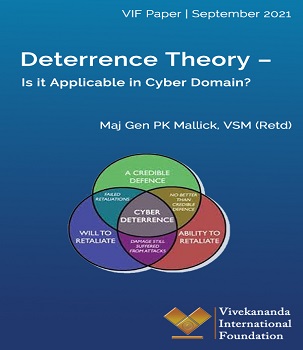 The Deterrence Theory was developed in the 1950s, mainly to address new strategic challenges posed by nuclear weapons from the Cold War nuclear scenario. During the Cold War, the U.S. and the Soviet Union adopted a survivable nuclear force to present a ‘credible’ deterrent that maintained the ‘uncertainty’ inherent in a strategic balance as understood through the accepted theories of major theorists like Bernard Brodie, Herman Kahn, and Thomas Schelling.1 Nuclear deterrence was the art of convincing the enemy not to take a specific action by threatening it with an extreme punishment or an unacceptable failure.


:quality(70)/cloudfront-us-east-1.images.arcpublishing.com/mco/QLS4EDU5E5F4FPQYKA4S5RAO3Q.jpg)