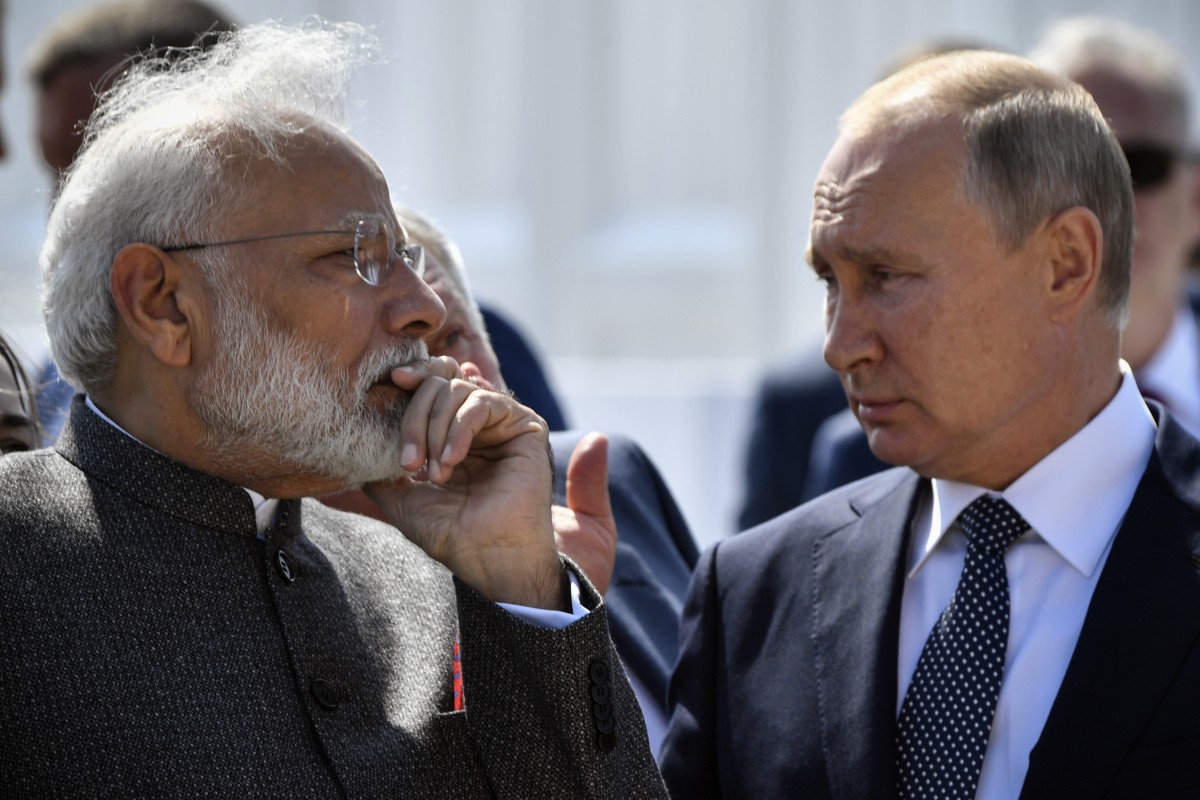
Indian Prime Minister Narendra Modi and Russian President Vladimir Putin chat while visiting a shipyard outside the far-eastern Russian port of Vladivostok on September 4, 2019. Photo: APThe Profession of Arms: A Guide for Young Army Officers
It takes courage, especially for a young officer, to check a man met on the road for not saluting properly or for slovenly appearance, but, every time he does, it adds to his stock of moral courage, and whatever the soldier may say, he has respect for the officer who does pull him up.
Read Document →The Dragon's Teeth: Assessing China's Military Modernization
PLA has focused on modernising its capabilities across all warfare domains to achieve these goals. This includes land, air, and maritime operations, nuclear, space, counter-space, electronic warfare and cyberspace operations, aiming to become a fully integrated joint force.
Read Document →Transforming the PLA: A Decade of reorganisation from SSF to ISF
PRC has engaged in a sustained and broad effort to transform the PLA from an infantry-heavy, low-technology, ground forces-centric military into a high-technology, networked force with an increasing emphasis on joint operations and naval and air power projection.
Read Document →Eyes without Borders: Exploring the World of Open Source Intelligence (OSINT) in the Digital Age
Open Source Intelligence (OSINT) is gaining prominence with the rise of social media, the digital society and the vast growth of publicly and commercially available information (PAI and CAI).
Read Document →
The PLA’s Developing Cyber Warfare Capabilities and India's Options
Informationised warfare blurs the lines between peacetime and wartime. A nation in the information age cannot wait for the hostilities to break out to collect intelligence, carryout influence operations, develop antisatellite systems or design computer software weapons.
Read Document →
Galwan and After
Why did China did this when he is under tremendous pressure in all fronts, is this China's salami slice tactics being progressed rigorously, what will be new Rules of Engagement, what will be escalatory control mechanism, who has taken this decision, will there be some pressure put by China in India's North-East through insurgency.
Read Document →
India’s Joint Doctrine for Cyberspace Operations: A Critical Review
Chief of Defence Staff (CDS) General Anil Chauhan and Secretary, Department of Military Affairs, formally released declassified versions of the Joint Doctrines for Cyberspace Operations during the Chiefs of Staff Committee meeting in New Delhi.
Read Document →
Know your Enemy General(now Field Marshal) Syed Aseem Munir
Gen SA Munir's position in the hierarchy of Pakistan was not very comfortable. The state of economy, insurgency in Pakhtoonistan and Balochistan, attack on the Jaffar Express, constant protests by supporters of Imran Khan's supporters inside and outside of parliament.
Read Document →
Decoding Operation SINDOOR: Key Aspects and Implications
Precision strikes were carried out on nine sites—four in Pakistan and five in PoK—linked to anti-India terrorist groups such as the LeT, JeM and the Hizbul Mujahideen. The targeted sites included Muridke (LeT headquarters) and Bahawalpur (JeM headquarters).
Read Document →
Chinese Cyber Exploitation in India's Power Grid - Is There a linkage to Mumbai Power Outage?
The New York Times (NYT), based on analysis by a U.S. based private intelligence firm Recorded Future, reported that a Chinese entity penetrated India’s power grid at multiple load dispatch points. Chinese malware intruded into the control systems that manage electric supply across India, along with a high-voltage transmission substation and a coal-fired power plant
Read Document →27 August 2020
Why India’s bid to bring Russia into the Indo-Pacific initiative is unwise
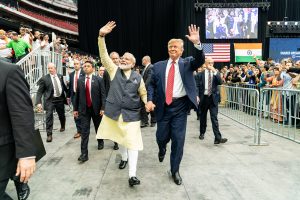
Indian Prime Minister Narendra Modi and Russian President Vladimir Putin chat while visiting a shipyard outside the far-eastern Russian port of Vladivostok on September 4, 2019. Photo: APIndia Must Counter the Bidirectional Psychological Warfare
Of late, India has been experiencing a psychologically driven Chinese war strategy at various occasions. For instance, during the 2017 Doklam standoff, and with a much-renewed vigour in the recent military standoffs in Sikkim and at multiple points along the Line of Actual Control (LAC) in Eastern Ladakh. Thus, ‘Winning without Fighting’ has become a characteristic feature of China’s warfare strategy which is commonly called ‘psychological warfare’ (psywar).It Is Time to Accept That India's Defence Planning Is Crippled by Severe Financial Woes
Stung by China’s chicanery along the Line of Actual Control (LAC) in Ladakh, that resulted in a savage clash in Galwan valley on June 15 in which 20 Indian soldiers died, the Ministry of Defence (MoD) has gone into overdrive, clearing procurement of materiel worth billions of rupees.India and US Likely to Sign Geospatial Intelligence Pact
Notes from a CSIS Virtual Event: Countering Chinese Espionage
China and the United States Are in a Race to Lose Power
From Pivot to Deance: American Policy Shift in the South China Sea
Why there won’t be a US-China war
In 1976, world heavyweight champion Mohammed Ali fought an exhibition bout in Tokyo with karate master Antonio Inoki. Inoki spent most of the match on his back kicking at Ali’s shins crab-fashion.Xi Jinping's Geopolitical Cataclysm
Why America Doesn't Have to Worry About Losing the South China Sea
The South China Sea isn't anyone's sea. It belongs to the whole world. But the country that would suffer most from its closure in time of war would be China. Having developed A2/AD capabilities of its own, it would be hard-pressed were any country other than the United States to develop them, too.Does the U.S. Need to Fear That China Might Invade Taiwan?
Hackers Leak Alleged Internal Files of Chinese Social Media Monitoring Firms
Army War College
Belarus Protests Test Limits of Lukashenko’s Brutal, One-Man Rule
US Army to alter cyber drill in support of new multidomain forces
WASHINGTON — The U.S. Army is altering one of its cyber events in an effort to shape and equip one of the service’s newer multidomain formations.The Greater Middle East: From the “Arab Spring” to the “Axis of Failed States”
How Did America Bring Democracy To Germany? By Bombing It Into Dust
Which Past Is Prologue?
The End of American Illusion
Racial Injustice Protests Spark Think Tank Diversity Push
For the First Time, EU Sanctions in Response to Cyberattacks: Enhanced Deterrence Efforts by Western Countries?
On July 30, 2020, the European Union decided to impose restrictive measures on nine individuals and entities from China, North Korea, and Russia for their responsibility or involvement in cyberattacks. The sanctions include a travel ban, asset freeze, and prohibition to make funds available to these individuals and entities. On the political level, it seems that Western countries have managed, despite other differences, to demonstrate a coordinated approach in this field and act in cooperation. From the perspective of international cyber policy, this step seems to be in line with previous measures taken by Western countries and by the European Union itself, as well as with the cyber deterrence strategy advanced in recent years by the United States. The European Union may be seeking to send a deterrent message against cyberattacks, in particular during the Covid-19 crisis.As Many As 646,000 Die Globally Thanks to the Flu (And Then Came COVID-19)
These days, most Americans are inundated with up-to-the-minute data detailing the horrific effects of the novel coronavirus.