Maj Gen P K Mallick, VSM (Retd), Consultant, VIF

It takes courage, especially for a young officer, to check a man met on the road for not saluting properly or for slovenly appearance, but, every time he does, it adds to his stock of moral courage, and whatever the soldier may say, he has respect for the officer who does pull him up.
Read Document →PLA has focused on modernising its capabilities across all warfare domains to achieve these goals. This includes land, air, and maritime operations, nuclear, space, counter-space, electronic warfare and cyberspace operations, aiming to become a fully integrated joint force.
Read Document →PRC has engaged in a sustained and broad effort to transform the PLA from an infantry-heavy, low-technology, ground forces-centric military into a high-technology, networked force with an increasing emphasis on joint operations and naval and air power projection.
Read Document →Open Source Intelligence (OSINT) is gaining prominence with the rise of social media, the digital society and the vast growth of publicly and commercially available information (PAI and CAI).
Read Document →
Informationised warfare blurs the lines between peacetime and wartime. A nation in the information age cannot wait for the hostilities to break out to collect intelligence, carryout influence operations, develop antisatellite systems or design computer software weapons.
Read Document →
Why did China did this when he is under tremendous pressure in all fronts, is this China's salami slice tactics being progressed rigorously, what will be new Rules of Engagement, what will be escalatory control mechanism, who has taken this decision, will there be some pressure put by China in India's North-East through insurgency.
Read Document →
Chief of Defence Staff (CDS) General Anil Chauhan and Secretary, Department of Military Affairs, formally released declassified versions of the Joint Doctrines for Cyberspace Operations during the Chiefs of Staff Committee meeting in New Delhi.
Read Document →
Gen SA Munir's position in the hierarchy of Pakistan was not very comfortable. The state of economy, insurgency in Pakhtoonistan and Balochistan, attack on the Jaffar Express, constant protests by supporters of Imran Khan's supporters inside and outside of parliament.
Read Document →
Precision strikes were carried out on nine sites—four in Pakistan and five in PoK—linked to anti-India terrorist groups such as the LeT, JeM and the Hizbul Mujahideen. The targeted sites included Muridke (LeT headquarters) and Bahawalpur (JeM headquarters).
Read Document →
The New York Times (NYT), based on analysis by a U.S. based private intelligence firm Recorded Future, reported that a Chinese entity penetrated India’s power grid at multiple load dispatch points. Chinese malware intruded into the control systems that manage electric supply across India, along with a high-voltage transmission substation and a coal-fired power plant
Read Document →Maj Gen P K Mallick, VSM (Retd), Consultant, VIF


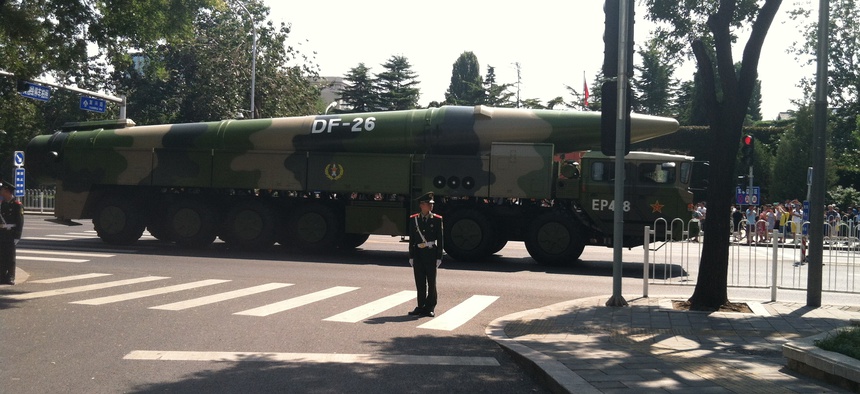
As “great power competition” becomes the lingua franca of American strategy, U.S. policymakers and analysts must build a greater familiarity with the Chinese strategic systems that increasingly worry combatant commanders and which would play an essential role in any Indo-Pacific crisis.
Americans are increasingly wary of Chinese Communist Party influence on U.S. universities—and rightly so. Despite the Ivory Tower’s leftward slant, universities remain a wellspring of American scientific, technical, and engineering research and innovation.
Whither the “Quad”? Is the Quad, or Quadrilateral Security Dialogue—a loose grouping of likeminded Indo-Pacific nations—a military coalition in the making?


Spare a moment to consider the frustration of Chinese officials handicapping U.S. election results and policies. Like much of the rest of the 2016 world, China expected another Clinton administration after the relatively accommodative Obama administration. They were not alone. Washington lore held that Japan was the only nation with any preparation at all for a Trump victory. Japan became a “first mover” with Prime Minister Shinzo Abe visiting New York bearing a gold golf club gift. Many think Japan, and particularly Abe, enjoyed something like a special relationship as a result.
Enemy radar relies upon an electronic signal, guidance systems directing incoming enemy missiles need electronics to impact targets, and many forms of enemy communications such as radio and RF-based datalinks also require electromagnetic transmissions. These seemingly obvious or self-evident realities speak to an increasingly vital, yet under-recognized element of modern war: electronic warfare.

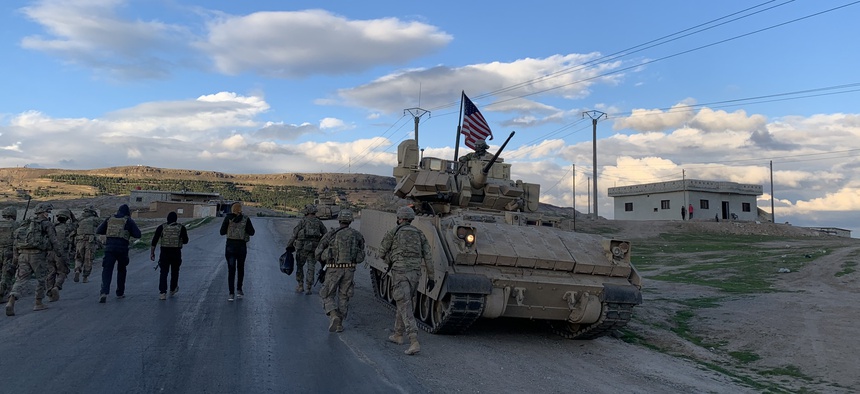
NEAR DERIK, SYRIA — On a bright blue afternoon in February, troops from the Louisiana National Guard load into up-armored vehicles in America’s true forgotten war. The trucks rumble out of a bare-bones base in the seeming middle of nowhere, heading to a small village named Hemzebeg on what the military refers to as a “presence patrol.”
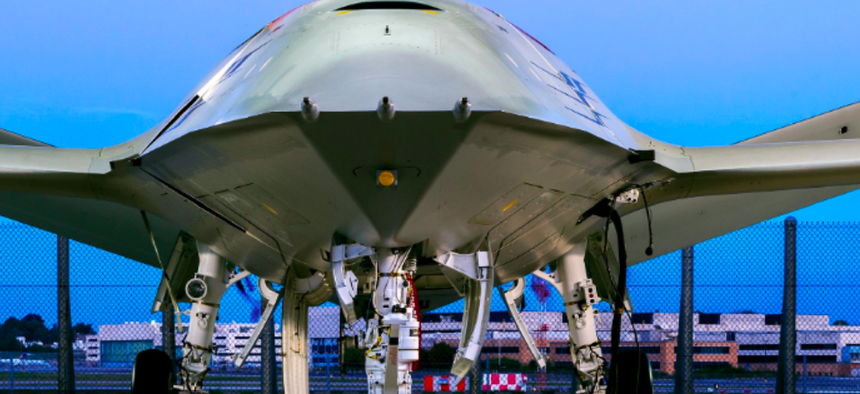
One day, drones may make up nearly half of a carrier air wing — but don’t expect that overnight, the Navy’s warfighting requirements chief told lawmakers this week.