21 October 2016

The Tactical Nuclear Weapons (TNW) Conundrum

By Maj Gen PK Chakravorty
20 Oct , 2016

Introduction

The Indian Army needs to be complimented for undertaking precise surgical strikes at numerous locations across the Line of Control (LoC) on the night of 28 and 29 September. Though Pakistan has denied the event and gone to the extent of taking press correspondents to the LoC to state that nothing had occurred, radio leaks from Pakistan prove otherwise. The operations were executed with surprise and numerous Pakistani militants were killed. Pakistan is awakening its sleeper cells that are carrying out sporadic attacks; there was an attack in Pampore which commenced on 10 October and the terrorists held out for three days despite heavy firing. While India is doing its best to restrain further escalation, the terrorists under guidance from Pakistan are giving no respite. There have been six attacks in 27 days commencing from 18 September. Further there are intermittent Cease-Fire violations across the LoC which are being responded without escalation. It is a matter of patience how long such a situation can continue with India determined to break the terrorist infrastructure in Pakistan. Diplomatically, this has not produced results, therefore the military option to destroy these camps by firepower, Special Forces and manoeuvre need to be considered. What would be the reaction from Pakistan? Will they use Tactical Nuclear Weapons (TNW)?

Pakistan’s TNW

Post Uri the Pakistani Defence Minister threatened to use nuclear weapons if issues went out of control. It is essential we understand Nasr – the TNW that Pakistan possesses. Nasr is stated to have a range of 60 Km and underwent its first flight test on 19 April 2011. The launch system is similar to the artillery rocket system. It is believed to be derived from the Ws-2 Weishi Rockets system developed by China’s Sichuan Aerospace Corporation. Four missiles can be carried on the Chinese-origin Transport Erector Launcher. The warhead section has been estimated to have a cylindrical section 361 mm in diameter, 940 mm long with a conical portion that is 660 mm long. The first question is whether the warhead has been miniaturised successfully for the Nasr. There is no scientific proof that the same has been completed. Accordingly, the weapon remains cold tested which is not certain to function. The next issue pertains to its deployment. As the range is extremely limited, the weapon will perforce have to be deployed possibly about 20 km from the Line of Control (LoC) or the International Boundary (IB). This has its own problems as the usage becomes decentralised.

Conundrum
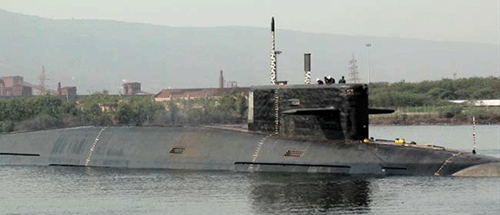
INS Arihant finally provides India a second launch capability

By Brig Arun Bajpai
20 Oct , 2016

Till now we had Prithvi, Agni -1, Agni-2 and Agni -3 nuclear capable missiles as our land delivery means while the likes of SU 30 MKI and Mirage 2000 fighter aircrafts catered for our air delivery systems. Location of these land missile silos as also the air bases operating these fighter aircrafts, both are vulnerable to enemy nuclear strikes since their locations can be found out by the enemy. Not so when an INS Arihant type SSBN nuclear powered submarine is around, hiding deep down in Arabian Sea with its nuclear capable missile ready to be launched at moment’s notice. This provides India a second launch capability which is robust, infallible and potentially insuperable.

India is the first country in the world that has taken a huge technological leap and has straight away constructed an SSBN.

Was it just a coincidence that Indian indigenous nuclear powered submarine INS Arihant, with its 750 km range nuclear capable Sagarika missiles, and 3500 km range Agni -3 nuclear capable missiles got quietly commissioned in Navy for active service in Aug 2016 without any fanfare, and India launched its surgical strike on 29 Sep despite Pakistan rattling its nuclear arsenal?

How Debt Forced Ruias To Downsize; Other Conglomerates Also In Tailspin


October 17, 2016

The price you pay for over-leveraging is loss of your best assets. And yes, conglomerates are being cut to size.

Conglomerates in India got created during the crony capitalist years of the licence-permit-raj, but it was in the post-liberalisation period after 1991 that they became unwieldy and bloated.

Debt kills. Especially heavy debt taken on during bullish times.

The $13 billion deal to sell 98 percent of Essar Oil to Russia’s Rosneft, Trifigura, and United Capital Partners, announced on Saturday by the Ruias, is one more piece of evidence that India’s over-leveraged businesses are having to sell their crown jewels in order to remain afloat. It is further proof that Indian conglomerates will have to shrink before they can grow again.

A few days ago, over-leveraged Anil Ambani inked a pact to sell 51 percent of the tower assets of his telecom company Reliance Communications (RCom) to Brookfield for Rs 11,000 crore. While the deal may take some time to consummate, essentially it will convert the owner of the towers (ie, RCom) into a tenant. RCom will be using the same towers for running its network and pay lease rents. Again, a case of giving up your crown jewels to reduce debt.

In July, the Aditya Birla Group sealed a deal to buy debt-burdened Jaiprakash Group’s 17.2 million tonnes of cement capacity for an enterprise value of Rs 16,189 crore. Again, this was a case of a forced firesale. Asked why he was selling his best businesses, Jaiprakash Group Executive Chairman and CEO told ET Magazine in an interview: “In tough times only good things go. That pain of selling some of our best assets will be there for life.”

Why Japan and India must be partners in Myanmar


OCT 18, 2016

BERLIN – Myanmar’s de factor leader, Aung San Suu Kyi, is seeking to carefully balance relations with major powers as part of her commitment to revive the country’s tradition of employing a neutral foreign policy. Suu Kyi’s India visit this week follows trips to Beijing and Washington.

Myanmar’s geographic, cultural and geostrategic positioning between India and China makes it critical to the long-term interests of both these powers.

Crippling U.S.-led sanctions since the late 1980s pushed resource-rich Myanmar into China’s strategic lap. Sanctions without engagement have never worked. During his 2010 Indian tour, U.S. President Barack Obama criticized India’s policy of constructive engagement with Myanmar, only to return home and pursue, within months, a virtually similar policy. The shift in U.S. policy helped to spur Myanmar’s reform process, thereby ending half a century of military-dominated rule.

Yet today the Obama White House is ignoring that lesson by pursuing a sanctions-only approach toward North Korea, which recently carried out its fifth and most-powerful nuclear test and then conducted a failed missile test launch last weekend.

On her first visit to a major capital since her National League for Democracy (NLD) party came to power almost seven months ago, Suu Kyi in August visited Beijing, not New Delhi where she was educated. Her aim was to smooth over the frayed relationship with China. Ties with China have been roiled by Myanmar’s 2011 suspension of the $3.6 billion, Chinese-financed Myitsone Dam project. The suspension on the eve of China’s national day constituted a slap in the face to Beijing — a loss of face made worse by the fact that the action became a turning point for Myanmar’s democratization and reintegration with the outside world.

What the Next US President Needs to Know About Rising India-Pakistan Tensions

BY SEEMA SIROHI
OCTOBER 18, 2016

Pakistan, in particular, finds itself once again at the center of the tussle between China, Russia, and the United States. 

The Obama administration, now in its last phase, is unlikely to take any strong action against Pakistan even though the White House tacitly supported recent Indian military strikes against terrorists on Pakistan’s side of the Line of Control (LoC).

The Indian strikes came after a cross-border attack on an army camp in Uri, that killed 20 soldiers. The White House issued a short statement the same day, calling on Pakistan to do the right thing. But that is as far as president Barack Obama might be willing to go given the ongoing crises in Syria and Yemen and the volatile nature of the presidential election at home.

It should not surprise New Delhi even though it may disappoint many that the Obama administration does not support a bill introduced in the US Congress on Sept. 20 by congressman Ted Poe, chairman of the house subcommittee on terrorism, calling for Pakistan to be designated as a state sponsor of terrorism.

When asked if the administration would support the move, the state department spokesman John Kirby was more than clear. “Obviously, we don’t,” was the short answer.

The bill, introduced in the House of Representatives shortly after the attack in Uri, cites the administration’s own 2016 report on terrorism that Pakistan did not take “substantial action against the Afghan Taliban, Haqqani Network, Lashkar-e-Tayyiba and Jaish-e-Mohammad, which continued to cooperate, train, organise, and fundraise in Pakistan.”

Why The Big Powers Will Not Support Us Against The Jihadist State Of Pakistan


October 19, 2016

One of the big features of Narendra Modi’s prime ministership has been his proactive global diplomacy. Never before, not since Nehru, has an Indian Prime Minister managed to raise the country’s global clout and profile as Modi has. But here’s the counter-point: none of this has helped India in its biggest external challenge: Pakistan-based jihadi terrorism.

Not that the diplomacy has been a waste. We have got words of comfort and understanding, even some minor action, but what we have not got is active support to bring Pakistan to heel. After Uri, Modi got verbal support from the US, the European Union, Russia and even some helpful noises from China, but not one of them is willing to go further to rein in Pakistan. They will all condemn terrorism in generic terms, but will not act against Pakistan.

One cannot fault the Modi government for this failure, for the reason is the changed global power scenario and threat perceptions over the last 15 years, especially after 9/11. We thus need to recalibrate our Pakistan policy and global diplomacy in the context of the new realities.

Before 9/11 and the US’s ill-fated war in Iraq, the US was the only global superpower. In the decade-and-a-half after that, and especially after the Lehman crisis of 2008, the US is a diminished economic power, and China is the second superpower, having reached half of US GDP, with more than commensurate military power. The third collective superpower, the European Union, has shot itself in the foot economically by pursuing faulty monetary union and a common currency – an idea that has divided the EU more than anything else.

US prepares for worst-case scenario with Pakistan nukes


By Robert Windrem

NBC News Investigative Producer for Special Projects 

As U.S.-Pakistani relations spiral downward, the specter of a showdown between the increasingly antagonistic allies is garnering more attention, including the worst-case scenario of the U.S. attempting to “snatch” Pakistan’s 100-plus nuclear weapons if it feared they were about to fall into the wrong hands.

That would be a disastrous miscalculation, former Pakistani President and army chief Pervez Musharraf told NBC News, saying that such an incursion would lead to “total confrontation” between the United States and Pakistan.

A Medium Range Ballistic Missile Hatf V (Ghauri) missile takes off during a test fire from an undisclosed location in Pakistan on Dec. 21 in this photo distributed by the Pakistani military. The liquid-fuel missile can carry both conventional and nuclear warheads and has a range of more than 800 miles.

Privately, current and former U.S. officials say that ensuring the security of Pakistan’s nuclear weapons has long been a high national security priority, even before the Sept. 11 terrorist attacks, and that plans have been drawn up for dealing with worst-case scenarios in Pakistan.

The greatest success of the U.S. war on terrorism – the military operation that killed Osama bin Laden in his safehouse in Pakistan in May – has fueled the concerns about Pakistan’s nuclear arsenal, increasing suspicions among U.S. officials that he had support within the ISI, Pakistan’s intelligence service, and emboldening those in Washington who believe an orchestrated campaign of lightning raids to secure Pakistan’s nukes could succeed.

It’s no secret that the United States has a plan to try to grab Pakistan’s nuclear weapons -- if and when the president believes they are a threat to either the U.S. or U.S. interests.Among the scenarios seen as most likely: Pakistan plunging into internal chaos, terrorists mounting a serious attack against a nuclear facility, hostilities breaking out with India or Islamic extremists taking charge of the government or the Pakistan army.

COUNTERING CHINESE EXPANSION THROUGH MASS ENLIGHTENMENT

By James E. Fanell and Ryan D. Martinson

From Newport to New Delhi, a tremendous effort is currently underway to document and analyze China’s pursuit of maritime power. Led by experts in think tanks and academia, this enterprise has produced a rich body of scholarship in a very short period of time. However, even at its very best, this research is incomplete—for it rests on a gross ignorance of Chinese activities at sea. 

This ignorance cannot be faulted. The movements of Chinese naval, coast guard, and militia forces are generally kept secret, and the vast emptiness of the ocean means that much of what takes place there goes unseen. Observers can only be expected to seek answers from the data that is available.

The U.S. Navy exists to know the answers to these secrets, to track human behavior on, above, and below the sea. While military and civilian leaders will always remain its first patron, there is much that USN intelligence can and should do to provide the raw materials needed for open source researchers to more fully grasp the nature of China’s nautical ambitions. Doing so would not only improve the quality of scholarship and elevate the public debate, it would also go a long way to help frustrate China’s current—and, to date, unanswered—strategy of quiet expansion. Most importantly, sharing information about the movements and activities of Chinese forces could be done without compromising the secrecy of the sources and methods used to collect it.

The Constellations are Visible…

Examining ISIS Support and Opposition Networks on Twitter


6.8 MB 


7.6 MB 


16.9 MB 

Best for Kindle 1-3. 

Technical Details » 

Research Questions 
How can we differentiate ISIS supporters and opponents on Twitter? 
Who are they, and what are they saying? 
How are they connected, and who is important? 

The Islamic State in Iraq and Syria (ISIS), like no other terrorist organization before, has used Twitter and other social media channels to broadcast its message, inspire followers, and recruit new fighters. Though much less heralded, ISIS opponents have also taken to Twitter to castigate the ISIS message. This report draws on publicly available Twitter data to examine this ongoing debate about ISIS on Arabic Twitter and to better understand the networks of ISIS supporters and opponents on Twitter. To support the countermessaging effort and to more deeply understand ISIS supporters and opponents, this study uses a mixed-methods analytic approach to identify and characterize in detail both ISIS support and opposition networks on Twitter. This analytic approach draws on community detection algorithms that help detect interactive communities of Twitter users, lexical analysis that can identify key themes and content for large data sets, and social network analysis.

Key Findings

Truly winning the battle of Mosul


October 18, 2016 

True victory in the battle of Mosul, the Islamic State’s capital in Iraq and the largest city it controls, will be difficult. Far harder than the military fight will be the political struggle, writes Dan Byman. This post originally appeared on Lawfare.

victory in the battle of Mosul, the Islamic State’s capital in Iraq and the largest city it controls, will be difficult. It may take months or only a few short weeks, but I expect the Iraqi military, Kurdish Peshmerga, and other various militias—along with the U.S. forces that support them—to defeat the Islamic State defenders and liberate one of Iraq’s largest cities from their brutal rule. Far harder will be the political struggle. Iraqi forces need to maintain their unity as they go forward and a broader political settlement must be forged. Here the prognosis looks poor.

As always in Iraq, the political is harder than the military. In 2003, U.S. forces overthrow Saddam Hussein’s government with relative ease. Much harder but still temporarily successful was the counterinsurgency campaign that accompanied the 2007 “surge” in forces. In both these cases, the United States was not able to put in place a political settlement that would keep the peace. In 2016, with fewer forces and a more troubled region, success will be even further off.

The military challenges in the Mosul operation are considerable. (The New York Timeshas produced a useful graphic of how the fighting may commence.) Although the U.S. military estimates that there are only between 3,000 and 4,500 Islamic State fighters in Mosul, compared with tens of thousands of members of the coalition forces—and that excludes the advantage of U.S. airpower—the defenders enjoy the considerable advantages of their position within the city itself. Urban turf is a nightmare for attacking forces.

Tactical at the Expense of the Strategic

October 19, 2016

The primary objective of U.S. foreign policy should be to keep Americans safe and effectively defend our vital national interests. Frequent marketing-like statements made by senior leaders notwithstanding, an examination of our actions abroad confirm that the United States’ foreign policy elite do not hold such a view.

Many pundits and policy-makers declare that it is in the United States’ interests to militarily support armed forces and militias in Iraq and Syria in order to destroy other bad actors and militias, including ISIS. As I have often argued, such a position is not supported by logic or evidence. However, the battle to retake Mosul goes on the ground, the seeds of renewed internal conflict are already spouting among Shia, Sunni, and Kurdish militias. Additionally, as the operation gets underway, there is a major new row developing between Turkey and Iraq. 

Iraqi Prime Minister Haider al-Abadi has warned that if Turkish troops do not leave Iraqi territory, “a regional war” could break out. Turkish President Erdogan defiantly fires back at Abadi, telling him that “[y]ou are not on my level, you are not of my quality. You ranting and raving from Iraq is not of any importance to us." There is no evidence that the wars raging inside both Iraq and Syria will burn out anytime soon. American actions clearly are not advancing U.S. interests, nor have they led to any positive outcome, let alone political reconciliation among rival factions.

In the pursuit of lesser tactical objectives, we are sacrificing our interests on a strategic level. If Washington continues to take tactical actions such as those in Iraq and Syria but doing so harms the strategic interests of the United States, the effort must not be undertaken – or ended with the least damage possible if it is already in progress.

Why the battle for Mosul is a turning point

by N.P.
Oct 18th 2016

SINCE the Iraqi army and its allies began their counterattack against Islamic State (IS) in late 2014, they have managed to liberate many cities in northern and western Iraq. So it might be tempting to view the battle for Mosul, which started in the early hours of October 17th, as just one more skirmish in the jihadists’ steady retreat. But the struggle for Mosul is concentrating minds like no other encounter with IS. Why do so many inside and outside Iraq consider Mosul a turning point?

Mosul has formed the centrepiece of Islamic State’s (IS) ambitions since its capture by the jihadist group in June 2014. From the pulpit of the city’s great mosque, Abu Bakr al-Baghdadi, the leader of IS, proclaimed himself caliph and turned Iraq’s second city into his base. In history, size and strategic location, the city dwarfed IS’s other holdings, including Raqqa, its capital in Syria. Tens of thousands of Sunni Iraqis left camps for the internally displaced to seek refuge under his rule. Without Mosul, IS will be shorn of its tax base and oil fields; the group will be a shadow of its former self.

But Mosul has significance beyond the fall of IS. Ever since Sennacherib made the city his capital in 700 BC, whoever ruled it has dominated the region—be they Assyrians, Babylonians, Arabs, Ottoman sultans or the British empire. It remains strategically important in the 21st century: regional powers regard a post-IS Mosul, if not as a jewel to conquer, at least as a place to deny to rivals. The Turks view it as a barrier to Iran’s expansion of influence westwards. Arabs fear what they suspect are the neo-Ottoman aspirations of Recep Tayyip Erdogan, Turkey’s president, to regain the city. Sparring Iraqi Arabs and Kurds consider Mosul crucial for control of northern Iraq. Meanwhile, Mosul represents a larger battle between America, which is directing the effort, and Russia. If it goes to plan, America will highlight the chasm between its operations in Iraq and Russia’s pummelling of the city of Aleppo, which in history, religious and ethnic mix and mercantile character is Mosul’s Syrian counterpart. If instead the American-led offensive results in a prolonged siege and the devastation of Mosul’s old city and its inhabitants, it will invite an unflattering comparison to the assault on its sister-city.

Burning the Village to Save It

October 19, 2016

This essay is part of the #StrategyAndEthics series, which asked a group of academics and national security professionals to provide their thoughts on the confluence of ethical considerations, the development of strategy, and the conduct of war. We hope this launches a debate that may one day shape policy.

The first, the supreme, the most far-reaching act of judgment that the statesman and commander have to make is to establish by that test the kind of war on which they are embarking; neither mistaking it for, nor trying to turn it into, something that is alien to its nature.[1]

—Carl von Clausewitz, On War

Western politicians, strategists, and tacticians have a shared problem. Interestingly, it is a problem that goes to the heart of the West’s conception of war, but is one we seem entirely uncomfortable discussing. It rarely makes its way explicitly onto the agendas of our principal decision-making bodies. It is not (and I stand to be corrected) being openly discussed in parliaments and defense headquarters. It is only briefly discussed in most Staff College courses.

The problem is one of ethics, or to be specific, to what extent ethics should influence political decisions about war, the development of strategies for war, or the tactics of how war is fought.

HOW JUS AD BELLUM DO WE NEED TO BE, AND HOW JUS IN BELLO MUST WE ACT?

A "Lasting Defeat" of the Islamic State Will Be Elusive

October 19, 2016

As the Iraqi government and Coalition forces launched the offensive to retake Mosul, the US military has optimistically said that the campaign will deal a “lasting defeat” to the Islamic State. But, if the recent history of the fight against jihadist groups in the Middle East, Africa, and South Asia is any indicator, a lasting defeat of the Islamic State will remain elusive.

On Oct. 16, the US military made the claim that the Mosul operation will “deliver ISIL [Islamic State] a lasting defeat” [emphasis mine]:

Tonight Iraqi Prime Minister Haider al-Abadi announced the start of Iraqi operations to liberate Mosul from ISIL. This is a decisive moment in the campaign to deliver ISIL a lasting defeat. The United States and the rest of the international coalition stand ready to support Iraqi Security Forces, Peshmerga fighters and the people of Iraq in the difficult fight ahead. We are confident our Iraqi partners will prevail against our common enemy and free Mosul and the rest of Iraq from ISIL’s hatred and brutality.

Keep in mind that many analysts were quick to pronounce the Islamic State’s predecessor, al Qaeda’s Islamic State of Iraq, as defeated after the US surge that began in 2007 rooted out the jihadists from its sanctuaries across Iraq. By 2010, Iraqi and US forces killed the Islamic State of Iraq’s emir, Abu Omar al Baghdadi, and War Minister Abu Ayyub al Masri a.k.a. Abu Hamza al Muhajir, and the group was driven underground. But these setbacks did not deter the Islamic State of Iraq. Its new leader, Abu Bakr al Baghdadi rallied the Islamic State of Iraq’s remaining forces and reconstituted the organization. In Syria, the Islamic State of Iraq took advantage of the Syrian civil war to rebuild its strength. By 2012, it created the Al Nusrah Front, its branch in Syria, and was launching large scale raids inside Iraq, such as the one in Haditha in March 2012, that presaged the events of 2014, which saw Iraqi forces defeated in Anbar, Salahaddin, Ninewa, and Diyala.

The Islamic State is not alone in its phoenix-like rebirth after losing ground to local forces backed by the US. Al Qaeda branches in Somalia, Yemen, and Mali, have experienced major setbacks and lost ground it held, only to regroup and retake territory. The same is true with Boko Haram in Nigeria and Taliban branches in Afghanistan and Pakistan. Each of these countries have been in a state of perpetual war for well over a decade due to jihadist insurgencies.

Russia Perceptively Retrieves Policy Drift in South Asia Policy towards Pakistan

By Dr Subhash Kapila
18-Oct-2016

Russia has finally positively acted in retrieving its South Asia policy drift towards Pakistan witnessed recently in Russia-India Summit on the side-lines of BRICS Summit in Goa last weekend. Credit should go to PM Modi to induce Russia to do so.

The above is evidenced by nearly twelve odd agreements signed therein, with the major ones covering major defence purchases by India in terms of advanced S-400 Air defence systems, 200 Kamov helicopters and two frigates for the Indian Navy. Besides Russia has contracted to build additional nuclear reactors to boost India’s nuclear-power generation.

Surely, two factors would have weighed heavily in the revised policy directions of Russia. The major consideration would have been that was it geopolitically wise for Russia to endanger its time-tested relationship with an Emerging Power like India for an uncertain new relationship with a duplicitous Pakistan which could soon become a liability, notwithstanding China underwriting it.

The second major consideration that seemed to have worked is that Russia may have perceived a small window of opportunity that some major defence deals could work out sensing that India’s war-preparedness could prompt it to turn to Russia foe speedy deliveries and at competitive rates.

Russian Military Theorists Consider Future War: Bridging the NATO-Russia Gap


October 14, 2016

Russian military theorists have a long-developed reputation for paying close attention to the possible contours of future wars. And now—in the context of Moscow’s military modernization, its involvement in armed conflicts in Ukraine and Syria, as well as its continued strained relations with the North Atlantic Treaty Organization (NATO)—Russian theorists are again actively assessing trends in modern warfare and what they will mean for the future of the country’s Armed Forces. A range of real-world actions implemented by Moscow in recent months, ranging from strengthening air defense for the deployed forces in Syria, changes to Ground Forces’ structures, or reportedly moving the conventional and nuclear-capable strike system Iskander-M (without nuclear warheads) into Kaliningrad, connect intrinsically with how the top brass and leading military thinkers view future warfare (see EDM, October 6, 12, 13; Nezavisimoye Voyennoye Obozreniye, October 7; Voyenno Promyshlennyy Kuryer, October 4).

It is in this context that one of the most significant works in recent years to examine Russian perspectives on future warfare was recently published. Voyna budushchego: kontseptual’nyye osnovy i prakticheskiye vyvody. Ocherki strategicheskoy mysli, (The War of the Future: A Conceptual Framework and Practical Conclusions. Sketches of Strategic Thought, Moscow 2016, 832 pp), co-authored by Colonel (ret.) Igor Popov and Colonel (ret.) Musa Khamzatov, is a culmination of three years’ work, involving roundtables and extensive discussion. The roundtables, presented as an appendix, delved into the conflicts in Ukraine and Syria, war as controlled chaos, threats in cyberspace, and the development of military robotics, among other topical issues. According to the book preface, this is not an academic textbook or a traditional military-theoretical work. In fact, the co-authored study aims to explore the problems and perspectives on future warfare by unifying practical and theoretical approaches. Although the book targets career General Staff officers, its overall style seems to range beyond the narrow field of such work for military specialists (Nezavisimoye Voyennoye Obozreniye, September 30).

SDF’s expanding missions


OCT 18, 2016

The revised bilateral agreement on logistical cooperation between military forces of Japan and the United States, for which the government plans to seek Diet approval during the ongoing session, significantly expands the scope of the Self-Defense Forces’ support of the U.S. military not just in geographical terms but in the nature of the support they provide. The accord is yet another step for full implementation of the Abe administration’s security legislation that came into force in March, but the changes in SDF missions in support of U.S. forces was not discussed in full detail when the legislation — a package of a new law and amendments to 10 existing laws — was deliberated in the Diet last year. Lawmakers should spend enough time to highlight what the revised bilateral accord will entail for Japan’s overseas military missions.

Since it was first concluded in 1996, the Acquisition and Cross-Servicing Agreement (ACSA) has been updated in line with the expansion in bilateral defense cooperation. Initially, the mutual provision of supplies such as food, water and fuel as well as transportation, lodging and other services between the SDF and U.S. forces was limited to peacetime cooperation such as joint exercises and United Nations-led peacekeeping operations. The scope of logistical cooperation was expanded to contingencies in areas surrounding Japan in 1998. The agreement was revised again in 2004 to enable supply of ammunition to U.S. forces in “noncombat” areas when enemy attack on Japan was either taking place or anticipated.

The revised agreement signed by Tokyo and Washington in late September brings SDF troops providing logistical support for U.S. forces much closer to the battlefield. The previous government policy dictated that Japanese troops in such missions operate only in “noncombat” zones — explained as areas where the fighting is currently not taking place and where fighting is not expected to occur over the duration of the support mission — so that the SDF troops providing the logistical support would not become an integral part of the use of force by the other forces in combat missions, as prohibited by the war-renouncing Article 9 of the Constitution.

The Cyber-War on Wikileaks

OCTOBER 18, 2016

Sreฤ‡ko Horvat & Julian Assange at the Ecuadorian Embassy in London – Sunshine Press Publications.

When the ruling class is in panic, their first reaction is to hide the panic.

They react out of cynicism: when their masks are revealed, instead of running around naked, they usually point the finger at the mask they wear. These days the whole world could witness a postmodern version of the infamous quote “Let them eat cake”, attributed to Marie-Antoinette, queen of France during the French Revolution.

As a reaction to WikiLeaks publishing his emails, John Podesta, the man behind Hillary Clinton’s campaign, posted a photo of a dinner preparation, saying “I bet the lobster risotto is better than the food at the Ecuadorian Embassy”.

A similar version of vulgar cynicism emerged earlier this month when Hillary Clinton reacted to the claim that she reportedly wanted to “drone” WikiLeaks founder Julian Assange (“Can’t we just drone this guy?”) when she was the US Secretary of State. Instead of denying her comments, Clinton said that she doesn’t recall any such joke, “It would have been a joke if it had been said, but I don’t recall that”.

One doesn’t have to read between the lines to understand that if Hillary Clinton had said that, she would have considered it a joke. But when emperors joke, it usually has dire consequences for those who are the objects of their “humor.”

Cyber-war Not with Russia…but WikiLeaks

How Scary is Disruptive Technology?


Martin Feldstein, Professor of Economics at Harvard University and President Emeritus of the National Bureau of Economic Research, chaired President Ronald Reagan’s Council of Economic Advisers from 1982 to 1984. In 2006, he was appointed to President Bush's Foreign Intelligence Advisory Board, and,… READ MORE

CAMBRIDGE – The steady stream of improvements in driverless cars has convinced me that before too long the roads will be filled with cars and trucks operating without humans at the wheel. Likewise, I am convinced that the revolution in artificial intelligence will allow computers and robots to do many of the tasks that white-collar workers now do.

It’s not surprising, therefore, that many people are worried about the fate of those whose jobs are vulnerable – or have already been lost – to the latest disruptive technology. What will happen to the millions of men and women who now drive trucks and taxis when the trucks and taxis can drive themselves? What will happen to the accountants and health workers when computers can do their jobs

Some analysts have estimated that, with many fewer employees needed to produce the current volume of goods and services, a large share of current employment could be made redundant.

I hear these worries and realize that they cannot be easily dismissed. But I am optimistic that the United States, at least, will adapt successfully to the new technology. There may be some losers as well as winners, but the American public as a whole will be better off. And those who lose their jobs to the new technology will soon find other employment.

I believe that there is little reason to worry that the new technology will create large-scale unemployment. The changes in technology will increase the economy’s output and raise the potential standard of living of the population. Those who want to work will continue to find jobs.

Winning the Cyber Gage: Intelligence Dominance in the Digital Information Age

October 18, 2016 

Winning the Cyber Gage: Intelligence Dominance in the Digital Information Age

Introduction

In the age of sail, warships sought tactical advantage in engagements by maneuvering to windward of enemy ships. This “weather gage” allowed ships freedom of movement while the enemy’s relative movement was limited. Similarly, in the digital information age, maritime superiority will be determined by the extent to which a force is able to seize the cyber gage. For naval intelligence to effectively support the Chief of Naval Operation’s new strategy, it must first adapt to the realities of the digital information age.[i] Naval intelligence faces additional challenges posed by an increasingly integrated global maritime transportation system, a rapid rate of technological change, an austere budget climate, and a return to great power competition with China and Russia. This future operating environment will demand seizing the digital initiative, the cyber gage, through better intelligence, delivered faster, across a broader social network.

The Future Environment

Future realities will drive operational requirements. The twin forces of globalization and rapid technological change are creating a world in which a majority of people will soon have access to digital information networks through cyberspace. If the rate of Internet growth continues, we can expect an additional 2.5 billion users by 2030.[ii] Autonomous devices are also increasingly linked to the Internet. Devices ranging from home security systems to refrigerators are forming a menacing new galaxy in cyberspace: the Internet of Things (IOT). By connecting billions of people and things worldwide, cyberspace will drive geometric growth in the number of social networks, their complexity, and the ability of individuals to quickly plan and act independently of traditional human institutions. Despite this growth, there will still be a significant portion of human activity that remains offline. While cyber relationships help broaden an individual’s personal network, non-cyber relationships tend to be stronger and therefore more decisive in terms of predicting future behavior. For this reason, human derived intelligence will be a critical tool in providing overall situational awareness and predictive intelligence to operators. The complexity of cyber-enabled social networks has expanded beyond traditional geographical limitations, holding significant policy implications for businesses, governments, and intelligence agencies alike.

A new Army pilot could change the way you get your next assignment

October 17, 2016

A new Army pilot could change the way you get your next assignment

The Army is preparing to launch a pilot program that could fundamentally change the way the service manages its soldiers and matches people to their next assignments.

The Assignment Interactive Module pilot is scheduled to begin in December, said Maj. Gen. Wilson Shoffner, director of the Army talent management task force.

AIM is designed to collect in one database information on soldiers’ job preferences, background, skills and expertise, everything from foreign language proficiency to civilian-acquired skills, Shoffner said. The pilot is a precursor to the Integrated Pay and Personnel System-Army, or IPPSA, which will for the first time allow the Army to look at soldiers and their talents and abilities across all three Army components.

This gives the Army “total visibility and automated ability,” as it manages almost 1 million people, Shoffner said.

“The big idea is that we can enhance readiness if we can figure out how to maximize everyone’s potential to contribute,” Shoffner said. “Some might say it’s about taking care of your best, but it is much more than that. We want to find those talents that may not be readily apparent. We want to find out what people can do, abilities they have that may not be obvious and then are more difficult to manage.”

IPPSA will allow the Army to track a soldier’s abilities in multiple areas and better match them with assignments or jobs as they progress in their careers, said Lt. Gen. James McConville, the deputy chief of staff for personnel (G-1).

Commentary: What the U.S. should learn from Britain’s dying navy

Aug 11, 2016

The Royal Navy's largest ever warship HMS 'Queen Elizabeth' is floated out of its dock for the first time in Rosyth, Scotland, July 2014. Wikipedia/Creative Commons

Britain used to boast the most powerful navy in the world. No more. 

That’s a serious problem for allies like the United States. 

Traditionally, Britain’s Royal Navy has been the U.S. Navy's closest partner. The two have fought together against most every foe. So any weakening of the Royal Navy also erodes Washington's naval power. 

Today, however, the Royal Navy is a shadow of its former self. Government budgeteers have repeatedly, and excessively, cut the numbers of its ships, planes and manpower. It can barely patrol the United Kingdom’s own waters, much less project British influence abroad. 

Though London officials now vow to reverse the decline, it might be too late. With morale plummeting, and its few remaining ships frequently malfunctioning at sea, the Royal Navy’s suffering might be terminal. 

The timing couldn’t be worse. The West is mobilizing to defeat Islamic State, deter an increasingly aggressive Russia and manage China's meteoric rise as a world power. The British fleet's collapse is an object lesson for cash-strapped governments struggling to balance competing budgetary needs in a seemingly ever more volatile world. 

One Last Chance to Save the Royal Navy’s Flagship

by ROBERT BECKHUSEN

The helicopter carrier HMS ‘Ocean’ will sail into the sunset unless Britain finds the money … and the sailors

HMS Ocean, the British Royal Navy’s flagship, will retire in 2018 to be either sold or scrapped.

She is Britain’s sole carrier, at least until the 280-meter-long HMS Queen Elizabeth becomes fully operational in 2020. A second new flattop, Prince of Wales, will be ready for combat in 2023. These ships will initially operate 24 vertical-lift F-35B Joint Strike Fighters each.

The 203-meter-long Ocean, however, is not a “true” carrier. She is an amphibious assault ship with 18 helicopters and no fighter jets — and her cavernous hold allows the vessel to disgorge hundreds of Royal Marines aboard landing craft.

Which means that for five years, the Royal Navy’s amphibious capability will fall to its two smaller Albion-class landing docks, of which only one is currently operational due to cost. During that time, the Royal Navy will modify Prince of Wales to take over Ocean’s job, with Queen Elizabeth to possibly follow.

There is deep uneasiness about this in British military circles. Not the least because it’s exceedingly unlikely both Queen Elizabeth-class carriers will operate at the same time. Carriers are complex machines and need regular maintenance, so one will likely rest in dock when the other is away.

Get thinking on drones


India should work out its own principles regarding the use of UAVs in the context of a global regime, writes Harsh V. Pant 

A global regime to manage the use of drones is slowly being put in place. The United States of America, along with over 40 other states, issued a declaration earlier this month outlining the principles that, in their view, should govern the export and use of armed drones to ensure that they do not cause instability or help terrorism and organized crime. This declaration to establish a set of standards for the use and sale of drones has set the stage for a meeting next year to hammer out the details. While many of the allies of the US such as Britain, Germany and Australia signed the declaration, other states like France, Russia, Brazil and China did not do so. This makes it certain that the participants in next year's meeting will find it very difficult to achieve a consensus, which will be needed to set up a global regime.

The document, called the "Joint Declaration for the Export and Subsequent Use of Armed or Strike-Enabled Unmanned Aerial Vehicles", recognizes that misuse of armed or strike-enabled drones "could fuel conflict and instability, and facilitate terrorism and organized crime", and therefore that "the international community must take appropriate transparency measures to ensure the responsible export and subsequent use of these systems". But it adds that such concerns should not be seen as undermining a state's "legitimate interest" to produce, export or acquire drones, thereby trying to strike a balance between global good and national interest. The declaration also underlines that international laws on armed conflict and human rights should apply to the use of armed drones, and exports should be consistent with existing multilateral export control and nonproliferation regimes.

Countering Gray-Zone Hybrid Threats

October 19, 2016

The gray zone is an operating environment in which aggressors use ambiguity and leverage non-attribution to achieve strategic objectives while limiting counter-actions by other nation states. Inside the gray zone, aggressors use hybrid tactics to achieve their strategic objectives. While hybrid threats have historically been associated with irregular and conventional warfare, their use in the gray zone leads to a dichotomy between two types of hybrid threats that can mainly be attributed to the need for ambiguity and non-attribution in the gray zone. The two types of hybrid threats are “open-warfare hybrid threats” and “gray-zone hybrid threats.” A case in point is Russia’s military actions in eastern Ukraine, part of what the Kremlin calls its “New Generation Warfare.” In this MWI report, Capt. John Chambers draws on this case study to recommend ways the U.S. Army can improve its capacity to counter ongoing as well as future gray-zone hybrid threats.

Read full report here.

Capt. John Chambers is an instructor of American politics in the Department of Social Sciences at the U.S. Military Academy at West Point. The views in this report are the author’s and do not represent those of the Department of Defense or the U.S. Army.


20 October 2016

*** Does SAARC have a Future?

By NS Venkatraman
19 Oct , 2016

The recent cancellation of the 19th summit of South Asian Association for Regional Cooperation (SAARC) that was scheduled to take place in Islamabad on November 15-16 has led to serious doubts as to whether SAARC can fulfill its objectives and remain as a useful forum that would be beneficial to the eight nations that are members of the SAARC. 

India cited Pakistan’s involvement in the September 18 terrorist attack at an Army camp in Uri town of Kashmir, in which 19 soldiers died, as the reason for its decision to boycott the summit. When a few other member countries such as Afghanistan, Bangladesh and Bhutan supported India’s stand and decided not to attend the 19th summit at Islamabad, there was no option for Nepal, the Chairman of SAARC to cancel the summit.

Obviously, this has created considerable dissatisfaction in Pakistan, creating serious fissures amongst SAARC nations.

SAARC, with member states of Afghanistan, Bangladesh, Bhutan, India, Nepal, Maldives, Pakistan and Sri Lanka , comprises 3% of the world’s area, 21% of the world’s population and around 9% of the global economy. With such strength, SAARC has the potential to emerge as a strong centre of power in the world, with prospects of emerging as a decisive economic and trade entity.

** At the Mosul Front: Traps, Smoke Screens and Suicide Bombers

By BRYAN DENTON and MICHAEL R. GORDON
OCT. 17, 2016

Pesh merga fighters outside Badana village near Mosul. CreditBryan Denton for The New York Times

Bryan Denton and Michael R. Gordon are with Kurdish forces near Sheikh Amir, Iraq, on the eastern approach to Mosul.

The Kurdish pesh merga forces started their advance by moonlight, in the early hours of Monday. East of the Islamic State-held city of Mosul, columns of tanks and trucks lumbered their way toward the objective: clearing villages of militants before any broader advance on the city could happen.

As day broke, the vehicles piled off the roads to avoid any improvised bombs and began moving across the dusty Nineveh plain toward the villages. The tank fire began, booming across the distance. Soon the crawl became a run.

Thick funnels of black smoke began rising from the towns — a past tactic used by the Islamic State militants, setting oil barrels aflame to try to screen them from American airstrikes. The strikes came anyway, sending shock waves through the haze.

How Russian MiGs and Sukhois laid the foundation of PLAAF?

By Bharat Lather
19 Oct , 2016

As the People’s Republic of China (PRC) emerged from the 2nd Sino-Japanese war (1937-45) and revolution in 1949, China soon went to war against the United States in November 1950, the opening Chinese offensive, launched from deep within North Korea, and took U.S. forces by complete operational surprise. The U.S.-led United Nations offensive into North Korea was thrown back, with the U.S. Army handed its worst defeat since the American Civil War. Still, it became apparent that the Chinese economy lacked the capacity to compete with the U.S. or the U.S.S.R. in the production of advanced military technology. Transfers from the Soviet Union helped remedy the gap in the 1950s, as did transfers from the United States and Europe in the 1970s and 1980s. Still, the stifled technology and scientific research left the Chinese even farther behind.

According to US Defense Department report, PLAAF continues to fly over 400 J-7s, an effective aircraft, but not competitive in any sense with the U.S. fleet; but by developing an integrated multi-layered air defense network, even J-7s (Mig-21) would pose a grave threat to U.S. fighter jets.

J-7/ MiG-21

In 1961, as tensions between the USSR and the PRC reached a fever pitch following Khrushchev’s policy of De-Stalinization; the Soviets transferred blueprints and materials associated with its new MiG-21 interceptor to China. The offering represented an effort to bridge part of the gap, and suggests to China that cooperation between the Communist giants remained possible. However, the offering didn’t work.

Things began to deteriorate between the two Communist giants with Nikita Khrushchev’s policy of De-Stalinization which resulted in withdrawing nuclear assistance to China by 1959. Relations got further deteriorated when the former Soviet Union (Presently Russia) decided to sell its MiG-21 jets to India; a country which China saw its major Asian rival. Sino-Soviet tensions continued to increase, nearly to the point of war in 1969 along the Ussuri River line which was claimed by both of them.