4 November 2016

How Do America and China’s Huge New Warships Stack Up?

by DAVID AXE
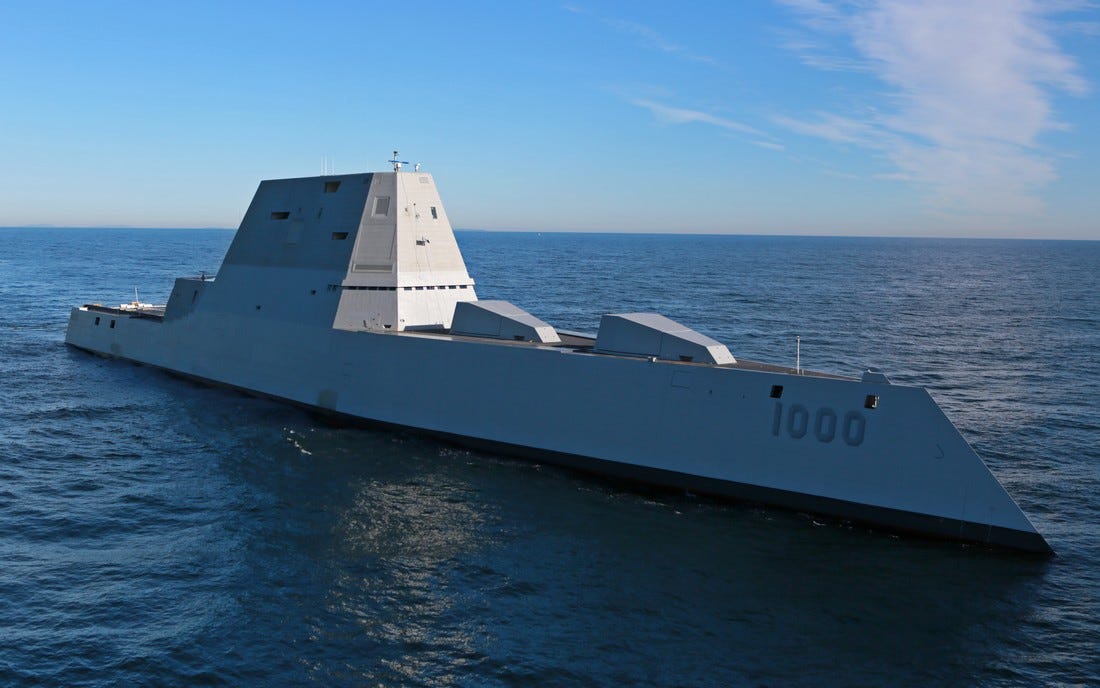
On Oct. 15, 2016 in Baltimore on the U.S. East Coast, the U.S. Navy commissioned the guided-missile destroyer USS Zumwalt into service following a protracted and costly development.

Six hundred feet long and displacing 14,500 tons, Zumwalt — the first of three stealthy land-attack destroyers — is America’s largest surface combatant in generations.

But she’s not alone in her weight class. While the Americans were celebratingZumwalt’s entry into service, on the other side of the world at a shipyard in Shanghai, the Chinese navy was hard at work on its own 14,000-ton-displacement surface warship.

The Type 055 just began major construction and probably won’t enter service before 2018. But when she does, she could be the biggest and most powerful surface warship in Asia.

It’s unclear exactly what the Type 055 will do, but indications are that she’ll function as the main air-defense escort for China’s new domestically-built aircraft carrier, currently under construction at Dalian in northern China.

Consider the Type 055’s superstructure facets, apparently meant to support radar emitters similar to the SPY-1 emitters that are part of the U.S. Navy’s Aegis air-defense system. U.S. Navy flattops never go anywhere without at least one Aegis-equipped cruiser and several Aegis destroyers as escorts.Zumwalt, notably, is the first new major American surface combatant class in 30 years not to have Aegis.

The Type 055 likely won’t be a direct competitor of Zumwalt. Rather than integrating Zumwalt and her two sisters into carrier battle groups, the U.S. Navy will probably deploy the giant destroyers on solo cruises near land in order to take advantage of the vessels’ radar-evading hull-form and their twin, 155-millimeter guns, which can fire projectiles a distance of at least 80 miles in order to support amphibious landings and special operations.

China's New Stealth Fighter, World's Largest Seaplane To Debut at Air Show


Oct 31, 2016 

One of the largest air shows in the world is currently being held in Zhuhai, China. Currently in its eleventh year, the air show has become the go-to spot for seeing the latest in Chinese military hardware. An impressive number of new airplanes are making their debuts there this year, including the J-20 stealth fighter, Y-20 strategic airlifter, and AG-600 seaplane.

The 11th China International Aviation and Aerospace Exhibition—known to most people simply as the Zhuhai Air Show—starts November 1st and runs until November 6th, taking place at the China International Aviation Exhibition Center in Zhuhai, Guangdong Province. Seven hundred exhibitors from 42 countries and regions around the world will exhibit at the show, but all eyes will be on the latest Chinese aircraft and weapons.

A number of pictures have trickled out of the show a day early, giving us the rundown on what will be on display. The show venue is divided into an Aviation and Aerospace Hall and a Weapons Exhibition Hall.

China's J-20 fighter. Via People's Daily.

The People's Liberation Army Air Force, also known as the Chinese Air Force, hasconfirmed that the country's new J-20 jet fighter will make its public debut at Zhuhai. The fifth generation fighter has been spotted in a new camouflage pattern and has reportedly entered low-rate initial production. But there's still one thing everyone would like to know, and that's what, exactly, the large, twin-engine fighter is for. Speculation is that the fighter could be a long-range air superiority fighter, light bomber, or some combination of both.

China Debuts Its New, Nearly Battle-Ready Stealth Jet

11.02.16 

China’s first stealth fighter made its official, public debut at the annual Zhuhai air show in southeast China Tuesday, bringing the plane one step closer to frontline service with the Chinese air force—and a step closer to presenting America’s own stealth warplanes their first high-tech opponent.

But there’s no reason for the Pentagon to panic. The U.S. military is still way, way ahead when it comes to radar-evading warplanes.

Two twin-engine, twin-tail J-20s flew a brief, minute-long display in the smoggy gray sky over Guangdong province, showing off their superb low-speed maneuverability in front of a crowd of thousands of Chinese citizens plus hundreds of foreign reporters and aerospace professionals.

With their gray camouflage paint jobs, the J-20s at Zhuhai were clearly combat-ready, production examples of the single-seat, supersonic fighter—as opposed to the 10 prototype test jets that have hogged the media spotlight since the very first J-20 made its unofficial debut in grainy photos leaked by the Chinese government in late December 2010.

The J-20s’ appearance in Guangdong was no surprise—an air show schedulelisting the jets’ aerobatic routine leaked in early October. All the same, the jets’ performance underscored just how close the J-20 is to being war-ready. Very close.

Shortly after the J-20 flew for the first time in January 2011, then-U.S. Defense Secretary Robert Gates insisted the Chinese fighter wouldn’t be operational before 2020. A year later in 2012, David Helvey, then the deputy secretary of defense for East Asia and Asia Pacific Security Affairs, told reporters the J-20 could be war-ready by 2018.

A collision of Chinese manufacturing, globalization, and consumer ignorance could ruin the internet for everyone


On Oct. 23, one of the largest coordinated cyber attacks in history took down several major internet sites in the United States and Europe.

In the aftermath of the attack, one company in particular has been implicated: Hangzhou Xiongmai Technologies. According to security researchers, the Chinese company built hardware and software for internet-connected security cameras that was insecure. Then hackers deployed a malicious strain of malware known as Mirai into the devices, and used them to direct huge amounts of internet traffic to Dyn, a Domain Name System (DNS) provider that often serves as a virtual “first stop” for computers connecting to sites on the internet.

Popular websites including Twitter, Spotify, Netflix, and PayPal were knocked out by the Distributed Denial of Service (DDoS) attack, which unleashes so much traffic to a targeted website or service provider that it can no longer function.

Xiongmai’s negligence is without question, analysts say, but it is just part a larger problem in the global hardware industry. In fact, the same system that brought exploding hoverboards into consumers’ homes last Christmas is responsible for unleashing hundreds of thousands of vulnerable cameras into American households—and probably millions of other equally vulnerable internet-connected devices.

As manufacturing supply chains have grown more fragmented globally, and electronics products have become commodities, security and safety standards haven’t caught up. While this particular attack knocked out popular websites, consumers’ personal information, from credit card details to the footage shot in their homes, is equally at risk. As hospitals, airplanes, and cars add internet-connected devices, it’s not just privacy that’s in danger—people’s lives will be too.

Stolen Data On US Nukes And Drones: The Secret Behind China’s ‘Successful’ Military-Industrial Complex

29 Oct, 2016

China’s sprawling military-industrial complex, which has often been credited with designing and producing modern aircraft and missiles, has managed to do so with sensitive technology stolen from the United States, a soon-to-be-released congressional report says.

According to RT, Chinese intelligence agencies repeatedly targeted US national security agencies, email accounts of US officials and other sources of military technology. They also hacked data related to secret US war plans, gained information about nuclear weapons, and snooped into electrical power grids and financial networks. They were also successful in hacking secret data about the MQ-9 Reaper drone, which has been a staple of US airstrikes in Iraq, Afghanistan and Pakistan over the past nine years.

Chinese cyber espionage is carried out by what the report said was a “large, professionalised cyber espionage community”, put in place by the Chinese government and managed by the intelligence agencies.

A draft of the annual report was obtained by the Washington Free Beacon. The final version of the report, prepared by the US-China Economic and Security Review Commission, will be released on 16 November.

The report for 2016, as cited by the Washington Free Beacon, says:

Memo to the Next President: Avoid the ‘Vision Thing’ in the Mideast

By AARON DAVID MILLER and RICHARD SOKOLSKY 
October 31, 2016

The U.S. Constitution talks about creating a more perfect Union, not a more perfect world. When, as a country, are we going to remember that? For decades now America has been trapped in a Middle East it cannot transform nor leave, and where bold ambitions and transformational visions more often than not go to die That calls for a cruel and unforgiving assessment of U.S. interests and the smart application of American power and leadership, mixed with a healthy dose of prudence and caution, to protect them. And it mandates avoidance of discretionary enterprises that aren’t connected directly with vital U.S. interests.

We are neither declinists nor isolationists. But based on more than a half century of combined experience working on Middle Eastern issues in the Department of State,

here is our list of ten things the next administration should not do or say if it is to have any chance of navigating its way out of the landmines, traps, hopeless causes, and impossible missions that dot the region.

First, the administration has to purge the vocabulary it uses to describe America’s role and responsibilities in the region. With apologies to Madeleine Albright and Hillary Clinton, for whom both of us worked, it is not helpful to talk of the United States as the indispensable power able to jump tall buildings in a single bound. De Gaulle had it right: The cemeteries of France are filled with indispensable people. America does not have the capacity or the interest to set itself up as the go to power for every hopeless Middle East cause, particularly when those causes cut to the core of issues such as sectarian or national identity and internal governance (see Syria). We can look for opportunities in conjunction with others to help promote security and stability; but we cannot afford to play the lead role in transforming the political and economic institutions of the region—what foreign policy expert Michael Mandelbaum called foreign policy as social work. We can barely keep our own house in order on some critically important issues to have the time and luxury to be running round the world repairing, let alone constructing, the houses of others.

US troops backing Iraqi attack in Mosul


NEAR MOSUL, Iraq — U.S. special operators were at the front line on the edge of Mosul earlier on Tuesday with elite Iraqi troops who were preparing to enter the Islamic State’s last stronghold in the country.

The Americans wore black uniforms and drove black armored vehicles, blending in with their Iraqi counterparts from the U.S.-trained Golden Division just outside the village of Gogjali on the eastern edge of Mosul. Several had skull and crossed swords patches and one had a sign on his helmet that read: “Hippie Killer.” They were not allowed to talk to the media and asked not to be photographed.

Later Tuesday, Iraq's special forces entered the outskirts of Mosul, taking the state television building and advancing despite fierce resistance by Islamic State group fighters who control the city, an Iraqi general told The Associated Press.


Members of the Iraqi army's elite Golden Division near Mosul, Iraq, on Tuesday Nov. 1, 2016.

Troops entered Gogjali, a neighborhood inside Mosul's city limits, and later the borders of the more built-up Karama district, according to Maj. Gen. Sami al-Aridi of the Iraqi special forces. As the sun went down, a sandstorm blew in, reducing visibility to only 100 meters (yards) and bringing the day's combat to an end, the AP reported.

The Insane D.I.Y. Weapons of the ISIS War

11.01.16 

The coalition assault on Mosul has steadily chipped away at ISIS’s last and biggest major stronghold in Iraq. A reported 100,000 Iraqi, Kurdish, and coalition troops—including American commandos, air-controllers, and artillerymen—have attacked from south and east, respectively, aiming to dislodge an estimated 10,000 ISIS fighters in the northern city of 1.5 million people.

The stakes couldn’t be higher—and both sides know it. ISIS and the U.S.-led coalition have both deployed their latest, best and—in a few cases—most desperate weaponry. From city-block-smashing rocket-tanks to DIY killer robots, these are the defining weapons of the battle for Mosul.

Soviet-Era Rocket-Tanks

In 1988, the Soviet army introduced a fearsome new weapon—the TOS-1 rocket-tank. Built on the chassis of a T-72 main battle tank, the TOS-1 boasts a 24-pack of roughly 9-inch-diameter rockets in place of the tank’s turret. Each of those rockets lugs 220 pounds of explosives and can hit targets from up to 3 miles away. Ripple-firing all 24 rockets could blanket an area the size of two city blocks in munitions.

And not just any munitions. The TOS-1’s rockets are thermobaric weapons. Where traditional warheads count on instantaneous explosive force for their destructive power, thermobaric weapons are slower and more insidious in nature—and potentially much more destructive, pound for pound. The TOS-1’s rockets spread a cloud of flammable gas then ignite the cloud, burning up all the oxygen for hundreds of feet in all directions and producing a devastating blast effect.

The Soviets developed the TOS-1 as a way of flattening dense urban defenses in order to clear paths for attacking tanks. Needless to say, the TOS-1’s rockets pose at least as much danger to civilians as they do to dug-in combatants.

Iran’s Man in Beirut

10.31.16 

On the morning of 13 October, 1990, the Syrian Air Force launched fighter jet strikes on the Lebanese presidential palace in Baabda, southeast of Beirut. Their target was a General Michel Aoun, an army commander appointed two years previously by an outgoing president to lead a temporary cabinet until elections could be held, who instead went rogue, moving himself into Baabda Palace and effectively declaring himself ruler of the republic—and happy to fight anyone who said otherwise.

His reign, such as it was, saw thousands killed in quixotic military campaigns against rival warlords and the Syrian army then occupying Lebanon. By October 1990, the Syrians were determined to finish him off, and the United States – of whom he had also managed to make an enemy—was willing to let them, not least as a nod of gratitude for Damascus’ assistance in the liberation of Kuwait from Saddam Hussein. “I am ready to die on the battlefield of honor rather than surrender—be sure I shall die fighting,” Aoun told a crowd of supporters on the 12th, when it was clear a final Syrian push was imminent. By noon the following day, Aoun had surrendered without firing a shot and fled to the French embassy, leaving scores of his men massacred in the ground and air onslaught, and the presidential palace in ruins. Lebanon’s fifteen-year civil war was over.

Today, the same Michel Aoun—now 81 years old—was elected to return as president to the same Baabda Palace, ending Lebanon’s thirty-month leadership vacuum after spending over a quarter of a century between exile in France and Lebanon, tirelessly plotting his eventual comeback with near-Shakespearean ambition. “I can add colours to the chameleon,” boasts the rapacious Richard III in Henry VI; “Change shapes with Proteus for advantages/ And set the murd’rous Machiavel to school.” Aoun’s long life has seen him morph from a Fort Hill-trained commander in a US-backed army (once even photographed in Israeli company) to an anti-American proxy of the Iraqi Baath regime to a Bush-supporting neoconservative fellow traveler (speaking at the Hudson Institute in favor of the Iraq War on a 2003 tour of Washington, during which he also testified to Congress in support of the Syria Accountability and Lebanese Sovereignty Restoration Act) to, most recently, a stalwart comrade of the Iranian-Syrian “Axis of Resistance.” His election today came after he and his Hezbollah ally boycotted all electoral sessions for more than two years, bluntly refusing to attend unless and until his victory was guaranteed in advance. Earlier in the month, the last of his major remaining opponents—Saad al-Hariri of the Saudi Arabia-backed Future Movement—caved in, endorsing Aoun in what he called a “sacrifice […] for the nation, the state, and stability.”

Iraqi Forces Enter IS-Held Mosul, Facing Stiff Resistance

November 2, 2016

Iraqi special forces seized control of state television facilities inside Mosul on Tuesday, as a loose-knit combat coalition allied with Baghdad pressed an offensive to drive Islamic State extremists from the city.

Kurdish and Western journalists embedded with the force said it was meeting stiff resistance inside the city, encountering concrete blast walls and roadside bombs planted by IS fighters to slow the Iraqi advance.

The Iraqi military also said an armored division was approaching southeastern districts, as part of a push to free outlying villages and encircle the city.

Separate coalition units pressing toward Mosul from the north were also reported in control of several key villages.

The long-awaited offensive comes two weeks after the coalition of Iraqi and Kurdish forces — backed by Shiite militia, Sunni Arab tribesmen and U.S.-led airstrikes — began the largest military operation in the country since 2003 to clear the city of IS fighters.

In Washington on Tuesday, the U.S. anti-terror special envoy Brett McGurk voiced optimism about the offensive, telling Radio SAWA it is now simply "a matter of time before Iraqi security forces enter and liberate this great city." However, he also called for patience, cautioning that retaking the city will take time and will unfold in stages.

Meanwhile, in Geneva, United Nations spokeswoman Ravina Shamdasani said IS fighters are continuing their push to forcibly move thousands of civilians closer to Mosul to provide extremists inside the city with human shields.

THE BIGGER ISSUES AT PLAY: MOSUL AND THE FUTURE OF NORTHERN IRAQ

NOVEMBER 1, 2016

Mosul was not the first city to fall to the self-proclaimed Islamic State of Iraq and the Levant (ISIL), but it was itscapture that shocked the world into action. Over two years later, the much-anticipated Iraqi offensive to liberate Mosul from ISIL is in its early stages. Since the halt of the ISIL offensive outside Baghdad and Irbil and the engagement of U.S and coalition airpower, this battle and its result were preordained. Urban fights bring complications, and the coalition of forces advancing on Mosul should seek to minimize casualties and human suffering. But the moral and strategic imperative is to liberate the citizens of Mosul from the brutalities of ISIL rule, including vicious repression, regular executions and — for the minorities — organized rape.

The complex and varied groups of loosely allied military forces descending on Mosul have been the subject of a great deal of analysis, debate, and skepticism. While (almost) all these forces — willing to shoulder personal risk to liberate a captured city — should be applauded, this is not to say that there are not a host of serious concerns, both in the liberation and the aftermath. Mosul is a deeply complicated piece of terrain, both internally and in relation to external powers. There are serious equities that must be balanced or checked, even as Mosul’s citizens are liberated.

The forces encircling Mosul are primarily those of the Iraqi government — the Army, Federal Police, and Special Forces. Then there are the Kurdish Peshmerga, Sunni Arab forces trained by Turkey, and predominantly Shia Popular Mobilization Forces (PMF). There is also a small detachment of Turkish troops in the area that is not yet involved in the fighting.

How Putin Derailed The West – OpEd

NOVEMBER 2, 2016

“Nation state as a fundamental unit of man’s organized life has ceased to be the principal creative force: International banks and multinational corporations are acting and planning in terms that are far in advance of the political concepts of the nation-state.” — Zbigniew Brzezinski, “Between Two Ages: The Technetronic Era”, 1971

“I’m going to continue to push for a no-fly zone and safe havens within Syria….not only to help protect the Syrians and prevent the constant outflow of refugees, but to gain some leverage on both the Syrian government and the Russians.” — Former Secretary of State Hillary Clinton, Third Presidential Debate

Why is Hillary Clinton so eager to intensify US involvement in Syria when US interventions in Afghanistan, Iraq and Libya have all gone so terribly wrong?

The answer to this question is simple. It’s because Clinton doesn’t think that these interventions went wrong. And neither do any of the other members of the US foreign policy establishment. (aka–The Borg). In fact, in their eyes these wars have been a rousing success. Sure, a few have been critical of the public relations backlash from the nonexistent WMD in Iraq, (or the logistical errors, like disbanding the Iraqi Army) but–for the most part– the foreign policy establishment is satisfied with its efforts to destabilize the region and remove leaders that refuse to follow Washington’s diktats.

Hillary, Trump And Sartre: How Existentialism Disrobes Major US Presidential Candidates – Analysis

By Dr. Arshad M. Khan* 
NOVEMBER 2, 2016
Hillary Clinton’s emails are back in the news as the FBI is obliged to investigate again, subsequent to a sordid case involving a former Congressman married to her close aide; Trump is facing lawsuits for sexual assault although he denies wrongdoing.

Thus the US political system has now disgorged two candidates the citizenry cannot be less enthusiastic about. Driven by ambition more than a love of the people or a sincere desire to serve, one can be forgiven for wondering if they are just as trapped by their motivations as the public in its two-party myopia. No authentic leader among the two …

These thoughts lead to the rage of my youth, existentialism, and to Jean-Paul Sartre, who died 36 years ago last April. More than 50,000 mourners lined the streets and packed Montparnasse cemetery at his funeral, many quite young — improbable they would exhibit a similar interest in the successor philosophies, notably the current preoccupation with deconstruction, a focus on whether the written or spoken word is successful (or not) in clarity of meaning.

Difficult as existentialism may be to pin down, there are a few necessary elements: the individual, free will as crucial to human existence, the subsequent responsibility for action that accompanies it, leading to an unavoidable anxiety as a consequence. The authentic life then is one chosen freely rather than imposed by society. No wonder it appealed to the young.

Stop Using ‘Strategic’ To Mean Everything Under the Sun

BY JOSH KERBELREAD BIO
OCTOBER 31, 2016
Linguistic sloppiness is impeding the U.S. government from coming to grips with today’s interconnected security challenges.

How often have you heard “strategic” and “complex” applied to things no more strategic and complex than a shopping list?

Few terms are more ubiquitous in our national security discourse, or more haphazardly used. Perhaps that didn’t matter so much in the past. But today, when our overarching security challenge is strategic complexity itself, this linguistic sloppiness is hurting our ability to grapple with it. As George Orwell put it, “The slovenliness of our language makes it easier for us to have foolish thoughts.”

First, let’s be clear: strategic complexity—the increasingly expansive interconnectivity and interdependence of the global system—is what makes most of today’s major national security challenges so tough. A short list of these interwoven phenomena would include political and economic contagion (e.g., Arab Spring, Brexit repercussions, 2008 financial crisis); pandemics; terrorism; mass migration; arms proliferation; urbanization; climate change; stateless commerce and digital currency; transnational organized crime; super-empowerment of individuals and non-state organizations; Russia’s and China’s disruptive potential; and cyber-security.

These intertwined challenges are so different from yesterday’s comparatively discrete and more readily categorized problems that they all but demand a new way of writing, thinking, and talking about them. But since we’re unlikely to adopt an entirely new national security lexicon, we’ll have to use our current terminology with a new degree of deliberation, explication, and discipline. 

New Instrument Could Search For Signatures Of Life On Mars

NOVEMBER 2, 2016

A sensing technique that the U.S. military currently uses to remotely monitor the air to detect potentially life-threatening chemicals, toxins, and pathogens has inspired a new instrument that could “sniff” for life on Mars and other targets in the solar system — the Bio-Indicator Lidar Instrument, or BILI.

Branimir Blagojevic, a NASA technologist at the Goddard Space Flight Center in Greenbelt, Maryland, formerly worked for a company that developed the sensor. He has applied the technology to create an instrument prototype, proving in testing that the same remote-sensing technology used to identify bio-hazards in public places also could be effective at detecting organic bio-signatures on Mars.

BILI is a fluorescence-based lidar, a type of remote-sensing instrument similar to radar in principle and operation. Instead of using radio waves, however, lidar instruments use light to detect and ultimately analyze the composition of particles in the atmosphere.

Although NASA has used fluorescence instruments to detect chemicals in Earth’s atmosphere as part of its climate-studies research, the agency so far hasn’t employed the technique in planetary studies. “NASA has never used it before for planetary ground level exploration. If the agency develops it, it will be the first of a kind,” Blagojevic said.
A Rover’s ‘Sense of Smell’

As a planetary-exploration tool, Blagojevic and his team, Goddard scientists Melissa Trainer and Alexander Pavlov, envision BILI as primarily “a rover’s sense of smell.”

New Telecom Reforms With Special Focus On Spectrum Space And Digital Literacy

01 Nov, 2016

India is set to embark on a new telecom revolution with a focus on improving the quality of services and enhancing digital literacy. The Department of Telecommunications (DoT) is looking to herald second generation reforms like simplifying licences and launching electromagnetic field (EMF) portals to help people test the level of radiation from towers.

"We are now looking at second generation reforms, which include simplifying licences, moving from the access spectrum space to backhaul spectrum space and EMF portal, to make it possible for the citizens to test the radiation level from towers," Telecom Secretary J S Deepak said on Tuesday.

Addressing the inaugural session of "India Telecom 2016", organised jointly by DoT and Federation of Indian Chamber of Commerce and Industry, Deepak said in the last six to eight months there have been huge reforms in the spectrum space, like sharing and trading of airwaves. "We have adopted a transparent system of allocation of spectrum," he said.

"There is no longer an environment of spectrum scarcity. So much spectrum is now available with our telcos that it can improve the quality of services, including mobile broadband. Sharing of passive infrastructure vis-a-vis licences and lighter regulations with issuing of self certification are some of the other things," he added.

Cyber Security: Five Firms Working to Squash Cyber Attacks

David Dittman, Editorial Director
Oct 27, 2016

Angry at a journalist for writing mean things about you? Trying to make ends meet and need a blackmail scheme? Get your own DDoS botnet on the internet today! 

Whodunit? 

That’s the multibillion-dollar question this week after hackers took down the internet on October 21 with a distributed denial-of-service (DDoS) attack on one of the largest Domain Name System (DNS) service providers in the world. 

Who’s responsible is indeed a compelling mystery. 

A more important and immediate consideration is how to protect your network against hackers. 

Another is which companies stand to profit from the effort to ramp up security in the aftermath of such a high-profile event. 

Below, we discuss two small-cap stocks and three startups that figure to benefit from rising awareness of DDoS attacks and the importance of cyber security. 

Here’s what we know so far about what happened last Friday. 

STAFF SERGEANT DISRUPTOR: OBSERVATIONS ON LEADING INNOVATION

NOVEMBER 2, 2016

Early this year, I witnessed a new surveillance capability employed in Operation Inherent Resolve. It implemented a modernized flexible model of intelligence collection that should guide all future efforts, but it was not developed by the traditional defense contractors the military relies on. Instead, a handful of forward thinking junior NCO’s and officers, empowered and networked by their leadership, turned bar napkin concepts into new targeting opportunities and battlefield advantage. While an impactful example of innovation by airmen, this is a rare exception to the reality — the military does not truly enable innovation from its force.

In order to grow strategic agility in the face of uncertain future threats, as called for in top-level defense documents including the Air Force Strategic Master Plan, commanders themselves must take the initiative to build innovative capacity into the force at the unit level. Despite substantial emphasis by senior leaders on defense innovation, much of today’s effort is externally focused and ignores building innovative capacity within and across the force. It ignores the savvy junior enlisted and officers who are acutely aware of their challenges and new possibilities. As Bensahel and Lt. Gen. (ret.) Barno discussed on War on the Rocks recently:

The armed forces don’t tap this stunningly diverse population by offering them early opportunities to use their unique skills, and they often don’t even bother to find out what talents they have.

To change this construct, individual unit commanders must work to become more sophisticated leaders of innovation, connecting and empowering their forward thinking talent. This article provides practical observations for leaders to consider when starting on the path to build innovation focused units.

The Challenges

THE PENTAGON’S NEW CHIEF INNOVATION OFFICER SHOULD TREAD LIGHTLY

NOVEMBER 2, 2016

Unlike most government boards, the Defense Innovation Advisory Board is a particularly eclectic assembly that includes astrophysicist Neil deGrasse Tyson, Amazon CEO Jeff Bezos, and Instagram Chief Operating Officer Marne Levin. With startling speed, they recently released their first findings, aimed at encouraging a culture of innovation in the Department of Defense. Four of the findings were discrete ideas about developing greater programming expertise across different elements of the Department of Defense. But two were more strategic — appointing a chief innovation officer and providing combatant commands with funds for their own innovation initiatives. Secretary of Defense Ashton Carter is already moving to implement the first idea.

A chief innovation officer would provide coordination and top-cover to innovation efforts happening across the Pentagon. This suggests that top-down intervention to foster an innovation culture is needed. Providing combatant commands with funding enables those who are closer to the ground to turn ideas from the field into reality. This suggests an opposite impulse to use a bottom-up, user-centric approach to fostering a culture of innovation.

Both ideas have merit only if the values they represent are carefully balanced against each other. This will be a challenge for the Pentagon. It is an enormous bureaucracy. Its existing 2016 annual research and development budgetis ten times that of Apple’s. The procurement budget is bigger than the gross domestic product of many countries. With so much money and so many entrenched processes involved, it may be difficult for these disparate ideas to hang together if they are both put into action.

Killed in the War the Election Ignored

11.01.16 10:30 AM ET

CANTON, Illinois — After thanking a man for his kind words, Dave Riney stood with his hands at his side in expectation that another would soon approach.

Dave had been shaking hands and receiving hugs and thanking people for their compassion since the funeral began at 11 a.m. on Monday, through the procession in this small town that involved dozens of fire trucks and hundreds of motorcycle riders, and at the gravesite where those hundreds and at least a hundred more watched the service.

Dave Riney has been doing all of this since the moment his son landed at the nearby National Guard base, his body in a coffin that was draped with the flag.

Now, Dave can finally sit down.

“It’s overwhelming,” he said. “There’s just no other way to put it.”

Dave was not talking about the death of his son, Douglas Riney, 26, who along with a civilian Army employee was murdered by a gunman in an Afghan army uniform in Kabul on Oct. 19. No, Dave is overwhelmed because of the groundswell of support that has taken some of the load off the Rineys as they unexpectedly dealt with the worst homecoming a military family can experience.

“I just can’t express how amazing it’s been,” he said.

Pentagon Can’t Afford To Field 3rd Offset Tech Under BCA: Frank Kendall

October 31, 2016 

WASHINGTON: Can the Pentagon afford its Third Offset Strategy? From anti-ship missiles to artificial intelligence, the military is experimenting with a host of high-tech systems to counter increasingly sophisticated Russian and Chinese forces. That effort is essential, said the Defense Department’s procurement chief, but there’s one problem:

If we want to go beyond experiments and actually buy any of these systems in numbers large enough to matter on the battlefield, it’ll cost a lot more money — money the militarydoesn’t actually have. That punts some hard decisions to the next president, whoever he orshe may be.

“Ultimately, we need capability, and to get capability in the hands of the warfighters, we have to go to the next step,” undersecretary Frank Kendall told reporters Friday on the margins of a Third Offset conference at the Center for Strategic & International Studies. Kendall’s seen similar efforts — such the Advanced Concept Technology Demonstrations (ACTDs) — fizzle in the past, he said. His fear: “We’ll do the demo, we’ll be very happy with the results, (but) we won’t have the money to go on. That’s what I’m concerned about.”

Consider the plan to upgrade the Army’s ATACMS artillery missile to strike moving targets on both land and sea, which Defense Secretary Ashton Cartermade public at the CSIS conference. “What he was talking about was an experimental program,” Kendall emphasized, not yet a large-scale fielding. “It’s a demonstration, so you do one tests or two tests, and you say ‘okay, it works, now I’ve got to go finish the engineering so I can put it in the field.. and then do the production.'” But upgrading missiles en masse for use in actual war is much more expensive overall (albeit much less expensive per missile) than modifying a handful for tests.

You don’t need to fund all the experiments now getting underway, Kendall clarified: The whole point of experimenting is figuring out what works well enough to fund and what doesn’t. “Some of these will fail anyway,” he said, “but some of them need to succeed and become real programs, and those decisions are decisions that are going to have to be made over the next few years.”

3 November 2016

A tale of two Americas

November 3, 2016

In this June 8, 2016 photo, images of U.S. Democratic presidential candidate Hillary Clinton and Republican presidential candidate Donald Trump are seen painted on decorative pumpkins.

Thirty years ago nobody took Donald Trump seriously. Today many people do. Because, in America, the future is no longer what it used to be

“Mr. Gorbachev, open this gate. Mr. Gorbachev, tear down this wall.” — U.S. President Ronald Reagan, speaking in what was then West Berlin, June 12, 1987.

“There’s a great big beautiful tomorrow.” — Theme song to ‘Carousel of Progress’, the longest running stage show at the Walt Disney World Resort in Orlando, Florida. The show started in 1964 and runs to date.

“Future ain’t what it used to be.” — Graffiti at a restaurant in the Ohio countryside.

“Build that wall.” — The most heard slogan at the rallies of Republican presidential candidate Donald J. Trump.

It is not a coincidence that we get to repeatedly hear about “the last 30 years” in political rhetoric in many parts of the world. Donald Trump and Bernie Sanders, who lost out on the Democratic presidential nomination to Hillary Clinton, are two prominent critics of America’s involvement in thetrade-driven global capitalist system, and they frame all their arguments in the temporal framework of the last three decades. To cite an example closer home, Prime Minister Narendra Modi repeatedly points out that this is first time in three decades that India has a single party with a parliamentary majority. The three decades in question roughly start with the Reagan speech quoted above and end with the last slogan — the journey of America, from yearning to “tear down that wall” to the war cry of “build that wall”. Understanding what has happened in America in these three decades is essential to understanding what has happened in India, and anticipating what may happen. Because, America remains and will remain in the foreseeable future the global centre of capital, technology and ideas that will influence the rest of the world.

*** Need for Persevering with the Dialogue Process in Jammu & Kashmir

By Gautam Sen
02 Nov , 2016

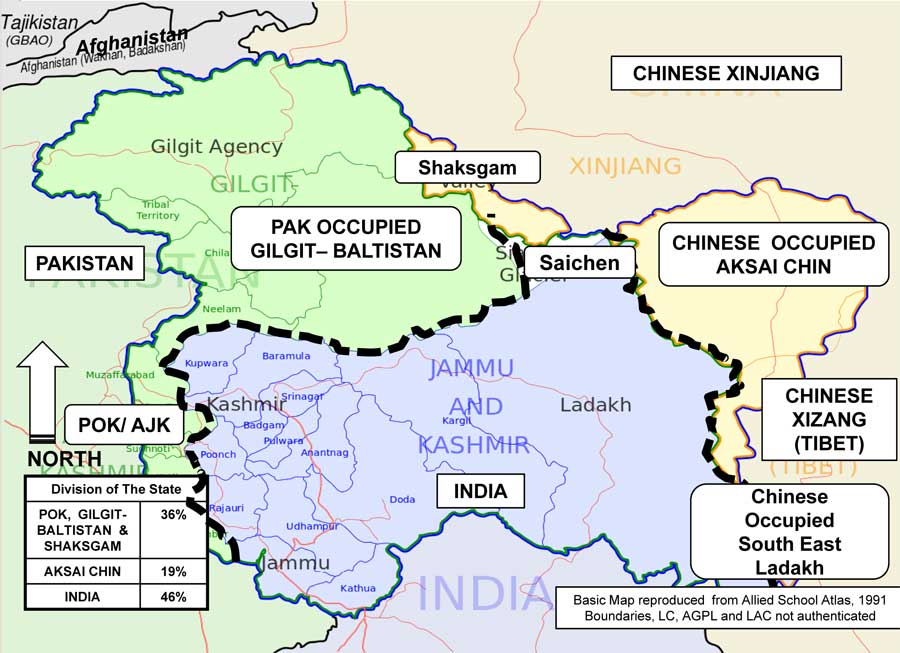
The latest process of dialogue with Kashmir Valley separatists initiated by the Yashwant Sinha-led five-member delegation is an interesting development. Notwithstanding Sinha’s claim that the delegation does not have an official status, the efforts of his team may be viewed as a Track-II internal dialogue process between the Government of India (GOI) and the Hurriyat group of Indian separatists and other stakeholders. The composition of the delegation seems to have been worked out carefully in consultation and with the blessings and support of the authorities. Wajahat Habibullah, a member of the delegation, was a former senior government functionary and has wide experience in the state’s administrative affairs. Air Vice Marshal (retd.) Kapil Kak and journalist Bharat Bhusan have an appreciation of Kashmir affairs, while Shushova Barve, a member of the Centre for Dialogue and Reconciliation, has experience working on civil society issues.

During their visit which began on October 25, the delegation interacted with most of the main Hurriyat leaders, the Kashmir Chamber of Commerce representatives, and held discussions with Governor N.N. Vohra and Chief Minister Mehbooba Mufti. It is significant that Vohra stressed on the need for a `sustained` dialogue with all stakeholders. It is appropriate that the dialogue process has resumed despite the continuing civil unrest in the aftermath of the death of Burhan Wani of the Hizb-ul-Mujahideen in a counter-insurgency operation on July 8.

The scale of the present upsurge significantly differs from past spells of unrest in 2008 or in 2010. An entire generation of youth and civil society at large seems to be involved now, even beyond the influence and control of the Hurriyat, with hardcore Pakistan-engineered militants instigating the agitators at selective places. A multi-pronged intervention is therefore required on a long-term and planned basis, to impress upon the middle rung of Kashmiri society and particularly the youth about the bona fides of the Indian state to promote economic welfare without compromising their distinctive ethnicity and culture under norms of democratic governance.