9 January 2020

The Department of Defense Posture for Artificial Intelligence

by Danielle C. Tarraf,

What is the state of AI relevant to the DoD?

What is the DoD’s current posture in AI?

What internal actions, external engagements, and potential legislative or regulatory actions might enhance the DoD’s posture in AI?

The 2019 National Defense Authorization Act mandated a study on artificial intelligence (AI) topics. In this report, RAND Corporation researchers assess the state of AI relevant to the U.S. Department of Defense (DoD), and address misconceptions about AI; they carry out an independent and introspective assessment of the Department of Defense's posture for AI; and they share a set of recommendations for internal actions, external engagements, and potential legislative or regulatory actions to enhance the Department of Defense's posture in AI.

Key Findings

Infographic Of The Day: What The Experts See Coming In 2020


While there was no firm consensus on where 2020 will take us, there were a few themes that appeared in multiple publications. Today's infographic highlights these reappearing predictions, and below, we examine seven of them in more detail.

3 Big Ways That The US Will Change Over The Next Decade

by Dudley L. Poston, Jr

The U.S. has just entered the new decade of the 2020s.

What does our country look like today, and what will it look like 10 years from now, on Jan. 1, 2030? Which demographic groups in the U.S. will grow the most, and which groups will not grow as much, or maybe even decline in the next 10 years?

I am a demographer and I have examined population data from the U.S. Census Bureau and from the Population Division of the United Nations.

Projections show that whites will decline; the number of old people will increase; and racial minorities, mainly Hispanics, will grow the most, making them the main engine of demographic change in the U.S. for the next 10 years and beyond.

What executives are reading in 2019

Time to restock your shelves? We asked leaders of some of the world’s biggest organizations to share the books they look forward to reading or revisiting.

DOWNLOADABLE RESOURCESOpen interactive popup

We have books on the brain, with the recent release of the Financial Times–McKinsey Business Book of the Year long list.1 (See coverage of last year’s winner, Bad Blood, on our blog, and check back December 3, when the 2019 award is given.) There’s inspiration aplenty in the selections, which offer compelling insights on topics crucial to business today. But we also wanted to see what CEOs and other business leaders are keeping on their shelves or tucking into their suitcases—consider it food for thought in picking your next read. Read on for selections from leaders at Novartis, PayPal, Walmart, and more.
Doug McMillon

Blockchain’s Occam problem

By Matt Higginson, Marie-Claude Nadeau, and Kausik Rajgopal
Blockchain has yet to become the game-changer some expected. A key to finding the value is to apply the technology only when it is the simplest solution available.

Blockchain over recent years has been extolled as a revolution in business technology. In the nine years since its launch, companies, regulators, and financial technologists have spent countless hours exploring its potential. The resulting innovations have started to reshape business processes, particularly in accounting and transactions.

Amid intense experimentation, industries from financial services to healthcare and the arts have identified more than 100 blockchain use cases. These range from new land registries, to KYC applications and smart contracts that enable actions from product processing to share trading. The most impressive results have seen blockchains used to store information, cut out intermediaries, and enable greater coordination between companies, for example in relation to data standards.

One sign of blockchain’s perceived potential is the large investments being made. Venture-capital funding for blockchain startups reached $1 billion in 2017. IBM has invested more than $200 million in a blockchain-powered data-sharing solution for the Internet of Things, and Google has reportedly been working with blockchains since 2016. The financial industry spends around $1.7 billion annually on experimentation.

Remembering Michael Howard Soldier, Scholar, Sage of Military History

By Lawrence Freedman 

Sir Michael Howard, who died on November 30, 2019, a day after his 97th birthday, was a giant in the worlds of military history and strategic studies. A decorated veteran who redefined the study of war, he was also a voice of reason and conscience in some of the most important policy debates of his time, offering sage commentary on subjects as wide-ranging as nuclear policy and counterterrorism. Some of his most important writings appeared in these pages, where he contributed 12 articles between 1960 and 2002.

Howard is perhaps best known for his invaluable translation of Carl von Clausewitz’s On War, undertaken with his former student Peter Paret. But it was Howard’s prize-winning book The Franco-Prussian War that established military history as a serious area of scholarship and him as a leading practitioner. Prior to the book’s publication in 1961, military histories had mainly sought to describe specific campaigns or battles. What Howard demonstrated was the need to consider the conduct of war against the backdrop of broader social and economic changes. His later works—including War in European History, War and the Liberal Conscience, and The Invention of Peace—are masterpieces of concision, capturing big themes with economy of language and elegance of style. His lectures at King’s College London, and later at Oxford and Yale Universities, were delivered with wit, timing, and an eye for telling detail.

8 January 2020

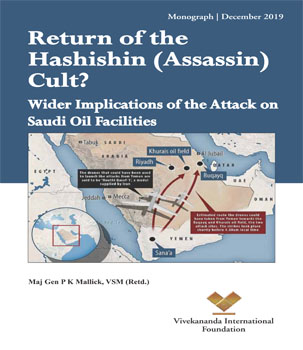
Return of the Hashishin (Assassin) Cult?: Wider Implications of the Attack on Saudi Oil Facilities

Maj Gen P K Mallick,VSM (Retd)

The attack on Saudi oil installations has large scale implications for the hydrocarbon supply to the world specially for countries like China, India and the Asian giants of Japan and South Korea. The Strait of Hormuz becomes critical for energy imports of these countries.

The Middle East has become the world’s most polarized region. Both Saudi Arabia and Iran exploit the Shiite-Sunni rift to mobilize their respective constituencies. Iran’s military strategy is to keep tensions at a low level and avoid a direct confrontation with the U.S. Even if neither side wants to fight a war it could still happen due to miscalculation and missed signals. A minor clash can lead to a regional conflagration with devastating effects for Iran, the U.S. and the Middle East. India has to remain sensitive to the happenings in the Gulf region. India spent $111.9 billion on oil imports in 2018-19. Saudi Arabia is the second-largest supplier of crude oil and cooking gas to India. Every dollar increase in the price of oil raises the import bill by around Rs10,700 crore annually.

This Monograph tries to provide how the attack took place, its effect on world economy and oil market, effects on various stake holding countries and their reactions, military implications and India’s concerns..

Trends In Terrorism: What’s On The Horizon In 2020 – Analysis

By Colin P. Clarke*

(FPRI) — As we usher in a new year, what trends in terrorism are likely to dominate the global security landscape in 2020? Geopolitical realignments, emerging technologies, and demographic shifts will all contribute to different manifestations of ideologically and politically motivated violence. Much of this will continue to have a transnational dimension, with once seemingly parochial challenges made even more complex as a result of the globalization of violence. The threat posed by transnational terrorism in 2020 thus presents a complex mosaic.

The Islamic State enters 2020 as a different group than it has been since its rise to power six years ago. The physical caliphate has been demolished, and the organization seems to be at a nadir, especially when compared to its peak, when it controlled massive swaths of territory and maintained a proto-state in the heart of the Levant. The Islamic State will continue to atomize, making the group weaker in some regards, but also making its network more difficult to target since it will be more decentralized. In Iraq and Syria, there are already reports that the group is attempting to rebuild itself, relying on guerrilla tactics and hit-and-run attacks against Iraqi security forces and the Assad regime in Syria. Sleeper cells are reportedly lying in wait to launch attacks, including bombings and assassinations.

Soleimani's Killing Sets the Stage for a Long-Term Oil Price Rise


The oil market is poised to contain the price fallout from the assassination of a key Iranian commander, but perhaps only for the immediate future....

The Big Picture

Crude oil rose nearly 4 percent on news of the U.S. strike that killed senior Iranian military official Qassem Soleimani in Iraq. In the short term, however, it will be difficult for the market to price in much more risk regarding possible Iranian retaliation without suffering actual losses in volume. In the next few weeks, Iran has reason to avoid strikes against tankers or its neighbors' oil infrastructure, but that could change in the longer term.

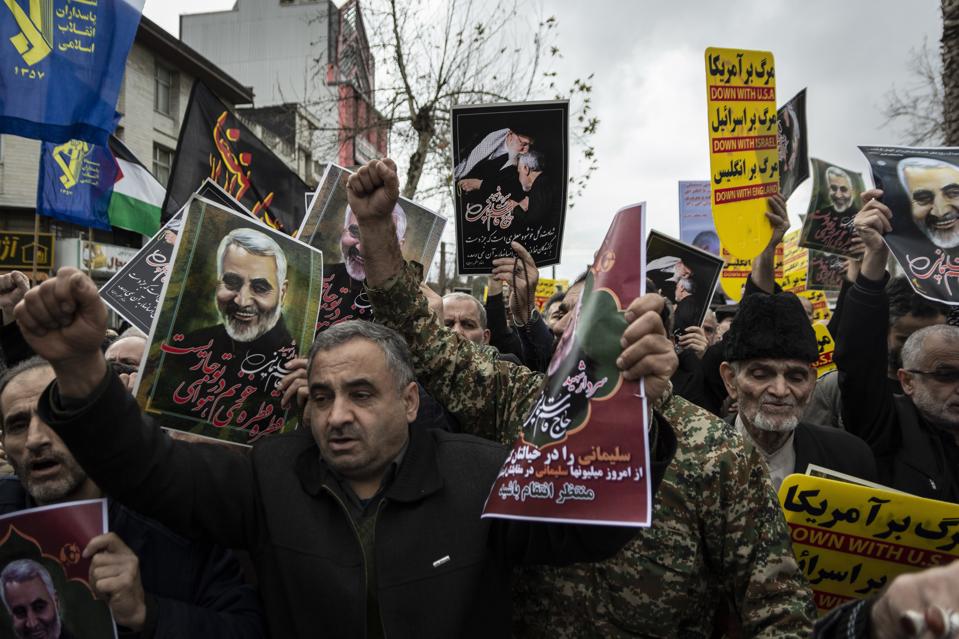
The killing of Maj. Gen. Qassem Soleimani, head of the Quds Force unit of the Islamic Revolutionary Guards Corps (IRGC), is reverberating around the world, not least of all in oil markets. The price of crude oil has surged nearly 4 percent since the United States killed the senior Iranian military leader in Baghdad early on Jan. 3 — although the rise is only about a third of the rise that occurred in the first trading session after Iran attacked Saudi oil facilities at Abqaiq and Khurais in September.

Iran has the capability to launch cyber attacks on very short notice, expert says

Akiko Fujita

Iran’s Supreme Leader Ayatollah Ali Khemanei vowed “harsh retaliation” against Washington, in response to the assassination of top General Qassem Soleimani. Intelligence experts say cyber warfare could be a primary focus, given Tehran’s vastly improved capabilities.

The country has invested heavily in its development of cyber warfare, since the destructive “Stuxnet” malware crippled Iran’s nuclear capabilities back in 2010. That has drastically reduced its response times to attacks, putting it on the same level as the U.S., according to Tom Warrick, a Non-Resident Fellow at The Atlantic Council and former Deputy Assistant Secretary for Counterterrorism Policy at the Department of Homeland Security.

“It's quite possible, as we sit here right now that Iranian cyber attacks may be launched against American targets, whether they be banks oil companies, academic institutions,” said Warrick, speaking to Yahoo Finance’s On The Move. “It's certainly clear that Iran has the capability to launch attacks on very short notice from cyber.”

Soleimani ‘Revenge’—This Is Why Iran’s Most Dangerous Cyber Weapons Will Stay Hidden

Zak Doffman

The fact the U.S. has taken the decision to kill Iran’s most powerful general, Qassem Suleimani, is less surprising than the fact it took them this long. The commander of the country’s Quds Force was viewed as an extreme threat to U.S. interests, the second most influential person in Iran behind Ali Khamenei, the most dangerous person in the region. American and European nationals have now been warned to leave a Middle East bracing for a short-term physical response that might include attacks on security and commercial facilities, on tourism and shipping, on the Strait of Hormuz.

We can expect something “immediate and spectacular,” says Philip Ingram, formerly a senior officer within British Military Intelligence, now a defence analyst—he expects “a longer term sustained escalation of proxy wars in the region, deniable terror attacks.” The significance of Soleimani’s killing “cannot be underestimated,” he tells me, but the organisation survives, with a protege in charge.

US officials, lawmakers warn of potential Iranian cyberattacks

BY MAGGIE MILLER
Senior government officials and lawmakers warned Friday that Iran may attempt to carry out cyberattacks against the U.S. in retaliation for the killing of Quds Force commander Qassem Soleimani.

"The Iranians have a deep and complex cyber capability, to be sure. Know that we have certainly considered that risk,” Secretary of State Mike Pompeo said on Fox News.

His remarks came the same day that Iranian Supreme Leader Ayatollah Ali Khamenei said a “harsh retaliation is waiting” for the U.S. after President Trump ordered a drone strike in Baghdad that killed Soleimani.

Lawmakers said the strike has raised the odds of possible attacks from Iran, long-identified as one of the top international cyber threats to the U.S.

House Homeland Security Committee Chairman Bennie Thompson (D-Miss.) told The Hill in a statement that “President Trump’s reckless actions in the Middle East have made us less secure and risk serious consequences for the security of the homeland by escalating an already volatile situation. We have to be vigilant.”

US government agency website hacked by group claiming to be from Iran


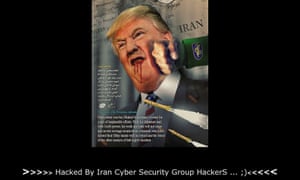
A group claiming to be hackers from Iran have breached the website of a little-known US government agency and posted messages vowing revenge for Washington’s killing of top military commander Qassem Suleimani.

The website of the Federal Depository Library Program was replaced on Saturday with a page titled “Iranian Hackers!” that displayed images of Iran’s supreme leader Ayatollah Ali Khamenei and the Iranian flag.

“Martyrdom was (Suleimani’s)... reward for years of implacable efforts,” read a graphic depicting US president Donald Trump being punched by a fist emanating from Iran as missiles fly by.

Will Iran’s Response to the Soleimani Strike Lead to War?

By Ilan Goldenberg 

Qasem Soleimani, commander of the Islamic Revolutionary Guard Corps Quds Force, was one of the most influential and popular figures in the Islamic Republic and a particular nemesis of the United States. He led Iran’s campaign to arm and train Shiite militias in Iraq—militias responsible for the deaths of an estimated 600 American troops from 2003 to 2011— and became the chief purveyor of Iranian political influence in Iraq thereafter, most notably through his efforts to fight the Islamic State (ISIS). He drove Iran’s policies to arm and support Syrian President Bashar al-Assad, including by deploying an estimated 50,000 Shiite militia fighters to Syria. He was the point man for Iran’s relationship with Hezbollah in Lebanon, helping to supply the group with missiles and rockets to threaten Israel. He drove Iran’s strategy to arm the Houthis in Yemen. For all these reasons and more, Soleimani was a cult hero in Iran and across the region.

In short, the United States has taken a highly escalatory step in assassinating one of the most important and powerful men in the Middle East.

Killing Iran’s Qassem Soleimani changes the game in the Middle East

By Daniel Byman 
Source Link

On Thursday night, the Pentagon announced that the United States killed Maj. Gen. Qassem Soleimani, the head of Iran’s paramilitary forces, in an airstrike in Iraq “at the direction of the President.”

The strike that took out Soleimani also reportedly killed the leader of Kataib Hezbollah, an Iranian proxy militia in Iraq that has repeatedly attacked US and allied forces and recently launched rockets at a US military base. Those attacks killed an American contractor, which led the United States to respond and kill 25 operatives in attacks in Iraq and Syria. In separate operations, US forces have also captured and arrested leaders of other important Iraqi militias with close ties to Iran.

The killing of Soleimani, the long-time head of Iran’s Islamic Revolutionary Guard Corps Quds Force (IRGC-QF) is likely to prove a watershed in Washington’s relations with Iraq and Iran and will substantially affect the overall US position in the Middle East. The blowback may be huge, and much depends on how well prepared the United States is for Iran’s response and that of its many proxies in the Middle East.

How to Avoid Another War in the Middle East

By Kelly Magsamen
Source Link

Killing the Iranian commander Qasem Soleimani may well have been the most consequential foreign policy decision of Donald Trump’s presidency. Its repercussions will be felt for days, months, and even years to come—but what exactly they will be depends on what the Trump administration does next.

The strike has been explained by senior U.S. officials as both an effort to deter future Iranian aggression and an act of preventive defense in the face of an imminent attack. Trump and Secretary of State Mike Pompeo are already out crowing with patriotic tweets reminiscent of the “Mission Accomplished” banners rolled out in the first weeks of the Iraq war. But what was true then in Iraq is true now: the crisis will not end here.

Iran’s retaliatory actions will unfold over time, often in ways no one expects, and they won’t be limited to Iraq or even to the Middle East. The Trump administration needs to prepare for a full range of contingencies: cyberattacks, terrorist attacks abroad and on U.S. soil, attempts to assassinate U.S. officials, and more assaults on Saudi oil fields. Iran will likely take more provocative steps on its nuclear program: in fact, the country was already expected to announce its latest move away from the 2015 nuclear accord, the Joint Comprehensive Plan of Action (JCPOA).

Johns Hopkins University Applied Physics Laboratory

Johns Hopkins APL Technical Digest, v. 35, no. 1, 2019

o Defense Advanced Research Projects Agency Spectrum Collaboration Challenge at APL: Introduction

o Overview of the Colosseum: The World’s Largest Test Bed for Radio Experiments

o Software Project Management for the Defense Advanced Research Projects Agency Spectrum Collaboration Challenge

o Development and Operations on the Defense Advanced Research Project Agency’s Spectrum Collaboration Challenge

o The Resource Manager for the Defense Advanced Research Projects Agency Spectrum Collaboration Challenge Test Bed

o Standard Radio Nodes in the Defense Advanced Research Projects Agency Spectrum Collaboration Challenge

The challenge of non-state actors and stand-off weapons

The proliferation of ballistic missiles, cruise missiles and uninhabited aerial vehicles to non-state actors in the Middle East represents a future challenge for national militaries, explores Timothy Wright.

Ongoing wars in the Middle East are setting a worrying precedent, revealing a proliferation in the region not only of ballistic missiles, but also cruise missiles and improvised stand-off munitions in the form of low-cost uninhabited aerial vehicles (UAVs). Iranian ballistic- and cruise-missile technology has been ‘supplied’ to Ansarullah in Yemen, while Iranian-sourced weapons in Hizbullah arms depots in Syria continue to be attacked by the Israeli Air Force.

The latest round of Israeli airstrikes against alleged Iranian missile depots in Syria and recurrent missile attacks by the Houthis against a variety of targets in southern Saudi Arabia underscore the extent of the proliferation of precision-guided missiles and associated missile technology to non-state actors in the Middle East.
Ansarullah and Hizbullah

Ansarullah’s use of ballistic and cruise missiles and UAVs – the latter deployed as improvised stand-off munitions – is an attempt to begin to offset the Saudi-led coalition’s air power in Yemen’s civil war. The group’s ability to strike back, however limited, has propaganda value in this regard.

Fleet commander directs US Navy’s surface force to develop concepts for unmanned ships

By: David B. Larter 

WASHINGTON — The head of the U.S. Navy’s Fleet Forces Command has ordered the service’s surface force to develop a concept of operations for both the large and medium unmanned surface vessels in development, according to a Dec. 19 message seen by Defense News.

The message, which was coordinated with U.S. Naval Forces Europe and U.S. Pacific Fleet, directs the surface fleet’s Surface Development Squadron to develop concepts for “the organization, manning, training, equipping, sustaining, and the introduction and operational integration of the Medium Unmanned Surface Vehicle and Large Unmanned Surface Vessel with individual afloat units as well as with Carrier Strike Groups, Expeditionary Strike Groups, and Surface Action Groups.”

The message comes after a long battle with Congress over funding for unmanned surface combatants, during which lawmakers expressed skepticism that the Navy was knowledgeable enough about the technology for which it was seeking funding. Ultimately Congress appropriated funds for the Navy to buy two large unmanned surface vessels, but lawmakers forbade the service from equipping the vessels with vertical launch tubes, as the Navy intended.

Trump and His Generals: The Cost of Chaos

Neil Hassler

Veteran journalist Peter Bergen’s new book, Trump and His Generals: The Cost of Chaos, is a deeply reported account of the politics and personalities of the Trump administration’s foreign policy. Bergen focuses on the major military-turned-bureaucratic personalities of the Trump administration: former Secretary of Defense and retired Marine General, James N. Mattis; former Secretary of Homeland Security and Chief of Staff, as well as Retired Marine General John F. Kelly; and former National Security Advisor and Army Lieutenant General H.R. McMaster.

The book’s narrative arc begins with the President’s desire to staff his administration with highly respected military officials and concludes with the President’s growing self-reliance on national security and foreign policy matters. The book touches on a number of important themes, including a potential return to great power competition, the fracturing of the western alliance, and an increasingly wary American approach to the world.

NH: Describe what the President’s affinities for staffing military officials in his administration tell us about his foreign policy views and commitments?

Is This The Next Great Oil Frontier?

By Meredith Taylor 
Source Link

Now Namibia is joining the African oil conversation with one of the most oil-friendly regimes on the continent. It’s offering 5% royalties on what might just be a very productive shale play in Reconnaissance Africa’s (RECO.V) Kavango Basin.

Emerging markets are where oil upside might be found these days but navigating them is a challenge.

As Africa’s largest producer of oil, Nigeria has outsized status in the hydrocarbons world. But the party is coming to an end from an investor’s standpoint.

Nigeria is home to about 37 billion barrels in oil reserves. And while it’s got some 32 active oil rigs out there, only 81 wells were completed last year - down from 141 in 2014.

Since oil prices started tumbling in 2014, the government has been taking more from oil companies, with back taxes and new legislation. Now, it wants majors Chevron, Shell and French Total SA to pay them around $62 billion. It claims in was short-changed under a revenue-sharing agreement dating back to the 1990s.

CSIS Bad Idea: Debating Grand Strategy

By MATTHEW FEY

It is fitting that the last in our series from the Center for Strategic and International Studies (CSIS) on “Bad Ideas in National Security” should center on the role of ‘grand strategy’ in US foreign and military policy. Readers of history will recall that the pre-eminent grand strategy of the Cold War was ‘containment’ of the Soviet Union and the Communist ideology, crafted by senior diplomat George Kennan, writing anonymously as ‘Mr. X’ in Foreign Affairs in 1947. Since then, US pundits, theorists, diplomats, and former statesmen/women have been struggling to come up with something similar for the post-Cold War world, and as CSIS’s Matthew Fey argues below, largely failed — perhaps because the task itself is impossible.

The desire to author a new grand strategy is a longstanding and understandable tradition in American foreign policy. Indicative of the professional renown accorded to ostensible grand strategists, the contest to identify a post-Cold War successor to containment was glibly referred to as the “Kennan Sweepstakes.” Entries in the contest have thus proliferated ever since, and the contest continues today.

There are fewer wars when you take power away from men in big castles

Source Link


Russian President Vladimir Putin is one of the foremost practitioners of old power, while other nations are handing more power to the people. Itar Tass / Reuters

Those who have power want to be told they have it and how to keep it. Those that don't have power want someone to envy. As a result, the audience for books on power is seemingly endless.

So I was initially cautious about another one released this week – but New Power by Jeremy Heimans and Henry Timms turns out to be a nifty guide to the 21st century that is genuinely new. Instead of one more catchy way of describing how the world works, they have written a manifesto for organising that world with more humanity and purpose.

Ultimately you'll either hate it or wish you had written it, depending on whether you believe in old or new power.

But what does that actually mean? For Heimans and Timms, old power is closed, inaccessible, top down and spent carefully. Think of a traditional currency. Old power values are more formal and managerial. Old power thrives on competition, confidentiality and exclusivity. You can picture the colleague. Donald Trump's "I alone can fix this" is the motto of this power model. It has dominated history.

The Embassy Attack Revealed Trump’s Weakness

Peter Beinart

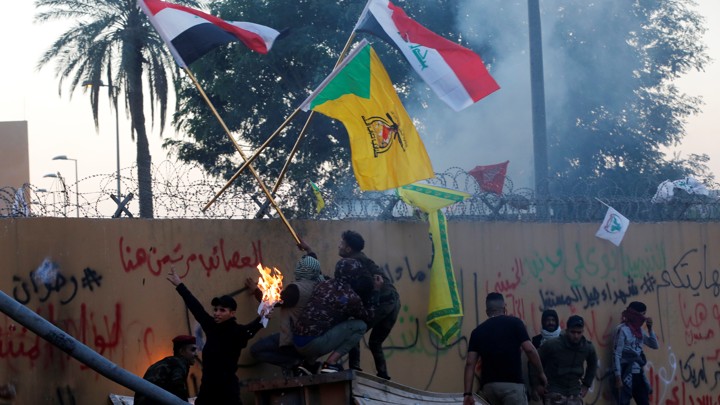
Over the past 18 months, Donald Trump has picked a fight with Iran that he won’t end and can’t win. That fight has had horrifying consequences for the Iranian people, led Tehran to restart its nuclear program, and now left parts of the American embassy compound in Baghdad in flames. In the days and weeks to come, Trump’s policy will likely lead either to war or to additional American humiliation, or both.


The fight began in May 2018, when the Trump administration left the Iran nuclear deal, and intensified last spring, when the United States designated Iran’s Revolutionary Guard Corps a terrorist organization and moved to shut off Iran’s ability to export oil. Numerous observers warned that Iran would meet America’s escalation with escalation of its own. The Revolutionary Guard Corps designation, The New York Times reported last April, “was opposed by some top Trump administration national security officials who said it could incite retaliation by Tehran against American troops and intelligence officers.” The following month, the Times added that “in private meetings, military officials have warned the White House that its maximum-pressure campaign against Iran is motivating … threats to United States troops and American interests in the Middle East.” In The Atlantic that same month, Mike Giglio noted, “The militia groups that act as Iranian proxies in Iraq … would be an effective tool for further [Iranian] escalation” against the U.S.

The End of the Soft-Power Delusion

By TAYLOR DINERMAN

The aircraft carrier USS Ronald Reagan under way in the South China Sea, August 2018. (Mass Communication Specialist Second Class Kaila V. Peters/US Navy)After decades of wishful thinking, it’s finally become clear that cultural influence is no substitute for economic and military strength in foreign policy.

On the night of October 2, 2019, Comedy Central broadcast the South Park episode “Band in China,” a devastating satire of the way Beijing has used access to the Chinese market to shape how the U.S. entertainment industry operates. The plot involves one of the main characters’ going to China to try and sell marijuana, getting arrested, and being rescued by Mickey Mouse and the Disney corporation, whose subservience to China is emphasized. Disney agrees to kill Winnie the Pooh, supposedly for resembling the Chinese leader, in exchange for opening up the Chinese pot market. Meanwhile, back in the U.S., some of the other main characters are trying to make a movie while being supervised and censored by the Chinese military.

“Band in China” made it clear that Hollywood’s soft power was no match for Beijing’s economic hard power. Indeed, the American entertainment industry has failed to have any cultural influence on China, while China has used its hard power to neutralize the influence of American culture.

A New Cold War…With Eurasia?

JAMES PINKERTON
Source Link

Amidst all the headlines—taking note of the end of the year, as well as the end of the decade—one headline, for this author, stands out. That headline looms large not because it speaks of something that has happened, but because it speaks of something that could happen. That is, a new Cold War, in which the U.S. is forced to square off with dominant Eurasian powers, operating in unison. That’s a scary concept, made even scarier, of course, by the risk that a cold war can always get hot.

The headline in the December 28 Financial Times was modest, even if it did appear on the front page: “US rivals launch Mideast war games.” As the newspaper put it, “Russia, China, and Iran launched their first joint naval exercises in the Gulf of Oman yesterday, throwing down a direct challenge to U.S. influence in the Middle East.”

We might pause over those words, “a direct challenge to U.S. influence.” The article quoted Iranian admiral Gholamreza Tahani as saying, “The most important achievement of these drills . . . is the message that the Islamic Republic of Iran cannot be isolated.” Tahani added, “These exercises show that relations between Iran, Russia, and China have a reached a new high level while this trend will continue in the coming years.”

A Decade of No Lessons Learned in U.S. Overseas Intervention

BRIAN DOHERTY 

As this decade began, U.S. armed forces were in year nine of their occupation of Afghanistan. A fresh surge of new U.S. military personnel was sent in by then-President Barack Obama that raised troop levels there to just below 100,000 by August 2010. The estimated expense of the occupation for 2010 was $94 billion, with a cumulative total through the end of that year of $338 billion.

Obama had promised he'd start to reverse his troop surge by July 2011, and it seemed just barely possible that the Nobel Peace Prize winner might actually end a U.S. war in the 2010s.

Instead, not counting 2010, this decade has seen its own cumulative cost of our Afghanistan adventure come in at $690 billion. In 2019, civilian casualties in that tortured nation hit all-time quarterly highs.

Royal United Services Institute (RUSI)


Nuclear Power in a Changing UK 

Tactical Nuclear Weapons and Deterrence Stability in South Asia 

Britain’s Weapons Establishment and Tacit Knowledge: Selling Skills 

Could Generation IV Nuclear Reactors Strengthen Russia’s Growing Sphere of Influence? 

Deterrence Goes Orbital 

New Futures for Nuclear Arms Control: Hypersonic Weapons 

Conventional and Nuclear Applications of Artificial Intelligence: A Brief Examination of India and Pakistan 

The Impact of Artificial Intelligence on Strategic Stability, Escalation and Nuclear Security 

A Troubling Forecast: Climate Change and the Future of Nuclear Deterrence 

UK Political Understanding of the Term ‘Nuclear Deterrence’: Addressing a Deficiency 

More than a Mission: Simulating a Support Solution to Achieve Submarine Availability, Cost and Safety 

Betwixt and Between Transformation? India and Nuclear South Asia 

The UK and the Ban Treaty 


The World Didn’t Change Much in 2019. That’s Bad News for 2020.

BY STEPHEN M. WALT
Source Link

It’s not hard to think of worthy candidates in the category of “most significant foreign-policy event of 2019.” Pick your poison: the Hong Kong protests, the whistleblower revelations that led to the House of Representatives voting to impeach U.S. President Donald Trump, the Amazon and Australian fires, British Prime Minister Boris Johnson’s electoral triumph, or Indian Prime Minister Narendra Modi’s march toward a new and narrower conception of Indian nationalism. Or if you prefer to look on the bright side, maybe you’d cite the U.S. stock market, the record number of women sworn into the 116th Congress, or the progress made in addressing diseases such as cystic fibrosis and Ebola.

But when it comes to foreign policy, the most significant feature of 2019 was the persistence of the status quo. Trump’s boorish antics continued to alarm and kept the chattering classes busy, but 2019 was a potential turning point where most aspects of world politics failed to turn. I’m by nature a bit of a Burkean conservative, but this degree of stasis may not be a good thing.

Consider the following:

Why the Berlin Wall Still Matters

BY JUSTIN JAMPOL
Source Link

The Newseum in Washington, D.C.—which closed in December—had long featured a BT-9, the iconic and infamous guard tower that loomed over the death strip behind the Berlin Wall, its wardens watching for any potential escapees from the East or provocations from the West.

BT stands for Beobachtungsturm, or observation tower. The succeeding number refers to the height. BT-9 meant the structure was nine meters (some 30 feet) high. The tower featured a semi-automated spotlight, rifle racks, flares, Carl Zeiss Jena optics, communications equipment, and even heating for cold Berlin nights.

This particular tower design, unveiled in 1975, represented years of research and advancements, transforming the border from cinder blocks with barbed wire to a sophisticated surveillance system of walls, tank traps, mines, towers, motion sensors, and guard dogs.

And it worked.

The Year of the Trade Truce

BY SALVATORE BABONES

U.S. President Donald Trump meets with Chinese Vice Premier Liu He and members of the U.S. and Chinese trade negotiation teams while announcing a “phase one” trade agreement with China at the White House on Oct. 11. 

Impeachment used to be a big deal. The 1868 impeachment of U.S. President Andrew Johnson paralyzed Congress for three months, and the Senate came within one vote of removing him from office. President Bill Clinton’s 1999 trial lasted five weeks, with many Republicans joining the minority Democrats in rejecting the charges. President Donald Trump’s trial could be over in a day, if Senate Majority Leader Mitch McConnell sees no political benefit in prolonging it. Even if it goes on longer, Trump will be exactly where he most likes to be: at the center of attention.

Thinking back to the early days of the Trump presidency, no one would have been surprised by the thought that, within three years, he would be impeached. People might be considerably more surprised to hear that he would successfully renegotiate the North American Free Trade Agreement and obtain broad congressional support for the new deal. They would be even more shocked to discover that mainstream political opinion had swung behind his trade war with China.

Going Backwards in the “Race for 5G”

By Tom Wheeler 

The collision of corporate opportunism and Republican anti-government orthodoxy has pushed the United States backwards on the allocation of important spectrum for fifth-generation wireless networks (5G). Positioning the U.S. as engaged in no-holds-barred competition with China, President Trump declared in April, “The race to 5G is on and we must win.” With typical bravura, he then promised, “my administration is freeing up as much wireless spectrum as is needed.”

Unfortunately, such is not the case when it comes to the most desired piece of 5G spectrum. Thanks to the Trump Federal Communications Commission (FCC), the effort to free up a large and important piece of 5G spectrum known as C-Band is farther behind at the end of 2019 than it was at the beginning of the year.

A Phone Call

7 January 2020

India–UK counter-terrorism cooperation: convergences and challenges

Rahul Roy-Chaudhury

Cooperation on counter-terrorism is an important, but little-known, aspect of the India-UK security relationship. This was formally institutionalised in 2002 with the establishment of their foreign ministry-led Joint Working Group (JWG) on Terrorism. Continued and more sustained cooperation on counter-terrorism will remain key to a meaningful bilateral strategic partnership.

Both countries have a strong shared interest in preventing terror attacks on their mainland, having suffered such attacks in the recent past. The deadliest single terror act on British soil took place in London on 7 July 2005; one of the most devastating terror attacks in India took place in Mumbai on 26-28 November 2008. With the Indian government now perceiving terrorism as the single biggest threat to peace, security and development, counter-terrorism has emerged as one of Indian Prime Minister Modi’s top priorities for bilateral and multilateral cooperation.

Bilateral cooperation

Suicide Bombings Worldwide in 2019: Signs of Decline following the Military Defeat of the Islamic State

Yoram Schweitzer, Aviad Mendelboim, Dana Ayalon
Source Link

Suicide bombings in 2019, despite a sharp decline in number from the previous year, remained one of the most effective tactics available to terrorist groups. The drop in number is in keeping with an ongoing (albeit more modest) decline seen in recent years, but the figures of 2019 can be attributed to the final military defeat of the Islamic State. Therefore, while the Islamic State and its affiliates - the organizations that since 2015 have committed the most suicide bombings – remain the groups primarily responsible for suicide bombings, the actual number of attacks plummeted. According to collected data in 2019, 149 suicide bombings were carried out in 24 countries by 236 suicide bombers, among them 22 women. In these suicide bombings, 1,850 people were killed and 3,660 were wounded.In 2019, around 149 suicide bombings were carried out worldwide (compared to around 293 in 2018 - a decline of around 49 percent). For the second consecutive year, the most active arena in this regard was Asia, where around 68 suicide bombings were carried out – primarily in Afghanistan - accounting for 45.5 percent of all suicide bombings globally. In the Middle East, around 47 suicide bombings were carried out in 2019, accounting for around 31.5 percent of all suicide bombings. In Africa, around 33 such attacks were carried out in 2019, accounting for around 22 percent of attacks during the year. Latin America saw a sole, rare attack, launched in Colombia, by the National Liberation Army, killing 21 people.

What to worry about: 6 top risks to watch for in 2020

BY ROBERT A. MANNING

2019 brought no great surprises or “black swans.” But the fragile world order did move further down the path of unraveling. What to worry about in 2020? Some nasty disruptions may lie ahead. Here’s the top of my list of things to watch out for in 2020:

2020 elections: Either a Trump reelection or a victory for a Democratic challenger is bound to deepen U.S. political tribalism. A Trump victory would likely result in four more years of U.S. withdrawal from the multilateral world order and a global leadership deficit, while a narrow Trump loss could cause domestic political turmoil. A Democratic victory and left populist economic policies could also fuel uncertainty and turmoil in markets; 

Brexit: One certainty is that Brexit will finally occur, with the United Kingdom out of the European Union by January 31. But political and economic uncertainties abound. A U.K.-EU trade deal may drag out beyond 2020. Brexit may lead to the breakup of the United Kingdom, as the Scottish Nationalist Party pursues another independence referendum and Irish nationalist MPs strong election performance in Northern Ireland positions them to ponder their future; London’s global financial hub is also at risk;