18 January 2014

Failing elites threaten our future

January 15, 2014

In 2014, Europeans commemorate the 100th anniversary of the start of the first World War. This calamity launched three decades of savagery and stupidity, destroying most of what was good in the European civilisation of the beginning of the 20th century. In the end, as Churchill foretold in June 1940, “the New World, with all its power and might”, had to step “forth to the rescue and the liberation of the old”.

The failures of Europe’s political, economic and intellectual elites created the disaster that befell their peoples between 1914 and 1945. Their ignorance and prejudices allowed catastrophe: false ideas and bad values were at work. These included the atavistic belief, not just that empires were magnificent and profitable, but that war was glorious and controllable. It was as if a will to collective suicide seized the leaders of great nations.

Complex societies rely on their elites to get things, if not right, at least not grotesquely wrong. When elites fail, the political order is likely to collapse, as happened to the defeated powers after first World War. The Russian, German and Austrian empires vanished, bequeathing weak successors succeeded by despotism. The war also destroyed the foundations of the 19th century economy: free trade and the gold standard. Attempts to restore it produced more elite failures, this time of Americans as much as Europeans. The Great Depression did much to create the conditions for the second World War. The cold war, a conflict of democracies with a dictatorship sired by the first World War, followed.

Epic failures

The dire results of elite failures are not surprising. An implicit deal exists between elites and the people: the former obtain the privileges and perquisites of power and property; the latter, in return, obtain security and, in modern times, a measure of prosperity. If elites fail, they risk being replaced. The replacement of failed economic, bureaucratic and intellectual elites is always fraught. But, in a democracy, replacement of political elites at least is swift and clean. In a despotism, it will usually be slow and almost always bloody.

This remains true today. If one looks for direct lessons from the first World War for our world, we see them in the Middle East, on the borders of India and Pakistan and in the vexed relationships between a rising China and its neighbours. The possibilities of lethal miscalculation exist in all these cases, though the ideologies of militarism and imperialism are, happily, far less prevalent than a century ago. Today, powerful states accept the idea that peace is more conducive to prosperity than the illusory spoils of war.

Yet this does not, alas, mean the West is immune to elite failures. On the contrary, it is living with them. But its failures are of mismanaged peace, not war.

We Hacked North Korea With Balloons and USB Drives

An airborne challenge to Kim Jong Un’s information monopoly
JAN 15 2014

Former North Korean defectors release balloons containing one-dollar banknotes, radios, CDs and leaflets denouncing the North Korean regime near the demilitarized zone in Paju, South Korea, on January 15. (Reuters/Kim Hong-Ji)

PAJU, South Korea — At the base of a mountain almost two miles from the North Korean border, the giant helium balloons slowly float upward, borne by a stiff, cold wind. These are not balloons in the conventional sense—the transparent, cylindrical tubes covered in colorful Korean script are more than 20 feet in length and each carries three large bundles wrapped in plastic. The characters painted on one of the balloons reads, “The regime must fall.”

The launch site is at the confluence of the Imjin and Han Rivers, which form the border with North Korea. From here, it’s possible to see the Potemkin village constructed on the shores across the river. The picturesque agrarian hamlet is really just a series of uninhabited sham structures, which contrast sharply with the bustle and industry of the South Korean side. Using binoculars we can see people “walking” back and forth and pretending to till the land despite below-freezing temperatures.The embargo of information into and out of the country has forced human rights groups to be creative in their methods of reaching North Korean citizens.

We’re here to hack the North Korean government’s monopoly of information above the 38th parallel on the Korean peninsula. The North Korean dictatorship continues to be one of the most totalitarian regimes on the planet. While other regimes oppress their dissidents and censor the Internet, North Korea has no dissidents and no connection to the outside world. It has no Internet. The Kim family rules with absolute authority, arbitrarily imprisoning or executing anyone who stands in their way. The regime goes even further; not only is the offender imprisoned, but entire generations of his family are also sent to the gulags. The embargo of information into and out of the country has forced human rights groups to be creative in their methods of reaching North Korean citizens.

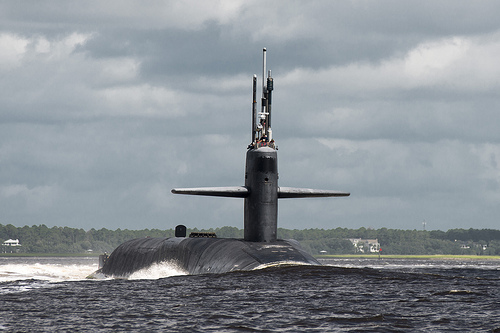
The Five Best Submarines of All Time

Published on The National Interest (http://nationalinterest.org)
January 18, 2014

Editor’s Note: Please also see the Top Five Naval Battles of All Time [3] and Top Five Fighter Aircraft of All Time [4].

There have been three great submarine campaigns in history, and one prolonged duel. The First and Second Battles of the Atlantic pitted German U-boats against the escorts and aircraft of the United Kingdom and the United States. The Germans very nearly won World War I with the first campaign, and badly drained Allied resources in the second. In the third great campaign, the submarines of the US Navy destroyed virtually the entire commercial fleet of Japan, bringing the Japanese economy to its knees. US subs also devastated the Imperial Japanese Navy, sinking several of Tokyo’s most important capital ships.

But the period most evocative of our modern sense of submarine warfare was surely the forty year duel between the submarines of the USSR and the boats of the various NATO navies. Over the course of the Cold War, the strategic nature of the submarine changed; it moved from being a cheap, effective killer of capital ships to a capital ship in its own right. This was especially the case with the boomers, submarines that carried enough nuclear weapons to kill millions in a few minutes.

As with previous “5 Greatest” lists [5], the answers depend on the parameters; different sets of metrics will generate different lists. Our metrics concentrate on the strategic utility of specific submarine classes, rather than solely on their technical capabilities.

· Was the submarine a cost-effective solution to a national strategic problem?

· Did the submarine compare favorably with its contemporaries?

· Was the submarine’s design innovative?

And with that, the five best submarines of all time:

U-31:

The eleven boats of the U-31 class were constructed between 1912 and 1915. They operated in both of the periods of heavy action for German U-boats, early in the war before the suspension of unrestricted warfare, and again in 1917 when Germany decided to go for broke and cut the British Empire off at the knees. Four of these eleven boats (U-35, U-39, U-38, and U-34) were the four top killers of World War I; indeed, they were four of the five top submarines of all time in terms of tonnage sunk (the Type VII boat U-48 sneaks in at number 3). U-35, the top killer, sank 224 ships amounting to over half a million tons.

The Benefits of Being Clear on Taiwan

Could making whatever implied understanding exists on Taiwan more explicit reduce tensions in East Asia?

By Amitai Etzioni
January 17, 2014

Making more explicit that which is viewed by many as an implicit understanding between China and the United States regarding the status of Taiwan would constitute a major step in defusing tensions between the two powers. The governments of both China and the United States have already shown considerable restraint in this matter, ignoring demands from Chinese who wish to use force to “reclaim” Taiwan as part of the mainland and from Americans who call for recognizing Taiwan as an independent nation. These measures of self-restraint should be made more explicit, by letting it be known that as long as China does not use force to coerce Taiwan to become part of the People’s Republic of China (as it did with Tibet), the United States will continue to refrain from treating Taiwan as an independent state.

True, the way Taiwan is treated is currently a much less pressing issue than settling the differences about the status of the Senkaku/Diaoyu islands and other territorial matters concerning the South China Sea and the various re drawings of Air Defense Identification Zones (ADIZ) in the region. However, if one seeks to resolve simmering conflicts and to draw on such resolutions to build constructive relations between China and the United States based on mutually assured restraint – rather than containment or a Cold War-style arms race – clarifying the status of Taiwan could serve as a major step forward.

I recently asked eight experts on Taiwan whether there was an implicit understanding between China and the U.S. about the ways Taiwan should be treated. Five responded that there was no such understanding; two responded by saying that the answer to my question was not clear; and one held that indeed there was such an understanding. The range of their responses serves to verify that the issue surely could benefit from clarification. Indeed, it turns out that matter is far more complex than it may at first seem.

One scholar wrote, “You are correct that there is an implicit agreement between U.S. and China that China will not use military force to “reclaim” Taiwan. […] There is an implicit understanding between U.S. and Taiwan that should China invade Taiwan, the U.S. may intervene, partly to honor the fact that Taiwan has been an important ally in the Pacific Rim and partly to protect U.S. interests in the region.”

Another scholar, however, wrote, “I am not aware of any such implicit understanding. That is why the Taiwan issue remains such a sensitive issue in U.S.-China relations. Many assume that the U.S. would defend Taiwan if China attacked without provocation, but that it would not if Taiwan declared independence unilaterally. The U.S. [government] has never made clear what its policy actually is, if it indeed has a policy other than encouraging neither side to upset the status quo.” Note that after indicating that he is unaware of such an understanding, this expert outlines a key element of such an understanding. The fact that it is not “clear” and merely “many assume” is what others might view as an implicit understanding.

The Cost of an Army Path in the Pacific

January 16, 2014

PACIFIC OCEAN ( Dec 9, 2013) Sailors aboard the guided-missile cruiser USS Lake Erie (CG 70) direct an Army OH-58 Kiowa Warrior helicopter from the 25th Combat Aviation Brigade (25th CAB) off the coast of Hawaii during joint training operations. The 25th CAB is expected to participate similarly in other training exercises in 2014. (U.S. Navy photo by Chief Mass Communication Specialist John M. Hageman/Released)

The following contribution is submitted by Major David Andersen, US Marine Corps.

Recently, Rajiv Chandrasekaran discussed the Army’s efforts to become more expeditionary and maritime capable. Yet, as Mr. Chandrasekaran points out; the United States already has a maritime expeditionary force: the Marine Corps. 

In business, new initiatives are challenged by various barriers such as cost, equipment design, licensing, and market saturation. If a hardware store wants to expand its business, it’s unlikely to diversify into car tune-ups. Just because a handyman can turn a wrench doesn’t mean he can drop an engine. However similar the Army and Marine Corps may appear to the untrained eye, the same may be said regarding amphibious operations. While the Army did amphibious landings quite well in World War II, they involved a short time at sea as a preamble to the sustained operations ashore that armies are designed for. Today’s amphibious operations are more diverse and require a force designed, trained and equipped to operate at and from the sea over extended periods—as Marines are.

The Army’s current barriers include: 

Cost: Army equipment is not “marinized;” a process where everything from engine intake systems to the metals and paints used are designed to withstand high levels of salt water so that corrosion can be minimized and service life extended. This is why several Army aircraft were scrapped after Operation Uphold Democracy in Haiti, as Mr. Chandrasekaran pointed out. The Army subsequently explored the price of marinization and concluded it was cost-prohibitive.

Equipment design: The majority of Army helicopters have neither rotor brakes nor folding blades and tail booms. These features are unnecessary for land-based operations but essential for safety, shipboard stowage, and operational tempo reasons in sea-based operations. Without brakes rotor blades continue spinning for extended periods of time, gradually drooping as they slow and endangering crews and equipment on a pitching flight deck. Without folding components most Army helicopters take up an inordinate amount of precious deck space on an amphibious ship. A few do have manually folding blades to permit occasional embarkation in C-17 transport planes, rather than the faster and less manpower intensive automated type found in Marine aircraft. As a result, in the time it takes to tow, spread, spot and start a single Army H-60, a typical Marine squadron can launch two full waves of six aircraft. 

Shale or not, emissions will continue to rise

January 18, 2014
Fiona HarveyTerry Macalister

Global greenhouse gas emissions are set to rise by nearly a third in the next two decades, putting hopes of curtailing dangerous climate change beyond reach, a new report by BP has found. The drastic rise in emissions, despite international efforts to cut carbon, will reportedly come despite the predicted enormous growth in the use of shale gas.

Shale gas, previously inaccessible because the exploitation of these resources requires technology that have only recently been perfected, will account for a rising proportion of the growth in energy in the years approaching 2035, but its use will not cause a decline in greenhouse gases.

The finding deals a blow to proponents of shale gas, who have argued that its use will cut emissions. Burning gas produces much less carbon dioxide than burning coal, but the effect of a huge rise in shale gas exploration will not ameliorate the increases in emissions that scientists say will take the world to dangerous climate change.

Proponents of the fuel have argued that shale gas can counteract dependence on coal. But while shale gas use has increased dramatically, particularly in the United States, where it brought down gas prices from $12 to below $3 at one stage, global emissions have continued to rise as the coal that would otherwise have been used has been exported elsewhere.

BP in its global energy outlook said gas would take a 27-per-cent share of global energy consumption and global emissions would rise 29 per cent by 2035, with a similar share for coal, oil, and an amalgamated low-carbon sector including nuclear, hydro, wind and sun.

The Intergovernmental Panel on Climate Change says that emissions must peak by 2020 to give the world a chance to avoid a further two degrees of warming, beyond which the effects of climate change become catastrophic and irreversible.

Tony Bosworth, Friends of the Earth energy campaigner, says: “The real answers to the energy challenges we face [are] energy efficiency and renewable power.” — © Guardian Newspapers Limited, 2014


Printable version | Jan 18, 2014 11:12:40 AM | http://www.thehindu.com/opinion/op-ed/shale-or-not-emissions-will-continue-to-rise/article5587066.ece

© The Hindu

17 January 2014

The Perils of Punditry

Ramachandra Guha: Ten reasons why India will not and must not beco
By Michael Krepon

US commentary on nuclear developments in Pakistan and India is usually not well received on the subcontinent. One reason is that cautionary messages sound hypocritical. Pundits from a country that has been guilty of wretched nuclear excess are on thin ice when passing judgment on nuclear arsenals that may barely extend into three digits.

Another reason has to do with the etiquette of pointing out shortcomings. It’s OK when a Pakistani or an Indian writes about negative developments at home, but when a US commentator writes about similar failings, he or she is perceived to demonstrate an anti-Pakistan or an anti-Indian bias. Even when negative foreign commentary is based on inarguable facts, it still feels like piling on. US commentators are therefore labeled as either anti-Pakistan/pro-India or anti-India/pro-Pakistan. Once affixed, these labels are hard to remove.

In addition, Indian strategic analysts are annoyed because China doesn’t figure nearly enough in US commentary. From an Indian perspective, US analysts seem fixated on the nuclear competition between India and Pakistan, when India’s primary threat emanates from China. 

This critique has merit because China is a far more formidable competitor to India than Pakistan. But China, unlike the Soviet Union and the United States, hasn’t made the mistake of equating strategic power with the size of its nuclear arsenal. Instead, Beijing is moving slowly on its nuclear programs while focusing on weapon systems that are more likely to be used in combat. In contrast, Pakistan places a very high priority on its nuclear programs which, for now, keep pace with India. Within a decade, China’s nuclear capabilities will certainly warrant more attention. In the near term, the nuclear competition that matters most is between Pakistan and India, which remain one severe terrorist incident away from a confrontation.

Another complaint -- perhaps most annoying to Pakistani and Indian analysts – is that US commentators keep harping on problems of escalation control and deterrence stability, as if leaders on the subcontinent lack sensitivity to these dangers. Indian and Pakistani decision makers have indeed been very mindful of escalatory dangers during prior crises and during the Kargil war. But those who take umbrage at alarums emanating from the United States would have a more persuasive grievance if India and Pakistan worked harder at diplomacy to reduce nuclear risks.

Disagreements between US and South Asian strategic analysts are usually not over facts, or even the narrative used to assemble them. Instead, they are over a presumed lack of understanding of regional culture, politics, and security dilemmas. What does the United States really know about the South Asia? Not nearly enough. But then again, what does South Asia really know about competitive nuclear dynamics? A learning process starts by acknowledging complexities and drawing lessons from mistakes, whether foreign or domestic. 

Because US analysts feel chastened by Cold War nuclear follies, they offer cautionary warnings to colleagues on the subcontinent, who then feel put off by messages that feel like scolding or condescension. In return, South Asian strategic analysts project assurance that matters are well in hand, even though their confident projections of deterrence stability after testing nuclear devices in 1998 were wildly off the mark.

US-INDIA: FALSE HOPES AND A MISREADING OF HISTORY


Myra MacDonald
January 15, 2014 · in Book Reviews

Rudra Chaudhuri, Forged in Crisis: India and the United States since 1947 (London/New York: Hurst/OUP, 2013)

Reading some of the Indian commentary on the row over the arrest of Indian diplomat Devyani Khobragade in the United States, you would be forgiven for thinking that India continued to play the role of victim confronted by great power arrogance. You might also come away bemused by the volatility of the US-India relationship—it has oscillated from India’s closeness to the Soviet Union during the Cold War to the “strategic partnership” promised by the 2005 US-India nuclear deal to the explosive, but petty, row over the diplomat and her alleged treatment of her Indian maid. (The row was partially resolved last week after Khobragade was accorded diplomatic immunity and sent home; in response, the Indian government under the ruling Congress party expelled a U.S. diplomat.)

A new book on U.S.-India relations dispels, however, both the myth of India as victim and the idea of volatility, suggesting instead a remarkable consistency in India’s determination since independence in 1947 to defend its own interests and its approach to the United States.

In “Forged in Crisis; India and the United States since 1947”, author Rudra Chaudhuri argues that India has always been willing to mix idealism with expediency—or, in his words, “ideas and interests”—to gain economic and military help from the United States without sacrificing its independence. Its first prime minister, Jawaharlal Nehru—one of the architects of the Non-Aligned Movement—was clear from the start on the need to seek “engagement without entanglement” with Washington. “I am anxious to avoid any dependence on the USA,” he declared in 1948. “I do not like the way they are going and they have a method of trying to get their pound’s flesh…” Yet far from being the lofty idealist that he is commonly remembered as, Nehru was ruthlessly pragmatic in pursuing Indian interests. Thus, for example, after seeking U.S. military help against China in a 1962 border war, Nehru subsequently rejected all attempts to make western aid conditional on a settlement of the Kashmir dispute. Indeed, as early as 1963, it was the United States rather than the newly defeated India which was forced to back down by accepting that military aid would not be contingent on a Kashmir settlement.

Nehru’s daughter, Prime Minister Indira Gandhi, displayed the same determination to pursue Indian interests when she signed a “Treaty of Friendship” with the Soviet Union in 1971 to shield India from the risk of U.S. and Chinese intervention in its war with Pakistan. “Yet her instinct for and sense of non-alignment was by no means divorced from Nehru’s understanding and approach to foreign policy,” writes Chaudhuri. Rather than become a Soviet satellite, India resumed its engagement with the United States after the war—which led to the independence of then East Pakistan, now Bangladesh—while pursuing a nuclear weapons program to guarantee its autonomy. It conducted its first nuclear test in 1974.

Indian Army's Stellar Role in Nation Building

15/01/2014

Besides ensuring India’s territorial integrity, the Indian army has played a major role in nation building. Ever since independence, the army has been involved in fighting multiple insurgencies and “militancies” with fissiparous tendencies and has participated vigorously in stemming the rot and stabilising the situation. It has also extended the reach of the state to inaccessible areas and, through egalitarian recruitment policies and secular conduct, it has contributed immensely to national integration. It could be said that the Indian army’s march through the six decades since independence has been a long “Knit India” campaign. It has been the primary force engaged in keeping the nation together in the face of internal discord, communal disharmony and fissiparous tendencies.

Interventions Abroad

Contrary to the popular belief of a pacifist culture, independent India has not hesitated to intervene in its neighbourhood in the national interest. The ethnic conflict between the Tamilians and Sinhalese in Sri Lanka sucked in India when, in response to a request from President Jayawerdene, the Indian army was deployed in Sri Lanka to implement the Indo-Sri Lanka Accord in 1987. The army was called upon to intervene in the Maldives in the 1980s and was ready to set sail to come to the aid of the government of Mauritius, but it was not necessary ultimately. Individual soldiers and units performed heroically on foreign soil under extremely unfavourable conditions, including restrictions on the use of force. Besides these, units of the army have served with distinction in various United Nations peace-keeping operations. With these operations, India signalled the nation’s emergence as a pre-eminent power in the southern Asian and northern Indian Ocean regions.

Maintaining Internal Security

The Indian army has been engaged in internal security and counter-insurgency operations in the country almost throughout the post-independence period. The armed insurrections supported by various foreign powers in almost all the northeastern states since the early 1950s were successfully fought by the army and the Assam Rifles that is officered by the army. In Punjab, after the Pakistan-supported militancy had continued to fester for many years, the army was employed as a force of the last resort to neutralise Bhindranwale’s armed followers. The army was once again called out in the early 1990s to assist the civil administration to effectively control the internal security situation in conjunction with the Punjab Police.

HIS GREAT RESPONSIBILITY CAME WITH LITTLE POWER

17 January 2014 

In 2009, Manmohan Singh could have left the Prime Minister’s Office in a blaze of glory. It is a pity he did not realise that the dual power-centre arrangement was a recipe for disaster

When Mr Manmohan Singh assumed office in 2004, there was a sigh of relief, as the Congress had chosen a respected economist, with a reputation of impeccable personal integrity, to lead the Government. He took over at a time when the policies of economic liberalisation, initiated by Prime Minister Narasimha Rao, had set the country for an era of high growth. The preceding NDA years had been marked by prudent fiscal management, and a process of defence modernisation was underway to deal with challenges from Pakistan and China. On foreign relations, the UPA1 Government inherited policies which had led to better relations with the US, Russia and the EU, together with moves for greater economic integration with the countries of South, Southeast and East Asia.

In what was evidently his valedictory Press conference, Prime Minister Singh candidly admitted: “My best moment as PM was when we struck a nuclear deal with the US”. The Government, however, failed to explain to people in India what the India-US nuclear deal really involved. It was never clearly explained that as a non-signatory to the Treaty on the Non-Proliferation of Nuclear Weapons, India was facing sanctions on access to all high-tech items which had dual uses, and that its economic growth and modernisation was suffering because of sanctions by 45 members of the Nuclear Suppliers Group. A country facing such sanctions could obviously, not globally play the role of a responsible, technologically advanced power. Moreover, given its vast resources of Thorium, India has virtually unlimited potential for development of nuclear energy. But, for this process to be kick-started, India needs vast amounts of uranium ore for installing new uranium-fuelled nuclear power reactors. It lacked exploitable indigenous uranium resources for such a programme —a vital shortcoming, which the nuclear deal has overcome.

The most significant aspect of the India-US nuclear deal was that it ended global nuclear sanctions, without eroding or compromising our nuclear weapons programme. Despite this, the deal faced serious domestic political opposition, especially from the UPA’s communist allies. India’s communist parties, unlike their Chinese counterparts, are still wedded to the dogmas of Marxism-Leninism, which have been discredited and discarded everywhere, especially with the collapse of the Soviet Union and the advent of China’s economic reforms. Adding to Mr Singh’s troubles was the fact that Congress president Sonia Gandhi was never enthusiastic about economic liberalisation and was averse to countering the Communist effort to torpedo the nuclear deal. The Prime Minister’s spokesman Sanjaya Baru was compelled to quit his job, for observing that the Congress was not backing the Prime Minister. Mr Baru’s departure from the Prime Minister’s Office had far-reaching effects on the functioning of Mr Singh and his office. The Prime Minister lost his only aide who could keep him frankly informed of media and public opinion.

Singh and Abe, Act Two

January 17, 2014

If there is one country in the world that ought to welcome Japan’s revival and its desire to be an active player in the new global balance of power it is India. (PTI)

SUMMARY

Why today’s India must pay greater attention to Japan.

This is not a reflection of the lack of strategic thinking in the military, but of the absence of political will to put vital strategic issues in writing.

The visit to New Delhi next weekend of Japan’s Prime Minister Shinzo Abe, as chief guest at the Republic Day celebrations, could prove to be the most important bilateral engagement for Prime Minister Manmohan Singh during his entire second term in office. No other summit meeting of the Indian PM during the tenure of the second United Progressive Alliance (UPA 2) government has yielded the kind of results that India and Japan expect from this visit of Prime Minister Abe. If the visit achieves its objectives, then the credit should go to both leaders for overruling their naysayers at home and moving forth boldly to write a new chapter in the bilateral relationship of Asia’s oldest democracies.

On his first visit to India as prime minister, during his previous tenure in office, Abe told the Indian Parliament: “Japanese diplomacy is now promoting various concepts in a host of different areas so that a region called ‘the Arc of Freedom and Prosperity’ will be formed along the outer rim of the Eurasian continent. The Strategic Global Partnership of Japan and India is pivotal for such pursuits to be successful.” Abe could not pursue this initiative since he was unseated and replaced in quick succession by a clutch of relatively weak PMs in awe of China’s rising power.

Returning to power in December 2012, riding a wave of renewed national fervour, Abe sought to become Japan’s “Man of Destiny”. He understood the desire of his people to overcome a sense of national loss triggered, on one hand, by China overtaking Japan to become the world’s second biggest economy and, on the other, by the Fukushima nuclear tragedy.

Abe is no ordinary politician. He not only has political pedigree in Japan but also enjoys a special status as a member of the extended imperial family. Having learnt important lessons from his aborted first term, he inaugurated his second term by simultaneously seeking to revive Japan’s moribund economy and its sense of destiny as the Land of the Rising Sun.

Abe’s “three arrows” economic strategy, dubbed Abenomics and comprising of monetary policy, fiscal policy and structural economic reforms, has revived sentiment and spirit in Japan and about Japan. While critics continue to worry that only the first two arrows have hit their mark and the third arrow has not even been drawn, Abe’s slow and steady reform agenda has proved a wiser strategy, and is beginning to yield results.

Class, economy, monarchy: Thailand’s multidimensional malaise

15 January 2014

The attempt on Monday 13 January to shut down Bangkok, orchestrated by the People's Democratic Reform Committee led by Suthep Thaugsuban, a former Deputy Prime Minister and member of the opposition Democrat Party, does not seem to have achieved its objective.

Moreover, through the soft policing of the demonstrations, the caretaker government of Yingluck Shinawatra limited the kind of violence that the opposition had hoped would provoke a military coup and thus thwart the early elections planned for 2 February. These elections are being boycotted by a parliamentary opposition which is conscious that it would probably lose, given the popularity of the present government.

Does this mean the Thai crisis has ended? Probably not, for what is occurring in Thailand is not so much a 'crisis' but something far more serious: a profound malaise within Thailand as a whole.

If one were to seek an image, that of Russian dolls comes to mind: inside one manifestation of this malaise are to be found several others. The longstanding competition for power among elites is eclipsed by social cleavages, economic uncertainty and an almost existential angst linked to a 'fin de rรจgne'.

Particularly since the end of the absolute monarchy in 1932, Thailand has experienced constant inter-elite competition for power. With the military stepping into the background (while in reserve to intervene) and the bureaucracy becoming more professionalised, since the 1970s this inter-elite competition became one between politically connected economic elites using the electoral process.

Indians Succeed Everywhere, Except India


January 15, 2014

By Kishore Mahbubani


SINGAPORE: Indians are not used to winning global sporting competitions. No Indian Tiger Woods or Serena Williams has captured the global imagination. And in the Olympics, on a per capita basis, Indians rank near bottom in medal wins. Psychologically, and except for cricket, Indians have gotten used to the idea that they are not good at winning global competitions.

It will therefore come as a big shock to many Indians to learn that they are the world's number one in the most important global competition in the world: the competition in economic performance. The arena where the toughest competition takes place is in the United States. America welcomes immigrants from all over the globe, offering a level playing field, and encourages them to test themselves against world-class competition. Mexican bodega owners fight for customers against Korean grocers. Israeli coders challenge Russian hackers. Chinese microbiologists compete for funding with Swiss geneticists.

And who has come out ahead in this unparalleled global free-for-all? Indians. Their per capita income now ranks as the highest of any ethnic group in the United States: In 2010, Indians earned $37,931 annually, compared to a national average of $26,708. If India's population of 1.2 billion could achieve only half of the per capita income of Indian immigrants in the United States, the country's GDP today would be $24.65 trillion instead of a relatively trifling $1.85 trillion, less than Italy's. The gap between India's potential and its actual performance is huge, perhaps the biggest of any country in the world.

India's performance in the US arena is not exceptional. Sizeable amounts of Indians have emigrated to all corners of the world - North and South America, Europe and Africa, and all over Asia. Wherever they go, they have done well. The record shows that on a level playing field in global economic competition, Indians can become number one.

Sadly, few Indian leaders or policymakers seem to have understood the meaning of this comprehensive global data on the economic competitive abilities of Indians. If they did, India would become the top champion of more rapid globalization. Instead, even though the evidence shows that Indians could benefit from globalization's acceleration, the Indian government continues to put its foot on the brakes whenever globalization is discussed. The latest example was the Bali meeting of the World Trade Organization where India fought hard to maintain its trade-distorting grain subsidies instead of switching to cash assistance to the poor. By putting its foot on the brakes, the Indian government is effectively shooting itself in the foot. Instead of serving the long-term interests of Indian society, it is undermining them. To reverse this disastrous pattern of self-destructive behavior, Indian society should immediately embrace three new attitudes:

Dilution is no answer

January 17, 2014
Wajahat Habibullah

SUMMARY

If the army feels it requires continuation of the AFSPA to discharge its responsibilities, no other agency is qualified to credibly challenge that view.

Shekhar Gupta (‘Disarming Kashmir’, December 7) questioned the role and presence of the army in J&K. Lt Gen Syed Ata Hasnain, former corps commander in Kashmir, wrote back, saying that ‘victory’ had to be defined before the army’s role could be determined (‘‘Victory’ in the Valley’, December 11). Lt Gen H.S. Panag joined the debate, arguing that military strategy is contingent on political direction that is lacking in Kashmir (‘The drift in the Valley’, December 18). Taking the debate forward:

This is in response to Shekhar Gupta’s recent article in The Indian Express, ‘Disarming Kashmir’ (National Interest, December 7). He argues that with peace and normalcy returning on the ground, there is scope for a partial thinning of the army presence in the Valley and some symbolic dilution of the AFSPA. In the process, he has made certain observations, like the presence of half a million Indian soldiers protected by the most illiberal of laws fighting in the Valley, a new factor in Indian policymaking by way of a veto power for the army, etc. All merit serious analysis to reach the right conclusion.

The issue of Kashmir provides a wicket that, in cricketing parlance, is called a spinner’s delight. It is so easy to give twists and turns to these issues, however fickle the supporting facts. To get the right answers, it is essential to get basic facts right. The myth about the presence of half a million army boots in the state is off the mark. The army has for some time now adopted a posture of added emphasis towards maintaining the sanctity of the Line of Control and the counter-infiltration grid, and is already very thin in the hinterland. Only the reserve brigades of the 3 Corps and 62 battalions of the Rashtriya Rifles are deployed in the hinterland on the counter-insurgency grid, with an optimal strength of approximately 55,000-60,000 army troops. This is a far cry from the oft-quoted figure of half a million. By quoting erroneous figures, we only end up providing a handle to our adversaries.

Yes, the proxy war situation has improved considerably with the majority of terrorists eliminated, but there are still a large number of them in the staging areas across the LoC, awaiting their turn to infiltrate. Even more importantly at the strategic level, the overall security matrix in Afghanistan merits consideration. As the American-led Nato forces prepare to withdraw in 2014, if the Taliban gets even partial control of Afghanistan with Pakistan’s support, it is possible that these radicalised jihadis may be directed against India in Kashmir. With this uncertainty, we would be better advised to keep our security posture intact and the contingency plans worked out.

Missing a Defence White Paper

January 17, 2014

SUMMARY

This is not a reflection of the lack of strategic thinking in the military, but of the absence of political will to put vital strategic issues in writing.

The debate on Kashmir in these columns has been rich, substantive and provocative, enabling some nostalgic indulgence and crystal gazing. Three salient issues are raised: the counter-insurgency campaign has been won, and therefore troops can be withdrawn and AFSPA scrapped; the intricacies of securing a political mandate from the government; and the final settlement of the Kashmir “masla”. As someone who has served both north and south of Pir Panjal, as well as north of Zojila, and is familiar with the tyranny of geography and terrain, some comment is in order.

My Kashmir story begins along the Cease Fire Line (CFL) in the peaceful Uri sector 10 years after Pakistani tribal raiders first entered the Srinagar valley when innocent locals would curiously inquire about “the time in India” and our weekends were spent convivially in the Srinagar Club. On Rustam picket, the copy of the Calcutta Statesman would arrive on muleback seven days late, but AIR and BBC filled the news gap.

Just before the 1965 war and launch of Pakistan’s Operation Gibraltar, my home was the Balnoi-Mendhar CFL. It was Pakistan’s second futile attempt at infiltration and fuelling insurgency. Cross-CFL raids were common for collection of body parts as evidence of revenge.

Sniping and laying of mines in each other’s territory was routine. Post commanders, then as perhaps now, slept with their boots on. The most curious event of 1965 was the capture and return — twice — to Pakistan of Point 13620, the feature dominating Shingo river and Kargil-Leh road. At least three Maha Vir Chakras were won storming 13620, which was kept for good after the 1971 war when the CFL transformed into the Line of Control (LoC).

Pakistani posts were at their docile best immediately after the wars they lost, especially 1971. The trick was to attain and retain ascendency over the opposing battalion through Gorkhali guile and rituals of loud khukuri drills, and within their sight, sacrificing buffaloes with a single strike of the khukuri.

What executives should know about open data

January 2014 | byMichael Chui, James Manyika, and Steve Van Kuiken
McKinsey Quarterly

Novel and more accessible forms of information from government and private sources represent a new and rapidly growing piece of the big-data puzzle.

Not all data that’s valuable is internal and proprietary. New initiatives by governments as diverse as those of the United States, Mexico, and Singapore are opening the spigots of readily usable public data. Corporate information too is becoming more “liquid,” moving across the economy as companies begin sharing data with their business partners and, sometimes, consumers. Also surging is the richness of the information from data aggregators, which are assembling, rendering anonymous, and selling (to interested third parties) a wide range of data flows. Then add huge volumes of data from social-media interactions, available from providers of digital platforms such as Twitter and Facebook.1

These new sources of open data represent an expanding trove of largely unexploited value. One everyday illustration of open data at work is a smartphone app that uses real-time data (provided by transit authorities) to tell commuters when the next bus or train will arrive. Using open or pooled data from many sources—all the businesses in a particular sector, for example—often combined with proprietary big data, can help companies develop insights they could not have uncovered with internal data alone.

Urban Villagers Are Asia’s New Force

By Pankaj Mishra
Jan 15, 2014

Last week in an upmarket part of Delhi, where apartments sell for millions of dollars, I came across a household where both the poorly paid staff and the owner had voted for Arvind Kejriwal, the former engineer-turned-politician, who is now the new chief minister of the Delhi capital region -- India’s most urbanized state.

This was not an unusual sample by any means. The urban poor toiling at the lowest levels of Delhi’s economy preferred Kejriwal, as did the affluent class that longs for a technocratic government and a smoother integration into the global economy.

It does indeed seem that a fresh episode in Indian -- and Asian -- politics began last month withKejriwal’s victory. Rising on a wave of disaffection with the corruption and inefficiency of established political parties, his Aam Aadmi (“Common Man”) Party adds an Indian dimension to a worldwide phenomenon: the emergence of external challengers -- ranging from Beppe Grillo, a comedian, in Italy to Imran Khan, a sportsman in Pakistan -- to entrenched political elites.

Kejriwal not only evokes the chief executives of large cities -- such as Boris Johnson in London -- that stand aloof from their socially and economically backward hinterlands. Presently calculating his chances in India’s national elections this year, Kejriwal may well follow the example of Turkey’s Prime Minister Recep Tayyip Erdogan, previously mayor of Istanbul, and leapfrog into national politics.

But Kejriwal confronts many challenges as an aspiring national politician in a substantially rural country undergoing an extensive and risky urbanization -- urbanization that as yet holds little prospect of development or prosperity for a majority of the urbanized. In that sense, his true model is not Johnson but another Asian politician from nowhere who also sings the glories of decentralization and advocates “bottom-up” governance: Joko Widodo, Jakarta’s governor.

Widodo, better known as Jokowi, came to politics after a successful career as a businessman, and is his country’s most preferred candidate in this year’s presidential elections. Along with Surabaya’s mayor, Tri Rismaharini, he is a product of the kind of decentralized governance that India is lurching toward and Indonesia has already embraced. Pitted against a heavily centralized state and elite domination of the economy, both Jokowi and Kejriwal are working against the old top-down model of economic growth that, as I wrote in a previous column on Jokowi, opens up “massive disparities between the center and the periphery and rural and urban areas.”

Many of their supporters belong to the “floating mass” of workers from villages. From Thailand to Turkey, liberalized and globalized economies have created new urban middle classes, which in classical modernization theory have been expected to democratize their countries. But we have yet to take on board the impact of a bigger, much less understood and politically more significant demographic: urban migrants connected to their homes in the hinterland through the flow of remittances, investment, culture and ideas, and steadily politicized with the help of print literacy, electronic media, job mobility and mobile phones.

Karzai's Future and the Afghan Elections


JANUARY 14, 2014
Source Link


Afghan presidential elections increasingly loom near, with voting scheduled for April 5 of this year. Few events could be more important in Afghanistan. With President Hamid Karzai due to step down, after reaching his constitutional limit of two full terms, the country is approaching what political scientists say is always important in a young democracy: the first attempt at a peaceful, constitutional transfer of power.

And believe it or not, so far, so good. Most news reaching the United States about Afghanistan is troubling, but the election campaign is going reasonably well. Though much could, of course, still go wrong, the initial period of campaigning and preparation has been fairly promising. For a country with weak political institutions, a history of conflict and assassination, a citizenry traumatized by a generation of war, and a recent history of elections marred by fraud, there are ample reasons for hopefulness right now. Of the 11 presidential candidates, all favor an ongoing close relationship with the United States and the international community in general. None are running on a sectarian agenda designed to pit one group against another internally. None propose splitting the country or dissolving the government's institutions. And -- crucially -- none propose putting Karzai on trial for his various policies and other actions while in office.

This latter point is key. Five of Afghanistan's leaders since the 1970s have been killed for political reasons, most recently former President Burhanuddin Rabbani, when the latter was appointed as the head of the country's High Peace Council. Karzai has suffered several assassination attempts already himself, and his half-brother, Ahmed Wali Karzai, was assassinated in office in Kandahar several years ago. In neighboring Pakistan, putting leaders and former leaders on trial has been a tradition going back at least to Prime Minister Zulfikar Ali Bhutto in the 1970s (hanged by his successor). Other possible precedents -- from President Nicolae Ceau?escu in Romania to President Augusto Pinochet in Chile to President Alberto Fujimori in Peru -- raise the question of how Karzai can assure the safety and security of himself and his family at this juncture. We do not intend to fear monger or sow anxiety with this argument. But this issue is almost surely on the president's mind as he wonders about the upcoming transition -- which he has admirably supported to date. A chief goal of policy now should be to ensure that he keeps doing so.

Stirring the pot

A new political party opens up Indian politics
Jan 11th 2014
DELHI

A MEASURE of his sudden success is how intensely Arvind Kejriwal provokes either cheer or dismay. Mr Kejriwal is a former civil servant who leads India’s newest and brightest movement, the “Common Man” or Aam Aadmi Party (AAP), born in 2012 of an anti-graft campaign. Barely two months ago political analysts wondered, before an election there, whether he could influence local politics in Delhi, the capital. Now they ask how he might affect India’s general election, which will probably take place in April.

Without a scintilla of governing experience, so far the AAP has exceeded expectations. In December it got 30% of votes in polls for Delhi’s assembly, taking 28 of 70 seats (the national capital territory is in effect a state). It both walloped the incumbent Congress and took support from the main opposition, the Bharatiya Janata Party (BJP). Backed by Congress’s few remaining legislators, on January 2nd Mr Kejriwal was confirmed as Delhi’s powerful chief minister.

His first days in office have been true to form. Champion of the little man, he refuses to move into the enormous Lutyens bungalow in New Delhi which was long the chief minister’s residence. He and his team of young ministers spurn the flashing red beacons on official cars that Delhiites so resent. Police will lose powers to fine rickshaw drivers for petty offences, playing to a core group of supporters. And taxpayers will subsidise a fixed quantity of electricity and water for every household. That is popular, given high rates of inflation, though it does nothing for many without wires or pipes in the first place.

Now Mr Kejriwal has a platform for campaigning beyond Delhi. On January 5th the party said that it will compete in a pending state assembly election in Haryana, Mr Kejriwal’s home state, as well as launch a national drive for members. In the general election it will contest parliamentary seats in 20 of India’s 35 states and territories. Crucially, it will stand in all 80 constituencies in Uttar Pradesh (UP), a huge northern state of over 200m people that is sure to shape the overall result. Look out especially for the Amethi constituency of Rahul Gandhi, Congress’s scion, where the AAP hopes for an upset.

Just as its governing abilities in Delhi are untested, so its national electoral chances are unclear. Mostly its appeal is in cities, where voters are particularly fed up with national rule by Congress but less prone to voting by religion or caste. They are also likely to be most swayed by the enthusiastic media and online coverage of Mr Kejriwal. This is a big slab of voters: 53 Indian cities now have 1m or more residents, accounting for around 70 out of 543 parliamentary constituencies for the lower house.

A single-issue, anti-graft movement will probably broaden into a grouping of socially active, left-leaning, secular voters. It would mean drawing in activists on local issues, for example those against a nuclear power station in a coastal part of southern Tamil Nadu, or right-to-information campaigners who oppose mining firms in Goa and Karnataka.

The Big Bang Theory in Little China

There's a demographic reason why fictitious nerds from CalTech have charmed millions of Chinese viewers.
JANUARY 14, 2014

When producers at U.S. network CBS launched a show in 2007 chronicling the daily lives and dating woes of four nerdy California Institute of Technology scientists and their cute female neighbor, they almost certainly didn't expect to create one of the biggest television sensations in China. Yet that's exactly what they did with The Big Bang Theory, a sitcom that has accumulated almost 1.3 billion views since first appearing on popular Chinese video site Sohu TV in 2009. The show's amiable but socially inept protagonists have found a surprisingly robust audience in China -- just as the country has entered a new era of geek culture.

Awkward bookworms like the male characters in The Big Bang Theoryare becoming more hip in China, or at least more mainstream: One of China's most popular words in 2013 was diaosi, a once-pejorative term for poor, girlfriend-less geeks that translators generally render as "loser." In one survey conducted by popular Internet portal Sohu, over 80 percent of respondents aged 24 to 34 identified as diaosi. On Douban, a social media platform for television and book lovers, one commenter remarkedthat "many diaosi were watching" The Big Bang Theory. The state-run newspaper Guangzhou Daily wrote in an August 2012 review of the sitcom that "we have experienced the life of a diaosi," which is why "we see ourselves in The Big Bang Theory."

It may seem odd that young Chinese would willingly label themselves losers, but as non-profit research website Civil China explains, diaosi are different: their status is shaped not by personal failings but "by larger social conditions." By embracing the moniker, Chinese youth are implicitly blaming their lack of material, professional, or romantic success on problems like China's low social mobility, a growing gender imbalance, and the high cost of urban living.

Chinese college students comprise a healthy portion of The Big Bang Theory's audience, perhaps because over 90 percent of all Chinese students identify as diaosi. As China's growth slowed, its class of 2013faced the toughest job market in recent history. Almost 7 million Chinese graduated in 2013, up 300 percent from 2003. Partly as a result, only 35 percent of graduating college students had found jobs as of mid-April of last year, a 12 percent drop from 2012, according to an online survey jointly conducted by Internet company Tencent and data firm MyCOS.