14 August 2014

A Covert Operation Gone Horribly Wrong: Putin Faces Prospect of Humiliating Defeat in the Eastern Ukraine

Russia: Send In Troops To Fix And Annex It

strategypage.com, August 12, 2014

Ukrainian security forces have been pushing back pro-Russian rebels in eastern Ukraine for weeks now. Because this means a humiliating defeat for Russian efforts to annex the Donbas there is fear that the Russians will escalate. Ukraine and the rest of the world are waiting to see if Russia will admit defeat or escalate by sending heavily armed “peacekeepers” into Donbas “for humanitarian reasons” to “pacify” the area by expelling Ukrainian troops and annex Donbas. This would make Russia an international outcast, subject to more sanctions and be a major setback for the Russian economy. The two Ukrainian provinces (Donetsk and Luhansk) which comprise the Donbas contain about nine percent of Ukrainian territory, 13 percent of the population and 15 percent of the GDP. Donbas is about 38 percent ethnic Russian. For Ukraine, the Donbas is worth fighting for where Crimea was not. The two provinces comprising the Donets Basin (or “Donbas”) were for a long time an economic powerhouse for Soviet Russia. But that began to decline in the 1980s and accelerated when the Soviet Union fell and Ukraine became independent in 1991.

This looming defeat in Ukraine angers Russia, where senior politicians have portrayed the Ukraine situation as all the fault of the West which was seeking to turn Ukraine into an enemy of Russia (which Ukrainians prefer) rather than a part of a Russian empire (which Russians prefer). Bad relations between Russia and Ukraine go back over a thousand years but Russians still claim Ukraine is theirs and consider any disagreement over that attitude to be a hostile act towards the Russian people. The current Russian leadership is backing this myth but that support is becoming a lot more expensive than originally expected. The West sees the Russian efforts in Ukraine as a return to ancient forms of politics which began to die out in the 20th century. This ancient “create a crises and send in troops to fix and annex it” has been used for thousands of years to justify acquiring more territory. Most large nations used it to a greater or lesser extent to become large nations. This sort of thing had gone out of fashion by the late 20th century and Russia is being widely and loudly criticized for trying to drag the world back to a savage past most people want to move away from.

Despite continued Russian denials that they have anything to do with the Donbas rebels more proof keeps showing up, including recent incidents where Russian soldiers serving with the rebels posted pictures and comments on social media sites. The U.S. has released satellite photos of Russian artillery firing into Ukraine and Russian armored vehicles and trucks loaded with weapons and ammo entering Donbas. Russia denounces all this as falsifications but most Russians seem to believe it, even if many would rather not.

This war has been going on since April and has left at least 1,300 dead so far. About 44 percent of those dead were Ukrainian troops and most of the rest were rebels. Civilian deaths have been low because both rebels and troops have avoided attacking civilians. The fighting has caused nearly 300,000 civilians in the Donbas to flee their homes.

Deputy Secretary of Defense Speech

http://www.defense.gov/speeches/speech.aspx?speechid=1873
National Defense University Convocation

As Prepared for Delivery by Deputy Secretary of Defense Bob Work, National Defense University, Washington, DC, Tuesday, August 05, 2014

Thank you, Ambassador Nesbitt, for that kind introduction. And thank you Ambassador for your inspired leadership in guiding this great institution during this period of change. Ladies and gentleman, distinguished guests, it’s a real pleasure for me to join all of you here for this very important occasion. And what a great turnout this morning at this historical setting.

Let me reverse the traditional order of these things and begin by welcoming the students. Because this university, and today’s ceremony in particular, is all about you. Congratulations on being selected to attend this fine institution that fills such an important role providing for the education of our Joint warfighting community and our interagency team members. Take full advantage of this great institution and its outstanding faculty – they have cut their teeth on real world crises and the hardest of security problems. You’re in for a great year where you will form lasting friendships and a valuable network of your peers. By all means enjoy the pomp and circumstance this morning – but be ready to work hard.

To our many international students here, welcome. You bring a diversity of views that we Americans must have in today’s global security context. More than your perspectives, we need your help. As President Obama noted in his speech at West Point earlier this year, when global challenges arise, “we must mobilize allies and partners to take collective action.” We won’t always see eye-to-eye on every challenge we face around the world, but as a wise and famous British leader once said, the only thing worse than trying to wage a war with allies, is fighting without them. So welcome our international partners – you are the foundation upon which future successful collective actions will be built.

Let me also extend my appreciation to the faculty and staff of the entire National Defense University. Your devotion to teaching and scholarship are justly renowned the world over. Secretary Hagel joins me in thanking each of you for your dedication to high standards, rigorous education, and this world class program. Press on with preparing tomorrow’s strategic leaders for what is becoming an ever more complex and challenging world. Arm these students well, for we’re going to need them, and probably sooner than any of us expect.

Drug-Resistant Malaria: The World’s Next Health Crisis?


Drug-resistant malaria strains are emerging in mainland Southeast Asia.

This is my first column for The Diplomat’s ASEAN Beat. Given the timing, I was tempted to write a reflection on the latest round of Asian summitry in Myanmar or the relevance of the Association of Southeast Asian Nations (ASEAN) following the regional grouping’s 47th anniversary on August 8th.

Instead, I’d like to take this opportunity to shed light on a far less “sexy” but immensely significant issue. A few weeks ago, a study published in The New England Journal of Medicine found that drug-resistant malaria strains were emerging in mainland Southeast Asia, thereby threatening to reverse years of progress in eradicating the disease, which still kills more than 600,000 people every year.

This is the third time since the 1950s that strains of the malaria parasite have become immune to the available treatment, and previous instances have led to millions of deaths. Scientists are now essentially warning that history may repeat itself, with resistance growing to the most effective modern malaria drug artermisinin in Thailand, Cambodia, Vietnam and Myanmar and possibly spreading to India and Africa – a nightmare for malaria control efforts worldwide.

Not all hope is lost, however. Some say extending the course of malaria treatment from the standard three days to six days could help slow the spread of the disease in the short term. Focusing on building healthcare systems in countries like Myanmar – which accounts for nearly 80 percent of all malaria cases in the Mekong region – would go a long way in helping both prevent and treat malaria. More help could also be on the way. Newer drugs now in the pipeline by companies like Novartis and GlaxoSmithKline could enter the market over the next few years. We are also learning more about the malaria parasite which could tell us how to develop even stronger antimalarial drugs in the longer term.

Actually stemming what could be the world’s next health crisis is easier said than done, however. It requires countries that may have divergent views and other priorities to focus on this and coordinate their efforts along with organizations like the WHO and companies such as the Bill & Melinda Gates Foundation to resource efforts to fight drug-resistant malaria. The artermisinin that we widely use now emerged from China and was deployed by groups including the Global Fund to Fight AIDS, Tuberculosis and Malaria, a coalition comprised of governments and private funders. And as the latest Ebola epidemic has shown, living in an interconnected world increases the risk that diseases (and, relatedly, the drug resistance to them) may reach other countries more quickly.

Non-traditional security challenges like diseases and climate change often do not receive the same level of attention that territorial disputes or great power rivalries do. But they should, not just because their consequences could be catastrophic, but because they are more difficult to address since they cross so many borders and require a multitude of actors to resolve, thereby exposing the collective action problems of a world dominated by nation states. When it comes to drug-resistant malaria, the path forward is clear and the time for action is now.

The Arms Industry Is Ripe Pickings for Hackers

Intellectual property law inadvertently gives online thieves an opening

Israel’s Iron Dome rocket-defense system may not work, but China would like to know for itself.

Recent reports indicate that Chinese hackers have attempted to steal data on the Iron Dome from Israeli contractor Rafael. Iron Dome is depicted above in the photo by the AP’s Tsafrir Abayov.

This instance of cyber-espionage is only the latest in a series of attacks targeting different defense firms around the world.

Beyond the obvious fact of the development of the Internet, trends in intellectual property law are transforming the nature of military industrial espionage.

The traditional world of technology espionage has involved a bewildering and fascinating array of ways to acquire and replicate foreign technology. A recent subplot in the FX TV series The Americans traced the efforts of a Soviet spy ring to gain access to U.S. computing technology in order to produce quieter submarines.

The scheme bore a very faint similarity to the Toshiba-Konigsberg scandal of the 1980s, where a Norwegian and a Japanese firm transferred technology to the Soviet Union that allowed it improve its sub propulsion systems.

A modern weapon system requires the interaction of a bewildering number of actors. Many systems—especially the most innovative—result from alliance between firms. These companies negotiate with subcontractors to produce specialized components.

Often, the contractor-subcontractor relationships cross borders, requiring the regularization of different systems of IP protection.

The need to protect intellectual property multiplies these problems. Military products involve several different kinds of intellectual property. Patents grant a temporary monopoly for certain inventions. Trade secrets protection gives firms the right to protect valuable commercial information and techniques from competition. Software copyright prevents the outright theft of code and technique.

The ownership of intellectual property often results in conflict between governments and corporations, and also different corporate partners. Many firms—especially those that produce dual-use technology—envision selling their wares to clients other than the government, and don’t want to give up all of their value IP to a single consumer.

For its part, the government generally seeks ownership of all intellectual property associated with a technology, including trade secrets and testing data. The government believes that it needs this data in order to hedge against the closure of a firm or production line, such that it could transfer manufacture of a critical capability to another supplier.

Moreover, the government itself is in the intellectual property business. Because the state contributes resources to the research process, it often demands a share of the IP that results.

This has created legal and financial complications since the turn of the 20th century. See Katherine Epstein’s outstanding book Torpedo for an account of intellectual property and the torpedo industry.

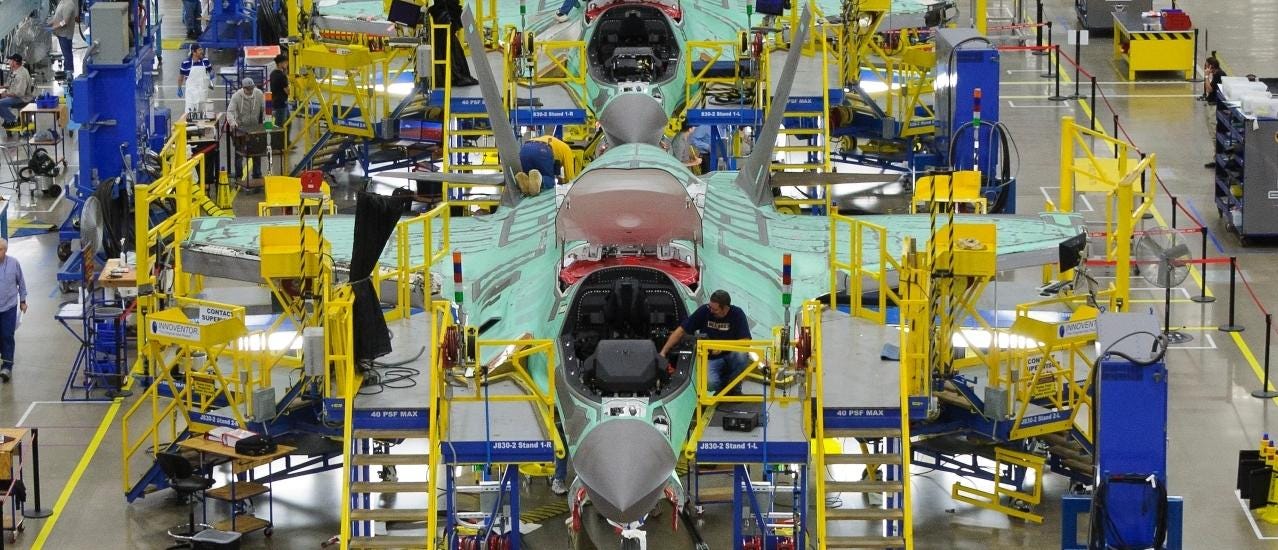
F-35 production line. Lockheed Martin photo

The CIA's reconnaissance operations in India

11 Aug , 2014

The CIA recently declassified a new series of documents on the history of the U-2 surveillance planes.

In their “The Central Intelligence Agency and Overhead Reconnaissance: The U-2 and OXCART Programs, 1954-1974”, Gregory W. Pedlow and Donald E. Welzenbach mentioned the U-2s operations in India.

On 11 November 1962, Prime Minister Jawaharlal Nehru consented to the proposed operation and gave the United States permission to refuel the reconnaissance aircraft (U-2s) in Indian airspace.

[I quote from pages 231 to 233]

In October 1962, the People’s Republic of China launched a series of massive surprise attacks against India’s frontier forces in the western provinces of Jammu and Kashmir and in the North-East Frontier Agency (NEFA). The Chinese overran all Indian fortifications north of the Brahmaputra Valley before halting their operations.

The Indian Government appealed to the United States for military aid. In the negotiations that followed, it became apparent that Indian claims concerning the extent of the Chinese incursions could not be reliably evaluated. US Ambassador John Kenneth Galbraith, therefore, suggested to the Indian Government that US aerial reconnaissance of the disputed areas would provide both governments with a more accurate picture of the Communist Chinese incursions.

On 11 November 1962, Prime Minister Jawaharlal Nehru consented to the proposed operation and gave the United States permission to refuel the reconnaissance aircraft (U-2s) in Indian airspace.

In late November, Detachment G [1] to Ta Khli, [2] to carry out the overflights of the Sino-Indian border area. Since the U-2s were not authorized to overfly Burma, they had to reach the target area via the Bay of Bengal and eastern India and, therefore, required midair refueling.

Because of severe winter weather conditions, the first flight did not take place until 5 December. Poor weather and air turbulence hampered the mission, and only 40 percent of the target area could be photographed. A second mission on 10 December was more successful, but the U-2 experienced rough engine performance because of icing of the fuel lines.

Photography from these missions was used in January and again in March 1963 to brief Prime Minister Nehru, who then informed the Indian Parliament about Communist Chinese troop movements along the border

Detachment G U-2s made four more overflights of the Sino-Indian border areas in January 1963, which led to a PRC protest to India. Photography from these missions was used in January and again in March 1963 to brief Prime Minister Nehru, who then informed the Indian Parliament about Communist Chinese troop movements along the border. Although Nehru did not reveal the source of his intelligence, a UPI wire story surmised that the information had been obtained by U-2s.

The United States had provided photographic coverage of the border area to India for two reasons. First of all, US policymakers wanted a clear picture of the area under dispute. In addition, the intelligence community wanted to establish a precedent for overflights from India, which could lead to obtaining a permanent staging base in India for electronic reconnaissance missions against the Soviet ABM [Anti-Ballistic Missile] site at Saryshagan and photographic missions against those portions of western China that were out of range of Detachment H.

In April 1963, Ambassador Galbraith and the Chief of Station at New Delhi made the first official request to India for a base. The following month, President Kennedy agreed to DCI [Director Central Intelligence] McCone’s suggestion to raise the question of a U-2 base in India when he met with India’s President Savepalli Radhakrishnan on 3 June. This meeting resulted in an Indian offer of an abandoned World War II base at Charbatia, south of Calcutta [near Cuttack in Odisha].

Contract Documents Reveals Locations of A Number of Overseas Nuclear Test Detection Sites Operated by Air Force Technical Apllications Center (AFTAC)

August 11, 2014

I was cruising through the internet this morning, and chanced up this document filed on the U.S. government’s website (www.fbo.gov) announcing contracts bids and requests for information from defense contractors.

The document is fascinating because since the 9/11 terrorist attacks, the little-known Air Force Technical Applications Center (AFTAC), which runs the U.S. intelligence community’s global nuclear weapons test detection network (officially known as the Atomic Energy Detection System - AED), has been trying to hide all facets of its operations from public view. At the behest of AFTAC, U.S. Air Force security personnel removed thousands of pages of formerly declassified documents pertaining to the organization’s overseas operations from the public shelves of the National Archives until the operation’s cover was blown in 2006.

AFTAC stubbornly refuses to declassify almost everything about its history and current operations, especially the locations of the manned stations and unmanned equipment locations around the world where the organization has hidden its nuclear test detection sensors.

Well, take a look at this document, which AFTAC placed on the fbo.gov website back in May 2009, which lists the locations (including latitude and longitude data) of a fairly large number of the organization’s overt and covert nuclear test detection stations in the U.S. and overseas. Turns out that AFTAC has operational facilities in such glorious travel destinations as Mongolia, Kazakhstan, South Africa, Romania, and even Afghanistan.

I attach copy of the notice below because AFTAC has a really nasty habit of trying to reclassify everything substantive that it by mistake discloses about itself.

United States Atomic Energy Detection System (USAEDS) Network

Solicitation Number: HC101309R200X

Agency: Defense Information Systems Agency

Office: Procurement Directorate

Location: DITCO-Scott

Synopsis:

Added: May 26, 2009 12:08 pm

Request for Information (RFI) for

The Air Force Technical Applications Center (AFTAC)

United States Atomic Energy Detection (USAEDS)

‘CLIMATE-SMART’ POLICIES FOR AFRICA ARE STUPID, AND IMMORAL – OPED


The 2014 US-Africa Leaders Summit hosted by President Obama this past week brought together the larges t-ever gathering of African government officials in Washington, DC. They discussed ways to bolster trade and investment by American companies on a continent where a billion people – including 200 million aged 15 to 24 – are becoming wealthier and better educated.

They have steadily rising expectations and recognize the pressing need to create jobs, improve security, reduce corruption, and control diseases like Ebola, HIV/AIDS, tuberculosis and malaria. They also understand that better roads and air transportation, improved agriculture and nutrition, and far more energy – especially electricity – are the sine qua non to achieving their aspirations. Indeed, nearly 700 million Africans still do not have electricity or get it only sporadically, a few hours a day or week.

“The bottom line is, the United States is making a major and long-term investment in Africa’s progress,” Mr. Obama stated. One has to wonder whether his rhetoric matches his policy agenda – and whether Africans would do well to remember the presiden t’s assurances that Americans could keep their doctors, hospitals and insurance, when they hear his fine words and lofty promises for Africa.

The fact is, no modern economies, healthcare systems or wealth-building technologies can function in the absence of abundant, reliable, affordable electricity and motor fuels. They require far more than can possibly come from “climate-smart” wind, solar and biofuel sources. Adequate food and nutrition require modern agriculture. Eradicating malaria requires chemical insecticides, DDT and ACT drugs.

Obama Administration policies on all these matters are likely to hold Africa back for decades.

For President Obama, everything revolves around fears of “dangerous manmade climate change” and a determination to slash or end fossil fuel use. He has said electricity rates must “necessarily skyrocket.” His former Energy Secretary wanted gasoline prices to reach European levels: $8-10 per gallon. His EPA is waging a war on coal. And his own requirements would prevent Africa from modernizing.

In 2009, the president told Africans they should focus on their “bountiful” wind, solar, geothermal and biofuel resources, and refrain from using “dirty” fossil fuels. He signed an executive order, directing the Overseas Private Investment Corporation to ensure that any projects it finances reduce their greenhouse gas emissions by 30% by 2020. He launched a number of domestic and international climate initiatives.

Afterward, when Ghana asked OPIC to support a $185 million gas-fired electrical generator (that would utilize natural gas being flared and wasted at its oil production operations), OPIC refused to help. When South Africa sought a World Bank loan for its state-of-the-art Medupi coal-fired power plant (which will reduce dangerous pollutants 90% below what 1970s-era plants emitted), the White House ”abstained” from supporting the loan. Thankfully, approval squeaked by anyway, and Medupi will soon be a reality.

Even more absurd and unethical, the White House announced l ast October that it will now oppose any public financing for coal-based power projects, except in the world’s poorest nations, unless they meet the draconian carbon dioxide emission standards now imposed on new coal-fired generators in the USA.

The global rule of law is under fire


ERNA PARIS
Aug. 09 2014

Erna Paris’s latest book is The Sun Climbs Slow: The International Criminal Court and the Struggle for Justice.

Are we witnessing a hollowing out of the global rule of law and other norms that have provided a framework for peace since the end of the Second World War? It is true that the laws, treaties, statutes, and regulations – so reluctantly negotiated by nations anxious to maintain their sovereignty and rights – have often been honoured in the breach; but until recently the breach, itself, was seen as an aberration, as a subject of fierce international debate.

Less so now, it seems. As postwar configurations of power shift and new pockets of violence erupt, international institutions seem less able to make a difference. In consequence, the world is becoming a lot more dangerous – again.

Russian President Vladimir Putin illegally annexes Crimea in a throwback to similar deadly events that preceded both world wars, then initiates a proxy campaign in Ukraine. The international community imposes sanctions: its only non-military tool. A beleaguered Secretary of State John Kerry fails to mediate a sustained ceasefire in the Gaza war, signalling America’s diminishing influence in the Middle East. Israel and Hamas feel free to dismiss the envoy of the United States. They’ll take care of business once they’ve met their respective goals. Independent cells such as ISIL in Iraq threaten populations. The UN Security Council recommends humanitarian aid. U.S. President Barack Obama unilaterally orders airstrikes.

The surprise may be that humanity was able to establish international rules in the first place. After the bloodletting of the American civil war, the 19th-century European powers strained to define the laws of war. The League of Nations was born in a burst of hope after the First World War, then dissolved into failure. Not until 1945, with the horrors wrought by Hitler still fresh in memory, were ongoing international safeguards established.

After a homicidal half-century in which tens of millions died, the founding of the United Nations was hailed as a moral and legal triumph. The Geneva Conventions had been fought over since 1864 before they were agreed to by the major powers in 1949. The creation of myriad UN agencies such as UNESCO, mandated to promote universal education; UNICEF, with a focus on protecting children; the UN Commission for Human Rights, devolved from the unprecedented Universal Declaration of Human Rights; and the novel concept of UN peacekeeping – all were expressions of internationalism and postwar hope.

The structures still exist; in fact, they were augmented by the Responsibility to Protect doctrine, which was adopted at the 2005 World Summit, and the creation of the International Criminal Court in 2002, both of which advanced international humanitarian law and loosened the constraints of sovereignty if a state committed atrocities against its own citizens. But they have become incrementally fragile, and with hindsight two milestone events may suggest why.

The U.S. Military's Ultimate Fear: Are Aircraft Carriers Too Big To Fail?

http://nationalinterest.org/blog/the-buzz/the-us-militarys-ultimate-fear-are-aircraft-carriers-too-big-11066?page=show


Henry Holst

August 12, 2014

Various defense pundits, scholars, and journalists have spent a considerable amount of digital ink debating the various threats to America’s carrier fleet while avoiding a more central question. In the clichรฉ phrase of our time: Are carriers too big to fail? Clausewitz tells us, “war is the continuation of politics by other means.” Is there any political situation of such gravity that losing a carrier would be deemed an acceptable risk? In other words, how expendable are carriers? The answer to this question has large implications for the tactical and strategic options available to U.S. policymakers.

Total security from all risk is impossible. The aircraft carrier is not invulnerable to attack. The new U.S. Ford-class aircraft carrier will be a floating home to over 4,000 sailors and comes in at the hefty price tag of around $12 billion dollars. In light of the development and proliferation of anti-access/area-denial (A2/AD) weaponry, does this enormous investment of human resources narrow U.S. tactical and strategic options? What are the implications of the sinking of a U.S. aircraft carrier?

Political Implications:

Over 4,000 American soldiers died during the recent eight and a half year Iraq war. These casualties played a large role in the extensive domestic opposition to the conflict. Imagine for a moment that a similar number of sailors perish in less than an hour. Such an event would be a national catastrophe and would likely create enormous political pressure to end combat operations. Such a catastrophic scenario is characteristic of naval warfare. In his book Seapower, Naval strategist Geoffrey Till tells us that:

“The nature of forces engaged in maritime operations…are expensive, hard to replace, and even the smallest units represent a sizeable investment in human resources, whose loss can be sudden and instantaneous and very hard for publics and governments to bear.”

The U.S. public is not conditioned to enduring high amounts of casualties. The last time commensurate numbers of U.S. troops died in a single military engagement was in 1950 during the Korean War. Knowing that, what would be the reaction if a U.S. carrier were attacked and sunk?

How it Could Happen:

To Major Slider: Listen up, the Army doesn't owe you anything, so move on

AUGUST 11, 2014

By Capt. Peter Crawford, U.S. Army

Best Defense guest respondent

First, to Major Slider and the rest of my fellow officers who recently received pink slips: thank you for your service and sacrifice. The vast majority of the citizenry you served will never truly understand what you have done. While it is, I believe, our duty to educate them when asked, they have no duty to listen or fully appreciate. Such is the inherent "injustice" of selfless service.

Perhaps unfortunately, this same injustice means that we do not "deserve" any more explanation from the Army than we have already received when it comes to these separation boards. In fact, let's just stop pretending that the Army owes us anything. We are all public servants -- perhaps virtuous for our volunteerism and sacrifice, but virtue is its own reward. When the public no longer requires our service, as determined through the proxies of Congress and military personnel officers, we have no recourse. We know this is true from moment we raise our hands to take the oath of office. Given the nature of the massive bureaucracy in which we serve, even the careers of officers with valor awards and Purple Hearts can stumble on past mistakes and fall victim to policies driven by cold, unfeeling bureaucratic logic.

I am no apologist for our military's personnel policies. Frankly, I find them absurd; the words "arbitrary" and "unfair" often do not even begin to describe them. As one of my fellow captains in my battalion recently put it to me, "You have to laugh about it because otherwise you'll just cry." In these uncertain times for military officers, though, I am an advocate of seeing the nature of military service as it is and not how we want it to be. Nowhere in my service contract with the Army is there a clause guaranteeing me a full and fulfilling career. My commissioning oath does not legally bind the military to employ me to my full potential for a minimum of twenty years, and it does not require the Army G1 to consider the entire body of my work for advancement. This might be unfair, but until Congress changes it, this is our system.

I believe that we have an unhealthy culture in the military of career entitlement. Perhaps this is an unintended consequence of the "up or out" promotion system or one of the many other vagaries of talent management in this business. This culture has not only manifested itself during this era of officer separation boards. Every time we allow a fellow soldier with eighteen years in the military to "finish out his career" despite discovering that he has been stealing from his men for the last eight years, we perpetuate the problem. As officers, in this way we also inherit the Army we deserve. I have seen an attitude of entitlement in some of the arguments brought forth in favor of women serving in combat arms -- and I am not the only one who has noticed this trend. To be absolutely clear, I am not making an argument against women in the combat arms; rather, I am suggesting that not being able to serve where you want and achieve the rank and position that you want does not make a solid case for women. Nor does it bolster an argument that demands an explanation for why someone chooses to "remove [your] services" from the American people. Let us meet our bureaucratic adversary with equally cold logic when we have opportunities to identify necessary changes.

What Can We Learn from ISIS?


In this week’s professional discussion I would like to consider the value of unlikely role models. We tend to look to those who resemble us for wisdom, both as individuals and organizations. Furthermore, we tend to want to look to those that are “better” according to seemingly objective criteria. I would submit that this perspective is too limited and for that puts at risk real opportunities to grow in wisdom and capability. Enjoy the read and please join the fray at #CCLKOW.

Last week the Marine Corps announced that it would re-brand its MARSOC units under the historic Raider moniker.

The grand history of the Marine Raiders is generally well known. Less well understood is that the Raider tradition is not a single, coherent thing. Two Raider legacies emerged from the war, as Mike Edson and Evans Carlson were given tremendous leeway in command to create their units as they saw fit. And here is where it gets very interesting, because Carlson’s Raiders were formed with a heavy dose of Chinese/PLA influence.

Evans Carlson was unique for many reasons. Most compelling for me, he was a man who took lessons and wisdom wherever they appeared regardless of source. This was nowhere more true than in his travels with the various Chinese forces confronting the Japanese in 1937. There Carlson had the opportunity to study closely the operations and values of the irregular warfare the PLA had adopted to fight the Japanese. Seeing their generally positive results – on the battlefield, within the units, and among the people in and near the Japanese occupation – impressed him. Many of the concepts he saw validated in China would be adapted and implemented within his Raider unit, to include the iconic battle cry, Gung Ho.

Consider that for a moment. The United States, which by the eve of WWII was already militarily potent, was taking lessons in warfare from what would have been considered at the time as a third rate army. Looking only at their record on Guadalcanal suggests that the PLA practices were indeed valuable to the Raiders. And yet conventional wisdom would never have identified the PLA as a role model for American military capabilities.

From the perspective of military innovation, from tactics to strategies, we find ourselves in very interesting times. In every corner of the globe there are niche military formations which, for their poverty and irregularity, for their freedom from institutional legacies and traditions, have taken what they needed from any sector to cobble together capabilities to relatively good effect. ISIS, for example, has created social media as a potent “arm” of its forces. Jihad by tweet won’t win any conflicts, but it certainly enhances ISIS’ interaction with its own audience and those it is trying to woo. That is but only one small piece of the innovation afoot in warfare. Even a military super-power could benefit from consideration of these advances, no matter that it might mean learning from an unlikely role model.

So, the questions for this week are:

In what areas do Western military capabilities lag behind contemporary weaker or lesser forces? That is, where might they benefit from an unlikely role model?

13 August 2014

Pakistan can’t wage war, kills by proxy: PM

 by Mir Ehsan 
August 13, 2014

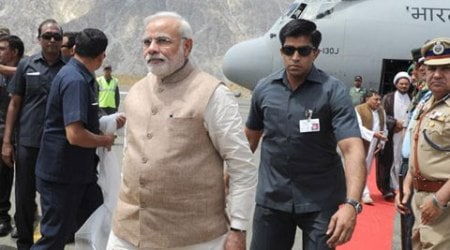
Prime Minister Narendra Modi arrives at Kargil, J&K. (Source: PIB)

Modi said the Indian armed forces were suffering more casualties from terrorism than from war.

Prime Minister Narendra Modi on Tuesday came out strongly against Pakistan for continuing its proxy war of terrorism against India, saying it has lost the strength to fight a conventional war.

Addressing troops of Army and the Indian Air Force on his maiden trip to Leh and Ladakh, Modi condemned the continuing proxy war by Pakistan.

“The neighbouring country has lost the strength to fight a conventional war, but continues to engage in the proxy war of terrorism,” he said.

The Prime Minister said the Indian armed forces were suffering more casualties from terrorism than from war.

Addressing Army and Air Force personnel drawn from various formations at Leh, the Prime Minister said, “It is unfortunate that our neighbour’s attitude… they have lost the power to fight a war but they use proxy war. There has been a process of killing innocent people through this proxy war. How many innocents are being killed? The number of people getting killed through the bullets of cowards is more than those killed in conventional wars.”

“The Indian armed forces are suffering more casualties from terrorism than from war,” he said. Terming terrorism as a global problem, he said all “humanitarian forces of the world should unite to fight it”. “India is committed to strengthening and uniting these humanitarian forces,” Modi said.

The sharp attack on Pakistan came two months after Modi assumed office and came in the midst of his peace initiatives. He had invited Pakistan Prime Minister Nawaz Sharif and other SAARC leaders for his swearing-in on May 26.
Flanked by Chief Minister Omar Abdullah, Governor N N Vohra, Army Chief Dalbir Singh and National Security Adviser Ajit Doval, Modi also spoke of modernisation of the Army. He said India is committed to strong armed forces, well-equipped with modern arms and technology.

Boosting the morale of the forces, he said the entire country supports the soldiers who remain focused in spite of the many struggles their families face in day-to-day life. “This energy and sense of duty inspires me and therefore, I keep on visiting jawans on the border to seek inspiration,” he said.

From Leh, Modi went to the Muslim-dominated Kargil, where he addressed an impressive rally at Thi Sultan Cho stadium, the first by a Prime Minister after the Kargil war. Modi recalled the days when he visited the place during the Kargil war, but he did not mention Pakistan.

“I had come to this place earlier also. Today I am hearing cheers from the crowd, but when I came to this place as a BJP worker, guns were booming from across the border and we only could hear the blasts of guns and shells. I have seen the generosity of the people of Kargil. They offered everything to me free of cost and never charged a single penny. They told me that they are doing it as a service towards the nation,” Modi said amid applause from the crowd.

Modi told the gathering that during the Kargil war the help provided by the local population to soldiers raised their morale. “I have seen how civilians celebrated the victory of Tiger hill and Tololing and the patriotism of the people of Kargil inspires the people of India,” he said.

UN calls for global response in Ebola fight

August 13, 2014 

APUN Chief Ban Ki-Moon

A total of 1,848 cases have been reported, including 1,013 deaths, according to the latest WHO figures

UN Secretary-General Ban ki-Moon on Tuesday called for a coordinated international response to the Ebola outbreak and appointed Britain’s David Nabarro as the UN coordinator in its fight against the deadly disease.


Mr. Ban spoke about urgent steps in combating the Ebola outbreak in West Africa, which its specialised agency, World Health Organisation (WHO) has declared a public health emergency of international concern, Xinhua reported.

Wars of Frustration: The Results of Israel’s Third Invasion of the Gaza Strip

Israel: The Dead End Strategy

strategypage.com, August 11, 2014

The fighting in Gaza has left nearly 2,000 dead, over 96 percent of them Palestinian. Hamas says it won’t stop fighting until the Israeli-Egyptian blockade is lifted. Israel and Egypt refuse to do that until Hamas drops its support for terrorism and disarms. Since Israeli troops left Gaza (and Hamas took control in 2007) Gaza has become a sanctuary for Islamic terrorists. Most seek the destruction of Israel but a growing number seek to establish a religious dictatorship in Egypt. Hamas does not expect to get the blockade lifted but does see itself gaining respect (and cash donations along with more diplomatic support) in the Moslem world. At the moment Hamas is still designated an international terrorist organization by the UN, most Western nations and even some Moslem ones.

Israel has plenty of electronic and video evidence of Hamas using ceasefires to move weapons and personnel and prepare to continue firing on Israel. Broadcasting this evidence is opposed by Israeli intelligence officials because putting the evidence out there enables Hamas to see where and how they are vulnerable to detection. With this knowledge Hamas can better hide its activities in the future.

Hamas has fired over 3,300 rockets since July 9th. Some 70 percent landed in Israel but less than four percent hit populated areas (killing three and wounding 85 civilians) . Iron Dome intercepted about a quarter of the rockets fired at Israel as the Iron Dome computers predicted these would land in or near a populated area. About 20 percent of the rockets fired towards Israel were defective and landed inside Gaza or were aimed at targets in Gaza. This included some of the 11 percent of all rockets were fired at Israeli troops inside or near Gaza. Some 69 percent of the rockets were fired from northern Gaza (where most of the Israeli counterstrikes have been) while 13 percent were launched from central Gaza and the rest from southern Gaza. Over 80 percent of the rockets were fired from unpopulated areas but at least 18 percent were fired from locations that were clearly civilian (including schools, Mosques and medical facilities.) Hamas was believed to have had about 10,000 rockets in early July. Since then over 3,000 have been fired and over 4,000 destroyed before they could be fired. Israeli aircraft, helicopters, ships, armored vehicles and ground troops have attacked nearly 5,000 targets in Gaza since July 9th and about a third of those attacks were against rocket launching sites, often while rockets were being prepared for launch. Hamas rockets have killed three Israeli civilians and 64 military personnel (and 670 wounded) so far. Some 82,000 Israeli reservists have been mobilized and most have been sent to the Gaza border. Hamas considers each Israeli they kill a victory and plays that up in their media. The Israeli military casualty rate is about the same as the U.S. suffered at the height of the fighting in Iraq. In other words; historically quite low.

Some Israeli leaders want the ground troops to go back in and shut down Hamas once and for all. But that would involve a lot of combat and if Gaza were to be completely cleared of Islamic terrorists hundreds of Israeli troops would die and thousands wounded. Most Israeli politicians do not believe Israelis in general are willing to pay that high a price. Instead Israel will continue using its intelligence capabilities to find Hamas personnel and weapons and attack them with smart bombs and missiles. Other Islamic terrorist groups in Gaza are also being hit. But the Islamic terrorists are hiding among the 1.8 million civilians in Gaza. There are several hundred thousand buildings and hundreds of tunnels and bunkers. Less than one percent of these structures holds terrorist weapons or personnel and the Israelis already know that they cannot watch all of Gaza in great detail all the time. Israeli military leaders point out that there would be a lot of Palestinian civilian casualties because Hamas deliberately surrounds its weapons and key personnel with civilians. While some Palestinians answer the Hamas propaganda and volunteer for this duty, most do not and will flee if given a chance. For Hamas victory is simply surviving and still being able to issue victory statements. Israeli victory is suppressing terrorist capabilities. Ultimate victory is eliminating the terrorist threat but given the massive support for destroying Israel in the Arab world, ultimate victory remains a long term goal, not one that can be won right now in Gaza. Right now most media in the Arab (and Moslem) world portray Hamas as misguided but valiant fighters for a cause (the destruction of Israel) that still has a lot of popular support in the Moslem world. Most Westerners, especially journalists, don’t grasp that aspect of the situation and try to portray Gaza as a humanitarian disaster that only Israel can fix. Most Israelis are exasperated at the attitude of so many non-Moslems overseas and attributes it to ignorance, greed (oil-rich Arab states have spent billions to push the Arab point of view towards Israel) or anti-Semitism.

The Plight of Nepal’s Migrant Workers

By Kamal Dev Bhattarai
August 11, 2014
Often cheated and frequently facing atrocious working conditions, young Nepalese are still flocking abroad for work. 
Confronted with a lack of employment opportunities at home, every day 1,500 or more young Nepalese go aboard seeking employment opportunities, according to official data. In fact, the number is likely to be even higher, as government records do not include illegal migrant workers.

Prolonged political transition, economic depression, and the closure of industries are the main reasons for the alarming level of unemployment (with a youth unemployment rate of 38 percent in 2012) that prevails in the Himalayan country. The failure of Nepal’s political parties to adopt a new constitution has further hindered economic development. Young Nepalese are losing hope that they will find jobs at home.

The rate of growth of Nepal’s manufacturing sector is projected to fall to a five-year low of 1.86 percent this year, hit by energy shortages, labor issues, and political instability. This further limits job opportunities, creating a palpable sense of frustration among youths.

The government of Nepal has opened up 109 countries for work opportunities. The major destinations for Nepalese migrant workers are Saudi Arabia, South Korea, United Arab Emirates, Qatar, Kuwait, Malaysia, Oman, Afghanistan and Japan. At present, 3.5 million young Nepalese are working abroad.

The majority of Nepalese migrant workers employed in these countries are unskilled or semi-skilled laborers, and mostly work in construction, manufacturing or domestic capacities. The number of Nepalese who have gone India for work is not recorded given the open border between the two countries, but officials believe the figure is in the millions.

Last year, the South Korean government announced that it would select 8,000 people for employment. Some 70,000 Nepalese sought to be selected, underscoring the grim conditions at home. In 2012, around 3,800 Nepalese traveled to South Korea for work. South Korea is a lucrative destination for migrant workers: one can earn around $1,000 dollars a month.

On any given day, a visitor to Tribhuwan International Airport in Kathmandu can see crowds of youths lined up at waiting for flights abroad. The remittances they back home are among the highest in the world as a percentage of GDP, at around 25 percent. These remittances play a significant role in attenuating local poverty.

Yet policymakers and economist worry that if the current trend of young Nepalese going abroad continues it will impede the country’s long-term economic development. They argue that while remittances might be a temporary boon to the country’s sick economy, the exodus would stymie the growth of domestic industries and agriculture, to the detriment of the country’s overall economic policy.

With its youth leaving to work abroad, Nepal is finding itself short of labor for the agricultural sector, and thousands of hectares of fertile land are being left untilled. Nepal was once known for its agricultural sector, yet it is now in the position of having to import grains, rice and other staples from its neighbors. As rural villages are denuded of their younger people, the government has to date offered little in the way of policy solutions.

Artillery Modernisation

Artillery Modernisation
11 Aug , 2014

Artillery modernisation in India implies the largest modernisation of this arm and needs to be given as much, if not more, importance commensurate with the manoeuvre arms it supports. The relevance is more in the Indian context because of the mountainous terrain where it needs to support infantry operations plus in counter insurgency and counter terrorist operations. Unquestionably, artillery units will continue to be used to support the infantry to the benefit of all. It is precisely in these sorts of operation that the new precision of artillery will become more telling and relevant. India has a long way to go in modernising its artillery. Presently, the artillery modernisation plan appears to be stymied. There is an urgent need to provide it an impetus considering the enhanced threat posed to us along a two and a half front.

In Kargil conflict where 100 Bofors guns broke the back of well-entrenched Pakistani forces on high mountain peaks.

The importance of artillery in battle needs no emphasis. What the artillery can achieve in contact battle has been highlighted in the two world wars and more recently, nearer home during the Kargil conflict where 100 Bofors guns broke the back of well-entrenched Pakistani forces on high mountain peaks. But the latter also highlighted woes of the crying need for modernisation of our artillery. Fortunately, India had imported 400 pieces of this excellent gun before the firm was banned. Despite the Rs 60 crore Bofors scam and the freeze on spare parts, India’s holdings could be cannibalised to give the enemy a bloody nose.

No worthwhile modernisation has taken place since then though the artillery is in the process of procuring and developing gun systems, ammunition (including propellants and fuzes), support systems and networking systems in terms of software and hardware which incorporate state-of-the-art technology. Ironically, though Transfer of Technology (ToT) for the Bofors gun had taken place right at the beginning, the indigenous version is being developed now after a gap of two decades.

Concept of Firepower

Pakistani Taliban Increasingly Targeting Pakistani Police Officers in City of Karachi

Killings Rise in Karachi as Taliban Target Police

Zia ur-Rehman and Declan Walsh

New York Times, August 12, 2014

KARACHI, Pakistan — Karachi’s embattled police force recently passed a grim milestone — the killing of its 100th police officer this year, putting the force on track to exceed the 2013 toll of 166 police deaths, which was itself a record.

Some killings stemmed from the factors that have roiled Karachi, a restless megalopolis of 20 million people, for decades: ethnic politics, sectarian militancy and old-fashioned criminal gangs. But much of the toll came from the city’s newest force for violent chaos, the Pakistani Taliban.

The Taliban have been steadily expanding in Karachi for two years, running extortion rackets, killing political rivals and carrying out audacious attacks on prominent targets, including the city airport in June.

Now they have trained their sights on the city police. In the sprawling Pashtun slums on the city’s eastern and northern flanks, Taliban militants have gunned down police officers, assaulted poorly defended police stations and sent suicide bombers to assassinate top police commanders.

Main theaters of conflict in northwestern Pakistan.
OPEN Map

The killings offer new proof, officials say, that the guerrilla war that was once confined to the tribal belt in northwestern Pakistan, the Taliban’s stamping ground, has spread to its biggest city.

The Foreign Policy Essay: Afghan Lessons Learned

August 10, 2014

Editor’s Note: The United States is supporting the Afghan government with troops and other military assistance in the fight against Islamist radicals based in Pakistan. As the United States ponders its policy options, it would do well to heed lessons from a time when the situation was reversed. In one of America’s biggest Cold War successes, the Carter and Reagan administrations supported the anti-Soviet mujahedin in Afghanistan and helped them defeat the Soviet Union. Bruce Riedel, author of the newly released What We Won: America’s Secret War in Afghanistan, identifies lessons from the anti-Soviet struggle and contends that the United States risks repeating some of Moscow’s many mistakes.

Twenty five years ago, after 3,331 days of war, the Soviet 40th Red Army retreated in defeat from Afghanistan. An American-led coalition had orchestrated support for the Afghan mujahedin that shattered the myth of Red Army invincibility. The CIA had won the last and decisive battle of the Cold War. The Berlin Wall fell within months of the Soviets’ defeat in Afghanistan and the Warsaw Pact disintegrated. The danger of nuclear war between the two super powers, which had terrorized the world for generations, vanished overnight.

This secret war a quarter century ago holds many lessons for Americans considering how to react to crises in 2014. At a cost of roughly $3 billion and without a single American casualty, the secret American war in Afghanistan may have been the most successful covert action in our nation’s history. It was a bipartisan victory. President Jimmy Carter created the coalition of Pakistan, Saudi Arabia, China, Britain and others that secretly backed the mujahedin in just a few weeks after the Russian invasion in early 1980. President Ronald Reagan continued the covert campaign and then escalated it in 1986 to victory. The Congress was not only kept fully informed on the war, it was an enthusiastic supporter.
Covert actions can produce significant policy successes if they are well planned, have achievable goals, are supported by robust coalitions, and exploit enemy weaknesses. But they inevitably have unforeseen consequences which must be understood in real time, not after the fact.

Days after the Soviet invasion of Afghanistan on Christmas Eve 1979, Carter told the CIA to turn Afghanistan into Russia’s Vietnam, a quagmire that would bog Moscow down in an endless insurgency. The goal was simple and clear cut. The Afghans were eager to fight the Russians; all they needed was weapons. In 1986, at the prompting of Pakistan’s dictator, Zia-ul-Haq, Reagan gave the mujahedin Stinger surface-to-air missiles. In less than six months, both the Russians and Iranians had captured Stingers, but Reagan did not stop supplying them. He was not paralyzed by fear of weapons falling into the wrong hands; it was a price worth paying for victory.

Global success stories


In this file photograph taken on July 22, 2014, Indonesian presidential candidate Joko Widodo gestures following his victory address in Jakarta's port district of Sunda Kelapa after the General Elections Commission declared him as winner in the presidential race against opponent Prabowo Subianto. (Romeo Gacad/AFP/Getty Images)

Wherever you look these days, the world seems on fire. New hot spots like Russia-Ukraine are competing with old ones like Gaza. Festering conflicts like those in Syria and Iraq are getting worse. Even Afghanistan, which seemed in better shape than the other places, had a setback this week. Is there any good news out there? 

In fact, some of the most important countries in the world are making remarkable progress, affecting at least 1.5 billion people. Let me give you the good news. 

Fareed Zakaria writes a foreign affairs column for The Post. He is also the host of CNN’s Fareed Zakaria GPS and editor at large of Time magazine.

Indonesia is the largest Muslim country in the world. It has more Muslims than Egypt, Iraq, Syria, Libya, Jordan, Lebanon, Saudi Arabia and all the Gulf states put together. It is also crucially located, in East Asia where great power politics and rivalries are heating up. Only 10 years ago, the fear was that Islamic militants were taking over the country and that it was an economic mess and an unreliable crisis spot in the region. The country has defied all skeptics and last month it took a big step forward. 

The election of Joko Widodo marks the consolidation of Indonesia’s democracy. Jokowi, as he is always referred to at home, defeated an iconic member of Indonesia’s old guard, Prabowo Subianto, a former general and former son-in-law of President Suharto who is thoroughly enmeshed in the ways of the past. (Prabowo is contesting the result.) In his campaign, Prabowo used demagogic appeals to nationalism, populism and Islam. Jokowi, by contrast, is a businessman-turned-politician, with a reputation as a competent and honest governor and mayor. He ran on a platform of economic development with virtually no reference to religion. His first steps have been promising, tackling a taboo right at the start — the country’s huge fuel subsidies, which are inefficient, distort the market and are a crippling burden on the national budget. 

The other encouraging election this year has been in the second most populous country on the planet, India. First, there was the election, which is often taken for granted but should be marveled at. In one of the poorest countries in the world, 834 million registered voters got a chance to exercise their democratic rights (and 66.4 percent of them did). The elections were held without violence or controversy, using electronic voting that produced a result within hours. Compare that to the United States, which will again go to the polls this year with dozens of different kinds of ballots, many using paper, and with inefficiencies and inevitable controversies. 

India’s elections could mark a turning point. The country has been mired in deadlock and paralysis for years because of a weak coalition government, ineffectual leadership and an obstructionist opposition. So people voted for a single party to take power (the first time in 30 years) and gave the new prime minister, Narendra Modi, a mandate. Modi campaigned brilliantly and effectively, and his message was unrelenting — development, development, development. Despite his party’s roots in Hindu fundamentalism, he chose to appeal to the country’s hunger for economic growth. If Modi can maintain that focus, eschew the Hindu nationalist agenda and make difficult decisions on cutting subsidies and encouraging economic competition, he will likely return India to a path of high growth, thus lifting hundreds of millions of people out of poverty. 

Halfway around the world, Mexico took a big, bold step this week. The Mexican Congress passed the ambitious energy reform proposals of President Enrique Peรฑa Nieto, ending 75 years of state control of the energy sector. They have the potential to be a game changer, bringing investment, new technology and hundreds of thousands of jobs to Mexico. Since his inauguration in December 2012, Peรฑa Nieto has pressed for educational and telecommunications reforms that have also mostly been enacted. These reforms have not been popular and have not produced quick growth. This is understandable because most structural reforms have a negative effect on the economy in the short term — they end subsidies, reduce inefficiencies and allow competition for protected companies. In the long run, however, they boost productivity and growth. 

If Peรฑa Nieto continues to have the courage to enact major reforms, Mexico will slowly but surely be transformed into a middle-class country. And the result of that will be a sea change in its relations with the United States, which will finally see Mexico not as a problem but as a partner. It is already happening on the ground. Between 2005 and 2010, there was no net migration from Mexico into the United States. But perceptions take a while to change — especially in Washington. But once they do, North America — the United States, Mexico and Canada — will become the world’s most important, vibrant and interdependent economic unit. 

That’s what’s been happening in the world while the news about rockets, bombs, assassinations and terrorism takes up the front pages.