LAUREN C. WILLIAMS
PHILADELPHIA—The Army wants to build an AI pipeline with proven and trusted tech to fuel new programs in the service’s shop for intelligence and electronic warfare programs.
“The data available to intel analysts at speed and scale is impossible to leverage in real time, so they're gonna have to have models and algorithms just to help sort through this giant amount of data. And that's where Linchpin comes in,” Col. Chris Anderson, the program manager for intelligence systems and analytics at Program Executive Office Intelligence, Electronic Warfare, and Sensors, told Defense One. “There will always still be a human in the loop. But we're gonna have to have AI and [machine learning] to filter out the stuff that doesn't matter.”
At its core, Project Linchpin aims to help program managers seamlessly integrate AI and machine learning capabilities in their portfolios without having to build a pipeline themselves.
“Program managers build the bridge across the valley of death. We've seen time and time again, a really good idea and it'll get some initial resources and some initial stakeholder support. But then as folks rotate out and priorities change, if it's not a program of record, it tends to go away,” Anderson said.
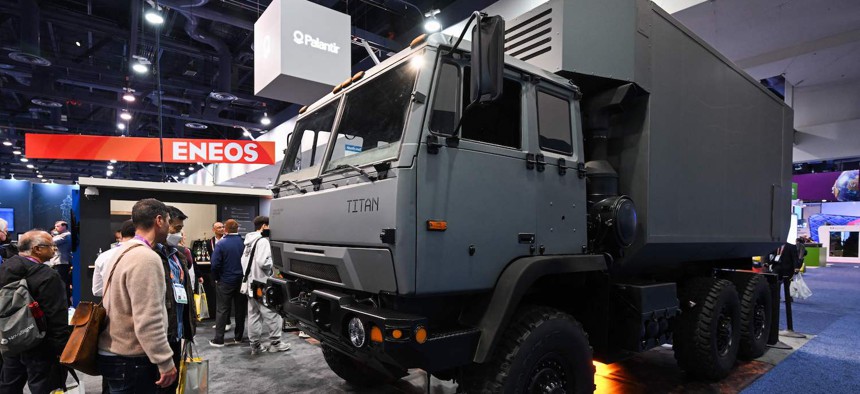
The plan is to make Project Linchpin a program of record by 2026 and start awarding contracts by April 2024. The Tactical Intelligence Targeting Access Node, or TITAN program, which will help commanders parse information on the battlefield, will be the first to use Linchpin, he said.
Defense One sat with Anderson at the Army’s Technical Exchange Meeting to learn more about the burgeoning program and what it means for the service, industry, and AI on the battlefield.
Why does Linchpin matter?
:quality(70)/cloudfront-us-east-1.images.arcpublishing.com/archetype/5IHM6YEQSFFAJOKBE3PEPCWBZM.jpg)
:quality(70)/cloudfront-us-east-1.images.arcpublishing.com/archetype/BR6YXRTF3FD6HLY7THX5FJ36RQ.jpg)