29 November 2022

DoD releases zero-trust strategy to thwart hackers who ‘often’ breach network ‘perimeter’

JASPREET GILL

WASHINGTON — After months of teasing its zero-trust strategy, the Defense Department today released its plan outlining what it’ll take to achieve “targeted zero trust” by fiscal 2027 to address current threats, including those posed by adversaries like China — starting with a zero-trust cloud pilot this fiscal year.

“With zero trust we are assuming that a network is already compromised and through recurring user authentication and authentic authorization, we will thwart and frustrate an adversary from moving through a network and also quickly identify them and mitigate damage and the vulnerability they may have exploited,” Randy Resnick, DoD zero trust portfolio management office chief, told reporters ahead of the strategy’s release.

The 29-page strategy paints a concerning picture for DoD’s information enterprise, which is “under wide-scale and persistent attack from known and unknown malicious actors,” from individuals to state-sponsored adversaries, specifically China, who “often” breach the Pentagon’s “defensive perimeter.”

DoD must ‘think very differently’ about armed conflict, cyber in light of Ukraine war: Official

JASPREET GILL

WASHINGTON — After watching Ukraine take on Russia in both the real world and in cyberspace, a top American cyber official said the Defense Department must “think very differently” about how it will fight in both realms in the future.

Mieke Eoyang, deputy assistant secretary of defense for cyber policy, told the Aspen Institute Cyber Summit today that the war “is a really important conflict” for DoD to understand, and one of the things she’s seeing “is the context of the armed conflict dwarfs the cyber impacts” of the war.

“When you think about the physical destruction relative to the cyber disruption of what happens here, things that Russians tried to disrupt via cyber… did not have the strategic impact that they wanted, and they sought to destroy those things physically,” she continued.

28 November 2022

Ukraine is attempting to retake a crucial spit of land that could disrupt Russia's missile barrages

SINÉAD BAKER

Ukraine has confirmed that is trying to regain control of the Kinburn Spit — a thin stretch of land across much of the mouth of the Dnipro river that it lost to Russia in June.

Ukrainian officials have said that it would release no details on the operation until it had concluded. Forbes reported on Thursday that Ukrainian commandos landed in small boats on the spit in an amphibious attack.

It did not say how big or well-armed a landing party was. It was also not clear how much of a defense Russia was making.

But if Ukraine were to retake the Kinburn Spit, it would get a significant new advantage.

Russia has been using the strip for its missile and artillery strikes nearby Ukrainian cities, according to a recent update from The Institute for the Study of War.

GROUND ZERO The Evacuation of the CIA’s Afghan Proxies Has Opened One of the War’s Blackest Boxes

Fahim Abed

ON A RAINY Saturday morning in May, Hayanuddin Afghan, a former member of a CIA-backed militia that was once his country’s most brutal and effective anti-Taliban force, welcomed me to his new home in a hilly neighborhood of Pittsburgh.

He invited me in through the kitchen, where his wife, who was pregnant with their fourth child, was baking traditional Afghan bread with flour from Aldi’s. The trip downtown to buy groceries was among the greatest challenges of Hayanuddin’s new life in Pittsburgh. It involved hauling heavy bags back home on foot and in multiple city buses, whose schedules were unknowable since he didn’t speak English and had not downloaded the relevant app.

“It is difficult to descend from a very strong position to a very weak position,” Hayanuddin told me. In Afghanistan, “we had value. It was our country, and we were making sense for that country. But now, even our generals and commanders, everyone is in the same position.”

In Afghanistan, it was impossible to talk at any length to members of the secretive commando forces known as the Zero Units. They hunted the Taliban in night raids and were widely accused of killing civilians, including children. But last September, Hayanuddin and his Zero Unit comrades were the beneficiaries of the most successful aspect of the Biden administration’s chaotic withdrawal from Afghanistan: the CIA’s rescue of its allied militias. Their arrival in the U.S. over the last year has cracked open one of the war’s blackest boxes.

Why China’s efforts to help world’s largest iPhone factory descended into violent protests, further disrupting Apple’s supply chain

Ben Jiang Shenzhen and Tracy Qu

Protests over Covid-19 measures and employee benefits that descended into violent clashes between hundreds of workers and security forces at the world’s largest iPhone factory in Zhengzhou, capital of central Henan province, are expected to further derail manufacturing and global shipment schedules of Apple’s flagship product.

That turn of events also showed how the efforts by Henan authorities to help resume full production at the Foxconn Technology Group-operated facility have backfired, which could accelerate the pace of shifting more electronics production outside mainland China to countries like Vietnam and India.

Videos that circulated online on Tuesday and Wednesday, which were verified by several former Foxconn employees in Zhengzhou, showed fights breaking out between workers and security forces at the factory. These videos also showed angry workers kicking down barriers and dismantling polymerase chain reaction testing kiosks.

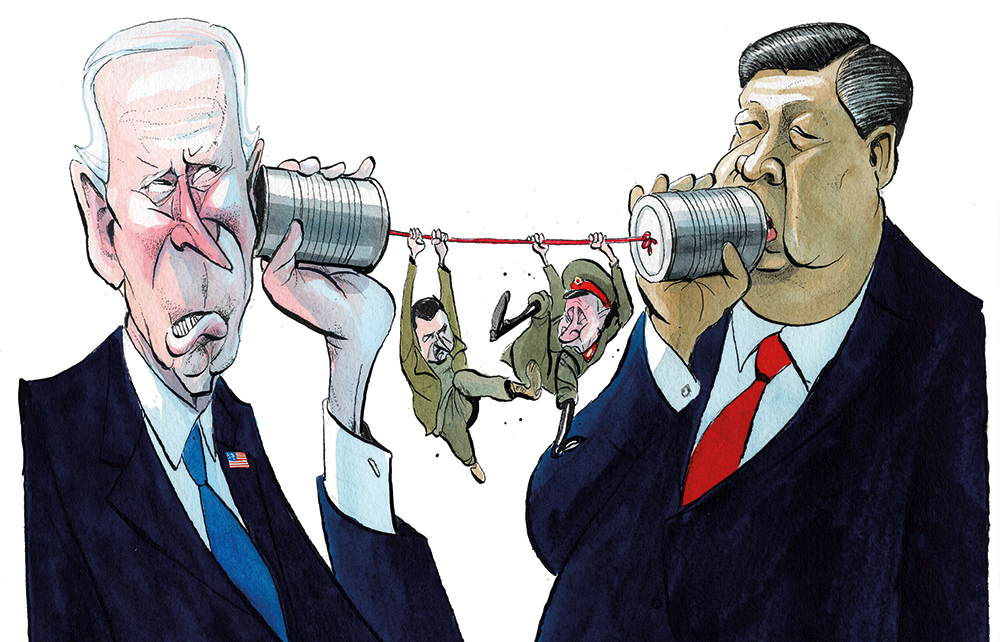
The red line: Biden and Xi’s secret Ukraine talks revealed

Owen Matthews

Since the beginning of Russia’s invasion of Ukraine, China has played a decisive – though publicly low-profile – role in strategic decision-making in both Washington and Moscow. As I report for the first time in my new book Overreach, it was a back-channel intervention approved by Beijing that caused the US to scupper a deal for the Poles to provide Soviet-made MiG-29 jets to the Ukrainian Air Force back in March. And since September a flurry of personal diplomacy by Chinese foreign minister Wang Yi with Nato and the US has led to a rare moment of public agreement over Russia, when Xi Jinping said that the world ‘needs to prevent a nuclear crisis on the Eurasian continent’ in a meeting with Joe Biden at the G20 summit in Bali.

Throughout the war, China’s true position on the Russia-Ukraine conflict has been hard to pin down – not least because Beijing has been telling both sides what they want to hear. In March, Wang implicitly appeared to be blaming the US for ‘stoking tensions’ and ‘sowing discord’ with Russia. Last month he told his Russian counterpart, Sergei Lavrov, that ‘China will also firmly support the Russian side, under the leadership of President Putin, to unite and lead the Russian people’, according to state broadcaster CCTV. Wang also promised that ‘China is willing to deepen contacts with the Russian side at all levels’. Yet in September, on the sidelines of the UN General Assembly, Wang had told Nato Secretary-General Jens Stoltenberg that China ‘stays open-minded to dialogues and exchanges with Nato and is willing to jointly promote the sound and steady development of bilateral relations … in the spirit of honesty and mutual respect’.

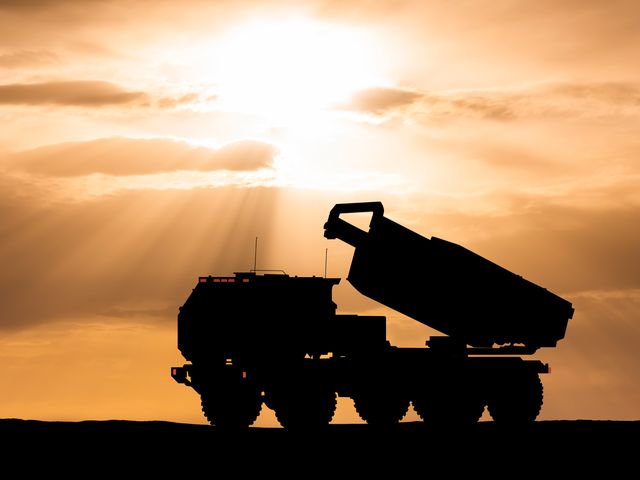
How HIMARS Rocket Launchers Helped Ukraine ‘Get Back in the Fight’ Against Russia

THOMAS MUTCH

KHERSON CITY, UKRAINE—It seemed like every inch of the town square was draped in blue and yellow flags. An old woman wept as she spoke to a family member on the phone for the first time in weeks. A group of young people sang the Ukrainian national anthem at the top of their lungs on a raised plinth. To cap it all off, the man of the moment, President Volodymr Zelensky, confidently strode through the middle of the city, which about six weeks ago, Russia had presumed to annex. He made a point to thank the United States for its delivery of HIMARS, which he said made a “huge difference” in the Ukrainian Army’s efforts to liberate its territory, while speaking at a recent press conference attended by Popular Mechanics.

Before the recent counter offensives in Kharkiv and Kherson began, nighttime explosions could be heard anywhere in Russian-occupied Ukraine. Ammunition depots, command posts, bridges, and railways are just a few of the dozens of targets that the Ukrainian army had been pulverizing for weeks with Western-supplied weapons ahead of its bid to liberate territory in southern and eastern Ukraine.

Cloud Empires How Digital Platforms Are Overtaking the State and How We Can Regain Control

Vili Lehdonvirta

The early Internet was a lawless place, populated by scam artists who made buying or selling anything online risky business. Then Amazon, eBay, Upwork, and Apple established secure digital platforms for selling physical goods, crowdsourcing labor, and downloading apps. These tech giants have gone on to rule the Internet like autocrats. How did this happen? How did users and workers become the hapless subjects of online economic empires? The Internet was supposed to liberate us from powerful institutions. In Cloud Empires, digital economy expert Vili Lehdonvirta explores the rise of the platform economy into statelike dominance over our lives and proposes a new way forward.

Digital platforms create new marketplaces and prosperity on the Internet, Lehdonvirta explains, but they are ruled by Silicon Valley despots with little or no accountability. Neither workers nor users can “vote with their feet” and find another platform because in most cases there isn't one. And yet using antitrust law and decentralization to rein in the big tech companies has proven difficult. Lehdonvirta tells the stories of pioneers who helped create—or resist—the new social order established by digital platform companies. The protagonists include the usual suspects—Amazon founder Jeff Bezos, Travis Kalanick of Uber, and Bitcoin's inventor Satoshi Nakamoto—as well as Kristy Milland, labor organizer of Amazon's Mechanical Turk, and GoFundMe, a crowdfunding platform that has emerged as an ersatz stand-in for the welfare state. Only if we understand digital platforms for what they are—institutions as powerful as the state—can we begin the work of democratizing them.

Industry Perspective: JADC2 Could Introduce Cyber Risks At Unprecedented Scale

Jason Atwell

Technology has always played a major role in military competition, and military competition has always leaned heavily on industry. The two spheres, the military and industry, overlap so much that “military-industrial complex” is common parlance.

However, the dynamic has historically been mostly one way in the sense that once technology is turned over by industry to the military, industry moves on to developing more technology while the military operates whatever is already on the shelf.

Post 9/11, most people are familiar with the growing role of contractors in supplementing the military, but joint all-domain command and control, better known as JADC2, has the potential to close this loop once and for all by creating a dynamic wherein industry will be both the progenitor and operator of the technology, with the military mostly serving in the role of providing guidance and legal authorization for use cases.

The Ukraine War in data: After 9 months of war, what the data tells us

Alex Leeds Matthews,Matt Stiles, Tom Nagorski

It’s nine months ago that Russian troops went into Ukraine. Nine months ago that Russian President Vladimir Putin told his people and the world that a “special military operation” was required to purge Ukraine of its “Nazi” and “genocidal” regime. These were the first salvos of lies and misinformation that would become a regular feature of a Putin’s war on Ukraine.

Western governments and military experts — and by all accounts Putin and his top advisers themselves — thought the “operation” would be brief. It’s now nine months old, with no negotiations underway and no other endgames in view.

In this week’s edition of the war in data, we use the available data to step back and take stock of where things stand in the war, from a range of perspectives.

First, the battlefield. For all the surprise gains made by the Ukrainian resistance, one-fifth of Ukraine’s territory remains in Russian hands. The good news for the Ukrainians is that recent momentum is with their side; Ukraine’s armed forces have now reclaimed about 55 percent of the territory Russia had occupied earlier in the war.

Putin's only alliance could crumble after special summit shows Russian despot isolated

ALESSANDRA SCOTTO DI SANTOLO

The Moscow-led group of ex-Soviet states met in Armenia's capital Yerevan on Wednesday. Vladimir Putin was expecting to project Russia's power at the meeting but it looked as if Moscow's recent lack of interest in his partners is starting to form some cracks in the alliance.

At the end of the summit, Armenia's Prime Minister Nikol Pashinyan clashed with the Russian leader over Putin's reluctance to come to his aid in a conflict against Azerbaijan.

Tensions rose in September between Armenia and Azerbaijan and two sides say more than 200 soldiers died in the conflict.

Mr Pashinyan told his counterparts at the summit: “It is depressing that Armenia’s membership in the CSTO did not deter Azerbaijan from aggressive actions.

“Right up to today we have not managed to reach a decision on a CSTO response to Azerbaijan’s aggression against Armenia. These facts do grave harm to the image of the CSTO both inside our country and outside its borders, and I consider this the main failure of Armenia’s chairmanship of the CSTO.”

SAB: change of power in Russia due to Putin’s failing health or coup is unlikely


Since February 2022 different mass media outlets have been reporting more and more claims and assumptions regarding possible political changes within Russia’s power system, predicting, for example, Russian President Vladimir Putin losing power or Russia collapsing economically or regionally, notes Latvian Constitution Protection Bureau (SAB).

On Thursday, 24 November, SAB published the third article from its series of analytical articles about different important societal issues. This time SAB offers comments about the stability of Vladimir Putin’s regime and analyses the possibility of different political changes.

According to SAB, Russia’s political system has been relatively stable for a long time, but the war in Ukraine, its length, as well as Ukraine’s and the west’s resistance have only increased tension in society and among the political elite. The regime employs various tactics to preserve the status quo, but this also causes long-term risks.

The war in Ukraine is exposing the limits of cyber warfare — and Russian hackers

Thomas Macaulay

It’s safe to say that Putin’s invasion of Ukraine hasn’t gone to plan. Russian forces are suffering mounting setbacks, after underestimating the resistance of his adversaries — and that’s just in cyberspace.

The Kremlin’s hacker army – like its conventional military – hasn’t lived up to its fearsome reputation. At least, not yet.

Analysts have offered an array of explanations for Russia’s cyber limitations. They range from upgrades to Ukraine’s defenses to changes in the Kremlin’s tactics.

The early signs were ominous. Ever since armed conflict in the Donbas erupted in 2014, Russia-linked hackers have bombarded Ukrainian IT systems. Their exploits have set several alarming milestones, from the first known power outage caused by a digital weapon to the costliest cyberattack in history.

Hamas’ cyber terror is a test case for other non-state players, report says

Ruth Marks Eglash

JERUSALEM, Israel — Iranian-backed Palestinian terror group Hamas, the de facto rulers of the impoverished Gaza Strip, is stepping up its cyber activities against Israel. And it's time for Western nations, including the U.S., to take such threats more seriously, a report published recently by Washington-based think tank the Atlantic Council has found.

According to the report authored by non-resident fellow Simon Handler, while the U.S. overwhelmingly focuses its cybersecurity concerns on the "big four" nation-state adversaries — China, Russia, Iran and North Korea — non-state actors are becoming increasingly organized and efficient in cyber warfare.

Hamas, a designated terror organization according to the U.S., is a clear test case for what such groups are capable of and, writes Handler, "is an emerging and capable cyber actor."

Handler highlights how Hamas, which has fought numerous wars with Israel and carried out countless terror attacks against its civilians, has not necessarily shifted its overall goals – to terminate what it views as the illegitimate state of Israel and establish an Islamic, Palestinian state in its place – but rather has now harnessed advanced high-tech terror options in its fight.

Cyber Operations During Russia’s Invasion of Ukraine in 2022

Nurlan Aliyev

Russia has been known as a capable actor in conducting a wide range of cyber espionage and sabotage operations since the 1990s. Russia also conducted several cyber-attacks on Ukraine before the invasion in 2022. One of the most sophisticated operations was blacking out Kyiv in 2016. At midnight, a week before Christmas, hackers struck an electric transmission station north of the city of Kyiv, blacking out a portion of the Ukrainian capital equivalent to a fifth of its total power capacity. According to experts, it was the first real-world malware that attacked physical infrastructure since Stuxnet.

However, although Russia has conducted several cyber-attacks on Ukraine since the start of the invasion in 2022, it has not flagged up any strikingly successful Russian CW operations up to now. In this respect, a question is whether Russia has not used its sophisticated cyber capabilities in the war yet, or the cyber defence quality of Ukraine and its allies has helped blunt them. This commentary aims to explore these problems.

Why Imran Khan Can’t Outplay Pakistan’s Military

Abbas Nasir

After surviving an assassination attempt on Nov. 3 while leading a protest march, Mr. Khan accused Shehbaz Sharif, who succeeded him as prime minister of Pakistan, Rana Sanaullah, the interior minister, and a third man of conspiring to assassinate him. In a significant breach in civil-military relations, Mr. Khan claimed that the third man was a major general in the Inter-Services Intelligence, the dreaded spy agency of Pakistan’s military, which supported his own rise to power.

The saga of Mr. Khan’s embrace of the military and his fallout and confrontation with the generals is a reminder of the limits of power exercised by civilian politicians in Pakistan, where the military has ruled directly for 33 years and always been the power behind the throne.

Mr. Khan took office as prime minister in August 2018 and was deposed by a no-confidence vote in Parliament in April of this year. Rakishly handsome, utterly vain and stubborn at 70, Mr. Khan hasn’t reconciled with his loss of power.

Inside the US: Muslim Brotherhood Member Calls for Jihadist Terrorism Worldwide

Cynthia Farahat

A Muslim Brotherhood propagandist based in New York City has called for jihad both in the United States and internationally.

Bahgat Saber, a member of the Muslim Brotherhood, operates from his New York apartment and often streams live videos from Times Square. During his multi-hour videos, Saber routinely incites terrorism, assassinations, kidnapping and torture in an extremely graphic manner. The calls for violence in his videos are viewed by millions of people across the world.

In October, when Saber called for bloodshed, he used a code-phrase employed by al-Qaeda to activate their terrorist cells for open warfare. In a video titled, "Ride, O horses of Allah." Saber started his video with, "We are working in the upcoming phase on Ride, O horses of Allah" — which is al-Qaeda's call for activating terrorism.

Defense Primer: Ballistic Missile Defense


The United States has been developing and deploying ballistic missile defenses (BMD) to defend against enemy missiles continuously since the late 1940s. In the late 1960s and early 1970s, the United States deployed a limited nuclear-tipped BMD system to protect a portion of its U.S. land-based nuclear ICBM (intercontinental ballistic missile) force in order to preserve a strategic deterrent against a Soviet nuclear attack on the Homeland. That system became active in 1975 but shut down in 1976 because of concerns over cost and effectiveness. In the FY1975 budget, the Army began funding research into hit-to-kill or kinetic energy interceptors as an alternative—the type of interceptor technology that dominates U.S. BMD systems today.

In 1983, President Reagan announced an enhanced effort for BMD. Since the start of the Reagan initiative in 1985, BMD has been a key national security interest in Congress, which has appropriated well over $200 billion for a broad range of BMD research and development programs and deployment of BMD systems here and abroad.

The Missile Defense Agency (MDA) is charged with the mission to develop, test, and field an integrated, layered, BMD system (BMDS) to defend the United States, U.S. deployed forces, and U.S. allies and partners against ballistic missiles of all ranges and in all phases of flight. The FY2023 budget request is $24.7 billion for missile defense, $9.6 billion of which is for MDA.

Drone sales to Russia spark a debate in Iran

Javad Heiran-Nia

The revelation that Iran has sold drones to Russia that the latter is now using to attack Ukraine has touched off a debate about whether this growing closeness to Russia is in Iran’s national interest.

According to Realism, at a time of increasing polarization in the international system, small or medium-sized powers generally try to make coalitions with big powers in order to balance against rivals (external balancing), keep a safe distance from great powers, and avoid entering their conflicts. Based on this, Iranian reformists and even some conservatives have criticized the issue of delivering drones to Russia as undermining Iranian interests.

The drone sales have led to additional sanctions against Iran by the United States, Switzerland, and the European Union. They have also led some to accuse Iran of violating United Nations (UN) Security Council resolution 2231, which maintains restrictions on the export of Iranian missiles until 2023.

Climate Change and the Instrumentalisation of Natural Resources in the Continuum of War: the Role of Non-state Armed Groups and International Responses

Irene Mia

The increasing scarcity of key natural resources can increase their intrinsic value as a tool for military and political leverage in the continuum of war, including in its aftermath. Irene Mia and Erica Pepe investigate the dynamics of this phenomenon and identify priorities for action.
An important effect of accelerating climate change is its impact on the availability of key natural resources, including water, food, energy and land. While their increasing scarcity can exacerbate or drive conflict, it can also raise their intrinsic value as a tool for military and political leverage in the continuum of war, including in its aftermath, with major negative implications for environmental sustainability and human security.1 Such a trend is very apparent in the context of internal confrontations, which comprise the majority of active conflicts globally and are often intractable amid a proliferation of actors and motivations. Non-state armed groups’ (NSAGs’) recourse to natural resources as an instrument of warfare and political power is a particularly alarming development with far-reaching implications for counter-insurgency efforts and conflict and post-conflict interventions, as well as for environmental preservation and efforts to address structural fragilities.2

In trying to address this issue, the existing shortcomings in international rules – in terms of applicability, compliance and enforcement where NSAGs are concerned – represent a major challenge.3 Given this context, a strategic investigation of the dynamics of the phenomenon is needed to identify priorities for action and explore solutions, including possible preventative measures, adjustments to the legal framework and multilateral solutions. The fact that across the world between 60 million and 80m people live under the quasi-state governance of NSAGs adds to the urgency of the matter.4

Behind lofty declarations, major Muslim and Hindu groups compete for power

James M. Dorsey

As Indonesia passed the chairmanship of the Group of 20 (G-20) to India earlier this month, major Muslim and Hindu organisations, some backed by their governments, are battling to define the role of religion in global politics and whether the world's significant faiths need reform to harness the power of their convictions.

The battle's outcome could determine what constitutes religious moderation, the state's role in defining what religion stands for, and whether notions of reform will involve significant jurisprudential and doctrinal reforms aimed at erasing concepts of supremacy and enhancing principles of pluralism and greater freedom.

The stage for the battle was set at the Religion Forum-20 (R-20), a gathering of religious leaders in Bali, earlier this month in advance of a summit of the Group of 20 that brought together leaders of the world’s major economies.

Six reasons the Afghan government utterly collapsed during US withdrawal

Adam Weinstein

Last week, the official Afghanistan reconstruction watchdog released a report assessing why the Afghan government collapsed during the U.S. withdrawal. With Afghanistan already a distant memory, the report elicited little media coverage. But it contains crucial lessons, both for Afghanistan and for the future of U.S. foreign policy.

So what does the Special Inspector General for Afghanistan Reconstruction’s latest report conclude? It boils down the causes of the Afghan government’s collapse to six factors: (1) Kabul failed to recognize the U.S. would actually leave; (2) the decision to exclude the Afghan government from US-Taliban talks undermined it; (3) Kabul insisted that the Taliban be integrated into the Republic rather than create a new model altogether; (4) the Taliban wouldn’t compromise; (5) former Afghan President Ashraf Ghani “governed through a highly selective, narrow circle of loyalists” (read: yes men) which destabilized the government; and (6) Kabul was afflicted by centralization, corruption, and a legitimacy crisis.

The breadth and nuance of this report is a welcome addition to last spring’s interim report on the collapse of the Afghan National Defense and Security Forces, which opened with the assertion that “SIGAR found that the single most important factor in the ANDSF’s collapse in August 2021 was the U.S. decision to withdraw military forces and contractors from Afghanistan through signing the U.S.-Taliban agreement in February 2020 under the Trump administration, followed by President Biden’s withdrawal announcement in April 2021.” This was apparent in that the Doha agreement and U.S. withdrawal were the proximate events that enabled the Taliban to fully capitalize on years of their own gains and Kabul’s dysfunctions. But it led to a flurry of simplistic headlines that did not capture the rest of the interim document.

27 November 2022

Artillery Is Breaking in Ukraine. It’s Becoming a Problem for the Pentagon.

John Ismay and Thomas Gibbons-Neff

WASHINGTON — Ukrainian troops fire thousands of explosive shells at Russian targets every day, using high-tech cannons supplied by the United States and its allies. But those weapons are burning out after months of overuse, or being damaged or destroyed in combat, and dozens have been taken off the battlefield for repairs, according to U.S. and Ukrainian officials.

A third of the roughly 350 Western-made howitzers donated to Kyiv are out of action at any given time, according to U.S. defense officials and others familiar with Ukraine’s defense needs.

Swapping out a howitzer’s barrel, which can be 20 feet long and weigh thousands of pounds, is beyond the capability of soldiers in the field and has become a priority for the Pentagon’s European Command, which has set up a repair facility in Poland.

Western-made artillery pieces gave Ukrainian soldiers a lifeline when they began running low on ammunition for their own Soviet-era howitzers, and keeping them in action has become as important for Ukraine’s allies as providing them with enough ammunition.

Is Imran Khan Pakistan’s Comeback Kid?

Lynne O’Donnell

Imran Khan, the cricketer-turned-politician and Pakistan’s last prime minister, is the man considered most likely to become Pakistan’s next prime minister.

A populist whose Pakistan Tehreek-e-Insaf (PTI) party has racked up impressive victories in most of the elections it has contested since he was ousted in a no-confidence vote in April, Khan draws huge crowds as he calls out corruption and the military’s influence in politics. He has a penchant for conspiracy theories, disdains journalists, yet loves smartphones and social media.

Khan is recovering from bullet wounds to his legs sustained in an assassination attempt on Nov. 3 during one of his many mass marches. He has blamed his successor, Prime Minister Shehbaz Sharif, for ordering the shooting. Speaking from his fortified home in Lahore, Khan sat down with Foreign Policy to discuss his legacy and aspirations, his relations with Washington, and how he’d deal with inflation, unemployment, and soaring national debt if he retook power.

The White House Is Pushing Congress to Rein in Big Tech Before the GOP Takes Over the House

ERIC CORTELLESSA

With only a few weeks left to pass two high-profile antitrust bills targeting Big Tech, the White House is privately pushing the offices of the Democratic leaders in Congress to pass the legislative package during the lame duck session, according to sources familiar with the matter.

In private meetings with the staffs of Senate Majority Leader Chuck Schumer and House Speaker Nancy Pelosi, multiple sources say, White House officials have emphasized that it’s a priority to pass the American Innovation and Choice Online Act (AICO) and the Open App Markets Act (OAMA) before Republicans take control of the House of Representatives in January. The officials have also said they believe the bills have more than 60 votes needed to pass the Senate, as the Biden Administration has been holding a series of meetings with Senate and House leaders to orchestrate a campaign to get the legislation to President Joe Biden’s desk, sources say.

What We Lose if We Lose Twitter

.
Howard W. French

In the United States, the daily news accounts of Twitter’s decline and possible demise can give the impression that Elon Musk’s disastrous early days as the owner of the social media company is a largely American story.

One day, the headlines are dominated by Musk polling his Twitter followers to determine whether former U.S. President Donald Trump should be allowed to return to the platform. Unsurprisingly, given Musk’s politics, he was. Another day, the public learns that Marjorie Taylor Green, one of the most radical exponents in Congress of Trump’s “Make America Great Again” movement, has been granted renewed access to Twitter. And at virtually the same moment, Canadian psychologist and media personality Jordan Peterson, a long-standing provocateur in the United States’ culture wars and notable opponent of the protection of rights of transgender and nonbinary people, was welcomed back to Twitter.

Ukrainians Returning to Liberated Towns Find Utter Destruction

Sam Skove

Standing in the ruins of his niece’s house in eastern Ukraine, Mykola Myroneko, an upbeat 58-year-old man with a trim white beard, seemed oddly at peace with the devastation caused by months of fighting after Russia’s invasion.

It wasn’t clear which army had destroyed the house. It could have been Ukrainian soldiers, battling to push out any Russians who had gained a foothold there. But Myroneko didn’t have harsh words for the Ukrainian soldiers who may have shelled it. “If I was a soldier, I would have done the same,” he said on a gray day in October. “If there had been Russians in my home, I would have said let’s bomb it.”

Myroneko had come back to visit his home of Dolyna, a tiny village in eastern Donetsk, after taking refuge for months in western Ukraine. A sweeping Ukrainian counteroffensive in September had finally made it safe for Myroneko and his nieces, Maryna Snizhinska and Nina Karpets, to return. The village was in ruins. Maryna’s home had been hit by direct artillery fire at least 12 times. In the garden, the tailfin of a Grad rocket stuck up like a flower.

All the Kremlin’s Trolls

Amy Mackinnon

In the summer of 2018, a little-known Russian journalist arrived in Washington with a bold plan to test the limits of U.S. freedom of speech. Special counsel Robert Mueller’s investigation into Moscow’s interference in the 2016 U.S. presidential election was in full swing, and the media pulsated with stories of alleged Russian spies, collusion, and plots to undermine U.S. democracy.

Alexander Malkevich was the latest emissary of Russia’s hopes for poisoning U.S. political discourse, this time using a news site called USA Really, tied to Yevgeny Prigozhin, the wealthy ally of Russian President Vladimir Putin behind the infamous social media “troll factory” and sponsor of the mercenary outfit Wagner Group. Unlike previous Russian influence efforts, Malkevich spoke openly about his plans, which included opening an office a block from the White House. “I want to make this media interesting and very much involved in the everyday life of Americans,” he told Foreign Policy in an interview at the time. “And maybe, in some years I can be a Pulitzer Prize winner.”

As Winter Descends, Europe Cools on Ukrainian Refugees

LISA ABEND/DUBLIN

When he finally arrived in Dublin on Oct. 21, Serghey Chudaev was flooded with relief.

A comedian and television producer from Kyiv, he had spent the previous months organizing benefits in Ukraine and Poland to raise money and supplies for fellow Ukrainians suffering from the effects of the war. But with the Russian army again bombarding his home city, the situation had become so difficult he felt he could no longer stay.

After landing at Dublin airport he was transported to Citywest, a convention center turned transit hub where refugees are issued the temporary protection documents that grant them the right to stay in Ireland and receive benefits. Once he received his papers, Chudaev was outfitted with a wristband to grant him access to a cot and meals at the center while the state located more permanent housing for him. But it wasn’t long after an official secured the pink bracelet around his wrist that it was cut off again.

The Solution to Climate Change Isn’t Demilitarization

Erin Sikorsky

Since U.S. President Joe Biden took office in 2021, the U.S. military has released a Climate Adaptation Plan, a Climate Risk Analysis, various climate strategies, and a new National Defense Strategy that calls climate change a “destabilizing and potentially catastrophic transboundary challenge.” This month, the Defense Department sent a high-level delegation to the United Nations climate change conference (or COP27) in Egypt, led by the department’s first-ever chief sustainability officer. Defense Secretary Lloyd Austin has called climate change an “existential threat,” and many organizations—including the one I direct, the Center for Climate and Security—have lauded the U.S. military’s growing focus on climate risks.

For Neta C. Crawford, author of The Pentagon, Climate Change, and War: Charting the Rise and Fall of U.S. Military Emissions, these initiatives are likely too little, too late. All of this activity, in Crawford’s estimation, merely nibbles around the edges of the larger, more systemic problem of “a long-term cycle of economic growth, fossil fuel use, and dependency,” which is driven in part by “militarization and war.” Crawford is skeptical of security analysis that identifies risks of conflict and instability stemming from climate change. That analysis, she argues, will justify further military expansion under the guise of fighting “climate wars.” Instead, Crawford believes that a significant reduction of the U.S. military writ large will be necessary to meaningfully cut the world’s emissions.

The Franco-German Motor Is on Fire

Caroline de Gruyter

One day during the 1990s, former European Commission official Riccardo Perissich, an Italian citizen, bumped into then-European Commissioner Manuel Marín in a corridor of their office building in Brussels. Clearly upset by something, the commissioner, a Spaniard, said to him: “Riccardo, do you know what you are? You are a question.” When Perissich looked puzzled, Marín went on: “Only the French and Germans are allowed to have problems in this place. The British are allowed to have difficulties from time to time. The rest of us are only allowed to have questions.”

Perissich, now retired, recently brought up this anecdote when describing the importance of a well-functioning Franco-German relationship for the European Union. As he indicated, there is a lot of friction between France and Germany at the moment. Germany stands accused of behaving in an un-European manner with its large national energy subsidy packages for citizens and industry, its continued unilateral deal-making with China, and its insufficient financial and material support for Ukraine. It’s so bad that a joint parliamentary meeting was canceled in October. Perissich points out, however, that in the EU there are almost always problems between France and Germany. And solving them often has priority over solving other countries’ problems.

Billionaires Won’t Save Ukraine’s Internet

Olga Boichak

On Oct. 3, tech billionaire Elon Musk tweeted a strikingly ill-informed proposal to end Russia’s war in Ukraine—one that experts called both unhelpful and straight out of the Kremlin playbook. Among other measures, Musk suggested Ukraine cede Crimea to Russia and hold elections in other Russian-occupied territories. Faced with tremendous backlash from the public, including many Ukrainians, Musk on Oct. 14 announced his intention to stop supporting Starlink operations in the country and demanded the Pentagon pick up the bill. Then, in yet another tweet on Oct. 16, he reversed this decision, writing, “The hell with it … we’ll just keep funding Ukraine govt for free.”

Musk’s flippant statements came in stark contrast to his previously constructive relationship with Ukrainian authorities. In the days following Russia’s Feb. 24 invasion, Musk agreed to supply Ukraine with Starlink satellite internet technology—built by his company SpaceX—to ensure data connectivity for the country’s armed forces and civilians in regions that had experienced Russian cyberattacks or infrastructural damage.

Lessons for Europe from China’s quest for semiconductor self-reliance

Alicia García-Herrero Pauline Weil

1 Introduction

Semiconductors are China’s main import item, ahead of oil. They are a critical input to information and communication technology production, which China dominates globally, and also to other industries which China either already dominates (solar panels) or wants to dominate (electric vehicles and 5G-ready telecommunications hardware, among others).

Chinese policymakers are fully aware of their country’s semiconductor production limitations. Since 2014, the Chinese government has supported its semiconductor industry, alongside several other strategic industries, through an industrial policy that is oriented towards reducing excessive dependence on the rest of the world (so-called ‘dual circulation’). The semiconductor industry is probably the most important of all strategic sectors because semiconductors are an essential input to many other sectors and, thus, essential to climbing up the value chain. In addition, the United States’s push to contain China’s technological development is very much centred around the semiconductor sector, which is perceived as China’s technological Achilles’s heel. In fact, the US’s so-called ‘Entity List’, or list of Chinese companies, organisations and individuals targeted by US trade restrictions imposed by the Trump Administration[1], focuses on limiting China’s access to high-end semiconductors, among other products. This US pressure has accelerated China’s quest for self-reliance, as clearly reflected in President Xi dual circulation strategy, announced on 14 May 2020 (García-Herrero, 2021).

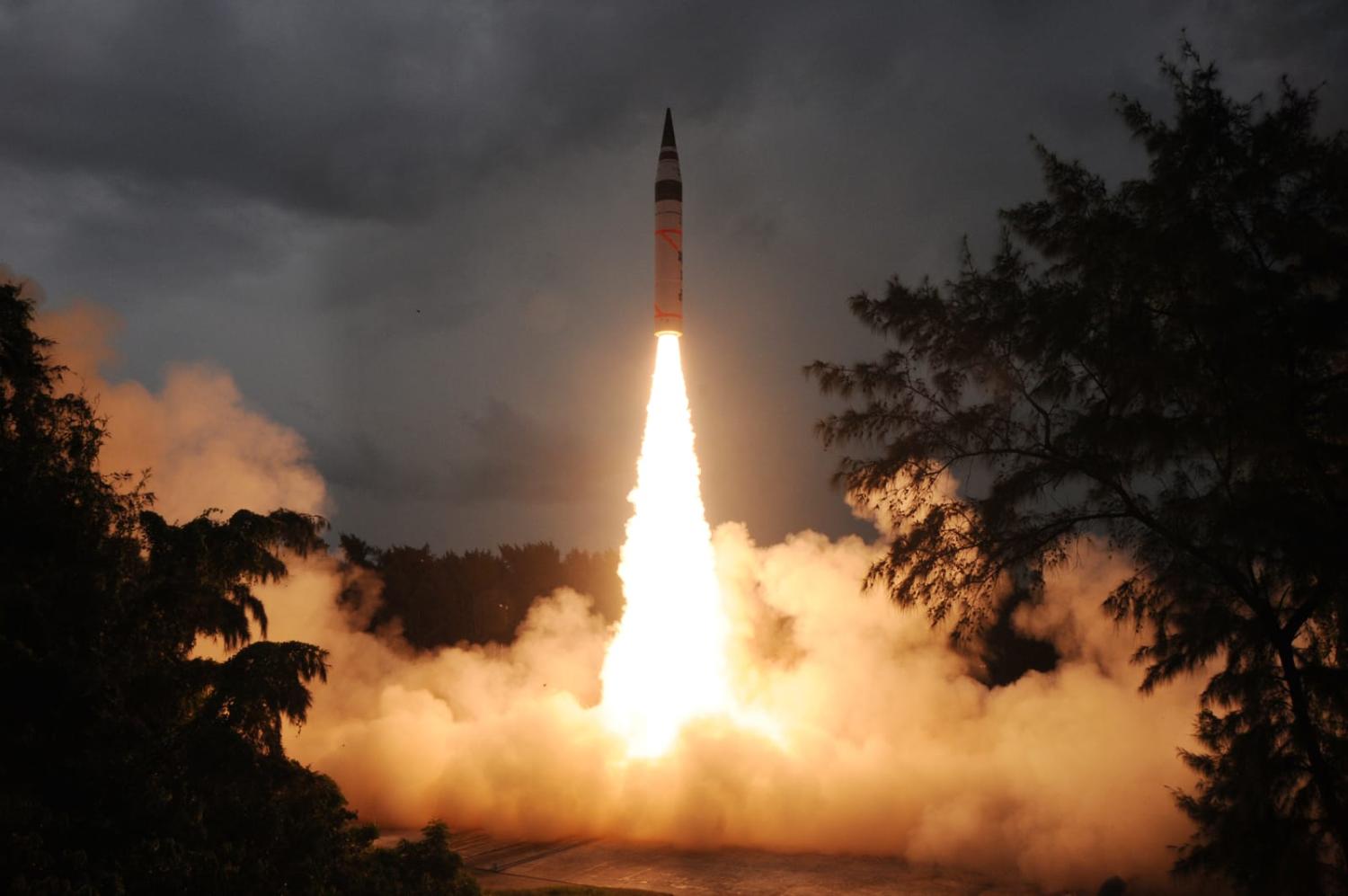
India’s military: a tech leap risks a nuclear chasm

RAJESH BASRUR WU SHANG-SU

Propelled by the Himalayan face-off with China, India’s military machine has been rapidly incorporating a range of new equipment to defend its borders. The bigger drive is to undertake a technological leap and build a truly powerful military by acquiring capabilities stemming from the newest technologies such as cyber, artificial intelligence (AI), drones, hypersonic vehicles and directed energy weapons.

But, in the pursuit of higher levels of security, India’s armed forces have yet to take full cognisance of the nuclear risks associated with the acquisition of what are viewed as conventional applications of high technology. This is evident from the limited attention given to the linkage between the conventional and nuclear domains.

While the problem of “cross-domain” effects of weapons systems has drawn considerable attention globally, Indian policymakers and military officials do not appear to have given sufficient thought to it. Senior officials are not unaware of the complexities of the issue: Lt Gen (retd) Rakesh Sharma has written on the subject and then army chief General Manoj Naravane acknowledged it in 2020. But much remains to be considered about the problems arising from the incorporation of these technologies.
The advent of the new technologies has accelerated the pace at which decisions may have to be taken in times of crisis.

Xi Jinping is not looking to go to war over Taiwan anytime soon

Derek Grossman

Derek Grossman is a senior defense analyst at the think tank RAND Corp. in Santa Monica, California and adjunct professor in the practice of political science and international relations at the University of Southern California. He formerly served as an intelligence adviser at the Pentagon.

For well over a year now, a growing chorus of American government and military officials have cited 2027 as Chinese President Xi Jinping's potential deadline for the forcible unification of Taiwan with the mainland.

In recent weeks, several senior U.S. officials have warned that the time frame could even be 2023 or 2024. However, after meeting with Xi on Monday ahead of the Group of 20 Summit in Bali, U.S. President Joe Biden appeared to walk back these assessments by stating, "I do not think there is any imminent attempt on the part of China to invade Taiwan."