The Profession of Arms: A Guide for Young Army Officers
It takes courage, especially for a young officer, to check a man met on the road for not saluting properly or for slovenly appearance, but, every time he does, it adds to his stock of moral courage, and whatever the soldier may say, he has respect for the officer who does pull him up.
Read Document →The Dragon's Teeth: Assessing China's Military Modernization
PLA has focused on modernising its capabilities across all warfare domains to achieve these goals. This includes land, air, and maritime operations, nuclear, space, counter-space, electronic warfare and cyberspace operations, aiming to become a fully integrated joint force.
Read Document →Transforming the PLA: A Decade of reorganisation from SSF to ISF
PRC has engaged in a sustained and broad effort to transform the PLA from an infantry-heavy, low-technology, ground forces-centric military into a high-technology, networked force with an increasing emphasis on joint operations and naval and air power projection.
Read Document →Eyes without Borders: Exploring the World of Open Source Intelligence (OSINT) in the Digital Age
Open Source Intelligence (OSINT) is gaining prominence with the rise of social media, the digital society and the vast growth of publicly and commercially available information (PAI and CAI).
Read Document →
The PLA’s Developing Cyber Warfare Capabilities and India's Options
Informationised warfare blurs the lines between peacetime and wartime. A nation in the information age cannot wait for the hostilities to break out to collect intelligence, carryout influence operations, develop antisatellite systems or design computer software weapons.
Read Document →
Galwan and After
Why did China did this when he is under tremendous pressure in all fronts, is this China's salami slice tactics being progressed rigorously, what will be new Rules of Engagement, what will be escalatory control mechanism, who has taken this decision, will there be some pressure put by China in India's North-East through insurgency.
Read Document →
India’s Joint Doctrine for Cyberspace Operations: A Critical Review
Chief of Defence Staff (CDS) General Anil Chauhan and Secretary, Department of Military Affairs, formally released declassified versions of the Joint Doctrines for Cyberspace Operations during the Chiefs of Staff Committee meeting in New Delhi.
Read Document →
Know your Enemy General(now Field Marshal) Syed Aseem Munir
Gen SA Munir's position in the hierarchy of Pakistan was not very comfortable. The state of economy, insurgency in Pakhtoonistan and Balochistan, attack on the Jaffar Express, constant protests by supporters of Imran Khan's supporters inside and outside of parliament.
Read Document →
Decoding Operation SINDOOR: Key Aspects and Implications
Precision strikes were carried out on nine sites—four in Pakistan and five in PoK—linked to anti-India terrorist groups such as the LeT, JeM and the Hizbul Mujahideen. The targeted sites included Muridke (LeT headquarters) and Bahawalpur (JeM headquarters).
Read Document →
Chinese Cyber Exploitation in India's Power Grid - Is There a linkage to Mumbai Power Outage?
The New York Times (NYT), based on analysis by a U.S. based private intelligence firm Recorded Future, reported that a Chinese entity penetrated India’s power grid at multiple load dispatch points. Chinese malware intruded into the control systems that manage electric supply across India, along with a high-voltage transmission substation and a coal-fired power plant
Read Document →9 July 2014
U.S. job far from done in Afghanistan
Gone: sea larger than Bengal UN tribunal awards Dhaka marine chunk
When, exactly, did India get a nuclear weapon?
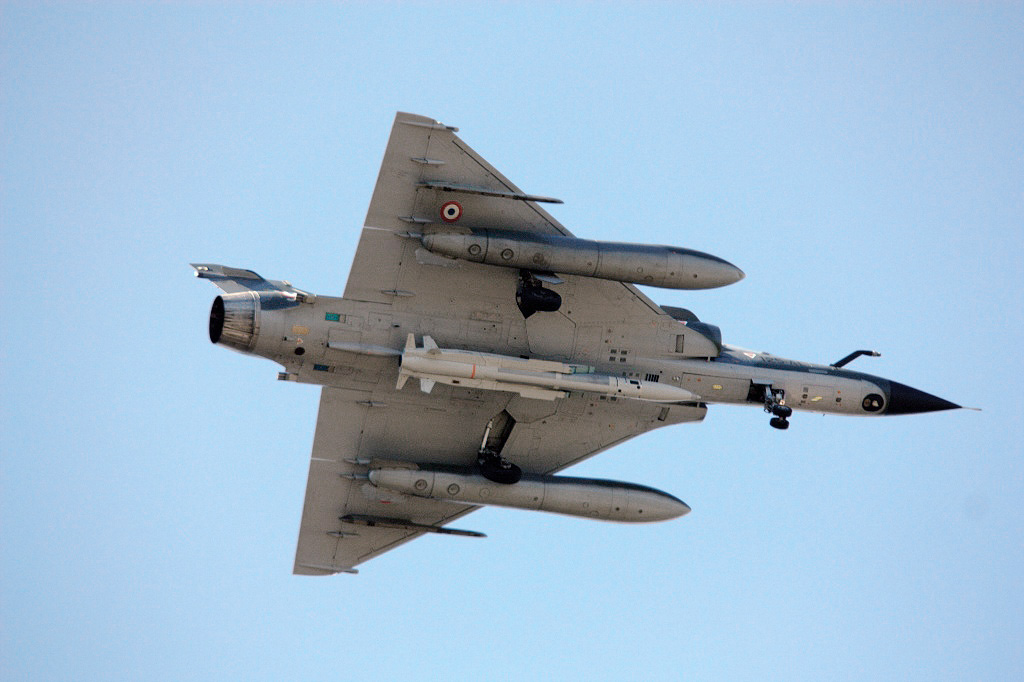
French Mirage 2000N carrying a nuclear-capable missile (India operates the Mirage 2000H variant). Photo from The Aviationist
According to one senior air force official, “In the early 1990s, the air force was thinking of one-way missions. . . . [I]t was unlikely that the pilot deployed on a nuclear attack mission would have made it back.”
A senior Indian defense official privy to this effort disclosed to the author that, until [Kargil in 1999], the air force had no idea (1) what types of weapons were available; (2) in how many numbers; and (3) what it was expected to do with the weapons.
In the latest IS (the journal, not the jihadist group!), Gaurav Kampani has a fascinating article on India’s nuclear weapons [1].
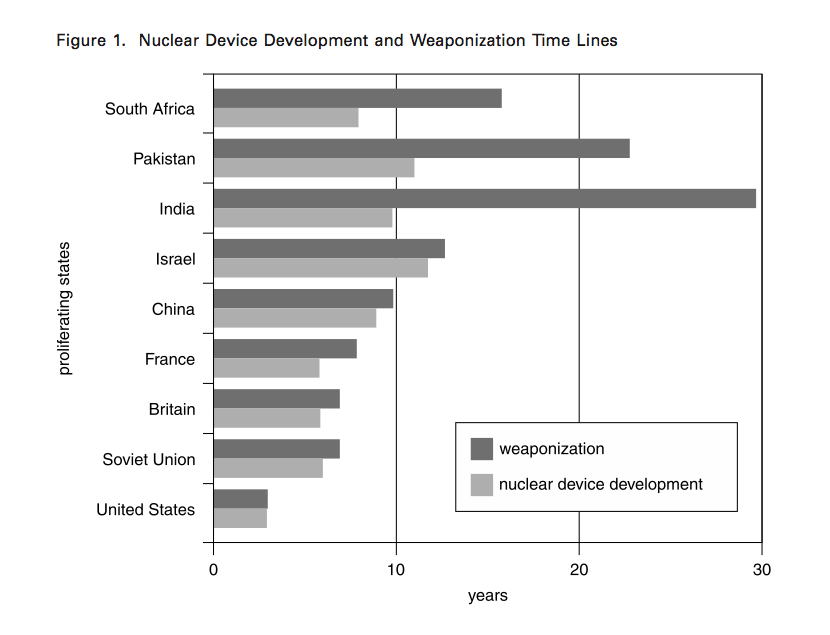
He makes a conceptual distinction (p79-80) between a nuclear device (“an apparatus that presents proof of scientific principle that a nuclear explosion will occur”) and actual weaponization (“building compact reliable rugged weapons and mating them with delivery vehicles”), and then asks why the “process of weaponization in South Africa, India, and Pakistan took eight, fifteen and ten years, a nearly twenty-eight-fold increase on average” when compared to the P5 states. India conducted its first nuclear test in 1974, but only developed a weapon much later.
Timeline for producing a nuclear device versus a weapon proper (from Kampani, “New Delhi’s Long Nuclear Journey”, IS, p87)
His answer is secrecy (p81-2):
Indian political leaders feared pressures for nuclear rollback from the United States. These pressures pushed the weaponization process underground, deep into the bowels of the state. To safeguard secrecy, policy planning was weakly institutionalized. Sensitive nuclear weapons–related information was tightly compartmentalized and hived off within an informal social network consisting of a small number of scientists and civilian bureaucrats. Secrecy concerns prevented decision-makers and policy planners from decomposing problem sets and parceling them out simultaneously for resolution to multiple bureaucratic actors, including the military …
In the absence of holistic planning stretching back to the 1980s, many technical problems, particularly those related to the integration of weapons with combat aircraft, were only partially anticipated. In other instances, policy planners remained unaware of the technical challenges until they demanded resolution. All of these factors became roadblocks on the path to weaponization. Secrecy concerns similarly prevented policy planners from institutionalizing the soft organizational and training routines between the scientific and military agencies necessary to move weapons from the stockpile to the target, in effect attenuating the state’s capacity to make good on its insinuated threat to punish a nuclear aggressor via a retaliatory response.
Battling for Islamic space, imagination
Published: July 9, 2014
Talmiz Ahmad
ISIS is not a monolithic jihadi entity. Not surprisingly, its dramatic proclamation of a ‘Caliphate’ in the territories of Iraq and Syria has hardly evoked much enthusiasm outside ISIS’ immediate jihadi circle.
On June 29, the night before the commencement of Ramadan, the spokesman of the Islamic State of Iraq and Syria(ISIS) announced the establishment of the “Caliphate” in the territories of Iraq and Syria occupied by it. This, he said, was “a dream that lives in the depths of every Muslim believer.” He declared that the leader of ISIS, Abu Bakr al-Baghdadi, would be the caliph and called upon all Muslims to pledge their allegiance to him. The territory controlled by ISIS would now simply be called the “Islamic State.” This event marks the high point of endeavours by jihadists to capture the Islamic space and imagination that began in modern times with the global jihad in Afghanistan and reached its apogee with the assault on American targets on September 11, 2001.
Early history
The predecessor of ISIS is the ferocious jihadi zealot, Abu Musab al-Zarqawi who met Osama bin Laden in Afghanistan in 1999. Following 9/11, Zarqawi moved to Iraq and, after the United States occupation in 2003, gained notoriety for his violence — including beheadings, kidnappings and suicide bombings — against U.S. forces but more often against Shia targets and even Sunni civilians. In October 2004, he pledged his formal allegiance to bin Laden and named his group Al-Qaeda in Iraq (AQI). Zarqawi was killed by the Americans in June 2006. Soon after, in October 2006, AQI renamed itself the Islamic State of Iraq (ISI), emphasising its links to Iraq and its focus on setting up an Islamic state.
The jihadi outlook and violence of the ISI alienated large sections of the Sunni population in Iraq’s Anbar province, including tribal chiefs, professionals and Baathists, who then organised themselves into militia to fight the jihadis. In major confrontations in 2006-09, this movement, known as Sahwa (Awakening), succeeded in defeating the ISI and forcing it to go underground.
The civil conflict in Syria from 2011 provided the opportunity for the ISI to revive itself by sending fighters into Syria who set up a new jihadi organisation, Jabhat Nusra, which formally came into being in January 2012 under the leadership of Abu Mohammed al-Jolani. By the end of 2012, Jabhat Nusra had become the most effective fighting force in Syria. This success encouraged the ISI leader in Iraq, Abu Bakr al-Baghdadi, who had taken over in 2010, to extend ISI’s role into Syria by renaming his organisation the Islamic State of Iraq and Syria (ISIS), and announcing the merger of ISIS with Jabhat Nusra. This was rejected by Jolani, who had the support of Ayman Zawahiri, now head of Al-Qaeda.
Chinese takeaway: Beijing’s Diaspora
The number of citizens travelling beyond China’s shores is expected to cross 100 million this year.
India is not the only country coming to terms with the mounting challenge of protecting its citizens abroad. New Delhi has Beijing for company. The Indians and Chinese have, for centuries, migrated to distant corners of the world. The overseas Chinese population, estimated to be around 50 million, is nearly double that of India. If we include Pakistanis, Bangladeshis, Nepalese and Sri Lankans, the size of the subcontinental diaspora is indeed comparable with China’s. As ancient and highly populated regions, China and the Indian subcontinent have for long shaped global migration patterns. Unlike Delhi, which has had to deal with diaspora issues ever since Independence, Beijing’s problems have just begun. After the formation of revolutionary China, Beijing had to deal with issues relating to large minority populations for a brief while, especially in neighbouring Asian countries.
Given its closed socialist economy, there was little new Chinese migration after the People’s Republic was proclaimed in 1949. At least until recently. After Deng Xiaoping opened up China at the end of 1970s, there has been a steady increase in its citizens travelling abroad for study, work, business and pleasure. Chinese passport holders living abroad are estimated to number around 6 million, nearly half that of India. As three and a half decades of rapid economic growth tightens China’s integration with the world, these numbers are bound to grow faster in coming decades.
For example, the number of citizens travelling beyond China’s shores is expected to cross 100 million this year. The number of Chinese youth from the PRC studying abroad has risen from virtually nothing in the late 1970s to about half a million now. After the Chinese leadership decided in 1999 to encourage its state-owned enterprises to invest abroad under the “Go Out” policy, there has been a rapid increase in the number of Chinese workers, skilled and unskilled, working on overseas projects across the world.
THE PLA’S ROLE
As in Delhi so in Beijing, the political leadership is under tremendous pressure from public opinion to respond vigorously to foreign crises involving nationals. If it is the electronic media that pushes Delhi, the large mass of Chinese netizens quickly build up the pressure on Beijing.
In the last few years, China has sought to strengthen its mechanisms for consular protection. It has increased the number of consular officers in Beijing and its field missions. China is making an extra effort to educate migrant labour, encourage employers to register workers being taken abroad and provide timely information on potential threats to their safety and security. Evacuation of citizens trapped in civil wars, disasters or other crisies has become a new focus for China in the last few years. According to a recent study by the Stockholm Institute of Peace Research, Beijing launched 13 operations to evacuate civilians from crises in different parts of the world during the years 2006-13.
The Iraq crisis puts India's 'strategic partnership' with America into question
By KANWAL SIBAL
PUBLISHED: 8 July 2014 |
Current developments in Iraq expose further the failure of US policies in West Asia.
With all the resources at its command, of information, analysis and technical expertise, and the sense of responsibility that must accompany the overwhelming power it possesses, the US should not be committing egregious mistakes in dealing with an unstable region like West Asia, riven with historical enmities, issues of nationhood, religious extremism, sectarian conflict and terrorism.
Instead of stabilising the region and releasing forces that would bring about real improvements in governance, participatory politics, institution building and social modernisation, US policies have largely done the opposite.
Conflict: The US's unwillingness to confront extremist ideologies has led to the growth in confidence of fundamentalist groups like the Taliban, who have made people flee their homes in Pakistan
This becomes glaring as the declared reasons for interventions are the promotion of democracy, pluralism, human rights and western values.
Terrorism
The Arab Spring, supposedly the harbinger of democracy in West Asia and evidence that Islam and democracy are not antithetical, has degenerated into an ouster by the military of a democratically-elected regime in Egypt that seemed determined to Islamise the polity, contrary to majority opinion.
After endorsing the toppled Muslim Brotherhood as a moderate force, the US now backs a military regime that is determined to decimate it in the name of democracy and human rights.
Libya's Gaddafi was eliminated in a brutal manner to general glee, and now lawlessness and political anarchy reign in the country.
The killing of the US Ambassador in Benghazi illustrated the folly of assuming self-imposed burdens to end tyranny in third countries and gift western freedoms to their peoples.
Pursuing ill-thought-out regime change policies, a peaceful street protest in Syria suppressed by force by the Syrian government became the peg for the West to hound President Assad, peremptorily summoning him to step down, threatening military reprisals, supporting a motley of violent opposition groups to force his eviction, all unmindful of the religious and ethnic diversity of the country and the danger of sectarian forces destroying its secular fabric.
With the country torn by a raging civil war worsened by external meddling, the cause of democracy and human freedoms in Syria has been buried under the debris of destruction there.
If military interventions in the region were intended to eliminate international terrorism, that objective has not been achieved either.
The US had wrongly accused Saddam Hussain of Al Qaida links. Afghanistan was attacked and the Taliban regime evicted for harbouring Al Qaida.
Although remnants of the Osama-led Al Qaida leadership remain in Pakistan, the overall success in vanquishing Al Qaida was cited as reason for US withdrawal from Afghanistan.