The Profession of Arms: A Guide for Young Army Officers
It takes courage, especially for a young officer, to check a man met on the road for not saluting properly or for slovenly appearance, but, every time he does, it adds to his stock of moral courage, and whatever the soldier may say, he has respect for the officer who does pull him up.
Read Document →The Dragon's Teeth: Assessing China's Military Modernization
PLA has focused on modernising its capabilities across all warfare domains to achieve these goals. This includes land, air, and maritime operations, nuclear, space, counter-space, electronic warfare and cyberspace operations, aiming to become a fully integrated joint force.
Read Document →Transforming the PLA: A Decade of reorganisation from SSF to ISF
PRC has engaged in a sustained and broad effort to transform the PLA from an infantry-heavy, low-technology, ground forces-centric military into a high-technology, networked force with an increasing emphasis on joint operations and naval and air power projection.
Read Document →Eyes without Borders: Exploring the World of Open Source Intelligence (OSINT) in the Digital Age
Open Source Intelligence (OSINT) is gaining prominence with the rise of social media, the digital society and the vast growth of publicly and commercially available information (PAI and CAI).
Read Document →
The PLA’s Developing Cyber Warfare Capabilities and India's Options
Informationised warfare blurs the lines between peacetime and wartime. A nation in the information age cannot wait for the hostilities to break out to collect intelligence, carryout influence operations, develop antisatellite systems or design computer software weapons.
Read Document →
Galwan and After
Why did China did this when he is under tremendous pressure in all fronts, is this China's salami slice tactics being progressed rigorously, what will be new Rules of Engagement, what will be escalatory control mechanism, who has taken this decision, will there be some pressure put by China in India's North-East through insurgency.
Read Document →
India’s Joint Doctrine for Cyberspace Operations: A Critical Review
Chief of Defence Staff (CDS) General Anil Chauhan and Secretary, Department of Military Affairs, formally released declassified versions of the Joint Doctrines for Cyberspace Operations during the Chiefs of Staff Committee meeting in New Delhi.
Read Document →
Know your Enemy General(now Field Marshal) Syed Aseem Munir
Gen SA Munir's position in the hierarchy of Pakistan was not very comfortable. The state of economy, insurgency in Pakhtoonistan and Balochistan, attack on the Jaffar Express, constant protests by supporters of Imran Khan's supporters inside and outside of parliament.
Read Document →
Decoding Operation SINDOOR: Key Aspects and Implications
Precision strikes were carried out on nine sites—four in Pakistan and five in PoK—linked to anti-India terrorist groups such as the LeT, JeM and the Hizbul Mujahideen. The targeted sites included Muridke (LeT headquarters) and Bahawalpur (JeM headquarters).
Read Document →
Chinese Cyber Exploitation in India's Power Grid - Is There a linkage to Mumbai Power Outage?
The New York Times (NYT), based on analysis by a U.S. based private intelligence firm Recorded Future, reported that a Chinese entity penetrated India’s power grid at multiple load dispatch points. Chinese malware intruded into the control systems that manage electric supply across India, along with a high-voltage transmission substation and a coal-fired power plant
Read Document →6 September 2015
Germany and Sweden Helping the U.S. Target Its Drone Strikes in Afghanistan
India and Pakistan’s Dialogue of the Deaf
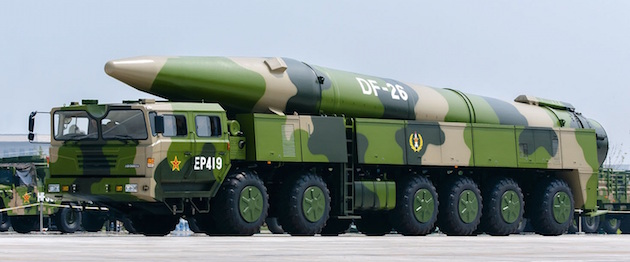
China Displays New DF-26 Ballistic Missile That Can Hit Guam
Assassinating Chiang Kai-shek
During World War II, it was sometimes hard to know who hated the Chinese Nationalist commander Chiang Kai-shek more: his sworn enemy, the Chinese Communist Party, and its leader Mao Zedong — or the Americans. It is a little known fact that at least twice during the long course of the war, senior officials of the United States considered assassinating Chiang, who was fighting the Japanese on the side of the Americans. During the Cairo Conference in November 1943, attended by President Franklin D. Roosevelt, British Prime Minister Winston Churchill, and Chiang, Roosevelt met privately with his senior commander in China, Maj. Gen. Joseph Stilwell. “Big boy,” Stilwell said when he got back to China’s wartime capital Chongqing, quoting Roosevelt to his chief of staff, Gen. Frank “Pinky” Dorn, “if you can’t get along with Chiang and can’t replace him, get rid of him once and for all. You know what I mean. Put in someone you can manage.”Beijing Tightened Internet Controls Before Glitzy Military Parade
Beijing Tightened Internet Controls Before Glitzy Military Parade
It was impossible to miss the choreography on display in the streets of Beijing Thursday — thousands of goose-stepping troops, tanks in perfect formation, and an array of new missiles. Marking the 70th anniversary of the end of World War II, the parade was a chance for Chinese leader Xi Jinping to stir his country’s nationalist feelings and also to assert his own authority by announcing plans to slash 300,000 troops from China’s bloated military.
But before the tanks ever got rolling, Chinese censors worked hard to ensure that the parade would be a propaganda success. In the weeks leading up to the parade, Beijing didn’t just direct its state media apparatus to cover the preparations in exhaustive detail. Behind the scenes, it also continued its campaign to limit what citizens can see online by clamping down on the tools ordinary Chinese use to jump what is widely known as the Great Firewall. The phrase refers to restrictions preventing Chinese netizens from accessing certain sites deemed inappropriate by the government. In response, a cottage industry of so-called “circumvention tools” have popped up to allow ordinary Internet users to bypass those obstacles.
esc_attr( get_the_title( $cat_image ) ) China Wants More Planes and Ships — and 300,000 Fewer Troops
China is slashing 300,000 troops, but the cuts aren’t being made to reduce tensions with Beijing’s increasingly anxious neighbors. Instead, China is trying to trim the fat from a force burdened with massive Soviet-era bureaucracy, aging equipment, and enormous numbers of poorly trained, badly paid draftees.China Lost World War II
On Sept. 3, China held a military parade — the 15th since its founding and the first to celebrate its victory over Japan in World War II. Highlighting Beijing’s commitment to “preserving world peace,” according to official pronouncements, this parade showcased China’s most advanced military capabilities, including ballistic missiles, tanks, and fighter jets. Twelve thousand troops marched past Tiananmen Square in view of the assembled dignitaries, including 30 visiting heads of state. The parade was more than a display of raw power: It projected a narrative that placed China, especially the ruling Communist Party, at the center of the global anti-fascist and anti-imperialist struggle.Indictment of 5 Chinese Military Hackers in 2014 Has Not Deterred China From Continuing to Hack U.S. Secrets
The horrific results of Obama’s failure in Syria
For four years, the Obama administration has engaged in what Frederic Hof, former special adviser for transition in Syria, calls a “pantomime of outrage.” Four years of strongly worded protests, and urgent meetings and calls for negotiation — the whole drama a sickening substitute for useful action. People talking and talking to drown out the voice of their own conscience. And blaming. In 2013, President Obama lectured the U.N. Security Council for having “demonstrated no inclination to act at all.” Psychological projection on a global stage.