The Profession of Arms: A Guide for Young Army Officers
It takes courage, especially for a young officer, to check a man met on the road for not saluting properly or for slovenly appearance, but, every time he does, it adds to his stock of moral courage, and whatever the soldier may say, he has respect for the officer who does pull him up.
Read Document →The Dragon's Teeth: Assessing China's Military Modernization
PLA has focused on modernising its capabilities across all warfare domains to achieve these goals. This includes land, air, and maritime operations, nuclear, space, counter-space, electronic warfare and cyberspace operations, aiming to become a fully integrated joint force.
Read Document →Transforming the PLA: A Decade of reorganisation from SSF to ISF
PRC has engaged in a sustained and broad effort to transform the PLA from an infantry-heavy, low-technology, ground forces-centric military into a high-technology, networked force with an increasing emphasis on joint operations and naval and air power projection.
Read Document →Eyes without Borders: Exploring the World of Open Source Intelligence (OSINT) in the Digital Age
Open Source Intelligence (OSINT) is gaining prominence with the rise of social media, the digital society and the vast growth of publicly and commercially available information (PAI and CAI).
Read Document →
The PLA’s Developing Cyber Warfare Capabilities and India's Options
Informationised warfare blurs the lines between peacetime and wartime. A nation in the information age cannot wait for the hostilities to break out to collect intelligence, carryout influence operations, develop antisatellite systems or design computer software weapons.
Read Document →
Galwan and After
Why did China did this when he is under tremendous pressure in all fronts, is this China's salami slice tactics being progressed rigorously, what will be new Rules of Engagement, what will be escalatory control mechanism, who has taken this decision, will there be some pressure put by China in India's North-East through insurgency.
Read Document →
India’s Joint Doctrine for Cyberspace Operations: A Critical Review
Chief of Defence Staff (CDS) General Anil Chauhan and Secretary, Department of Military Affairs, formally released declassified versions of the Joint Doctrines for Cyberspace Operations during the Chiefs of Staff Committee meeting in New Delhi.
Read Document →
Know your Enemy General(now Field Marshal) Syed Aseem Munir
Gen SA Munir's position in the hierarchy of Pakistan was not very comfortable. The state of economy, insurgency in Pakhtoonistan and Balochistan, attack on the Jaffar Express, constant protests by supporters of Imran Khan's supporters inside and outside of parliament.
Read Document →
Decoding Operation SINDOOR: Key Aspects and Implications
Precision strikes were carried out on nine sites—four in Pakistan and five in PoK—linked to anti-India terrorist groups such as the LeT, JeM and the Hizbul Mujahideen. The targeted sites included Muridke (LeT headquarters) and Bahawalpur (JeM headquarters).
Read Document →
Chinese Cyber Exploitation in India's Power Grid - Is There a linkage to Mumbai Power Outage?
The New York Times (NYT), based on analysis by a U.S. based private intelligence firm Recorded Future, reported that a Chinese entity penetrated India’s power grid at multiple load dispatch points. Chinese malware intruded into the control systems that manage electric supply across India, along with a high-voltage transmission substation and a coal-fired power plant
Read Document →9 August 2017
*** Who Will Win the Great China-India Naval War of 2020?
A Nuclear Command and Control System for India
Why It’s A Bit Premature To Presume That Modi Will Win Hands Down In 2019
It is advisable for the BJP to curb its triumphalism, and focus on delivering jobs. It would help if the party softened its political rhetoric and made genuine efforts to engage with the opposition parties on big issues.Standoff on the border
Raja Mandala: Doklam’s unintended consequence
Full-scale India-China war likely soon, Washington will back New Delhi: Meghnad Desai
Rescue Sino-Indian ties from the Pak morass
Finding a Realistic Middle Way for the U.S. in Afghanistan
While not as dangerous as Iran and North Korea, Afghanistan remains one of America’s thorniest and most frustrating security challenges. Since the George W. Bush administration intervened in that country after the attacks of 9/11, the United States has tried to create an Afghan government and train security forces that could stabilize the country and eradicate extremist organizations like al-Qaida that had been given sanctuary there under Taliban rule. The idea was that after some period of international help, the government and security forces of Afghanistan would be able to stand on their own. To Win Afghanistan, Get Tough on Pakistan
President Trump’s review of American policy in Afghanistan should involve adopting a tougher approach to Pakistan. Although the Taliban are said to control or contest 40 percent of Afghanistan’s territory, Taliban leadersoperate from the safety of Pakistan. United States incentives since the Sept. 11 attacks have failed to dissuade Pakistan from supporting the Taliban, and Mr. Trump must now consider alternatives.Remembering How We Won The Last War And Why It Is A Good Thing To Do So
The U.S. military has been fighting in Afghanistan since 2001. That fact, our 16 year trial, is not what this piece is about, really — about how we struggled, earnestly, to keep villages and towns and neighborhoods free from violent religious extremists. The thugs and crooks with whom we allied ourselves in order to clean the Taliban out, the cynical politicians and the mystified U.S. public back home, nobody really believing any of it might make some kind of difference. The black nights and hot days spent huddled in a concrete water main or the Tactical Operations Center, sweating through salt stained helmet and body armor covers in case this rocket attack was part of something bigger. It’s not about what it felt like to watch an AC-130 pound some insurgent compound, or how our bodies adapted to the knock-knocking of nearby 155s, and learned to roll over at night if the booms weren’t “incoming.” The piece is not about America’s fight in Afghanistan, because although that fight still ticks on every day, relatively unchanged, the U.S. military’s mission has changed.Contractors in Afghanistan: What Erik Prince Gets Right
China - Anti-Satellite Missile Test Launched In July
Is The Arctic The Next South China Sea? Not Likely
As global reach grows, China builds military to match
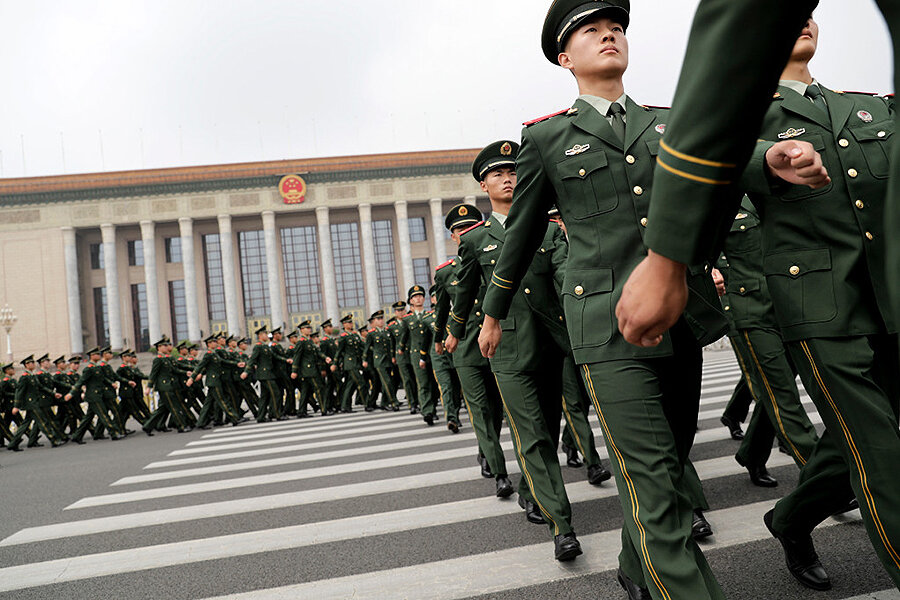
AUGUST 4, 2017 BEIJING—The military parade China held on Sunday to celebrate the 90th anniversary of the People’s Liberation Army was an impressive show of force. More than 12,000 troops marched at the remote Zhurihe training base in Inner Mongolia, about 250 miles north of Beijing, as President Xi Jinping looked on from an open-top jeep.China’s digital economy: A leading global force
If The U.S. Starts A War With North Korea, China Won’t Be On Our Side
A Grim Future For Russia’s Nuclear Sub Fleet
America's Endless Search for a Strategy
Surviving a Nuclear Attack
An Interview with Stanley McChrystal
Turnabout Is Fair Play: A Marine Officer Interviews Tom About Military Leadership
Best Defense is on summer hiatus. During this restful spell we offer re-runs from the past 12 months. This item originally ran on Mar. 13.What is the Army doing to secure and defend its cyber terrain?
This is part six of a series exploring the differences between military cyber forces, capabilities, mission sets and needs. For previous installments, see part one, part two, part three, part fourand part five.