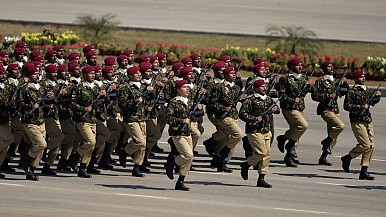
The Profession of Arms: A Guide for Young Army Officers
It takes courage, especially for a young officer, to check a man met on the road for not saluting properly or for slovenly appearance, but, every time he does, it adds to his stock of moral courage, and whatever the soldier may say, he has respect for the officer who does pull him up.
Read Document →The Dragon's Teeth: Assessing China's Military Modernization
PLA has focused on modernising its capabilities across all warfare domains to achieve these goals. This includes land, air, and maritime operations, nuclear, space, counter-space, electronic warfare and cyberspace operations, aiming to become a fully integrated joint force.
Read Document →Transforming the PLA: A Decade of reorganisation from SSF to ISF
PRC has engaged in a sustained and broad effort to transform the PLA from an infantry-heavy, low-technology, ground forces-centric military into a high-technology, networked force with an increasing emphasis on joint operations and naval and air power projection.
Read Document →Eyes without Borders: Exploring the World of Open Source Intelligence (OSINT) in the Digital Age
Open Source Intelligence (OSINT) is gaining prominence with the rise of social media, the digital society and the vast growth of publicly and commercially available information (PAI and CAI).
Read Document →
The PLA’s Developing Cyber Warfare Capabilities and India's Options
Informationised warfare blurs the lines between peacetime and wartime. A nation in the information age cannot wait for the hostilities to break out to collect intelligence, carryout influence operations, develop antisatellite systems or design computer software weapons.
Read Document →
Galwan and After
Why did China did this when he is under tremendous pressure in all fronts, is this China's salami slice tactics being progressed rigorously, what will be new Rules of Engagement, what will be escalatory control mechanism, who has taken this decision, will there be some pressure put by China in India's North-East through insurgency.
Read Document →
India’s Joint Doctrine for Cyberspace Operations: A Critical Review
Chief of Defence Staff (CDS) General Anil Chauhan and Secretary, Department of Military Affairs, formally released declassified versions of the Joint Doctrines for Cyberspace Operations during the Chiefs of Staff Committee meeting in New Delhi.
Read Document →
Know your Enemy General(now Field Marshal) Syed Aseem Munir
Gen SA Munir's position in the hierarchy of Pakistan was not very comfortable. The state of economy, insurgency in Pakhtoonistan and Balochistan, attack on the Jaffar Express, constant protests by supporters of Imran Khan's supporters inside and outside of parliament.
Read Document →
Decoding Operation SINDOOR: Key Aspects and Implications
Precision strikes were carried out on nine sites—four in Pakistan and five in PoK—linked to anti-India terrorist groups such as the LeT, JeM and the Hizbul Mujahideen. The targeted sites included Muridke (LeT headquarters) and Bahawalpur (JeM headquarters).
Read Document →
Chinese Cyber Exploitation in India's Power Grid - Is There a linkage to Mumbai Power Outage?
The New York Times (NYT), based on analysis by a U.S. based private intelligence firm Recorded Future, reported that a Chinese entity penetrated India’s power grid at multiple load dispatch points. Chinese malware intruded into the control systems that manage electric supply across India, along with a high-voltage transmission substation and a coal-fired power plant
Read Document →11 November 2017
*** Saudi Arabia’s Saturday Night Massacre
** Trump Angles for a Win in Asia
U.S. efforts to contain Pyongyang will be complicated by South Korea's objection to a hardline approach to dealing with the North.ISIS Might Have One Last Escape Route: Pakistan
The fall of its de facto Syrian capital Raqqa last month signaled the death of the Islamic State (ISIS) in the Middle East. On Friday, Syrian troops retook Deir ez-Zor, the last major city with an ISIS presence, just as Iraqi forces took over the crossing in al-Qaim, near the group’s final urban stronghold.Trump’s Wake-Up Call on China
Trump Is Ceding Global Leadership to China
Amid the pomp that President Xi Jinping of China is bestowing upon his visiting American counterpart, President Trump, it’s hard not to see two leaders — and two countries — heading in very different directions. Mr. Xi emerged from last month’s Communist Party Congress the undisputed master of the Middle Kingdom. “Xi Jinping Thought” was enshrined in the Constitution — an honor previously granted only to Mao Zedong and Deng Xiaoping. Breaking with precedent, Mr. Xi neglected to anoint a successor — a big hint that he feels emboldened to extend his rule beyond the second five-year term he has just begun. The Economist heralded Mr. Xi with an honorific usually reserved for America’s president: the world’s most powerful man.China’s New Aircraft Carrier to Use Advanced Jet Launch System
The People’s Liberation Army Navy’s (PLAN) next-generation aircraft carrier, designated Type 002, will likely be fitted with an advanced electromagnetic catapult system for launching aircraft, according to Chinese military experts. Chinese engineers have allegedly successfully developed a new integrated propulsion system (IPS)–“a medium-voltage, direct-current transmission network”—which would allow more power for a catapult assisted take-off but arrested recovery (CATOBAR) aircraft launch system similar to the U.S. Navy’s electromagnetic aircraft launch system (EMALS) without having to resort to nuclear power, the South China Morning Post (SCMP)reported on November 1.HARD CONSTRAINTS ON CHINA’S NUCLEAR FORCES
China is the only nuclear weapon state recognized by the Nonproliferation Treaty that is actively expanding its nuclear arsenal. Its nuclear forces have increased modestly from an estimated 130 to 200 warheads in 2006 to an estimated 170 to 260 today. The qualitative changes to its nuclear forces have been more significant, with the introduction of more mobile solid-fueled missiles, multiple independently targetable reentry vehicles (MIRVs), and an emerging fleet of nuclear-powered ballistic missile submarines (SSBNs).Arrests in Saudi Arabia: Causes and Implications
Saudi Arabia has united with Israel against Iran – and a desert storm is brewing
Until last weekend, the Ritz-Carlton in Riyadh’s exclusive Diplomatic Quarter was colloquially known as the Princes’ Hotel. It was a luxurious retreat from the heat, where royals could engage in the kind of wheeling and dealing with the global business elite that had made them millionaires on the back of the 1970s oil boom. No deal could be brokered without paying a bribe to at least one prince. Last Saturday that era of boundless opportunity and total impunity came to a dramatic end. The VIP guests were booted out, the front doors were shuttered, and heavily armed security forces took up positions around the perimeter.The cancer of Islamist extremism spreads around the world
This week’s tragic terrorist attack in New York was the kind of isolated incident by one troubled man that should not lead to generalizations. In the 16 years since 9/11, the city has proved astonishingly safe from jihadist groups and individuals. And yet, speaking about it to officials in this major global hub 10,000 miles away, the conclusions they reach are worrying. “The New York attack might be a way to remind us all that while ISIS is being defeated militarily, the ideological threat from radical Islam is spreading,” says Singaporean Home Minister K. Shanmugam. “The trend line is moving in the wrong direction.”A Strategy for the Post-ISIS Middle East
With Islamic State nearly vanquished in Syria and Iraq, it’s time for a serious debate about the broader U.S. security strategy in the Middle East. Leaving aside the Israeli-Palestinian peace process and its unpromising near-term prospects, this debate must address the array of issues affecting American interests in the region: violent conflict, alliances, political and economic reform, and the central challenge of dealing with Iran.The New Testament of Strategic Innovation
Inside story: How Russians hacked the Democrats' emails
It was just before noon in Moscow on March 10, 2016, when the first volley of malicious messages hit the Hillary Clinton campaign. The first 29 phishing emails were almost all misfires. Addressed to people who worked for Clinton during her first presidential run, the messages bounced back untouched. Within nine days, some of the campaign’s most consequential secrets would be in the hackers’ hands, part of a massive operation aimed at vacuuming up millions of messages from thousands of inboxes across the world.Facing Russian threat, NATO boosts operations for the first time since the Cold War
BRUSSELS — As the specter of conflict with Russia looms over Europe, NATO defense ministers decided Wednesday to expand the alliance’s operations for the first time since the Cold War, sharpen its focus on cyber operations, and boost its capability to respond to Kremlin aggression. Facebook Can’t Cope With the World It’s Created
As Mark Zuckerberg returns from his latest pilgrimage to Beijing, it’s time for him to pay more attention to the countries in Asia where Facebook actually matters.The Facebook CEO has spent years courting Chinese officials in the hopes of winning admittance to the world’s largest internet market. But while he’s been beating his head against the Great Firewall, Facebook has swept like wildfire through the rest of Asia, with complicated and sometimes dangerous results.An edge for non-state actors: AI
Commercial advancements in artificial intelligence and machine learning could level the playing field and lower the barrier of entry for smaller nation states, as well as non-state actors. While highly advanced and destructive cyberspace capabilities have historically resided strictly with top-level nation states, those days may soon be over. Commercial advancements in artificial intelligence and machine learning could level the playing field and lower the barrier of entry for smaller nation states, as well as non-state actors.Chief: Commission Silicon Valley Superstars for Future Wars
The U.S. Army’s chief of staff on Tuesday appealed to young leaders as well as private industry to help the service be ready for a new age of warfare.Speaking before an audience at the 2017 International Conference on Cyber Conflict, Gen. Mark Milley it will be up to young lieutenants and captains to figure out how the Army will fight on a future battlefield that is dominated by cyber weapons, precision fires and artificial intelligence.Army looks to its youngest soldiers, officers to lead in cyber warfare
WHAT CHINA'S MILITARY LOOKS LIKE COMPARED TO THE U.S.
The Death of American Conventional Warfare
Now, we are pleased to present one of the essays selected for honorable mention, from Jahara Matisek of Northwestern University and Ian Bertram of the U.S. Air Command and Staff College. Conventional warfare is officially dead. This has become an obvious trend with innumerable adversaries engaging the American military and its allies in unconventional ways with unconventional means. The long-held notion of the decisive battle that brings the combat power of two nations against each other for a winner-take-all slugfest lies in the next grave. Even wars of attrition, in the model of the American Civil War, First and Second World Wars, and Korea are gone. If America hopes to remain strategically significant, its political and military leadership must adapt to the new reality that no adversary wants to fight the United States in a symmetrically conventional fashion.