The Profession of Arms: A Guide for Young Army Officers
It takes courage, especially for a young officer, to check a man met on the road for not saluting properly or for slovenly appearance, but, every time he does, it adds to his stock of moral courage, and whatever the soldier may say, he has respect for the officer who does pull him up.
Read Document →The Dragon's Teeth: Assessing China's Military Modernization
PLA has focused on modernising its capabilities across all warfare domains to achieve these goals. This includes land, air, and maritime operations, nuclear, space, counter-space, electronic warfare and cyberspace operations, aiming to become a fully integrated joint force.
Read Document →Transforming the PLA: A Decade of reorganisation from SSF to ISF
PRC has engaged in a sustained and broad effort to transform the PLA from an infantry-heavy, low-technology, ground forces-centric military into a high-technology, networked force with an increasing emphasis on joint operations and naval and air power projection.
Read Document →Eyes without Borders: Exploring the World of Open Source Intelligence (OSINT) in the Digital Age
Open Source Intelligence (OSINT) is gaining prominence with the rise of social media, the digital society and the vast growth of publicly and commercially available information (PAI and CAI).
Read Document →
The PLA’s Developing Cyber Warfare Capabilities and India's Options
Informationised warfare blurs the lines between peacetime and wartime. A nation in the information age cannot wait for the hostilities to break out to collect intelligence, carryout influence operations, develop antisatellite systems or design computer software weapons.
Read Document →
Galwan and After
Why did China did this when he is under tremendous pressure in all fronts, is this China's salami slice tactics being progressed rigorously, what will be new Rules of Engagement, what will be escalatory control mechanism, who has taken this decision, will there be some pressure put by China in India's North-East through insurgency.
Read Document →
India’s Joint Doctrine for Cyberspace Operations: A Critical Review
Chief of Defence Staff (CDS) General Anil Chauhan and Secretary, Department of Military Affairs, formally released declassified versions of the Joint Doctrines for Cyberspace Operations during the Chiefs of Staff Committee meeting in New Delhi.
Read Document →
Know your Enemy General(now Field Marshal) Syed Aseem Munir
Gen SA Munir's position in the hierarchy of Pakistan was not very comfortable. The state of economy, insurgency in Pakhtoonistan and Balochistan, attack on the Jaffar Express, constant protests by supporters of Imran Khan's supporters inside and outside of parliament.
Read Document →
Decoding Operation SINDOOR: Key Aspects and Implications
Precision strikes were carried out on nine sites—four in Pakistan and five in PoK—linked to anti-India terrorist groups such as the LeT, JeM and the Hizbul Mujahideen. The targeted sites included Muridke (LeT headquarters) and Bahawalpur (JeM headquarters).
Read Document →
Chinese Cyber Exploitation in India's Power Grid - Is There a linkage to Mumbai Power Outage?
The New York Times (NYT), based on analysis by a U.S. based private intelligence firm Recorded Future, reported that a Chinese entity penetrated India’s power grid at multiple load dispatch points. Chinese malware intruded into the control systems that manage electric supply across India, along with a high-voltage transmission substation and a coal-fired power plant
Read Document →5 May 2018
Petro-Goods Under GST Is Not Going To Happen, So Why Bull***T About It?
China-India Wuhan Summit April 2018: Competing Geopolitical Perspectives
In Canada, a Trade War Emerges
No matter which party is in power in Ottawa or Edmonton, Canada and Alberta will be compelled to push for more pipeline options to unlock further growth for their energy exports. British Columbia's tendency to reject pipeline projects on environmental grounds will put it on a collision course with its neighbor and the federal government. While Alberta is threatening to cut off oil and fuel shipments to British Columbia, the courts will rule on the legality of such measures.Taliban Control of Afghan Districts Remains Unchanged Despite Increased U.S. Military Pressure
Will China Replace the US Global Role?
Our previous article suggested that China may be committed to building a world order governed by the ancient Chinese concept of li (็คผ). Such an order regards propriety as the key means to conducting relationships; is based on a concentric zone structure; and is open. While this order is compatible with the current international system, the majority of the members will be China’s neighboring countries, as well as a small number of countries from other continents. By the time this order is fully established, will China have replaced the global leadership role currently held by the United States? This depends on two factors. First, does China have such a desire? Second, does China have such a capacity?Preparing for Future Food Needs, China Tries to Shed Its Past
One Belt, One Road, One Happy Chinese Navy
The Changbai Shan, a Chinese amphibious warfare ship that’s taken advantage of commercial ports for resupply, Jan. 26, 2015. Chinese leaders tout their trillion-dollar Belt and Road project, especially in the Indian Ocean, as a win-win commercial proposition meant to bring modern infrastructure and prosperity to an underdeveloped part of the world. In reality, Beijing’s acquisition of more than a dozen ports across the Indian Ocean is a state-directed effort to bolster Chinese political influence and extend its military reach from Indonesia to East Africa, according to a detailed new study released Tuesday.Faced With Chinese Expansion, Kazakhstan Seeks Alternative Energy Markets
Artificial Intelligence: China’s High-Tech Ambitions
China aims to become the world’s premier artificial intelligence innovation center by 2030. But does Beijing have the innovation capacity and strategy in place to achieve this goal? In this article, Sophie-Charlotte Fischer responds. She contends that while the US is still the global leader in AI, China’s ambitions should not be underestimated. Further, this is not just because of the state support behind Beijing’s plans but as Washington lacks an AI strategy of its own. This CSS Analyses in Security Policy was originally published in February 2018 by the Center for Security Studies (CSS). It is also available in German and French.What Happens to a Cruise Missile Captured by the Russians
This week the Russian ministry of defense showed pictures of what it claimed to be remains of U.S. cruise missiles used during the recent airstrikes on Syria. “They are now being examined by our experts,” said Col. Gen. Sergey Rudskoy. “The results of this work will be used to improve Russian weapons.” The debris shown is far from conclusive evidence, so we can't take Rudskoy's claim at face value. But for the sake of argument, let’s assume the Russians did capture significant parts of a long-range cruise missile including Tomahawks. What could its engineers do with the remains?Who are Iran's 80,000 'Shi'ite' Fighters in Syria?
Can North Korea Really Give Up Its Nukes?
North Korea's diplomatic outreach again raises the possibility that it is willing to use its nuclear program as a bargaining chip. With an eye toward regime survival and eventual Korean unification, Pyongyang could trade away the public face of its nuclear weapons program. Having offered such a concession, North Korea will demand a lot more than an easing of sanctions by South Korea and the United States in return.Moscow Plans New Arctic Port to Bypass Baltics and Ukraine
Beyond Syria and Ukraine: Wagner PMC Expands Its Operations to Africa
Time for a New U.S. Foreign Policy Narrative
Defending hospitals against life-threatening cyberattacks
Like any large company, a modern hospital has hundreds – even thousands – of workers using countless computers, smartphones and other electronic devices that are vulnerable to security breaches, data thefts and ransomware attacks. But hospitals are unlike other companies in two important ways. They keep medical records, which are among the most sensitive data about people. And many hospital electronics help keep patients alive, monitoring vital signs, administering medications, and even breathing and pumping blood for those in the most dire conditions.The promise and peril of military applications of artificial intelligence
Artificial intelligence (AI) is having a moment in the national security space. While the public may still equate the notion of artificial intelligence in the military context with the humanoid robots of the Terminatorfranchise, there has been a significant growth in discussions about the national security consequences of artificial intelligence. These discussions span academia, business, and governments, from Oxford philosopher Nick Bostrom’s concern about the existential risk to humanity posed by artificial intelligence to Tesla founder Elon Musk’s concern that artificial intelligence could trigger World War III to Vladimir Putin’s statement that leadership in AI will be essential to global power in the 21st century.Defense panels want the Pentagon to form a cyber reserve team to help states
The House Armed Services subcommittee wants to study the possibility of establishing cyber reserve components for each state that could also provide cyber support to civilian agencies. In a draft version of the annual defense policy bill released April 25 by the HASC subcommittee on emerging threats and capabilities, lawmakers requested a study on the feasibility, advisability, and necessity of a reserve cyber team for each state. As part of the study, the committee directs DoD to consider a series of tasks, including responding to major network attacks, and gauging the U.S. cyber workforce capacity for both homeland defense and national power.The Digital Vigilantes Who Hack Back
American companies that fall victim to data breaches want to retaliate against the culprits. But can they do so without breaking the law? Estimates suggest that ninety per cent of American companies have been hacked. Illustration by Golden Cosmos One day in the summer of 2003, Shawn Carpenter, a security analyst in New Mexico, went to Florida on a secret mission. Carpenter, then thirty-five, worked at Sandia National Laboratories, in Albuquerque, on a cybersecurity team. At the time, Sandia was managed by the defense contractor Lockheed Martin. When hundreds of computers at Lockheed Martin’s office in Orlando suddenly started crashing, Carpenter and his team got on the next flight.Cybersecurity and the New Era of Space Activities
Governments, critical infrastructure, and economies rely on space-dependent services—for example, the Global Positioning System (GPS)—that are vulnerable to hostile cyber operations. However, few spacefaring states and companies have paid any attention to the cybersecurity of satellites in outer space, creating a number of risks. A Tesla Roadster automobile floats through space after it was carried there by SpaceX's Falcon Heavy.Leap-Ahead Technologies: Could They Be the Army's Undoing?
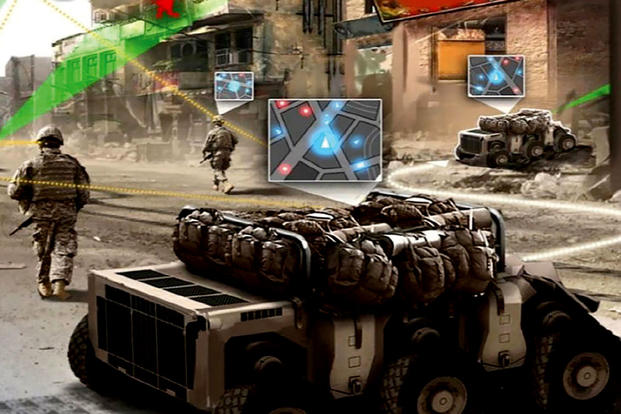
By 2025, the Army sees ground troops conducting foot patrols in urban terrain with robots -- called Squad Multipurpose Equipment Transport vehicles -- that carry rucksacks and other equipment. (US Army image) Prototype 1 of the Non-Line of Sight Cannon was unveiled June 11, 2008 on the National Mall in Washington, D.C. The weapon was part of the Army's Future Combat Systems modernization program -- cancelled in 2009. (US Army photo/C. Todd Lopez) UNDERSTANDING IRAN’S MILITARY STRATEGY
War, Business and ‘Hybrid’ Warfare: The Case of the Wagner Private Military Company (Part Two)
Make Your Guiding Principles Useful
Early in my first tour in the Army I received a copy of an unusual document I’d never come across before. Two sides of A4, typed and headed; it was the Commanding Officer’s Command Philosophy. ‘His philosophy?’, I thought. ‘Does he think he’s Plato?’ Since then I’ve wised up. I’ve seen many more command philosophies, company directives and regimental ethoses. Some have been good enough that I’ve saved copies ready to perhaps use myself one day. The reality is that when you reach a certain level of leadership you need to communicate in writing how you want the team to work and what you want the team to value.