The Profession of Arms: A Guide for Young Army Officers
It takes courage, especially for a young officer, to check a man met on the road for not saluting properly or for slovenly appearance, but, every time he does, it adds to his stock of moral courage, and whatever the soldier may say, he has respect for the officer who does pull him up.
Read Document →The Dragon's Teeth: Assessing China's Military Modernization
PLA has focused on modernising its capabilities across all warfare domains to achieve these goals. This includes land, air, and maritime operations, nuclear, space, counter-space, electronic warfare and cyberspace operations, aiming to become a fully integrated joint force.
Read Document →Transforming the PLA: A Decade of reorganisation from SSF to ISF
PRC has engaged in a sustained and broad effort to transform the PLA from an infantry-heavy, low-technology, ground forces-centric military into a high-technology, networked force with an increasing emphasis on joint operations and naval and air power projection.
Read Document →Eyes without Borders: Exploring the World of Open Source Intelligence (OSINT) in the Digital Age
Open Source Intelligence (OSINT) is gaining prominence with the rise of social media, the digital society and the vast growth of publicly and commercially available information (PAI and CAI).
Read Document →
The PLA’s Developing Cyber Warfare Capabilities and India's Options
Informationised warfare blurs the lines between peacetime and wartime. A nation in the information age cannot wait for the hostilities to break out to collect intelligence, carryout influence operations, develop antisatellite systems or design computer software weapons.
Read Document →
Galwan and After
Why did China did this when he is under tremendous pressure in all fronts, is this China's salami slice tactics being progressed rigorously, what will be new Rules of Engagement, what will be escalatory control mechanism, who has taken this decision, will there be some pressure put by China in India's North-East through insurgency.
Read Document →
India’s Joint Doctrine for Cyberspace Operations: A Critical Review
Chief of Defence Staff (CDS) General Anil Chauhan and Secretary, Department of Military Affairs, formally released declassified versions of the Joint Doctrines for Cyberspace Operations during the Chiefs of Staff Committee meeting in New Delhi.
Read Document →
Know your Enemy General(now Field Marshal) Syed Aseem Munir
Gen SA Munir's position in the hierarchy of Pakistan was not very comfortable. The state of economy, insurgency in Pakhtoonistan and Balochistan, attack on the Jaffar Express, constant protests by supporters of Imran Khan's supporters inside and outside of parliament.
Read Document →
Decoding Operation SINDOOR: Key Aspects and Implications
Precision strikes were carried out on nine sites—four in Pakistan and five in PoK—linked to anti-India terrorist groups such as the LeT, JeM and the Hizbul Mujahideen. The targeted sites included Muridke (LeT headquarters) and Bahawalpur (JeM headquarters).
Read Document →
Chinese Cyber Exploitation in India's Power Grid - Is There a linkage to Mumbai Power Outage?
The New York Times (NYT), based on analysis by a U.S. based private intelligence firm Recorded Future, reported that a Chinese entity penetrated India’s power grid at multiple load dispatch points. Chinese malware intruded into the control systems that manage electric supply across India, along with a high-voltage transmission substation and a coal-fired power plant
Read Document →9 May 2018
Sino-Nepali Relations: Scaling New Heights
India’s struggle for the soul of the Indo-Pacific
In 2017, the “Indo-Pacific” emerged as a defining geopolitical construct tying the future of states from East Africa to East Asia together with big powers, such as the US, China, India, and Japan.While Beijing has grabbed headlines in its quest to dominate the eastern part of this integrated system in the South China Sea, in the western Indian Ocean it has managed to escape the constraints of geography, building influence and infrastructure that could lead to political, ethical, and ideological control over the Asian littorals. In the western Indian Ocean, a battle for the soul of the Indo-Pacific is set to play out between China and the liberal order hitherto led by the US, and increasingly represented by India. While New Delhi and Beijing have initiated a tentative rapprochement, their interests do not align.Preparing for India’s next telecom revolution
India has had delayed roll-outs of 3G and 4G mobile technologies in the past. But the Narendra Modi government’s promise of Digital India requires coordinating India’s launch of 5G with its global arrival. There is a significant hurdle, however: The telecom industry’s stressed finances are likely to play spoilsport. Unlike 3G and 4G, which largely offered improvements in data transfer speeds on smartphones, 5G will allow a universe of connected devices to interact with each other. The key feature is dramatically reduced latency of less than 1 millisecond (ms) from the present 50ms, along with up to 10 gigabytes per second speed and higher bandwidth. This will enable applications that could not have been possible with longer response times. For example, remote surgery or telepresence would not work if it took time to relay the remote user’s response over the network. A more vivid example would be that of driverless cars, which should be able to “talk” to each other seamlessly across blind turns to prevent accidents.Modi-Xi throw Afghanistan a railway life line, but is it ready?
Pakistan’s Secret War Machine
Conventional Deterrence in the Asia-Pacific Region
The Diplomat‘s Ankit Panda (@nktpnd) and Franz-Stefan Gady (@hoanssolo) discuss conventional deterrence and conventional military forces in the Asia-Pacific. Click the arrow to the right to listen. If you’re an iOS or Mac user, you can also subscribe to The Diplomat’s Asia Geopolitics podcast on iTunes here. If you use Android, you can subscribe on TuneIn or on Google Play Music. If you like the podcast and have suggestions for content, please leave a review and rating on iTunes and TuneIn.Hegemonic Designs in the Middle East Clash
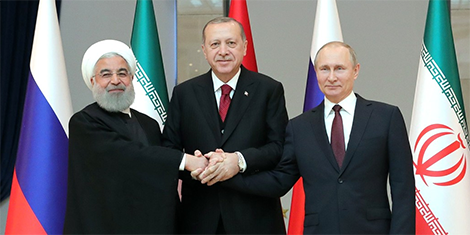
Western media are preoccupied by limited airstrikes from the United States, Britain and France in the Damascus area, in response to a chemical attack, as well as Russia’s “hybrid warfare” strategy against the West. Amidst many distractions, Vladimir Putin’s own fixation with his country’s emergence as a major player in the Middle East and its implications for regional stability do not receive ample attention. Russia is striving to increase its strategic visibility and sphere of influence in the Middle East, and US President Donald Trump, by pursuing his transactional foreign policy, is unwittingly presiding over the demise of traditional US strategic dominance in the Middle East and elsewhere in the world.Space: The next frontier for US-China rivalry
Lasers and Missiles Heighten U.S.-China Military Tensions
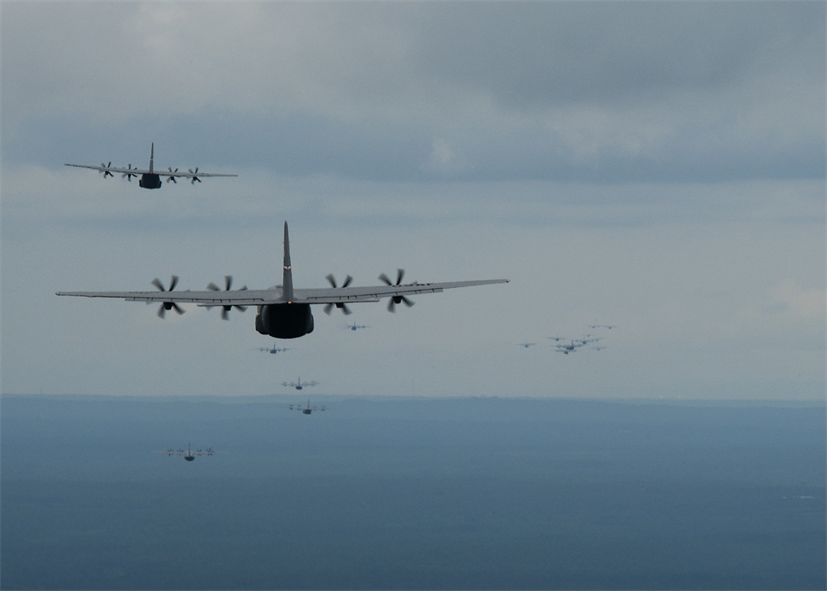
BEIJING — Tensions between the United States and China flared on two military fronts as Washington accused the Chinese of harassing American pilots flying over the African nation of Djibouti and warned of consequences to the deployment of missiles on artificial islands China has built in disputed waters in the South China Sea.The Pentagon’s spokeswoman, Dana W. White, said Thursday that personnel at China’s military base in Djibouti have in recent weeks been aiming powerful lasers at American aircraft that also operate in or near the country, which is where the Red Sea and the Gulf of Aden meet. She did not detail the number of incidents but said the lasers — which can be used to target aircraft — caused minor eye injuries to two American pilots.Chinese Lasers Injure U.S. C-130 Pilots, Washington Responds Through Diplomatic Channels
THE PENTAGON: The United States is accusing the China of using high-powered military lasers to target U.S. military aircraft flying in and out of Djibouti, the tiny Horn of Africa nation that houses military bases from both countries. One recent incident injured two U.S. airmen piloting a C-130 landing at the U.S. base there, said Maj. Sheryll Klinkel, a Pentagon spokesperson. The injuries were minor, she said, but she described the laser as “military grade,” without going into further detail. Washington has issued a dรฉmarche, or a formal complaint, over the laser attacks, which have numbered somewhere between two and ten over the past several weeks. The Federal Aviation Administration issued a Notice to Airmen on May 2 advising pilots about “unauthorized laser activity” and “multiple lazing events involving high power laser” near the Chinese military installation in Djibouti. It was the second warning from the FAA in as many weeks.WHAT BEIJING IS BUILDING IN THE SOUTH CHINA SEA
Why a Chinese Invasion of Taiwan Won't Be Easy
As Trump mulls the Iran deal’s fate, a three-ring circus ensues
How Wall Street Enabled the Fracking 'Revolution' That's Losing Billions By Justin Mikulka • Friday, May 4, 2018 - 10:34
The U.S. shale oil industry hailed as a “revolution” has burned through a quarter trillion dollars more than it has brought in over the last decade. It has been a money-losing endeavor of epic proportions. In September 2016, the financial ratings service Moody’s released a report on U.S. oil companies, many of which were hurting from the massive drop in oil prices. Moody's found that “the financial toll from the oil bust can only be described as catastrophic,” particularly for small companies that took on huge debt to finance fracking shale formations when oil prices were high.And even though shale companies still aren't turning a profit, Wall Street continues to lend the industry more money while touting these companies as good investments. Why would investors do that?Improving upon Trump’s high-risk, low-yield China trade policy
Will Arctic Oil Ever Make It To Market?
Washington Should Help Europe Achieve ‘Strategic Autonomy’, Not Fight It
According to Ronja Kempin and Barbara Kunz, US policymakers have mixed feelings about the EU’s 2016 Global Strategy, to say the least. The strategy outlines the ambition of strategic autonomy for the EU, and some US officials fear this could be detrimental to the transatlantic alliance. However, our authors explain that Washington should not worry: strategic autonomy has nothing to do with Europe turning away from the US. Indeed, they contend that the US should support this goal as doing so could help the Global Debt: The Next Great Financial Crisis?
We Need a NATO for Infowar
It was Sweden that manufactured the nerve gas that nearly killed Russian double-agent Sergey Skripal in Salisbury in March. Or the Czechs. Or in fact the UK itself. Russian media deliver a dizzying range of exaggerations and falsehoods about our countries, while we usually opt for the high road of near-silence. But truth won’t prevail on its own. We need a robust defense not just of our borders but of our free and open societies: in other words, a Communications NATO for information warfare. Following last month’s chemical attack in Syria, Foreign Minister Sergey Lavrov denounced reports of it as fabrications. A Russian military spokesman insisted that the UK had been involved, an allegation that Britain’s UN ambassador Karen Pierce dismissed as a “grotesque, blatant lie” and Foreign Secretary Boris Johnson called “demented.”‘Deny, distract and blame’: how Russia fights its propaganda and disinformation war on Twitter and Russian news networks
It's time to ditch our obsession with trade deficits. Here's why
The notion that trade surpluses are a measure of a country’s economic prowess dates back centuries. In 16th-century Europe, “mercantilists” from England to Venice sought to accumulate gold by promoting exports and discouraging imports. Their intellectual heirs today think trade surpluses boost national welfare, employment and economic growth, while deficits do the opposite. The preoccupation with surpluses is based on dubious arithmetic: since one country’s exports are another’s imports, it is impossible for all countries to be net exporters. It also overlooks a more fundamental point about trade. The main benefit from trade is imports – foreigners sending the fruits of their labour for us to enjoy, allowing us to focus on what we do best. Working to produce exports is the price we pay to enjoy these benefits.Industrial Revolutions Are Political Wrecking Balls
We may never stop arguing about which historic currents swept President Trump into the White House. Klaus Schwab, chairman of the World Economic Forum, is unlikely to have had Trump in mind when he described the fourth industrial revolution in Davos in January 2016: We stand on the brink of a technological revolution that will fundamentally alter the way we live, work, and relate to one another. In its scale, scope, and complexity, the transformation will be unlike anything humankind has experienced before. Compared with previous industrial revolutions, Schwab continued,A Criminal Gang Used a Drone Swarm To Obstruct an FBI Hostage Raid
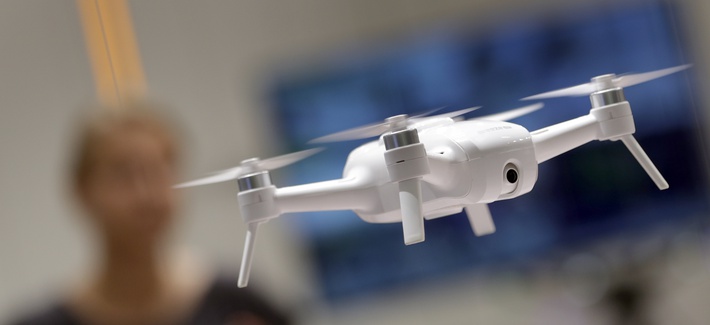
DENVER, Colorado — Last winter, on the outskirts of a large U.S.city, an FBI hostage rescue team set up an elevated observation post to assess an unfolding situation. Soon they heard the buzz of small drones — and then the tiny aircraft were all around them, swooping past in a series of “high-speed low passes at the agents in the observation post to flush them,” the head of the agency’s operational technology law unit told attendees of the AUVSIXponential conference here. Result: “We were then blind,” said Joe Mazel, meaning the group lost situational awareness of the target. “It definitely presented some challenges.”Marines Reorganize Infantry For High-Tech War: Fewer Riflemen, More Drones
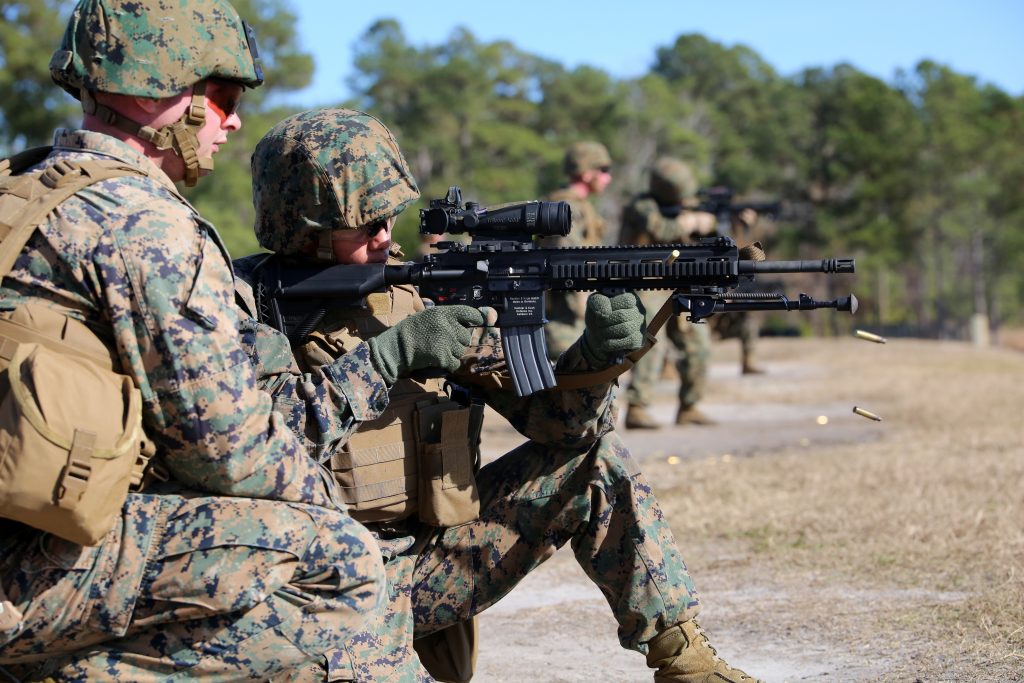
“Everything that Marine wears -- from their boots to their socks to their utilities to their helmet -- is all going to be changed," the Commandant said. "We’ve got money now to do that, and so we’ve got to make it happen now. We’ve got to make it happen now, because I’m not going to make the assumption that that money’s going to be there.” To conduct such “distributed operations,” Commandant Robert Neller said last night, the Marines are adding technical experts — in drones, intelligence, supply, and other specialties — to small units so they can operate more independently of higher headquarters. The tradeoff comes in old-fashioned firepower: Infantry squads will shrink from 13 Marines to 12, and infantry battalions will have fewer heavy-duty support weapons such as 81 mm mortars and TOW anti-tank missile launchers.