The Profession of Arms: A Guide for Young Army Officers
It takes courage, especially for a young officer, to check a man met on the road for not saluting properly or for slovenly appearance, but, every time he does, it adds to his stock of moral courage, and whatever the soldier may say, he has respect for the officer who does pull him up.
Read Document →The Dragon's Teeth: Assessing China's Military Modernization
PLA has focused on modernising its capabilities across all warfare domains to achieve these goals. This includes land, air, and maritime operations, nuclear, space, counter-space, electronic warfare and cyberspace operations, aiming to become a fully integrated joint force.
Read Document →Transforming the PLA: A Decade of reorganisation from SSF to ISF
PRC has engaged in a sustained and broad effort to transform the PLA from an infantry-heavy, low-technology, ground forces-centric military into a high-technology, networked force with an increasing emphasis on joint operations and naval and air power projection.
Read Document →Eyes without Borders: Exploring the World of Open Source Intelligence (OSINT) in the Digital Age
Open Source Intelligence (OSINT) is gaining prominence with the rise of social media, the digital society and the vast growth of publicly and commercially available information (PAI and CAI).
Read Document →
The PLA’s Developing Cyber Warfare Capabilities and India's Options
Informationised warfare blurs the lines between peacetime and wartime. A nation in the information age cannot wait for the hostilities to break out to collect intelligence, carryout influence operations, develop antisatellite systems or design computer software weapons.
Read Document →
Galwan and After
Why did China did this when he is under tremendous pressure in all fronts, is this China's salami slice tactics being progressed rigorously, what will be new Rules of Engagement, what will be escalatory control mechanism, who has taken this decision, will there be some pressure put by China in India's North-East through insurgency.
Read Document →
India’s Joint Doctrine for Cyberspace Operations: A Critical Review
Chief of Defence Staff (CDS) General Anil Chauhan and Secretary, Department of Military Affairs, formally released declassified versions of the Joint Doctrines for Cyberspace Operations during the Chiefs of Staff Committee meeting in New Delhi.
Read Document →
Know your Enemy General(now Field Marshal) Syed Aseem Munir
Gen SA Munir's position in the hierarchy of Pakistan was not very comfortable. The state of economy, insurgency in Pakhtoonistan and Balochistan, attack on the Jaffar Express, constant protests by supporters of Imran Khan's supporters inside and outside of parliament.
Read Document →
Decoding Operation SINDOOR: Key Aspects and Implications
Precision strikes were carried out on nine sites—four in Pakistan and five in PoK—linked to anti-India terrorist groups such as the LeT, JeM and the Hizbul Mujahideen. The targeted sites included Muridke (LeT headquarters) and Bahawalpur (JeM headquarters).
Read Document →
Chinese Cyber Exploitation in India's Power Grid - Is There a linkage to Mumbai Power Outage?
The New York Times (NYT), based on analysis by a U.S. based private intelligence firm Recorded Future, reported that a Chinese entity penetrated India’s power grid at multiple load dispatch points. Chinese malware intruded into the control systems that manage electric supply across India, along with a high-voltage transmission substation and a coal-fired power plant
Read Document →16 May 2018
Will mobile kill Maoism? Certainly technology can help improve governance for the Adivasis
No, the War in Afghanistan Isn't a Hopeless Stalemate
Trump Effect Comes to Afghanistan
Could Bangladesh Be Heading for One-Party Rule?
Two visuals dominate the cityscapes of Dhaka in central Bangladesh, Jashore (Jessore) in the southwest, and Khulna in the south: posters of Sheikh Mujibur Rahman, the founder of the country born of genocide and schism in 1971, and of his daughter, Prime Minister Sheikh Hasina Wajed, leader of the ruling Awami League (AL). Posters of leaders from the opposition are rare. Rarer still is opposition graffiti. Even in the vast Khulna Division, one of the eight in Bangladesh and a stronghold of the right-leaning Bangladesh Nationalist Party (BNP), it is almost impossible to see a poster or banner of the party or its leader, Begum Khaleda Zia.Xi Jinping's Excerpt on the Overall National Security Concept
CHINA WILL TAKE OVER THE WORLD, ONE PORT AT A TIME
CHINA MEDIA REPORTS A NEW MISSILE BRIGADE THAT CAN HIT MUMBAI/GUAM: WHAT IS REALLY NEW ABOUT IT?
China will take over the world, one port at a time
New research suggests China’s port investments as part of the Belt and Road Initiative are aimed at generating political influence and military presence in the Indo-Pacific. New Delhi: Launched in 2013, China’s ambitious Belt and Road Initiative (BRI) has been pegged as a trade masterstroke meant to recreate the ancient Silk Road, facilitating development along the way in a win-win situation. But new research suggests a clear political agenda behind the initiative, aided by the exercise of ‘corporate obfuscation’ by the Chinese companies involved.Report: Chinese government is behind a decade of hacks on software companies
Researchers said Chinese intelligence officers are behind almost a decade’s worth of network intrusions that use advanced malware to penetrate software and gaming companies in the US, Europe, Russia, and elsewhere. The hackers have struck as recently as March in a campaign that used phishing emails in an attempt to access corporate-sensitive Office 365 and Gmail accounts. In the process, they made serious operational security errors that revealed key information about their targets and possible location.China's first homegrown aircraft carrier heads out for sea trial
(CNN)China's first domestically built aircraft carrier began sea trials on Sunday, a historic step in the country's mission to build a navy capable of rivaling the world's leading maritime powers. The new aircraft carrier, temporarily named Type 001A, sailed out at around 7 a.m. in Dalian, in the northeast province of Liaoning, according to reports in Chinese state media. The 50,000-tonne ship will become the country's second aircraft carrier, and the first to be entirely built and designed inside of China, when it joins the navy sometime before 2020.China Wants 'Transformer' Drones (And It's More Likely to Happen Than You Think)
Why a Trade War Shouldn't Wreck World Markets
What Keeps Xi Jinping Awake at Night
Plastics mines? Europe struggles as pollution piles up
Trump made a savvy psychological evaluation of Kim Jong-un – so should we trust his judgment on Iran?
The US Should Embrace the EU’s New Defense-Cooperation Plan
In late December, all but three European Union nations agreed to activate the continent’s latest, and perhaps most promising, effort to coordinate their defense investments. This initiative, dubbed PESCO for Permanent Structured Cooperation, has largely been met with bewilderment and concern on this side of the Atlantic. But U.S. officials should welcome it — and press the EU’s leading nations to use its framework to move from project-based collaboration to properly resourced militaries with credible capability.Don't Bet Against American Shale
Russia Confirms a Revolutionary New Tank Was Sent to Syria
3 Reasons Israel Would Start a Nuclear War
CATACLYSMIC EVENT OR GRADUAL EROSION? THE DECLINE OF US DIPLOMATIC POWER
Last week Mike Pompeo, the newly-confirmed Secretary of State, announced to his new workforce that together they would “get our swagger back,” an unspoken but clear reference to the rock-bottom morale in Foggy Bottom during the tenure of his predecessor, Rex Tillerson. While Pompeo may see the Department of State’s doldrums as related solely to the management-style of his predecessor, Ronan Farrow argues persuasively in The War on Peace: The End of Diplomacy and the Decline of American Influence, that the department’s declining capacity and gradual exclusion from policy making began long before Tillerson’s ill-fated “restructuring” or what he sees as the militaristic inclinations of the forty-fifth president.On Brexit island it’s all getting a bit Lordships of the Flies
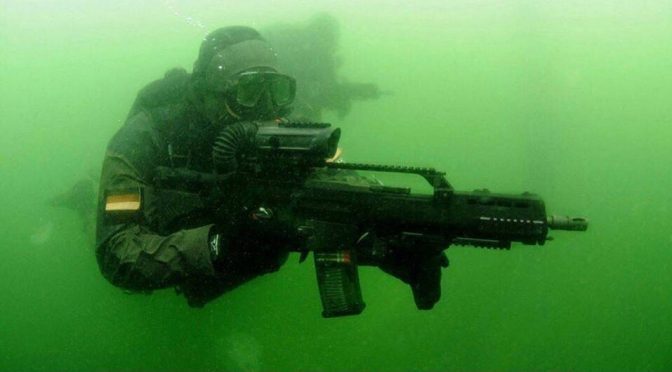
LITTLE MEN IN BLACK: THE FROGMAN THREAT IN MARITIME HYBRID WARFARE
What a cyberwar looks like — and what it doesn't
Future Challenges for Special Operations Forces
The U.S. Special Operations Command has about 67,000 troops and an annual budget of around 14 billion dollars. That may not seem to be a huge dent in the overall DoD budget (about 2%), but it greatly outnumbers the special operations budgets of other U.S. allies around the world. With deployments operating at high frequencies today and with operations increasing in places like Syria, what should we be thinking about in terms of the impact on U.S. Special Operations in the coming decade?