


 The IMF said global growth is projected to reach 3.9 per cent in 2018 and 2019, in line with the forecast of the April 2018 WEO, but the expansion is becoming less even, and risks to the outlook are mounting. The IMF on Monday forecast a growth rate of 7.3 per cent in 2018 and 7.5 per cent in 2019 for India, which was down by 0.1 per cent and 0.3 per cent respectively than its April projections. "India's growth rate is expected to rise from 6.7 per cent in 2017 to 7.3 per cent in 2018 and 7.5 per cent in 2019, as drags from the currency exchange initiative (demonetisation) and the introduction of the goods and services tax fade," said the International Monetary Fund's latest World Economic Outlook (WEO) update.
22 July 2018
IMF cuts India's growth projections for 2018, 2019
The IMF said global growth is projected to reach 3.9 per cent in 2018 and 2019, in line with the forecast of the April 2018 WEO, but the expansion is becoming less even, and risks to the outlook are mounting. The IMF on Monday forecast a growth rate of 7.3 per cent in 2018 and 7.5 per cent in 2019 for India, which was down by 0.1 per cent and 0.3 per cent respectively than its April projections. "India's growth rate is expected to rise from 6.7 per cent in 2017 to 7.3 per cent in 2018 and 7.5 per cent in 2019, as drags from the currency exchange initiative (demonetisation) and the introduction of the goods and services tax fade," said the International Monetary Fund's latest World Economic Outlook (WEO) update.Fear and loathing on the New Silk Road: Chinese security in Afghanistan and beyond
Angela Stanzel
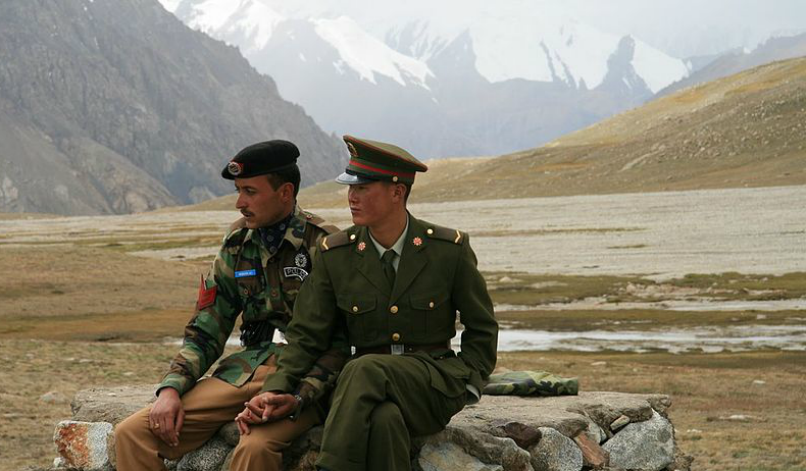 China’s focus in Afghanistan is moving away from development projects and towards the containment of perceived security threats. Europeans do not yet fully understand China’s new approach, seen in its patrols of the Wakhan Corridor – in what it calls a “joint counter-terrorism operations” with Kabul – and other security initiatives involving Afghanistan. It remains unclear whether China’s Belt and Road Initiative (BRI) is still a purely development-focused operation, or whether there is a planned and profound long-term shift in Chinese security priorities. So far, Beijing’s most substantive engagement with Afghanistan has been in border control efforts designed to prevent terrorists from entering China. In addition, “a similar pattern has emerged in Central Asia: China is working to deepen its cooperation with countries in the region by largely concentrating on measures to combat terrorist groups and other threats. Although Beijing rarely speaks about expanding its security ties with other countries, these trends indicate that it could be developing a capacity to promote stability in the region.”
China’s focus in Afghanistan is moving away from development projects and towards the containment of perceived security threats. Europeans do not yet fully understand China’s new approach, seen in its patrols of the Wakhan Corridor – in what it calls a “joint counter-terrorism operations” with Kabul – and other security initiatives involving Afghanistan. It remains unclear whether China’s Belt and Road Initiative (BRI) is still a purely development-focused operation, or whether there is a planned and profound long-term shift in Chinese security priorities. So far, Beijing’s most substantive engagement with Afghanistan has been in border control efforts designed to prevent terrorists from entering China. In addition, “a similar pattern has emerged in Central Asia: China is working to deepen its cooperation with countries in the region by largely concentrating on measures to combat terrorist groups and other threats. Although Beijing rarely speaks about expanding its security ties with other countries, these trends indicate that it could be developing a capacity to promote stability in the region.” Trade Troubles: China Is Poised to Bring Down the Global Economy
by Gordon G. Chang
 The Chinese economy is in distress, and the country’s currency and markets, reflecting unease, are tumbling. Xi Jinping, the Chinese ruler, has no solutions. The only thing he is doing is incurring more debt. That’s extremely unfortunate because an overly indebted Beijing is again set to push the world into recession. China, through predatory policies, precipitated the global downturn last decade, and it looks like it will cause the next one as well. Last time, the Chinese benefitted handsomely from worldwide misery. This time, they will not be so fortunate and will almost certainly end up being the greatest victims.
The Trade War—What Is Not in the Price
Veteran financial traders often lament that their younger coworkers have never lived through a bear market. But it is fair to say that no one alive has experienced a trade war comparable to what the United States under President Donald Trump is starting. Before the tariffs now being imposed on a range of products from China, it was solar panels, washing machines, steel, and aluminum. What's next? We believe it is a foregone conclusion that the "national security" auto case will result in tariffs—likely against high-end cars from European and Japanese automakers—before the November midterm elections. Why? Peter Navarro and Robert Lighthizer, Trump's top trade advisers, believe they know what to do based on the U.S. experience in the "car wars" with Japan in the 1980s.
In China, Unweaving the Tangled Web of Local Debt
Source link
 A slower economy, sluggish construction growth, weaker local government revenue and a sharp jump in maturing debt could boost the risk of default for some local government-related debt, particularly in the central and southwest regions.
A slower economy, sluggish construction growth, weaker local government revenue and a sharp jump in maturing debt could boost the risk of default for some local government-related debt, particularly in the central and southwest regions.
Despite previous announcements, Beijing may step in to assist or even bail out some loans if defaults accelerate. The urgency of the risk will compel the central government to accelerate efforts to revamp the country's tax structure, but its ability will be limited by the uncertain economic situation.
The devil’s bargain for AI companies working in China
American tech companies and research institutions — involved in the development of artificial intelligence in both the U.S. and China — face elevated ethical questions as the two superpowers race for dominance in the field. Why it matters: U.S. labs face the real possibility that collaborations with Chinese companies and universities will end up bolstering Beijing’s goal of dominating global civilian and military AI. What’s going on: China’s prestigious Tsinghua University recently laid out a vision for how it will develop AI for military applications, flagging a close relationship between universities, private companies, and the armed forces. In China, such collaborations are the default, but in the U.S., companies and institutions are still grappling with how willing they are to work with the military. Google recently withdrew from a Pentagon drone-surveillance program when some employees revolted.
The Relevance of Clausewitz and Kautilya in Counterinsurgency Operations
Debasis Dash
The concept of asymmetric warfare is neither new nor static and has been used over centuries as a means for an inferior force to counter a superior force. In nearly every century of recorded conflict, there have been events where various forms of asymmetric warfare were adopted by one set of belligerents as a means to enforce their goals on the target populace. Most familiar among them was insurgency, used as a strategy to challenge the government and its institutions.[1] However, the nature and complexity of an insurgency are such that they bind the levels of response by a counter-insurgent force to below conventional warfare and above low-intensity conflict. The period of engagement and intensity of the insurgency further escalates if it has the latent characteristics of a proxy war.[2] If the existence of an insurgency is within the national boundaries, the situation demands a level of military action while remaining within the sphere of law enforcement. The counterinsurgency operations led by coalition forces in Afghanistan and the engagement of Indian armed forces in Kashmir and elsewhere within India provide the context whereby we might better understand various facets of an insurgency and be able to devise a more effective counter-response strategy. This article will use those contexts to analyze the lessons provided by Kautilya and Carl von Clausewitz toward understanding modern-day counterinsurgency operations.
Islamist Actors: Libya and Tunisia
By Lisa Watanabe for Center for Security Studies (CSS)
 Attention has understandably been focused on jihadi actors in Libya and Tunisia. However, Lisa Watanabe contends that other Islamic actors also deserve greater scrutiny given the role they could play in shaping these countries’ future. To help address this gap, Watanabe here explores 1) the Muslim Brotherhood in Libya and Ennahda in Tunisia, groups who have gone the furthest in accepting democratic norms and principles; 2) more conservative Salafi actors, such as former jihadis; 3) quietist Salafis, who generally eschew political engagement and reject armed resistance against Sunni Muslim regimes, and more.
Israel’s Active Defense Campaign in Syria: The Next Phase
By Yaakov Lappin
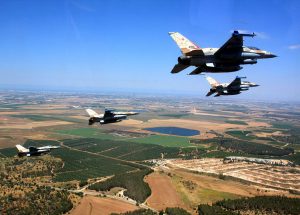
EXECUTIVE SUMMARY: Tehran’s recent decision to attempt direct clashes with Israel resulted in a resounding defeat on May 10, when the IDF destroyed 50 Iranian military targets in Syrian territory. Iran is now shifting gears back to its traditional proxy approach. While it appears reluctant to mobilize Hezbollah against Israel right now and risk a full-scale regional war, it is continuing to work on securing a military position in Syria to use for future aggression. Israel must maintain its flexibility and responsiveness in order to prevent the creation of a second Iranian mass missile front on the border. Judging from international media reports, Israel’s campaign to keep Iran out of Syria has entered a new phase.
RUSSIA'S MILITARY POSTURE: GROUND FORCES ORDER OF BATTLE
 Download the PDF
Catherine Harris, Russia and Ukraine Research Analyst at ISW
Frederick W. Kagan, Critical Threats Project Director at the American Enterprise Institute
 U.S. leaders and their European allies are unprepared for the ways in which Russia's President Vladimir Putin is poised to wage war in Ukraine and the Baltic. The Russian military is well positioned to launch a short-notice conventional war in Ukraine and a hybrid war in the Baltic States, the opposite of what Western leaders seem to expect in each theater. NATO leaders increasingly warn of the threat of a conventional invasion of the Baltic States (or even Western Europe). But Russian ground forces are not deployed or organized to initiate a short-notice conventional war in that region. They have, however, redeployed and reorganized since 2014 in a way that would support a rapid mechanized invasion of Ukraine from both north and east, while remaining well-prepared to conduct a hybrid warfare intervention in the Baltics similar to what they did in Ukraine after the Maidan Revolution. The United States and its partners should re-evaluate the most likely Russian courses of action and reconsider the mix of military and non-military tools required to defend NATO allies and Ukraine from potential Russian aggression.
Joint Force Quarterly (JFQ)
o Intelligence in a Data-Driven Age
o Strategic Shaping: Expanding the Competitive Space
o The Future of the Aircraft Carrier and the Carrier Air Wing
o 568 Balls in the Air: Planning for the Loss of Space Capabilities
o Transregional Capstone Exercise: Training for Tomorrow’s Fight
o The Case for Joint Force Acquisition Reform
o U.S. Special Operations Command’s Future, by Design
o Enhancing Global Security Through Security Force Assistance
o Cooking Shows, Corollas, and Innovation on a Budget '
o Bombs, Not Broadcasts: U.S. Preference for Kinetic Strategy in Asymmetric Conflict
o Reverse Engineering Goldwater-Nichols: China’s Joint Force Reforms
o Don’t Shoot the Messenger: Demosthenes, Churchill, and the Consensus Delusion
o Defending the AEF: Combat Adaptation and Jointness in the Skies over France
o The U.S. Government’s Approach to Economic Security
Military ReviewJuly-August 2018,
o The 75th Ranger Regiment Military Intelligence Battalion Modernizing for Multi-Domain Battle
o Developing a Light Infantry-Robotic Company as a System
o Reconnaissance beyond the Coordinated Fire Line Division Warfighter Trends
o The Suwalki Gap A Proving Ground for Cluster Munitions
o A Central Asian Perspective on Russian Soft Power The View from Tashkent
o The Decades-Long “Double-Double Game” Pakistan, the United States, and the Taliban
o Many Voices Telling One Story Public Affairs Operations across Africa in Support of Combatant Commanders
o Preparing Security Force Assistance Brigades for the Complexity of Human Interaction
o Lebanese Armed Forces Implementing Instruments of National Power as Lines of Effort to Engage a Palestinian Refugee Camp
o Mexico’s Fight against Transnational Organized Crime
o China-Latin America Arms Sales Antagonizing the United States in the Western Hemisphere?
Why Trump Is Getting Away With Foreign-Policy Insanity
BY STEPHEN M. WALT
 If U.S. President Donald Trump wanted to provoke most of the foreign-policy establishment into a feeding frenzy, then his bizarre, baffling, and in many ways pathetic performance at the Helsinki meeting with Russian President Vladimir Putin on Monday was a success. But his behavior is still hard to fathom: A guy who is trying to convince us that he isn’t Putin’s puppet and likes to portray himself as tough, strong, and “like, really smart” ended up exposing himself (again) as inarticulate, ill-prepared, gullible, and seemingly incapable of standing up to his Russian counterpart. If this were any other presidency, he’d be toast.
Trump’s ‘America First’ Policy Could Leave U.S. Defense Industry Behind
BY LARA SELIGMAN
 Signs that President Donald Trump’s “America First” policy could harm U.S. businesses and curb the United States’ clout around the world surfaced this week in an unexpected place—a small town outside London, during the world’s largest civil and military air event. The biennial gathering at the Farnborough International Airshow in the United Kingdom brings together military officials, diplomats, and arms dealers from around the world for plane-watching and deal-making. In other years, the United States has sent the Defense Department’s top weapons buyers, and top-end American products, such as the F-35 stealth fighter jet, have taken center stage.
Closing the Factory Doors
BY CHRISTINA LARSON
 Chea Leakhena and Ou Thyda were in their late teens when they began working in Canadia Industrial Park, on the outskirts of the Cambodian capital of Phnom Penh, stitching T-shirts and jeans for global brands including Adidas, Puma, Gap, and H&M. The two women hailed from the same tiny village in rural Prey Veng province, a three-hour bus ride away. Back home, Chea Leakhena’s wages from the factory had funded the installation of a new solar panel, providing enough electricity for the family’s first small TV and two fans. Several other dwellings in the village had similar additions, all paid for the same way. The factory work was hard and could be dangerous, but the women’s relatives in the village praised them as go-getters who had ventured far from home to improve their lives and those of their families.
U.S., Russia: What to Make of the Trump-Putin Summit in Helsinki
Source Link
 U.S. President Donald Trump met with Russian President Vladimir Putin in Helsinki on July 16. The meeting was the first official summit between the two leaders and included a one-on-one session as well as a group-level discussion with senior Cabinet officials from both sides. As Stratfor stated in the 2018 Third-Quarter Forecast, Russia will attempt to break a negotiating stalemate with the United States to talk sanctions, military build-ups and arms control. Moscow will likely promote its ability to mediate in the Syrian conflict, but as we previously stated: Don't hold your breath for a breakthrough. As Stratfor anticipated, no major agreements came out of the summit, though some of the key topics of discussion were highlighted in a joint press conference following the meeting.
U.S. President Donald Trump met with Russian President Vladimir Putin in Helsinki on July 16. The meeting was the first official summit between the two leaders and included a one-on-one session as well as a group-level discussion with senior Cabinet officials from both sides. As Stratfor stated in the 2018 Third-Quarter Forecast, Russia will attempt to break a negotiating stalemate with the United States to talk sanctions, military build-ups and arms control. Moscow will likely promote its ability to mediate in the Syrian conflict, but as we previously stated: Don't hold your breath for a breakthrough. As Stratfor anticipated, no major agreements came out of the summit, though some of the key topics of discussion were highlighted in a joint press conference following the meeting.
Addressing Nuclear Arms Control
Europe Should Call Trump’s Bluff
BY GARVAN WALSHE
 “Very well, alone” are the words beneath the famous June 1940 cartoon by David Low depicting a solitary British soldier facing a rough sea and enemy bombers. France had fallen, Panzer divisions had reached the English Channel, and Britain was the only major power holding out against the Nazis. At this point in the greatest struggle between freedom and tyranny, the Land of the Free hadn’t shown up yet. “America First” — the slogan of the isolationists in Congress in the early days of World War II — would tie President Franklin D. Roosevelt’s hands for another 18 months as Europe was left to its fate.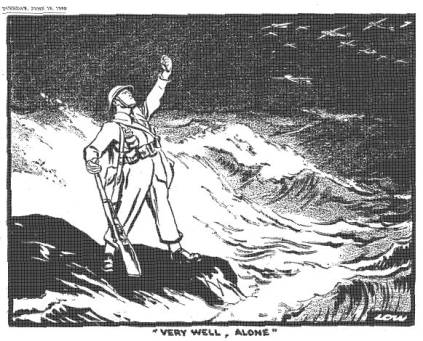
Robert Mueller Is Fighting a War
BY MARK GALEOTTI
 The recent indictment from Robert Mueller, the special counsel investigating Russian interference in the 2016 U.S. election, naming 12 officers from the GRU, Russia’s military intelligence agency, makes for compelling reading. But it would be a mistake to treat it as simply a law-enforcement instrument. It’s also the latest offensive, and an especially effective one, in an ongoing information war. At a time when Russia is involved in activities from allegedly poisoning people in the United Kingdom to backing divisive populists, the Mueller indictment offers valuable lessons to other democracies facing Moscow’s implausibly deniable campaigns of political subversion.
The Thai Cave Rescue: What Are the Leadership Lessons?
 Few experiences bring the finest display of management principles as the Tham Luang Cave Rescue, an 18-day saga that played out over recent weeks in a Thai forest reserve. Twelve boys, ages 11-16, and their soccer coach braved hunger, thirst, darkness and despair inside the flooded cave system before they were rescued. The episode holds exemplary lessons of leadership and large-heartedness, according to Wharton management professor Michael Useem and Andrew Eavis, U.K.-based president of the International Union of Speleology, an organization devoted to the study of caves. They discussed the salient takeaways from the rescue mission on the Knowledge@Wharton show on Wharton Business Radio on SiriusXM channel 111. (Listen to the podcast at the top of this page.)
Why the U.K. Has Few Options in the Brexit Negotiations
 Britain’s attempt this week to lay out a plan for it to leave the European Union on March 29, 2019, didn’t go smoothly. Ahead of the release on Thursday of a white paper detailing Britain’s Brexit agenda, two of Theresa May’s ministers quit, threatening the survival of her government. Then, a visiting Donald Trump all but killed Britain’s hopes for a trade deal with the U.S. In an interview with The Sun newspaper, he said, “If they do a deal like that, we would be dealing with the European Union instead of dealing with the U.K., so it will probably kill the deal.” (On Friday, Trump then contradicted himself during a press conference with May, where he said the two countries could work out a “great” trade deal following Brexit.)
'It Was a Miracle!' Thai Soccer Players Relive Daring Rescue from Flooded Cave
George Thomas
 Adul Sam-on and his teammates were all smiles Wednesday as they walked into a packed news conference, newly released from the hospital after being rescued from a flooded cave in Thailand. "It was a miracle, it was shocking," the 14-year-old said of the rescue mission as he and several of the Thai boys told the world for the first time in their own words what it was like being trapped in the Tham Luang cave complex. Adul is originally from Myanmar. Reports say he left his family when he was 7-years-old and moved to Thailand to get a better education. In Thailand, he lived in a church and was raised by Christian teachers.
Here’s how much a new artificial intelligence center could cost
/arc-anglerfish-arc2-prod-mco.s3.amazonaws.com/public/OLVXPOUZQJFMLMBEG5YALRJHI4.jpg) The Department of Defense plans to spend $1.7 billion over the next five years to stand up a new Joint Artificial Intelligence Center, according to new budgeting figures. The reprograming documents sent to Congress, obtained by C4ISRNET sister publication Defense News, outline the Pentagon plans to spend $5 million to get the center stood up with an estimated $70 million for the new project to be spent in fiscal year 2018. These funds will go toward the center’s establishment to “rapidly field Artificial Intelligence (AI) at scale to the Services and Combatant Commands (CCMDs) to effectively deploy AI-enabled capabilities in support of DoD’s warfighting missions and business functions,” the documents state.
The Department of Defense plans to spend $1.7 billion over the next five years to stand up a new Joint Artificial Intelligence Center, according to new budgeting figures. The reprograming documents sent to Congress, obtained by C4ISRNET sister publication Defense News, outline the Pentagon plans to spend $5 million to get the center stood up with an estimated $70 million for the new project to be spent in fiscal year 2018. These funds will go toward the center’s establishment to “rapidly field Artificial Intelligence (AI) at scale to the Services and Combatant Commands (CCMDs) to effectively deploy AI-enabled capabilities in support of DoD’s warfighting missions and business functions,” the documents state.Chinese Espionage Group TEMP.Periscope Targets Cambodia Ahead of July 2018 Elections and Reveals Broad Operations Globally
by Scott Henderson, Steve Miller, Dan Perez, Marcin Siedlarz, Ben Wilson, Ben Read
Introduction
FireEye has examined a range of TEMP.Periscope activity revealing extensive interest in Cambodia's politics, with active compromises of multiple Cambodian entities related to the country’s electoral system. This includes compromises of Cambodian government entities charged with overseeing the elections, as well as the targeting of opposition figures. This campaign occurs in the run up to the country’s July 29, 2018, general elections. TEMP.Periscope used the same infrastructure for a range of activity against other more traditional targets, including the defense industrial base in the United States and a chemical company based in Europe. Our previous blog post focused on the group’s targeting of engineering and maritime entities in the United States.
HOW CONSERVATION BECAME COLONIALISM
BY ALEXANDER ZAITCHIK
 In February, a group of Cofán men dressed in dark tunics and bandoliers studded with forest seeds gathered around a fire pit in northeastern Ecuador. In the thin light of dawn, they prepared to set out on a patrol of the Cayambe Coca National Park, a protected area that covers more than 1,500 square miles of rainforests, wetlands, glacial lagoons, and snowcapped cordillera, the tallest peak of which belongs to the massive Cayambe volcano. The men were all members of la guardia, a unit established by the Cofán in 2017 to push back against trespassers’ growing encroachment onto their ancestral lands.
 China military MILITARY REFORM Welcome to the modern military: China’s new combat units prepare for electronic warfare
Minnie Chan
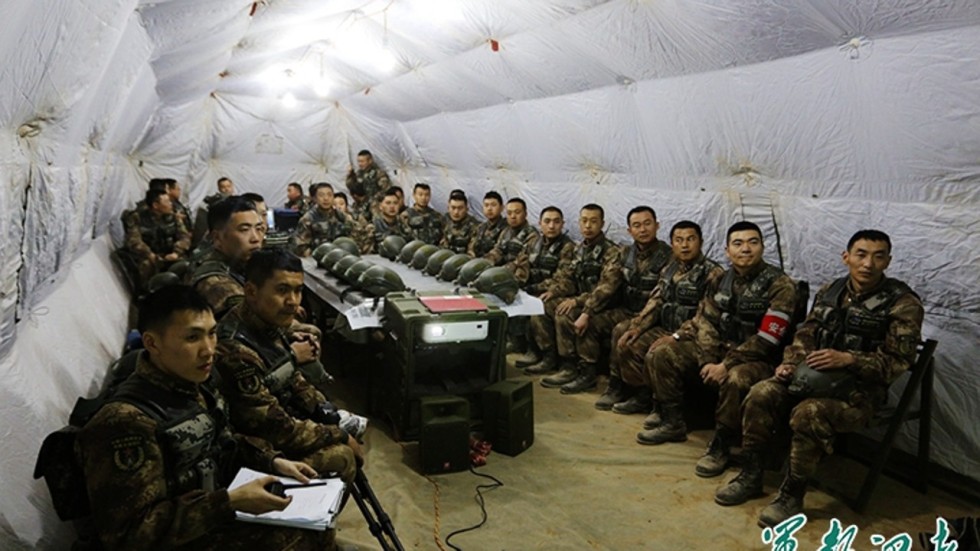 The war games, which started on Monday and test reconnaissance, electronic communication, cybersecurity, air strikes and other battle skills, are aimed at increasing ground troops’ understanding of modern warfare, and fostering new strategic ground force commanders after a sweeping PLA overhaul. More than 50 combat units involving about 2,100 officers are taking part at five training bases. They include airborne troops, special forces and electronic warfare experts from ground forces from the Eastern, Western, Northern, Southern and Central command theatres, according to official social media accounts. The ground force said the war games started simultaneously at the Zhurihe Combined Tactics Training Base in Inner Mongolia, and four military institutes in Chongqing, Hefei and Hebei provinces and the Guangxi Zhuang autonomous region.
Why cyber space matters as much to Nato as land, sea and air defence
Please use the sharing tools found via the email icon at the top of articles. Copying articles to share with others is a breach of FT.com T&Cs and Copyright Policy. Email licensing@ft.com to buy additional rights. Subscribers may share up to 10 or 20 articles per month using the gift article service. More information can be found here. Jens Stoltenberg on Article 5 and why cyber defence has become core to the alliance Cyber attacks can switch off city power supplies © Max Vetrov/AFP/Getty Images Share on Twitter (opens new window) Share on Facebook (opens new window) Share on LinkedIn (opens new window) Save Save to myFT Jens Stoltenberg JULY 12, 2018 Print this page2 One night, just before Christmas in 2015, the power went out across Kiev. As apartments rapidly chilled in the sub-zero temperatures and water pipes began to freeze, Ukrainian engineers raced to turn the power back on. A year later, exactly the same thing happened again.
Having a vision to tackle the hackers
By Andy Stout
 As events last year demonstrated, cybersecurity in the media and entertainment industry is of very real concern. As the world gets ever more connected and still more vulnerabilities open up, how can broadcasters and suppliers work together to prepare for and combat threats? On 27 June 2017, the NotPetya computer malware exploded round the world targeting computers running Microsoft Windows. Unlike previous ransomware viruses, its backend mechanisms to collect bitcoins from infected sites were rather malformed and seemed almost incidental, leaving experts to conclude that it was not built to extort money but simply to infect systems and cause the maximum amount of damage possible.
Opinion: We need to decide what constitutes an ‘act of war’ in the digital age
BY ALEX HOLLINGS
 In recent years, it’s begun to seem like cyber attacks from national level opponents are just a way of life. Reports of Russian efforts to gain access to the U.S. electrical grid or Chinese operatives seeking technical data on the U.S. defense apparatus have become so familiar that the stories themselves no longer draw a great deal of public interest. With no shots fired and no forces crossing any borders, a form of warfare is already raging — with digital security professionals squaring off against offensive operations aimed at the United States, and of course, others likely launching American offensives of our own.
An Assessment of the Likely Roles of Artificial Intelligence and Machine Learning Systems in the Near Future
Ali Crawford has an M.A. from the Patterson School of Diplomacy and International Commerce where she focused on diplomacy, intelligence, cyber policy, and cyber warfare. She tweets at @ali_craw. Divergent Options’ content does not contain information of an official nature nor does the content represent the official position of any government, any organization, or any group. Title: An Assessment of the Likely Roles of Artificial Intelligence and Machine Learning Systems in the Near Future Summary: While the U.S. Department of Defense (DoD) continues to experiment with Artificial Intelligence (AI) as part of its Third Offset Strategy, questions regarding levels of human participation, ethics, and legality remain. Though a battlefield in the future will likely see autonomous decision-making technology as a norm, the transition between modern applications of artificial intelligence and potential applications will focus on incorporating human-machine teaming into existing frameworks.
When Drones Attack: The Threat Remains Limited
By Scott Stewart
 Commercial drones have become widely available, not only to hobbyists but also to those with more nefarious purposes. To date, attacks by non-state actors using drones have involved dropping military ordnance from commercial models. The difficulty of obtaining military ordnance or fabricating improvised drone munitions will serve as a limiting factor for such attacks. A drone attack in the West by a terrorist is likely to cause more panic than outright damage. A series of recent events has me again thinking about the security threats posed by unmanned aerial vehicles — commonly referred to as drones.
The Big Picture
Subscribe to:
Posts (Atom)