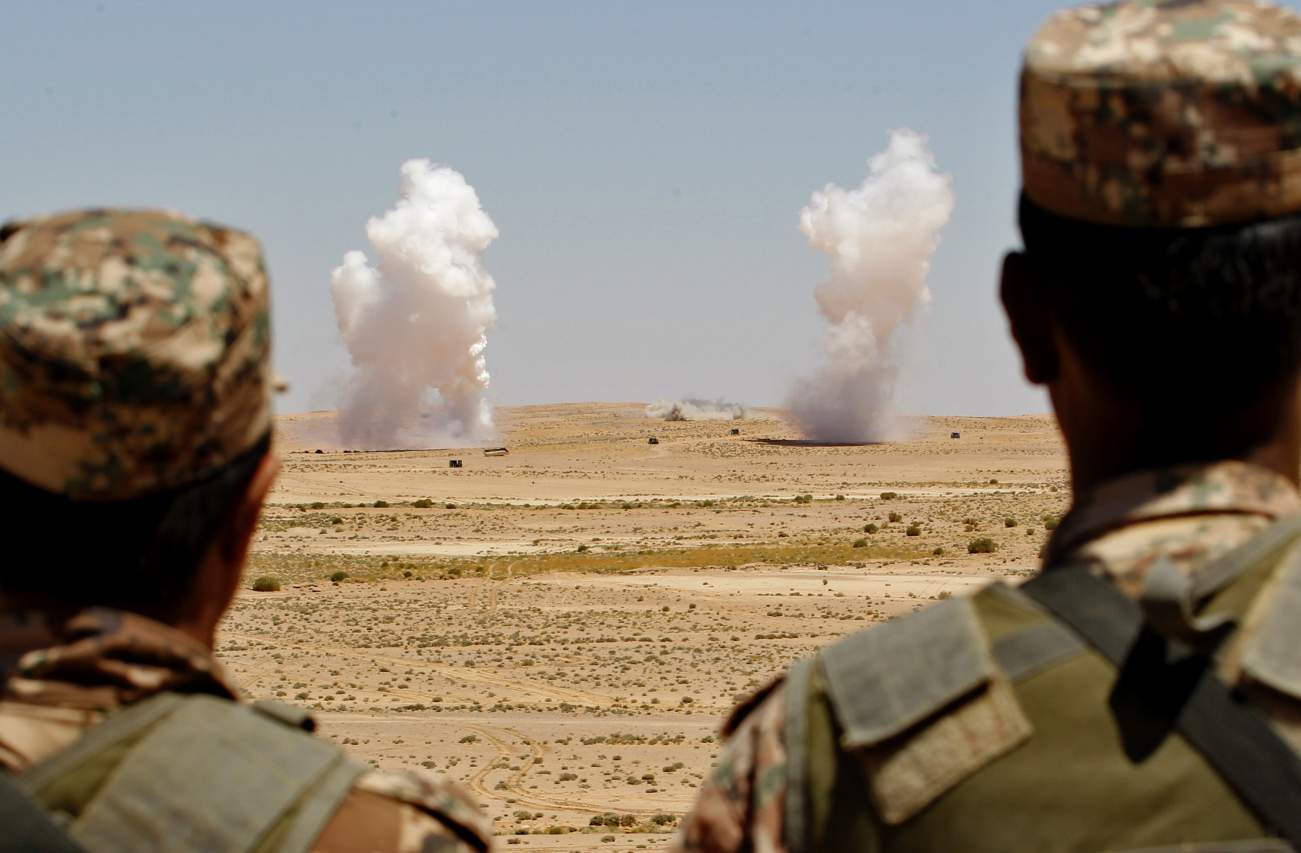
The Myanmar-based Nationalist Socialist Council of Nagaland-Khaplang (NSCN-Khaplang) in a ‘party emergency meeting’ held on August 17, 2018, at its ‘council headquarters’ in Myanmar’s Sagaing region, ‘elected’ Yung Aung, a Myanmarese national, as the new ‘acting chairman’ of the outfit. The NSCN-K in a release announced, “The National Socialist Council unanimously elected Mr. Yung Aung as the new Acting Chairman of the party by a majority vote on this day of 17th August 2018… effective from today he shall exercise his powers, functions….”The Profession of Arms: A Guide for Young Army Officers
It takes courage, especially for a young officer, to check a man met on the road for not saluting properly or for slovenly appearance, but, every time he does, it adds to his stock of moral courage, and whatever the soldier may say, he has respect for the officer who does pull him up.
Read Document →The Dragon's Teeth: Assessing China's Military Modernization
PLA has focused on modernising its capabilities across all warfare domains to achieve these goals. This includes land, air, and maritime operations, nuclear, space, counter-space, electronic warfare and cyberspace operations, aiming to become a fully integrated joint force.
Read Document →Transforming the PLA: A Decade of reorganisation from SSF to ISF
PRC has engaged in a sustained and broad effort to transform the PLA from an infantry-heavy, low-technology, ground forces-centric military into a high-technology, networked force with an increasing emphasis on joint operations and naval and air power projection.
Read Document →Eyes without Borders: Exploring the World of Open Source Intelligence (OSINT) in the Digital Age
Open Source Intelligence (OSINT) is gaining prominence with the rise of social media, the digital society and the vast growth of publicly and commercially available information (PAI and CAI).
Read Document →
The PLA’s Developing Cyber Warfare Capabilities and India's Options
Informationised warfare blurs the lines between peacetime and wartime. A nation in the information age cannot wait for the hostilities to break out to collect intelligence, carryout influence operations, develop antisatellite systems or design computer software weapons.
Read Document →
Galwan and After
Why did China did this when he is under tremendous pressure in all fronts, is this China's salami slice tactics being progressed rigorously, what will be new Rules of Engagement, what will be escalatory control mechanism, who has taken this decision, will there be some pressure put by China in India's North-East through insurgency.
Read Document →
India’s Joint Doctrine for Cyberspace Operations: A Critical Review
Chief of Defence Staff (CDS) General Anil Chauhan and Secretary, Department of Military Affairs, formally released declassified versions of the Joint Doctrines for Cyberspace Operations during the Chiefs of Staff Committee meeting in New Delhi.
Read Document →
Know your Enemy General(now Field Marshal) Syed Aseem Munir
Gen SA Munir's position in the hierarchy of Pakistan was not very comfortable. The state of economy, insurgency in Pakhtoonistan and Balochistan, attack on the Jaffar Express, constant protests by supporters of Imran Khan's supporters inside and outside of parliament.
Read Document →
Decoding Operation SINDOOR: Key Aspects and Implications
Precision strikes were carried out on nine sites—four in Pakistan and five in PoK—linked to anti-India terrorist groups such as the LeT, JeM and the Hizbul Mujahideen. The targeted sites included Muridke (LeT headquarters) and Bahawalpur (JeM headquarters).
Read Document →
Chinese Cyber Exploitation in India's Power Grid - Is There a linkage to Mumbai Power Outage?
The New York Times (NYT), based on analysis by a U.S. based private intelligence firm Recorded Future, reported that a Chinese entity penetrated India’s power grid at multiple load dispatch points. Chinese malware intruded into the control systems that manage electric supply across India, along with a high-voltage transmission substation and a coal-fired power plant
Read Document →29 August 2018
India-Myanmar: NSCN-K Coup – Analysis
The Myanmar-based Nationalist Socialist Council of Nagaland-Khaplang (NSCN-Khaplang) in a ‘party emergency meeting’ held on August 17, 2018, at its ‘council headquarters’ in Myanmar’s Sagaing region, ‘elected’ Yung Aung, a Myanmarese national, as the new ‘acting chairman’ of the outfit. The NSCN-K in a release announced, “The National Socialist Council unanimously elected Mr. Yung Aung as the new Acting Chairman of the party by a majority vote on this day of 17th August 2018… effective from today he shall exercise his powers, functions….”The status of public sector banks in India today
Media reports say the parliamentary committee on estimates, headed by Murli Manohar Joshi, has invited former Reserve Bank of India (RBI) governor Raghuram Rajan to brief it on the mounting non-performing assets (NPAs) of Indian banks. The invitation follows former chief economic adviser Arvind Subramanian’s praise for Rajan’s role in identifying the problem and taking steps to address it, before the committee. It is seeking Rajan’s views on the “crisis” —how it has been created and how it should be tackled.ASEAN Security ‘Centrality’ And The South China Sea
Leaders of ASEAN member countries have consistently proclaimed and promoted the bloc’s “centrality” in the guidance, mitigation, and mediation of regional security issues. Since its founding in August 1967, ASEAN has had some successes — like playing a role in averting war or major crises between its members, including over territorial and jurisdictional disputes in the South China Sea. ASEAN also hosts the most meaningful official multilateral security forums in the region. But the grouping has become ever more divided in regards to the South China Sea disputes. Indeed, for ASEAN, resolving or even mitigating the South China Sea issues between China and the United States may be a bridge too far. The contest between China and the U.S. for dominance there and in the region has exposed the reality that ASEAN is not sufficiently politically and militarily unified to be “central” to the region’s security when it is threatened by a clash between major powers.Playing Politics With Religion: Imran Khan Puts Himself Between Rock And Hard Place – Analysis
Less than a week in office, Pakistani Prime Minister Imran Khan has made blasphemy one of his first issues, empowering militants and initiating international moves, long heralded by Saudi Arabia, that would restrict press freedom by pushing for a global ban.Afghanistan: Terrorists Gaining Ground?
Philippine president says buying US F-16 jets ‘utterly useless’
MANILA, Philippines — The Philippine president is opposing an offer by the U.S. defense chief and other top American officials to buy F-16 fighter jets, saying such an acquisition would be “utterly useless” because his country needs lighter combat aircraft to fight insurgents.China's Air Force Is Powerful. But There Is One Giant Problem.
The Chinese defense industrial base is infamous for its tendency to รข€ลborrowรข€ from foreign designs, particularly in the aerospace industry. Almost the entirety of Chinaรข€™s modern fighter fleet have either borrowed liberally from or directly copied foreign models. The J-10 was reputedly based on the Israeli IAI Lavi and by extension the United Statesรข€™ General Dynamics F-16; the J-11 is a clone of the Russian Su-27; the JF-17 is a modern development of the Soviet MiG-21; the J-20 bears an uncanny resemblance to the F-22, and finally, the J-31 is widely believed to rely heavily on technology appropriated from the F-35 Joint Strike Fighter. Appropriation saves China time and money on research and development, allowing it to modernize the PLAAF at a fraction of the cost of its competitors. However, the appropriation strategy remains constrained by bottleneck technologies due to lack of testing data and industrial ecology. This problem is starkly illustrated by Chinaรข€™s ongoing difficulty in producing a high-quality indigenous jet engine.Is China Repeating Germany's World War I Mistakes?
At a recent show of Chinese naval might in the South China Sea, President Xi Jinping called for China to acquire a world-class navy, declaring to the assembled officers and crews that there has never been a more urgent need for the country to possess a powerful fleet. This demonstration of naval power was the largest ever put on display by the People’s Republic of China: forty-eight surface warships and submarines, including the aircraft carrier Liaoning, along with seventy-six aircraft, all paraded on review before the Chinese leader.The U.S. is overly paranoid about China’s tech rise
BEIJING — After decades of deriding China as a lousy copycat, the United States now fears China’s rapid rise as a technology powerhouse and sees it as a major — even existential — threat to U.S. dominance. The Trump administration has waged an escalating trade war against China under the pretext of punishing Chinese transgressions such as forced technology transfers, predatory licensing practices, cyber theft of intellectual property and the state-sponsored acquisition of American tech companies.To counter China, US needs to invest in superior technology
Measuring the status of Chinese military modernization
Infographic Of The Day: US China Trade War
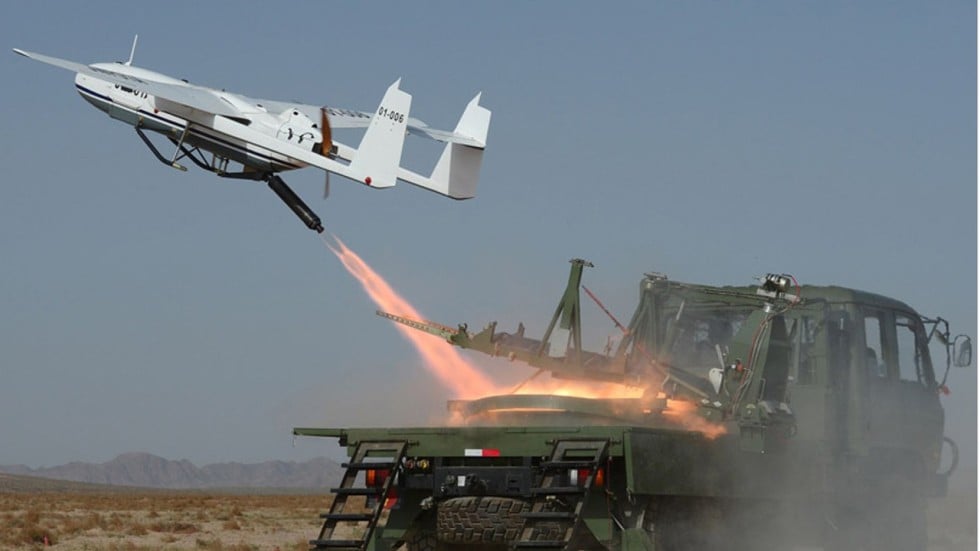
The drones that have become part of China’s military strategy
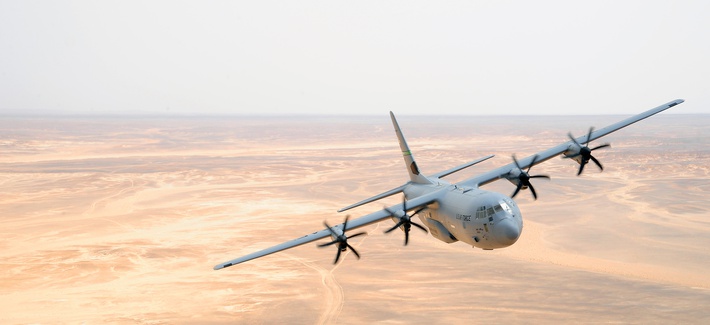
Toward A Smaller, Smarter Force Posture in the Middle East
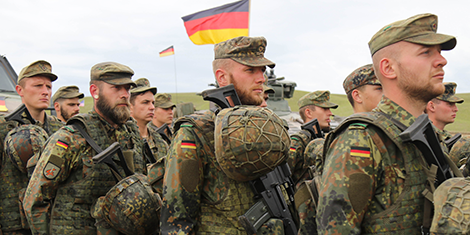
The National Defense Strategy’s turn toward Russia and China requires the U.S. military to alter its Gulf assets. Burden-Sharing within NATO: Facts from Germany for the Current Debate
Professor Rachel Epstein’s interview with Professor Donald Abenheim of the Naval Postgraduate School and Lieutenant Colonel (General Staff) Marc-Andrรฉ Walther of the German Armed Forces Command and Staff College in Hamburg.Navigating the Syrian endgame
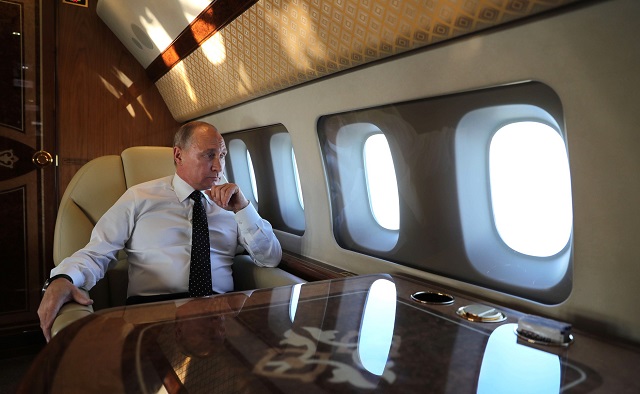
After a suspiciously sudden conversion, Russian President Vladimir Putin now claims to be worried about the fate of millions of refugees who have fled the carnage in Syria. In last weekend’s meeting with German Chancellor Angela Merkel, Putin expressed his hope that the European Union would help to rebuild Syria so that its displaced people could start to return home. And in recent weeks, Russian diplomats have been hawking the same message across European capitals.The desire for recognition, Fukuyama argues, is an essential threat to liberalism.
In February, 1989, Francis Fukuyama gave a talk on international relations at the University of Chicago. Fukuyama was thirty-six years old, and on his way from a job at the rand Corporation, in Santa Monica, where he had worked as an expert on Soviet foreign policy, to a post as the deputy director of policy planning at the State Department, in Washington. It was a good moment for talking about international relations, and a good moment for Soviet experts especially, because, two months earlier, on December 7, 1988, Mikhail Gorbachev had announced, in a speech at the United Nations, that the Soviet Union would no longer intervene in the affairs of its Eastern European satellite states. Those nations could now become democratic. It was the beginning of the end of the Cold War.Brazil Considers the Nuclear Option
Brazil will revive its nuclear energy program as part of a proposal that the government expects to present before Congress later this year. In the absence of any grave threats in South America, Brazil's nuclear program will largely focus on energy, medicine and agriculture, but the country will leave the door open to developing nuclear weapons by mastering atomic technology. The fate of Brasilia's nuclear plans could hinge on October's presidential elections, as one of the leading candidates, Marina Silva, vociferously opposes the atomic program.The culture of respect for religion has gone too far
The pope has flown home after a roughing-up in Ireland. Just a few years ago it was unimaginable that a gay taoiseach would dare berate a visiting pontiff face-to-face about the “dark aspects” of Ireland’s history and “brutal crimes perpetrated by people within the Catholic church”. Leo Varadkar’s magnificent assault eviscerated his country’s past cultural capture by the church. “The failures of both church and state and wider society created a bitter and broken heritage for so many, leaving a legacy of pain and suffering,” he said. “It is a history of sorrow and shame.” The sorrow is not just for victims of monstrous priestly abuse, but the abuse of an entire society in thrall to clerical oppression: lives crimped, warped and blighted, no escape from the church’s domination of everything. The best Irish literature breathes that pernicious incense.Cloud computing: the invisible revolution
For most people, the move to cloud computing has been an almost invisible transition from local storage and processing to network-based services. For many, it is akin to some magic that makes everything available, all the time, no matter where you are. For businesses and network architects, it is the biggest game changer since the advent of networked computers and has allowed companies at any scale to gain access to secure, affordable and incredibly powerful infrastructure. It has also fostered the “everything as a service” business model that many organisations and individuals rely on for income, and it has also created an astounding amount of wealth for the infrastructure owners.Former NSA, CIA director on cyber, Facebook and hacking back
Former head of the NSA and CIA Michael Hayden sat with with Fifth Domain Aug. 20 to discuss cyber in the Trump administration, threats from Russia and China, Facebook and the issue of hacking back.Infographic Of The Day: 5G - The Next Generation Of Mobile Connectivity
Revolutionary Future Ahead
The U.S. Trade War Is Spreading From Goods To Services
Infographic Of The Day: World Population Growth Visualized 1950-2100
The Future of Warfare is Irregular
Among the Trump administration’s most significant national security decisions has been the shift from counterterrorism to inter-state competition. The United States is increasingly engaging in global rivalry with “revisionist” states like China, Russia, Iran and North Korea. To do this well, some U.S. policymakers have argued that the United States needs to develop capabilities to fight—and win—conventional and possibly even nuclear wars against these states if deterrence fails. As the National Defense Strategy argues, “The surest way to prevent war is to be prepared to win one. Doing so requires a competitive approach to force development and a consistent, multiyear investment to restore warfighting readiness and field a lethal force.”In Cyber Warfare, the Front Line Is Everywhere the U.S. Government Isn’t
CAN SILICON VALLEY FIGHT THE CYBER-WAR THE WHITE HOUSE WON’T?
Last fall, when lawyers from Facebook, Twitter, and Google were summoned to Capitol Hill to account for the companies’ manipulation by Moscow during the 2016 election, lawmakers were ready to teach the new masters of the universe a lesson in humility. “I must say, I don’t think you get it,” California Senator Dianne Feinstein told representatives for the companies, which had dispatched lawyers in lieu of their C.E.O.s. “What we’re talking about is a cataclysmic change. What we’re talking about is the beginning of cyber-warfare.” Nearly a year later, however, with the midterm elections fast approaching, bipartisan fury has yielded to the realities of Washington. The Honest Ads Act, a bipartisan bill that would force companies like Facebook to disclose information about political ads, remains stuck in committee. The Republicans who control both houses of Congress have stonewalled legislation that would help safeguard U.S. elections, reportedly over objections by the White House. And so Silicon Valley, which arguably bears the most responsibility for failing to identify or address foreign propaganda campaigns during the last election cycle, has become something of a last line of defense for the next one.