


Mohit M Rao
6 September 2018
The impact of the river linking project
India Pushes Back Against Tech ‘Colonization’ by Internet Giants
By Vindu Goel
 NEW DELHI — In India, American companies dominate the internet. Facebook’s WhatsApp is the most popular app on phones. Virtually every smartphone runs on Google’s Android system. YouTube is the favorite video platform and Amazon is the No. 2 online retailer. For some Indian political leaders, it is as if their nation — which was ruled by Britain for a century until 1947 — is being conquered by colonial powers all over again. And they are determined to stop it. “As a country, we have to all grow up and say that, you know, enough of this,” Vinit Goenka, a railways official who works on technology policy for India’s governing Bharatiya Janata Party, said at a conference last week.
India will be number three in world military spending
brian wang
 The US defence budget is about three times as large as China’s. China’s military spending was three times more than India in 2017. China percentage of GDP spent on defence was less than India’s. The Stockholm International Peace Research Institute (SIPRI) database, estimated that China’s military expenditure was USD 228 billion in 2017 while India spent 64 billion. In 2017, India has spent 2.5% of its GDP in military, while China has spent 1.9% of the GDP in military. The government’s spending on military in India was 9.1% in 2017, China’s spending was 6.1%. India has been close to or below military spending of Russia and Saudi Arabia and is also passing Germany and the UK. With 7-8% GDP growth and with talk about increasing towards 3% of GDP spending on the military. India will clearly be able to sustain a world number three military spending level. Each year will see India get a wider margin of spending over the fourth and fifth place military spending countries.
Who are the Haqqanis, Afghanistan's most feared insurgents?
 Kabul (AFP) - The Taliban announced Tuesday the death of Jalaluddin Haqqani, a former CIA asset whose eponymous militant group is now considered one of the most dangerous factions fighting Afghan and US-led NATO forces in Afghanistan. The Haqqani network was founded by Jalaluddin, an Afghan mujahideen commander fighting the Soviet occupation in the 1980s with the help of the United States and Pakistan. Now a Taliban affiliate, it is blamed for some of the most shocking and brutal attacks across Afghanistan since the US invasion of 2001. Designated a terror group by Washington, targeting it is one of the top US priorities in the region. Long suspected of links to Pakistan's shadowy military establishment, the network was described by US Admiral Mike Mullen in 2011 as a "veritable arm" of Pakistani intelligence.
- Who are they? -
All hail the omnipotent
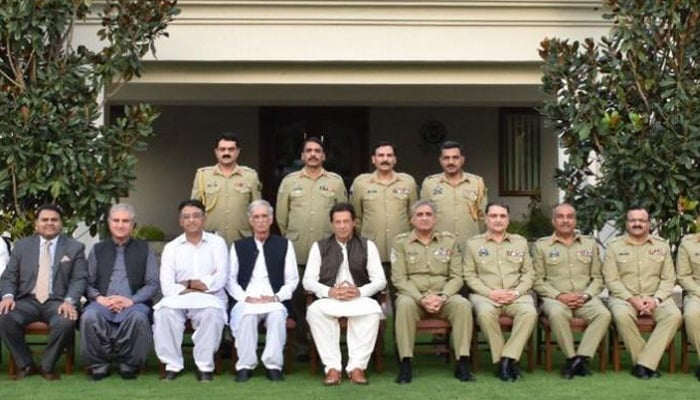 While in the last two weeks the PTI government has fallen prey to its own rhetoric and produced some humour, it is firmly in the saddle for two reasons. One, the opposition stands divided and the only thing it seems to agree on is that it won’t agree on anything soon. And two, the military is firmly in Prime Minister Imran Khan’s corner. The manner in which the GHQ received IK is how an elected PM ought to be received by generals who report to him. But we have seen nothing of the sort in recent history.
Pakistan’s military elite
The Pakistan Army is a politically important organization, yet its opacity has hindered academic research. We use open sources to construct unique new data on the backgrounds, careers, and post-retirement activities of post-1971 corps commanders and directors-general of Inter-Services Intelligence. We provide evidence of bureaucratic predictability and professionalism while officers are in service. After retirement, we show little involvement in electoral politics but extensive involvement in military-linked corporations, state employment, and other positions of influence. This combination provides Pakistan’s military with an unusual blend of professional discipline internally and political power externally – even when not directly ruling.
The US-China Cold War is now playing out in Pakistan
By Johann Chacko
On Sept. 01, days before US secretary of state Mike Pompeo and chairman of the joint chiefs of staff, Gen. Joseph Dunford, were due to arrive in Islamabad, a Pentagon spokesman announced that the department of defense intended to permanently cut $300 million from funds allocated to support Pakistan in the fight against America’s enemies in Afghanistan. So does this mean America and Pakistan are finally breaking up? The short answer is no. As much as both states are fed up with each other, they remain far too co-dependent to simply walk away. What we are seeing instead is a tough and protracted re-negotiation over the terms of the relationship. The question of Pakistan’s role in Afghanistan is not necessarily the hardest issue; there might even be convergence given the greater realism in Washington, Rawalpindi, and Islamabad.
Why we shouldn’t sign Phase II of Pak-China FTA
Zafar Hasan Khan
 PAKISTAN and China are set to sign the second phase of the Pakistan-China Free Trade Agreement (FTA); ten rounds of talks have already concluded in Beijing and Islamabad. In the first phase, Pakistan gave concessions on 5,686 tariff lines to China; while China gave concessions on 6,418 tariff lines. Chinese exports to Pakistan grew from $4.2 billion to around $12bn, whereas Pakistan’s exports to the country only moved up marginally from $0.6bn to $1.6bn. Besides the terms of trade under the FTA, several other barriers to trade should be discussed, including sanitary and phytosanitary measures and technical barriers to trade. These were not reviewed before the first phase of the agreement was signed.
US spells out terms of engagement with Pakistan
Anwar Iqbal
WASHINGTON: As the United States and the new Pakistani government prepare for their first face-to-face talks in Islamabad on Wednesday, the Trump administration has made it clear that Pakistan will have to back the US strategy in Afghanistan if it wants good relations with Washington. The strategy — as defined by both the State Department and the Pentagon this week — is to use a combination of military and diplomatic pressures to force the Taliban to work with Kabul for restoring peace in Afghanistan. Washington believes that a working relationship between the Taliban and Kabul can lead to an honourable withdrawal of US troops from Afghanistan. Washington sent its first clear message to Islamabad last week when US Secretary of State Michael Pompeo telephoned Prime Minister Imran Khan and asked the latter to take “decisive action against all terrorists operating in Pakistan”.
Far from all-in on the Indo-Pacific
 There are many who would like to see the ‘Indo-Pacific’ concept evolve from an idea to a reality. These supporters are looking to India and Indonesia to lead the way. But this is unlikely, owing to a misalignment between the two countries’ political and economic goals. Promoters of the ‘Indo-Pacific’ claim that growing economic and security links are contributing to the integration of the Indian and Pacific Ocean regions. These proponents, including Japanese Prime Minister Shinzo Abe [1], see India and Indonesia as the crucial drivers of this Indo-Pacific strategic system.
China’s lost little emperors... how the ‘one-child policy’ will haunt the country for decades
Mei Fong
 Endings matter. They herald a reckoning, something that doesn’t come about very often in a place like China. While there has been very little official stocktaking over painful aspects of the country’s recent history, private citizens are free to do their own assessments and there has been an enormous amount of public venting on the shortcomings of the one-child policy in recent years. Part of this is because, unlike the 1989 Tiananmen Square student demonstrations, which mostly affected the educated elite, the one-child policy has imprinted itself deeply into the lives of almost everyone in China, creating a hugely imbalanced population that has too many single men and too many retirees. The pressures are felt – and will continue to be felt – across every social level, from “bare branches” – rural men unable to find brides – to college-educated urban women stigmatised as “leftovers” if they stay single.
China pledges $60 billion in aid and loans to Africa, no ‘political conditions attached’
By Anna Fifield
 BEIJING —Chinese President Xi Jinping announced $60 billion in aid and loans for Africa on Monday while hosting more than 40 of the continent’s leaders in Beijing, saying that the money came with no expectation of anything in return. Beijing pushed back on criticism that it was shackling poorer countries with heavy debt burdens they will struggle to pay back, portraying the Chinese government as a magnanimous one motivated only to share its experience of rapid industrialization. “China’s investment in Africa does not come with any political conditions attached and will neither interfere in internal politics nor make demands that people feel are difficult to fulfill,” Xi said during a keynote address to the Forum on China-Africa Cooperation on Monday.
The world has underestimated China’s rise as a scientific power
By Akshat Rathi
As countries get richer, they get better at doing science. It should come as no surprise, then, that China is rising as a scientific power. What is surprising, though, is just how quickly the country is doing it. According to new research, China’s share of global scientific output now far exceeds its share of global economic output. The study, published by Qingnan Xie of Nanjing University and Richard Freeman of NBER, argues that the world has been underestimating China’s contribution to science. So far, the way country-level contributions are measured is based on how many scientific papers have authors with an address in a particular country. But the new study argues that using addresses does not account for cases in which, for instance, Chinese researchers author a paper while working at a US university.
IMF predicts robust growth for China despite trade fight with US
By GORDON WATTS
 For a “middleweight” battling a “heavyweight,” China appears to be holding its own in the trade fight with the United States. In a report from the IMF, the world’s second-largest economy is predicted to post “robust” growth with a crucial caveat. The International Monetary Fund review was rolled out on Friday just hours after mixed signals started to emerge from Beijing about the impact of the Washington dispute, with the state-owned media calling it a ‘David versus Goliath’ struggle. Huang Libin, a spokesman for the Ministry of Industry and Information Technology, played down the effects of a conflict which has dragged on since the beginning of the year.
 Op-Ed: China’s ‘Fight and win’ military doctrine vs media idiots
BY PAUL WALLIS
The headlines, based on US military analysis, (Military and Security Developments Involving the People’s Republic of China 2018) indicate that China has adopted a “fight and win” model for future military development. The world’s media, therefore, has seized on a phrase and extrapolated to say that the Chinese military is now being designed to fight and win against the US. This is despite the fact that the analysis says in so many words that China is designing to fight and win local/regional wars on page 2 of the Annual Update section. OK, it sells clicks, but it’s hardly an in depth, or accurate, view.There are broader strategic narratives in this analysis, and they are very complex. The analysis shows that:
Why is the Renminbi Depreciating?
YU YONGDING
 In 2015-2016, the People's Bank of China drained some $1 trillion from China’s foreign-exchange reserves intervening to prop up the falling currency. As the renminbi again begins to depreciate, Chinese policymakers should recall this experience and avoid similarly costly – and futile – interventions. BEIJING – China’s currency has started falling again. The last major depreciation of the Chinese renminbi began in the second half of 2015, triggered by a surge in capital outflows. Despite repeated interventions by the People’s Bank of China (PBOC), markets remained frenzied for more than a year. The currency’s value fell to nearly CN¥7 per US dollar, before stabilizing in early 2017.
Sectarianism in the Middle East Implications for the United States
by Heather M. Robinson, Ben Connable, David E. Thaler, Ali G. Scotten
Source Link
PDF file
Source Link
PDF file
Is the US Supporting Kurdish Insurgents Against Iran?
Iran’s Kurds don’t usually make the headlines like Kurds in Turkey, Syria and Iraq do. Iraqi Kurds helped beat back the Islamic State and held a failed independence referendum last year. Syrian Kurds still control much of northern Syria and have become a point of serious contention between Turkey and the U.S., which supports them against the Assad regime. Turkey’s military invaded northern Syria to push Kurdish militant groups away from the Turkish border. Iranian Kurds have been quiet by comparison. To be sure, they’ve waged a low-level insurgency off and on with the Iranian regime for decades, but it’s held steady at a low simmer for some time. This summer, however, something seems to have changed.
Oman Will Bend, But Not Break, From Gulf Pressure
 Oman has long maintained a neutral posture in Persian Gulf disputes, but the country has to work hard to avoid taking sides. With the United States targeting as many of Iran's economic lifelines as it can, Saudi Arabia and the United Arab Emirates are likely to question Oman's economic links to the Islamic republic. Riyadh and Abu Dhabi have their own reasons to bring Oman's policies into line with their own, but they will not be able to replicate their hard-line Qatar blockade strategy without losing the support of Washington. Oman could deflect external pressure by making adjustments to its policies, thereby preserving its overall independence.
Victory for Brussels is inevitable. In adopting Chequers, we have gone into battle waving the white flag
BORIS JOHNSON
 So it’s ding ding! Seconds out! And we begin the final round of that international slug fest, the Brexit negotiations. Out of their corners come Dominic Raab and Michel Barnier, shrugging their shoulders and beating their chests – and I just hope you aren’t one of those trusting souls who still thinks it could really go either way. The fix is in. The whole thing is about as pre-ordained as a bout between Giant Haystacks and Big Daddy; and in this case, I am afraid, the inevitable outcome is a victory for the EU, with the UK lying flat on the canvas with 12 stars circling symbolically over our semi-conscious head.
Russia’s Turn to Eurasia
By Jeronim Perović for Center for Security Studies (CSS)
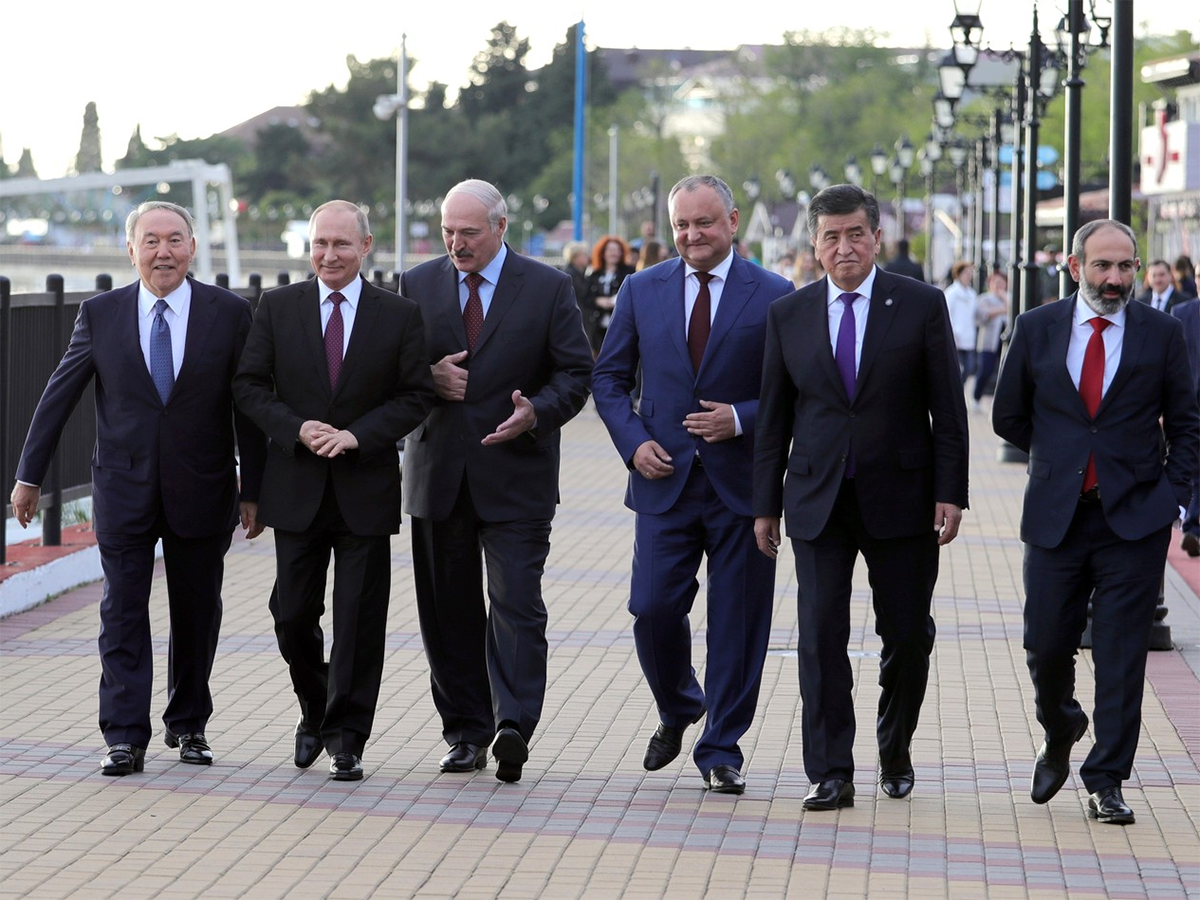 Jeronim Perović contends that Russia’s goal to integrate post-Soviet states into the Eurasian Economic Union (EAEU) was largely geopolitical in nature. However, he also notes that integration within the EAEU is now taking place primarily in the area of the economy and that the union is establishing trade and economic relations with other parties, including China. For these and other reasons, the union could have a lasting impact. As a result, Perović thinks it’s time for Europe to recognize the EAEU as an official partner.
How Russia Would Strike Back if America Launches "Dollar" Sanctions
by Josh Cohen
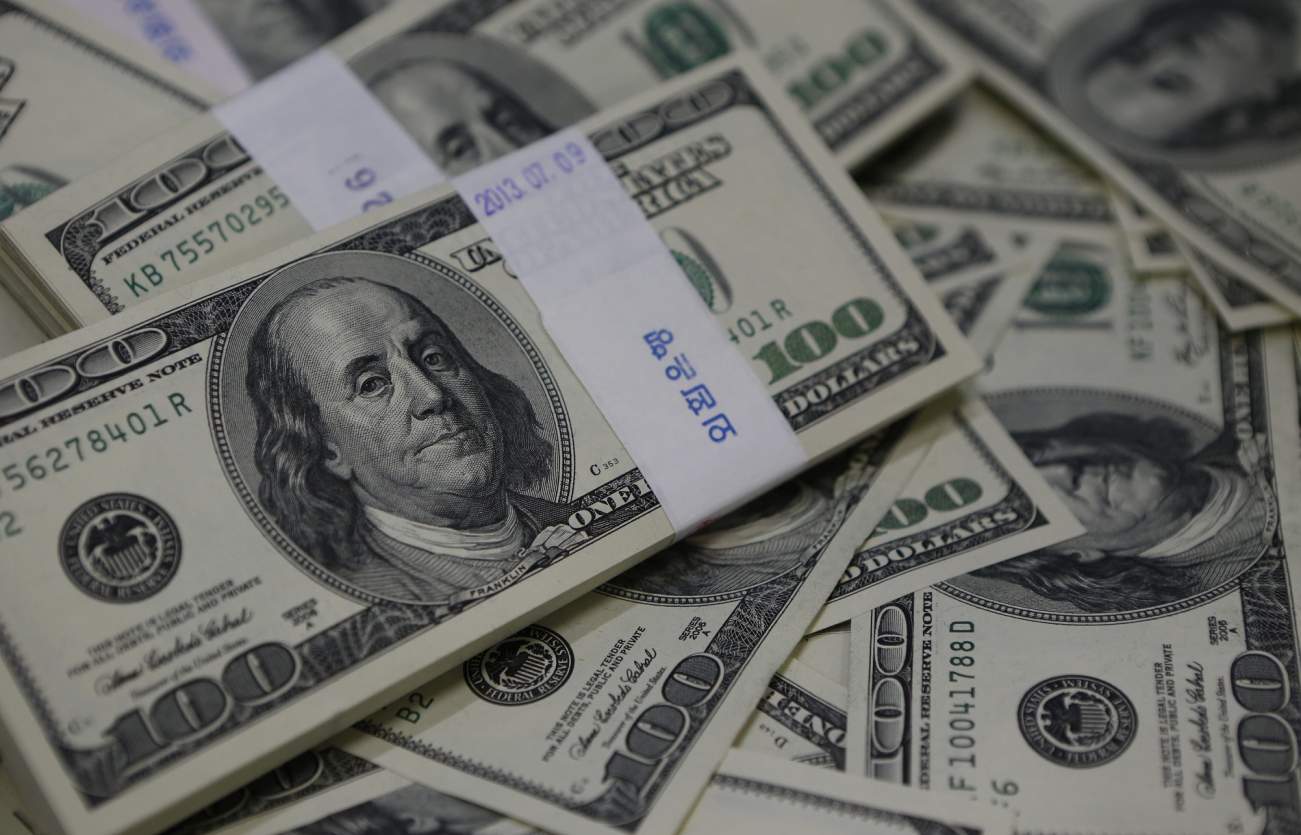 Since Russia’s annexation of Crimea, the United States has instituted numerous sanctions on Moscow. Russia typically ignores or even mocks these American sanctions. That recently changed though. In response to proposed Senate legislation that would target Russia’s state-controlled banks by freezing their access to dollars—a step which could genuinely damage the Russian economy—Moscow issued a new threat. “If we end up we end up with something like a ban on banking activities or the use of certain currencies, we can clearly call this a declaration of economic war,” Russian Prime Minister Dmitry Medvedev stated , emphasizing that Moscow would “respond to this war. By economic means, by political means and if necessary by other means.”
Idlib, the Latest Frontline in the Syrian Civil War
Deep Dive
After seven years of conflict, the future of the Syrian civil war may come down to the battle for Idlib. Syrian leader Bashar Assad has already taken back control of much of the country, and this northwestern province is the last remaining rebel stronghold. But taking back Idlib won’t be easy. In fact, it’ll be harder and more complicated than many of the other recent campaigns in the south for two reasons. First, it is a much larger region than the areas in the south, such as Daraa, Eastern Ghouta and Quneitra, that the Syrian army seized in recent months. It is, therefore, also more heavily populated with rebels, in part because many of the cease-fires brokered by Russia in the south allowed rebels safe passage out of these areas and into Idlib. Second, Turkey has a military presence in Idlib. This complicates the situation for all parties involved because Turkey and the Syrian regime have conflicting interests in this region. Russia supports the regime but doesn’t want to go to war with Turkey, a country with which it needs to maintain good relations. For this reason, the Syrians are afraid the Russians may abandon them. Meanwhile, Turkey wants room to maneuver in relation to the U.S., and having hostile relations with Russia would limit its options.
As the Economy Dips, Venezuelans Flee
Venezuela is facing an economic crisis. Its currency has plummeted, oil revenue has dropped and inflation has skyrocketed. Shortages of food and medicine have been widely reported. Now Venezuelans are fleeing to other countries in Latin America to escape the crisis. These countries are struggling to cope, and some have even asked for international aid to help manage the surge in migrants.
How America's 'most reckless' billionaire created the fracking boom
Between 2006 and 2015, the energy world was turned upside-down by an epic development in the oil industry few had foreseen. From the low point, in 2006, when it imported 60% of its oil, the US became an oil powerhouse – eclipsing both Saudi Arabia and Russia – and by the end of 2015, was the world’s largest producer of natural gas. This remarkable transformation was brought about by American entrepreneurs who figured out how to literally force open rocks often more than a mile below the surface of the earth, to produce gas, and then oil. Those rocks – called shale, source rock or tight rock, and once thought to be impermeable – were opened by combining two technologies: horizontal drilling, in which the drill bit can travel more than two miles horizontally, and hydraulic fracturing, in which fluid is pumped into the earth at a high enough pressure to crack open hydrocarbon-bearing rocks, while a so-called proppant, usually sand, holds the rocks open a sliver of an inch so the hydrocarbons can flow. A fracking entrepreneur likens the process to creating hallways in an office building that has none – and then calling a fire drill.
Britain’s Losing Trade Strategy
NGAIRE WOODS
With the United Kingdom's withdrawal from the European Union fast approaching, the British government has now launched its plan to turn the country into an "exporting superpower" in the years ahead. The problem is that much of what it needs to achieve that goal will have been destroyed by Brexit. The British government has now launched its plan to turn the United Kingdom into an “exporting superpower.” It is an ambitious, if not entirely fanciful, goal. Given the escalating trade war between the United States and China, countries around the world are rushing to consolidate their trade relations and preserve existing supply chains. Not so the UK, which is now in the final stages of negotiations to withdraw from the European Union – a move that will upend its relationship with its single largest trade partner. The country will soon become not just a lesser exporter, but also a lesser power.
Russia's Use of Media and Information Operations in Turkey
by Katherine Costello
 Russian media have sought to undermine Turkey's political and security cooperation with the United States and Europe by exacerbating mutual skepticism and highlighting policy differences. In Turkey, Russian media have also contributed to anti-American discourse and have reinforced and informed the Turkish government's own propaganda pursuits. This analysis assesses how Russia has used media and information operations to pursue its foreign policy goals related to Turkey. It examines Russian media responses to three significant events in Turkey: (1) Turkey's November 2015 shootdown of a Russian military aircraft, (2) the July 2016 Turkish coup attempt, and (3) the December 2016 assassination of the Russian ambassador.
 Why Technology Favors Tyranny
I. The Growing Fear of Irrelevance

There is nothing inevitable about democracy. For all the success that democracies have had over the past century or more, they are blips in history. Monarchies, oligarchies, and other forms of authoritarian rule have been far more common modes of human governance. The emergence of liberal democracies is associated with ideals of liberty and equality that may seem self-evident and irreversible. But these ideals are far more fragile than we believe. Their success in the 20th century depended on unique technological conditions that may prove ephemeral.
Microwave Weapons Are Prime Suspect in Ills of U.S. Embassy Workers
By William J. Broad
 Doctors and scientists say microwave strikes may have caused sonic delusions and very real brain damage among embassy staff and family members. ImageU.S. Marines outside the embassy in Havana in February. Diplomats working here reported strange noises and mysterious symptoms that doctors and scientists say may have resulted from strikes with microwave weapons. More recently, the American military itself sought to develop microwave arms that could invisibly beam painfully loud booms and even spoken words into people’s heads. The aims were to disable attackers and wage psychological warfare. Now, doctors and scientists say such unconventional weapons may have caused the baffling symptoms and ailments that, starting in late 2016, hit more than three dozen American diplomats and family members in Cuba and China. The Cuban incidents resulted in a diplomatic rupture between Havana and Washington.
Three Ways Making A Smartphone Can Harm The Environment
 Nearly five billion people worldwide will use a smartphone by 2020. Each device is made up of numerous precious metals and many of the key technological features wouldn’t be possible without them. Some, like gold, will be familiar. Others, such as terbium, are less well-known. Mining these metals is a vital activity that underpins the modern global economy. But the environmental cost can be enormous and is probably far greater than you realise. Let’s walk through some of the key metals in smartphones, what they do, and the environmental cost of getting them out of the ground.
Catastrophic mine waste spills
Subscribe to:
Posts (Atom)