In 2015, in South Africa, where Mohandas Gandhi lived from 1893 to 1914, a statue of him was defaced by protesters. The following year, the University of Ghana agreed to remove Gandhi’s statue from its campus, after an online campaign with the (misspelled) hashtag #Ghandimustfall charged the Indian leader with racism against black Africans. Compared with other recent targets of political iconoclasts—stalwarts of the Confederacy and Cecil Rhodes—Gandhi seems an unlikely symbol of racial arrogance. Nelson Mandela claimed that Gandhi’s tactics offered “the best hope for future race relations”; Martin Luther King, Jr., held Gandhi up as a model; decades before that, black activists such as Adam Clayton Powell, Sr., and Benjamin Mays were enthralled by the phenomenon of an Indian leading people of color in the campaign against British colonialism in India. Yet Gandhi’s legacy is no longer secure even in his own country. The Indian Prime Minister, Narendra Modi, cites V. D. Savarkar, a far-right Hindu supremacist who was accused of involvement in Gandhi’s assassination, in 1948, as his ideological mentor. A portrait of Savarkar, who loathed Gandhi for being too soft on minorities, hangs in the Indian Parliament building.The Profession of Arms: A Guide for Young Army Officers
It takes courage, especially for a young officer, to check a man met on the road for not saluting properly or for slovenly appearance, but, every time he does, it adds to his stock of moral courage, and whatever the soldier may say, he has respect for the officer who does pull him up.
Read Document →The Dragon's Teeth: Assessing China's Military Modernization
PLA has focused on modernising its capabilities across all warfare domains to achieve these goals. This includes land, air, and maritime operations, nuclear, space, counter-space, electronic warfare and cyberspace operations, aiming to become a fully integrated joint force.
Read Document →Transforming the PLA: A Decade of reorganisation from SSF to ISF
PRC has engaged in a sustained and broad effort to transform the PLA from an infantry-heavy, low-technology, ground forces-centric military into a high-technology, networked force with an increasing emphasis on joint operations and naval and air power projection.
Read Document →Eyes without Borders: Exploring the World of Open Source Intelligence (OSINT) in the Digital Age
Open Source Intelligence (OSINT) is gaining prominence with the rise of social media, the digital society and the vast growth of publicly and commercially available information (PAI and CAI).
Read Document →
The PLA’s Developing Cyber Warfare Capabilities and India's Options
Informationised warfare blurs the lines between peacetime and wartime. A nation in the information age cannot wait for the hostilities to break out to collect intelligence, carryout influence operations, develop antisatellite systems or design computer software weapons.
Read Document →
Galwan and After
Why did China did this when he is under tremendous pressure in all fronts, is this China's salami slice tactics being progressed rigorously, what will be new Rules of Engagement, what will be escalatory control mechanism, who has taken this decision, will there be some pressure put by China in India's North-East through insurgency.
Read Document →
India’s Joint Doctrine for Cyberspace Operations: A Critical Review
Chief of Defence Staff (CDS) General Anil Chauhan and Secretary, Department of Military Affairs, formally released declassified versions of the Joint Doctrines for Cyberspace Operations during the Chiefs of Staff Committee meeting in New Delhi.
Read Document →
Know your Enemy General(now Field Marshal) Syed Aseem Munir
Gen SA Munir's position in the hierarchy of Pakistan was not very comfortable. The state of economy, insurgency in Pakhtoonistan and Balochistan, attack on the Jaffar Express, constant protests by supporters of Imran Khan's supporters inside and outside of parliament.
Read Document →
Decoding Operation SINDOOR: Key Aspects and Implications
Precision strikes were carried out on nine sites—four in Pakistan and five in PoK—linked to anti-India terrorist groups such as the LeT, JeM and the Hizbul Mujahideen. The targeted sites included Muridke (LeT headquarters) and Bahawalpur (JeM headquarters).
Read Document →
Chinese Cyber Exploitation in India's Power Grid - Is There a linkage to Mumbai Power Outage?
The New York Times (NYT), based on analysis by a U.S. based private intelligence firm Recorded Future, reported that a Chinese entity penetrated India’s power grid at multiple load dispatch points. Chinese malware intruded into the control systems that manage electric supply across India, along with a high-voltage transmission substation and a coal-fired power plant
Read Document →17 October 2018
Gandhi for the Post-Truth Age
In 2015, in South Africa, where Mohandas Gandhi lived from 1893 to 1914, a statue of him was defaced by protesters. The following year, the University of Ghana agreed to remove Gandhi’s statue from its campus, after an online campaign with the (misspelled) hashtag #Ghandimustfall charged the Indian leader with racism against black Africans. Compared with other recent targets of political iconoclasts—stalwarts of the Confederacy and Cecil Rhodes—Gandhi seems an unlikely symbol of racial arrogance. Nelson Mandela claimed that Gandhi’s tactics offered “the best hope for future race relations”; Martin Luther King, Jr., held Gandhi up as a model; decades before that, black activists such as Adam Clayton Powell, Sr., and Benjamin Mays were enthralled by the phenomenon of an Indian leading people of color in the campaign against British colonialism in India. Yet Gandhi’s legacy is no longer secure even in his own country. The Indian Prime Minister, Narendra Modi, cites V. D. Savarkar, a far-right Hindu supremacist who was accused of involvement in Gandhi’s assassination, in 1948, as his ideological mentor. A portrait of Savarkar, who loathed Gandhi for being too soft on minorities, hangs in the Indian Parliament building.Pakistan’s Failing Economy Arises From Oversized Army Budget – Analysis
Pakistan in 2018 has ended up as a ‘Economically Failed State’ chiefly due to massive appropriations by Pakistan Army GHQ in Rawalpindi with no questions dare asked nor accountability called for by Pakistan’s elected/nominated Prime Ministers sitting in Islamabad. Pakistan’s gullible populace is sedated by Pakistan Army hierarchy that this is required to face Pakistan’s threats emanating from both flanks. Afghanistan and India over the decades have not posed any military threat to Pakistan or threatened it as such. It is the Pakistan Army flush with ‘black money’ diverted from Pakistan’s national exchequer has financed and trained Islamic Jihadi terrorist monsters inflicting terror and suicide bombings in Afghanistan and India.Robot War in the South China Sea?
Gordon Chang: China's Rise (and America's Fall) Just Won't Happen. Here's Why.
“This geopolitical recession is something really simple—it’s the end of the U.S.-led global order,” Ian Bremmer, head of risk advisors Eurasia Group, told the ANZ Finance & Treasury Forum in Singapore this week. Bremmer’s message plays well, and not just to those attending financial conferences. Most American policymakers, for instance, have bought into his “declinist” predictions about China’s rise and America’s fall. At least two—and maybe all three—of President Donald Trump’s immediate predecessors accepted the premise of eventual Chinese dominance. For a long time, those predictions were generally accepted. Most recently, however, there are even more reasons to challenge the assumptions underpinning the narrative of declinism.Are Trump and Xi on the brink of a new Cold War?
China's Belt and Road tempts states, but comes with risks
China’s “nuclear option” in the US trade war would be economic suicide
Five lessons ignored in the Trump administration’s new counterterrorism strategy
The Disappearance of Jamal Khashoggi and a Crown Prince’s False Promise
How Europe can stop African migration
Europe pledged to spend €6 billion in Turkey to keep refugees on the other side of the border. Some have suggested spending a similar amount in Africa. POLITICO asked Europe’s leading migration experts and policymakers: If the EU had €6 billion to spend on managing migration from Africa, how and where should the bloc spend it? Think beyond the money Dimitris Avramopoulos is European commissioner for migration, home affairs and citizenship. Europe’s engagement with third countries is not about money. Those who think you can put a figure on a relationship woefully underestimate the significance and intricacy of such partnerships.Brexit will weaken Europe, isolate Britain and fuel global tensions
Leave aside the particulars of this month's Brexit drama — Theresa May's dance moves, Boris Johnson's attacks on May's plan, and the latest warnings from European capitals — it's time to brace for Brexit. Let's focus on the few geopolitical certainties we know will follow the UK's exit from the European Union, on whatever terms it comes. Start across the Atlantic. Brexit won't do the "special relationship" between the US and Europe any favors. An EU without the UK is a much weaker partner for Washington when US-EU interests align and a much weaker foil when those interests collide. Yes, many of the issues currently dividing the US from Europe have been a long time coming — differences over Russia policy, NATO funding and Middle East adventurism have strained US-European relations before. But Brexit undermines the transatlantic alliance across the board because Brexit challenges will divert Brussels' overall energy and attention away from working with Washington to help bridge their divides.Could An Artificial Intelligence Be Considered A Person Under The Law?
US-Israel Relations: A Return of Agency
How Would the United States Cope If It Lost the Next War?
A Europeanized NATO? The Alliance Contemplates the Turmp Era and Beyond
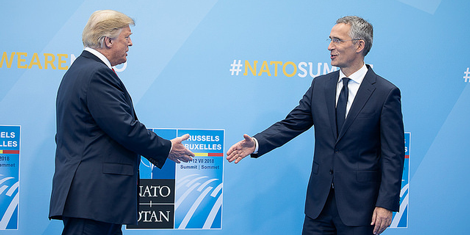
When asked about President Donald Trump’s July 2018 visit to Europe, Henry Kissinger presciently noted, “I think Trump may be one of those figures in history who appears from time to time to mark the end of an era and to force it to give up its old pretenses.” In other words, for all the uproar surrounding the president’s personality, something bigger is going on, and Trump has come to personify it. Perhaps the biggest challenge is, therefore, to put words to this shifting ground and imagine its potential consequences.The EU Can’t Avoid U.S. Sanctions on Iran
Will America Shape Its Grand Strategy Around China or Russia?
Late last week, as most of America’s political class was transfixed by the denouement of the Kavanaugh confirmation battle, Vice President Mike Pence gave a wide-ranging address on the U.S. relationship with China, and why the Trump administration is committed to opposing its expansionist designs. For the most part, it was a familiar litany of complaints about China’s efforts to coerce its neighbors in the western Pacific, its trade abuses, its hostility to religious freedom, and its support of unsavory regimes around the world. Yet halfway through his remarks, the vice president shifted his emphasis, turning from all the various ways the Chinese party-state was acting in the world outside America’s borders to how it was seeking to influence political and cultural life inside them.Global Governance to Combat Illicit Financial Flows
As the volume of legitimate cross-border financial transactions and investment has grown in recent decades, so too have illicit financial flows (IFFs or dirty money). IFFs derive from and sustain a variety of crimes, from drug trafficking, terrorism, and sanctions-busting to bribery, corruption, and tax evasion. These IFFs impose large, though hard to measure, costs on national and global welfare. IFFs and their predicate crimes thwart broader national and international goals by undermining rule of law, threatening financial stability, hindering economic development, and reducing international security.The Prophets of Cryptocurrency Survey the Boom and Bust
Not long ago, I was in Montreal for a cryptocurrency conference. My hotel, on the top floor of a big building downtown, had a roof garden with a koi pond. One morning, as I had coffee and a bagel in this garden, I watched a pair of ducks feeding on a mound of pellets that someone had left for them at the pond’s edge. Every few seconds, they dipped their beaks to drink, and, in the process, spilled undigested pellets into the water. A few koi idled there, poking at the surface for the scraps. The longer I watched, the more I wondered if the ducks were deliberately feeding the fish. Was such a thing possible? I asked the breakfast attendant, a ruddy Quebecer. He smiled and said, “No, but it is what I tell the children.”The problems transparency creates for cyber operations
The United States is doubling down on a cyber deterrence philosophy that focuses on building coalitions and clearly communicates that malicious activity will lead to consequences. The U.S. government is trying to craft an approach to thwart the daily barrage of cyber intrusions across a wide range of sectors and the recently released national cyber strategy describes a cyber deterrence initiative that will build a “coalition and develop tailored strategies to ensure adversaries understand the consequences of their malicious cyber behavior.”How to protect jets, missiles and ships from cyberattacks
Hackers pierced the weapon system’s terminal, giving them the ability to feed operators false commands or spoof logistics. But instead, the intruders opted to display a taunting message across the screen, according to a new report from the Government Accountability Office. They chose a time-tested instruction.The answer to battlefield logistics problems could be IoT
Defence Blogging: Why, When and How.
UK defence blogging is growing in strength and popularity, and the Wavell Room has been instrumental in helping push both acceptance and legitimacy of the role of the British Military Blogger as an entity that can communicate the role of the Armed Forces, debate thorny issues and show loyal dissent to encourage debate about how things could be done differently. But blogging is not easy or straightforward though, and for every blog that succeeds, many fail. I want to use this article to set out what has worked for me, and my thoughts on what anyone thinking of blogging needs to consider.In Pacific, US Army Shifts Training from Disaster Relief to War
Egypt Goes on an Arms Spending Spree
Over the past five years, Egypt has drastically increased its arms imports, making it the third largest destination for weapons in the world.v Military necessity does not adequately explain the major increase in arms purchases. Egypt has pursued the arms buildup to bolster regional influence and global prestige and to lessen its dependence on the United States. The buildup has come at a significant cost to military efficiency, because the types of weaponry differ widely throughout the armed forces. Ultimately, such expenditures are unsustainable due to Egypt's economic realities.