The Profession of Arms: A Guide for Young Army Officers
It takes courage, especially for a young officer, to check a man met on the road for not saluting properly or for slovenly appearance, but, every time he does, it adds to his stock of moral courage, and whatever the soldier may say, he has respect for the officer who does pull him up.
Read Document →The Dragon's Teeth: Assessing China's Military Modernization
PLA has focused on modernising its capabilities across all warfare domains to achieve these goals. This includes land, air, and maritime operations, nuclear, space, counter-space, electronic warfare and cyberspace operations, aiming to become a fully integrated joint force.
Read Document →Transforming the PLA: A Decade of reorganisation from SSF to ISF
PRC has engaged in a sustained and broad effort to transform the PLA from an infantry-heavy, low-technology, ground forces-centric military into a high-technology, networked force with an increasing emphasis on joint operations and naval and air power projection.
Read Document →Eyes without Borders: Exploring the World of Open Source Intelligence (OSINT) in the Digital Age
Open Source Intelligence (OSINT) is gaining prominence with the rise of social media, the digital society and the vast growth of publicly and commercially available information (PAI and CAI).
Read Document →
The PLA’s Developing Cyber Warfare Capabilities and India's Options
Informationised warfare blurs the lines between peacetime and wartime. A nation in the information age cannot wait for the hostilities to break out to collect intelligence, carryout influence operations, develop antisatellite systems or design computer software weapons.
Read Document →
Galwan and After
Why did China did this when he is under tremendous pressure in all fronts, is this China's salami slice tactics being progressed rigorously, what will be new Rules of Engagement, what will be escalatory control mechanism, who has taken this decision, will there be some pressure put by China in India's North-East through insurgency.
Read Document →
India’s Joint Doctrine for Cyberspace Operations: A Critical Review
Chief of Defence Staff (CDS) General Anil Chauhan and Secretary, Department of Military Affairs, formally released declassified versions of the Joint Doctrines for Cyberspace Operations during the Chiefs of Staff Committee meeting in New Delhi.
Read Document →
Know your Enemy General(now Field Marshal) Syed Aseem Munir
Gen SA Munir's position in the hierarchy of Pakistan was not very comfortable. The state of economy, insurgency in Pakhtoonistan and Balochistan, attack on the Jaffar Express, constant protests by supporters of Imran Khan's supporters inside and outside of parliament.
Read Document →
Decoding Operation SINDOOR: Key Aspects and Implications
Precision strikes were carried out on nine sites—four in Pakistan and five in PoK—linked to anti-India terrorist groups such as the LeT, JeM and the Hizbul Mujahideen. The targeted sites included Muridke (LeT headquarters) and Bahawalpur (JeM headquarters).
Read Document →
Chinese Cyber Exploitation in India's Power Grid - Is There a linkage to Mumbai Power Outage?
The New York Times (NYT), based on analysis by a U.S. based private intelligence firm Recorded Future, reported that a Chinese entity penetrated India’s power grid at multiple load dispatch points. Chinese malware intruded into the control systems that manage electric supply across India, along with a high-voltage transmission substation and a coal-fired power plant
Read Document →24 October 2018
Harvesting golden opportunities in Indian agriculture: From food security to farmers’ income security by 2025
There’s No Path to Victory in Afghanistan There never was.
Pakistan’s Civil-Military Relations
ADELAIDE: Of Pakistan’s many problems nothing is perhaps as enduring or as debilitating as the conflictual relationship between its civilian leadership and the military. Unlike in most democratic countries, Pakistan’s elected civilian government rarely commands the gun. Scholarly debates and analyses have identified multiple reasons including weak political institutions and parties, incompetent political leadership, the entrenched power of the civil-military bureaucracy, and threats to Pakistan’s sovereignty and territorial integrity. No Strings Attached? How Sri Lanka Can Make the Most of Security Grants
Sri Lanka is a middle-income country that is strategically located in the Indian Ocean. It emerged from a three-decade civil war and is now in a post-conflict era, struggling to maintain internal political and economic stability while maintaining friendly relations with the world. But Sri Lanka’s strategic location has led to geopolitical tensions among major powers, all seeking to further their ambitions in the Indian Ocean. Sri Lanka has thus seen the construction of Chinese funded ports, Indian management of national assets such as the Mattala airport, and Japanese aid.A Chinese Perspective on the Pentagon’s Cyber Strategy: From ‘Active Cyber Defense’ to ‘Defending Forward’
The 2018 Department of Defense Cyber Strategy is the third report of its kind: The document, a summary of which was issued on Sept. 18, follows the Department of Defense Strategy for Operating in Cyberspace in July 2011 and the April 2015 Department of Defense Cyber Strategy. As a Chinese cybersecurity analyst reading the three documents, I have noted several interesting developments over time. The most significant among them, in my opinion, is the change of operating concept—from “active cyber defense” to “defending forward.” Here, I’d like to consider what might be behind such a change and why the change in concepts will have implications not only for the U.S. military but also for international cyber stability.US Tech, Social Media Embolden China in Cyber War
US, China thrusting towards a new Cold War
China’s Great Leap Backward
WHAT JAPAN CAN TEACH CHINA ABOUT THE AMERICAN ART OF (TRADE) WAR
Nepal and the China-EU Lending Race
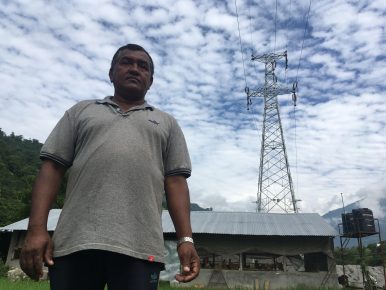
One morning in the summer of 2016, Chandra Mishra, a farmer from Udipur town in Nepal’s Lamjung district, discovered that a tree on his property had gone missing. It was a large Albizia tree, which Mishra had hoped to one day harvest for wood for making furniture. But during the night, someone had cut the tree and it fell down a steep bank into the Marsyangdi River, which courses below Mishra’s rice fields. Mishra soon learned that workers for a new electricity project – the 132 kilo-volt (kV) Bhulbhule power line, which transports electricity from a Chinese-built 50 megawatt hydro-electric power plant upriver to Nepal’s national grid – had cut his tree to make way for their development.Defining Xi’s ‘Chinese Dream’
China May Have $5.8 Trillion in Hidden Debt With ‘Titanic’ Risks
Assessment of Current Efforts to Fight the Islamic State
Iran and the GCC Hedging, Pragmatism and Opportunism
This is the front line of Saudi Arabia’s invisible war
The Next Arab Uprising
The 8 Major Forces Shaping the Future of the Global Economy
With billions of people hyper-connected to each other in an unprecedented global network, it allows for an almost instantaneous and frictionless spread of new ideas and innovations. Combine this connectedness with rapidly changing demographics, shifting values and attitudes, growing political uncertainty, and exponential advances in technology, and it's clear the next decade is setting up to be one of historic transformation. But where do all of these big picture trends intersect, and how can we make sense of a world engulfed in complexity and nuance? Furthermore, how do we set our sails to take advantage of the opportunities presented by this sea of change?The Anarchy That Came
Twenty-five years ago, in the February, 1994 issue of The Atlantic , I published a decidedly unAmerican cover story: unAmerican in that it was pessimistic, deterministic, and, most importantly, declared that the victory of the United States in the recently concluded Cold War would be not so much short-lived as irrelevant, because of various natural, demographic and cultural forces underway in the world that would overwhelm America’s classically liberal vision. It eschewed the debate over ideals that have traditionally been the fare of intellectual journals and newspaper opinion pages. Moreover, because of the unrestrained optimism of the era—globalization in the 1990s was being employed as a freshly conceived buzzword—the pessimism of my essay was deeply alienating, if not abhorrent, to many. The title that the editors chose said it all: “The Coming Anarchy: How Scarcity, Crime, Overpopulation, Tribalism, and Disease Are Destroying the Social Fabric of the Planet.” They turned “The Coming Anarchy” into “the most xeroxed article of the decade,” in the words of Lester Brown, president of the Worldwatch Institute.African Governments Are Paying for the World Bank’s Mauritius Miracle
How artificial intelligence is already impacting today's jobs - Some Extracts from A LinkedIn Report
The U.S. Government Needs to Better Immunize Itself From Supply-Chain Attacks
It has now been two weeks without confirmation of Bloomberg’s reporting concerning a supply chain attack targeting SuperMicro motherboards from any news outlet. Given the alleged widespread nature, incredibly strong denials from the allegedly affected companies and multiple intelligence agencies around the world (including the NSA), and at least two previous incidents where the same reporters probably got a computer security story horribly wrong, absent independent evidence many are right to call this particular incident a false alarm. Earning less attention is a new article by the same reporters describing an implant supposedly designed for an ethernet jack. This story makes less sense to me and adding a second, more suspicious story makes me less inclined to believe the original story.Trade War Damage Is Spreading And Time Is Running Out
Electronic Warfare From a Laptop
Effective EW – conflict in the electromagnetic spectrum – relies on a complicated mix of signals, data and critical decisions. Yet operators can find themselves in locations with fragmented connections, or in some cases, no connections at all. That can shut them off from the comms and data they need to make immediate, informed decisions, a bad situation made worse by the heavy investment the enemy may have made in their own EW technology. The U.S. Army recently enlisted Raytheon’s help in the European theater. The end result was Raven Claw, a mobile electronic warfare tool that helps operators control signals in the field even without a host server or reliable connection to external data.What Can 24 Satellites Do for U.S. Missile Defense?
The Digital Battlefield and the Future of War
While the United States has endured as a world leader in traditional warfare for well over a century, the global battlefield today has shifted decisively in the digital realm. With countries like Russia, Iran, and even North Korea showing signs of extremely sophisticated digital maneuvers capable of infiltrating other countries’ databases, influencing foreign elections, and even altering physical systems such as hard drives and power grids, large-scale digital are already occurring in real-time.