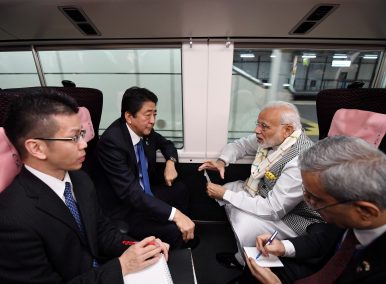
In scenic Yamanashi, where Japanese Prime Minister Shinzo Abe and his Indian counterpart Narendra Modi met over a private dinner and a brief tutorial on the use of chopsticks, there was a clear sense of bonhomie and trust. The 13th annual meeting between the leaders of the two countries included a visit to a Fuji Automatic Numerical Control (FANUC) factory.The Profession of Arms: A Guide for Young Army Officers
It takes courage, especially for a young officer, to check a man met on the road for not saluting properly or for slovenly appearance, but, every time he does, it adds to his stock of moral courage, and whatever the soldier may say, he has respect for the officer who does pull him up.
Read Document →The Dragon's Teeth: Assessing China's Military Modernization
PLA has focused on modernising its capabilities across all warfare domains to achieve these goals. This includes land, air, and maritime operations, nuclear, space, counter-space, electronic warfare and cyberspace operations, aiming to become a fully integrated joint force.
Read Document →Transforming the PLA: A Decade of reorganisation from SSF to ISF
PRC has engaged in a sustained and broad effort to transform the PLA from an infantry-heavy, low-technology, ground forces-centric military into a high-technology, networked force with an increasing emphasis on joint operations and naval and air power projection.
Read Document →Eyes without Borders: Exploring the World of Open Source Intelligence (OSINT) in the Digital Age
Open Source Intelligence (OSINT) is gaining prominence with the rise of social media, the digital society and the vast growth of publicly and commercially available information (PAI and CAI).
Read Document →
The PLA’s Developing Cyber Warfare Capabilities and India's Options
Informationised warfare blurs the lines between peacetime and wartime. A nation in the information age cannot wait for the hostilities to break out to collect intelligence, carryout influence operations, develop antisatellite systems or design computer software weapons.
Read Document →
Galwan and After
Why did China did this when he is under tremendous pressure in all fronts, is this China's salami slice tactics being progressed rigorously, what will be new Rules of Engagement, what will be escalatory control mechanism, who has taken this decision, will there be some pressure put by China in India's North-East through insurgency.
Read Document →
India’s Joint Doctrine for Cyberspace Operations: A Critical Review
Chief of Defence Staff (CDS) General Anil Chauhan and Secretary, Department of Military Affairs, formally released declassified versions of the Joint Doctrines for Cyberspace Operations during the Chiefs of Staff Committee meeting in New Delhi.
Read Document →
Know your Enemy General(now Field Marshal) Syed Aseem Munir
Gen SA Munir's position in the hierarchy of Pakistan was not very comfortable. The state of economy, insurgency in Pakhtoonistan and Balochistan, attack on the Jaffar Express, constant protests by supporters of Imran Khan's supporters inside and outside of parliament.
Read Document →
Decoding Operation SINDOOR: Key Aspects and Implications
Precision strikes were carried out on nine sites—four in Pakistan and five in PoK—linked to anti-India terrorist groups such as the LeT, JeM and the Hizbul Mujahideen. The targeted sites included Muridke (LeT headquarters) and Bahawalpur (JeM headquarters).
Read Document →
Chinese Cyber Exploitation in India's Power Grid - Is There a linkage to Mumbai Power Outage?
The New York Times (NYT), based on analysis by a U.S. based private intelligence firm Recorded Future, reported that a Chinese entity penetrated India’s power grid at multiple load dispatch points. Chinese malware intruded into the control systems that manage electric supply across India, along with a high-voltage transmission substation and a coal-fired power plant
Read Document →6 November 2018
India and Japan Boost Relations With High-Tech Focus
In scenic Yamanashi, where Japanese Prime Minister Shinzo Abe and his Indian counterpart Narendra Modi met over a private dinner and a brief tutorial on the use of chopsticks, there was a clear sense of bonhomie and trust. The 13th annual meeting between the leaders of the two countries included a visit to a Fuji Automatic Numerical Control (FANUC) factory.How did Sri Lanka find itself in a crisis and how will it affect its foreign policy?
The Diplomat‘s Ankit Panda (@nktpnd) and Prashanth Parameswaran (@TheAsianist) discuss the new constitutional crisis in Sri Lanka and its regional implications.The New US Hard Line Toward China Is Worrying Southeast Asia
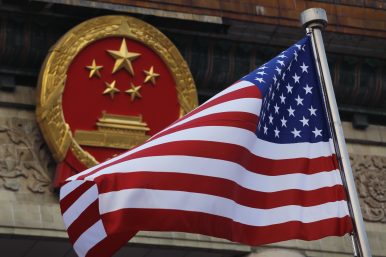
Analysts are feverishly debating whether the United States and China are on the brink of a modern version of their own “Cold War.” It is of course too early to tell and there are many reasons why that may not happen. But the “soft war” for the hearts and minds of Southeast Asian countries is clearly intensifying and the United States has suffered some recent setbacks.The Great Indo-Pacific Misread
The Reforms China Needs
Pushback: America’s New China Strategy
The U.S. government’s across-the-board hardening toward China emerged somewhat erratically over the past year but has shown remarkable momentum in recent months. This report offers a perspective from Washington for the use of those many observers in America and abroad seeking information and early analysis of the importance of the U.S. government shifts toward acute rivalry with China.Mapping China’s 'Re-Education' Camps: The Power of Open-Source Intelligence
The Return of Big Infrastructure as a Geopolitical Tool
Is a US-China war in Asia inevitable?
New York City - Chinese President Xi Jinping's recent talk of "preparing for war and combat" is just the latest example of tough language that has stoked fears of a military flare-up with the United Statesover two potential flashpoints: Taiwan and the South China Sea. Last week, Xi told his military commanders in Guangdong province to "concentrate preparations for fighting a war", in comments distributed by government-run media following a four-day visit to the south.Down But Not Out: Extremists’ Evolving Strateg
Moscow to Boost Protection of Russians Abroad and Make It Easier for Many to Return
A Radically Realistic Climate Vision
Israel Silent As Iran Hit
Mattis Shares Thinking Behind New National Defense Strategy
Trumping Asia
Russia’s Roadmap to Exiting Ukraine (Op-ed)
In its fifth year, Russia's armed aggression in Ukraine's Donbas region has become a costly burden with little strategic benefit. Ukraine, having lost over 10,000 lives, is more united against Russia — and more connected to Europe. Sanctions have heightened Russia’s isolation and forced it to cut spending, leading to protests over the government’s raising of the retirement age. Meanwhile, Russia’s continued military presence in Donbas blocks all Russian hopes of restoring dialogue with the West on shaping security in Europe.Managed Confrontation: UK Policy Towards Russia After the Salisbury Attack
Mapping Global Strategic Stability in the Twenty-First Century
THE BIG MELTDOWN
Angela Merkel Failed
The British politician Enoch Powell famously observed that “all political lives, unless they are cut off in midstream at a happy juncture, end in failure.” German Chancellor Angela Merkel appears to defy this rule. The present is hardly a happy juncture for her, yet her Oct. 29 announcement that she will step down as leader of her party, the Christian Democratic Union (CDU), has been lauded by observers as both dignified and elegant. Whether she can continue as chancellor until 2021, as she has said she would, is de facto not in her hands: Were the Social Democratic Party to leave the ruling coalition before then, prompting elections, she would not run again. Still, she is perceived as supremely in control, just as she has always seemed in control since heading her first government in 2005—with the fateful exception of the fall of 2015, when many citizens felt that the German state was no longer in charge of its own borders, as hundreds of thousands of refugees streamed into the country.If Terrorists Launch a Major Cyberattack, We Won’t See It Coming
“The FBI assesses the cyberterrorism threat to the U.S. to be rapidly expanding,” said one law-enforcement official, testifying before Congress. “Terrorist groups will either develop or hire hackers, particularly for the purpose of complementing large physical attacks with cyber attacks.” That assessment was made nearly 15 years ago. In the meantime, a generation of tech-savvy jihadists has exploited the internet to attract recruits, share bomb-making expertise, and incite violence. Yet they haven’t managed to pull off the devastating cyberattacks that experts have long feared.Singapore Sets Up World’s First Commercial Cyber Risk Pool
Energy and the Information Infrastructure: Part 2 – The Invisible & Voracious 'Information Superhighway'
5G Technology Set To Fuel Technological Change And Transform Global Economy
THE RETURN OF BIG INFRASTRUCTURE AS A GEOPOLITICAL TOOL
Then and now – coming out from the shadows
Changes in the global economy are bringing with it a wealth of opportunities for Australia, but we need to be open-eyed on the potential threats to our most important interests, says Mike Burgess, director-general of the ASD.Data Localisation: A Strategic Weapon In Cyber War
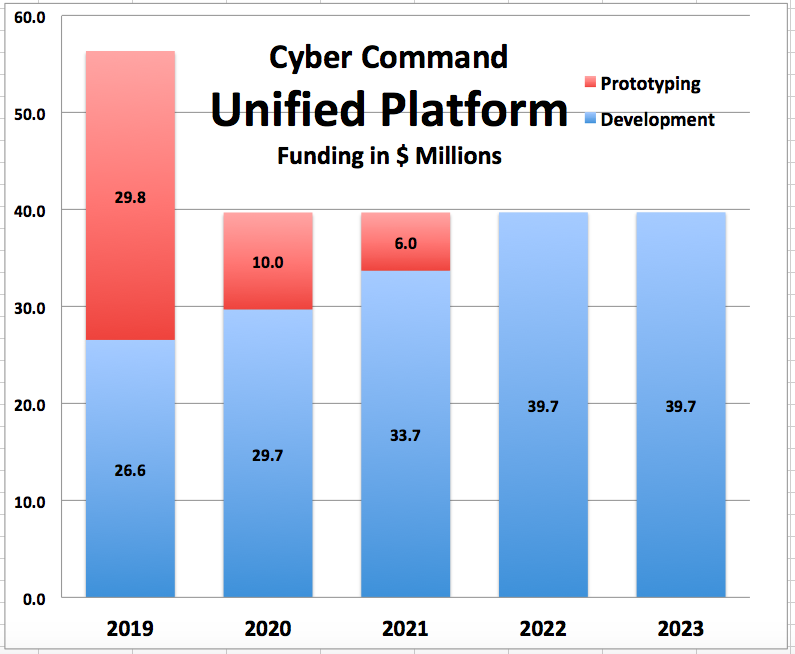
Data is the new oil, and I believe it is the new cyber weapon too. Those whose possess, control and mine the data are the proxy rulers of cyber space. Data being localised in Indian borders gives a better control even for law enforcement agencies to gather electronic evidence without any foreign countries prejudice. Till the ECPA (Electronic Communications and Privacy Act), exists in the US, they are never going to share data with India’s law enforcement agencies. My personal interaction with a US Government attorney in Washington made me aware that they do not even expect ECPA to be amended in favour of data sharing with countries like India.What Northrop’s $54M Unified Platform Win Means For Cyber War
CyberCom Is Targeting Russia’s Election Meddlers — and Changing How Governments Use Cyber
We learned last week that U.S. Cyber Command is conducting operations against Russian operatives suspected of interfering in U.S. elections. The goal according to the New York Times is “to deter them from spreading disinformation” and “[tell] them that American operatives have identified them and are tracking their work.” Direct messages were apparently sent to these individuals to erase doubt about who attacked them and why.