Discriminatory policies of Myanmar’s government since the late 1970s have compelled hundreds of thousands of Muslim Rohingya to flee their homes in the predominantly Buddhist country. Most have crossed by land into Bangladesh, while others have taken to the sea to reach Indonesia, Malaysia, and Thailand. Beginning in 2017, renewed violence, including reported rape, murder, and arson, triggered an exodus of Rohingya amid charges of ethnic cleansing against Myanmar’s security forces. Those forces claim they are carrying out a campaign to reinstate stability in the western region of Myanmar, but international pressure on the country’s elected leaders to rein in violence continues to rise.The Profession of Arms: A Guide for Young Army Officers
It takes courage, especially for a young officer, to check a man met on the road for not saluting properly or for slovenly appearance, but, every time he does, it adds to his stock of moral courage, and whatever the soldier may say, he has respect for the officer who does pull him up.
Read Document →The Dragon's Teeth: Assessing China's Military Modernization
PLA has focused on modernising its capabilities across all warfare domains to achieve these goals. This includes land, air, and maritime operations, nuclear, space, counter-space, electronic warfare and cyberspace operations, aiming to become a fully integrated joint force.
Read Document →Transforming the PLA: A Decade of reorganisation from SSF to ISF
PRC has engaged in a sustained and broad effort to transform the PLA from an infantry-heavy, low-technology, ground forces-centric military into a high-technology, networked force with an increasing emphasis on joint operations and naval and air power projection.
Read Document →Eyes without Borders: Exploring the World of Open Source Intelligence (OSINT) in the Digital Age
Open Source Intelligence (OSINT) is gaining prominence with the rise of social media, the digital society and the vast growth of publicly and commercially available information (PAI and CAI).
Read Document →
The PLA’s Developing Cyber Warfare Capabilities and India's Options
Informationised warfare blurs the lines between peacetime and wartime. A nation in the information age cannot wait for the hostilities to break out to collect intelligence, carryout influence operations, develop antisatellite systems or design computer software weapons.
Read Document →
Galwan and After
Why did China did this when he is under tremendous pressure in all fronts, is this China's salami slice tactics being progressed rigorously, what will be new Rules of Engagement, what will be escalatory control mechanism, who has taken this decision, will there be some pressure put by China in India's North-East through insurgency.
Read Document →
India’s Joint Doctrine for Cyberspace Operations: A Critical Review
Chief of Defence Staff (CDS) General Anil Chauhan and Secretary, Department of Military Affairs, formally released declassified versions of the Joint Doctrines for Cyberspace Operations during the Chiefs of Staff Committee meeting in New Delhi.
Read Document →
Know your Enemy General(now Field Marshal) Syed Aseem Munir
Gen SA Munir's position in the hierarchy of Pakistan was not very comfortable. The state of economy, insurgency in Pakhtoonistan and Balochistan, attack on the Jaffar Express, constant protests by supporters of Imran Khan's supporters inside and outside of parliament.
Read Document →
Decoding Operation SINDOOR: Key Aspects and Implications
Precision strikes were carried out on nine sites—four in Pakistan and five in PoK—linked to anti-India terrorist groups such as the LeT, JeM and the Hizbul Mujahideen. The targeted sites included Muridke (LeT headquarters) and Bahawalpur (JeM headquarters).
Read Document →
Chinese Cyber Exploitation in India's Power Grid - Is There a linkage to Mumbai Power Outage?
The New York Times (NYT), based on analysis by a U.S. based private intelligence firm Recorded Future, reported that a Chinese entity penetrated India’s power grid at multiple load dispatch points. Chinese malware intruded into the control systems that manage electric supply across India, along with a high-voltage transmission substation and a coal-fired power plant
Read Document →11 April 2019
The Rohingya Crisis
Discriminatory policies of Myanmar’s government since the late 1970s have compelled hundreds of thousands of Muslim Rohingya to flee their homes in the predominantly Buddhist country. Most have crossed by land into Bangladesh, while others have taken to the sea to reach Indonesia, Malaysia, and Thailand. Beginning in 2017, renewed violence, including reported rape, murder, and arson, triggered an exodus of Rohingya amid charges of ethnic cleansing against Myanmar’s security forces. Those forces claim they are carrying out a campaign to reinstate stability in the western region of Myanmar, but international pressure on the country’s elected leaders to rein in violence continues to rise.India’s February 2019 Strike in Pakistani Territory: A Jus ad Bellum Analysis
On Feb. 14, a suicide bombing in the Indian state of Jammu and Kashmir killed more than 40 members of Indian paramilitary forces—the deadliest terrorist attack in Kashmir’s history. Jaish-e-Mohammed (JeM), a terrorist group based in Pakistan and rumored to have “close ties” to its spy agency, claimed credit for the bombing. JeM’s continued existence has long been a pressure point in India-Pakistan relations, and this latest incident was no different. The attack set off an escalating chain of aerial attacks, first by India and then by Pakistan, that culminated in an Indian pilot being held captive as a prisoner of war by Pakistan for two days. India’s initial attack in Pakistani territory, on Feb. 26, was followed by a statement by the Indian foreign secretary, which described the attack as a “non-military preemptive strike” conducted in self-defense against JeM.Afghanistan’s Future Cannot be secured by sidelining India:
China and Pakistan Have Struck a Devil’s Bargain With Militants
The tense standoff between India and Pakistan has gotten tenser with a surprising move by China. On March 14, China blocked a United Nations effort to designate as a terrorist Masood Azhar, a militant group leader who had brought the two South Asian nuclear rivals to the brink of war. Azhar is the founder and leader of Jaish-e-Mohammed (JeM), which took credit for the Feb. 14 suicide attack in India-administered Kashmir that sparked the recent India-Pakistan crisis.Economic interdependence vs. war with China
US-China Clash Regarding The Regime For Passage Through The Taiwan Strait – Analysis
On March 31 two People’s Liberation Army Air Force fighter jets deliberately crossed the median line of the Taiwan Strait and, despite repeated warnings from Taipei’s military, flew 43 nautical miles into Taiwan’s airspace. This was the first such crossing in nearly two decades and was probably response to the increasing US political support for the DPP/Tsai Ing-wen government in the face of Beijing’s more assertive posture toward Taipei. But it was also likely a manifestation of a creeping clash of legal positions between Beijing and the U.S. regarding the regime for passage of warships and warplanes through the Strait. This legal controversy has potentially dangerous practical implications.Global Silence on China’s Gulag
In the absence of international censure, China has stepped up its systematic persecution of Muslims, under the dubious pretense that it is fighting "terrorism" and protecting its economic interests. But more than just an attack on human rights, the crackdown is representative of President Xi Jinping's totalitarian ambitions.How a Massive Naval Blockade Could Bring China To Its Knees In a War
Despite considerable challenges, a naval blockade is both operationally and strategically possible, albeit only within certain limits.What Iraq Has to Gain, and Lose, by Resurrecting a Border Deal With Iran
Iraq: Basra Pushes for Autonomy
Although Iraq is a fairly diverse country with three broad groupings – Shiites, Sunnis and Kurds – the country's Shiite contingent is easily the largest. But Iraqi Shiites are deeply internally divided. Currently, many in the Shiite-dominated province of Basra are pushing for increased autonomy and calling for more local investment and development due to the province's energy wealth. But the Iraqi government — also predominantly Shiite — is unlikely to support this goal, since its economic health relies on Basra's resources.Lessons of the War in Ukraine for Western Military Strategy
Stable or Still Cause for Concern? Understanding the Global Economy's Mixed Signals
America Is Wide Open for Foreign Influence
Ever since the Treaty of Westphalia, the idea of territorial sovereignty has been central to how most of us think about international politics and foreign policy. Although a huge amount of activity occurs across state borders, one of the chief tasks of any government is to defend the nation’s territory and make sure—to the extent it can—that outsiders are not in position to interfere in harmful ways. But for all the effort and expense devoted to keeping harmful influences out, sometimes countries wind up locking and bolting the windows while leaving the front door wide open.The WTO Protects Its Power in a Landmark National Security Case
A WTO panel has ruled that Moscow was within its rights to block Kiev's access to Russian rail transit over national security concerns, marking the first such decision in the body's history. But while the panel cleared Russia in this instance, it also stated that it has jurisdiction to decide such cases, implying that countries will have less leeway to cite national security concerns to impose protectionist policies. This makes it less likely that the WTO will side with the Trump administration on its steel and aluminum tariffs or that the United States will cease blocking appointments to the organization's appellate body, which hears panel appeals.Can Change UK Break Up the British Two-Party System?
Cutting U.S. Aid to Central America Is No Way to Address Immigration
President Donald Trump announced late last month that he is cutting off $450 million in U.S. aid to Guatemala, Honduras and El Salvador, delivering on a previous threat amid news that another migrant caravan was forming in Central America. The move has drawn significant criticism, even from within Trump’s administration. The aid is largely used for social, economic and governance development programs that many consider to be an effective, long-term solution to underlying issues—such as violence, poverty and corruption—that are driving people out of their home countries and toward the United States. How Western Economies Can Avoid the Japan Trap
Inside The European Debate On Islamic Immigration – OpEd
There is no more sensitive issue for European politicians than that of Islamic immigration. The fact of mass immigration from Muslim-majority countries in the Middle East, Africa and South Asia is plain to see, but all but the most nationalist speak in general terms about “migration” and “integration.” Those who raise the religious dimension usually refer to European “values” rather than Christianity. The dictates of one of those values, multiculturalism, make it impossible to judge Islamic culture as such.Italy’s Economic Crisis And The OECD Warnings – Analysis
At the Columbia University in New York I have recently met many young, skilful and well-trained Italians, who are very worried about the future of their country.What’s Driving the Global Slowdown?
America, You’re Not Listening to Us
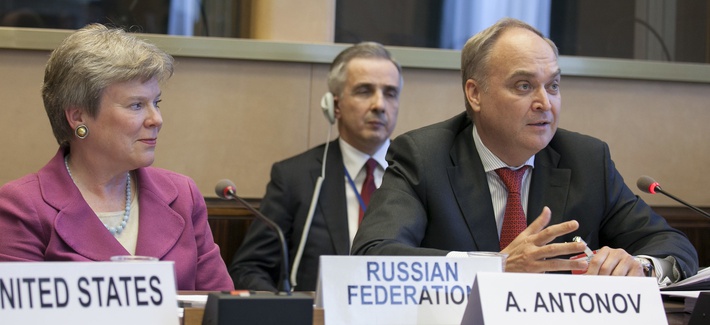
Russia’s ambassador: We’re ready for urgently needed security dialogue — when our U.S. counterparts are ready to engage in good faith.What the Brexit Mess Means for America
Donald Trump Jr. has taken to the op-ed pages to lecture the British about how they should have taken his father’s “advice” on handling the Brexit issue. A more instructive cross-Atlantic comparison would examine how the state of political parties in the United Kingdom and the United States figures prominently in current problems in each country, but in opposite ways.Stratfor Worldview Android and iOS Update
The improved Stratfor App for Android and iOS lets users experience Stratfor's world-class analysis — right on their mobile device. Subscribers will be able to access and store their content in a new and easy-to-use way. Update today! [Note: The current Stratfor mobile app is being shut down and will no longer work in the coming days, so please read on to get the new experience enabled.]Free Trade: A Key To A Rising Standard Of Living – OpEd
Trade is a key to a rising standard of living in society, especially for those at the bottom of the economic ladder.
/arc-anglerfish-arc2-prod-mco.s3.amazonaws.com/public/XTC2JU3U4VCW7OSXFNOP4HYFJU.jpg)