On March 30, 2019, a former District Council member, identified as Seliam Wangsa, who was campaigning for a Bharatiya Janata Party (BJP) candidate, Honchun Ngandam, was killed by suspected militants at Nginu village in the Longding District of Arunachal Pradesh. Ngandam is the BJP candidate for the Arunachal Pradesh East parliamentary seat.The Profession of Arms: A Guide for Young Army Officers
It takes courage, especially for a young officer, to check a man met on the road for not saluting properly or for slovenly appearance, but, every time he does, it adds to his stock of moral courage, and whatever the soldier may say, he has respect for the officer who does pull him up.
Read Document →The Dragon's Teeth: Assessing China's Military Modernization
PLA has focused on modernising its capabilities across all warfare domains to achieve these goals. This includes land, air, and maritime operations, nuclear, space, counter-space, electronic warfare and cyberspace operations, aiming to become a fully integrated joint force.
Read Document →Transforming the PLA: A Decade of reorganisation from SSF to ISF
PRC has engaged in a sustained and broad effort to transform the PLA from an infantry-heavy, low-technology, ground forces-centric military into a high-technology, networked force with an increasing emphasis on joint operations and naval and air power projection.
Read Document →Eyes without Borders: Exploring the World of Open Source Intelligence (OSINT) in the Digital Age
Open Source Intelligence (OSINT) is gaining prominence with the rise of social media, the digital society and the vast growth of publicly and commercially available information (PAI and CAI).
Read Document →
The PLA’s Developing Cyber Warfare Capabilities and India's Options
Informationised warfare blurs the lines between peacetime and wartime. A nation in the information age cannot wait for the hostilities to break out to collect intelligence, carryout influence operations, develop antisatellite systems or design computer software weapons.
Read Document →
Galwan and After
Why did China did this when he is under tremendous pressure in all fronts, is this China's salami slice tactics being progressed rigorously, what will be new Rules of Engagement, what will be escalatory control mechanism, who has taken this decision, will there be some pressure put by China in India's North-East through insurgency.
Read Document →
India’s Joint Doctrine for Cyberspace Operations: A Critical Review
Chief of Defence Staff (CDS) General Anil Chauhan and Secretary, Department of Military Affairs, formally released declassified versions of the Joint Doctrines for Cyberspace Operations during the Chiefs of Staff Committee meeting in New Delhi.
Read Document →
Know your Enemy General(now Field Marshal) Syed Aseem Munir
Gen SA Munir's position in the hierarchy of Pakistan was not very comfortable. The state of economy, insurgency in Pakhtoonistan and Balochistan, attack on the Jaffar Express, constant protests by supporters of Imran Khan's supporters inside and outside of parliament.
Read Document →
Decoding Operation SINDOOR: Key Aspects and Implications
Precision strikes were carried out on nine sites—four in Pakistan and five in PoK—linked to anti-India terrorist groups such as the LeT, JeM and the Hizbul Mujahideen. The targeted sites included Muridke (LeT headquarters) and Bahawalpur (JeM headquarters).
Read Document →
Chinese Cyber Exploitation in India's Power Grid - Is There a linkage to Mumbai Power Outage?
The New York Times (NYT), based on analysis by a U.S. based private intelligence firm Recorded Future, reported that a Chinese entity penetrated India’s power grid at multiple load dispatch points. Chinese malware intruded into the control systems that manage electric supply across India, along with a high-voltage transmission substation and a coal-fired power plant
Read Document →20 April 2019
India: Tranquillity At Risk In North East – Analysis
On March 30, 2019, a former District Council member, identified as Seliam Wangsa, who was campaigning for a Bharatiya Janata Party (BJP) candidate, Honchun Ngandam, was killed by suspected militants at Nginu village in the Longding District of Arunachal Pradesh. Ngandam is the BJP candidate for the Arunachal Pradesh East parliamentary seat.The Afghan Endgame: What, When, and How
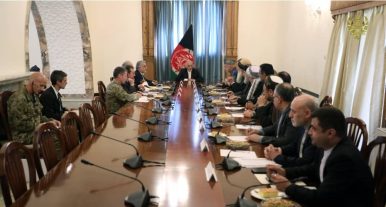
China’s Crackdown on Uighurs in Xinjiang
Human rights organizations, UN officials, and many foreign governments are urging China to stop the crackdown. But Chinese officials maintain that what they call vocational training centers do not infringe on Uighurs’ human rights. They have refused to share information about the detention centers, however, and prevent journalists and foreign investigators from examining them.The Closing of the Chinese Mind
China Adds Coal Capacity Despite Pledge To Cut – Analysis
After years of cutting overcapacity in the coal industry, China appears to be reversing course, raising environmental concerns as the government spurs economic growth.Pentagon Developing Military Options to Deter Russian, Chinese Influence in Venezuela
Recycle Your Batteries, Before China Wins That Race, Too
With global demand rising for critical and rare earth materials in new tech, it's not too late for the U.S. to secure its own sources.The Belt and Road: The Good, the Bad, and the Mixed
Much of the narrative on China’s Belt and Road Initiative (BRI) has been polarized. On the one hand, there is a hawkish countermobilization centered on the “debt-trap,” “Chinese colonialism,” and “yellow peril” narratives. The “debt-trap” conjuring was for the most part introduced by South Asian writers referring to Sri Lanka’s Hambantota port, and later adapted by some U.S. think tanks, popularized by mainstream media, and echoed by politicians across the world. The implications of indebtedness to China became a paradigm of Chinese diplomacy after a Center for Global Development report further popularized the argument. The “Chinese colonialism” dialectic evolved in parallel, often taking as example the Chinese presence in Africa, and connecting to the long-standing “yellow peril” phobia. On the other hand, Chinese official responses have been mostly on the defensive, trying to de-link the Belt and Road Initiative from geopolitical or hegemonic ambitions, arguing that BRI projects “benefit the local population” and are opportunities for “shared development.”The U.S. Is Losing a Major Front to China in the New Cold War
A Concise Guide to the Belt and Road Initiative
Iraq's Place in the Saudi Arabian-Iranian Rivalry
The skeptics questioning whether Saudi Arabia’s conspicuous overtures during the last year and a half to improve bilateral relations with Iraq will bear fruits, after twenty-five years of estrangement, may now have to reconsider their doubts.Trump's Foreign Policies Are Better Than They Seem
President Donald J. Trump “is not given sufficient credit for his foreign policies,” writes Robert D. Blackwill, Henry A. Kissinger senior fellow for U.S. foreign policy at the Council on Foreign Relations. “All the chaos generated by this flawed president does produce actual policies, the substance of which in many cases is likely to be more consequential than the ways by which the policies arrived and the character of the man who formulated them,” asserts Blackwill. “What matters most is the effectiveness of U.S. policy over time and its consistency with U.S. national interests, not the personal qualities of its leaders.”Brzezinski’s Warning To America – OpEd
The liberal world order, which lasted from the end of World War 2 until today, is rapidly collapsing. The center of gravity is shifting from west to east where China and India are experiencing explosive growth and where a revitalized Russia has restored its former stature as a credible global superpower. These developments, coupled with America’s imperial overreach and chronic economic stagnation, have severely hampered US ability to shape events or to successfully pursue its own strategic objectives. As Washington’s grip on global affairs continues to loosen and more countries reject the western development model, the current order will progressively weaken clearing the way for a multipolar world badly in need of a new security architecture. Western elites, who are unable to accept this new dynamic, continue to issue frenzied statements expressing their fear of a future in which the United States no longer dictates global policy.Hate Speech on Social Media: Global Comparisons
A mounting number of attacks on immigrants and other minorities has raised new concerns about the connection between inflammatory speech online and violent acts, as well as the role of corporations and the state in policing speech. Analysts say trends in hate crimes around the world echo changes in the political climate, and that social media can magnify discord. At their most extreme, rumors and invective disseminated online have contributed to violence ranging from lynchings to ethnic cleansing.Lessons of the War in Ukraine for Western Military Strategy
In this article, Niklas Masuhr writes that NATO is prioritizing conventional military capabilities to deter Russian encroachment on the Alliance. Further, Western planners and strategists view the war in Ukraine as a key benchmark that defines future capability requirements. As a result, various adaptive processes are underway within national armed forces.The Trump-Putin Relationship, As Dictated by the Kremlin
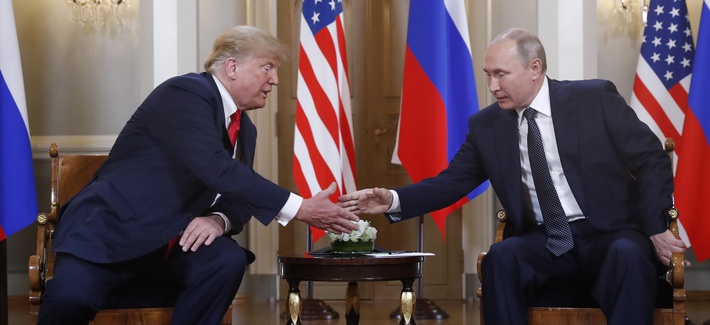
In December 2017, Russian President Vladimir Putin spoke with President Donald Trump at least twice by phone, ostensibly about economic and counterintelligence issues. Americans first learned about both calls from the Kremlin. When then–CIADirector Mike Pompeo met with Russian intelligence officials subjected to sanctions in January 2018 at Langley, Americans learned about it first from the Russian Embassy—via Twitter.Oil Market Update: Checking in on Venezuela
Don’t Believe the Doomsayers: NATO Has a Future
ANXIETY ABOUT the North Atlantic Treaty Organization’s (NATO) future is older than the actual alliance. Its founders worried about the prospects for its survival before the Washington Treaty was fully drafted, much less signed and ratified. Today’s concerns about NATO’s future are, in a sense, old hat.America’s Misuse of Its Financial Infrastructure
THREE DECADES ago, a German history professor listed 210 proposed explanations for the fall of the Roman Empire. The remarkable array included such fanciful causes as Bolshevism, public baths, hedonism, the pressure of terrorism and, most famously, lead poisoning.Haven’t We Done This Before? Lessons From and Recommendations for Strategic Competition in Sub-Saharan Africa
A trio of White House strategies have heralded the return of strategic competition between the United States and its adversaries, China and Russia, in sub-Saharan Africa. In the National Security Strategy, National Defense Strategy, and President Trump’s Africa Strategy, the U.S. government committed itself to countering threats posed by its global rivalries. In December 2018, National Security Adviser John Bolton claimedBeijing and Moscow’s activities “stunt economic growth in Africa; threaten the financial independence of African nations; inhibit opportunities for U.S. investment; interfere with U.S. military operations; and pose a significant threat to U.S. national security interests.”Leadership in a Multipolar World
The United States Owes the World $1 Trillion
Even as international efforts to address climate change have gathered momentum, emissions of heat-trapping gasses have risen, reaching a new peak last year. The next major opportunity to reverse the trend will be the United Nations’ Climate Action Summit in New York this coming September. But a necessary element that could break the deadlock—U.S. leadership—will be absent.Asynchronous Warfare, Part 2: Strategy and Phases

Could artificial intelligence save the Pentagon $15 billion a year?
U.S. Air Force aircraft maintainers perform post-flight maintenance on an E-3 Sentry AWACS. (Senior Master Sgt. Roger Parsons/U.S. Air National Guard) The first time Chinese government officials came to visit Tom Siebel in hopes of convincing him to work on artificial intelligence projects it was 2011. Then delegations of mayors and senior leaders came back in 2012, and in 2013, and in 2014.Breaking Defense eBrief: Army Aviation Modernization
After 15 years of hovering in place, upgrading old helicopters without buying new designs, Army aviation is now hurtling forward — but will their ambitious new programs soar or crash?