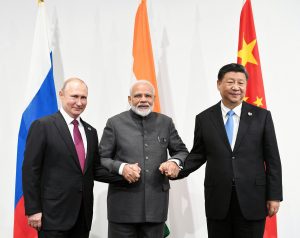
The Russia-India-China trilateral meeting between (from left) Russian President Vladimir Putin, Indian Prime Minister Narendra Modi, and Chinese President Xi Jinping on the sidelines of G-20 Summit 2019 in Osaka, Japan, June 28, 2019.The Profession of Arms: A Guide for Young Army Officers
It takes courage, especially for a young officer, to check a man met on the road for not saluting properly or for slovenly appearance, but, every time he does, it adds to his stock of moral courage, and whatever the soldier may say, he has respect for the officer who does pull him up.
Read Document →The Dragon's Teeth: Assessing China's Military Modernization
PLA has focused on modernising its capabilities across all warfare domains to achieve these goals. This includes land, air, and maritime operations, nuclear, space, counter-space, electronic warfare and cyberspace operations, aiming to become a fully integrated joint force.
Read Document →Transforming the PLA: A Decade of reorganisation from SSF to ISF
PRC has engaged in a sustained and broad effort to transform the PLA from an infantry-heavy, low-technology, ground forces-centric military into a high-technology, networked force with an increasing emphasis on joint operations and naval and air power projection.
Read Document →Eyes without Borders: Exploring the World of Open Source Intelligence (OSINT) in the Digital Age
Open Source Intelligence (OSINT) is gaining prominence with the rise of social media, the digital society and the vast growth of publicly and commercially available information (PAI and CAI).
Read Document →
The PLA’s Developing Cyber Warfare Capabilities and India's Options
Informationised warfare blurs the lines between peacetime and wartime. A nation in the information age cannot wait for the hostilities to break out to collect intelligence, carryout influence operations, develop antisatellite systems or design computer software weapons.
Read Document →
Galwan and After
Why did China did this when he is under tremendous pressure in all fronts, is this China's salami slice tactics being progressed rigorously, what will be new Rules of Engagement, what will be escalatory control mechanism, who has taken this decision, will there be some pressure put by China in India's North-East through insurgency.
Read Document →
India’s Joint Doctrine for Cyberspace Operations: A Critical Review
Chief of Defence Staff (CDS) General Anil Chauhan and Secretary, Department of Military Affairs, formally released declassified versions of the Joint Doctrines for Cyberspace Operations during the Chiefs of Staff Committee meeting in New Delhi.
Read Document →
Know your Enemy General(now Field Marshal) Syed Aseem Munir
Gen SA Munir's position in the hierarchy of Pakistan was not very comfortable. The state of economy, insurgency in Pakhtoonistan and Balochistan, attack on the Jaffar Express, constant protests by supporters of Imran Khan's supporters inside and outside of parliament.
Read Document →
Decoding Operation SINDOOR: Key Aspects and Implications
Precision strikes were carried out on nine sites—four in Pakistan and five in PoK—linked to anti-India terrorist groups such as the LeT, JeM and the Hizbul Mujahideen. The targeted sites included Muridke (LeT headquarters) and Bahawalpur (JeM headquarters).
Read Document →
Chinese Cyber Exploitation in India's Power Grid - Is There a linkage to Mumbai Power Outage?
The New York Times (NYT), based on analysis by a U.S. based private intelligence firm Recorded Future, reported that a Chinese entity penetrated India’s power grid at multiple load dispatch points. Chinese malware intruded into the control systems that manage electric supply across India, along with a high-voltage transmission substation and a coal-fired power plant
Read Document →30 June 2020
After Galwan Valley Standoff, Does the Russia-India-China Trilateral Still Matter?
The Russia-India-China trilateral meeting between (from left) Russian President Vladimir Putin, Indian Prime Minister Narendra Modi, and Chinese President Xi Jinping on the sidelines of G-20 Summit 2019 in Osaka, Japan, June 28, 2019.Chinese Navy Submarines Could Become A Reality In Indian Ocean

China’s Indian Ocean ambitions
Delhi Must Help Taipei Get Into the WHO
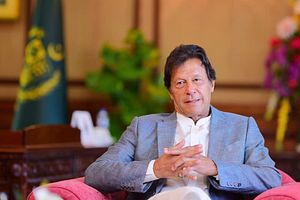
Pakistan’s Prime Minister Dubs Osama Bin Laden a ‘Martyr’: What Now?
Pakistani Prime Minister Imran Khan has stirred new controversy after a speech he gave in the national parliament in which he described Al Qaeda leader Osama bin Laden’s death as martyrdom by the United States. Bin Laden was “martyed,” he said.Regional Implications of a U.S. Pullout from Afghanistan
Dr. Thomas Parker worked in the Executive Office of the President, the Office of the Secretary of Defense, the State Department’s Policy Planning Staff, the Intelligence Community and the U.S. Congress over the course of thirty years. He currently teaches security studies at George Washington University.Asia Hurtling Towards A Fentanyl Disaster – Analysis
An Emboldened Beijing Seeks to Consolidate Its Power
China’s Answer to GPS Is Now Fully Complete
Technological independence and superiority have long been hallmarks of superpowers; China too, in its quest to be a dominant force in the world, has invested heavily in state-of-the-art communication and transmission systems. On June 23, China concluded its decades-long project to build its own global navigation satellite system, a venture that will make it self-sufficient and avoid dependence on foreign rivals when it comes to a network that undergirds modern business, technologies and the military.Amid a U.S-China 'Cold War,' Here's Where Conflicts Could Break Out
Planes in China's Air Force.
Central Asian Gas Exports to China: Beijing’s Latest Bargaining Chip?
CATCHING UP IN A TECHNOLOGY WAR—CHINA'S CHALLENGE IN ARTIFICIAL INTELLIGENCE
HONOLULU (16 June 2020)—In July 2017, China’s State Council released the Next Generation Artificial Intelligence Development Plan (AIDP). The plan is a road map for using artificial intelligence (AI) to upgrade China’s manufacturing and service industries and to catch up with the US and other advanced economies. This is just the latest in a long string of Chinese efforts to create an advanced technology ecosystem that would be less vulnerable to outside pressures.Monitors at Huawei's Bantian campus in Shenzhen, China, display AI applications for facial recognition. Photo: Kevin Frayer/Getty Images.EXPLORING CHINA’S UNMANNED OCEAN NETWORK
China has deployed a network of sensors and communications capabilities between Hainan Island and the Paracel Islands in the northern South China Sea. These capabilities are part of a “Blue Ocean Information Network” (่ๆตทไฟกๆฏ็ฝ็ป) developed by China Electronics Technology Group Corporation (CETC), a state-owned company, to aid in the exploration and control of the maritime environment using information technology. The network constructed in the northern South China Sea between early 2016 and 2019 is referred to as a demonstration system. However, future plans for the Blue Ocean Information Network involve expanding the sensor and communications network to the rest of the South China Sea, the East China Sea, and other ocean areas far from Chinese territory. While the Blue Ocean Information Network is largely cast as an environmental monitoring and communications system, the military utility of its sensing and communications functions makes its development important to monitor.The Monarchs’ Pawns?
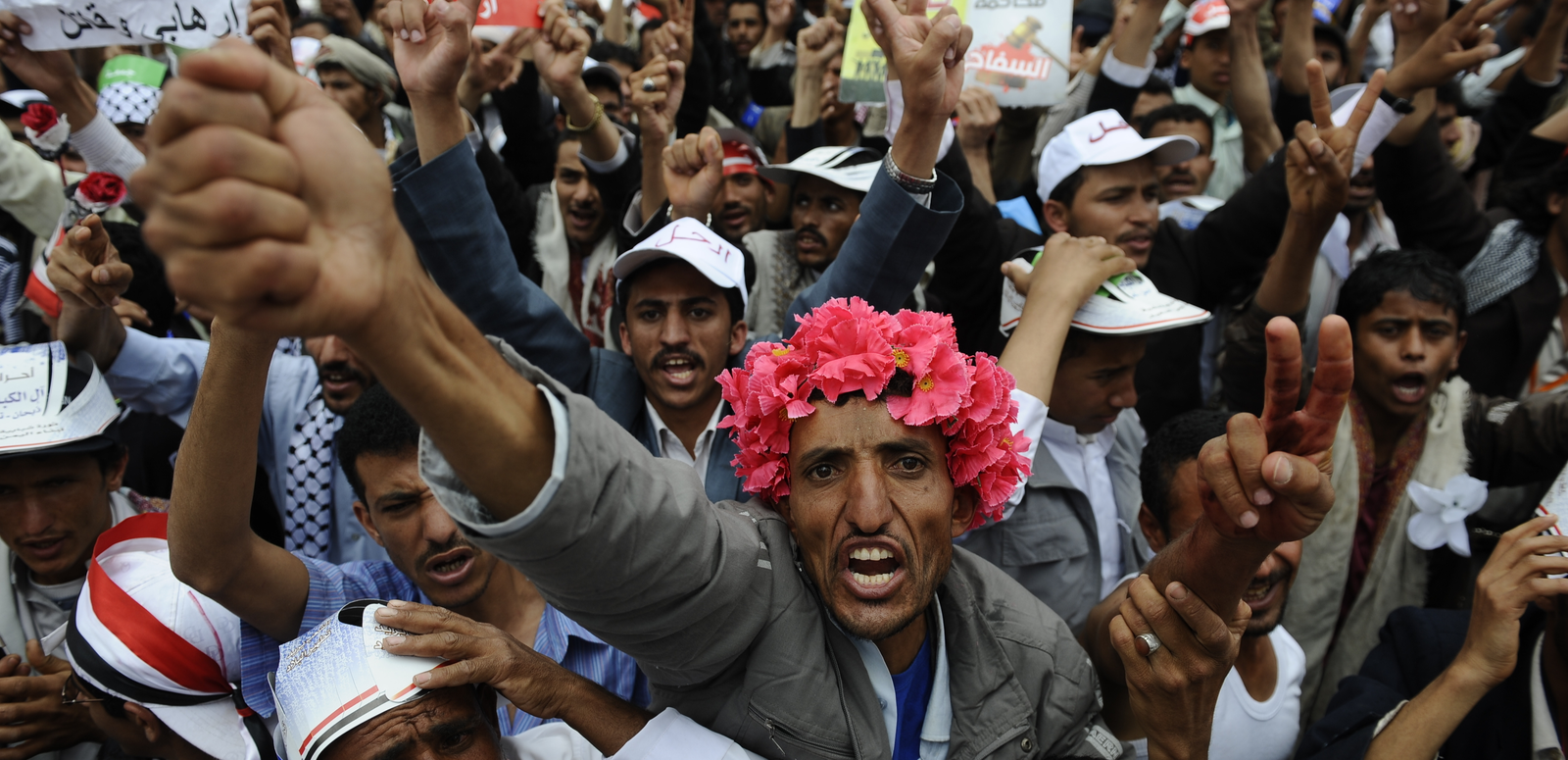
This report examines the combined influence of four factors by about 2014 led three Gulf monarchies to change their calculations and adopt proxy warfare strategies aimed more consistently at managing crises that threatened their spheres of interest and maintaining the political status quo for the region rather than revising the regional balance of power. After introducing you to the three Gulf monarchies the report is divided into four sections. The first section examines each of these three Gulf monarchies’ strategic interests in the early post-Arab Spring period from 2011 through 2014 and goes on to look at how these interests shaped their proxy interventions in Bahrain, Libya, and Syria. The second section examines the four factors that led the Gulf states to change their strategic assessments, and the third section examines the interventions that followed that turning point in Yemen. Finally, the conclusion discusses what the Gulf states’ shifting approach means for U.S. policy in the Middle East.Why Putin’s Bid to Become President for Life Is No Sure Thing
Reopening America&The World
Pompeo says US ready to team up on China, but EU eyes a post-Trump world
The Retrenchment Syndrome
South Korea’s Digital New Deal
As the world continues to recover from the COVID-19 induced economic recession, the Moon administration has proposed spending 76 trillion won ($62 billion) over the next five years on the Korean New Deal to prepare the South Korean economy for the future.