Maj Gen P K Mallick, VSM (Retd)
The Profession of Arms: A Guide for Young Army Officers
It takes courage, especially for a young officer, to check a man met on the road for not saluting properly or for slovenly appearance, but, every time he does, it adds to his stock of moral courage, and whatever the soldier may say, he has respect for the officer who does pull him up.
Read Document →The Dragon's Teeth: Assessing China's Military Modernization
PLA has focused on modernising its capabilities across all warfare domains to achieve these goals. This includes land, air, and maritime operations, nuclear, space, counter-space, electronic warfare and cyberspace operations, aiming to become a fully integrated joint force.
Read Document →Transforming the PLA: A Decade of reorganisation from SSF to ISF
PRC has engaged in a sustained and broad effort to transform the PLA from an infantry-heavy, low-technology, ground forces-centric military into a high-technology, networked force with an increasing emphasis on joint operations and naval and air power projection.
Read Document →Eyes without Borders: Exploring the World of Open Source Intelligence (OSINT) in the Digital Age
Open Source Intelligence (OSINT) is gaining prominence with the rise of social media, the digital society and the vast growth of publicly and commercially available information (PAI and CAI).
Read Document →
The PLA’s Developing Cyber Warfare Capabilities and India's Options
Informationised warfare blurs the lines between peacetime and wartime. A nation in the information age cannot wait for the hostilities to break out to collect intelligence, carryout influence operations, develop antisatellite systems or design computer software weapons.
Read Document →
Galwan and After
Why did China did this when he is under tremendous pressure in all fronts, is this China's salami slice tactics being progressed rigorously, what will be new Rules of Engagement, what will be escalatory control mechanism, who has taken this decision, will there be some pressure put by China in India's North-East through insurgency.
Read Document →
India’s Joint Doctrine for Cyberspace Operations: A Critical Review
Chief of Defence Staff (CDS) General Anil Chauhan and Secretary, Department of Military Affairs, formally released declassified versions of the Joint Doctrines for Cyberspace Operations during the Chiefs of Staff Committee meeting in New Delhi.
Read Document →
Know your Enemy General(now Field Marshal) Syed Aseem Munir
Gen SA Munir's position in the hierarchy of Pakistan was not very comfortable. The state of economy, insurgency in Pakhtoonistan and Balochistan, attack on the Jaffar Express, constant protests by supporters of Imran Khan's supporters inside and outside of parliament.
Read Document →
Decoding Operation SINDOOR: Key Aspects and Implications
Precision strikes were carried out on nine sites—four in Pakistan and five in PoK—linked to anti-India terrorist groups such as the LeT, JeM and the Hizbul Mujahideen. The targeted sites included Muridke (LeT headquarters) and Bahawalpur (JeM headquarters).
Read Document →
Chinese Cyber Exploitation in India's Power Grid - Is There a linkage to Mumbai Power Outage?
The New York Times (NYT), based on analysis by a U.S. based private intelligence firm Recorded Future, reported that a Chinese entity penetrated India’s power grid at multiple load dispatch points. Chinese malware intruded into the control systems that manage electric supply across India, along with a high-voltage transmission substation and a coal-fired power plant
Read Document →10 December 2021
CYBER, COMMUNICATIONS, EW & TECHNOLOGY (C2ET) DIGEST
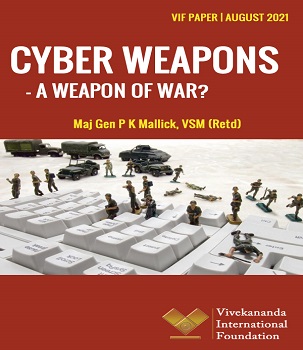
Cyber Weapons – A Weapon of War?
Maj Gen PK Mallick, VSM (Retd)
The character of warfare has changed fundamentally over the last decade. In the past, it was essential for an adversary nation or insurgent to physically bring weapons to bear during combat. That requirement is no longer a necessity. In cyber operations, the only weapons that need to be used are bits and bytes. In this new era of warfare, logistics issues that often restrict and limit conventional warfare and weaponry are not impediments. This new weaponry moves at the speed of light, is available to every human on the planet and can be as surgical as a scalpel or as devastating as a nuclear bomb.Britain’s New Swing Voters? A Survey of British Indian Attitudes
India-Taiwan Ties: A Case for Stronger Partnership
Afghanistan’s Looming Catastrophe Why the United States and Its Allies Must Act Now to Prevent a Humanitarian Disaster
Bangladesh’s Identity Crisis: To Be or Not to Be Secular

All Roads Need Not Lead To China

Microsoft disrupts Chinese hacking group targeting organizations in dozens of countries
Protecting people from recent cyberattacks

Is the Africa-China Relationship at Its Lowest or Highest Level Yet?

What China Learned From the Collapse of the USSR

US military minds still stuck in Pearl Harbor mentality
Beijing’s Strategic Blueprint Is Changing as Tensions Grow
China Seeks First Military Base on Africa’s Atlantic Coast, U.S. Intelligence Finds
China’s cyber vision: How the Cyberspace Administration of China is building a new consensus on global internet governance
Diplomacy Is the Middle East’s Best Bet, but It’s Still a Long Shot

The Intelligence Community Must Work to Gain the Public’s Trust
The Age of Global Protest

US-China geoeconomic rivalry intensifies: A risk or an opportunity for European companies?
Russian group behind SolarWinds incident ramping up hacking efforts, analysis says
Japan Steps in to Support India Against China in South Asia

Russia planning massive military offensive against Ukraine involving 175,000 troops, U.S. intelligence warns
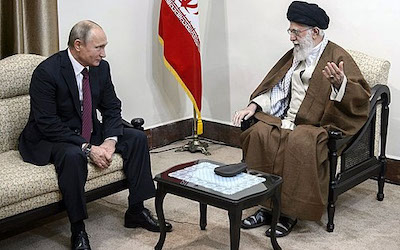
Why the Russia-Iran Alliance Will Backfire Whither Iran?

Diplomacy—and Strategic Ambiguity—Can Avert a Crisis in Ukraine
The Evolution of Russian and Iranian Cooperation in Syria
The Russian intervention in September 2015 provided decisive air power to Syrian and Iranian-backed ground forces, expanding Bashar al-Assad's territorial control and solidifying the regime's hold on power through parallel diplomatic efforts. Challenges associated with military integration materialized due to the Iranians' perceived lack of Russian air support and misunderstandings over basing agreements. However, throughout the course of the Syrian Civil War, regularized military and political exchanges strengthened the Russia-Iran relationship while contributing to greater coherence between Moscow and Tehran on the limits and parameters of cooperation. With the changing military dynamics in Syria, Russia, Iran, and Turkey spearheaded the Astana Process as a parallel track to UN mediation. Moscow's diplomatic and military gains, however, have also embroiled them in the broader regional conflict between the United States, Russia, Israel, and Iran.Europe offers a third way in the technological transformation
STRATEGIC FORESIGHT AND THE EU CYBER THREAT LANDSCAPE IN 2025

Strategic Alert: National Security Implications of Quantum Technology and Biotechnology

It’s Time to Democratise Doctrine

U.S. Military Has Acted Against Ransomware Groups, General Acknowledges