26 March 2014

Saudi grant kills Iran-Pakistan pipeline

Mar 21, '14 
By Syed Fazl-e-Haider

KARACHI - A US$1.5 billion donation to Pakistan from Saudi Arabia is hotly being debated in the country's parliament, political circles and among the analysts. The main question being under what deal Riyadh disbursed the crucial amount to help the cash-strapped country make short-term economic gains? What has Pakistan guaranteed or promised to do in return? Many believe Saudi Arabia killed many birds with one stone.

Saudi Arabia did what the US could not do to keep Pakistan away from a $7.5-billion gas pipeline project with Iran. In a tit-for-tat deal, Saudi Arabia might have persuaded Islamabad to cancel the Iran-Pakistan (IP) pipeline project, which is vital to end energy shortages that are crippling Pakistan's economy.

Pakistan's oil minister Shahid Khaqan Abbasi, after receiving funds from Saudi Arabia last month, reportedly said work on the pipeline was not possible because of sanctions imposed by the United States and the European Union on Iran over its nuclear program. Iran has warned that Islamabad is contractually obliged to complete the project which would allow Tehran to export gas to its southeastern neighbor.

"Iran has carried out its commitments ... and expects the Pakistani side to honor its own," Iran's deputy oil minister Ali Majedi was reported to have said. "They should even pick up the pace of work and make up for falling behind schedule in constructing Pakistan's [780-kilometer] side of the pipeline."

Iran has already laid the pipeline its side up to its border with Pakistan. Financing has been the key issue for Islamabad. Islamabad has so far failed to secure the required funding for the IP pipeline due to the threat of sanctions from the US. Pakistan had been asking Iran, China and Russia to fill the finance gap.

Ironically, Saudi Arabia's $1.5 billion donation was the amount Pakistan needed complete the portion of pipeline on its territory. But this donation, or "gift" as called by Ishaq Dar, Pakistan's finance minister, could not be used to finance the construction of the IP pipeline.

The Saudi grant has, however, helped Pakistan to shore up its foreign exchange reserves. It improved the health of the Pakistani rupee, which appreciated 6% to a nine-month high against the US dollar within a week.

Beijing's Caribbean Logic

Published on The National Interest (http://nationalinterest.org)


March 25, 2014

Editor’s Note: The following is an excerpt from Robert Kaplan’s latest book Asia's Cauldron: The South China Sea and the End of a Stable Pacific [3] (copyright 2014, Random House). Mr. Kaplan will be appearing at the Center for a New American Security [4] to discuss his work on March 25, 2014.

American policymakers bristle at China’s gunboat aggression against Japan in the East China Sea and against countries like Vietnam and the Philippines in the South China Sea. But to understand what China really wants, they need to understand their own history better: particularly America’s diplomatic and military history in the Caribbean. The Caribbean may now suggest a geopolitically obscure place useful only for winter vacations, but for generations of Washington foreign policy professionals in the 19th and early 20th centuries, it was the region of choice to advance careers – the equivalent of the Middle East today.

The Greater Caribbean (including the Gulf of Mexico) is roughly the size of the South China Sea - 1,500 miles in one direction and 1,000 miles in the other. Whereas the South China Sea can be dubbed the Asian Mediterranean because of its centrality to the Indo-Pacific world, the Greater Caribbean can be dubbed the American Mediterranean because of its centrality to the whole Western Hemisphere. For as the mid-20th century Dutch-American strategist, Nicholas J. Spykman, observed, the basic geographical truth of the Western Hemisphere is that the division within it is not between North America and South America, but between the area north of the Amazon jungle and the area south of it. Colombia and Venezuela, as well as the Guianas, although they are on the northern coast of South America, are functionally part of North America and the American Mediterranean. So once the United States came to dominate the American Mediterranean, that is, the Greater Caribbean, and separated as it is from the southern cone of South America by yawning distance and a wide belt of tropical forest, the United States had few challengers in its own hemisphere. The domination of the Greater Caribbean, by providing domination of the Western Hemisphere, left America with resources to spare for influencing the balance of power in the Eastern Hemisphere. First the Greater Caribbean, next the world, in other words: such was the history of the United States in the 20th century with its two world wars.

Han Nationalism in China

Raymond Lee
Last Updated: : Thursday 20 March 2014

Abstract

Great interest has quickly been developing in the international community about the rising Han nationalism in China. Most of the media spotlight was cast on China’s latest military adventurism and Beijing's assertive foreign policy against neighbouring countries regarding island disputes in East and South China Sea. More and more attention has also been paid to the escalation of unrest in Xinjiang.

This report illustrates the main aspects of Han nationalism and explains its recent growth. The analysis shows that Beijing intends to promote Han nationalism to resolve problems of political legitimacy during the transition process of power under Xi's new leadership. The rising Han nationalism could be exercised towards developing a stronger China as long as China simultaneously keeps decent economic growth and maintains social stability, and provided that unrest in Xinjiang unrest is successfully pacified and no military conflict breaks out in Pacific Asia. 

Introduction

Over the past several years, great interest has quickly been developing in the international community about the rising Han nationalism in China. (1) Most of the media spotlight was cast on China’s latest military adventurism and Beijing's assertive foreign policy against neighbouring countries regarding island disputes in East and South China Sea. (2) More and more attention has also been paid to the escalation of unrest in Xinjiang, which demonstrates severe conflicts between Beijing's scale-up stability measures and the Uyghur resistance to Han rule. (3) The two news topics nicely delineates the essential feature of Han nationalism: there is a growing sentiment of Chinese nationalism in the PRC's leadership, which leads to their application of tougher measures to defend national interest in international and domestic arenas, regardless of international criticisms. (4)

Under these ostensible signs, there are deeper reasons that exist for rising Han nationalism in China. While China is largely able to maintain political and social stability under fast modernisation, top leaders face three arduous problems. First, how can they justify the huge developmental gap as well as the many socioeconomic problems in the current capitalist economy that runs counter to the official communist ideology? Second, how can they justify the one-party authoritarian regime and maintain CCP’s political legitimacy? Third, how can they successfully achieve transition of power the first time round without Deng Xiaoping’s political arrangement in the post-Deng era? (5) The answers to all these three questions all converge on a single solution: promoting Chinese nationalism to regain the nation’s glory by achieving great power status that gives utmost legitimacy to the new CCP leadership whilst quieting any dissident voice under the supreme nationalistic goal. 

The Main Aspects of Han Nationalism 

Mao Zedong had publicly criticised Han chauvinism and claimed that Chinese nationalism denotes a multi-ethnic nation which includes Han majority and other 55 ethnic minorities on an equal basis. (6)However, the terms "Chinese nationalism" and "Han nationalism" are often used interchangeably, (7)for the fact that most of the minority people have been highly sinicised except Uyghur, Tibetan, and a few minorities in the Northwest China. In reality, the main discourse of Chinese nationalism is established on the history of Han people and most cultural elements are directly linked to the Han identity, including the language, customs, moral codes, Confucianism, and shared memory. Therefore, Han nationalism is often applied to a political ideology by which people not only identify themselves as Chinese but also advocate the unity and prosperity of the Chinese people, though the definition of the Chinese is subject to change. 

China’s Slowing Fixed Asset Investment

The slowdown will have repercussions for a number of other sectors. Can Beijing find a new source of growth? 

March 24, 2014

China’s rate of growth in fixed asset investment is declining, and while this technical measure of infrastructure, property, and plant and machinery is not as eye-catching as say, consumer sentiment, this particular indicator has been bolstering GDP since the global financial crisis hit China. Its decline means not only that GDP will have to come from other sources in the near future, but that there will be knock-on effects in a number of sectors, including infrastructure, real estate, construction, metals, and machinery, that will compound a slowdown in growth.

China’s investment in infrastructure and real estate has been enabled by a large increase in funding through non-traditional means—i.e., not through bank loans, but through, rather, the shadow banking sector, which includes funds from a number of under-regulated, under-monitored sources such as trust companies. A surge in liquidity stemming from trust companies and other shadow banking entities fueled China’s infrastructure and real estate boom. What is more, stimulus provided by the Chinese government for construction of infrastructure helped to maintain China’s high rate of GDP growth, but returns to both infrastructure and real estate have declined, and shadow banking loans have soured, revealing weaknesses in productivity of these sectors. But that’s not all.

First, declining growth in infrastructure and real estate will have a direct impact on the construction sector, as fewer individuals are employed to work either on government or privately owned projects. The construction sector consists of building, planning and management services, and material provision and installation. Most of the sector is occupied by private enterprises that will lose business as fixed asset investment growth falls off. This sector is labor-intensive and will result in unemployment if its decline is unchecked.

Second, the metals sector will also suffer fallout from a decline in the infrastructure and real estate sectors. The metals sector was boosted by growth, particularly in the infrastructure stimulus packages put through by the government in recent years. Production of steel and aluminum are expected to turn downward as demand for these materials for use in construction declines. Smaller metals producers will face potential bankruptcies as the sector experiences a slump in growth.

Third, China’s machinery sector is expected to decline; production of construction machinery was the most lucrative component of the machinery sector in recent years, and as construction slows, so will domestic demand for construction machinery. High levels of competition in the machinery market due to high fixed costs may result in potential failures of less profitable machinery producers, while machinery producers that remain in business will have to turn to other sources of revenue.

Why the Ukrainian Army Threw Up Its Hands

MAR 24, 2014

Ukrainian soldiers in Crimea have pulled off an impressive feat: ceding a large chunk of territory to an invading army without firing a shot. The question is whether they will be perceived as heroes, traitors or just a sad bunch of guys in ill-fitting camouflage betrayed by their commanders in Kiev.

Russian troops and local pro-Russian militias are now in control of most Ukrainian military bases on the Crimean peninsula, after bloodless "stormings" in which armored vehicles broke through garrison gates, some warning shots were sounded and, in some cases, stun grenades were used. Russian forces took pains not to harm any of their formal adversaries, and the 22,000 Ukrainian troops stationed on the peninsula managed to refrain from shooting at Russians. Only one Ukrainian serviceman has died since Russia invaded the peninsula with unmarked troops in early March, and it is not entirely clear who shot him in the neck.


For their peaceful abdication, the troops received praise from both sides. On Tuesday, Russian President Vladimir Putin thanked "those Ukrainian servicemen who did not go the way of bloodshed." On Friday, acting Ukrainian President Oleksandr Turchynov said that "despite enormous losses, Ukrainian troops in the Crimea have done their duty," which apparently consisted of buying time for Ukrainian armed forces elsewhere "to prepare for defense, to achieve full combat readiness and begin a partial mobilization."

By "enormous losses," Turchynov meant the hundreds and possibly thousands who have defected to Russia from the chronically underfinanced, underarmed and even underfed Ukrainian army. "I've been serving for 15 years, and in these 15 years the Ukrainian army has given me nothing, not even a dorm room," warrant officer and Crimea native Maxim Shumeyev told the BBC's Russian service. "As I served the Ukrainian people, so I remain to serve the people of the Crimea."

To the extent that the Ukrainians defied the Russians, their efforts were largely symbolic. In one famous video, a small Ukrainian unit marches, unarmed and singing the national anthem, on three unbadged Russian soldiers sent to bar their way to the Belbek airbase. The march took courage, and the unit commander, Colonel Yuli Mamchur, quickly became a hero to many Ukrainians. 

Mamchur also expressed the exasperation of local Ukrainian officers with their commanders in faraway Kiev. "Under constant pressure from the Russian military, the local population and local government, we have oral orders to hold on, not submit to provocations and not to use weapons," Mamchur said in a YouTube video less than two weeks after his march. "To avoid armed clashes, I ask you, as soon as possible, to make a considered decision concerning further action by unit commanders in case of a direct threat to the lives of servicemen and their families." In the absence of orders from Kiev, Mamchur threatened to fall back on Ukrainian military regulations, which, not surprisingly, require servicemen to open fire on armed intruders. The orders never came, and Mamchur's unit still never fired a shot: When the Russian came to take it over, the Ukrainians again sang the national anthem.

China and the Ukraine Crisis: Walking on the Razor’s Edge

24 March 2014
Srikanth Kondapalli
Professor, Chinese Studies, Jawaharlal Nehru University

The Ukrainian political crisis, like the earlier crises in Egypt, Libya and Syria, is proving to be a nightmare for China, despite Beijing’s maintenance of a calm stance on the surface. The referendum in Crimea is potentially applicable to Taiwan and Tibet. While the attempted 2004 and 2008 plans for referenda in Taiwan failed as it could not muster the required 50 per cent voter turnout, Beijing was palpably upset over the move. China is also wary of the Dalai Lama’s November 2007 statement that suggested a referendum for a decision over the future set up of the Tibetan leadership. 

Given the impact of such a position on its minimalist foreign policy goals (such as the referendum issue over Taiwan and Tibet) and its maximalist goals (such as the rise of China, trade, conventional weapons import, nuclear agreement, etc), China is attempting a walk on the razor’s edge. Hence, Beijing abstained from the UN Security Council draft resolution of March 16, 2014, proposed by the western countries and vetoed by Moscow, while calling for respecting “sovereignty and territorial integrity.” 

The Ukrainian crisis also upsets the Chinese applecart – which it had assiduously built with Kiev since 1992. China and Ukraine have cobbled up a “strategic partnership” since 2011, and have mutually beneficial relations in trade, investments, conventional weapons transfer, and even a nuclear security agreement since December 2013. The $10 billion Beijing-Kiev bilateral trade is largely in favour of the former (with $7 billion in exports). Furthermore, apart from the construction of Kiev airport light rail and a power station, China plans to provide an estimated $8 to 10 billion in aid (compared to the $15 billion bail-out promised by the EU) in addition to developing over 7 million acres of land in eastern Ukraine. 

In the light of the Western arms embargo on China following the Tiananmen Square incident in 1989, Ukrainian military exports to China proved crucial. These include turbofan engines, tankers, amphibious landing craft, gas turbines, diesel engines, self-propelled guns and even an aircraft carrier (Varyag, renamed Liaoning following refurbishment). These could be in jeopardy after the ouster of President Viktor Yanukovych, who visited China several times. During Yanukovych’s December 2013 visit, both sides approved a “Strategic Partnership Development Plan” for a four-year period from 2014-2018. Significantly, both signed an agreement according to which China will “provide Ukraine nuclear security guarantee when Ukraine encounters an invasion involving nuclear weapons or Ukraine is under threat of a nuclear invasion.” 

WHY THE UKRAINE CRISIS PUTS GLOBALIZATION AT RISK

March 25, 2014 ·

The Ukraine crisis will be a turning point for how states think about globalization. For almost twenty years, the United States and all major powers have pursued greater economic, financial, and technological integration as an end in itself. Global integration held the promise of peace, stability, and mutual prosperity.

On several occasions, most notably after the financial crisis in 2008, experts predicted the end of integration and the return of protectionism but it never came. It took the Ukraine crisis to bring the world to the cusp of a period of de-globalization.

The Ukraine crisis shows that at a moment of high tension the major powers will use the leverage they gain from interdependence as a weapon against each other. Thus, this week, the United States imposed sanctions against Russian banks and oligarchs. Russia is employing its own economic weapons against Ukraine and is reportedly considering retaliation of its own against the European Union and America.

The logical response to the prospect of economic warfare is for states and major companies to hedge against the risk of vulnerabilities created by interdependence. They will adopt a strategic approach to integration—pursuing it where it works to their benefit, but stepping away from it when it exposes them to potential actions by a hostile government. This will be a sea change in international economic policy and U.S. grand strategy more generally.

Russian companies have already pulled billions of dollars from western banks, presumably to preempt sanctions, while Putin demanded that Russian companies register “onshore” instead of abroad. Western European governments are acutely aware of their exposure to Russia and are looking for ways to reduce their dependence on Russian energy. Western banks are already paying a price while companies like Boeing and General Electric are closely tracking how sanctions on Russia may detrimentally impact upon their interests there.

We saw some signs of hedging even before the Ukraine crisis. The United States and many of its allies prevented Huawei, a Chinese technology company, from investing in critical infrastructure because of concerns it could be influenced by the Chinese government. Some U.S. analysts havewarned against being overly reliant on China’s purchase of U.S. treasuries.

Cold War Lessons for Dealing with Russia

Published on The National Interest (http://nationalinterest.org)


March 25, 2014

As Russia tightens its grip on the Crimean peninsula amid heightening East-West tensions, observers have drawn [3]evocative parallels [3]between the current crisis and the Cold War.

In some ways such comparisons are misplaced. Clearly, Putin’s Russia is not the Soviet behemoth. It is a regional, not a global player. Economically, culturally, and socially, it is too tightly integrated with the West for it to be easily shut off with another Iron Curtain. Moreover, unlike the Soviet Union, which represented an alternative vision of modernity—Communism—Russia represents no such thing. Putin’s foreign policy is not underpinned by a coherent ideology.

Nevertheless, Soviet decision-making during the Cold War provides useful reference points for understanding Putin’s actions. For twenty-five years scholars have scrutinized declassified Soviet records, translated and published by the [4]Cold War International History Project [4]. They have unwrapped mysteries, deciphered enigmas and solved many of the riddles that had plagued Western perceptions of Soviet policies at the height of the Cold War. With hindsight, we can say see where the West got it wrong.

Lesson 1. Russia does not always act opportunistically. Western perception of Moscow’s actions have been colored by an assumption that Putin ‘is out to get us,’ if he is given a chance. Best, then, not to give him one. The intellectual forefather of this line of thought was none other than George Kennan who wrote in the [5]Long Telegram [5] of February 1946 that “Soviet power… does not work by fixed plans. It does not take unnecessary risks. Impervious to logic of reason, it is highly sensitive to logic of force.”

The answer to the Russian challenge, in Kennan’s view, was containment, a word that has already crept up in relation to the Crimean situation in commentary by Western scholars and policy makers. Yet the key assumptions of “containment” strategy turn out to be misplaced.

Stalin, recent Cold War scholarship shows, prioritized great-power cooperation with the West in the immediate postwar years, evidenced in his approach to civil wars in Greece and China and to the crisis in Iran, and his initial preference for a unified and neutral Germany. It was not until the Marshall Plan of 1947, which, Stalin thought, unfairly interfered with ‘his’ sphere of influence, that he decided firmly on taking his spoils and shutting his bloc off from the West. Stalin initially preferred Western recognition of what he thought to be his legitimate interests to mindless, opportunistic expansion.

Putin, likewise, had tried to work with the West. It is easy to forget amid the Crimean passions that he was supportive of George W. Bush’s war on terror and even volunteered, at one point, to join NATO. In days not so long ago, Putin was an enthusiastic advocate of a “reset” in Russia’s relations with the West. It may well be that, like Stalin, Putin is not at all ‘out to get us.’ He may simply be reacting to changing circumstances seeing his dreams of great-power cooperation impaled on the horns of another big “M”: not the Marshall Plan but the Magnitsky Act.

Libya is a disaster we helped create. The west must take responsibility

Who could object to the removal of Colonel Gaddafi? But what has happened since shames western interventionists

The Guardian, Monday 24 March 2014

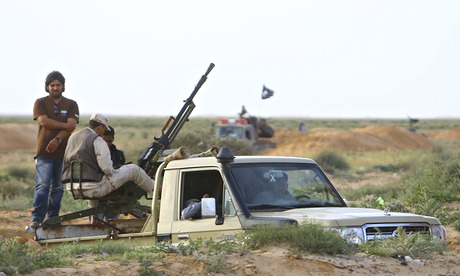
Armed vehicles belonging to the forces of rebel leader Ibrahim Jadran. 'Under militia rule, Libya is beginning to disintegrate.' Photograph: Esam Omran Al-Fetori/Reuters

It's called the pottery store rule: "you break it, you own it". But it doesn't just apply to pots and mugs, but to nations. In the build-up to the catastrophic invasion of Iraq, it was invoked by Colin Powell, then US secretary of state. "You are going to be the proud owner of 25 million people," he reportedly told George W Bush. "You will own all their hopes, aspirations and problems." But while many of these military interventions have left nations shattered, western governments have resembled the customer who walks away whistling, hoping no one has noticed the mess left behind. Our media have been all too complicit in allowing them to leave the scene.

Libya is a striking example. The UN-authorised air campaign in 2011 is often lauded as a shining example of successful foreign intervention. Sure, the initial mandate – which was simply to protect civilians – was exceeded by nations who had only recently been selling arms toMuammar Gaddafi, and the bombing evolved into regime-change despite Russia's protests. But with a murderous thug ejected from power, who could object?

Today's Libya is overrun by militias and faces a deteriorating human rights situation, mounting chaos that is infecting other countries, growing internal splits, and even the threat of civil war. Only occasionally does this growing crisis creep into the headlines: like when an oil tanker is seized by rebellious militia; or when a British oil worker is shot dead while having a picnic; or when the country's prime minister is kidnapped.

According to Amnesty International, the "mounting curbs on freedom of expression are threatening the rights Libyans sought to gain". A repressive Gaddafi-era law has been amended to criminalise any insults to officials or the general national congress (the interim parliament). One journalist, Amara al-Khattabi, was put on trial for alleging corruption among judges. Satellite television stations deemed critical of the authorities have been banned, one station has been attacked with rocket-propelled grenades, and journalists have been assassinated.

Some human rights abuses began in the tumultuous days that followed Gaddafi's removal, and were ignored by the west. Ever since the fall of his dictatorship, there have been stories of black Libyans being treated en masse as Gaddafi loyalists and attacked. In a savage act of collective punishment, 35,000 people were driven out of Tawergha in retaliation for the brutal siege of the anti-Gaddafi stronghold of Misrata. The town was trashed and its inhabitants have been left in what human rights organisations are calling "deplorable conditions" in a Tripoli refugee camp. Such forced removals continue elsewhere. Thousands have been arbitrarily detained without any pretence of due process; and judges, prosecutors, lawyers and witnesses have been attacked or even killed. Libya's first post-Gaddafi prosecutor general, Abdulaziz Al-Hassadi, was assassinated in the town of Derna last month.

*** In Defense of Empire


It can ensure stability and protect minorities better than any other form of order. The case for a tempered American imperialism.

MAR 19 2014, 

O.O.O.P.S.

In June 1941, during the festival of Shavuot, a mob of Arab soldiers and tribesmen led a pogrom in the Jewish quarter of Baghdad, murdering well over 180 men, women, and children. The pogrom, known locally as the Farhud (“looting”), was documented by the late Baghdadi Jew and Middle East specialist Elie Kedourie in his 1970 book The Chatham House Version and Other Middle-Eastern Studies. Kedourie blamed British authorities for failing to protect the Jews, despite having taken over responsibility for Mesopotamia from the Ottoman Empire more than two decades earlier. He explained that the Jews could “cheerfully acknowledge” the “right of conquest,” whether exercised by the Ottomans or by the British, because “their history had taught them that there lay safety.” But the British failure to enforce the law and provide imperial order was the kind of transgression that ethnic and religious minorities could ill afford: traditionally, imperialism itself, most notably that of the Hapsburgs and the Ottomans, had protected minorities from the tyranny of the majority. It wasn’t imperialism per se that Kedourie railed against, but weak, ineffectual imperialism.

To be sure, the British had their hands full in Mesopotamia in 1941: given the tendency of the Arab masses toward anti-Western and anti-Zionist ideologies (a tendency that was itself at least in part a reaction to British dominance), colonial authorities were desperate to keep Nazi influence out of the Middle East. As a result, the British ambassador opted for a lighter hand when at a certain point he ought to have used a heavier one. Be that as it may, what is not at issue, as Kedourie correctly stated, is the responsibility that conquest historically carried with it.

Throughout history, governance and relative safety have most often been provided by empires, Western or Eastern. Anarchy reigned in the interregnums. To wit, the British may have failed in Baghdad, Palestine, and elsewhere, but the larger history of the British Empire is one of providing a vast armature of stability, fostered by sea and rail communications, where before there had been demonstrably less stability. In fact, as the Harvard historian Niall Ferguson has argued, the British Empire enabled a late-19th- and early-20th-century form of globalization, tragically interrupted by a worldwide depression, two world wars, and a cold war. After that, a new form of globalization took root, made possible by an American naval and air presence across large swaths of the Earth, a presence of undeniably imperial dimensions. Globalization depends upon secure sea lines of communication for trade and energy transfers: without the U.S. Navy, there’d be no globalization, no Davos, period.

But imperialism is now seen by global elites as altogether evil, despite empires’ having offered the most benign form of order for thousands of years, keeping the anarchy of ethnic, tribal, and sectarian war bands to a reasonable minimum. Compared with imperialism, democracy is a new and uncertain phenomenon. Even the two most estimable democracies in modern history, the United States and Great Britain, were empires for long periods. “As both a dream and a fact the American Empire was born before the United States,” writes the mid-20th-century historian of westward expansion Bernard DeVoto. Following their initial settlement, and before their incorporation as states, the western territories were nothing less than imperial possessions of Washington, D.C. No surprise there: imperialism confers a loose and accepted form of sovereignty, occupying a middle ground between anarchy and full state control.

Turmoil in Ukraine

George Visan
Last Updated: : Thursday 20 March 2014

 
People wave Russian flags as they protest in the southern Ukrainian city of Sevastopol, the base of the Russian Black Sea fleet. [AFP] 

Abstract

This report explains the current crisis in Ukraine by looking at Russia’s strategic aims in invading and annexing Crimea. The political, strategic, historical and cultural significance of Crimea are explored in order to explain Russia’s actions in Ukraine. The report also takes a look at the European security implications of Russia’s behaviour in Ukraine. 

Understanding Russia’s Actions in Crimea

Russia’s actions in Crimea are motivated by an external and internal calculus. The Kremlin considers that in order to reclaim its status as a global power it must first dominate what it calls the ‘near abroad’ which comprises the states that emerged after the dissolution of the Soviet Union in 1991 (1). In terms of political symbolism Ukraine is important as it was its independence from the USSR that brought the latter’s extinction as a political actor in the international system.

Russian foreign policy has tried in the past decade to bring back into its sphere of influence Kiev with limited success. In 2004 Kremlin tried to coerce Ukraine to accept a Moscow friendly successor to Leonid Kuchma, however the rigged election of Viktor Yanukovych triggered the Orange Revolution that forced a repeat of the ballot and the election of the western oriented Viktor Yushcenko. In 2013 as Ukraine was preparing to sign an association and free trade agreement with the European Union, Russia used a series of strong arm tactics and inducements to discourage Kiev to foster closer relations with Brussels. Although Ukraine caved in November 2013 to Russian pressure and abandoned its plans to sign the DCFTA with the EU, Moscow’s aggressive tactics resulted in the largest protests since the 2004 Orange Revolution, and eventually forced President Viktor Yanukovych out of office.

John H. Makin: America's interests lie with Abe's new Japan

March 24, 2014
JOHN H. MAKIN

The economic and geopolitical interests of the U.S. are far better aligned with Japan's goals than with China's. Now Japan is at an important turning point, and Washington needs to take notice.

World War II has been over for nearly 70 years, at least two full generations. A new, forward-looking generation of Japanese leadership has emerged, spearheaded by Prime Minister Shinzo Abe. Abenomics in 2013 brought a fresh set of policies -- the so-called "three arrows" aimed at ending deflation, rationalizing Japan's fiscal stance and deregulating industries and financial institutions.

Deflation has been halted. The attendant 20% weakening of an overvalued yen has been accompanied by world-beating stock performance. Japan's market soared 57% in 2013, surpassing not only all other industrial countries' markets but also China's Shanghai index, which fell 5.4% despite the accession of new leadership promising both reform and steady growth. 

Meanwhile, Northeast Asia -- a "dangerous neighborhood," to recall Herman Kahn's description -- has recently seen a sharp escalation of tension between Japan and China. The friction centers on the Senkaku (Diaoyu) Islands, a group of islets strategically located close to large, underwater oil and natural gas reserves. China does not possess the naval strength to prevail in an open conflict over the islands, yet it is taking a provocative stance in the Pacific against Japan and the U.S. In November, China radically expanded its air defense identification zone to include the Senkakus. On Dec. 5, a Chinese naval vessel reportedly passed within 90 meters of a U.S. Navy cruiser in international waters, forcing it to alter course in order to avoid a collision.

The U.S. wavered on openly opposing China's cheeky ADIZ gambit while Japan outright refused to recognize the new zone. The American response to the near-collision was also somewhat passive, confined largely to a U.S. defense secretary's report on the incident and the potential dangers it entailed.

It has been suggested that China's rising "military adventurism" is due to a perception that the 2008 global financial crisis signaled a collapse of American power. China late that year unleashed massive fiscal stimulus amounting to 14% of gross domestic product, financed by easy money. The aim was to make China a bastion of growth in a world where financial crises had presumably weakened the leading capitalist economy.

NATO: Coming to terms with America’s Frankenstein monster


Robert Bridge has worked as a journalist in Russia since 1998. Formerly the editor-in-chief of The Moscow News, Bridge is the author of the book, “Midnight in the American Empire.”
Get short URLPublished time: March 24, 2014 14:03

A U.S. soldier stands next to a Patriot surface-to-air missile battery at an army base in Morag, Poland May 26, 2010. (Reuters/Peter Andrews)

The fifteenth anniversary of NATO’s bombing of Yugoslavia, a barbaric and illegal act that mocked international law, provides an opportunity to consider the ultimate purpose of the US-led military machine.

NATO’s attack on Yugoslavia, which saw US-built cruise missiles pound the Balkan nation into submission after 78 consecutive days of bomb strikes (March 24, 1999 to June 10, 1999), taught Russia a valuable lesson: Whenever the Western military alliance holds out a fig leaf of partnership, be prepared for fireworks to erupt somewhere on the planet.

In May 1997, the NATO-Russian Founding Act was signed between Brussels and Moscow, which created the illusion that Russia was a “security partner” in the Western military bloc. Less than two years later NATO bombing of Yugoslavia began in earnest, despite fierce objections from Russia.

The bombing campaign seemed to reveal NATO’s ultimate purpose: The eastward expansion of American military power - right to Russia’s doorstep. How else to explain Washington’s de facto alliance with the Kosovo Liberation Army (KLO), a group that had been labeled a terrorist organization by US officials, but which NATO suddenly agreed to protect against “Serbian aggression.”

In March 1999, Washington was clearly committed to a full-blown military solution to the Serbian-Kosovo standoff when it demanded that Belgrade agree to the occupation of Yugoslavia by NATO forces. Although the impossible demands were barely mentioned in Western media coverage of the talks, the so-called Rambouillet Agreement was rejected outright by the Serbs as well as their Russian allies.

No self-respecting government, and certainly not Slobodan Miloลกeviฤ‡, then the president of Yugoslavia, could have agreed to the excessive and humiliating demands. The icing on the cake came when then-US Secretary of State Madeleine Albright arrogantly declared, “We accept the agreement,”as if that was all that really mattered.

The Cyber Double Standard: The Fundamental Hypocrisy of US Power

John Glaser, March 24, 2014

In September 2012, the Washington Post reported that the U.S. government considers cyber-attacks to constitute acts of war that can justly be countered with conventional retaliation.

“Cyberattacks can amount to armed attacks triggering the right of self-defense and are subject to international laws of war, the State Department’s top lawyer said Tuesday,” the report stated clearly.

The hypocrisy of this position was obvious at the time, given what we knew about U.S. cyber-warfare against Iran and other enemies of the state. But the flagrant hypocrisy was all the more apparent following revelations from documents leaked by Edward Snowden.

According to reports this week in the New York Times, Der Spiegel, and elsewhere, the NSA conducted cyber-warfare against the Chinese company Huawei, created “back-doors” and “obtained information about the workings of the giant routers and complex digital switches that Huawei boasts connect a third of the world’s population, and monitored communications of the company’s top executives.” The Times puts it succinctly enough:

American officials have long considered Huawei, the Chinese telecommunications giant, a security threat, blocking it from business deals in the United States for fear that the company would create “back doors” in its equipment that could allow the Chinese military or Beijing-backed hackers to steal corporate and government secrets.

But even as the United States made a public case about the dangers of buying from Huawei, classified documents show that the National Security Agency was creating its own back doors — directly into Huawei’s networks.

A Global Zero World Would Be MAD

Abolishing nuclear weapons would make the world more violent and, paradoxically, more prone to nuclear warfare. 

March 24, 2014

This week world leaders are gathering in the Netherlands for the 3rd Nuclear Security Summit. Although the purpose of the Nuclear Security Summits is to secure nuclear materials around the world, it is also part of President Barack Obama’s larger goal of eliminating all nuclear weapons.

This goal was announced in President Obama’s infamous Prague speech in 2009 during which he committed the U.S. to work towards a world free of nuclear weapons. Since that speech, leaders from around the world have joined President Obama in endorsing global nuclear disarmament, including the UN Security Council, whose permanent members are the same five states the Nuclear Non-Proliferation Treaty (NPT) recognizes as nuclear weapon states.

There are many reasons to support the global nuclear disarmament movement, but all are ultimately geared towards creating a more peaceful world free from the menace of nuclear war. As President Obama explained in his famous Prague speech in 2009, eliminating nuclear weapons would “leave this world more prosperous and more peaceful than we found it.”

In fact, global nuclear disarmament, if achieved, is likely to lead to a less peaceful world and one where the threat of nuclear war is, paradoxically, much greater.

One of the biggest dangers of nuclear disarmament is not that a rogue nation would cheat, but that there would be no nuclear deterrence to prevent conventional conflicts between great powers. Nearly seven decades removed from the end of the last great power conflict, it’s easy to understate just how destructive these wars can be. For that reason, it’s imperative that we periodically revisit history.

The number of deaths in the last great power conflict, WWII, is generally calculated to be anywhere from 50 to 70 million people, which includes civilian and military deaths. However, the global population was only about 2.25 billion at the start of WWII, or less than a third of the current global population of 7.152 billion. Thus, assuming the same level of lethality, a great power conflict today would result in between 150 and 210 million deaths, many times greater than an accidental nuclear launch or nuclear terrorist attack, however devastating both would be.

Lebanon's Next Flashpoint

Published on The National Interest (http://nationalinterest.org)


March 25, 2014

For the approximately 18,000 Palestinians remaining in Syria’s besieged Yarmouk refugee camp, life is a horrifying daily struggle, a veritable hell on earth. Earlier this month, Amnesty International released a report confirming this dystopian reality. The report reveals that 128 people have died from starvation since last July; the inevitable outcome of a military blockade imposed on the camp by Syria’s embattled President Bashar al-Assad. The purpose of the siege is to root out foreign Sunni jihadist militias, e.g. Jabhat al-Nusra, who now occupy the camp. These militants have set up bases within the camp, and have been able to recruit new fighters from within the vulnerable Palestinian population in order to further their goal of toppling the Assad regime. Rumors of people resorting to eating grass and stray cats and dogs while trying to avoid being killed by sniper fire or Assad’s crude yet lethal barrel bombs are now tragically commonplace. The United Nations Relief and Works Agency (UNRWA), the organization charged with bringing in humanitarian aid to the famished population, has been unable to consistently carry out its mission, as firefights, broken truces, and Syrian military obstructions have impeded its access to the camp. Amnesty and others are now claiming Assad is using starvation as a weapon of war, a distinctly savage strategy in a war where barbarism and brutality have become the norm.

One could dismiss Yarmouk as a war crime committed by a uniquely cruel and cornered dictator, a crisis that could not be repeated elsewhere. This would be a mistake. As the Syrian war spills over into Lebanon, we are witnessing a chain of events that could lead to a similar standoff between the Lebanese Army (LAF) and/or Hezbollah and Sunni jihadists now taking sanctuary in Palestinian refugee camps within Lebanon such as Ain el-Hilweh, the largest in the country with a population now bursting with well over one hundred thousand people. While the Cairo Agreement of 1969 - which granted the PLO security authority over the camps in Lebanon - has been nullified, the common practice within Lebanon is still to leave policing of the camps to the various Palestinian factions within the framework of security committees. De facto Palestinian sovereignty in the camps (which are governed in the form of popular committees), and self-policing by the security committees has, with exception, been a successful endeavor. Historically, Palestinian security forces have been able to locate and hand over wanted men to the LAF, and thus the LAF has routinely been able to stay out of the camps. Regrettably, this fragile tacit agreement may not survive much longer.

The influx of formerly Syrian-based Palestinian refugees, some already radicalized, into Lebanese camps such as Ain el-Hilweh has coincided with the infiltration of well-armed, well-trained fighters whose goal is to bring the Syrian war to Lebanon, punishment for Hezbollah’s “interference” in Syria and the LAF’s perceived loyalty to Hezbollah and bias against local Sunnis who claim they are defending themselves from Shia aggression in cities such as Tripoli, Sidon and Arsal. These jihadists, well-versed in the enticing poetics of martyrdom, have been able to exploit the impoverished conditions and bleak nature of camp life in Lebanon – perhaps the worst in the Arab world – to recruit Palestinians and sow discord within the camps. Such destabilization flies in the face of the camps’ pledge to be a neutral party to the regional sectarian chaos now plaguing both Syria and Lebanon and to stay out of the internal politics of their host countries.

Soldiers – who will they vote for?

IssueNet Edition| Date : 25 Mar , 2014

People sleep peaceably in their beds at night only because rough men stand ready to do violence on their behalf.

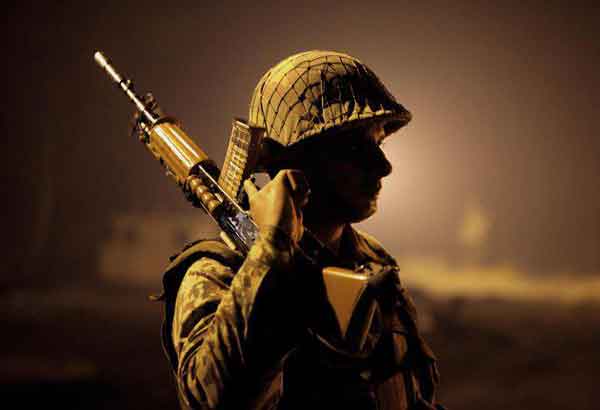
With the landmark Supreme Court judgment removing ‘mischievous’ stipulations to not let soldiers vote in elections at their place of posting and directions that with effect from 1st January 2014, all soldiers can vote wherever they are posted, at last the soldiers have got the right that had been denied to them for the last 67 years; a right they had been fighting for as warranted under the Constitution, and more importantly a right that had been enjoyed by every citizen of India other than soldiers. Full marks to Independent Rajya Sabha MP Rajeev Chandrasekhar (who also heads the Flags of Honour Foundation) in taking up the issue with the Election Commission and most importantly executing the coup de grรขce in securing the milestone judgment from the Supreme Court before the forthcoming elections. What many may also not know is that the original petitioner of this cause is Ms Neela Gokhale, an accomplished Supreme Court advocate and wife of a serving officer (Lt Col Kedar Gokhale of the Bombay Sappers).

…from 1st January 2014, all soldiers can vote wherever they are posted, at last the soldiers have got the right that had been denied to them for the last 67 years…

Why I term the changing stipulations on voting by serving soldiers at place of posting as “mischievous” is because such changes were designed to make voting by soldiers at place of posting difficult and eventually well neigh impossible. Apparently institutional integrity of the Election Commission too had been violated through political pressure akin to other so called autonomous bodies. Why else would the stipulations be at such variance, by what logic and due to what deliberations? For example in 2007, a serving soldier had to have minimum six months service in a station to vote. This left out individuals and whole battalions and regiments that moved into a station in the less than six months from election day. But then the rule was changed saying that the soldier had to have served minimum three years in a station and should also have his family staying with him, which virtually cut out the whole of army for the simple reason that given the tenure of individuals and units, you will hardly find anyone in a station serving beyond three years.

This second change was obviously done because under the minimum six month service in said station, the Army got to vote albeit sporadically, which perhaps upset political calculations; playing on perpetuating divisions on caste, creed and reservation lines, something which the military does not believe in. So, another ‘Constitutional Scam’ was silently executed in denying voting by soldiers by enforcing the minimum three year rule. And lo and behold, this Constitutional Scam could be blatantly termed ‘notional’ (like many other scams) because the rules never said that the soldier could ‘not’ vote. In fact, investigation into what led to the implementation of the three year rule and what were the compulsions of the then CEC is highly warranted, for is this not Contempt of the Constitution to deny voting rights to the 1.3 million military as well as other security forces? The guilty actually need to not only be punished but divested of their voting rights for life, if considered appropriate by the lawful authority.

25 March 2014

How India & China see each other

V. R. Raghavan


Title: IRSA Asymmetrical threat Perceptions in India-China Relations. Author: Tien-sze Fang.

A fascinating analysis of the mutual threat perceptions of the two countries

International relations theories during the Cold War were largely predicated on the global matrix of two super powers setting the context for relations amongst smaller powers. The end of Cold War and emergence of new powers have tested and stretched the theoretical framework. It is still a work in progress and the series of writings related to South Asia, led by Oxford International Relations in South Asia Series, has made a valuable contribution in the field. The book under review is remarkable in Sino-Indian relations being addressed by a Taiwanese diplomat-scholar. Taiwan has a unique relationship with China based on a mix of historical animosity, national identity, economic and power asymmetry and the dominant influence of United States. Unlike the mainstream neo-realism or neo-liberal streams of international relations analysis, this book attempts a constructivist understanding of the relations between India and China. The author, who was based in India, makes a fascinating analysis of the mutual threat perceptions of the two countries. It is interesting that both the stronger and weaker player in the Sino-Indian dyad, see the other as a threat to its interests. The analysis covers the four major dimensions of the two states’ troubled relationship, viz; nuclear issues, Tibet, border problem and regional competition.

Perceptions and misperceptions of threat become a variable in the strategic policies of states. International relations theorists have long analysed threat perceptions as the estimated intent and capabilities of the adversary state. Based on such analysis, not always wise or right, states adopt countermeasures to cope with the perceived threat. These have often taken the form of balancing, through internal strength, either military or economic or both, or external partnerships with allies. Some other states try ‘band wagoning’ by joining another power while some others seek a constructive engagement through Confidence Building Measures (CBMs) to reduce the threat. The book puts out the view, not surprisingly, that the weaker of the two will attempt to reduce the asymmetry by improving its capabilities. This is what in fact India is doing militarily albeit slowly and by building a network of cooperative relationship with other states extending from the Asia Pacific to Indian Ocean. As the author argues, this in itself can be a trigger for perceptional misunderstanding.

India’s nuclear weapons capability, is quite clearly not driven by the nuclear powers in the UN Security Council other than China. Pakistan’s nuclear capability, supported and sustained by China, added to New Delhi’s perceptions of asymmetry. India was willing to pay the price of economic and other sanctions in order to become a nuclear weapons state. It was a major measure to change the asymmetry, which allowed New Delhi to approach its bilateral problems with China in a more confident manner. China does not see India as a serious nuclear threat, but the resulting change in India’s stature as a rising power and the resultant improved ties with the US is a new variable in China’s calculus of asymmetry.

Tibet has been a source of continuing friction between China and India. China has not been able to satisfy either the Tibetan population or the global opinion on its intentions in Tibet. It opposes the discourse on autonomy, and has hugely changed the military infrastructure in Tibet. It has little leverage over the role of the Dalai Lama and over international media on its reporting on Tibet. Beijing’s sense of inadequacy clearly creates a perception of threat in China’s party and military leadership. While India is not the cause of this, and has unambiguously stated its position on Tibet being a part of China, the Tibetan question will continue to remain part of China’s sense of asymmetric threat to its national identity. Indian analysts are not unjustified in arguing that the slow pace of boundary negotiations and a continuing series of irritants on the disputed borders have a connection with Beijing’s Tibet conundrum.

FOR THE PROMOTION OF GREATER SYNERGY

The making of foreign policy would be smoother if consultation between the Union and the states is institutionalized, writes Pinak Ranjan Chakravarty

Two major issues have brought foreign policy formulation and implementation into the domain of public debate recently and flagged the question about the role of all stakeholders in the formulation of India’s foreign policy. Stakeholders in foreign policy today include a range of actors — from the traditional to the non-traditional. In the Indian context, there is the crucial role of state governments, business and industry organizations for economic issues, health and educational organizations, organizations concerned with connectivity, particularly transport and energy grids, non-governmental organizations and a host of other actors who impinge on foreign policy formulation.

Though the Central government in India is the driver of foreign policy, it could not sign the Teesta river water sharing treaty and the land boundary agreement with Bangladesh because the state government of West Bengal objected to their provisions. The second issue was the demand by the Tamil Nadu government that the prime minister of India boycott the Commonwealth summit in Sri Lanka in order to highlight the plight of Sri Lankan Tamils and to protest against the Sri Lankan government dragging its feet on the issue of autonomy for the Tamils in the northern and eastern provinces. The Indian prime minister’s decision not to attend the summit underlined the state government’s ability to influence policy on issues relating to external affairs.

In 1987, before the then prime minister, Rajiv Gandhi, decided to send Indian Air Force to airdrop food provisions to the beleaguered Tamils in Jaffna, he had the Tamil Nadu chief minister, M.G. Ramachandran, flown to Delhi for consultations. Details of this consultation perhaps still lie in the classified archives of the government. In case of the Ganga waters treaty with Bangladesh that lays down detailed water sharing-arrangements and monitoring, the Central government consulted closely with the West Bengal government and its then chief minister, Jyoti Basu. It is impossible to conceive that these two chief ministers, whose stature and political influence were considerable, could have objected to the Central government’s policy decisions in 1987 and 1996 respectively. It would be safe to assume that both stalwarts were fully on board with the Central government’s decisions.

India’s first prime minister, Jawaharlal Nehru, was prolific in sending letters to the chief ministers from 1947 to 1964. These have been published and are a source of great interest to scholars and others. The issues addressed in these letters were largely domestic but there were also many dealing with India’s external relations. It would perhaps be difficult to call these letters a manifestation of Union-state “consultation”, but they were, at the very least, an exercise in informing and educating the chief ministers about foreign affairs. There is no evidence to suggest that the chief ministers wrote back conveying their views on issues concerning foreign affairs discussed in these letters.