4 September 2015

Welcome to the Most Japanese City in China

BY MICHAEL MEYER
SEPTEMBER 2, 2015

With a one-off national holiday on Sept. 3, China will celebrate the 70th anniversary of victory in the “war of resistance against Japanese aggression,” as it calls its theater of World War II. But in the country’s northeast — formerly known as Manchuria — Japan’s occupation still feels near. You can sleep in former Japanese hotels, embark at Japanese-designed train stations, and descend into former Japanese bunkers. Farmers still sink hoes into unexploded ordinances; shuttered Shinto temples squat stubbornly in parks. Erstwhile colonial buildings are now museums or government offices, protected and marked as “patriotic education bases” and popular with domestic tour groups.

The largest concentration of these sites is 600 miles northeast of Beijing, in the city of Changchun. In 1932, it was declared the capital of “Manchukuo,” a puppet state nominally headed by China’s last emperor, Puyi. The Japanese military lured him north to legitimize its occupation, which began six years before an all-out invasion of the country. Puyi claimed to have been duped: To his dismay, he sat not on the throne of the restored Qing dynasty but in an office, behind an empty desk. “I soon discovered that my authority was only shadow without substance,” he wrote in his memoir, From Emperor to Citizen. “I didn’t even have the power to decide whether or not I could pass out of the door to go for a walk.” Yet were he to stroll outside today, Puyi would recognize a surprising amount of Changchun.

How History Shaped China's Water Crisis

By David Pietz
September 03, 2015

During the hot, dry month of August 1992 the farmers of Baishan village in Hebei province and Panyang village in Henan came to blows. Residents from each village hurled insults and rudimentary explosives at the other across the Zhang River – the river that feeds the Red Flag Canal Irrigation System and forms the border between the two provinces.

The emotions of that afternoon were fueled by events of the previous night, when 70 Baishan villagers had waded into the river to build a barrage to divert water to their fields. Upon hearing of the treachery, Panyang villagers assembled to drive the dam-builders away.

Two days later, Baishan villagers crossed the river to the Henan side and dynamited an irrigation canal that watered Panyang’s fields. 

Struggles over water are not new in China or around the world. But these struggles have their own unique historical and cultural contexts. Climate, geography, and social forces all combined to escalate tensions over water resources on the North China Plain during the 1990s.

Former KMT Chairman Meets China's President Ahead of WW2 Anniversary Parade

September 03, 2015

Taiwan has officially declined to participate in tomorrow’s military parade in Beijing, claiming that the Chinese Communist Party’s narrative distorts history by exaggerating its own role in the war. But that narrative is being undercut by the presence of a former high-ranking KMT (or Nationalist Party) official at the parade.

Lien Chan, a former vice president of Taiwan as well as former chairman of the KMT, is in Beijing. Not only will he attend the parade tomorrow, but he’s held a series of meetings with Chinese officials (most notably President Xi Jinping). Lien is officially going as a private citizen, but his visit provides Chinese state media with opportunities to showcase their narrative of both the war and of cross-strait relations – to the discomfort of many of Taiwan’s politicians.

Ma Ying-jeou said it was “inappropriate” for Lien to attend the event. Taiwan’s Ministry of National Defense (MND) had previously urged its veterans not to join the parade, either. “Retired comrades-in-arms should steadfastly support the view of Taiwan’s government, exercise self-restraint and refrain from visiting mainland China to attend the Chinese Communist Party’s anniversary activities,” a statement from the MND said,according to Reuters.

China’s Crisis Could Get a Lot Worse, Quickly

BY DANIEL ALTMAN
SEPTEMBER 1, 2015

What are global investors thinking? After two weeks of “Made in China” havoc, share prices in established and emerging markets alike had made a comeback — at least until this morning. But to judge by the major indices, plenty of traders seem to think the worst is over and that the problems on Chinese exchanges have been or will be contained. I disagree.

First, let’s examine investors’ recent behavior and its context. On Aug. 11, China began to devalue its currency — or allowed it to lose value in the market, if you prefer — which pushed other Asian currencies downward, too. The reasons were twofold. First, with Chinese exports becoming cheaper, China’s competitors need their exchange rates to fall as well in order to keep up. Second, the weakness in China’s economy and the tumult in its stock market also lowered expectations for its own import demand. This hurt China’s suppliers in East Asia and beyond, leading foreign investors to sell these companies’ stocks and bonds, and often their countries’ currencies along with them.

How History Shaped China's Water Crisis

By David Pietz
September 03, 2015

“China’s water challenges can only be fully understood from a historical perspective.” 

During the hot, dry month of August 1992 the farmers of Baishan village in Hebei province and Panyang village in Henan came to blows. Residents from each village hurled insults and rudimentary explosives at the other across the Zhang River – the river that feeds the Red Flag Canal Irrigation System and forms the border between the two provinces.

The emotions of that afternoon were fueled by events of the previous night, when 70 Baishan villagers had waded into the river to build a barrage to divert water to their fields. Upon hearing of the treachery, Panyang villagers assembled to drive the dam-builders away.

Two days later, Baishan villagers crossed the river to the Henan side and dynamited an irrigation canal that watered Panyang’s fields. 

Is China's "Carrier-Killer" Really a Threat to the U.S. Navy?


It seems tomorrow will be a big day for China-military watchers around the world: the mighty DF-21D, or “carrier-killer” anti-ship ballistic missile (ASBM) will likely be one of the features of Beijing’s end of World War II celebrations. But how much should America or anyone else in Asia fear this supposed killer of carriers?

The “carrier-killer” has been a favorite topic of mine for some time now. The weapons are launched from a mobile truck-mounted launcher into the atmosphere, with most likely over-the-horizon radar, satellite tracking and possibly unmanned aerial vehicles each providing guidance to a target in the open oceans. It also incorporates a maneuverable warhead, or MaRV, to help find its target.

The DF-21D would be instrumental in striking a vessel in the open ocean or denying access to a potential opponent in transiting to a conflict zone, like in the East or South China Seas. An August 2011 report by Taiwan’s Ministry of National Defense warned that: “A small quantity of the missiles [was] produced and deployed in 2010.”

When looking at this weapon, there are really two basic questions I have been asking for years: How capable is it? And if capable, can U.S. Navy vessels defend against it?

A Cold Summer for China and Russia?

By Gregory Shtraks
September 01, 2015

World War II officially ended on September 2, 1945 when the representatives of the Empire of Japansigned a formal surrender on board the USS Missouri. By that time four tumultuous months had already passed since the declaration of victory over the Nazis in Europe. Thus, Russia and China, the two victors who suffered the most casualties during the war, commemorate the anniversary of the triumph in late spring and early autumn, respectively. Xi Jinping’s attendance of Moscow’s victory parade last May was largely seen as the next step in the formation of a new world order, as Xi, flush with pride after the successful launch of the Asian Infrastructure Investment Bank, stood shoulder to shoulder with Putin – the two leaders using the occasion to announce the merger of China’s “New Silk Road Initiative” with Russia’s “Eurasian Economic Union.”

Four months have passed and the summer of 2015, while not as turbulent as that of 1945, has significantly altered the global geoeconomic balance. Vladimir Putin’s reciprocal visit to Tiananmen Square to attend Beijing’s celebration on September 3 provides a convenient checkpoint to assess the progress made in the Sino-Russian relationship since May.

The Cold Summer of 2015

Revealed: China for the First Time Publicly Displays 'Guam Killer' Missile

August 31, 2015

During rehearsals for the military parade on September 3rd, commemorating the 70th anniversary of Japan’s surrender in China, the Second Artillery Corps of the People’s Liberation Army has for the first time publicly shown some of the most modern missiles in its inventory.

According to IHS Jane’s Defence Weekly, the parade preparations offered glimpses on new missiles such as the Dong Feng (DF, East Wind) DF-15B short-range ballistic missile (SRBM), the DF-16 medium-range ballistic missile (MRBM), the DF-21C MRBM, the warhead section of the DF-5B intercontinental ballistic missile (ICBM), the DF-31 A ICBM, the DF-10 land-attack cruise missile (LACM) and the DF-26 intermediate range ballistic missile (IRBM) – dubbed the “Guam killer” missile.

The presence of the DF-26 at the rehearsals was confirmed by Shao Yongling, a senior colonel from the People’s Liberation Army (PLA) Second Artillery Command College in an interview with the Global Times:

The latest weaponry – the DF-26 intermediate-range ballistic missile that could reach a major US base in Guam in the western Pacific, and the most potent missile, the DF-5 intercontinental ballistic missile, were seen in the rehearsal.

3 Chinese Missiles To Look Out For During the September 3 Parade

September 02, 2015

China’s doing quite a bit to prepare for its September 3 military parade to commemorate 70 years since it triumphed in the “War of Chinese People’s Resistance Against Japanese Aggression.” The least we can do is pay attention. Notably, many expect that Beijing will show off new cruise and ballistic missile systems, possibly even lifting the veil off never-before-seen systems. Recently, a deputy chief of the Operations Department of the General Staff Headquarters of the People’s Liberation Army, involved in the planning of the parade, ntoed that 84 percent of what we’ll see at the parade will be on public display for the first time. Indeed, as Franz-Stefan Gady noted earlier this week, we’ve already seen a few peeks of never-before-seen systems in rehearsals for the parade. Here are three systems in particular that you should keep an eye out for as Thursday’s parade approaches:

Should We Stop Calling Kazakhstan an Autocracy?

September 03, 2015
http://thediplomat.com/2015/09/should-we-stop-calling-kazakhstan-an-autocracy/

Kazakhstan celebrated Constitution Day on August 30, marking 20 years since the country’s constitution was approved by a referendum in the extended wake of the Soviet Union’s dissolution. In remarks made during a conference marking the holiday and reported by Tengrinews, Kazakh president Nursultan Nazarbayev celebrated Kazakhstan’s stability and pushed back against those that call Kazakhstan an autocracy:


I know that we are often accused of autocracy. But how can one talk about autocracy, when every 4 or 5 years people vote to elect their president and parliament at free alternative elections. We are told to move faster towards democracy practiced by western countries, from the USA to Europe. We understand it all well. Democracy is a path towards development of humanity. We are making our way there. But we also have to consider that our country is an Asian society. Our traditions differ from Western ones. Our cultural and religious views are different. That is why we must pave our way carefully.

In the full remarks, as posted on the president’s official website, Nazarbayev prefaces his defense by highlighting how far Kazakhstan has come since 1995. He says that after the Soviet Union collapsed Kazakhstan was desperately poor, had no experience in self-governing, and had few options. Nazarbayev does not mention Tajikistan specifically, but the reference is certainly implied as he notes how other CIS states experienced conflicts or civil war. A further implication garnered from Nazarbayev’s remarks is that if Kazakhstan had rushed into setting up some idealized version of a Western democracy, it would have disintegrated into chaos.

“Nation-building can not be done on the basis of a strict timetable and utopian plans,” Nazarbayev said, urging others to take into consideration Kazakhstan’s system, history, culture, and traditions.

On social media, Central Asian watchers and human rights activists pushed back in turn on Nazarbayev’s comments. While Kazakhstan does, indeed, hold routine elections, the OSCE repeatedly has reported that the elections lack genuine choice. Of the most recent presidential election, held in April, the OSCE election monitoring mission’s final report said:


Preparations for the 26 April election were efficiently administered, however, necessary reforms for holding genuine democratic elections still have to materialize. The predominant position of the incumbent and the lack of genuine opposition limited voter choice. A restricted media environment stifled public debate and freedom of expression. Election day generally proceeded in an orderly manner, but serious procedural deficiencies and irregularities were noted throughout the voting, counting and tabulation processes.

In a new book, Democracy in Central Asia: Competing Perspectives and Alternative Strategies, Mariya Y. Omelicheva, an associate professor of political science at the University of Kansas, explores how Central Asian regimes understand democracy and why Western efforts to promote democracy in the region have been fumbling, insensitive, and ultimately unsuccessful. In her interview with The Diplomat, Omelicheva said that Central Asians (both governments and the people) “believe that democracy cannot be transferred from one context to another.” Instead, “they embrace a ‘culturally sensitive’ understanding of democracy that take into account historical and cultural experiences of the peoples of the region.”

Whereas Western democracies–those in Europe and the United States–see democracy as universal, Central Asians perceive it as more contextualized. Strong leadership and economic stability are highly valued by Central Asians. Omelicheva conducted surveys throughout the region, which seemed to confirm that a majority of people there embrace “traditional values” that factor into support for strong leadership:


Central Asians, for example, noted the importance of respect for seniority, reverence for parents and older people, and acceptance of gender hierarchies. They also pointed out the importance of “love for motherland.” Less than a quarter of survey participants said that individualism and competitiveness (the two traits associated with democratic consciousness) were among the human qualities they possessed or found important.

This is perhaps what Nazarbayev meant when he said, “I would suggest our friends study our system, history, culture and traditions of the Asian society deeply.” Is one person’s strong leader another person’s autocrat? Many of those who use “autocrat” to describe Nazarbayev are deeply versed in Central Asian history and culture–they just also believe that a free press defines an open society, dissent and debate are necessary for generating better policies, and people ought to be able to practice their religions as they wish. Nazarbayev, put another way, is borrowing a Western policy and advising a kind of “strategic patience” in this regard.

Meanwhile, in neighboring Uzbekistan, the state has decided that political science–the study of government systems, political behavior and activity–is simply not relevant. As reported by RFE/RL, Uzbekistan recently announced the removal of political science from university curriculums, denouncing it as a Western import:


Ultimately, the [Education] ministry determined that “the literature in this field is solely based on Western publications” and doesn’t take into account “our own specific model of development, the Uzbek model.”

Seems to me to be an excellent argument for more Central Asian political scientists, not fewer.

Propaganda of the Deed: How insurgents are seizing the initiative in the information environment

https://medium.com/the-bridge/propaganda-of-the-deed-808fdfd4b6bc

Editor’s Note: This essay was first published by the Australian Army Intelligence Corps Journal, Bridges Review. 

On a clear afternoon in March 2011, the relatively still air in Uruzgan’s Tarin Kot bowl was punctured by a blast wave and flame ball that rose more than 100 metres into the sky.

Insurgents had concealed an improvised explosive device within a motorcycle, and infiltrated it into the logistics soak yard outside the Multi-National Base Tarin Kot. The IED was set between two civilian trucks carrying highly flammable JP-8 jet fuel, which blazed through the soak yard when the device was remotely detonated. Several civilian trucks were destroyed and a small number of Afghan civilians were killed or injured in the attack. Importantly, Multi-National Base Tarin Kot was not breached, no military personnel were wounded or killed, and the loss of two tankers worth of aviation fuel had no impact on operations from the base. The soak yard, a force protection measure, worked as it should.

Our Radical Islamic BFF, Saudi Arabia

SEPT. 2, 2015 

The Washington Post ran a story last week about some 200 retired generals and admirals who sent a letter to Congress “urging lawmakers to reject the Iran nuclear agreement, which they say threatens national security.” There are legitimate arguments for and against this deal, but there was one argument expressed in this story that was so dangerously wrongheaded about the real threats to America from the Middle East, it needs to be called out.

That argument was from Lt. Gen. Thomas McInerney, the retired former vice commander of U.S. Air Forces in Europe, who said of the nuclear accord: “What I don’t like about this is, the number one leading radical Islamic group in the world is the Iranians. They are purveyors of radical Islam throughout the region and throughout the world. And we are going to enable them to get nuclear weapons.”

Sorry, General, but the title greatest “purveyors of radical Islam” does not belong to the Iranians. Not even close. That belongs to our putative ally Saudi Arabia.

The Believer

SEPTEMBER 1, 2015

IBRAHIM AWWAD IBRAHIM AL-BADRI was born in 1971 in Samarra, an ancient Iraqi city on the eastern edge of the Sunni Triangle north of Baghdad. The son of a pious man who taught Quranic recitation in a local mosque, Ibrahim himself was withdrawn, taciturn, and, when he spoke, barely audible. Neighbors who knew him as a teenager remember him as shy and retiring. Even when people crashed into him during friendly soccer matches, his favorite sport, he remained stoic. But photos of him from those years capture another quality: a glowering intensity in the dark eyes beneath his thick, furrowed brow.

1/8ABU BAKR AL-BAGHDADI

Early on, Ibrahim’s nickname was “The Believer.” When he wasn’t in school, he spent much of his time at the local mosque, immersed in his religious studies; and when he came home at the end of the day, according to one of his brothers, Shamsi, he was quick to admonish anyone who strayed from the strictures of Islamic law.

Ukraine Declares Russia Country’s Top Military Threat and Moves to Join NATO

September 2, 2015

New Ukraine Doctrine Declares Russia Military Opponent

KIEV, Ukraine — Ukraine’s national security council on Wednesday approved a new military doctrine that declares Russia to be a military opponent and calls for the country to pursue NATO membership.

There was no immediate official reaction from Russia, which hotly denies claims that it has sent troops and equipment to separatist rebels in Ukraine’s east and which opposes Ukraine joining NATO.

The move came amid strong political tensions over President Petro Poroshenko’s efforts to get approval of a constitutional change that would devolve some powers to the regions, including the eastern regions held by the rebels. Opponents say the change would effectively be capitulation to Russia.

It was unclear if the military doctrine’s stance against Russia could dilute opposition to the decentralization.

Can South Korea Fix Northeast Asia’s Cooperation Deficit?

September 03, 2015
http://thediplomat.com/2015/09/can-south-korea-fix-northeast-asias-cooperation-deficit/

Northeast Asia has a regional cooperation deficit, and a new South Korea-proposed institutional process seeks to address it. Although welcome in principle, it holds little prospect for transforming Northeast Asian security dynamics. It will inevitably generate opportunities for China to try to undermine the regional liberal order and the U.S. alliance network. It may even negatively impact efforts to denuclearize North Korea.

And yet, for all its flaws, Northeast Asia’s newest institutional process has a chance to achieve something that may be impossible without it: preventing competition in geopolitics from permanently overriding cooperation in non-competitive domains.

Geopolitics in Northeast Asia is a high-stakes game whose basic logic is well understood by its players. Whether the Korean DMZ, the Dokdo/Takeshima dispute, the Taiwan Strait, Chinese claims of influence over the Yellow Sea, or the Japan-held Senkakus, all of today’s Northeast Asian flashpoints have existed largely unchanged for decades.

Why Did China Opt Out of the Arctic Climate Change Statement?

September 01, 2015

On Sunday and Monday, foreign ministers and other international leaders met in Anchorage, Alaska to attend the Conference on Global Leadership in the Arctic: Cooperation, Innovation, Engagement, and Resilience (GLACIER). The State Department described the meeting as “focused on changes in the Arctic and global implications of those changes, climate resilience and adaptation planning, and strengthening coordination on Arctic issues.”

The United States is currently the chair of the Arctic Council, a grouping of the eight Arctic States (Canada, Denmark, Finland, Iceland, Norway, Russia, Sweden, and the United States) plus a dozen states with permanent observers status, including China, India, Japan, South Korea, and Singapore. The U.S. made it clear that the GLACIER conference was not an official Arctic Council event, but said the meetings would “focus attention on the challenges and opportunities that the Arctic Council intends to address.”

Putin’s deceptive pause: What are Russia’s next steps in Ukraine?

Marvin Kalb
September 1, 2015

A deceptive late-summer pause has settled over the Ukraine crisis. At least, in the coverage of it. For many weeks now, the war in the Donbas has slipped off the front page. Although leaders such as Germany’s Chancellor Angela Merkel and Ukraine’s President Petro Poroshenko still search for an acceptable formula to end the war, it has continued in the southeast corner of Ukraine, with casualties mounting.

Who fired first is no longer a relevant question. The point is that the war stumbles along with no end in sight. The twin rebel “republics” of Donetsk and Luhansk have slowly frozen into a Russian stronghold, effectively detached from the rest of Ukraine. They are always available to be manipulated as a pro-Russian weapon in the East-West battle for Ukraine’s future.
Warming up?

Why Is the PLAN Near Alaska?

September 03, 2015
http://thediplomat.com/2015/09/why-is-the-plan-near-alaska/

On Wednesday, the Wall Street Journal reported that the U.S. Department of Defense, for the first time, had detected five Chinese People’s Liberation Army Navy (PLAN) ships in the Bering Sea, close to the Aleutian Islands. Though the Pentagon didn’t quite say what the ships were doing in the Bering Sea, the development is another notch in the Chinese navy’s “blue water” credentials. As the PLAN modernizes and expands, it is looking to operate in waters far away from the Chinese coastline, beyond the second island chain.

As the WSJ report notes, the ships were detected at a somewhat strange time. The Bering Sea is just west off the Alaskan coast. U.S. President Barack Obama just happens to have been visiting Alaska this week, marking the first visit by a U.S. president to that state. Putting two and two together, one might conclude that the PLAN is trying to “send a message” or flexing its muscles. But there’s nothing intrinsically threatening about its activities in international waters that just happen to be near Alaska. Even if these ships were involved in intelligence-gathering or reconnaissance activities, as long as they remained outside of U.S. territorial waters, there’s no real issue.

Welcome to Planet Tajikistan

September 03, 2015

By far the most amusing story out of Central Asia this week was news that a small planet had been named Tajikistan in honor of the contributions of Tajik scientists to the study of astrophysics. Too bad the story isn’t true and, besides being ridiculous, again exposes the poor state of Tajikistan’s press.

Khovar, the state press agency, first carried the story which was then elaborated on (and rightfully questioned) by Eurasianet, a series of other Central Asian-focused news sites, and the Washington Post.

According to Eurasianet’s report, the “International Astrophysicists Union” named a minor planet Tajikistan and President Emomali Rahmon received a certificate saying so. The planet reportedly orbits the sun once every five years and is between Mars and Jupiter, exactly “250 million kilometers from earth and 436 million kilometers from the sun.”

“There are some unexplained aspects to this story, however,” Eurasianet wrote:

The Soft Logic of Soft Targets

BY STEPHEN M. WALT
AUGUST 28, 2015

Everyone is freaking out over the France train attack. But the sad truth is, you’re more likely to be murdered in America than killed by Islamic State terrorists.

The recent “lone-wolf” attack on a French train — thankfully foiled by three alert and courageous American passengers — has sparked new concerns about terrorist assaults on so-called “soft targets.” These are places where people congregate and are potentially vulnerable, but are not subject to airport-style security procedures. The Islamic State has called upon sympathizers to conduct such attacks wherever they might be, and European governments are now pondering additional measures to protect trains and railway stations. And on Aug. 22, just one day after the thwarted attack, the New York Times brought it all home by warning: “Train Attack in Europe Puts Focus on Vulnerability of U.S. Rail.”

As I’ve suggested before, it’s time to “chill out” in the face of this latest supposedly grave danger. It is obviously not a good thing that these (and other) attacks have taken place, and counterterrorism officials should continue to take reasonable precautions against future occurrences. But hyping the threat and turning ourselves inside-out to prevent any and all attacks will squander resources and play into our adversaries’ hands.

The Fallacy of Information Dominance

SEPTEMBER 2015

The laws and norms surrounding the movement of economic goods across geopolitical boundaries are well-defined. By contrast, the ability to create and manipulate information has become ubiquitous and robust legal frameworks governing how state actors, individuals, and institutions interact with the information ecosystem do not yet exist. This creates risk and opportunity for state and non-state actors looking to devise new information manipulation tactics and make claims on this evolving space. Information control has always been a key component of strategy; however the current speed of evolution provides an advantage to potential disruptors, who do not have sunk costs in existing expensive processes and techniques. Whereas during the medieval period, a limited number of literate clergy had the ability to control the information space (which was explicitly linked to the capacity to wage war), today both state and non-state actors, no matter how marginal, have the ability to contribute to the information battlespace. Even a single, well-placed YouTube video, such as the beheading videos released by ISIL can influence military response.

Malaysia and Mahathir: The Doctor Is Still in the House

By Joyce Lee
September 02, 2015

Mahathir Mohamad received a hero’s welcome at the Bersih 4.0 rally in Kuala Lumpur this weekend, swept up in a groundswell of yellow t-shirts and vuvuzela horns. On Saturday, he stopped by to urge protestors to continue, before being ushered away by his bodyguards. The next day, the 90-year-old former prime minister visited again to give an impromptu press conference, mobbed by journalists and elated citizens. He used the opportunity to call for the resignation of Prime Minister Najib Razak, in light of a nasty corruption scandal, a debt-saddled state development fund, and a plummeting ringgit.

Coverage of Mahathir’s surprise appearance at the 34-hour rally would be remiss if it overlooked the hypocrisy of the moment. The former leader is widely acknowledged for his authoritarian leadership style, as well as for his penchant for attacking critics and political challengers with scathing words and detention orders. Bersih – a movement that advocates fair elections, the right to protest, a transparent government, a stronger parliamentary democracy, and economic reform – hardly ranks on Mahathir’s long list of hobbies (horse-riding and woodworking among them).

The Road You Take

SEPTEMBER 2015

When you look in the mirror, are you satisfied with who you see? Are you one of those military officers who won’t speak out when you know something isn’t quite right because you don’t want to make waves? While these may seem like philosophical questions, no matter how junior you are or how long you have been in the military, if you don’t question your values and consider what you would be willing to sacrifice to take a stand, chances are you are going to miss the boat. The ultimate choice you will have to make in your tenure as a military officer is which fork of the road you will take- the road to rank and popularity or the road to the moral high ground.

By the time I was commissioned as a second lieutenant in the United States Marine Corps, I had been taught by my parents to stand up for what I believed in no matter what the cost. At that time, it would never have occurred to me that I would be relieved from command after 19 years of service for holding my Marines accountable and pointing out the existence of lowered expectations for females and gender bias on the Marine Corps Recruit Depot. However, I quickly learned that for all of our talk of core values and ethics in the Marine Corps, many individuals I served with were more concerned with being liked than making difficult but necessary decisions. Some careerist commanders demonstrated that when assessing leadership, the words “negative command climate” carried far more weight than an officer’s actual ability to hold subordinates accountable for conduct and performance.

The CH-5 appears to be based on the United States’ MQ-9 Reaper drone design.

September 02, 2015

Beijing’s biggest combat UAV has made its maiden flight. 

China’s heaviest attack and reconnaissance drone to date, the Caihong 5 (CH-5), or Rainbow 5 recently made its maiden flight at an undisclosed airfield in Gansu province, according to China Military Online.

The UAV’s maiden flight, conducted in the early morning, lasted only about 20 minutes, although the new UAV can allegedly stay in the air for more than 30 hours.

According to the South China Morning Post, Chinese state television announced that the debut of the Rainbow 5 will “change the game in airstrikes.”

The CH-5, developed by the China Aerospace Science and Technology Corporation (CASC), appears to be based on the United States’ MQ-9 Reaper drone design and has a wingspan of 20 meters (66 feet) and a takeoff weight of about 3 tons. It can carry a maximum payload of around 900 kilograms – which allegedly is 2.5 times more than previous UAVs of the CASC Rainbow series.

Carter: New generation needs new military personnel system


By Andrew Tilghman
September 1, 2015 

Highlights from the "Worldwide Troop Talk" with Defense Secretary Ash Carter, who answered service members' questions about changing personnel, pay, compensation, and retirement.
Defense Secretary Ash Carter told troops and veterans Tuesday that he's looking at some large-scale reforms for the military's personnel system, but he made clear that he feels careers in uniform should remain distinct because not all civilian-sector solutions will fit the military.

"For us to keep recruiting and retaining the best, the military has to be an attractive place to work," Carter told thousands of veterans gathered at the American Legion National Convention in Baltimore.

That requires recognizing "the generational reality that some young Americans aren't satisfied with industrial-age career tracks," he said. "They want to 'jungle-gym' careers, where you advance by moving around and having new experiences; not an escalator, where you get on and wait your turn."

'Game-Changing' Weapons: What the U.S. Military Needs to Know

September 2, 2015

Game-changers are clearly not a substitute for fielding conventional and strategic capabilities. But game-changing ought to be part of U.S. military strategy.

Who isn’t fascinated by the prospect of "game-changers"—unprecedented technological breakthroughs that provide military advantages that leave competitors scratching their heads over how to keep up? Game-changers can increase leverage, so pursuing them makes sense—but only if the game-changer supports the overall security strategy.

Game-changers are not a substitute for fielding conventional and strategic capabilities. But game-changing ought to be part of U.S. military strategy.

Game-changers in warfare are as inevitable as a Kardashian on a red carpet. Sooner or later one of them is going to show up. The cavalry of the Mongol Golden Horde caught the world by surprise. Englishman bowman spoiled the French day at Agincourt. Artillery toppled the great fortifications of Europe. Everybody dreaded the Dreadnought. Quick-firing field and machine guns changed the face of battle during World War I. Throughout history, new weapons and tactics have popped up, forcing all sides to rethink how they fight. Such disruption is part of war.

Is Germany's Military Dying?

September 1, 2015 


It won't be a loss on the battlefield that destroys Berlin's armed forces, but rather massive underfunding. 

The modern German armed forces, or Bundeswehr, were created just ten years after the end of World War II. Cold war tensions and the presence of Soviet troops in East Germany, Czechoslovakia and Poland made a West German defense force necessary.

The Bundeswehr eventually grew to one of the largest, well-equipped armed forces in the world, boasting twelve combat divisions, hundreds of combat aircraft in the Luftwaffe (German Air Force), and a formidable force of surface ships, submarines, and maritime aircraft in the Bundesmarine (Navy).

The end of the Cold War and withdraw of the Red Army from Eastern Europe was a boon for European security. The National Volksarmee of East Germany and the Bundeswehr merged into a new national army. Inventories of ships, aircraft and armored vehicles were cut by up to seventy five percent, and the German defense budget was cut further. Germany now spends just 1.2% of GDP on defense, far below the NATO recommended 2%.

The Military Needs To Promote Innovation From Within, Not Import It From The Private Sector


August 31, 2015

If the Pentagon wants to truly focus on innovation and disruption, then it needs to promote an entrepreneurial mindset among its future leaders.

In a May interview with the Washington Post, retired Gen. Stanley McChrystal recommended the military place corporate superstars into military positions of authority. Similar ideas have been presented that apply this disruption to the lower ranks as well. Carl Forsling recommended giving junior officers the opportunity to take a sabbatical. These plans are good, but they don’t address how these scenarios would play out in the real world. For instance, would these business superstars leave after achieving what they came to do and take all of their expertise with them? How would you ensure that the junior officers would add value after their sabbatical?

The American military must focus on promoting an entrepreneurial mindset if it is to remain the greatest fighting force on the planet. Instead of lip service to disruption and innovation, officers with a fundamental understanding of entrepreneurship must be fostered from within.

Enforcing The Army’s Definition Of Professional Ethic Requires More Than A Written Document


September 1, 2015

Writing the definition of Army profession was easy; now we need the training program to support it.

It’s a common phrase: the Profession of Arms. I remember taking the oath of affirmation the day before starting my junior year at West Point and shaking many officers’ hands afterward, all attached to smiling faces uttering the phrase, “Welcome to the Profession of Arms.”

Back in August 2004, much of the Army’s understanding of what that phrase meant and represented was largely unwritten. We understood that the nature of the Army profession required specialized and unique skills, a moral and ethical framework and code of conduct, continuous training and education, self-policing, shared identity, and offering a valuable service. We understood that working within a profession required significant amounts of trust — trust between members, between subordinates and leaders, and between the profession and the remainder of the population.

Indonesia, Malaysia Step Up Fight Against Piracy

September 02, 2015

Indonesia and Malaysia are both stepping up their fight against piracy in the wake of growing security concerns in surrounding waters, news sources reported August 27.

Piracy is hardly a new issue for Southeast Asian states. As I have written before, the region is a logical target for such attacks as it is home to vital shipping lanes through which about half of world trade and a third of the world’s oil supply pass (See: “Over Half of World Piracy Attacks Now in ASEAN“).

Despite notably enhanced regional cooperation in recent years to address piracy concerns, incidents have nonetheless continued to be on the rise. According to the International Maritime Bureau, the first six months saw a total of 134 incidents of piracy and armed robbery, an increase from 116 during the same period last year. ReCAAP, a Singapore-headquartered anti-piracy organization, recorded six piracy incidents in the straits of Malacca and Singapore on 21 and 22 August alone.

3 September 2015

Return of Haji Pir Pass in 1965 – Myth and the Reality

By Maj Gen Sheru Thapliyal
02 Sep , 2015

In 1965 war, Indian Army had captured the strategic Haji Pir Pass. During the Tashkent talks between Indian and Pakistan, held through the good offices of Soviet Union, India agreed to return Haji Pir Pass, Pt 13620 which dominated Kargil town and many other tactically important areas. To add mystery to the whole process, Prime Minister Shastri died on 10th January, 1966 after signing the Tashkent Declaration with President Ayub Khan of Pakistan. He was denounced by all and sundry for caving in to the Russian pressure and made to return Haji Pir Pass to Pakistan, resulted in two grave disadvantages to us: One- had the pass been held by us, the distance from Jammu to Srinagar through Poonch and Uri would have been reduced by over 200 Kms. Two – later on Pak commenced its infiltration into J & K in 1965, through the Uri – Poonch Bulge which continues even today. They why did we commit this error of judgement?

Haji Pir Operations:

Multi-Calibre Assault Rifle: Made in India vs Make in India

By Danvir Singh
02 Sep , 2015

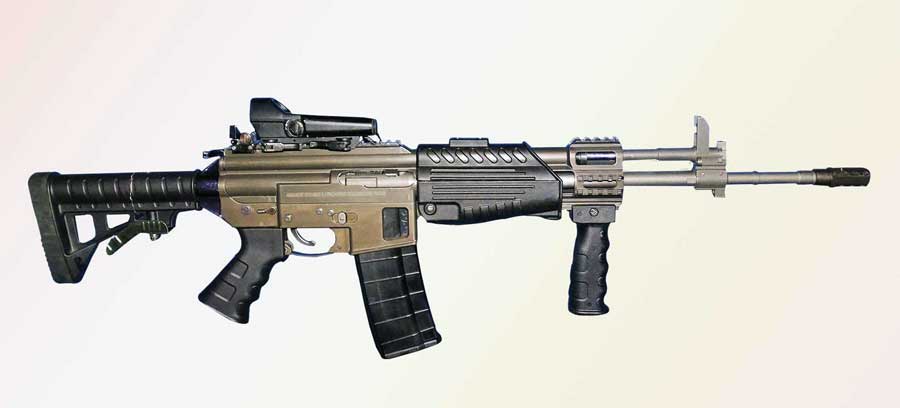
Aping the philosophy of the West, the Indian Army wanted a rifle that would incapacitate a solider instead of killing him thus increasing the logistics burden for each soldier injured. However, as the Army started getting involved in Counter Insurgency especially in the North, the requirement for a gun with a higher kill capacity was felt. The infantrymen now prefer the famed AK-47 rifle over the INSAS.

Braving all criticism of an inefficient INSAS rifle to its credit, unbelievably though, the ARDE has simultaneously developed a Multi-Calibre Individual Weapon System (MCIWS)…

Stories on 1965 War should be included in School Curriculum: Manohar Parrikar

By IDR News Network
01 Sep , 2015

The Defence Minister Manohar Parrikar has stressed the need to include the stories of gallantry and sacrifices of our brave soldiers in 1965 Indo-Pak War in the school curriculum.

He said, this is essential so as to instil the spirit of patriotism and values in the minds of the future generations.

Manohar Parrikar was addressing the tri-services seminar on the Golden Jubilee Commemoration of 1965 Indo-Pak War here today. The two-day seminar was inaugurated by the Vice President Hamid Ansari in the midst of several retired Service Chiefs, War Veterans and Senior Officers from the three Services and Ministry of Defence.

The Defence Minister in his speech said, in this War, despite limitations the Indian Armed Forces displayed their spirited professional approach and gained considerable praise and respect of all the countrymen.