26 November 2016

Israel’s New Friends – OpEd

NOVEMBER 24, 2016

In February, the Israeli prime minister praised the British government for introducing new guidelines prohibiting publicly funded bodies from boycotting Israeli products. ‘I want to commend the British government for refusing to discriminate against Israel and Israelis and I commend you for standing up for the one and only true democracy in the Middle East,’ Netanyahu said.

‘Modern anti-Semitism,’ he went on, ‘not only attacks individual Jews, but attacks them collectively, and the slanders that were hurled over centuries against the Jewish people are now hurled against the Jewish state.’

Progressive voices such as Jewish Voice for Peace have tried for years to counter the insidious conflation of criticism of Israel with anti-Semitism, but the identification may now be unravelling at last because of a forceful intervention from the right.

Two of Donald Trump’s first appointments as president-elect, his chief strategist Steve Bannon and attorney general Jeff Sessions, are white supremacists with anti-Semitic reputations. The Jewish Telegraphic Agency, for example, accused Bannon of carrying anti-Semitic journalism on Breitbart News and of making anti-Semitic remarks himself; Sessions allegedly found fault with the Ku Klux Klan only when he realised they smoked marijuana. One might have expected the Israeli government to criticise these appointments, pointing to the real and present danger of anti-Semites working in the US administration, as well as to the message it conveys to white supremacists around the world. But Netanyahu has said nothing.

Mr. Trump Leave Us Alone: We Will Make African Great Again – OpEd

By MK Ngoyo* 
NOVEMBER 24, 2016

Africa barely got a mention in the US presidential election. This is good. If Trump succeeds in purging the factions that advocate war, interventionism and imperialism from the US government he will have done all that he needs to do for Africa. We can ask no more than to be left alone by the world hegemon.

Prof Patrick Bond in his piece in Pambazuka News last week gives an interesting perspective on the election of Donald Trump to the US presidency. His article has inspired me to give my own quite different perspective.

How Donald Trump will govern is by no means certain at this point. However, on the basis of the speeches and interviews he has given since his election, there is no reason to conclude that the sky has fallen. In fact his election may prove to be a tremendous opportunity for Africa.

Trump is clearly neither a neoliberal nor a neoconservative. His position on cooperation and good relations with Russia shows him to be a noninterventionist. That is to say he is not an imperialist. The problem for Africa in its relations with the USA is not that the US intervenes too little in African affairs, but rather that it intervenes too much. If the US turns towards isolationism this will allow Africa a golden opportunity to increase and intensify its engagement with Asia, particularly China, but also with India, South America and Russia, free from American interference.

At the same time, because Trump is neither neoliberal nor neoconservative, it is unlikely that his appointments to the world’s multilateral institutions will come from the ranks of those factions. Besides if Trump is true to his promise to cooperate with other countries and in particular Russia, such cooperation will undoubtedly impact his choices for top posts in those organizations such as the World Bank where the US vote is determinative.

Theresa May’s Foreign Policy – Analysis

By Giancarlo Elia Valori* 
NOVEMBER 24, 2016

How to define the post-Brexit foreign policy of Prime Minister May? The question is not simple at all and shows a series of new and unexpected signs. Meanwhile, Theresa May’s primary project is to increase her own international role outside traditional alliances so as to make up for the loss – scarcely relevant at military level, but highly symbolic – of the UK presence in the European Union.

Last September the Tory government led by Prime Minister May hosted the Qatari emir, Sheikh Al-Thani, to start new political and financial relations with the Emirate, with the sale of various leading-edge technologies for Defense.

Furthermore a new British attachΓ© will be posted to Qatar, so as to support the UK strong commitment in the country, also at training level.

In mid-October Prime Minister May also hosted the King of Bahrain, Ahmad bin Isa al Khalifa, and, in her welcome speech, she underlined “the strong support for the efforts designed to make the Gulf region safe”.

Also Oman, a UK traditional friend, as well as the other United Arab Emirates, will shortly receive support from Great Britain, which will build new military bases in the region.

The Great Britain of Gertrude Bell and Christine Granville is back again.

Again a woman, Theresa May, is rebuilding the communication and strategic network with the Middle East.

Russia Wants To Remake Globalization In Its Own Image – Analysis

By Richard Weitz* 
NOVEMBER 24, 2016

Globalization is under assault, claims Russia, from a Western-dominated world order with benefits limited to a few.

Russians see globalization and international institutions in crisis. They offer to rescue this failing project, but on their terms, with a readjustment of world order more to their liking.

At the October meeting of the Valdai Discussion Club – a group of Russian and foreign international affairs specialists – the attendees assessed the processes of globalization under the rubric “global revolt and the global order.” Russians described Western-led neoliberal globalization as universally destructive economically, culturally, and politically and responsible for sparking a worldwide revolt.

Globalization is under assault “from two fronts,” suggested Fyodor Lukyanov, author of the upcoming Valdai conference report. One set of countries had no say in constructing the Western-dominated world order and considered it unfair, while anti-establishment political parties and social movements in Western countries, often backed by Moscow, reject globalization as an elite-driven project that benefits only a few. Together, the two trends impede needed international economic and security cooperation.

Russia’s concern for globalization was endorsed at the highest level when President Vladimir Putin addressed the final conference session. “Essentially, the entire globalization project is in crisis today” due to these challenges and the continued escalation of “the tensions engendered by shifts in distribution of economic and political influence.”

Putin cited that the triumph of anti-establishment parties in developed countries, the vote of the British people to leave the European Union, and Donald Trump’s capture of the Republican Party as evidence that even in the wealthy West, citizens no longer accept the rule of “unelected and uncontrolled bureaucrats and political elites.”

What if nuclear weapons are used?

16 NOVEMBER 2016
http://thebulletin.org/what-if-nuclear-weapons-are-used10183

Victor Gilinsky has for many years been an independent consultant, mainly on nuclear issues. He earlier served two terms on the Nuclear Regulatory Commission. Before that he was head of the...

The world relies too much on the indefinite continuation of the post-1945 taboo on military use of nuclear weapons. It was never a secure bar to such use, but now official statements and academic writings indicate a perceptible weakening of it. If a nuclear weapon country used its weapons in anger, anywhere, even on a relatively small scale, it would signal that nuclear war was no longer a theoretical possibility, but a reality. That realization is likely to have far-reaching political and social consequences worldwide. Yet it is hard to find any examination of what these consequences may be.

I don’t mean studies on the effects of nuclear weapons, or of a nuclear Armageddon, of which there is no lack. Anyone can access web-based graphic displays to estimate the devastation of a nuclear bomb dropping on his or her city. I have never heard of anyone moving out of one of those cities out of fear of a nuclear attack, but if a real nuclear bomb dropped somewhere, even far off, people are likely to think about it differently.

Nuclear terrorism: The diversion. I also don’t mean studies on what might happen if terrorists—rather than a country—used a nuclear weapon. There are many such studies, as well. The world’s leaders have adopted countering terrorist use of nuclear weapons as the main subject of the heavily advertised international security summits. It makes for “successful” meetings because all countries are on the same side in dealing with nuclear terrorism—they are all against it.

Nuclear terrorism is a concern, but the disproportionate official and academic focus on it diverts attention from the much more serious, but also much more difficult, problems of restraining countries that have nuclear weapons and keeping others who have an interest in getting them from doing so—and then using them. Dealing with nuclear weapon states, and would-be nuclear weapon states, means confronting argument over the rights and wrongs of nuclear weapon possession and considering major policy changes, all of which world leaders stay clear of.

The complicated geopolitics of renewable energy

04 Oct 2016

Abstract

A recent UN climate agreement has the potential to shift global energy consumption from a mix dominated by fossil fuels to one driven by low-carbon technologies. It is clear that if this happens, fossil-fuel-producing countries will have to adjust their economies to reflect lower export earnings from oil, coal, and natural gas. The rise of renewable energy may also create new centers of geopolitical power. As renewable resources become widely distributed, supply-side geopolitics are expected to be less influential than in the fossil-fuel era. Instead of focusing on just two major resources, oil and natural gas, low-carbon energy geopolitics may depend on many additional factors, such as access to technology, power lines, rare earth materials, patents, storage, and dispatch, not to mention unpredictable government policies. Despite uncertainty, there is no question that the balance of power in energy geopolitics is shifting from fossil-fuel owners to countries that are developing low-carbon solutions. 

Meeting the goals set at the 2015 climate conference in Paris calls for dramatic changes in the global energy mix. One-hundred and ninety-five countries agreed on the objective of limiting the global average surface temperature to “well below” 2°C above preindustrial levels (United Nations 2015United Nations. 2015. “Adoption of the Paris Agreement.” Accessed September 22, 2016.http://unfccc.int/resource/docs/2015/cop21/eng/l09r01.pdf). To achieve this target, a shift to zero- and low-carbon energy-producing technologies will be required in the near future (IPCC 2014IPCC (Intergovernmental Panel for Climate Change). 2014. “Climate Change 2014 Synthesis Report, Summary for Policymakers.” Accessed September 22, 2016.http://www.ipcc.ch/pdf/assessment-report/ar5/syr/AR5_SYR_FINAL_SPM.pdf), with wide deployment of negative-carbon technologies – those that remove carbon dioxide from the atmosphere – in the second part of the century.

The Role of U.S. Soft-Infrastructure in Influencing the Reconnecting of Asia

November 16, 2016

In October, CSIS launched its Reconnecting Asia project, which seeks to track the various initiatives by China, Russia, Japan, South Korea, and other growing Asian powers to reconnect Asia and Europe via old trade routes. These modern-day Silk Roads will use highways, railroads, ports, bridges, and pipelines to reduce the travel time between the two continents. The best known of these initiatives is China’s “One Belt, One Road” in Central Asia. This is an ambitious undertaking across 43 countries that encompasses 69 percent of the global population and 60 percent of global gross domestic product (GDP). The efforts to reconnect Asia with Europe will be one of the biggest forces shaping the next 30 years, bringing new markets, people, and resources into the fabric of the global geopolitical landscape. If successful, it will revolutionize logistics and create trillions of dollars in economic value through increased trade and economic activity.

The United States has approached China’s One Belt, One Road initiative with some misgivings. In addition to the initiative itself, China has launched a new multilateral bank—the Asian Infrastructure Investment Bank (AIIB). Some in Washington view this as a direct threat to the existing multilateral development banks, of which the United States is either the largest or second-largest shareholder. The U.S. government, however, needs to consider how it can engage constructively in reconnecting Asia. The United States should seek to ensure that the soft infrastructure undergirding a reconnected Asia will support open markets and open societies with an even playing field for U.S. goods and services.

There are six areas where the United States can directly influence the soft infrastructure in the reconnecting Asia footprint: leveraging U.S.-led financing in multilateral and regional development banks, trade deals such as the Trans-Pacific Partnership (TPP), securing bilateral investment treaties (BITs) and Trade and Investment Framework Agreements (TIFAs) in every possible country, ensuring that procurement rules incorporate life-cycle costs, completing all World Trade Organization (WTO) Trade Facilitation Agreement requirements, the use of the U.S. dollar as the operating currency, and English as the operating language across the footprint. All of these must be done in coordination with our bilateral and multilateral partners.

The Private Heisenberg and the Absent Bomb


by Werner and Elisabeth Heisenberg, edited by Anna Maria Hirsch-Heisenberg and translated from the German by Irene Heisenberg. 

Heisenberg Family Archives

Werner and Elisabeth Heisenberg, GΓΆttingen, Germany, circa 1946

Almost as soon as World War II ended in Europe, and with redoubled intensity after the bombing of Hiroshima, physicists all over the world began to ask how close the Germans had come to making an atomic bomb. But it was not clear whom to ask. Everything to do with development of the bomb was cloaked in secrecy and ten of the leading scientists involved in German atomic research had gone missing. One of them, Otto Hahn, the first to explain the fission process that made bombs possible, was on November 15, 1945, awarded the Nobel Prize in chemistry for his discovery, but the prize committee, it turned out, had no idea where Hahn was. 

Among the few who did know were leading scientists who had developed the American bomb at Los Alamos in New Mexico. Many of them were Jews by Nazi standards who had fled Hitler’s Germany, including the physicists Hans Bethe and Victor Weisskopf, who had feared at the beginning of the war that the great German theoretical physicist Werner Heisenberg would build a bomb for Hitler. In 1942, learning that Heisenberg was going to give a scientific talk in Zurich, Bethe and Weisskopf had proposed an American operation to kidnap Heisenberg in Switzerland and even offered to take part themselves. This episode, improbable as it sounds, has been well documented elsewhere1 and after many twists and turns the original proposal led to Heisenberg’s detention in southern Germany in May 1945. 

By November, Heisenberg, Hahn, and the other German scientists were being secretly held and closely monitored at a British country house called Farm Hall. The man who had the most to do with putting them there was the Dutch-born physicist Samuel Goudsmit, scientific director of an intelligence group called the Alsos mission. Goudsmit’s task was to track down the Germans who had been working on nuclear fission during the war and to answer the basic question—how close did the Germans get? 

Which Countries Will Get the Bomb?


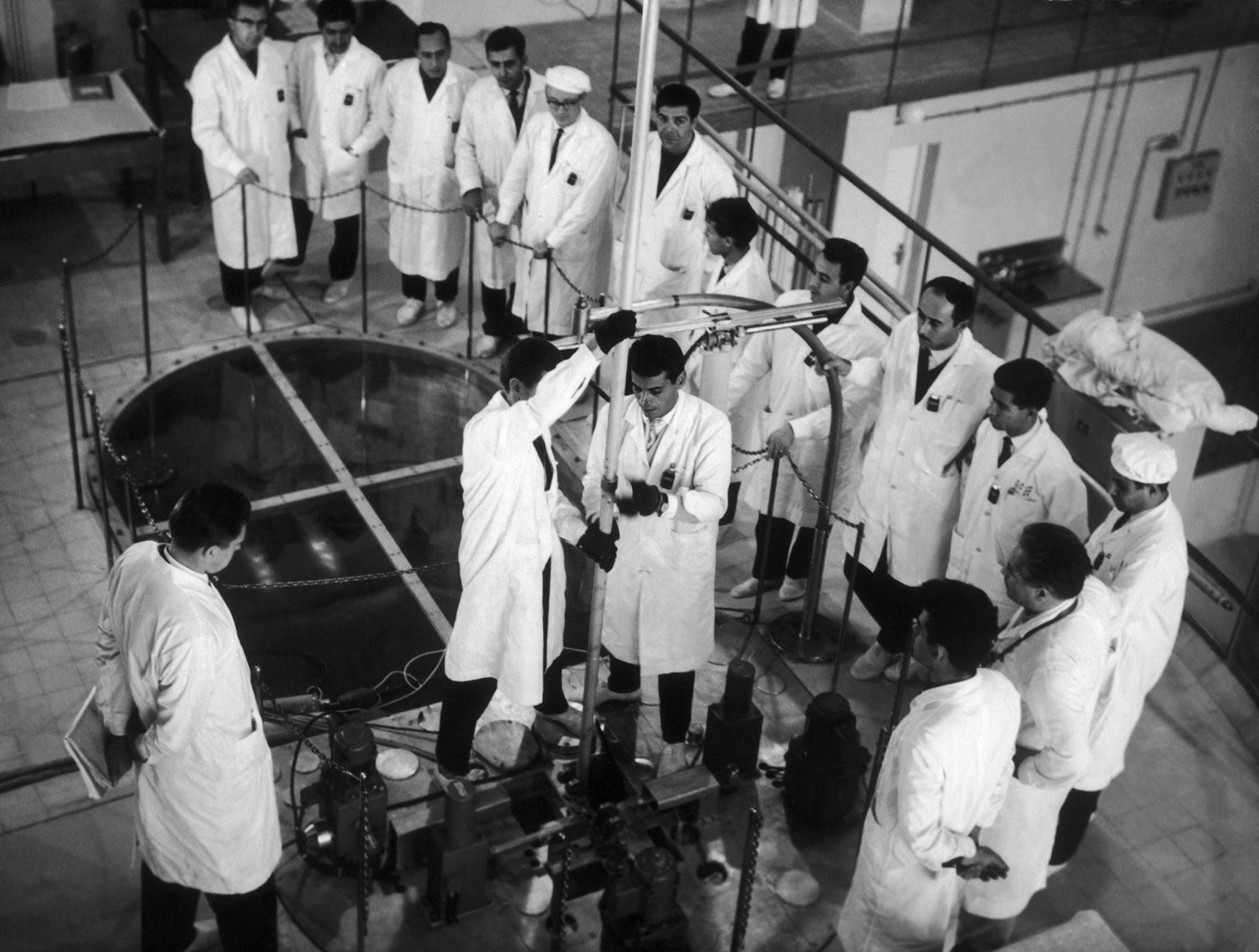
Scientists inspecting Iraq’s first nuclear reactor in Baghdad, supplied by the Soviets, February 1968
For some years I have been puzzling over the question of why some countries that want nuclear weapons succeed in building them and others don’t. As we enter what could be a new age of proliferation, the question takes on considerable importance. The US has a president-elect who has said he would repeal the Iran deal, which among other things prevents substantial uranium enrichment by Tehran for ten years, and who openly suggested during the campaign that our allies in Asia, and even the Arabian peninsula, take responsibility for their own nuclear deterrence. If, say, South Korea or Saudi Arabia began to pursue a nuclear program, how likely might they be to succeed? 

History offers us a number of insights about this. Among the countries that succeeded in getting the bomb were Israel and South Africa and among those that didn’t were Libya and Iraq. It seemed to me that what the successful countries had in common was both a substantial technological infrastructure and a government that was both determined and permissive. An anecdote I once heard about the Soviet program makes the point. Stalin decided that the program might be better motivated if he appointed the much-feared Lavrentiy Beria, the head of the secret police, to direct it. When Beria decided that some of the nuclear scientists were straying off the ideological reservation he went to Stalin to complain. Stalin allegedly said to him, “You leave my physicists alone. We can shoot them later.” 

"Separating Fact from Fiction in the Debate over Drone Proliferation"

Sergeant Ross Tilly (RAF)

Journal Article, International Security, volume 41, issue 2, page 7–42

Authors: Michael Horowitz, Former Research Fellow, International Security Program, 2005-2007, Sarah Kreps, Former Research Fellow, International Security Program, 2007–2008, Matthew Fuhrmann, Former Associate, Project on Managing the Atom, January–August 2009; Former Research Fellow, Project on Managing the Atom/International Security Program, 2008–December 2009

Claims that drones will soon remake warfare or international politics are unwarranted. Although almost a dozen states now possess armed drones, and more are racing to acquire them, they will not play a decisive role in interstate conflicts. Drones will rarely be “winning weapons,” because they are vulnerable to air defenses. States will, however, continue to use drones against terrorists and domestic opponents.

THANKSGIVING: AN AMERICAN HOLIDAY FORGED IN WAR

NOVEMBER 24, 2016

Happy Thanksgiving from War on the Rocks! Today is all about tradition: turkey and stuffing; family, friends, and football. From early childhood, we all learn the origin story of Thanksgiving that is so mythically central to its celebration. Pilgrims in Plymouth Colony marked a successful harvest with a feast to which they invited Native Americans who had lent much-needed assistance after the previous hard winter. Records of earlier harvest celebrations and debates (google “thanksgiving origins” if you’re interested and have hours to kill) about the actual provenance of what would become our Thanksgiving aside, it is no surprise that the centuries-long history would make it the holiday most steeped in uniform tradition across America.

But how did thanksgiving become Thanksgiving? The first recognition of a single, nationally celebrated holiday of Thanksgiving came in a proclamation by the Second Continental Congress in 1777, a year after it signed the Declaration of Independence. It came as our young country’s future was far from certain, and was indeed issued from a temporary meeting site because the national capital of Philadelphia itself was then occupied by British forces. The language was marked by its central theme of gratitude for American forces’ successes, thanking God,

particularly in that he hath been pleased, in so great a Measure, to prosper the Means used for the Support of our Troops, and to crown our Arms with most signal success.

The document also issued prayers for further good fortune on the battlefield:

Quit Social Media. Your Career May Depend on It.

By CAL NEWPORT 
November 19, 2016

I’m a millennial computer scientist who also writes books and runs a blog. Demographically speaking I should be a heavy social media user, but that is not the case. I’ve never had a social media account.

At the moment, this makes me an outlier, but I think many more people should follow my lead and quit these services. There are many issues with social media, from its corrosion of civic life to its cultural shallowness, but the argument I want to make here is more pragmatic: You should quit social media because it can hurt your career.

This claim, of course, runs counter to our current understanding of social media’s role in the professional sphere. We’ve been told that it’s important to tend to your so-called social media brand, as this provides you access to opportunities you might otherwise miss and supports the diverse contact network you need to get ahead. Many people in my generation fear that without a social media presence, they would be invisible to the job market.

In a recent New York magazine essay, Andrew Sullivan recalled when he started to feel obligated to update his blog every half-hour or so. It seemed as if everyone with a Facebook account and a smartphone now felt pressured to run their own high-stress, one-person media operation, and “the once-unimaginable pace of the professional blogger was now the default for everyone,” he wrote.

I think this behavior is misguided. In a capitalist economy, the market rewards things that are rare and valuable. Social media use is decidedly not rare or valuable. Any 16-year-old with a smartphone can invent a hashtag or repost a viral article. The idea that if you engage in enough of this low-value activity, it will somehow add up to something of high value in your career is the same dubious alchemy that forms the core of most snake oil and flimflam in business.

Data sharing systems used within the Five Eyes partnership

Peter Koop
November 23, 2016

Data sharing systems used within the Five Eyes partnership

From the Snowden revelations, the general public learned about the Five Eyes partnership between the signals intelligence agencies of the United States, the United Kingdom, Canada, Australia and New Zealand, but details about this cooperation remained shrouded in secrecy.

Now, a batch of internal newsletters of the NSA’s Signals Intelligence Directorate(SID), published last August by the website The Intercept, provides new information about various systems for sharing information, metadata, content and reports among the Five Eyes partners.


From BRUSA to Five Eyes

The Five Eyes community grew out of the cooperation between Britain and the United States during World War II. On March 5, 1946 both countries signed the BRUSA (now known as UKUSA) Agreement on communications intelligence cooperation. This is not only about collecting signals intelligence, but also about security measures, like the use of codewords to restrict access to highly sensitive sources and reports.*

The cyber threat in outer space

21 NOVEMBER 2016

Patricia Lewis is the research director for international security at the London-based think tank Chatham House.

David Livingstone is an associate fellow for international security at the London-based think tank Chatham House.

In 2011 a draft report to the US Congress stated that at least two US environment-monitoring satellites had suffered interference four or more times in 2007 and 2008. A Landsat-7 Earth observation satellite built by NASA and managed by the US Geological Survey experienced 12 or more minutes of interference in October 2007 and July 2008. A NASA-managed Terra AM-1 Earth-observation satellite suffered similar interference for two minutes or more on a single day in June 2008, and at least nine minutes on one day in October 2008. And the US National Oceanographic and Atmospheric Administration reported that its Satellite Data Information System was taken offline in September 2014 after a serious hacking incident, denying high volumes of data to weather forecasting agencies around the world for 48 hours.

This is not futuristic science fiction—it is real and it is happening right now.

Satellites that orbit the Earth form the exoskeleton of the world’s critical infrastructure. Global communications, air transport, maritime trade, financial services, weather and environmental monitoring, and defense systems all depend on an expansive network of satellites in space. As the September 2014 cyber attack on the US weather system starkly demonstrated, the strategic space-based assets of America and other nations have serious cyber vulnerabilities. In the maritime arena too, space-based monitoring systems are regularly being jammed or spoofed by vessel operators entering false information in order to disguise their illicit activities.

Your Government Wants to Militarize Social Media to Influence Your Beliefs

November 14, 2016

A global conference of senior military and intelligence officials taking place in London this week reveals how governments increasingly view social media as “a new front in warfare” and a tool for the Armed Forces.

The overriding theme of the event is the need to exploit social media as a source of intelligence on civilian populations and enemies; as well as a propaganda medium to influence public opinion.

A report from the American Civil Liberties Union (ACLU) last month revealed how a CIA-funded tool, Geofeedia, was already being used by police to conduct surveillance of Facebook, Twitter and Instagram to monitor activists and protesters.

Although Facebook and Twitter both quickly revoked Geofeedia’s access to their social feeds, the conference proves that social media surveillance remains a rapidly growing industry with no regulatory oversight. And its biggest customers are our own governments.

The event, the Sixth Annual Conference on Social Media Within the Defence and Military Sector, is sponsored by the Thales Group, the tenth largest defense company in the world, which is partially owned by the French government.

Participants in the conference—chaired by Steven Mehringer, Head of Communication Services at NATO—will include military and intelligence leaders from around the world, especially “social media experts from across the armed forces and defense industry.”

25 November 2016

*** Separate State for Gujjars in J&K

By Shamsher Hakla Poonchi
24 Nov , 2016

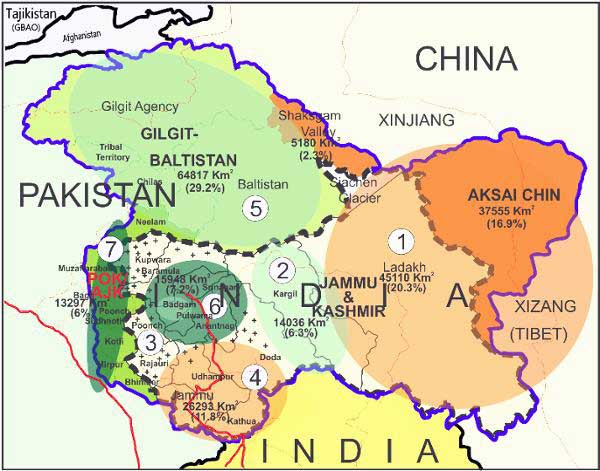
Problems and need of Gujjar Bakarwal are quite different from other communities of the J&K state. Language and culture of Gujjar community is also different than those of other communities of this state that is why community has its own peculiar position. Gujjar Bakarwal community is different and as such the community has a distinct identity.

Gujjar community mostly resides in far flung, hilly mountainous areas near forests and on the Indo-Pak Line of Control. They are originals from Rajputana, Gujarat, and Kathiawar. They migrated from there due to famine. Historians could not fix exact date of their migration. But some historians are of the opinion that there is some description of these Gujjars in Raj Tarangni, the famous history of Kashmir. They are mentioned as living on borders of Kashmir in 9th and 10th centuries. After some time most of them converted to Islam were divided into two sects’ viz. Gujjars and Bakarwals.

Far from being a dividing line, the well known range of Gujjar region is in fact the major linking range of hills and mountains around which the saga of heroic Gujjars and Bakarwals is woven from times immemorial. Strange as it sounds, this watershed has bound together rather than distanced the two climatically and topographically varying regions of the State, viz. Kashmir valley and Jammu Division.

*** FROM APPRENTICE TO MASTER: MAXIMIZING JUNIOR ENLISTED TALENT IN THE ARMY CYBER CORPS

NOVEMBER 23, 2016

Battlefield commissions in the U.S. military were commonplace during World War II. Recognizing talent within enlisted ranks, the U.S. Army elevated individuals to higher ranks. Draftees, such as J. Glenn Gray, who entered the Army the same day he earned his doctorate in philosophy from Columbia, found themselves leading as lieutenants following their performance in combat. More recently, the Army authorized battlefield promotions by empowering commanders to elevate select servicemembers to staff sergeant (E-6) based on the individual’s contribution in zones of conflict. Despite these limited promotion opportunities, the prevailing view within the military, according to Lt. Gen. (ret.) Dave Barno and Nora Bensahel, is that “the armed forces don’t tap this stunningly diverse population by offering them early opportunities to use their unique skills.” Based in part on a talk at the recent Defense Entrepreneurship Forum by John Gillis, Barno and Bensahel believe the military does not manage junior enlisted talent nearly well enough. Yet there are some positive signs. The experiences of Army’s cyber and electronic warfare force feature the recognition, placement, and use of talent at all ranks, especially junior enlisted soldiers and the unique skillsets they provide the force. The integrated teams, diverse senior leader experiences, and emphasis on mentorship set an example that the rest of the Army and joint force ought to follow.

Apprenticing Talent Management

Talent management reform is not a new issue for the U.S. military, as highlighted by B.J. Armstrong. The Navy used multiple means to promote — from “plucking” to actual selection — and learned that short-term solutions must account for strategic visions of the force. In the Army, the process of talent management begins at the lowest levels and in theory continues throughout careers. The Army’s Talent Management Strategy discusses the service’s four objectives: to acquire, develop, employ, and retain talent. The Army clearly prioritizes the recruitment of talent along with the education and employment of individuals in positions that align with their skills in an attempt to increase retention.

*** IS INDIA’S MILITARY MODERNIZATION EVIDENCE OF AN AGGRESSIVE NATIONAL SECURITY POLICY?

By Christopher L. Budihas
October 18, 2016


In this Land Warfare Paper, Budihas looks back to six years ago when a group of defense policy analysts studied and wrote about India’s status and projected growth. Collectively, these authors claimed that India was increasing its military capacity commensurate with its rising economic power, and they suggested that the United States could influence India to use its modernizing military to support U.S. goals vis-Γ -vis China. Current evidence, however, in contrast with the events forecasted by these writers, reveals that India has shown neither the political fortitude nor the military capability to prosecute aggressive security strategies. In point of fact, India gives its domestic economy priority over military spending. Ultimately, then, it would be a miscalculation for the United States to rely on India to counterbalance China in the Asia–Pacific.

The new chief


As General Raheel Sharif retires, Nawaz Sharif has a challenge and an opportunity.

When Pakistan army chief General Raheel Sharif hangs up his uniform on November 29, it will be a moment of rupture. In most other countries, an army chief retiring on the due date would be nothing extraordinary. But in Pakistan, army chiefs do not walk away easily.

Even General Sharif’s predecessor, General Ashfaq Parvez Kayani, got an extension as army chief and Kayani’s predecessor, General Pervez Musharraf, did not even need that fig leaf because he was the military dictator. Had General Sharif sought an extension, not many would have been surprised. After all, he has been a very popular general, with #ThankYouRaheelSharif trending often on social media. While social media trends could be blamed on an overactive Inter-Services Public Relations directorate, General Sharif has also been pictured on the publicity material of candidates in local bodies’ elections and occasionally also on the posters put up by banned groups.

The rhetoric used to burnish his public image set the bar high and had General Sharif continued, he may have faced the same public disappointment as Kayani and Musharraf did in their last years as army chief.

UP shows the way


The most awe-inspiring aspect of this project has been its time-bound execution.


Six Indian Air Force jets on a simulated landing sortie at the Agra-Lucknow expressway was a most impressive spectacle. This was done once last year as a measure of war-like emergency preparedness when jets landed on the Yamuna Expressway near Mathura. What Monday’s event on a 3.2 km stretch symbolised is the progress Uttar Pradesh has made in infrastructure growth. When India’s longest greenfield expressway is finally operational, the six-lane Rs 13,200-crore 302-km highway will cut travel time between Lucknow and New Delhi by around three to six hours. It’s not just the autobahn-type experience for motorists that makes it so attractive, but the faster flow of goods and people, facilitating commerce.

The new abnormal in Kashmir

Jean Drèze

Continued repression is likely to intensify the alienation in Kashmir. It would be much wiser for the government to realise the futility of stonewalling and initiate unconditional talks with all concerned

Sixteen years is a long time to do something about a situation that causes immense suffering to millions of innocent people. But when I returned to Kashmir last month, after a gap of 16 years, I found that people’s agony and anger had — if anything — intensified.

Deciphering the shutdown

As in 2000, I found an intense popular aspiration for azadi (freedom). The Indian Army is perceived, almost unanimously, as an occupying force, and people are fed up with the controls, crackdowns, searches, arrests, beatings, torture and pellet guns. The most common graffiti found around the towns and villages of Kashmir is “Go India, go back”.

The latest expression of this anger is the popular uprising that has rocked Kashmir during the last few months. The Indian media commonly refers to it as a “shutdown”, an ambiguous term that fails to clarify who is shutting what. This so-called shutdown is actually a general strike (hartal). Ever since Hizbul Mujahideen ‘commander’ Burhan Wani was killed in early July, shops have been closed in Kashmir, traffic has been halted, and schools have been deserted. There have been thoughtful exemptions from the strike, say for street vendors, chemist shops and specific times of the week. Some public services, notably health care and the public distribution system, were not only allowed but encouraged to keep going. For the rest, the strike has brought public life to a halt for months on end. That, at any rate, was the situation until I visited Kashmir in late October.

** Not NSG only - China may block India at every opportunity

By Lt Gen Prakash Katoch
24 Nov , 2016

Prior to the Vienna meet on November 11-12, media talked of “fresh hopes for India’s NSG dreams”. Not that we have got over the curse of short memory, considering what happened during the last meet at Seoul. China’s then and current stance that she does not believe in waivers, (NPT in case of NSG membership) is hollow because China herself agreed to a waiver in favour of India during the Indo-US Nuclear Deal of 2008. The meeting in Seoul was preceded by ambiguous statements from Beijing and China lobbied against India despite Prime Minister personally discussing the issue with Chinese President Xi Jinping and China signaling that “China will play constructive role” on the issue.

Though China is a signatory of NPT, her nuclear proliferation record is atrocious especially in initiating and sustaining the nuclear programs of Pakistan and North Korea.

After China’s exposure at Seoul, having any hopes about the Vienna meet was sheer utopia. More so because if China continues to veto radical mullah Azhar Masood being designated terrorist at the UN behind the euphuism of ‘technical hold’, NSG membership for India is something very big, especially given the fact that India has been admitted to MTCR while China has been denied the same.

** Using Information Operations to Our Advantage

SEPTEMBER 29, 2016 

Our enemies use social media as a chief recruitment tactic—it's time we met them where they're at. 

The changing nature of the internet makes for a terrain that is different from what military organizations are used to, with the measure of success quickly turning out to be information operations (IO).

IO is the integrated employment of information-related capabilities and other lines of operation to influence, disrupt, corrupt or usurp the decision-making capabilities of adversaries while defending one’s own. Through a combination of the network effect—which occurs when a message reaches many touch points—and the phenomenon of “viral” content—a message that spreads as quickly as a contagion—cyber-adversaries find social media to be an adept platform for bulking their forces. 

But despite the fact that technology has changed, leadership philosophies have not. Military leaders have long found success following the “observe, orient, decide, act” (OODA) model, a decision science method that allows those in the field to get their bearings and, if enacted sufficiently, maintain an advantage over their adversary.

In order for an OODA loop to be effective, it needs to have the right information, fast enough and at the right time. When it comes to most areas of information gathering, commanders in the U.S.military have historically opted for taking the high ground—observation balloons and surveillance technology allow them to gain a better understanding of the battlefield’s topography.

** THE UNCERTAIN ROLE OF THE TANK IN MODERN WAR: LESSONS FROM THE ISRAELI EXPERIENCE IN HYBRID WARFARE

July 6, 2016

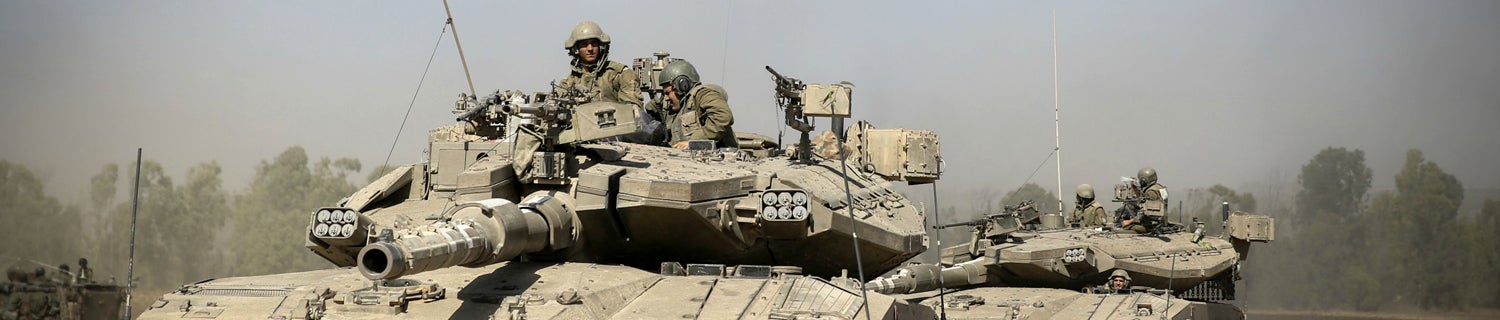
In this Land Warfare Paper, Kim presents a case study of the Israel Defense Forces’ experience during Operation Protective Edge (2014) in order to inform the role of the M1 Abrams by analyzing hybrid threat trends, examining Army force-structure challenges and assessing the relevancy of combined-arms maneuver—in which the M1 Abrams tank is a key element—in the future operating environment. Based on this case study, the author argues that the role of this tank in the Army of 2015–2025 is to provide a mobile and survivable precision firepower platform to execute effective combined-arms operations against a sophisticated hybrid threat in urban and conventional environments. Given the nature of the military profession and the increasingly limited resources provided by our nation to execute combat, the responsibility to properly allocate resources, direct training and develop force structure is great. The Army must consider modernizing its armored platforms with an active armor protection system and improved munitions.


* India-Nepal Relations

By Sumit Kumar
24 Nov , 2016

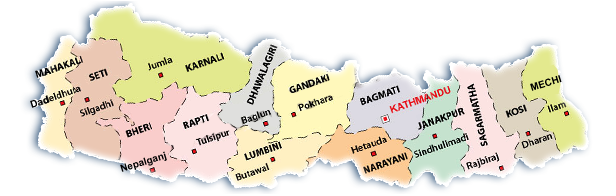
President Pranab Mukherjee’s three day visit to Nepal in November 2016 was historic. He became the first Indian President in the last 18 years to visit Nepal. Nepalese President Bidhya Devi Bhandari received and saw President Mukherjee off at the Tribhuvan international airport and the Nepal government announced a holiday on 02 November for President Pranab Mukherjee’s visit. President Mukherjee held a wide range of discussions across the Nepal’s political class, sending a clear and strong message to the people of Nepal that “India will support Nepal in its pursuit of peace, stability and development.” President Mukherjee’s message reaffirming India’s desire to strength the relationship with Nepal has assumed huge significance in light of the fact that relations between the two countries have been tense in the recent past.

Soon after coming into power in May 2014, Prime Minister Narendra Modi showed an ardent desire to reinvigorate the engagement with Kathmandu under his government’s “first neighbourhood policy. However, Modi’s initiative of inviting Prime Minister Khadga Prasad Sharma Oli of Nepal for the swearing-in ceremony of his government as a member of the South Asia Association of Regional Cooperation (SAARC) and his visits to Nepal in August and November 2014 did not produce the expected results. This became evident when despite India’s proactive efforts to help Nepal in the aftermath of the earthquake in April 2015, Nepalese recoiled at the presence of Indian media on their soil, charging the Indian government with indulging in a cheap public relations exercise. In September 2015, Nepal accused India of supporting the Madhesi people, who began protesting against the new constitution adopted by the Constituent Assembly (CA) II and blocked all the entry points with India, leading to the huge shortage of essential items including medicines, petroleum products and others. Nepal’s media claimed that India had an invisible hand in the blockade. Oli himself accused India of carrying out an “unofficial blockade” in Nepal and raised the issue with UN Secretary General Ban Kimoon.

NSG’s Consultative Group And Need For Evolving New Process – OpEd

NOVEMBER 23, 2016

India’s application could not acknowledge a confirmatory response from a few members of the Group, yet it leaves the impression that New Delhi is determined for the full membership of NSG. Like the Seoul plenary meeting of June 23-24, 2016 failed to reach a consensus in 48 members of NSG cartel, the recent consultative group’s meeting also could not reach to any consensus with regards to India’s bit for NSG.

It is evident that both India and Pakistan are consistently encountering tough resistance in getting the membership of NSG in the near future. Many members of the Group seem determined to thwart non-NPT members attempt to join the Group without a criteria-based approach. Nevertheless, New Delhi has robustly been lobbying with the intense support of Washington and its like-minded countries since 2010 to get a ‘special treatment’ by the NSG members. Simultaneously, Islamabad is equally determined to join the NSG.

Even though Pakistan wishes to be included in the NSG cartel on the basis of merit, it also wants to draw attention to the issue of discrimination in the group’s membership.

India is being treated on favorable terms, with laws amended and waivers granted to accommodate it. This despite the fact that India’s diversion of nuclear material and equipment for the so-called peaceful explosion of 1974 was the prime reason behind the creation of the NSG. It was created to prevent the diversion of nuclear material from civilian trade to military purposes, with seven suppliers of advanced nuclear technology, i.e. United States, United Kingdom, Canada, France, Japan, West Germany, and Soviet Union, getting together to form a cartel to control nuclear technology supplied for peaceful uses. India violated its obligations with Canada, diverting plutonium from the Canadian-Indian reactor that was being run by U.S. heavy-water, which was provided purely for peaceful purposes.

Can India Deny Power Of Technology To Bring Educational Reforms? – Analysis

NOVEMBER 23, 2016
Digital India has been envisioned as an ambitious program to transform India into a digitally empowered society and a knowledge economy. The young population in India in the last decade has become increasingly technology-driven, revealing considerable potential and readiness to imbibe and learn using digital media.

Also there have been unprecedented reforms in the education system in India at all levels, where much effort and commitment has been directed at improving the quality of education at all levels, especially at the schools.

One of the important debates in the Indian education policy has been how to improve the educational outcomes within schools. In this context increasing the quality of teachers and thereby the student outcome, is one such issue that is discussed by policy makers time and again. Digital education today is no longer limited to the four walls of a classroom. It has paved way for virtual classrooms, making learning attainable and providing easy access everywhere and every time.

The latest trends in digital education space also include adaptive and collaborative learning where a student is engaged by practicing, experiencing, sharing things and gaining knowledge in a collaborative environment. The fourth generation of communication technology is speculated to revolutionize the digital education space by providing cutting-edge user experience. Thus, the government’s focus is to integrate technology in digital learning for both urban and rural India. It is also looking at public-private-partnerships to enhance reach to rural and remote areas.