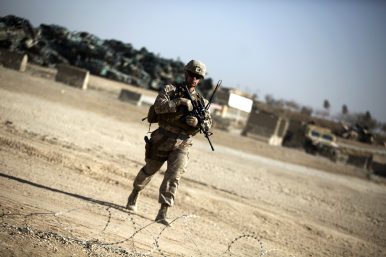
Lt. Col. Sam Fishburne, Maj. Joe Dumas, Maj. Benjamin Stegmann,Capt. Jim Burds,
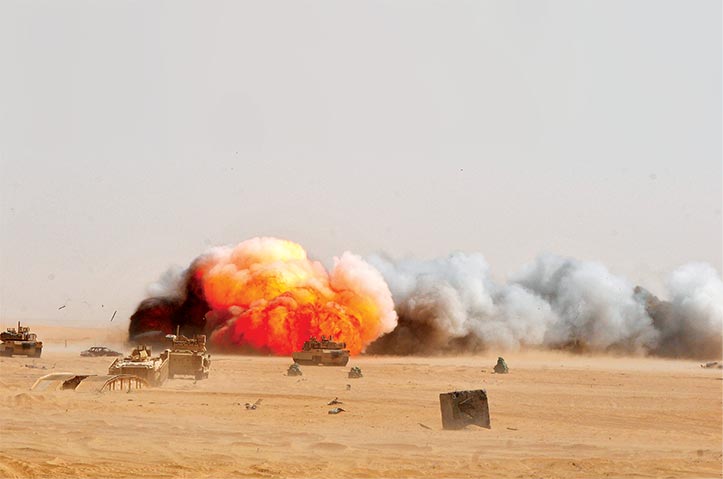 Engineers assigned to the 588th Brigade Engineer Battalion, 3rd Armored Brigade Combat Team, 4th Infantry Division, employ an M58 Mine Clearing Line Charge 9 July 2015 during a breaching training exercise at the Udairi Range Complex, Kuwait. (Photo by Spc. Gregory T. Summers, U.S. Army)
It is even better to act quickly and err than to hesitate until the time of action is past.
—Carl von Clausewitz
Published in October 2017, Field Manual (FM) 3-0, Operations, emphasizes the Army’s four strategic roles as part of the joint force: shape the security environment, prevent conflict, prevail in large-scale combat operations, and consolidate gains to make temporary success permanent (see figure 1).1 This is a significant departure from previous operational-level doctrine, which tended to focus on the tactical-level operations from the line of departure to a limit of advance with little discussion of linkages between strategic policy goals, operations, and the tactical tasks units conduct to achieve a desired end state across the conflict continuum. The new approach is necessary to account for an operational environment that is very different than those in Afghanistan and Iraq, an operational environment characterized by peer threats able to contest the joint force in all domains.








/arc-anglerfish-arc2-prod-mco.s3.amazonaws.com/public/D6L7HANI3NA4BN4UH2MYG4QGWM.jpg)


/arc-anglerfish-arc2-prod-mco.s3.amazonaws.com/public/MLHNZTKXJJFL3LM62N5UPB5M2M.jpg)